
AI Generated American Parenting Plan
PDF & Word - 2026 Updated
Docaro Pricing
When Do You Need a Parenting Plan in the United States?
American Legal Rules for a Parenting Plan
Using the wrong structure for a parenting plan can undermine its enforceability in court and fail to adequately protect parental rights.
What a Proper Parenting Plan Should Include
- Custody ArrangementDetails how parents will share legal and physical custody of the child, such as joint or sole custody.
- Visitation ScheduleOutlines specific times and days for each parent to spend with the child, including weekends and holidays.
- Child Support DetailsSpecifies the amount, payment method, and schedule for financial support of the child's needs.
- Healthcare and InsuranceDescribes how medical expenses, insurance coverage, and decisions about doctors will be handled.
- Education and ActivitiesCovers choices about schools, extracurricular activities, and how parents will communicate on these matters.
- Relocation RulesSets guidelines for what happens if one parent wants to move away with the child.
- Communication GuidelinesExplains how parents will talk to each other and the child about important issues.
- Dispute ResolutionProvides steps for resolving disagreements, like mediation, without going to court right away.
Generate Your Document in 4 Easy Steps
Why Use Docaro?
 United States
Free Example Parenting Plan Template
Below is a free template example of a Parenting Plan for use in the United States generated by our AI model.
The clauses in your actual Parenting Plan will vary from this example as they will be entirely bespoke to your requirements as set out in the questionnaire you complete.
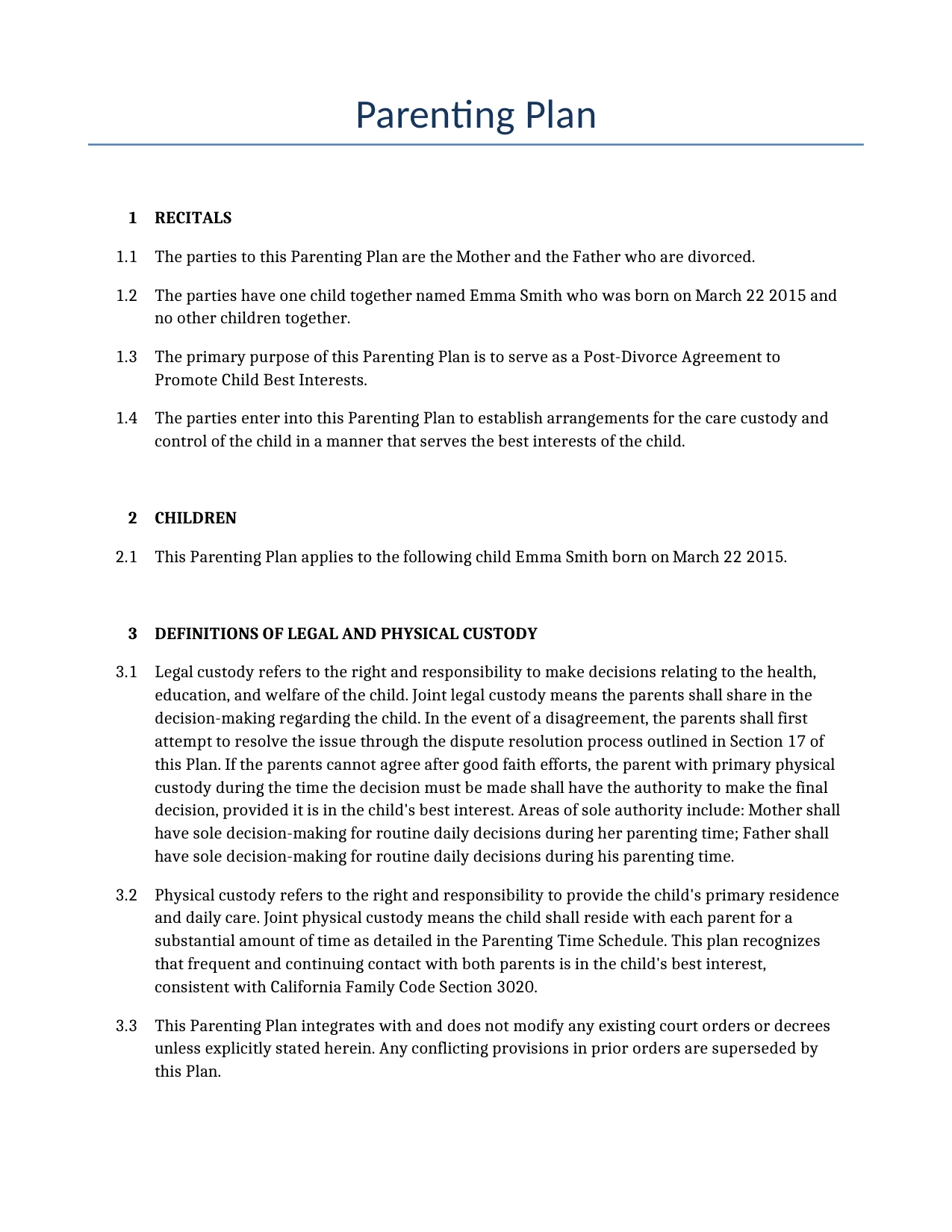
Parenting Plan
1RECITALS
The parties to this Parenting Plan are the Mother and the Father who are divorced.
The parties have one child together named Emma Smith who was born on March 22 2015 and no other children together.
The primary purpose of this Parenting Plan is to serve as a Post-Divorce Agreement to Promote Child Best Interests.
The parties enter into this Parenting Plan to establish arrangements for the care custody and control of the child in a manner that serves the best interests of the child.
2CHILDREN
This Parenting Plan applies to the following child Emma Smith born on March 22 2015.
3DEFINITIONS OF LEGAL AND PHYSICAL CUSTODY
Legal custody refers to the right and responsibility to make decisions relating to the health, education, and welfare of the child. Joint legal custody means the parents shall share in the decision-making regarding the child. In the event of a disagreement, the parents shall first attempt to resolve the issue through the dispute resolution process outlined in Section 17 of this Plan. If the parents cannot agree after good faith efforts, the parent with primary physical custody during the time the decision must be made shall have the authority to make the final decision, provided it is in the child's best interest. Areas of sole authority include: Mother shall have sole decision-making for routine daily decisions during her parenting time; Father shall have sole decision-making for routine daily decisions during his parenting time.
Physical custody refers to the right and responsibility to provide the child's primary residence and daily care. Joint physical custody means the child shall reside with each parent for a substantial amount of time as detailed in the Parenting Time Schedule. This plan recognizes that frequent and continuing contact with both parents is in the child's best interest, consistent with California Family Code Section 3020.
This Parenting Plan integrates with and does not modify any existing court orders or decrees unless explicitly stated herein. Any conflicting provisions in prior orders are superseded by this Plan.
4PARENTING TIME SCHEDULE
The regular parenting time schedule shall be as follows: The child shall reside with the Mother on alternating weeks from Monday at 6:00 PM until the following Monday at 6:00 PM. During the Father's alternating weeks, the child shall reside with the Father from Monday at 6:00 PM until the following Monday at 6:00 PM. This resolves any prior inconsistency between alternating weeks and weekday/weekend schedules. The weekday and weekend components are subsumed within the alternating full weeks unless otherwise specified for holidays or vacations. The custody arrangements under this Parenting Plan shall start on January 1 2024.
The schedule shall be reviewed and potentially adjusted when the child reaches age 13 to account for her developmental needs as a teenager, including increased consideration of the child's preferences regarding extracurriculars and social activities, as permitted under California Family Code Section 3042.
5HOLIDAY AND SPECIAL OCCASION SCHEDULE
The parties shall handle holiday parenting time by allocating specific holidays to each parent in even or odd years as specified below, rather than vague alternating without details. This supersedes any conflicting prior references.
The major holidays and their allocations are as follows: Thanksgiving - Mother in even-numbered years, Father in odd-numbered years, from 6:00 PM the Wednesday before Thanksgiving until 6:00 PM on the Sunday after Thanksgiving; Christmas Eve and Christmas Day - Mother in odd-numbered years (from 6:00 PM December 24 to 6:00 PM December 25 for Christmas Eve portion if split, but full Christmas period from December 24 at 6:00 PM to December 26 at 9:00 AM), Father in even-numbered years for the same period; New Year's Day - Father in odd-numbered years (December 31 at 6:00 PM to January 2 at 9:00 AM), Mother in even-numbered years for the same period; Independence Day (Fourth of July) - Mother in even-numbered years (from 9:00 AM July 4 to 9:00 AM July 5), Father in odd-numbered years for the same period; Halloween - Father in even-numbered years (from 4:00 PM October 31 to 9:00 AM November 1), Mother in odd-numbered years for the same period; Mother's Day - Mother shall have the child every year from 9:00 AM to 6:00 PM; Father's Day - Father shall have the child every year from 9:00 AM to 6:00 PM; Child's Birthday - The parent who does not have the child on the birthday shall have a minimum of 4 hours of parenting time with the child on the birthday or an adjacent weekend day if the birthday falls during school time, with priority to an in-person celebration; Spring Break - Alternating years, full week with one parent each year (Mother even years, Father odd years).
The vacation parenting time schedule shall provide each parent with 4 weeks of summer vacation time with the child, scheduled to not overlap unreasonably and with at least 60 days notice of proposed dates. The child's summer school break shall start on June 1 and end on August 31 each year. School breaks such as winter (December 20 to January 3) and spring (one week in March or April as per school calendar) shall be allocated equally, with the non-holiday portions split by alternating years or mutual agreement. International travel during parenting time shall be allowed with prior notice of itinerary, copies of travel documents provided 30 days in advance, and compliance with the Hague Convention on the Civil Aspects of International Child Abduction including written consent for passport use.
Make-up time for missed parenting time due to non-compliance shall be scheduled within the following 30 days at a time convenient for the non-offending parent, with priority given to restoring the missed time. If make-up time cannot be agreed upon, the dispute resolution process in Section 17 shall apply. Repeated non-compliance may result in court sanctions, including temporary suspension of parenting time, payment of transportation costs for make-up, or other remedies as the court deems in the child's best interest under California Family Code.
Fourteen days notice shall be required for schedule changes unless in an emergency. The parties shall provide special time for the children on their birthdays as detailed above.
6TRANSPORTATION AND EXCHANGES
The parties shall provide the transportation for the child exchanges on a Shared basis. The primary pickup location for child exchanges shall be the Mother's residence at 123 Main Street Anytown USA. The primary drop-off location for child exchanges shall be the Father's residence at 456 Oak Avenue Anytown USA. The parties shall conduct child exchanges in the Evening at exactly 6:00 PM. Supervision shall not be required during the child exchanges. Exchanges during holidays shall be handled with Adjusted Times based on the holiday schedule. The parties shall share the costs of transportation for exchanges. This transportation and exchange arrangement shall start on January 1 2024.
7COMMUNICATION BETWEEN PARENTS
The parties shall use Email and Co-Parenting App as the methods of communication for discussing matters about the children. All communications between the parents about the children shall be in writing and conducted respectfully without derogatory remarks. The parties shall provide Weekly Updates regarding the children's welfare such as health or school matters. Both parents shall share all school reports medical records and extracurricular information promptly. Each parent shall keep the other informed of the child's current address, school, medical providers, and any changes thereto within 48 hours.
8COMMUNICATION WITH CHILDREN
Each parent shall be permitted to communicate with the children while they are with the other parent using Phone Calls Video Chats and Text Messaging. Specific times for communication shall be 7:00 PM to 7:30 PM on weekdays when the child is with the other parent. Each communication session shall be limited to 15 to 30 Minutes. The communication rules shall adjust based on the child's age and developmental needs; for a 9-year-old like Emma, communications should be age-appropriate and not interfere with homework or bedtime. The rules regarding the use of electronic devices for parent-child communication while the children are with the other parent shall be that the Child Uses Device Privately and No Recording is Allowed. Each parent shall be prohibited from interfering with the other's scheduled communications with the children. This includes a prohibition on parental alienation or any interference with the parent-child relationship.
9DECISION-MAKING AUTHORITY
Both parents shall jointly make decisions on the children's education, healthcare, extracurricular activities, and religious upbringing. Religious upbringing decisions shall be made jointly, with the child exposed to both parents' faiths (if applicable) in a manner that does not conflict with the child's best interests. If the parents cannot agree on major decisions after good faith discussion, the disputes shall be resolved through the detailed dispute resolution process in Section 17, which includes timelines: initial consultation within 7 days, mediation within 30 days. In case of tie, the matter shall be mediated first; if unresolved, either parent may petition the court. Mother shall have sole authority over routine medical appointments during her time; Father during his. This is in addition to joint major decisions.
10HEALTHCARE AND MEDICAL DECISIONS
The parties shall have Joint authority to make decisions about the child's healthcare. The parties shall make healthcare and medical decisions jointly for major issues. The choice of the child's primary care physician or pediatrician shall require Joint agreement. The parties shall share all medical records and information about the child with each other. Either parent shall have authority to make decisions for the child in case of a medical emergency and shall notify the other parent immediately (within 2 hours) after any medical emergency via phone and email. Provisions for substance abuse monitoring: If either parent has a history or concern arises, random testing may be ordered, and supervised visitation could be imposed if safety is at risk, per California best practices.
11EDUCATION AND SCHOOL DECISIONS
The parties shall have Joint authority to make decisions about the child's education. Decisions about selecting the child's school shall be made by Joint decision of both parents. There shall be restrictions on school location to within 20 miles of both residences unless agreed otherwise. The Mother shall be responsible for helping the child with homework during her parenting time and the Father shall be responsible during his parenting time. Provisions for tutoring shall be included if the child needs academic support, decided jointly. Both parents shall have equal access to the child's educational records. Both parents shall participate in the child's school activities such as conferences and events. Both parents shall receive direct notifications from the school for school events and activities.
12EXTRACURRICULAR ACTIVITIES AND EXPENSES
The parties shall have Joint authority to make decisions about the child's extracurricular activities, with approval required before enrolling in new activities to avoid scheduling conflicts. The child currently participates in the extracurricular activity known as Soccer League which is a Sports activity. The schedule for the Soccer League is Practices on Tuesdays and Thursdays from 4:00 PM to 6:00 PM and games on Saturdays from 9:00 AM to 12:00 PM. The parties shall be responsible for transporting the child to this activity on a Shared Equally basis when it occurs during their parenting time. Provisions shall be included for reimbursing the other parent for transportation costs related to this activity within 30 days. The estimated annual cost of this extracurricular activity is 450 dollars. The costs of this extracurricular activity shall be shared between the parties through an Equal Split. Decisions about the child's extracurricular activities shall be made by Joint Decision, considering the child's preferences at age 9 and as she develops.
13CHILD SUPPORT
This Parenting Plan shall include child support payments. The Father shall be the payor of the child support payments. The monthly child support amount to be paid by the payor is 800 dollars, calculated based on California guidelines under Family Code Section 4050 et seq., considering income, custody time, and other factors. This amount may be deviated from only by court order if in the child's best interest. Enforcement mechanisms include wage assignment, contempt proceedings, or license suspension as provided by California law. Tax dependency claims: The parties shall alternate claiming the child as a dependent for tax purposes, with Mother claiming in even years and Father in odd years; the non-claiming parent shall provide any necessary forms. Any waiver of rights to claim the child as a dependent is only as specified herein.
14HEALTH INSURANCE AND MEDICAL EXPENSES
The parties shall provide health insurance coverage for the children. Both Parents shall be responsible for providing health insurance for the children. The name of the health insurance provider is Blue Cross Blue Shield and the policy number is ABC123456789 with an effective date of January 1 2024. Uninsured medical expenses for the children shall be split between the parties through an Equal Split. Medical expense reimbursements shall be made within 30 days after receiving documentation. The parties shall share all medical information and bills with each other promptly. Decisions about major medical treatments for the children shall be handled by Joint Decision. Both parents shall share the responsibility for maintaining health insurance coverage for the child under policy number ABC123456789. The parties shall notify each other within 5 days of any changes to the child's health insurance. Payments for the child's medical expenses shall be handled by Reimbursement within 30 days.
15RELOCATION
The parties shall require advance notice if either parent intends to relocate with the children. Sixty days advance notice shall be required for relocation. The methods of delivery allowed for relocation notices shall be Certified Mail and Email. A relocation requiring notice shall be a move of 50 miles from the current residence. The relocating parent's move shall require approval from the other parent or the court under the conditions of Moves Over 100 Miles or Moves Out of State. The parties shall require mediation before court involvement for relocation disputes. The relocation provisions in this Parenting Plan shall have an effective date of January 1 2024. If approving a relocation, the court shall consider the Child's Educational Needs and the Child's Relationship with Both Parents per California Family Code Section 3048. This section integrates with UCCJEA for interstate/international moves and requires passport consents under the Hague Convention for international travel.
16MODIFICATIONS AND DISPUTE RESOLUTION
The specific events or changes in circumstances that shall be defined as triggers for requesting a modification to the Parenting Plan are Relocation of a parent, Change in child's health or needs, the child reaching age 13, changes in employment, or birth of future siblings. The dispute resolution methods that shall be prioritized for resolving disagreements about the Parenting Plan are: (1) Good faith negotiation between parents within 7 days; (2) Confidential mediation as required under California Family Code Section 3170, with a mediator appointed within 14 days; (3) If unresolved, arbitration or court petition. Mandatory mediation or another alternative method shall be required before either party can seek court intervention for disputes. Each parent shall pay 50 percent of the costs for mediation or arbitration. The prevailing party in a dispute shall not recover attorney fees from the other unless the court finds bad faith. In case of emergencies affecting the child, the parties shall allow immediate actions without prior dispute resolution through Mutual agreement with documentation. The parties shall resolve disputes arising from the Parenting Plan through Mediation. A Guardian ad Litem (GAL) may be appointed by the court if deemed necessary for the child's best interests in contested matters.
This plan shall be reviewed every 2 years or upon significant life changes such as the child's transition to middle school, new employment of a parent, addition of pets or siblings, to ensure it continues to meet Emma's developmental needs at her current age of approximately 9 and as she grows.
17GENERAL PROVISIONS
Both parents shall comply with all terms of this Parenting Plan. The parties shall comply with a mutual non-disparagement clause prohibiting both parents from speaking negatively about each other in the presence of the child. Both parents shall be prohibited from using alcohol or illegal substances while caring for the child. No supervision shall be required for the child's time with each parent unless safety concerns arise related to domestic violence or substance abuse, in which case supervised visitation or monitoring may be imposed. Safety provisions: Each parent shall immediately notify the other and authorities of any domestic violence incident involving the child. Right of first refusal: If a parent is unable to care for the child during their scheduled time for more than 4 hours, they shall offer the other parent the right of first refusal before using third-party childcare. Emergency contact and notification protocols: Each parent shall maintain an updated list of emergency contacts and notify the other within 1 hour of any emergency. Indemnification and hold-harmless: Each parent agrees to indemnify and hold the other harmless from any liabilities arising from their actions during their parenting time. Provisions addressing international travel documentation: Written consent for passport applications and travel shall be provided within 7 days of request, consistent with the Hague Convention. Prohibitions on parental alienation or interference are incorporated herein. Integration of any existing custody evaluations or agreements: This Plan incorporates by reference any prior custody evaluation recommendations not inconsistent herewith. COVID/health crisis contingencies: In the event of a health crisis, the parties shall follow CDC guidelines and mutually agree on modifications to the schedule to protect the child's health, with disputes resolved via expedited mediation.
18ADDITIONAL PROVISIONS FOR CHILD'S WELFARE
This section addresses the child's preferences, developmental needs, and adaptation of the plan. Given that Emma is approximately 9 years old, the plan prioritizes stability, age-appropriate involvement in decisions (such as weighing her input on extracurriculars per California Family Code Section 3042), and emotional support. The plan will adapt as she grows by increasing her voice in scheduling at age 13, considering teen social needs, and reviewing for changes like potential future siblings or pets (e.g., custody of family pets to remain with primary residence unless agreed). The child's welfare is paramount, and both parents commit to fostering her relationship with both parents without interference.
Counseling obligations: Both parents and the child (if recommended) shall attend co-parenting counseling or individual therapy focused on neutral goals such as improving communication and co-parenting skills. Providers shall be a mutually agreed licensed therapist or one appointed by the court. Requirements are even: both parents shall complete a minimum of 8 sessions within 6 months of the effective date, with progress reports shared. This is not punitive but aimed at serving the child's best interests.
19PARENTING CLASSES OR COUNSELING
Attendance at parenting classes shall be required as part of this Parenting Plan for both parents. Attendance at co-parenting counseling shall be required as part of this Parenting Plan for both parents with neutral goals as outlined in Section 18. Attendance at other educational programs such as anger management or substance abuse education shall be required only if recommended by a professional or court order. Both Parents shall be required to attend parenting classes. The Mother and the Father shall be required to attend co-parenting counseling. Any other requirements shall apply equally unless a specific safety concern is documented.
20EFFECTIVE DATE AND DURATION
This Parenting Plan shall become effective on January 15 2024. This Parenting Plan shall end for each child when the child reaches the age of 18 or upon further court order.
21GOVERNING LAW
This Parenting Plan shall be governed by and construed in accordance with the laws of the State of California, including but not limited to the California Family Code Sections 3000-3200, the Uniform Child Custody Jurisdiction and Enforcement Act (UCCJEA), and the Uniform Interstate Family Support Act (UIFSA). Any state-specific requirements such as confidential mediation are incorporated.
22ENTIRE AGREEMENT
This Parenting Plan constitutes the entire agreement between the parties and supersedes any prior understandings or agreements. There are no other existing agreements or understandings outside of this Parenting Plan. This Parenting Plan may be modified in the future only in writing and signed by both parties or by court order.
23SEVERABILITY
If any provision of this Parenting Plan is found to be invalid or unenforceable the remaining provisions shall remain in full force and effect.
24NOTICES
Any notice required or permitted under this Parenting Plan shall be in writing and delivered by certified mail or email to the addresses provided by each party or to such other address as a party may designate in writing.
25VARIATION
No variation of this Parenting Plan shall be effective unless it is in writing and signed by both parties.
26SIGNATURES
The parties have executed this Parenting Plan on the dates indicated below. This is the final section of the document.
Mother: _______________________________ Date: _______________
Father: _______________________________ Date: _______________
This example shows approximately 70% of a typical document and is provided for illustrative purposes only. The remaining content has been omitted.
Every document generated by Docaro is tailored to your specific circumstances, jurisdiction and the information you provide. The completed document includes all applicable clauses and provisions required for your situation.
To generate the full, personalised document, answer a short series of questions and your document will be created instantly.