
AI Generated American Intellectual Property Assignment Agreement
PDF & Word - 2026 Updated
Docaro Pricing
When Do You Need an Intellectual Property Assignment Agreement in the United States?
American Legal Rules for Intellectual Property Assignment Agreements
Using the wrong type of intellectual property assignment agreement can result in incomplete transfers of rights or unintended retention of ownership by the assignor.
What a Proper Intellectual Property Assignment Agreement Should Include
- Clear Identification of IPSpecify exactly what intellectual property, like patents or copyrights, is being transferred to avoid any confusion.
- Details of the PartiesInclude the full names and contact information of the person or company giving up the IP and the one receiving it.
- Full Transfer of RightsState that all ownership rights, including the ability to use, sell, or license the IP, are completely handed over without holding anything back.
- Warranties from the SellerConfirm that the seller truly owns the IP and that it doesn't infringe on anyone else's rights.
- Payment TermsOutline how much is being paid for the IP and when the payment will be made.
- Signatures and DatesHave both parties sign and date the agreement to make it legally binding.
- Governing LawIndicate that the laws of a specific U.S. state will apply to any disputes arising from the agreement.
Generate Your Document in 4 Easy Steps
Why Use Docaro?
 United States
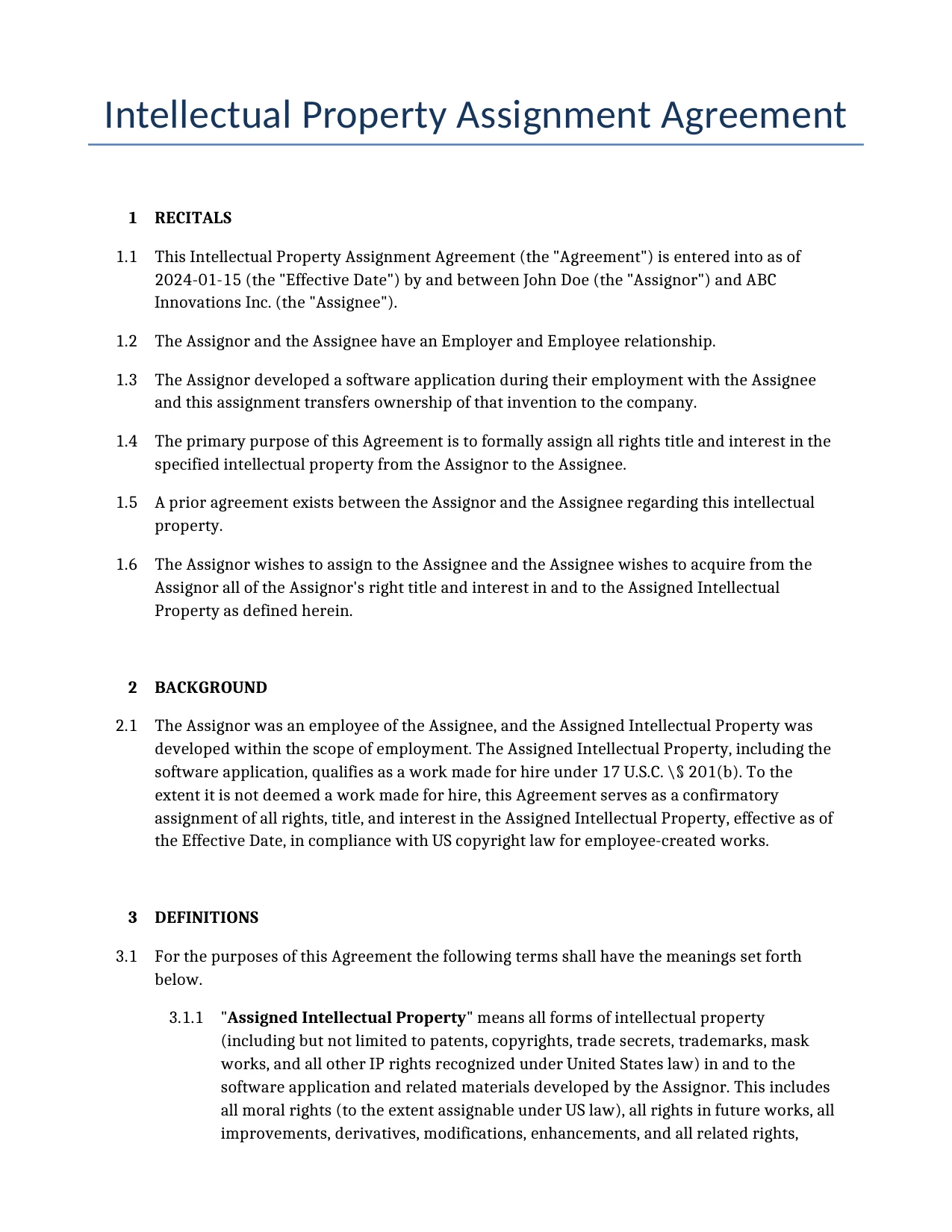
Free Example Intellectual Property Assignment Agreement Template
Below is a free template example of a Intellectual Property Assignment Agreement for use in the United States generated by our AI model.
The clauses in your actual Intellectual Property Assignment Agreement will vary from this example as they will be entirely bespoke to your requirements as set out in the questionnaire you complete.
Intellectual Property Assignment Agreement
1RECITALS
This Intellectual Property Assignment Agreement (the "Agreement") is entered into as of 2024-01-15 (the "Effective Date") by and between John Doe (the "Assignor") and ABC Innovations Inc. (the "Assignee").
The Assignor and the Assignee have an Employer and Employee relationship.
The Assignor developed a software application during their employment with the Assignee and this assignment transfers ownership of that invention to the company.
The primary purpose of this Agreement is to formally assign all rights title and interest in the specified intellectual property from the Assignor to the Assignee.
A prior agreement exists between the Assignor and the Assignee regarding this intellectual property.
The Assignor wishes to assign to the Assignee and the Assignee wishes to acquire from the Assignor all of the Assignor's right title and interest in and to the Assigned Intellectual Property as defined herein.
2BACKGROUND
The Assignor was an employee of the Assignee, and the Assigned Intellectual Property was developed within the scope of employment. The Assigned Intellectual Property, including the software application, qualifies as a work made for hire under 17 U.S.C. \§ 201(b). To the extent it is not deemed a work made for hire, this Agreement serves as a confirmatory assignment of all rights, title, and interest in the Assigned Intellectual Property, effective as of the Effective Date, in compliance with US copyright law for employee-created works.
3DEFINITIONS
For the purposes of this Agreement the following terms shall have the meanings set forth below.
"Assigned Intellectual Property" means all forms of intellectual property (including but not limited to patents, copyrights, trade secrets, trademarks, mask works, and all other IP rights recognized under United States law) in and to the software application and related materials developed by the Assignor. This includes all moral rights (to the extent assignable under US law), all rights in future works, all improvements, derivatives, modifications, enhancements, and all related rights, applications, registrations, renewals, and extensions thereof. This definition is intended to be as broad as possible to encompass everything intended under US law.
"Assigned Rights" means all rights title and interest in the Assigned Intellectual Property on a worldwide basis.
"Intellectual Property" means all patents copyrights trade secrets and other intellectual property rights recognized under United States law including but not limited to those protected by the Copyright Act of 1976 the Patent Act (35 U.S.C.) the Lanham Act (Trademark Act of 1946) and the Defend Trade Secrets Act (DTSA).
"Work Made for Hire" has the meaning set forth in 17 U.S.C. \§ 101. The software application qualifies as a work made for hire because it was developed by the Assignor within the scope of employment. If it is not deemed a work made for hire, this Agreement serves as an assignment of all rights therein.
4ASSIGNMENT OF INTELLECTUAL PROPERTY
The Assignor hereby irrevocably assigns, transfers, and conveys to the Assignee all of the Assignor's right, title, and interest (including all intellectual property rights) in and to the Assigned Intellectual Property, effective as of the Effective Date. The Assignor does hereby assign, sell, transfer, and set over to the Assignee all of Assignor's right, title and interest in and to the Assigned Intellectual Property, to the extent such assignment is not already effected by operation of law as a work made for hire under 17 U.S.C. \§ 201(b). This present-tense assignment is intended to satisfy the requirements of 17 U.S.C. \§ 204 for copyrights. The assignment also includes any and all causes of action, claims, and damages (whether accrued, contingent, or otherwise) related to the Assigned Intellectual Property, including the right to sue for past, present, or future infringements.
The assignment includes all Applications and Registrations related to the Assigned Intellectual Property.
The assignment includes all worldwide rights title and interest in the Assigned Intellectual Property.
The Assignor agrees that the assignment is made in accordance with the Copyright Act of 1976 the Patent Act (35 U.S.C.) and other applicable United States laws including provisions related to the Uniform Commercial Code (UCC) Article 2B as incorporated in state laws or the Uniform Computer Information Transactions Act (UCITA).
5CONSIDERATION
In consideration for the assignment of the Assigned Intellectual Property the Assignee shall pay to the Assignor the amount of $10,000 USD upon execution of this Agreement. The Assignor acknowledges that this monetary payment constitutes full and adequate consideration for the transfer of all Assigned Rights and that no further consideration is due. This satisfies the requirements for enforceability under US contract law.
The Assignor acknowledges that the consideration is adequate and sufficient for the transfer of all Assigned Rights.
6REPRESENTATIONS AND WARRANTIES OF THE ASSIGNOR
The Assignor represents and warrants that the Assignor is the sole owner of the Assigned Intellectual Property with full right to assign it.
The Assignor represents and warrants that the Assigned Intellectual Property is valid subsisting and enforceable under United States law.
The Assignor represents and warrants that the Assigned Intellectual Property is free from any liens encumbrances or third-party claims.
The Assignor represents and warrants that there is no pending or threatened litigation regarding the Assigned Intellectual Property.
The Assignor represents and warrants that the Assigned Intellectual Property does not infringe any third-party intellectual property rights.
The Assignor represents and warrants that all required maintenance fees or renewal obligations for the Assigned Intellectual Property have been paid up to date and all fees are current.
The Assignor represents and warrants that the Assignor has the full authority to assign the Assigned Intellectual Property without needing consent from any third party.
The Assignor represents and warrants that the Assignor has not previously assigned, licensed, or encumbered the Assigned IP in any way that would conflict with this Agreement. The Assignor further represents and warrants that the Assigned Intellectual Property is original and that the Assignor has disclosed any known third-party claims or potential issues related thereto.
These representations and warranties are made in accordance with the Copyright Act of 1976 the Patent Act (35 U.S.C.) the Lanham Act and the Defend Trade Secrets Act (DTSA).
7REPRESENTATIONS AND WARRANTIES OF THE ASSIGNEE
The Assignee represents and warrants that the Assignee is a Corporation formed in Delaware on 2020-01-15 and is currently in good standing in its jurisdiction of formation.
The Assignee represents and warrants that the Assignee has the full power and authority to enter into this Agreement.
The Assignee represents and warrants that the Assignee has the full power and authority to perform its obligations under this Agreement.
The Assignee represents and warrants that entering into this Agreement will not conflict with any of the Assignee's existing obligations or agreements.
The Assignee represents and warrants that the execution and delivery of this Agreement by the Assignee has been duly authorized by all necessary actions.
The Assignee represents and warrants that upon execution this Agreement will be a valid and binding obligation of the Assignee.
The Assignee represents and warrants that the Assignee is not currently involved in any litigation that could affect its ability to accept the Assigned Intellectual Property.
The Assignee represents and warrants that the Assignee has not filed for bankruptcy and is not insolvent.
8NO FURTHER OBLIGATIONS
Upon assignment, the Assignor has no further rights or obligations regarding the Assigned IP except as expressly stated in this Agreement (including further assurances and confidentiality obligations). The employment relationship between the parties has ended or is separate from this assignment.
9FURTHER ASSURANCES
The Assignor agrees to execute any further documents necessary to perfect the assignment of the Assigned Intellectual Property.
The Assignor agrees to provide any necessary information to assist in perfecting the assignment.
The Assignor agrees to assist with recordation purposes at the United States Patent and Trademark Office and the United States Copyright Office.
The Assignor shall take all actions requested by the Assignee to transfer ownership and to obtain maintain and enforce the Assigned Intellectual Property in accordance with applicable United States law.
10CONFIDENTIALITY
Each party (the "Receiving Party") acknowledges that during the term of this Agreement it may receive Confidential Information from the other party (the "Disclosing Party"). "Confidential Information" means any non-public information disclosed by the Disclosing Party to the Receiving Party, including technical specifications, know-how related to the Assigned Intellectual Property, business plans, strategies, and trade secrets. Confidential Information does not include information that: (a) is or becomes publicly available through no fault of the Receiving Party; (b) was rightfully known by the Receiving Party prior to disclosure; (c) is independently developed by the Receiving Party without use of the Disclosing Party's Confidential Information; or (d) is rightfully obtained from a third party without restriction. The Receiving Party agrees not to disclose Confidential Information to third parties without the prior written consent of the Disclosing Party. The Receiving Party agrees to restrict its use of Confidential Information solely to purposes related to the Assigned Intellectual Property. The Receiving Party agrees to return or destroy all Confidential Information upon request or termination of this Agreement. The confidentiality obligations survive for five (5) years after termination or expiration of this Agreement (or indefinitely for trade secrets). This section aligns with DTSA requirements for trade secret protection and includes notice that the Receiving Party shall be immune from liability under 18 U.S.C. \§ 1833(b) for the disclosure of a trade secret that is made in confidence to a government official or attorney solely for the purpose of reporting or investigating a suspected violation of law.
11INDEMNIFICATION
The Assignor shall indemnify, defend, and hold harmless the Assignee and its affiliates, officers, directors, employees, agents, successors, and assigns from and against all claims, losses, damages, liabilities, and expenses (including reasonable attorneys' fees) arising out of or related to any breach of the Assignor's representations, warranties, or covenants in this Agreement, or any third-party claims that the Assigned Intellectual Property infringes on others' rights (including copyright or trademark infringement). The indemnification obligations survive the termination or expiration of this Agreement.
The Assignee shall have the right to control the defense and settlement of any indemnified claims.
This indemnification is provided in accordance with applicable provisions of United States law including the Copyright Act of 1976 and the Lanham Act.
12TERM AND TERMINATION
This Agreement is effective as of the Effective Date and continues until fully performed. The representations, warranties, confidentiality obligations, indemnification obligations, and any other provisions that by their nature are intended to survive shall survive indefinitely or for the period specified herein.
13GOVERNING LAW
This Agreement shall be governed by and construed in accordance with American law specifically the laws of the State of Delaware without regard to its conflict of laws principles. The parties consent to the exclusive jurisdiction and venue of the courts located in Delaware for any disputes arising under this Agreement. The arbitration provision in the prior version of this Agreement is removed; any disputes shall be resolved in the Delaware courts. This choice of law and venue complies with US enforceability standards.
14ENTIRE AGREEMENT
This Agreement constitutes the entire understanding between the parties and supersedes all prior agreements or understandings whether written or oral, including without limitation the prior agreement referenced in Recital 1.5. This Agreement explicitly supersedes all prior written or oral understandings between the Assignor and the Assignee. Any future modifications to this Agreement must be made by Written Amendment Only and executed by both parties. The parties acknowledge that Exhibits or Schedules may be attached hereto detailing the Assigned Intellectual Property.
This Agreement explicitly supersedes all prior written or oral understandings between the Assignor and the Assignee.
Any future modifications to this Agreement must be made by Written Amendment Only and executed by both parties.
15SEVERABILITY
If any provision of this Agreement is found to be invalid or unenforceable the remaining provisions shall continue in full force and effect. This provision is governed by the laws of the State of Delaware.
16ASSIGNMENT AND DELEGATION
The Assignor may not assign its rights or delegate its obligations under this Agreement without the Assignee's prior written consent, which may be withheld in the Assignee's sole discretion. The Assignee may assign this Agreement or any of its rights or obligations to an affiliate or in connection with a merger, acquisition, or sale of all or substantially all of its assets without the Assignor's consent. Any permitted assignment shall bind the successors and assigns of the parties.
17TAXES
The Assignor is responsible for any taxes arising from the assignment of the Assigned Intellectual Property unless otherwise agreed in writing. This is in compliance with applicable US tax laws.
18WAIVER
The failure of either party to enforce any provision of this Agreement does not constitute a waiver of that or any other provision.
19NOTICES
All notices under this Agreement shall be in writing and delivered to the Assignor at 123 Innovation Drive Tech City CA 90210 USA and to the Assignee at 456 Corporate Avenue Business District NY 10001 USA.
Acceptable methods of delivery for notices are Certified Mail Overnight Courier and Electronic Mail.
Notices sent by mail are deemed received three business days after mailing.
Notices sent by email are deemed received immediately upon transmission provided confirmation of receipt is obtained.
Either party may update its notice address by providing written notice to the other party.
20COUNTERPARTS
This Agreement may be executed in multiple counterparts each of which shall be deemed an original and all of which together shall constitute one and the same instrument.
Electronic signatures shall be deemed original signatures for purposes of this Agreement.
21HEADINGS
Section headings in this Agreement are for convenience only and do not affect the interpretation of the Agreement.
22COMPLIANCE WITH INTELLECTUAL PROPERTY LAWS
This Agreement is intended to comply with all requirements under the Copyright Act of 1976 the Patent Act (35 U.S.C.) the Lanham Act (Trademark Act of 1946) the Defend Trade Secrets Act (DTSA) and relevant provisions of the Uniform Commercial Code (UCC) Article 2B as adopted or incorporated in state laws or through the Uniform Computer Information Transactions Act (UCITA). The parties shall take all actions necessary to record this Agreement with the USPTO for patents and patent applications under 35 U.S.C. \§ 261 and with the Copyright Office for copyrights under 17 U.S.C. \§ 205. The parties confirm that this Agreement is recordable in accordance with applicable laws.
The assignment of copyrights hereunder is expressly intended to comply with the requirements for transfer of ownership under the Copyright Act of 1976 including 17 U.S.C. \§ 204.
The parties intend for this Agreement to effect a present transfer of all rights in the Assigned Intellectual Property effective as of the Effective Date.
23FORCE MAJEURE
Neither party shall be liable for any failure or delay in performance due to causes beyond its reasonable control, including but not limited to acts of God, war, terrorism, strikes, or governmental regulations ("Force Majeure"). The affected party shall promptly notify the other party and use reasonable efforts to resume performance.
24EXPORT CONTROL COMPLIANCE
The parties shall comply with all applicable US export control laws and regulations, including those administered by the Bureau of Industry and Security and the Office of Foreign Assets Control, with respect to any technology or technical data included in the Assigned Intellectual Property.
25NO PARTNERSHIP OR JOINT VENTURE
Nothing in this Agreement shall be construed as creating a partnership, joint venture, or agency relationship between the parties. Each party is an independent contractor.
26ATTORNEY FEES
In any action or proceeding to enforce or interpret this Agreement, the prevailing party shall be entitled to recover its reasonable attorney fees and costs from the other party.
27EXHIBITS
Exhibit A: Detailed Description of Assigned Intellectual Property (including any patent numbers, copyright registration numbers, and full descriptions of the software application and related materials). Exhibit B: Copy of the Prior Agreement Referenced in Recital 1.5. Additional schedules may be attached as needed to detail the Assigned Intellectual Property.
28SIGNATURES
IN WITNESS WHEREOF the parties have executed this Agreement as of the Effective Date.
Assignor: _______________________________ Date: _______________ John Doe Witness: _______________________________ Date: _______________
Assignee: _______________________________ Date: _______________ ABC Innovations Inc. By: _______________________________ Name: Title: Witness: _______________________________ Date: _______________
NOTARY ACKNOWLEDGMENT State of _______________ County of _______________ On this ____ day of _______________, 2024, before me, a Notary Public, personally appeared John Doe, known to me to be the person whose name is subscribed to the foregoing instrument, and acknowledged that he executed the same for the purposes therein contained. In witness whereof, I hereunto set my hand and official seal. Notary Public: _______________________________ My Commission Expires: _______________
NOTARY ACKNOWLEDGMENT State of _______________ County of _______________ On this ____ day of _______________, 2024, before me, a Notary Public, personally appeared _______________________________, as _______________________________ of ABC Innovations Inc., known to me to be the person whose name is subscribed to the foregoing instrument, and acknowledged that he/she executed the same on behalf of the corporation for the purposes therein contained. In witness whereof, I hereunto set my hand and official seal. Notary Public: _______________________________ My Commission Expires: _______________
This example shows approximately 70% of a typical document and is provided for illustrative purposes only. The remaining content has been omitted.
Every document generated by Docaro is tailored to your specific circumstances, jurisdiction and the information you provide. The completed document includes all applicable clauses and provisions required for your situation.
To generate the full, personalised document, answer a short series of questions and your document will be created instantly.