
AI Generated Sale and Purchase Agreement for use in the United States
PDF & Word - 2026 Updated
Docaro Pricing
When Do You Need a Sale and Purchase Agreement in the United States?
American Legal Rules for a Sale and Purchase Agreement
Using the wrong type of sale and purchase agreement can lead to unenforceable terms or unintended liabilities for the parties involved.
What a Proper Sale and Purchase Agreement Should Include
- Parties InvolvedClearly identify the buyer and seller with their full names, addresses, and contact details.
- Property DescriptionProvide a detailed description of the item or property being sold, including any unique identifiers.
- Purchase PriceState the total amount to be paid and the payment terms, such as method and schedule.
- Payment TermsOutline how and when payments will be made, including any deposits or installments.
- Closing DetailsSpecify the date, time, and location for finalizing the transaction.
- ContingenciesList any conditions that must be met for the sale to proceed, like inspections or financing.
- Warranties and DisclosuresInclude guarantees about the item's condition and any required disclosures of known issues.
- SignaturesRequire signatures from both parties to make the agreement legally binding.
Generate Your Document in 4 Easy Steps
Why Use Docaro?
 United States
Free Example Sale and Purchase Agreement Template
Below is a free template example of a Sale and Purchase Agreement for use in the United States generated by our AI model.
The clauses in your actual Sale and Purchase Agreement will vary from this example as they will be entirely bespoke to your requirements as set out in the questionnaire you complete.
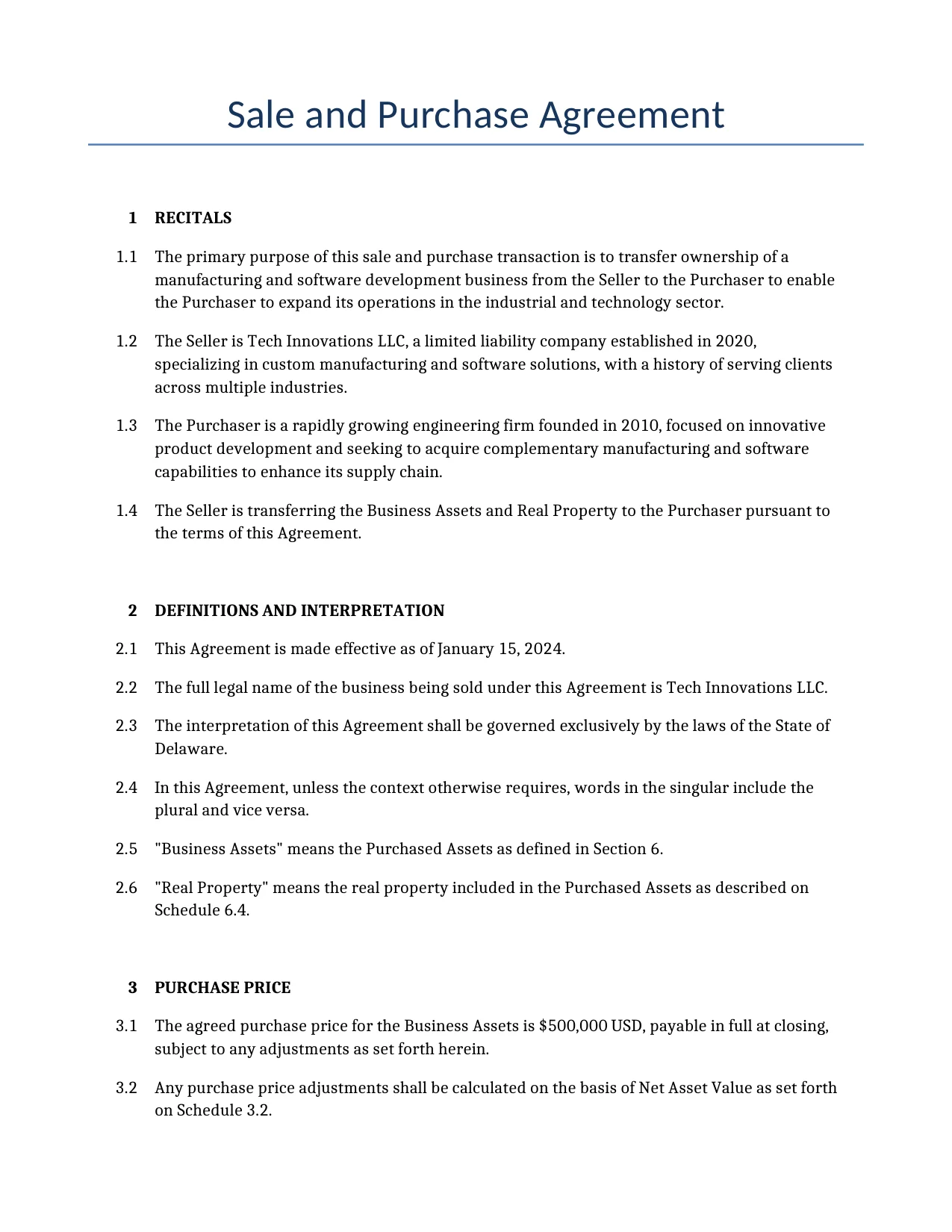
Sale and Purchase Agreement
1RECITALS
The primary purpose of this sale and purchase transaction is to transfer ownership of a manufacturing and software development business from the Seller to the Purchaser to enable the Purchaser to expand its operations in the industrial and technology sector.
The Seller is Tech Innovations LLC, a limited liability company established in 2020, specializing in custom manufacturing and software solutions, with a history of serving clients across multiple industries.
The Purchaser is a rapidly growing engineering firm founded in 2010, focused on innovative product development and seeking to acquire complementary manufacturing and software capabilities to enhance its supply chain.
The Seller is transferring the Business Assets and Real Property to the Purchaser pursuant to the terms of this Agreement.
2DEFINITIONS AND INTERPRETATION
This Agreement is made effective as of January 15, 2024.
The full legal name of the business being sold under this Agreement is Tech Innovations LLC.
The interpretation of this Agreement shall be governed exclusively by the laws of the State of Delaware.
In this Agreement, unless the context otherwise requires, words in the singular include the plural and vice versa.
"Business Assets" means the Purchased Assets as defined in Section 6.
"Real Property" means the real property included in the Purchased Assets as described on Schedule 6.4.
3PURCHASE PRICE
The agreed purchase price for the Business Assets is $500,000 USD, payable in full at closing, subject to any adjustments as set forth herein.
Any purchase price adjustments shall be calculated on the basis of Net Asset Value as set forth on Schedule 3.2.
The parties shall include provisions for contingency-based adjustments to the purchase price as set forth in this Agreement and in the escrow agreement referenced herein.
4PAYMENT TERMS
The Buyer shall pay the purchase price to the Seller by Wire Transfer at closing.
The Buyer shall provide a deposit as required under this Agreement, to be applied toward the purchase price at closing.
The remaining balance shall be paid in full at closing and shall not be paid in installments.
All payments must be completed by the closing date.
5PROPERTY DESCRIPTION
The Real Property to be transferred as part of the Business Assets is described on Schedule 6.4 attached hereto.
The sale and purchase shall include all fixtures, improvements, and appurtenances attached to the Real Property.
6PURCHASED ASSETS AND EXCLUDED ASSETS
At the closing, upon the terms and subject to the conditions set forth in this Agreement, Seller shall sell, transfer, convey, assign and deliver to Buyer, and Buyer shall purchase and acquire from Seller, all of the right, title and interest of Seller in and to the following assets used in or related to the business of Tech Innovations LLC (collectively, the "Purchased Assets"), free and clear of all liens, claims and encumbrances except as disclosed on the Disclosure Schedules:
All machinery, equipment, tools, furniture, fixtures and vehicles used in the Business, as listed on Schedule 6.1(a);
All inventory, raw materials, work-in-process and finished goods, as listed on Schedule 6.1(b);
All accounts receivable and other rights to payment arising from the Business, as listed on Schedule 6.1(c);
All intellectual property owned or used by the Seller in the Business, including patents, trademarks, copyrights, trade secrets, software code and related rights, as listed on Schedule 6.1(d) (the "Transferred IP");
The Real Property described on Schedule 6.4, together with all buildings, improvements and appurtenances thereto;
All contracts, leases, licenses and other agreements related to the Business, as listed on Schedule 6.1(e) (the "Assumed Contracts");
All permits, licenses and governmental approvals related to the Business, to the extent transferable;
All books, records, files and other documents related to the Business, excluding those related to Excluded Assets or Excluded Liabilities.
Notwithstanding anything to the contrary, the Purchased Assets shall not include the following (collectively, the "Excluded Assets"), which shall be retained by Seller:
All cash, cash equivalents and bank accounts of Seller;
All rights under contracts not included in the Assumed Contracts;
All insurance policies and rights to proceeds thereunder;
All tax refunds, credits or similar benefits relating to periods prior to the Closing Date;
The corporate seals, minute books, stock records and other documents relating to the organization of Seller.
Buyer shall assume only the following liabilities (the "Assumed Liabilities"), and no others: (i) all liabilities arising under the Assumed Contracts after the Closing Date; and (ii) all liabilities arising from the ownership or operation of the Purchased Assets after the Closing Date. All other liabilities of Seller, whether known or unknown, fixed or contingent, shall remain with and be retained by Seller (the "Excluded Liabilities"), including but not limited to all pre-Closing liabilities, all indebtedness for borrowed money, all taxes relating to periods prior to Closing, and all liabilities related to employees for periods prior to Closing except as expressly assumed pursuant to Section 11.
7TITLE AND OWNERSHIP
The method to be used for transferring title of the Real Property from the Seller to the Buyer is Special Warranty Deed or such other form as is customary in the jurisdiction where the Real Property is located.
The Seller confirms that the Seller has good and marketable title to all Purchased Assets, including the Real Property.
There are no outstanding liens or encumbrances on the Purchased Assets except as disclosed on Schedule 7.3.
The parties shall obtain owner's title insurance for the Real Property as set forth in Section 10.
The Real Property is currently owned by Seller free of any ownership disputes.
There are no pending disputes, lawsuits, or claims affecting the title to the Purchased Assets except as disclosed on the Disclosure Schedules.
8REPRESENTATIONS AND WARRANTIES OF SELLER
The full legal name of the Seller is Tech Innovations LLC, a Delaware limited liability company.
The nature of the Seller's business operations is that Tech Innovations LLC is a manufacturing and software development company specializing in custom fabrication, web applications and mobile apps for businesses, with operations including project management, coding, testing, client support and manufacturing, with a team of 20 employees.
The Seller is in good standing with all relevant state authorities.
The Seller has no subsidiaries or affiliates other than as disclosed on Schedule 8.4.
The legal structure of the Seller is a limited liability company duly organized under the laws of Delaware.
The date of formation of the Seller is March 15, 2020.
The sale requires no approvals from regulatory bodies or third parties other than as disclosed on Schedule 8.7 and the consents to assignment of the Assumed Contracts.
The Seller's annual revenue for the most recent fiscal year is $1,250,000 as reflected in the Financial Statements included in Schedule 8.8.
The total value of the Seller's assets as per the latest balance sheet included in the Financial Statements is $850,000.50.
The total amount of the Seller's liabilities is $200,000 as reflected in the Financial Statements, none of which are Assumed Liabilities except as expressly provided herein.
The Seller has fully complied with all tax obligations to date, except as disclosed on Schedule 8.11.
The date of the Seller's most recent tax filing is April 15, 2023.
The Seller is not currently involved in any litigation or legal disputes except as disclosed on Schedule 8.13.
The Seller complies with all applicable environmental laws and regulations, except as disclosed on Schedule 8.14.
There are no unresolved disputes with employees or labor unions except as disclosed on Schedule 8.15.
The Seller currently has 20 full-time employees, as listed on Schedule 11.1.
The Seller owns all Transferred IP used in operations free of liens, and such IP is valid and enforceable. The operation of the Business does not infringe any third-party intellectual property rights. All key IP assets are listed on Schedule 6.1(d).
The key contracts essential to the Seller's business operations are listed on Schedule 6.1(e).
The title to all Purchased Assets, including Real Property, is free and clear of encumbrances except as disclosed on the Disclosure Schedules.
Seller has provided true and complete copies of the Financial Statements for the past three (3) years, attached as Schedule 8.8.
9REPRESENTATIONS AND WARRANTIES OF BUYER
The full legal name of the Buyer is ABC Technologies Inc.
The Buyer was organized in the jurisdiction of Delaware, United States.
The Buyer is in good standing in its jurisdiction of organization.
The Buyer is qualified to do business in all jurisdictions where it is required for this transaction.
The Buyer has the corporate power to execute and perform under this Agreement.
The Buyer has obtained all necessary authorizations to enter into this Agreement.
Entering into this Agreement will not conflict with the Buyer's organizational documents or material contracts.
Entering into this Agreement will not violate any laws applicable to the Buyer.
There is no pending or threatened litigation against the Buyer that could affect the transaction.
The entity type of the Buyer is a corporation.
The Buyer is not a non-US entity or controlled by non-US persons.
The Buyer has secured all necessary financing to complete the purchase.
There has been no material adverse change in the Buyer's financial condition since the agreement date.
The Buyer was formed on May 15, 2020.
The principal place of business of the Buyer is 123 Innovation Drive, San Francisco, CA 94105, United States.
10CONDITIONS PRECEDENT
The Buyer's obligation to close is subject to the satisfaction of the following conditions: (i) completion of satisfactory due diligence; (ii) obtaining all necessary third-party consents for the assignment of the Assumed Contracts; (iii) delivery of title insurance commitment for the Real Property in form and substance satisfactory to Buyer; (iv) accuracy of Seller's representations and warranties; (v) Seller's compliance with all covenants; and (vi) no Material Adverse Effect having occurred.
The Buyer's due diligence approval must be satisfied before closing.
The deadline date for completing due diligence is December 15, 2024.
The Buyer's financing must be secured before closing.
Clear title insurance for the Real Property must be obtainable before closing.
All conditions precedent must be satisfied or waived by December 31, 2024.
11DUE DILIGENCE
The Buyer shall commence the due diligence period on January 15, 2024.
The Buyer's due diligence period shall end on March 15, 2024.
The Buyer shall have the right to inspect and review Financial Records, Physical Assets, Legal and Compliance Documents, Real Property, Intellectual Property, Material Contracts, and Employee Files during due diligence, all as more fully described in the Due Diligence Request List attached as Exhibit A.
The Seller shall provide reasonable assistance to the Buyer during due diligence, including access to personnel and facilities upon reasonable notice.
The Buyer shall keep all due diligence information confidential in accordance with the Confidentiality Agreement between the parties dated prior to the date hereof.
The Buyer shall have the right to terminate the Agreement based on due diligence findings that disclose a Material Adverse Effect, Environmental Issues, Title Defects, Financial Discrepancies or material inaccuracies in the representations and warranties.
The Buyer shall provide notice of any issues or termination during due diligence by written notice via email to the Seller's designated representative or certified mail to the Seller's address specified in the Notices section.
12COVENANTS OF SELLER
The Seller covenants to operate the Business in the ordinary course until closing and to maintain the Purchased Assets in their current condition, ordinary wear and tear excepted.
The Seller covenants to maintain all existing insurance policies in full force until closing.
The Seller must not make any material changes to the Business without the Buyer's prior written consent until the Closing Date.
The Seller covenants to timely pay all taxes and assessments due with respect to the Purchased Assets until closing and to comply with all applicable laws.
The Seller shall use commercially reasonable efforts to obtain all third-party consents necessary for the assignment of the Assumed Contracts.
Seller shall deliver all notices and comply with all requirements of any applicable bulk sales laws as set forth in Section 15.
13COVENANTS OF BUYER
The Buyer shall secure financing prior to closing on terms acceptable to Buyer.
The Buyer shall maintain its normal business operations until closing.
The Buyer shall comply with all applicable laws until closing.
Buyer shall cooperate with Seller in obtaining all necessary consents and approvals for the transaction.
14EMPLOYEE MATTERS
Schedule 11.1 contains a true and complete list of all employees of the Business, including each employee's name, title, current compensation, years of service, and accrued vacation or paid time off.
Buyer shall, or shall cause an affiliate to, extend offers of employment to all or selected employees of the Business effective as of the Closing Date on terms comparable to their current compensation, with credit for prior service with Seller for purposes of eligibility and vesting under Buyer's benefit plans (but not for benefit accrual).
Seller shall be responsible for all liabilities related to employees of the Business for periods prior to the Closing Date, including wages, benefits, vacation pay, and any claims arising from pre-Closing employment, except as expressly assumed by Buyer pursuant to this Section 14.
Buyer and Seller shall comply with all requirements of the Worker Adjustment and Retraining Notification Act (WARN Act) and any similar state laws with respect to any plant closing or mass layoff in connection with the transactions contemplated hereby. Seller shall be responsible for any liabilities under the WARN Act arising from actions taken by Seller prior to Closing.
Effective as of the Closing Date, the employees who accept Buyer's offer of employment shall cease to participate in Seller's employee benefit plans, and Buyer shall be responsible for all liabilities related to such employees arising after the Closing Date with respect to Buyer's employee benefit plans.
Seller shall retain all liabilities for any pre-Closing workers' compensation claims, COBRA obligations, and any other employment-related claims that relate to events occurring prior to the Closing Date.
15CLOSING
The closing date for this Agreement is December 15, 2024, or such other date as the parties may mutually agree in writing (the "Closing Date").
The closing shall take place at the offices of Buyer's counsel, or by electronic exchange of documents, on the Closing Date.
The type of closing procedure for completing the transaction is a simultaneous sign-and-close escrow closing.
16CLOSING DELIVERIES
At Closing, Seller shall deliver to Buyer: (i) a bill of sale and assignment and assumption agreement conveying the Purchased Assets and Assumed Liabilities; (ii) a special warranty deed for the Real Property; (iii) an assignment of the Transferred IP; (iv) original counterparts of all Assumed Contracts; (v) all keys, codes and access information for the Real Property and tangible assets; (vi) the officer's certificate required by Section 10; and (vii) such other instruments of transfer as Buyer may reasonably request.
At Closing, Buyer shall deliver to Seller: (i) the purchase price by wire transfer of immediately available funds; (ii) the executed assignment and assumption agreement; (iii) the officer's certificate required by Section 10; and (iv) such other documents as Seller may reasonably request.
The signing of all closing documents shall occur simultaneously with the transfer of funds and delivery of the Purchased Assets.
All deliveries shall be made by electronic transmission where possible, with originals to follow as necessary.
17TAXES
Seller shall be responsible for and shall pay all taxes arising out of or relating to the operation of the Business or ownership of the Purchased Assets for all periods (or portions thereof) ending on or prior to the Closing Date, including any sales, use, excise, or other transfer taxes attributable to the sale of the Purchased Assets.
Buyer shall be responsible for and shall pay all taxes arising out of or relating to the operation of the Business or ownership of the Purchased Assets for all periods (or portions thereof) beginning after the Closing Date. All real and personal property taxes shall be prorated between Seller and Buyer as of the Closing Date on a per diem basis.
Seller and Buyer shall cooperate in the preparation and filing of all tax returns and reports relating to the Business and Purchased Assets, including any required filings under applicable bulk sales or bulk transfer laws. Seller shall prepare and file all tax returns for periods ending on or before the Closing Date.
All transfer, documentary, sales, use, stamp, registration, value added and other such taxes and fees (including any penalties and interest) incurred in connection with this Agreement and the transactions contemplated hereby (collectively, "Transfer Taxes") shall be borne equally by Buyer and Seller. The party required by law to file any tax return or report relating to Transfer Taxes shall do so and the other party shall cooperate in the preparation and filing thereof.
Seller shall comply with any applicable bulk sales laws, including providing all required notices to creditors, filing all necessary affidavits, and obtaining clearance certificates from taxing authorities. If any creditor claims are asserted under bulk sales laws, Seller shall be responsible for satisfying such claims from its own funds so that Buyer does not incur any liability therefor. If compliance with bulk sales laws is not practicable, the parties shall cooperate to devise and implement an alternative arrangement to protect Buyer from any resulting liability.
18INDEMNIFICATION
Seller shall indemnify, defend and hold harmless Buyer and its affiliates, officers, directors, employees, agents and representatives (the "Buyer Indemnitees") from and against any and all losses, damages, liabilities, deficiencies, claims, interest, awards, judgments, penalties, costs and expenses (including reasonable attorneys' fees, costs and other out-of-pocket expenses) (collectively, "Losses") arising out of or resulting from: (i) any breach of any representation or warranty made by Seller in this Agreement or the Disclosure Schedules; (ii) any breach of any covenant or agreement by Seller in this Agreement; or (iii) any Excluded Liabilities or Excluded Assets.
Buyer shall indemnify, defend and hold harmless Seller and its affiliates, officers, directors, employees, agents and representatives (the "Seller Indemnitees") from and against any and all Losses arising out of or resulting from: (i) any breach of any representation or warranty made by Buyer in this Agreement; (ii) any breach of any covenant or agreement by Buyer in this Agreement; or (iii) any Assumed Liabilities after the Closing.
The representations and warranties contained in this Agreement shall survive the Closing as follows: (i) fundamental representations and warranties (including those relating to organization, authority, title to assets, taxes, brokers and capitalization) shall survive indefinitely; (ii) all other representations and warranties shall survive for a period of eighteen (18) months after the Closing Date; and (iii) covenants shall survive for the period specified therein or, if none, until fully performed. Claims for fraud or willful misrepresentation shall survive indefinitely.
No claim for indemnification may be made unless the aggregate amount of all Losses exceeds the Basket Amount of $50,000 (the "Basket"), in which event the indemnifying party shall be liable for all Losses including the Basket (tipping basket). The maximum liability of Seller for indemnification claims under this Section 18 (other than for fundamental representations, covenants, taxes or fraud) shall not exceed the Cap of $1,000,000. There shall be no Basket or Cap for claims based on fundamental representations and warranties, breaches of covenants, taxes, or fraud.
At Closing, $75,000 of the Purchase Price shall be deposited into an escrow account with the Escrow Agent pursuant to an escrow agreement to be entered into at Closing (the "Escrow Amount"). The Escrow Amount shall serve as security for Seller's indemnification obligations hereunder and shall be held and released in accordance with the terms of the escrow agreement. Claims for indemnification shall be made first against the Escrow Amount before seeking recovery directly from Seller, except for claims for which there is no Basket or Cap.
A party seeking indemnification (an "Indemnified Party") shall give the indemnifying party (the "Indemnifying Party") prompt written notice of any claim for indemnification (a "Claim Notice"), describing the claim in reasonable detail. The Indemnified Party's failure to give prompt notice shall not relieve the Indemnifying Party of its obligations except to the extent the Indemnifying Party is actually prejudiced thereby.
With respect to any third-party claim for which indemnification is sought, the Indemnifying Party shall have the right to assume and control the defense of such claim at its expense with counsel reasonably acceptable to the Indemnified Party, provided that the Indemnifying Party notifies the Indemnified Party within thirty (30) days of receipt of the Claim Notice of its election to assume the defense. If the Indemnifying Party does not assume the defense, the Indemnified Party may defend the claim at the Indemnifying Party's expense. The parties shall cooperate in the defense of any claim. The Indemnifying Party shall not settle any third-party claim without the prior written consent of the Indemnified Party (which consent shall not be unreasonably withheld) if the settlement would impose any non-monetary obligation on the Indemnified Party or would reasonably be expected to have a material adverse effect on the Indemnified Party's business or reputation.
The indemnification provisions in this Section 18 shall be the exclusive remedy for breaches of representations, warranties and covenants under this Agreement, except for claims based on fraud or willful misrepresentation, in which case the parties shall have all rights and remedies available under law. Nothing in this Agreement shall limit the parties' rights to specific performance or injunctive relief.
19CONFIDENTIALITY
The parties shall keep the terms of this Agreement and all related information confidential, except as required by law or as necessary to obtain consents or financing.
The confidentiality obligations shall be mutual, applying equally to both the Buyer and the Seller.
Confidential information shall include all information disclosed by one party to the other in connection with the transaction, whether before or after the date hereof, except information that is or becomes generally available to the public without breach of this Agreement.
The confidentiality obligations shall survive for five (5) years after the Closing Date or termination of this Agreement.
Permitted disclosures shall include disclosure required by law or court order (with prior notice to the other party where practicable), disclosure to professional advisors who are bound by confidentiality obligations, and disclosure with prior written consent.
The remedies for breaches of confidentiality shall include injunctive relief without the need to post a bond, in addition to any other remedies available at law or in equity.
20NON-COMPETE AND NON-SOLICITATION
For a period of three (3) years following the Closing Date, the Seller shall not, directly or indirectly, engage in any business that competes with the Business as conducted on the Closing Date within the states of California, New York, and Texas (the "Restricted Territory").
For a period of three (3) years following the Closing Date, the Seller shall not, directly or indirectly, solicit, hire or attempt to solicit or hire any employees of the Business or any person who was an employee of the Business within the six (6) months preceding the Closing Date, or solicit or divert any customers or suppliers of the Business.
The non-compete and non-solicitation restrictions shall end on the third anniversary of the Closing Date.
The geographic area that the non-compete covenant shall cover for the Seller is the states of California, New York, and Texas.
The Seller shall be prohibited under the non-compete covenant from engaging in manufacturing or software development activities that are competitive with the Business as conducted on the Closing Date.
The parties agree that the restrictions contained in this Section 20 are reasonable in scope and duration and are necessary to protect the legitimate business interests of Buyer. If any restriction is held to be unenforceable, it shall be reformed to the maximum extent permitted by law.
21TERMINATION
The Agreement may be terminated at any time prior to Closing: (i) by mutual written consent of Buyer and Seller; (ii) by either party if Closing has not occurred by March 31, 2025 (the "Outside Date"); (iii) by Buyer upon a material breach by Seller that is not cured within ten (10) business days after notice; (iv) by Seller upon a material breach by Buyer that is not cured within ten (10) business days after notice; or (v) by Buyer if there has been a Material Adverse Effect.
The Buyer may terminate the Agreement upon the occurrence of a Material Adverse Effect or Financing Failure (subject to any applicable cure periods).
The Seller may terminate the Agreement upon the occurrence of Buyer Default on Payment or if a Superior Offer is received and the Buyer does not match such offer within the time period specified herein.
A termination fee of $25,000 shall be payable by the Buyer to Seller upon termination under certain circumstances as specified in this Section 21.
No reverse termination fee shall be payable by the Seller upon termination under certain circumstances.
Any termination of the Agreement shall require written notice to the other party specifying the basis for termination.
The outside date for closing, after which either party may terminate (subject to any applicable exceptions), is March 31, 2025.
Upon termination, this Agreement shall become void and of no further force and effect, except that the provisions of Sections 19 (Confidentiality), 27 (Governing Law; Jurisdiction), and any other provisions that by their nature are intended to survive termination shall survive.
22REMEDIES
The parties agree that irreparable damage would occur if any provision of this Agreement were not performed in accordance with the terms hereof and that the parties shall be entitled to specific performance of the terms hereof, in addition to any other remedy at law or in equity.
The types of damages available in case of breach include actual damages. Consequential, punitive, special or indirect damages shall not be recoverable except in the case of fraud or willful misconduct.
This Agreement includes a provision for liquidated damages in the event of Buyer's failure to close when required and all conditions to Buyer's obligations have been satisfied or waived.
The remedies outlined in this Agreement are cumulative and do not limit any other remedies available under this Agreement or at law or in equity, except as expressly provided in the indemnification section.
Injunctive relief shall be allowed as a remedy for breaches that cannot be adequately compensated by damages.
The parties waive the right to a jury trial for disputes related to this Agreement to the fullest extent permitted by law.
23GOVERNING LAW; JURISDICTION
This Agreement shall be governed by and construed in accordance with the internal laws of the State of Delaware without giving effect to any choice or conflict of law provision or rule that would cause the application of the laws of any other jurisdiction.
Any legal action, suit or proceeding arising out of or relating to this Agreement or the transactions contemplated hereby shall be instituted exclusively in the federal courts of the United States or the courts of the State of Delaware, in each case located in the City of Wilmington and County of New Castle. Each party irrevocably submits to the exclusive jurisdiction of such courts and waives any objection to such venue. Each party irrevocably waives, to the fullest extent permitted by applicable law, any right it may have to a trial by jury in any legal proceeding arising out of or relating to this Agreement.
The prevailing party in any dispute shall be entitled to recover their reasonable attorney fees and costs.
24DISPUTE RESOLUTION
The parties consent to the exclusive jurisdiction of the courts of the State of Delaware for any disputes under this Agreement. Any legal action, suit or proceeding shall be brought exclusively in the state or federal courts located in Wilmington, Delaware.
The method for resolving disputes under this Agreement shall be by litigation in accordance with Section 23; provided, however, that the parties may agree to mediation or arbitration on mutually acceptable terms after a dispute arises.
This Agreement shall not include a mandatory mediation step before proceeding to litigation.
All dispute resolution proceedings shall be kept confidential to the extent permitted by law.
The prevailing party in a dispute shall be entitled to recover their attorney fees and costs.
The parties waive the right to a jury trial for any litigation under this Agreement to the fullest extent permitted by applicable law.
25ENTIRE AGREEMENT
This Agreement, together with the Exhibits and Schedules hereto and the other documents delivered pursuant hereto, constitutes the entire understanding between the parties and supersedes all prior agreements between the Buyer and the Seller, including any letter of intent or term sheet.
The effective date when this Agreement becomes the entire understanding between the Buyer and the Seller is January 15, 2024.
26AMENDMENTS
This Agreement may not be amended except by a written instrument signed by both parties. No oral amendments shall be permitted.
27SEVERABILITY
If any provision of this Agreement is held to be invalid or unenforceable, the remaining provisions shall remain in full force and effect. The invalid provision shall be reformed to the extent necessary to make it valid and enforceable while preserving the parties' original intent to the maximum extent possible.
28WAIVER
The failure of either party to enforce any provision of this Agreement shall not constitute a waiver of that right. No waiver shall be effective unless in writing and signed by the party granting the waiver. A waiver of one breach shall not constitute a waiver of any other or subsequent breach.
29NOTICES
All notices under this Agreement shall be in writing and shall be sent by hand delivery, certified mail (return receipt requested), or email (with confirmation of receipt).
The physical address specified for the Seller to receive notices is the address set forth on the signature page hereto, or to such other address as may be designated by Seller in writing.
The physical address specified for the Buyer to receive notices is the address set forth on the signature page hereto, or to such other address as may be designated by Buyer in writing.
Notices sent by certified mail shall be deemed received three (3) business days after mailing. Notices sent by hand delivery or email (with confirmation) shall be deemed received upon delivery or confirmation of receipt.
Notices shall become effective upon receipt.
Notices shall be copied to the attorneys for both the Seller and the Buyer at the addresses set forth on the signature page or as otherwise designated.
30ASSIGNMENT
Neither party may assign its rights or obligations under this Agreement without the prior written consent of the other party, except that Buyer may assign its rights to an affiliate or to a lender as collateral without Seller's consent provided that Buyer remains liable for all obligations hereunder.
31FORCE MAJEURE
Neither party shall be liable for any failure or delay in performance due to events beyond its reasonable control, including natural disasters, acts of war or terrorism, pandemics or epidemics, provided that such party gives prompt written notice of the force majeure event and uses commercially reasonable efforts to mitigate its effects.
Economic or financial events shall be excluded from being considered force majeure.
Any force majeure claims shall require written notice within seven (7) days after the occurrence of the force majeure event.
The parties shall be required to mitigate the effects of force majeure events using commercially reasonable efforts.
If a force majeure event prevents performance for more than sixty (60) days, either party shall have the right to terminate this Agreement upon written notice to the other party.
The force majeure clause shall apply to both the Buyer's and the Seller's obligations, except for payment obligations which shall not be excused by force majeure.
32EXPENSES
Each party shall be responsible for paying its own legal, accounting and other professional fees and expenses incurred in connection with the negotiation, preparation and execution of this Agreement and the transactions contemplated hereby, except as otherwise expressly provided herein or in the indemnification provisions.
Transfer Taxes and fees shall be allocated as set forth in the Taxes section.
Escrow fees shall be split equally between Buyer and Seller.
33FURTHER ASSURANCES
Following the Closing, each of the parties hereto shall, and shall cause their respective affiliates to, execute and deliver such additional documents, instruments, conveyances and assurances and take such further actions as may be reasonably required to carry out the provisions of this Agreement and give effect to the transactions contemplated hereby, including to vest in Buyer good and marketable title to the Purchased Assets.
34PUBLIC ANNOUNCEMENTS
Neither party shall make any public announcement or press release regarding this Agreement or the transactions contemplated hereby without the prior written consent of the other party, which consent shall not be unreasonably withheld, conditioned or delayed, except as may be required by applicable law or stock exchange rules (in which case the announcing party shall use reasonable efforts to consult with the other party prior to making such announcement).
35NO THIRD-PARTY BENEFICIARIES
This Agreement is for the sole benefit of the parties hereto and their respective successors and permitted assigns, and nothing herein, express or implied, is intended to or shall confer upon any other person or entity any legal or equitable right, benefit or remedy of any nature whatsoever under or by reason of this Agreement, except for the indemnification rights of the Buyer Indemnitees and Seller Indemnitees pursuant to Section 18, which are intended to be for the benefit of such persons.
36BULK SALES COMPLIANCE
Seller shall comply with the requirements of any applicable bulk sales, bulk transfer or similar laws of the states in which the Business is conducted. Seller shall provide all required notices to creditors at least ten (10) business days prior to Closing and shall obtain and deliver to Buyer all applicable clearance certificates from taxing authorities.
If Seller is unable to fully comply with bulk sales laws, the parties shall cooperate in structuring the transaction in a manner that minimizes any potential liability to Buyer, including through escrow arrangements or other security as mutually agreed. Any liability arising from non-compliance with bulk sales laws shall be borne solely by Seller and shall constitute an Excluded Liability.
37COMPLIANCE WITH SPECIFIED LEGISLATION
This Agreement and the transactions contemplated hereby comply with all applicable provisions of the Uniform Commercial Code as adopted in the State of Delaware and the State of Texas to the extent the sale of goods or secured transactions are involved in the transfer of the Business Assets.
This Agreement satisfies the Statute of Frauds by being in writing, signed by the parties, and containing sufficient detail regarding the subject matter and material terms of the transaction.
Seller represents that it is in material compliance with all applicable federal, state and local laws, including but not limited to environmental laws (as set forth in Section 8.14), labor and employment laws (including the WARN Act as addressed in Section 14), antitrust laws, and tax laws. The transactions contemplated by this Agreement do not require any filing under the Hart-Scott-Rodino Antitrust Improvements Act of 1976, as amended.
The transfer of the Real Property complies with all applicable state real property transfer laws in the jurisdiction where the Real Property is located.
38SCHEDULES AND EXHIBITS
The following Schedules and Exhibits are attached hereto and incorporated by reference: Schedule 3.2 (Net Asset Value Calculation); Schedule 6.1(a) (Equipment); Schedule 6.1(b) (Inventory); Schedule 6.1(c) (Accounts Receivable); Schedule 6.1(d) (Intellectual Property); Schedule 6.1(e) (Assumed Contracts); Schedule 6.4 (Real Property Description); Schedule 7.3 (Permitted Liens); Schedule 8.4 (Subsidiaries and Affiliates); Schedule 8.7 (Required Consents); Schedule 8.8 (Financial Statements); Schedule 8.11 (Tax Matters); Schedule 8.13 (Litigation); Schedule 8.14 (Environmental Matters); Schedule 8.15 (Labor Matters); Schedule 11.1 (Employees); Exhibit A (Due Diligence Request List); and the Disclosure Schedules containing exceptions to the representations and warranties.
The date of the most recent financial statements referenced is December 31, 2023.
This Agreement includes a schedule listing the intellectual property assets as Schedule 6.1(d).
This Agreement includes a schedule of employees and compensation as Schedule 11.1.
This Agreement includes a schedule of material contracts as Schedule 6.1(e).
This Agreement discloses all pending or threatened litigation in Schedule 8.13.
This Agreement includes a schedule of insurance policies as part of the Disclosure Schedules.
39SIGNATURE SECTION
IN WITNESS WHEREOF, the parties have executed this Agreement as of the date first above written.
Seller: Tech Innovations LLC By: ______________________________ Name: Title: Date:
Buyer: ABC Technologies Inc. By: ______________________________ Name: Title: Date:
This example shows approximately 70% of a typical document and is provided for illustrative purposes only. The remaining content has been omitted.
Every document generated by Docaro is tailored to your specific circumstances, jurisdiction and the information you provide. The completed document includes all applicable clauses and provisions required for your situation.
To generate the full, personalised document, answer a short series of questions and your document will be created instantly.