
AI Generated ESG Report for use in the United States
PDF & Word - 2026 Updated
Docaro Pricing
When Do You Need an ESG Report in the United States?
American Legal Rules for an ESG Report
Selecting an inappropriate structure for an ESG report can lead to incomplete disclosure of material risks and non-compliance with relevant regulatory standards.
What a Proper ESG Report Should Include
- Executive SummaryA brief overview highlighting the company's key ESG achievements, challenges, and commitments.
- Company OverviewA description of the business, its operations, and how ESG integrates into its strategy.
- Environmental PerformanceDetails on efforts to reduce environmental impact, such as lowering carbon emissions and conserving resources.
- Social ResponsibilityInformation on supporting employees, communities, and human rights through fair practices.
- Governance PracticesExplanation of ethical leadership, board diversity, and transparency in decision-making.
- Risks and OpportunitiesIdentification of ESG-related risks and how the company plans to address them.
- Metrics and GoalsSpecific, measurable targets for ESG progress with data to track performance.
- Future CommitmentsPlans for ongoing ESG improvements and alignment with global standards.
Generate Your Document in 4 Easy Steps
Why Use Docaro?
 United States
Free Example ESG Report Template
Below is a free template example of a ESG Report for use in the United States generated by our AI model.
The clauses in your actual ESG Report will vary from this example as they will be entirely bespoke to your requirements as set out in the questionnaire you complete.
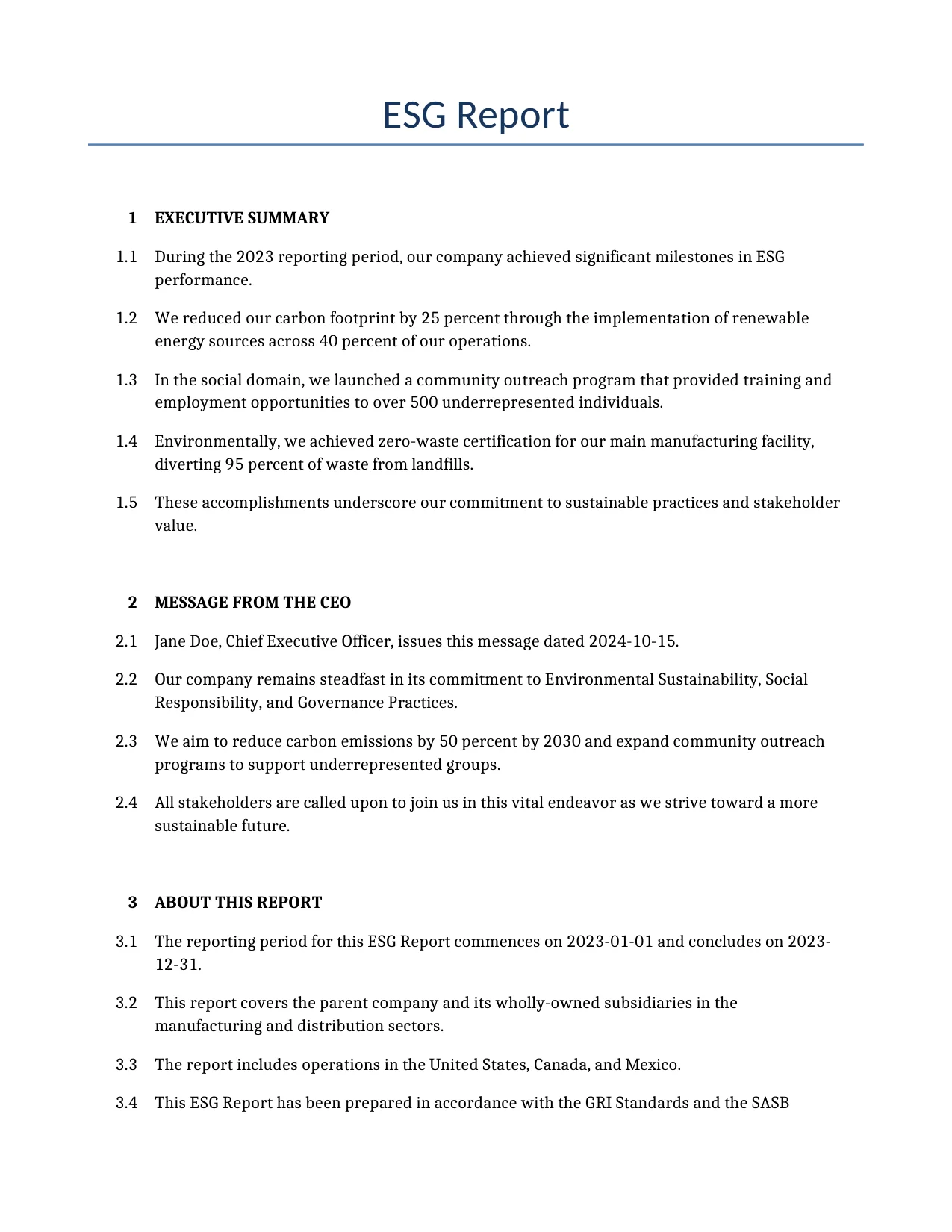
ESG Report
1EXECUTIVE SUMMARY
During the 2023 reporting period, our company achieved significant milestones in ESG performance.
We reduced our carbon footprint by 25 percent through the implementation of renewable energy sources across 40 percent of our operations.
In the social domain, we launched a community outreach program that provided training and employment opportunities to over 500 underrepresented individuals.
Environmentally, we achieved zero-waste certification for our main manufacturing facility, diverting 95 percent of waste from landfills.
These accomplishments underscore our commitment to sustainable practices and stakeholder value.
2MESSAGE FROM THE CEO
Jane Doe, Chief Executive Officer, issues this message dated 2024-10-15.
Our company remains steadfast in its commitment to Environmental Sustainability, Social Responsibility, and Governance Practices.
We aim to reduce carbon emissions by 50 percent by 2030 and expand community outreach programs to support underrepresented groups.
All stakeholders are called upon to join us in this vital endeavor as we strive toward a more sustainable future.
3ABOUT THIS REPORT
The reporting period for this ESG Report commences on 2023-01-01 and concludes on 2023-12-31.
This report covers the parent company and its wholly-owned subsidiaries in the manufacturing and distribution sectors.
The report includes operations in the United States, Canada, and Mexico.
This ESG Report has been prepared in accordance with the GRI Standards and the SASB Standards.
Data was collected through internal surveys, third-party audits, and automated tracking systems.
All quantitative data was verified against source documents, and qualitative information was reviewed by department leads.
This report excludes data from joint ventures where we do not have control.
Some emissions data relies on estimates due to incomplete supplier information.
The intended publication date for this ESG report is 2024-03-15.
4COMPANY OVERVIEW
The full legal name of the company is EcoTech Innovations Inc.
EcoTech Innovations Inc. was founded on January 15, 2005.
EcoTech Innovations Inc. was founded in 2005 by a group of environmental engineers in Silicon Valley.
Starting as a small startup focused on renewable energy solutions, the company grew rapidly through innovative solar panel technologies and expanded into waste management systems by 2010.
Key milestones include securing a major government contract in 2015 and going public in 2020, establishing itself as a leader in sustainable tech.
The mission statement of the company is to drive global sustainability by developing innovative, eco-friendly technologies that reduce carbon footprints and promote resource efficiency for businesses and communities worldwide.
The vision statement of the company is a world where sustainable practices are the norm, powered by clean energy and circular economies that benefit people, planet, and prosperity.
EcoTech Innovations operates a B2B model, selling customized renewable energy solutions and sustainability consulting services to corporations and industrial clients.
Revenue is generated through product sales, long-term service contracts, and licensing of proprietary green technologies.
We focus on partnerships with large enterprises to integrate our solutions into their operations, emphasizing cost savings and regulatory compliance.
Our matrix structure combines functional departments with project-based teams focused on specific client initiatives or product developments.
This allows for cross-functional collaboration while maintaining clear lines of authority from the CEO down to department heads.
We have regional divisions for North America, Europe, and Asia to support global operations.
The company maintains a global presence outside the United States.
The total number of employees in the company worldwide is 1250.
5ESG GOVERNANCE AND STRATEGY
The primary ESG focus areas that the company prioritizes for the reporting period are Environmental Sustainability, Social Responsibility, and Governance Practices.
For the upcoming period, our company will prioritize reducing carbon emissions by 30 percent through renewable energy adoption, enhancing employee diversity and inclusion programs, and strengthening ethical governance by implementing new anti-corruption training for all staff.
Our ESG governance framework is structured around a dedicated ESG Committee reporting directly to the Board of Directors.
The committee, comprising members from executive leadership, sustainability experts, and department heads, meets quarterly to review ESG performance metrics, assess risks, and approve initiatives.
It operates by integrating ESG considerations into all major business decisions, with clear policies on environmental impact assessments, social equity standards, and governance transparency, ensuring alignment with global standards like the UN Sustainable Development Goals.
The management team is responsible for embedding ESG principles into daily operations, including setting departmental ESG targets, allocating resources for sustainability projects, and conducting regular audits to monitor progress.
They report quarterly to the ESG Committee on key performance indicators such as emission reductions and community engagement efforts, while also training staff on ESG compliance to foster a culture of accountability.
The company maintains a dedicated executive position responsible for ESG matters, known as the Chief Sustainability Officer.
Our long-term ESG strategy aims for net-zero emissions by 2050, with interim goals of 50 percent renewable energy usage by 2030 and full supply chain decarbonization by 2040.
Socially, we target 40 percent diverse representation in leadership roles by 2035.
Governance goals include annual third-party audits starting in 2025 to ensure ethical practices and transparency in all operations.
The time horizon for the company's primary long-term ESG strategy is 25 years.
6ENVIRONMENTAL PERFORMANCE
The company reports on Scope 1 greenhouse gas emissions for the reporting period.
The total Scope 1 greenhouse gas emissions amount to 1250.5 metric tons of CO2 equivalent for the period ending on 2023-12-31.
The company reports on Scope 2 greenhouse gas emissions for the reporting period.
The total Scope 2 greenhouse gas emissions amount to 850.75 metric tons of CO2 equivalent for the period ending on 2023-12-31.
The company reports total energy consumption using the Final Energy method.
The company's total annual energy consumption is 150000.0 gigajoules.
35.2 percent of the total energy consumption comes from renewable sources.
The company primarily operates in Low Stress and Medium to High Stress water areas.
The total volume of water withdrawn by the company is 25000.0 cubic meters.
The total water consumed by the company is 18000.5 cubic meters.
The company maintains a program for recycling or reusing water.
The total amount of waste generated by the company is 1200.0 metric tons.
The company utilizes Recycling and Composting methods for waste disposal.
65.0 percent of waste is diverted from landfills through recycling or other means.
The company has conducted an assessment of biodiversity impacts from operations.
The company operates in or near protected areas or areas of high biodiversity value with Mitigation measures in place.
The overall reporting period for environmental performance data commences on 2023-01-01 and concludes on 2023-12-31.
7SOCIAL PERFORMANCE
The company confirms that it maintains a formal diversity and inclusion policy.
The current breakdown of the company's workforce diversity includes Gender Diversity, Racial and Ethnic Diversity, and Age Diversity.
The total number of full-time equivalent employees in the company is 1500 employees.
The company's human rights policy covers Anti-Discrimination, Modern Slavery Prevention, and Worker Health and Safety.
The company supports local education through annual scholarships and partners with community organizations for STEM workshops, impacting over 500 students yearly.
The company implements Quality Control Testing, Ethical Sourcing, and Consumer Privacy Protections as main measures for product safety and responsibility.
8GOVERNANCE PERFORMANCE
The board of directors maintains oversight responsibilities for ESG matters.
The Sustainability or ESG Committee is primarily responsible for overseeing ESG issues.
More than 75 percent of the board members are independent.
The board includes representation from underrepresented groups such as women or ethnic minorities with specific quotas or targets.
The company conducts annual evaluations of the board's performance.
The primary structure of executive compensation is performance-based with ESG metrics.
The ratio of the CEO's total compensation to the median employee compensation is 45.2.
The company maintains a clawback policy for executive compensation in cases of misconduct or financial restatements.
The company maintains a formal code of ethics applicable to all employees and directors.
12 ethics and anti-corruption training sessions were conducted for employees last year.
The date of the last internal audit on anti-corruption measures was 2023-06-15.
The company provides an anonymous hotline and online portal as mechanisms for reporting ethics violations anonymously.
9MATERIALITY ASSESSMENT
The company has conducted a materiality assessment to identify key ESG risks.
The materiality assessment involved a multi-step process including review of industry benchmarks, internal workshops with department leads, stakeholder surveys, and plotting issues on a materiality matrix based on impact to the business and stakeholder concerns.
The company conducted stakeholder engagement as part of the materiality assessment.
The materiality assessment process commenced on 2023-01-15 and was completed on 2023-06-30.
The materiality assessment utilized the GRI Standards and the SASB Standards.
8 material ESG issues were identified and prioritized.
The prioritized material ESG issues are climate change and carbon emissions, supply chain labor practices, data privacy and cybersecurity, diversity and inclusion, water resource management, waste reduction and circular economy, governance and ethics, and community impact and social responsibility.
10STAKEHOLDER ENGAGEMENT
The company conducts annual stakeholder engagement activities such as surveys or meetings.
The company conducts quarterly governance forums where stakeholders discuss board composition, ethical standards, and compliance matters.
The company also holds annual town halls to gather input on corporate policies, ensuring transparency and accountability in decision-making.
The company uses a materiality assessment framework to identify stakeholders, starting with an internal review of the value chain and impact areas.
This is followed by consultations with department heads and external experts to map out groups affected by ESG initiatives such as environmental impacts or social programs.
The categories of stakeholders with which the company engages include Employees, Customers, Investors, Suppliers, and Local Communities.
The company employs a mix of direct and indirect methods including one-on-one meetings with key investors, digital surveys for employees and customers, collaborative workshops with suppliers on sustainability standards, and community outreach events to address local concerns.
The primary channels used for stakeholder engagement are the Company Website, Surveys and Questionnaires, Meetings and Workshops, and Social Media.
The company maintains dedicated feedback mechanisms for stakeholders.
The company offers an anonymous online portal for submitting feedback on ESG topics, regular pulse surveys distributed via email, and a dedicated hotline for immediate concerns.
All inputs are reviewed by the ESG committee monthly to ensure timely follow-up.
The date of the company's most recent stakeholder engagement activity was 2023-10-15.
The company conducted 12 stakeholder engagement activities in the last fiscal year.
The company responds to stakeholder feedback through Direct Acknowledgment and Action.
Engagements led to the implementation of a new diversity hiring policy, increased supplier audits for ethical sourcing, and the launch of a community education program on environmental conservation, resulting in improved stakeholder trust and measurable ESG progress.
Stakeholder engagement identified material ESG issues for the company.
11RISK MANAGEMENT AND OPPORTUNITIES
The company integrates ESG risks into its overall enterprise risk management framework by incorporating them into quarterly risk assessments where ESG factors are evaluated alongside financial and operational risks.
The company utilizes a dedicated ESG committee to identify and score these risks, ensuring they influence strategic decision-making and resource allocation.
ESG factors are integrated through a structured process that includes annual training for risk managers on ESG topics, scenario planning that incorporates climate change and social impacts, and the use of ESG-specific KPIs in the risk dashboard for real-time monitoring.
The key ESG risk areas on which the company focuses in its enterprise risk management are Environmental Risks, Social Risks, and Governance Risks.
The company is monitoring emerging ESG risks such as biodiversity loss due to supply chain activities, increasing regulatory pressures on data privacy under new social governance standards, and the potential impacts of geopolitical tensions on sustainable sourcing.
The opportunities for sustainable growth that the company is pursuing include Renewable Energy Investments, Sustainable Supply Chain Enhancements, and Green Product Development.
The board of directors provides oversight on ESG risks and opportunities.
The company's mitigation strategies include partnering with third-party auditors for environmental impact assessments, implementing diversity training programs to address social risks, establishing a whistleblower hotline for governance issues, and setting measurable targets with regular progress reviews.
12PERFORMANCE METRICS AND TARGETS
The company achieved all predefined ESG targets for the reporting period.
The ESG topics on which the company focuses for performance metrics and targets are Environmental, Social, and Governance.
The key performance indicators for Environmental topics are carbon emissions in tons CO2e and water usage in liters.
The key performance indicators for Social topics are employee turnover rate in percentage and diversity index.
The key performance indicators for Governance topics are board diversity percentage and compliance violation incidents.
Historical data is available for the KPIs over the past three years.
The current achievement for the KPI was measured on 2023-12-31.
Over the past three years, carbon emissions have declined by 15 percent due to efficiency improvements, while employee turnover has remained stable at around 5 percent, with a slight increase in diversity index from 0.7 to 0.85.
The numerical value that the company aims to achieve as the future target for each KPI is 500.5.
The company plans to achieve the future target for each KPI by 2025-12-31.
The company will measure progress toward the ESG targets quarterly.
13CASE STUDIES AND INITIATIVES
The company includes case studies in this section of the ESG Report.
The company includes descriptions of ongoing ESG initiatives in this section of the ESG Report.
The ESG focus areas that the case studies and initiatives primarily address are Environmental and Social.
The title of the first ESG project or initiative featured is Sustainable Supply Chain Partnership.
The objective of this initiative is to reduce carbon emissions in the supply chain by partnering with key suppliers to implement renewable energy sources.
Key activities include auditing supplier facilities, providing training on sustainable practices, and co-developing green procurement policies.
This ESG initiative commenced on 2022-01-15.
A key quantifiable impact of this project is 15000.5 tons of CO2 reduced.
The success of this ESG project is measured using both quantitative and qualitative methods.
The title of the second ESG project or initiative featured is Community Education Program.
The objective of this initiative is to enhance environmental awareness and support underrepresented groups through educational workshops and training.
Key activities include organizing STEM workshops in local communities and providing scholarships for sustainability studies.
This ESG initiative commenced on 2022-06-01.
A key quantifiable impact of this project is 500 individuals trained.
The success of this ESG project is measured using both quantitative and qualitative methods.
14COMPLIANCE AND REGULATORY ALIGNMENT
The company currently complies with all applicable SEC guidelines for ESG disclosures.
The company adheres to all relevant EPA standards for environmental protection and emissions.
The company is aligned with the Task Force on Climate-related Financial Disclosures framework for climate risk reporting.
The date of the company's most recent compliance audit for ESG regulations was 2023-06-15.
The company has experienced no regulatory violations in the past three years related to ESG compliance.
The company employs a dedicated compliance team that conducts quarterly reviews of all ESG-related activities.
The company uses automated software to track emissions data against EPA standards and integrates SEC disclosure requirements into the annual reporting cycle.
Regular training sessions for employees ensure awareness of regulatory changes.
The company has fully implemented the TCFD recommendations in its disclosures.
15THIRD-PARTY ASSURANCE
The company obtained third-party assurance for parts of this ESG report.
The company has obtained third-party assurance for reported ESG data in this ESG Report.
The auditor confirmed that the ESG data presented is materially accurate and complies with relevant standards.
No significant discrepancies were found in the environmental or social metrics, and governance disclosures were deemed reliable.
The third-party provider conducted a limited assurance engagement following ISAE 3000 standards.
This involved reviewing internal controls, interviewing key personnel, and performing analytical procedures on carbon emissions, diversity metrics, and supply chain data.
The third-party assurance provider was independent from the company during the ESG data verification.
The assurance covered environmental data on greenhouse gas emissions and water usage, social data including employee diversity and community engagement, and governance aspects such as board composition and anti-corruption policies.
16FORWARD-LOOKING STATEMENTS
The company is committed to reducing carbon emissions by 50 percent by 2030 through investments in renewable energy sources and sustainable supply chains.
Socially, the company aims to enhance diversity in the workforce, targeting 40 percent representation from underrepresented groups by 2025.
In governance, the company will implement stricter anti-corruption policies and annual third-party audits starting next year.
The strategic ESG goals include achieving net-zero emissions by 2040, with interim targets of 25 percent reduction by 2025 and 50 percent by 2030.
Socially, the company plans to invest 10 million dollars annually in community development programs through 2035.
Governance targets involve 100 percent board diversity by gender and ethnicity by 2027, supported by comprehensive training programs.
All projections in this Forward-Looking Statements section are subject to uncertainties including Regulatory Changes, Market Volatility, and Supply Chain Disruptions and may not be achieved.
The company acknowledges that all projections in the Forward-Looking Statements section are subject to uncertainties and may not be achieved.
17COMPLIANCE WITH AMERICAN LAW
This ESG Report has been prepared in compliance with the Sarbanes-Oxley Act of 2002.
This ESG Report has been prepared in compliance with Regulation S-K.
This ESG Report has been prepared in compliance with the Dodd-Frank Wall Street Reform and Consumer Protection Act of 2010.
This ESG Report has been prepared in compliance with the Clean Air Act.
This ESG Report has been prepared in compliance with the Occupational Safety and Health Act of 1970.
This document shall be governed by and construed in accordance with American law.
18APPENDICES
The glossary of ESG-related terms includes Sustainability, Carbon Footprint, and Diversity and Inclusion.
Detailed data tables are included in the appendices.
A GRI content index is included in the appendices.
The GRI content index was last updated on 2023-10-15.
The contact information included in the appendices covers the ESG Department and Investor Relations.
The primary contact person for ESG inquiries is Jane Doe.
The email address for the primary ESG contact is jane.doe@company.com.
19SIGNATURE SECTION
This ESG Report is executed on behalf of EcoTech Innovations Inc. by the undersigned duly authorized officer as of the date first written above.
By: _______________________________
Name: Jane Doe
Title: Chief Executive Officer
Date: _______________________________
This example shows approximately 70% of a typical document and is provided for illustrative purposes only. The remaining content has been omitted.
Every document generated by Docaro is tailored to your specific circumstances, jurisdiction and the information you provide. The completed document includes all applicable clauses and provisions required for your situation.
To generate the full, personalised document, answer a short series of questions and your document will be created instantly.