
AI Generated American Retail Lease Agreement
PDF & Word - 2026 Updated
Docaro Pricing
When do you need a Retail Lease Agreement in the United States?
American Legal Rules for a Retail Lease Agreement
Using the wrong structure for a retail lease agreement can expose landlords to unintended liabilities under commercial zoning or tenant protection laws.
What a Proper Retail Lease Agreement Should Include
- Parties InvolvedClearly identifies the landlord and tenant, including their full names and addresses.
- Property DescriptionProvides a detailed description of the retail space being leased, including its location and size.
- Lease TermSpecifies the start and end dates of the lease, along with any options for renewal.
- Rent Amount and PaymentOutlines the total rent, due dates, and accepted payment methods.
- Security DepositDetails the amount of the deposit, how it will be held, and conditions for its return.
- Permitted UseDescribes the specific business activities allowed in the space.
- Maintenance and RepairsClarifies who is responsible for upkeep, repairs, and maintenance of the property.
- Utilities and ExpensesLists which utilities and other costs the tenant must pay.
- Insurance RequirementsSpecifies the types of insurance the tenant needs to carry and proof of coverage.
- Default and TerminationExplains what happens if payments are missed or the agreement is breached, including eviction processes.
- SignaturesIncludes spaces for both parties to sign and date the agreement.
Generate Your Document in 4 Easy Steps
Why Use Docaro?
 United States
Free Example Retail Lease Agreement Template
Below is a free template example of a Retail Lease Agreement for use in the United States generated by our AI model.
The clauses in your actual Retail Lease Agreement will vary from this example as they will be entirely bespoke to your requirements as set out in the questionnaire you complete.
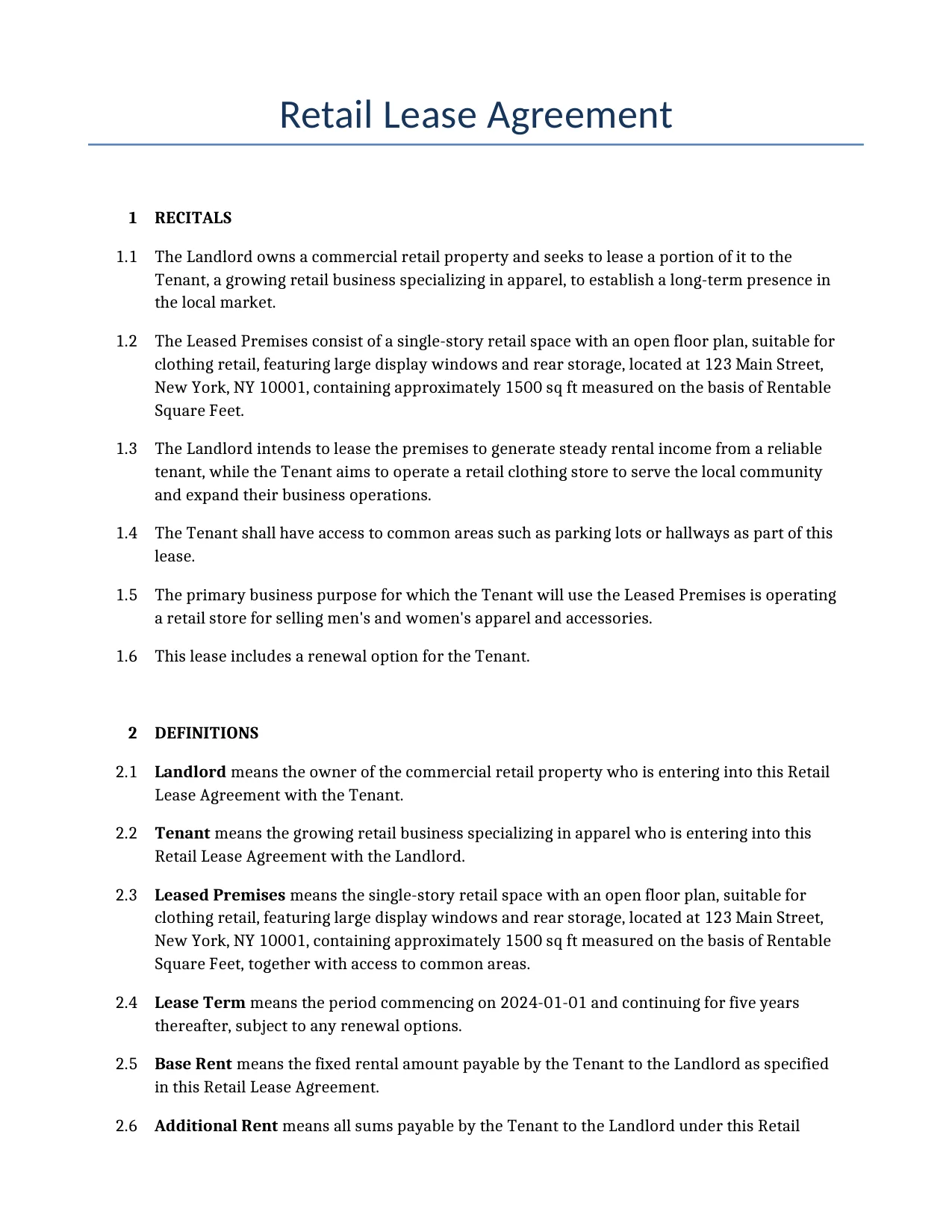
Retail Lease Agreement
1RECITALS
The Landlord owns a commercial retail property and seeks to lease a portion of it to the Tenant, a growing retail business specializing in apparel, to establish a long-term presence in the local market.
The Leased Premises consist of a single-story retail space with an open floor plan, suitable for clothing retail, featuring large display windows and rear storage, located at 123 Main Street, New York, NY 10001, containing approximately 1500 sq ft measured on the basis of Rentable Square Feet.
The Landlord intends to lease the premises to generate steady rental income from a reliable tenant, while the Tenant aims to operate a retail clothing store to serve the local community and expand their business operations.
The Tenant shall have access to common areas such as parking lots or hallways as part of this lease.
The primary business purpose for which the Tenant will use the Leased Premises is operating a retail store for selling men's and women's apparel and accessories.
This lease includes a renewal option for the Tenant.
2DEFINITIONS
Landlord means the owner of the commercial retail property who is entering into this Retail Lease Agreement with the Tenant.
Tenant means the growing retail business specializing in apparel who is entering into this Retail Lease Agreement with the Landlord.
Leased Premises means the single-story retail space with an open floor plan, suitable for clothing retail, featuring large display windows and rear storage, located at 123 Main Street, New York, NY 10001, containing approximately 1500 sq ft measured on the basis of Rentable Square Feet, together with access to common areas.
Lease Term means the period commencing on 2024-01-01 and continuing for five years thereafter, subject to any renewal options.
Base Rent means the fixed rental amount payable by the Tenant to the Landlord as specified in this Retail Lease Agreement.
Additional Rent means all sums payable by the Tenant to the Landlord under this Retail Lease Agreement other than Base Rent, including but not limited to the Tenant's share of common area maintenance, property taxes, insurance premiums, and operating expenses.
Alterations means any changes, additions, or improvements to the Leased Premises, excluding routine maintenance and repairs.
3TERM
The Lease Term shall commence on 2024-01-01 and shall continue for a period of five years, unless sooner terminated in accordance with the provisions of this Retail Lease Agreement.
The Tenant shall have the option to renew the Lease Term for one additional period of five years upon written notice to the Landlord given not less than six months prior to the expiration of the initial Lease Term.
The Tenant shall not have an early termination option under this Retail Lease Agreement.
4RENT
The Tenant shall pay to the Landlord Base Rent in the amount of Two Thousand Five Hundred and 00/100 Dollars ($2,500.00) per month.
Base Rent shall be due and payable on the first day of each month during the Lease Term.
The Tenant shall have a grace period of five days after the due date for payment of Base Rent before any late fees shall apply.
If the Tenant fails to pay Base Rent within the grace period, the Tenant shall pay to the Landlord a late fee of Fifty and 00/100 Dollars ($50.00) as a flat fee.
Base Rent shall be subject to annual escalations of three percent on each anniversary of the commencement date of the Lease Term.
5ADDITIONAL RENT AND OPERATING EXPENSES
The Tenant shall be responsible for paying a pro-rata share of common area maintenance expenses based on the Tenant's leased square footage relative to the total leasable area of the property.
The Tenant shall have the right to audit the Landlord's common area maintenance expense records upon reasonable notice and during normal business hours, not more than once per calendar year.
The Tenant shall be responsible for paying a pro-rata share of the property taxes.
The Tenant's share of property taxes shall be paid in monthly estimates with an annual true-up adjustment.
The Tenant shall be responsible for paying a pro-rata share of the property insurance premiums.
Operating expenses shall be included as part of Additional Rent calculations under this Retail Lease Agreement.
Additional Rent payments shall be due on the fifteenth day of each month.
6SECURITY DEPOSIT
The Tenant shall provide a security deposit in the amount of One Thousand Five Hundred and 00/100 Dollars ($1,500.00) to the Landlord by check on or before 2024-01-01.
No interest shall be paid on the security deposit.
The Landlord may use the security deposit for unpaid rent, repairs for damage, or cleaning costs.
The Landlord shall return the security deposit to the Tenant, less any deductions, within 30 days after lease termination.
7USE OF PREMISES
The Tenant shall use the Leased Premises solely for the primary business activity of retail sale of clothing and accessories.
The Tenant shall not use or store any hazardous materials on the Leased Premises.
The Tenant shall not store any materials or equipment outside the Leased Premises.
The Tenant may make minor alterations to the Leased Premises without the Landlord's prior consent, provided such alterations comply with all applicable laws and do not affect the structural integrity of the building.
The Tenant shall operate its business during standard retail hours.
8COMPLIANCE WITH LAWS
The Tenant shall comply with all applicable federal, state, and local laws, statutes, ordinances, rules, regulations, and orders during the term of this Retail Lease Agreement commencing on 2024-01-01.
The Tenant shall comply with all zoning laws and requirements applicable to the Leased Premises for retail use.
The Tenant shall comply with all applicable building codes, including any modifications or amendments thereto.
The Tenant shall ensure compliance with the Americans with Disabilities Act and similar accessibility laws.
The Tenant shall be responsible for costs associated with modifications required to comply with new or amended laws during the Lease Term.
The Tenant shall be solely responsible for obtaining and maintaining all necessary permits related to compliance with laws for the retail operations.
9MAINTENANCE AND REPAIRS
The Tenant shall perform daily cleaning of interior spaces and quarterly inspection of HVAC systems.
The Landlord shall perform structural repairs to the roof and foundation and shall provide pest control services.
The Tenant shall be responsible for all non-structural repairs to the Leased Premises.
The Tenant shall report needed repairs to the Landlord within 48 hours of discovery.
The Landlord shall be responsible for all emergency repairs regardless of cause.
The Tenant shall pay a pro-rata share based on leased space for maintenance of common areas like hallways and elevators.
The parties shall conduct an initial joint inspection of the Leased Premises for maintenance baseline on 2024-01-15.
The Tenant shall indemnify the Landlord for repair costs due to the Tenant's negligence.
10ALTERATIONS AND IMPROVEMENTS
The Tenant shall obtain the Landlord's prior written approval for any Alterations or improvements to the Leased Premises.
The Landlord shall approve or deny the Tenant's proposed Alterations based on criteria that are reasonable and in good faith and that ensure compliance with laws.
The Tenant shall not retain ownership of any non-structural improvements upon termination of the Lease Term.
The Tenant shall remove all non-structural alterations and any alterations made without approval at the end of the Lease Term.
The Tenant shall restore the Leased Premises to its original condition after removing any Alterations.
The Tenant shall provide the Landlord with 30 days' prior written notice before commencing any approved Alterations.
The Tenant shall provide lien waivers or bonds to protect the Landlord from mechanics' liens arising from Alterations.
During any period of Alterations the Tenant shall maintain builder's risk insurance, general liability insurance, and workers' compensation insurance.
11TENANT IMPROVEMENTS AND LANDLORD'S WORK
The Premises are accepted by Tenant in their 'AS IS' condition. Landlord shall have no obligation to perform any work to the Premises prior to or during the Lease Term. Any improvements or alterations to the Premises shall be performed by Tenant at Tenant's sole cost and expense in accordance with the Alterations provisions of this Lease.
12INSURANCE
Landlord shall maintain all-risk property insurance on the Building (including the Premises) at its full replacement cost with a waiver of subrogation in favor of Tenant. Landlord's property insurance shall not cover Tenant's personal property, trade fixtures, or leasehold improvements.
Tenant shall maintain commercial general liability insurance with limits of not less than One Million and 00/100 Dollars ($1,000,000.00) per occurrence and Two Million and 00/100 Dollars ($2,000,000.00) in the aggregate, which shall be primary and non-contributory with respect to any insurance carried by Landlord. Tenant shall also maintain workers' compensation insurance in the statutory amounts required by New York law and employers' liability insurance with limits of not less than One Million and 00/100 Dollars ($1,000,000.00).
Tenant shall maintain property insurance on leasehold improvements and contents at replacement cost value of Five Hundred Thousand and 00/100 Dollars ($500,000.00), covering fire and lightning, theft and burglary, and water damage.
Tenant shall name Landlord as an additional insured on Tenant's liability policy. Each party's insurance policy shall include a waiver of subrogation in favor of the other party.
Each party shall provide certificates of insurance to the other party evidencing the required coverages prior to commencement of the Lease Term and upon renewal or replacement of policies.
Tenant shall obtain its insurance through ABC Insurance Brokers Inc. located at 123 Main Street, New York, NY 10001, telephone (212) 555-0123, email info@abcinsurance.com, with the current policy expiring on 2024-12-31.
13INDEMNIFICATION
The Tenant agrees to indemnify the Landlord against claims arising from the Tenant's negligence and willful misconduct in its use of the Leased Premises.
The indemnification obligations shall be supported by the Tenant maintaining adequate insurance coverage as required under this Retail Lease Agreement.
14LIMITATION OF LIABILITY
Neither party shall be liable to the other for any consequential, incidental, indirect, punitive, or special damages arising out of or related to this Lease, regardless of the form of action. Landlord's liability under this Lease shall be limited to Landlord's interest in the Building and the land on which it is located, and Tenant agrees to look solely to such interest for the satisfaction of any judgment or other remedy. This limitation shall be mutual where applicable and is intended to be enforceable under New York law.
15ASSIGNMENT AND SUBLETTING
The Tenant may assign the lease or sublet the Leased Premises with the Landlord's prior approval, which approval shall not be unreasonably withheld.
The Tenant shall provide the Landlord with 30 days' prior written notice of any proposed assignment or subletting.
The original Tenant shall remain liable for all obligations under this Retail Lease Agreement after any assignment.
16SIGNS AND ADVERTISING
The Tenant shall have permission to install signs on the exterior facade of the building and above the main entrance, subject to Landlord's prior written approval of design, materials, and location, which approval shall not be unreasonably withheld, conditioned, or delayed. All signs must comply with applicable New York City zoning and building codes.
Signs shall not exceed 10 feet in width by 5 feet in height, with a total surface area of no more than 50 square feet per sign.
The Landlord shall review and approve the sign designs in writing within 10 business days of submission by the Tenant.
The Tenant shall maintain and repair the signs at the Tenant's own expense.
The Tenant shall remove the signs upon lease termination and restore the affected area.
The Landlord shall have the right to install its own signs on the Leased Premises.
The Tenant shall not engage in any illegal advertising, obscene content, or promotions without the Landlord's prior approval.
17PARKING
The Landlord shall allocate three parking spaces exclusively to the Tenant commencing on 2024-01-01.
The Tenant shall pay a monthly fee for the parking spaces as specified in a separate parking addendum to this Retail Lease Agreement.
The Tenant shall not be responsible for maintaining the parking spaces.
The Tenant shall not have the right to sublet the parking spaces.
18UTILITIES AND SERVICES
The Tenant shall be responsible for paying directly for electricity, water and sewer, and trash removal utilities, which shall be separately metered.
The Tenant shall not be responsible for paying the natural gas utility.
The Tenant shall be responsible for trash removal services and shall provide its own janitorial services for the Leased Premises.
The Landlord shall provide and maintain the HVAC services.
The Tenant shall arrange and pay for internet and telecommunications services.
The Tenant's responsibility for utilities shall commence on 2024-01-01. Landlord shall not be liable for any interruption in utilities unless caused by Landlord's gross negligence or willful misconduct, and Tenant waives any right to terminate this Lease or abate rent due to utility interruptions.
19ACCESS TO PREMISES
The Landlord shall provide the Tenant with 24 hours' reasonable notice before entering the Leased Premises for inspections, repairs and maintenance, or showings to prospective tenants.
The Landlord may enter the Leased Premises without notice in the case of emergencies.
20DEFAULT AND REMEDIES
The following events shall constitute a default by the Tenant: failure to pay rent, breach of lease obligations, or abandonment of the premises.
The Tenant shall have a grace period of five days to cure a monetary default before it triggers an event of default.
The Landlord shall provide written notice to the Tenant before declaring a non-monetary default as an event of default, and the Tenant shall have 10 days after receipt of such notice to remedy the non-monetary default.
Upon the Tenant's default the Landlord shall have the following remedies: eviction proceedings, damages recovery, and reletting costs, and all remaining rent shall be accelerated.
The Landlord shall not have self-help remedies such as changing locks without a court order in case of Tenant default.
The following events shall constitute a default by the Landlord: failure to provide services or non-repair of the premises.
Upon the Landlord's default the Tenant shall have the following remedies: rent abatement, self-help repairs, and damages claim.
21SUBORDINATION, NON-DISTURBANCE AND ATTORNMENT
This Lease and Tenant's rights hereunder shall be subject and subordinate at all times to any ground lease, mortgage, deed of trust, or other encumbrance (collectively, 'Mortgage') that may now or hereafter affect the Premises or the Building, and to all renewals, modifications, consolidations, replacements, and extensions thereof. Landlord shall obtain from any current or future mortgagee or ground lessor a subordination, non-disturbance, and attornment agreement ('SNDA') in a form reasonably acceptable to Tenant, which shall provide that so long as Tenant is not in default under this Lease, Tenant's possession and use of the Premises shall not be disturbed notwithstanding any foreclosure, sale, or other action under the Mortgage, and Tenant shall attorn to the successor landlord. The SNDA shall be in recordable form and shall be delivered to Tenant prior to the Commencement Date or, for future Mortgages, within thirty (30) days after Landlord's request for execution by Tenant.
22RECORDATION
Neither party shall record this Lease. However, either party may record a short-form memorandum of this Lease (the 'Memorandum') in the form mutually agreed upon by the parties, which shall include the names of the parties, the date of this Lease, a description of the Premises, and the Lease Term (including renewal options). The Memorandum shall be executed, acknowledged, and recorded in accordance with New York Real Property Law at the requesting party's expense.
23CASUALTY AND CONDEMNATION
(a) Casualty. If the Premises or the Building are damaged by fire or other casualty, Landlord shall promptly notify Tenant. If the damage is such that the Premises cannot reasonably be repaired within one hundred eighty (180) days after the date of the casualty (as reasonably determined by Landlord's architect), either party may terminate this Lease by written notice to the other within sixty (60) days after the casualty. If neither party terminates, or if the damage can be repaired within one hundred eighty (180) days, Landlord shall repair the Premises (excluding Tenant's property and any Alterations) with due diligence using insurance proceeds. Base Rent and Additional Rent shall abate proportionately during the period of repair to the extent the Premises are rendered untenantable. If insurance proceeds are insufficient, Landlord may elect to terminate the Lease. Tenant shall not be entitled to terminate this Lease except as expressly provided herein. All insurance proceeds for leasehold improvements shall be paid to Landlord.
(b) Condemnation. If all or a substantial part of the Premises or the Building is taken by eminent domain or conveyance in lieu thereof (a 'Taking'), either party may terminate this Lease effective as of the date of the Taking. If less than a substantial part is taken and the Premises remain reasonably usable for Tenant's business, this Lease shall continue and Base Rent and Additional Rent shall be equitably reduced. The award shall be paid to Landlord, except that Tenant may claim any separate award for its moving expenses, trade fixtures, and personal property. For temporary takings of less than one (1) year, Tenant shall continue to pay rent but shall be entitled to any award for such temporary taking.
24ENVIRONMENTAL PROVISIONS
The Tenant represents that it is not aware of any existing environmental contamination or hazardous conditions on the Leased Premises.
The Tenant shall be responsible for environmental remediation only for contamination caused by the Tenant.
The Tenant shall maintain environmental liability insurance.
The Tenant shall report any environmental incidents to the Landlord within 24 hours of occurrence.
The Landlord shall have the right to conduct environmental audits of the Leased Premises during the Lease Term upon reasonable notice.
25HAZARDOUS MATERIALS
Tenant covenants that it shall not cause or permit the presence, use, generation, storage, transportation, disposal, or release of any Hazardous Materials (as defined under CERCLA, RCRA, New York State Environmental Conservation Law, New York City Administrative Code, and any other applicable federal, state, or local environmental laws) on or about the Premises except in strict compliance with all applicable laws. Tenant represents and warrants that it has never caused or permitted any such release and that its operations will comply with all environmental laws including but not limited to the Comprehensive Environmental Response, Compensation and Liability Act (CERCLA), Resource Conservation and Recovery Act (RCRA), and New York equivalents. If Tenant causes or permits any release, Tenant shall promptly remediate the same at its sole expense to the satisfaction of all applicable governmental authorities and Landlord. Tenant shall indemnify, defend, and hold harmless Landlord from any claims, damages, costs, or liabilities (including attorneys' fees) arising from Tenant's breach of this section. Landlord may immediately terminate this Lease and pursue all remedies if Tenant breaches these obligations.
26FORCE MAJEURE
Neither party shall be liable for delays in performance caused by force majeure events, including government actions, regulations, or orders, provided that the affected party gives notice within five days of the event.
The Landlord's obligations under this force majeure clause shall be limited to uncontrollable events only.
The Tenant's obligations under this force majeure clause shall include standard uncontrollable events.
27NOTICES
All notices under this Retail Lease Agreement shall be given by personal delivery, certified mail, or email.
Notices to the Landlord shall be sent to 123 Main Street, New York, NY 10001.
Notices to the Tenant shall be sent to 456 Elm Avenue, Los Angeles, CA 90001.
Notices sent by certified mail shall be deemed delivered five days after mailing, notices sent by overnight courier shall be deemed delivered one day after sending, and all notices shall become effective upon receipt.
28GOVERNING LAW
This Lease shall be governed by, and construed and enforced in accordance with, the laws of the State of New York without regard to its conflict of laws principles.
The parties agree to the exclusive jurisdiction of the state and federal courts located in New York County, New York, for any action or proceeding arising out of or relating to this Lease. Each party irrevocably submits to the jurisdiction of such courts and waives any objection to venue or inconvenient forum.
29ATTORNEYS' FEES
In the event of any litigation or other dispute resolution proceeding arising out of or related to this Lease, the prevailing party shall be entitled to recover from the non-prevailing party its reasonable attorneys' fees and costs incurred in connection therewith. This provision shall be construed in accordance with New York law.
30ENTIRE AGREEMENT
This Retail Lease Agreement, together with all exhibits, schedules, and attachments referenced herein, constitutes the entire agreement between the parties and supersedes all prior oral discussions, written proposals or letters of intent, and emails or electronic communications.
Any modifications to this Retail Lease Agreement must be in writing and signed by both the Landlord and the Tenant, and electronic signatures shall be permitted for any such amendments.
31SEVERABILITY
If any provision of this Retail Lease Agreement is held to be invalid or unenforceable, the remaining provisions shall be fully severable and this Retail Lease Agreement shall be interpreted and enforced as if such invalid provision had never been a part hereof, to the fullest extent consistent with full preservation of the parties' intent.
32WAIVER
The failure of either party to enforce any provision of this Retail Lease Agreement shall not constitute a waiver of the right to enforce such provision or any other provision in the future.
33NO WAIVER
No waiver by either party of any breach of any provision of this Lease shall be effective unless in writing and signed by the waiving party. No waiver shall constitute a continuing waiver or a waiver of any subsequent breach of the same or any other provision. This provision shall be construed in accordance with New York contract law.
34QUIET ENJOYMENT
The Landlord covenants that the Tenant shall have quiet enjoyment of the Leased Premises provided the Tenant complies fully with all obligations under this Retail Lease Agreement.
The Landlord shall provide the Tenant with 48 hours' notice before entering the Leased Premises for non-emergency activities that might affect quiet enjoyment.
The Landlord shall address any interference with the Tenant's quiet enjoyment caused by third parties such as other tenants.
35BROKERS
Landlord and Tenant represent and warrant to each other that they have not dealt with any broker or finder in connection with this Lease other than the following: Landlord's Broker: [Insert Name and Address of Landlord's Broker, if any]; Tenant's Broker: [Insert Name and Address of Tenant's Broker, if any]. If no brokers were engaged, each party represents that no broker was engaged in connection with this transaction.
Each party agrees to indemnify, defend, and hold harmless the other party from and against any claims, damages, costs, or liabilities (including reasonable attorneys' fees) arising from any broker or finder claims made by any broker not identified above that was engaged by the indemnifying party. This provision complies with New York real estate brokerage disclosure and commission rules.
36RULES AND REGULATIONS
Tenant shall comply with the Rules and Regulations for the Building and/or shopping center (if applicable) attached hereto as Exhibit B and as may be reasonably amended by Landlord from time to time upon notice to Tenant. Such Rules and Regulations shall be applied in a non-discriminatory manner.
37RELOCATION
Landlord shall have no right to relocate Tenant during the Term except by mutual written agreement. If relocation is agreed upon, Landlord shall pay all reasonable costs of relocation to comparable space.
38CONFIDENTIALITY
Each party agrees to maintain the confidentiality of the terms of this Lease and any proprietary information disclosed during the Term, except as required by law, court order, or to enforce the Lease. This provision shall survive termination of the Lease.
39RADON AND MOLD
Tenant acknowledges that radon gas and/or mold may be present in commercial buildings in New York. Landlord makes no representations regarding the presence or absence of radon or mold. Tenant shall have the right to test for radon and mold at its own expense with prior notice to Landlord. If levels exceed applicable New York or federal standards, Tenant shall notify Landlord, and the parties shall cooperate in any required remediation. Landlord shall be responsible for remediation of pre-existing conditions not caused by Tenant; Tenant shall be responsible for conditions caused by its operations or alterations. Tenant waives any claims against Landlord for radon or mold exposure except to the extent caused by Landlord's gross negligence.
40EXHIBITS AND ATTACHMENTS
The site plan and any addendum for modifications to the standard lease terms, Rules and Regulations, and any other exhibits are attached hereto as exhibits and are incorporated into this Retail Lease Agreement by reference, effective as of 2024-01-01.
41COUNTERPARTS AND ELECTRONIC SIGNATURES
This Lease may be executed in one or more counterparts, each of which shall be deemed an original, but all of which together shall constitute one and the same instrument. Electronic signatures (including via DocuSign or similar platforms) shall be deemed original signatures for all purposes, in compliance with the New York Electronic Signatures and Records Act and the federal ESIGN Act.
42SIGNATURES
| LANDLORD | |
| Signature: | |
| Print Name: | |
| Date: |
| TENANT | |
| Signature: | |
| Print Name: | |
| Date: |
This example shows approximately 70% of a typical document and is provided for illustrative purposes only. The remaining content has been omitted.
Every document generated by Docaro is tailored to your specific circumstances, jurisdiction and the information you provide. The completed document includes all applicable clauses and provisions required for your situation.
To generate the full, personalised document, answer a short series of questions and your document will be created instantly.