
AI Generated American Personal Guarantee
PDF & Word - 2026 Updated
Docaro Pricing
When Do You Need a Personal Guarantee in the United States?
American Legal Rules for a Personal Guarantee
Using the wrong type of personal guarantee can expose the guarantor to unlimited liability or invalidate the agreement.
What a Proper Personal Guarantee Should Include
- Parties InvolvedClearly identify the lender, the borrower, and the guarantor by name and contact details.
- Guaranteed DebtSpecify the exact loan or debt amount, including any interest or fees, that the guarantor is backing.
- Guarantor's PromiseState that the guarantor agrees to pay the debt if the borrower fails to do so.
- Unconditional ObligationConfirm the guarantee is absolute and applies even if the original loan terms change.
- When It Starts and EndsDefine the effective date and conditions under which the guarantee expires, like full repayment.
- What Law AppliesIndicate the U.S. state or federal law that governs the agreement.
- Signatures and DateRequire signatures from all parties and the date to make the document legally binding.
Generate Your Document in 4 Easy Steps
Why Use Docaro?
 United States
Free Example Personal Guarantee Template
Below is a free template example of a Personal Guarantee for use in the United States generated by our AI model.
The clauses in your actual Personal Guarantee will vary from this example as they will be entirely bespoke to your requirements as set out in the questionnaire you complete.
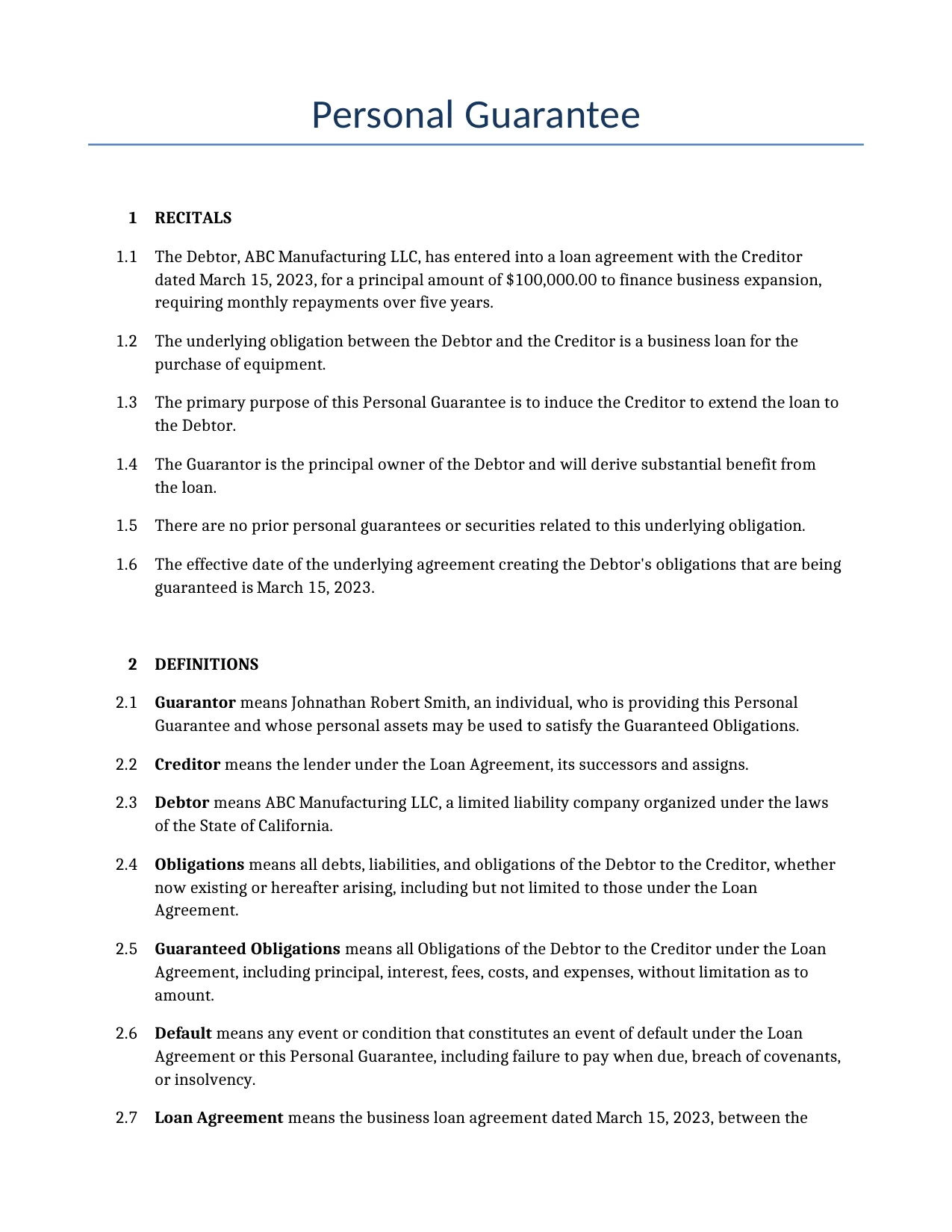
Personal Guarantee
1RECITALS
The Debtor, ABC Manufacturing LLC, has entered into a loan agreement with the Creditor dated March 15, 2023, for a principal amount of $100,000.00 to finance business expansion, requiring monthly repayments over five years.
The underlying obligation between the Debtor and the Creditor is a business loan for the purchase of equipment.
The primary purpose of this Personal Guarantee is to induce the Creditor to extend the loan to the Debtor.
The Guarantor is the principal owner of the Debtor and will derive substantial benefit from the loan.
There are no prior personal guarantees or securities related to this underlying obligation.
The effective date of the underlying agreement creating the Debtor's obligations that are being guaranteed is March 15, 2023.
2DEFINITIONS
Guarantor means Johnathan Robert Smith, an individual, who is providing this Personal Guarantee and whose personal assets may be used to satisfy the Guaranteed Obligations.
Creditor means the lender under the Loan Agreement, its successors and assigns.
Debtor means ABC Manufacturing LLC, a limited liability company organized under the laws of the State of California.
Obligations means all debts, liabilities, and obligations of the Debtor to the Creditor, whether now existing or hereafter arising, including but not limited to those under the Loan Agreement.
Guaranteed Obligations means all Obligations of the Debtor to the Creditor under the Loan Agreement, including principal, interest, fees, costs, and expenses, without limitation as to amount.
Default means any event or condition that constitutes an event of default under the Loan Agreement or this Personal Guarantee, including failure to pay when due, breach of covenants, or insolvency.
Loan Agreement means the business loan agreement dated March 15, 2023, between the Debtor and the Creditor for $100,000.00 to finance business expansion.
Personal Guarantee means this document and all its terms and provisions.
3GUARANTEE
The Guarantor hereby unconditionally and irrevocably guarantees to the Creditor the full and prompt payment and performance of all Guaranteed Obligations when due, whether at stated maturity, by acceleration, or otherwise. This is an unlimited personal guarantee of payment (not of collection), enforceable directly against the Guarantor and the Guarantor's personal assets without limitation in amount. The Creditor need not first exhaust any remedies against the Debtor or any collateral.
This Personal Guarantee shall become effective on the date first written above.
4CONSIDERATION
The Guarantor acknowledges that this Personal Guarantee is given for good and valuable consideration, including the Creditor's agreement to extend the loan to the Debtor under the Loan Agreement, forbearance from immediate collection actions, and other benefits received by the Guarantor as a result of the loan being made. This satisfies the requirements of contract law under California common law and the Statute of Frauds.
5GUARANTEED OBLIGATIONS
The Guaranteed Obligations include, without limitation: (i) the full principal amount of $100,000.00; (ii) all accrued interest; (iii) all fees, costs, charges, and expenses; (iv) any late fees and penalties; and (v) all other amounts payable under the Loan Agreement. This guarantee is unlimited in amount and covers all Obligations described in the Loan Agreement without contradictions.
6UNCONDITIONAL GUARANTEE
The Guarantor confirms that the guarantee is absolute and unconditional and is not contingent on prior enforcement against the Debtor or collateral.
The scope of the obligations that the Guarantor guarantees unconditionally includes principal debt, interest accruals, fees and costs, and future advances.
The Guarantor confirms that the guarantee is an independent obligation separate from the Debtor's.
7WAIVERS
The Guarantor agrees to waive any suretyship or guarantor defenses including release of guarantor, impairment of collateral, and extension of time.
The Guarantor waives requirements for notice of default or enforcement actions.
The Guarantor waives the right to receive notice of any default or other events related to the underlying obligation.
The Guarantor waives the right to demand that the lender first pursue the borrower before seeking payment from the Guarantor.
The Guarantor waives the right to protest or formal objection regarding any non-payment or dishonor of the underlying obligation.
8PAYMENT AND PERFORMANCE
The events that trigger the obligation of the Guarantor are failure to pay debt and breach of performance.
The Creditor shall provide a written demand before the obligation of the Guarantor is triggered.
The scope for the performance obligations of the Guarantor if the Debtor defaults is payment and performance.
9REPRESENTATIONS AND WARRANTIES
The Social Security Number of the Guarantor is 123-45-6789.
The Guarantor has the full legal authority to execute and provide this Personal Guarantee.
Providing this Personal Guarantee does not violate any applicable laws or regulations.
Providing this Personal Guarantee does not conflict with any existing contracts, agreements, or obligations of the Guarantor.
The Guarantor is not currently involved in any litigation, bankruptcy, or similar proceedings.
The Guarantor is currently solvent, meaning the Guarantor's assets exceed the Guarantor's liabilities.
The approximate total value of the Guarantor's assets is 500000.00.
The approximate total value of the Guarantor's liabilities is 150000.00.
There are no material undisclosed liabilities that could affect the Guarantor's ability to honor this Personal Guarantee.
The Guarantor has no prior guarantees or suretyships in place.
The Guarantor has read and understood the Loan Agreement in its entirety.
This Personal Guarantee is being provided voluntarily, and the Guarantor has had the opportunity to seek independent legal advice before signing.
All financial information provided by the Guarantor to the Creditor is true, accurate, and complete in all material respects.
10COVENANTS
The Guarantor shall maintain a minimum net worth of 500000.00 USD.
The Guarantor shall maintain a minimum liquidity ratio of 1.5.
The Guarantor shall provide financial statements quarterly.
The Guarantor shall provide notice within 30 days after a material adverse change.
The Guarantor shall not transfer or encumber material assets without providing prior written notice to the Creditor.
The Guarantor shall maintain adequate insurance on all insurable assets.
The Guarantor shall comply with all applicable federal, state, and local laws.
Breach of any covenant shall constitute an Event of Default under this Personal Guarantee, entitling the Creditor to exercise all available remedies.
The covenants in the Personal Guarantee shall be effective on the date first written above.
11FINANCIAL INFORMATION
The Guarantor shall provide the Creditor with ongoing financial disclosures, including annual tax returns, financial statements, and other information as reasonably requested by the Creditor from time to time. Failure to provide such information shall constitute an Event of Default.
12NO IMPAIRMENT
The Guarantor will not take any action that impairs the enforceability of this Personal Guarantee or the Creditor's rights hereunder, including incurring additional indebtedness or creating encumbrances on the Guarantor's assets without the Creditor's prior written consent if such action could reasonably be expected to materially impair the Creditor's rights.
13SUBROGATION
The Guarantor shall have rights of subrogation upon making any payment to the Creditor, but such rights, along with all rights of reimbursement, contribution, and indemnity, are fully subordinated to the Creditor's rights until the Guaranteed Obligations are paid in full. The Guarantor shall not exercise any such rights until the Guaranteed Obligations have been indefeasibly paid in full.
14EVENTS OF DEFAULT
There shall be a grace period of 10 days before failure to pay constitutes an event of default.
Failure to perform other obligations shall constitute an event of default under the guarantee.
There shall be a grace period of 30 days before failure to perform constitutes an event of default.
The Guarantor's bankruptcy or insolvency shall constitute an event of default under the guarantee.
The primary obligor's bankruptcy shall constitute an event of default under the guarantee.
Breaches of covenants that constitute events of default under the guarantee include financial covenants, operational covenants, and reporting covenants.
A cross-default under the Loan Agreement or any other indebtedness of the Guarantor or Debtor shall constitute an Event of Default hereunder.
The events of default provisions in the guarantee shall be effective on the date first written above.
15REMEDIES
The Guarantor shall pay interest on any amounts due upon default at the rate of prime rate plus five percent (or the maximum rate permitted by California law, if lower).
The Creditor may declare the entire guaranteed amount due upon default pursuant to an acceleration clause.
The Creditor may enforce the guarantee directly against the Guarantor without first pursuing the primary debtor, and shall have all rights of set-off against the Guarantor's deposits or other property.
The Creditor shall provide ten days notice to the Guarantor before exercising remedies upon default, to the extent required by California law.
The Creditor may recover attorney fees and costs from the Guarantor upon successful enforcement. The prevailing party in any action to enforce this Personal Guarantee shall be entitled to recover its reasonable attorney fees and costs pursuant to California Code of Civil Procedure Section 1717.
All remedies are cumulative and in addition to those available under California commercial law, including the California Commercial Code and Civil Code.
The personal guarantee shall become effective on the date first written above, triggering the remedies upon any subsequent default.
16INDEMNIFICATION
The Guarantor shall indemnify the Creditor for losses, costs, and expenses arising from the guaranteed obligations or enforcement of the guarantee.
The scope for the indemnification obligations of the Guarantor is all losses including consequential, to the maximum extent permitted by California law.
The Guarantor shall indemnify the Creditor for legal costs and attorney fees arising from enforcement.
The Guarantor shall indemnify the Creditor for court costs and filing fees related to the guaranteed obligations.
The Creditor shall provide 10 days notice to the Guarantor before making an indemnification claim.
17GOVERNING LAW
This Personal Guarantee shall be governed by and construed in accordance with the laws of the State of California. To the extent applicable, federal laws of the United States shall apply, particularly with respect to any banking or credit regulations.
18JURISDICTION AND VENUE
The Guarantor consents to the exclusive jurisdiction of the courts in the State of California for any disputes arising from the Personal Guarantee.
The venue for disputes under the Personal Guarantee shall be in Los Angeles County, California.
The jurisdiction in the Personal Guarantee is exclusive to the designated state courts.
The Guarantor waives objections to personal jurisdiction and venue in the Personal Guarantee.
19WAIVER OF JURY TRIAL
The Guarantor and the Creditor mutually waive the right to a jury trial in all litigation related to the guarantee.
20NOTICES
Notices under the Personal Guarantee may be given by hand delivery, certified mail, or email.
A notice sent by mail shall be deemed delivered after five days.
The physical address for notices to be sent to the Creditor is 123 Main Street, Suite 100, New York, NY 10001.
The physical address for notices to be sent to the Guarantor is 456 Oak Avenue, Apartment 5B, Los Angeles, CA 90001.
A notice shall become effective upon receipt.
21ASSIGNMENT
The Creditor may assign the guarantee and the underlying obligations to another party.
22SUCCESSORS AND ASSIGNS
The guarantee binds and benefits the successors and assigns of the parties.
The personal guarantee explicitly binds the Guarantor's successors such as heirs or estate administrators in the event of the Guarantor's death.
The personal guarantee benefits the successors of the creditor, ensuring they can enforce it if the creditor's rights are inherited.
The personal guarantee benefits the assigns of the creditor, allowing transferred parties to enforce it.
23ENTIRE AGREEMENT
This personal guarantee constitutes the entire agreement between the Guarantor and the Creditor and supersedes all prior understandings.
This personal guarantee shall become effective on the date first written above.
24AMENDMENTS
Any amendments to the Personal Guarantee must be in writing and signed by the Guarantor, the Creditor, and the Debtor.
25SEVERABILITY
If any provision of this Personal Guarantee is held to be invalid or unenforceable, the remaining provisions shall remain in full force and effect.
26WAIVER OF RIGHTS
No waiver of a breach is a waiver of any other breach or future breaches.
27COUNTERPARTS
This Personal Guarantee may be executed in counterparts, each of which shall be deemed an original, but all of which together shall constitute one and the same instrument.
28HEADINGS
Section headings are for convenience only and do not affect the interpretation of the document.
29NO ORAL MODIFICATIONS
This Personal Guarantee may not be modified orally.
30JOINT AND SEVERAL LIABILITY
If there are multiple guarantors the guarantee is joint and several.
There shall be 2 guarantors included in the Personal Guarantee.
The guarantors shall be jointly and severally liable for the full amount of the guarantee.
31CONTINUING GUARANTEE
This guarantee is a continuing guarantee and applies to all current and future obligations without limitation as to amount. The continuing guarantee may not be revoked for future obligations and shall remain in effect until all Guaranteed Obligations are paid in full.
The continuing guarantee applies from the effective date and covers principal and interest on loans, fees and charges, and future advances or credit extensions.
32TERM AND TERMINATION
The effective date for this personal guarantee is the date first written above.
The personal guarantee has an indefinite duration and survives the termination of the underlying agreement.
The personal guarantee is terminable only upon full satisfaction of all Guaranteed Obligations. Any termination does not release the Guarantor from obligations that accrued before termination.
33COMPLIANCE WITH APPLICABLE LAW
This Personal Guarantee is made in compliance with the Uniform Commercial Code (UCC) Article 3 governing negotiable instruments and UCC Article 9 governing secured transactions.
This Personal Guarantee satisfies the requirements of the Statute of Frauds by being in writing and signed by the Guarantor.
All collection activities related to this Personal Guarantee shall comply with the Fair Debt Collection Practices Act (FDCPA).
Any credit terms extended in connection with this Personal Guarantee shall comply with the Truth in Lending Act (TILA) and Regulation Z.
This Personal Guarantee has been extended without regard to any protected characteristics in compliance with the Equal Credit Opportunity Act (ECOA).
In the event of bankruptcy proceedings this Personal Guarantee shall be interpreted in accordance with the provisions of the Bankruptcy Code including 11 U.S.C. \§ 524.
34ATTORNEY FEES
The prevailing party in any action to enforce this Personal Guarantee shall be entitled to recover reasonable attorney fees and costs as provided in the Remedies section above, in compliance with California Code of Civil Procedure Section 1717.
35ADVICE OF COUNSEL
The Guarantor acknowledges having been advised to seek independent legal counsel before signing this Personal Guarantee and has either done so or voluntarily waived the right to do so. The Guarantor further acknowledges that the waivers and provisions herein are enforceable under California and United States law.
36SIGNATURES
IN WITNESS WHEREOF, the Guarantor has executed this Personal Guarantee as of the effective date first above written. The Guarantor acknowledges that the Guarantor has read the entire document, had an opportunity to consult with counsel, and is signing voluntarily.
Guarantor: _______________________________ Date: _______________ Printed Name: Johnathan Robert Smith
Creditor: _______________________________ Date: _______________ Printed Name/Title: [Creditor Name/Title]
Debtor: _______________________________ Date: _______________ Printed Name/Title: ABC Manufacturing LLC
State of California
County of Los Angeles
On ____________________ before me, __________________________, a Notary Public, personally appeared Johnathan Robert Smith, who proved to me on the basis of satisfactory evidence to be the person(s) whose name(s) is/are subscribed to the within instrument and acknowledged to me that he/she/they executed the same in his/her/their authorized capacity(ies), and that by his/her/their signature(s) on the instrument the person(s), or the entity upon behalf of which the person(s) acted, executed the instrument.
I certify under PENALTY OF PERJURY under the laws of the State of California that the foregoing paragraph is true and correct.
WITNESS my hand and official seal.
Signature: _______________________________ (Seal)
This example shows approximately 70% of a typical document and is provided for illustrative purposes only. The remaining content has been omitted.
Every document generated by Docaro is tailored to your specific circumstances, jurisdiction and the information you provide. The completed document includes all applicable clauses and provisions required for your situation.
To generate the full, personalised document, answer a short series of questions and your document will be created instantly.