
AI Generated American Non-Disclosure Agreement (NDA)
PDF & Word - 2026 Updated
Docaro Pricing
When do you need a Non-Disclosure Agreement (Employment) in the United States?
American Legal Rules for a Non-Disclosure Agreement (Employment)
Using the wrong structure for an employment NDA can inadvertently limit enforceability or expose the employer to unintended liabilities.
What a Proper Non-Disclosure Agreement (Employment) Should Include
- Definition of Confidential InformationClearly describe what counts as confidential, such as business plans, customer lists, or trade secrets, to protect your company's sensitive details.
- Employee's ObligationsState that the employee must keep the information secret and not share it with outsiders during and after employment.
- Permitted DisclosuresOutline situations where sharing is allowed, like when required by law or with the employer's written approval.
- Duration of ProtectionSpecify how long the secrecy rules apply, often for a set number of years after employment ends.
- Consequences of BreachExplain the penalties for breaking the agreement, such as lawsuits or financial damages, to deter violations.
- Return of MaterialsRequire the employee to return or destroy all confidential items when employment ends.
Generate Your Document in 4 Easy Steps
Why Use Docaro?
 United States
Free Example Non-Disclosure Agreement (Employment) Template
Below is a free template example of a Non-Disclosure Agreement (Employment) for use in the United States generated by our AI model.
The clauses in your actual Non-Disclosure Agreement (Employment) will vary from this example as they will be entirely bespoke to your requirements as set out in the questionnaire you complete.
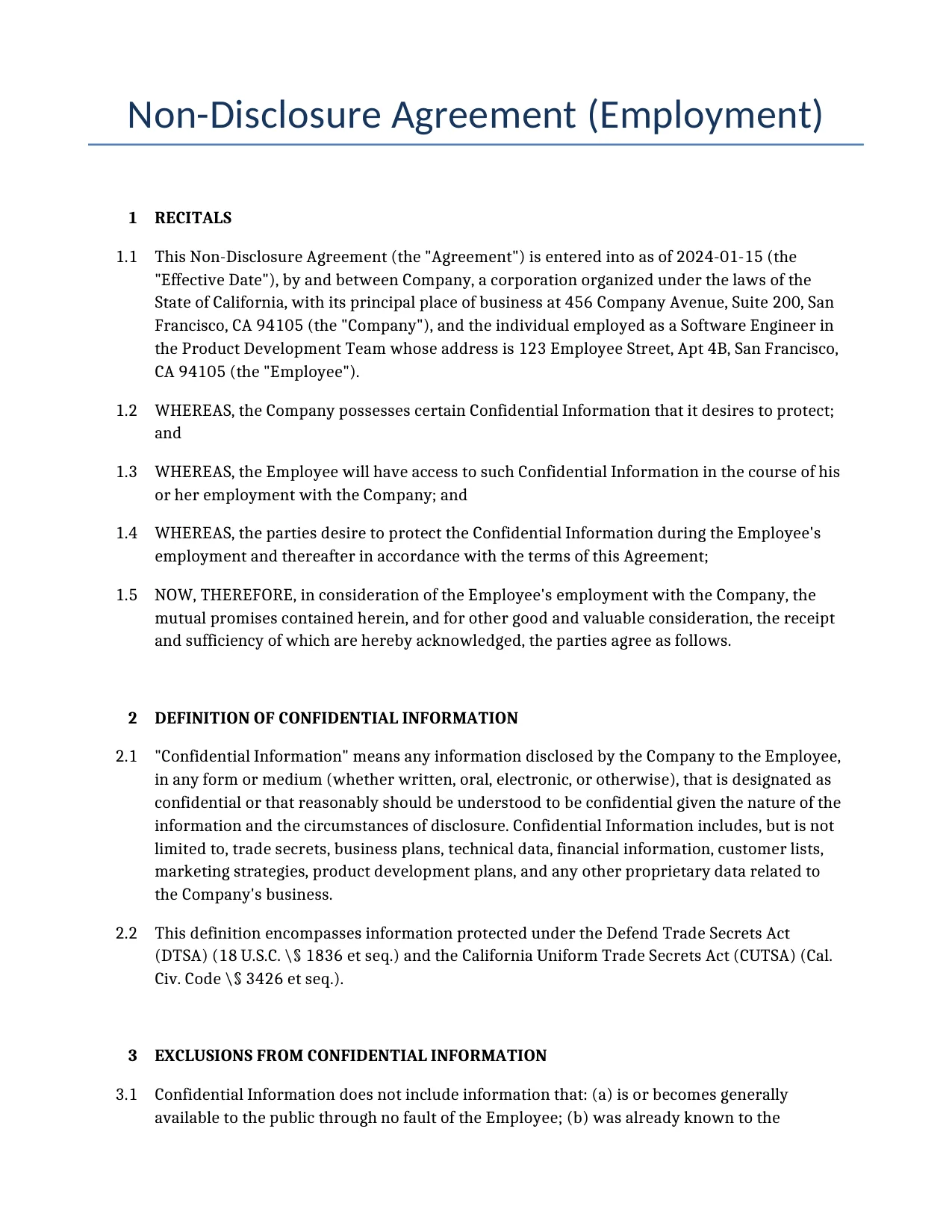
Non-Disclosure Agreement
1RECITALS
This Non-Disclosure Agreement (the "Agreement") is entered into as of 2024-01-15 (the "Effective Date"), by and between Company, a corporation organized under the laws of the State of California, with its principal place of business at 456 Company Avenue, Suite 200, San Francisco, CA 94105 (the "Company"), and the individual employed as a Software Engineer in the Product Development Team whose address is 123 Employee Street, Apt 4B, San Francisco, CA 94105 (the "Employee").
WHEREAS, the Company possesses certain Confidential Information that it desires to protect; and
WHEREAS, the Employee will have access to such Confidential Information in the course of his or her employment with the Company; and
WHEREAS, the parties desire to protect the Confidential Information during the Employee's employment and thereafter in accordance with the terms of this Agreement;
NOW, THEREFORE, in consideration of the Employee's employment with the Company, the mutual promises contained herein, and for other good and valuable consideration, the receipt and sufficiency of which are hereby acknowledged, the parties agree as follows.
2DEFINITION OF CONFIDENTIAL INFORMATION
"Confidential Information" means any information disclosed by the Company to the Employee, in any form or medium (whether written, oral, electronic, or otherwise), that is designated as confidential or that reasonably should be understood to be confidential given the nature of the information and the circumstances of disclosure. Confidential Information includes, but is not limited to, trade secrets, business plans, technical data, financial information, customer lists, marketing strategies, product development plans, and any other proprietary data related to the Company's business.
This definition encompasses information protected under the Defend Trade Secrets Act (DTSA) (18 U.S.C. \§ 1836 et seq.) and the California Uniform Trade Secrets Act (CUTSA) (Cal. Civ. Code \§ 3426 et seq.).
3EXCLUSIONS FROM CONFIDENTIAL INFORMATION
Confidential Information does not include information that: (a) is or becomes generally available to the public through no fault of the Employee; (b) was already known to the Employee without any obligation of confidentiality at the time of disclosure; (c) is independently developed by the Employee without use of or reference to the Company's Confidential Information; or (d) is rightfully received by the Employee from a third party without restriction on disclosure.
Additionally, nothing in this Agreement prohibits or restricts the Employee from disclosing information as required by law, provided that (unless prohibited by law) the Employee gives the Company reasonable notice of any such required disclosure to allow the Company an opportunity to seek protective measures. This Agreement also provides the notice required under the DTSA regarding whistleblower immunities.
4PROTECTION OF TRADE SECRETS
The Employee acknowledges that trade secrets are protected indefinitely under the DTSA and CUTSA for as long as the information qualifies as a trade secret. The Employee agrees to protect the Company's trade secrets in accordance with this Agreement and applicable law.
Pursuant to 18 U.S.C. \§ 1833(b), the Employee shall not be held criminally or civilly liable under any federal or state trade secret law for the disclosure of a trade secret that: (A) is made (i) in confidence to a federal, state, or local government official, either directly or indirectly, or to an attorney; and (ii) solely for the purpose of reporting or investigating a suspected violation of law; or (B) is made in a complaint or other document filed in a lawsuit or other proceeding, if such filing is made under seal. If the Employee files a lawsuit for retaliation by the Company for reporting a suspected violation of law, the Employee may disclose the trade secret to his or her attorney and use the trade secret information in the court proceeding, provided that the Employee files any document containing the trade secret under seal and does not disclose the trade secret except pursuant to court order.
5NON-DISCLOSURE OBLIGATIONS
During the term of employment and thereafter, the Employee shall hold the Confidential Information in confidence and shall not disclose it to any third party without the prior written consent of the Company. The Employee shall use at least reasonable care to protect the Confidential Information.
The Employee shall promptly notify the Company of any unauthorized disclosure or misuse of Confidential Information of which the Employee becomes aware.
Nothing in this Agreement shall be interpreted to restrict the Employee's rights under the National Labor Relations Act (NLRA) Section 7 to engage in concerted activities, including discussing wages, hours, or working conditions with colleagues or third parties. Additionally, nothing herein restricts the Employee from reporting violations of law to government agencies.
6PERMITTED USE AND DISCLOSURE
The Employee may use the Confidential Information solely to perform his or her job duties for the Company. The Employee may disclose the Confidential Information only with the Company's prior written consent or as required by law.
If the Employee is required by law or legal process to disclose any Confidential Information, the Employee shall (unless prohibited by law) promptly notify the Company in writing to allow the Company an opportunity to seek a protective order or other remedy. The Employee shall cooperate with the Company, at the Company's expense, in any effort to challenge or limit such disclosure. This provision does not limit the DTSA whistleblower immunities described in Section 4.
7TERM AND DURATION
This Agreement becomes effective on the Effective Date and continues during the Employee's employment with the Company.
The Employee's obligations under this Agreement regarding Confidential Information (other than trade secrets) shall continue for a period of three (3) years after the termination of employment. Obligations with respect to trade secrets shall continue for as long as the information remains a trade secret under applicable law.
8RETURN OF CONFIDENTIAL INFORMATION
Upon termination of employment or at any time upon the Company's request, the Employee shall promptly return or destroy all Confidential Information in his or her possession or control, including all copies, notes, and derivative works.
The Employee shall certify in writing to the Company that all such materials have been returned or destroyed. If complete destruction is not possible (e.g., due to backup systems or electronic archives), the Employee shall notify the Company and continue to protect such information in accordance with this Agreement.
9REMEDIES FOR BREACH
In the event of a breach or threatened breach of this Agreement, the Company shall be entitled to seek all available remedies at law or in equity, including but not limited to damages, injunctive relief, and reasonable attorney fees and costs to the extent permitted by law. The remedies provided herein are cumulative and not exclusive.
This Section does not alter any rights or obligations under the Fair Labor Standards Act, NLRA, or other applicable labor laws.
10INJUNCTIVE RELIEF
The Employee acknowledges that any breach of this Agreement may cause irreparable harm to the Company for which monetary damages would be inadequate. Accordingly, the Company shall be entitled to seek injunctive relief to prevent or remedy any breach or threatened breach, without the necessity of posting a bond to the extent permitted by law. The Employee agrees that a court may nonetheless require a bond. Such relief shall be in addition to any other remedies available to the Company.
11NO LICENSE GRANTED
Nothing in this Agreement grants the Employee any license, ownership, or other rights in or to the Company's Confidential Information, except the limited right to use it as expressly permitted herein. All rights, title, and interest in the Confidential Information remain with the Company.
12NO RESTRICTION ON COMPETITION OR SOLICITATION
Nothing in this Agreement prohibits the Employee from competing with the Company or soliciting customers or employees after the termination of employment, to the extent permitted by California law, including California Business and Professions Code \§ 16600. This Agreement is not intended to function as a non-compete agreement and shall not be interpreted as such.
13GOVERNING LAW
This Agreement shall be governed by and construed in accordance with the laws of the State of California, without regard to its conflict of laws principles. The parties agree to exclusive jurisdiction and venue in the state and federal courts located in San Francisco County, California, for any disputes arising under this Agreement.
This Agreement is intended to comply with the DTSA, CUTSA, NLRA, FLSA, California Business and Professions Code \§ 16600, and all other applicable laws.
14COMPLIANCE WITH LABOR LAWS
Nothing in this Agreement is intended to or shall restrict the Employee's rights under the National Labor Relations Act, the Fair Labor Standards Act, or any other applicable labor or employment laws, including the right to engage in concerted activities regarding wages, hours, or working conditions, or to report violations of law to government agencies.
15SURVIVAL
The obligations under this Agreement, including but not limited to those regarding non-disclosure, protection of trade secrets, return of information, and remedies, shall survive the termination of the Employee's employment for the periods specified herein.
16ENTIRE AGREEMENT
This Agreement, together with any existing or future employment agreement between the parties (if applicable), constitutes the entire understanding between the Company and the Employee with respect to the subject matter hereof and supersedes all prior agreements, understandings, or representations, whether written or oral. The recital in Section 1 confirming no prior employment relationship is noted; this Agreement does not alter the at-will nature of any employment relationship in California.
17AMENDMENTS
Any amendments to this Agreement must be in writing and signed by both the Company and the Employee.
18SEVERABILITY
If any provision of this Agreement is held to be invalid or unenforceable by a court of competent jurisdiction, the remaining provisions shall remain in full force and effect to the maximum extent permitted by law.
19WAIVER OF RIGHTS
No failure or delay by either party in exercising any right under this Agreement shall operate as a waiver of such right. A waiver of any provision must be in writing and signed by the party against whom the waiver is asserted.
20ASSIGNMENT
The Company may assign this Agreement to an affiliate or to a successor in interest in connection with a merger, acquisition, or other business transfer. The Employee may not assign this Agreement without the Company's prior written consent. This Agreement shall be binding upon and inure to the benefit of the parties' successors and permitted assigns.
21NOTICES
All notices under this Agreement shall be in writing and delivered by hand, certified mail (return receipt requested), or email. Notices to the Employee shall be sent to the address or email on file with the Company. Notices to the Company shall be sent to 456 Company Avenue, Suite 200, San Francisco, CA 94105 or hr@company.com. Notices sent by certified mail shall be deemed delivered three (3) business days after mailing.
22COUNTERPARTS
This Agreement may be executed in one or more counterparts, each of which shall be deemed an original, but all of which together shall constitute one and the same instrument. Electronic signatures complying with the California Uniform Electronic Transactions Act (UETA) and the federal ESIGN Act shall be deemed original signatures.
23HEADINGS
The headings in this Agreement are for convenience of reference only and shall not affect the interpretation of this Agreement.
24EMPLOYEE ACKNOWLEDGMENT
The Employee acknowledges that he or she has read and understands this Agreement, has received a copy of it, and has had the opportunity to seek independent legal advice before signing. The Employee further acknowledges that this Agreement does not alter the at-will nature of employment in California, if applicable.
25SIGNATURES
IN WITNESS WHEREOF, the parties have executed this Agreement as of the Effective Date.
Company: _______________________________ By: ________________________________ Title: _______________________________ Date: ________________________________
Employee: _______________________________ Signature: _______________________________ Printed Name: _______________________________ Date: ________________________________
This example shows approximately 70% of a typical document and is provided for illustrative purposes only. The remaining content has been omitted.
Every document generated by Docaro is tailored to your specific circumstances, jurisdiction and the information you provide. The completed document includes all applicable clauses and provisions required for your situation.
To generate the full, personalised document, answer a short series of questions and your document will be created instantly.