
AI Generated American Notice of Rent Increase
PDF & Word - 2026 Updated
Docaro Pricing
When Do You Need a Rent Increase Notice in the United States?
American Legal Rules for a Rent Increase Notice
Using the incorrect format or structure for a rent increase notice may fail to comply with state-specific requirements and render the notice invalid.
What a Proper Rent Increase Notice Should Include
- New Rent AmountState the exact new monthly rent amount clearly.
- Effective DateSpecify the date when the rent increase starts.
- Old Rent AmountMention the current rent for reference.
- Reason for IncreaseBriefly explain why the rent is going up, if required by law.
- Tenant InformationInclude the tenant's name and rental unit address.
- Landlord DetailsProvide the landlord's name and contact information.
- Notice PeriodConfirm the notice complies with local timing rules, like 30 or 60 days.
- Payment InstructionsDetail how and where to pay the new rent.
Generate Your Document in 4 Easy Steps
Why Use Docaro?
 United States
Free Example Rent Increase Notice Template
Below is a free template example of a Rent Increase Notice for use in the United States generated by our AI model.
The clauses in your actual Rent Increase Notice will vary from this example as they will be entirely bespoke to your requirements as set out in the questionnaire you complete.
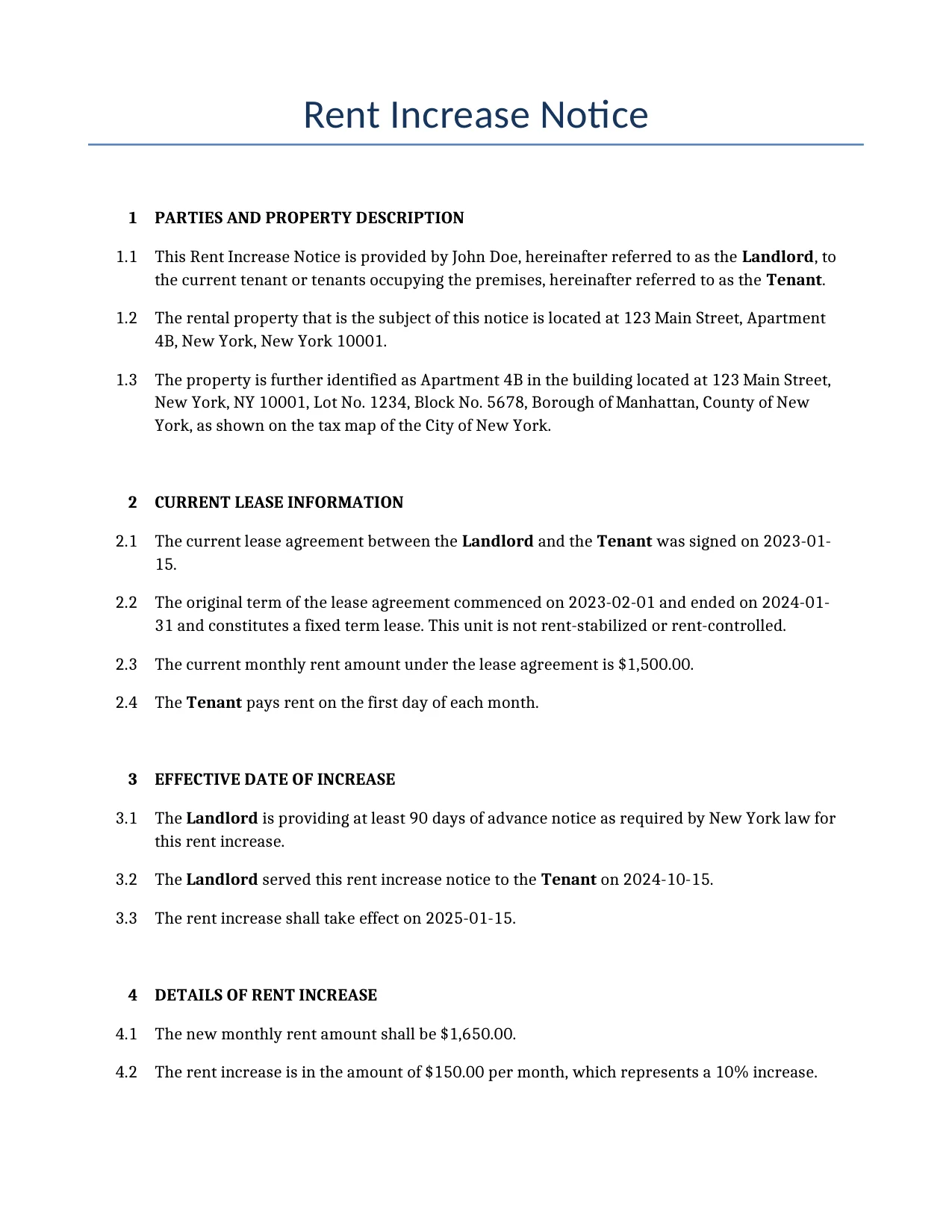
Rent Increase Notice
1PARTIES AND PROPERTY DESCRIPTION
This Rent Increase Notice is provided by John Doe, hereinafter referred to as the Landlord, to the current tenant or tenants occupying the premises, hereinafter referred to as the Tenant.
The rental property that is the subject of this notice is located at 123 Main Street, Apartment 4B, New York, New York 10001.
The property is further identified as Apartment 4B in the building located at 123 Main Street, New York, NY 10001, Lot No. 1234, Block No. 5678, Borough of Manhattan, County of New York, as shown on the tax map of the City of New York.
2CURRENT LEASE INFORMATION
The current lease agreement between the Landlord and the Tenant was signed on 2023-01-15.
The original term of the lease agreement commenced on 2023-02-01 and ended on 2024-01-31 and constitutes a fixed term lease. This unit is not rent-stabilized or rent-controlled.
The current monthly rent amount under the lease agreement is $1,500.00.
The Tenant pays rent on the first day of each month.
3EFFECTIVE DATE OF INCREASE
The Landlord is providing at least 90 days of advance notice as required by New York law for this rent increase.
The Landlord served this rent increase notice to the Tenant on 2024-10-15.
The rent increase shall take effect on 2025-01-15.
4DETAILS OF RENT INCREASE
The new monthly rent amount shall be $1,650.00.
The rent increase is in the amount of $150.00 per month, which represents a 10% increase.
5REASON FOR INCREASE
The primary reason for the rent increase is market adjustment.
The rent increase is due to recent market adjustments in the local area where comparable properties have seen an average 8 percent rise in rental rates over the past year due to high demand and limited supply.
6PAYMENT INSTRUCTIONS
The due date for rent payments shall remain the 1st of each month. Rent must be paid in full by the 1st of the month. Acceptable payment methods include personal check, money order, or electronic bank transfer via ACH. Payments should be sent to John Doe at 123 Main Street, Apartment 4B, New York, NY 10001. Pursuant to New York law, late fees may not exceed $50 or 5% of the monthly rent (whichever is less) and may only be charged if rent is more than 5 days late. This increase does not violate any local rent increase caps as the unit is not subject to rent stabilization.
7LEGAL BASIS AND COMPLIANCE
The rental property is not subject to rent control or rent stabilization.
This rent increase is authorized pursuant to New York Real Property Law Section 226-c, the Housing Stability and Tenant Protection Act of 2019, and complies with the Fair Housing Act (42 U.S.C. sections 3601 et seq.), the Servicemembers Civil Relief Act (50 U.S.C. sections 3901 et seq.), and all other applicable provisions of New York and federal law.
The Landlord confirms that the notice period provided meets all applicable state and local timeline requirements for rent increases.
The Landlord confirms that this rent increase notice is in the required format including all necessary disclosures and language per applicable New York laws. The Landlord certifies that this increase does not violate any rent increase limitations under New York law.
8TENANT RIGHTS AND OPTIONS
The Tenant has the option to accept the proposed rent increase by continuing to pay the new rent amount starting on the effective date.
The Tenant has the option to negotiate the rent increase with the Landlord.
The Tenant has the right to reject this rent increase. If the Tenant does not accept the increase, the lease will renew at the prior rental rate of $1,500.00 per month under the same terms. To terminate the tenancy instead, the Tenant must provide written notice of at least 30 days prior to the end of the current term in accordance with New York Real Property Law. It is illegal for the Landlord to retaliate against the Tenant for exercising any of these rights. The Tenant may file complaints regarding this notice or any related issues with the New York State Division of Housing and Community Renewal (DHCR) at www.hcr.ny.gov or by calling 1-866-466-7327, or contact local tenant organizations such as the New York City Tenant Union.
9CONTACT INFORMATION
The Landlord or property manager is John Doe with a full mailing address of 123 Main Street, Apartment 4B, New York, NY 10001.
The phone number for the Landlord or property manager is (555) 123-4567.
The preferred method for the Tenant to contact the Landlord regarding the rent increase is by phone.
10DATE OF NOTICE
This notice is issued and delivered to the Tenant on 2024-10-15.
11PROOF OF DELIVERY AND SERVICE
The Landlord is delivering this notice to the Tenant by certified mail with return receipt requested, which complies with New York service of notice rules under Real Property Law.
The Landlord has obtained or will obtain proof of delivery such as a signed receipt or affidavit of service. An attachment containing the proof of service form is referenced herein and will be retained by the Landlord.
The rent increase notice was served to the Tenant by certified mail.
The rent increase notice was served to the Tenant on 2024-10-15.
The notice was sent via certified mail with return receipt requested to the tenant address at 123 Main Street, Apartment 4B, New York, NY 10001.
The mailing was done on October 15, 2024.
12TENANT OBLIGATIONS POST-INCREASE
Upon the effective date of the rent increase, the Tenant is obligated to pay the new rent amount of $1,650.00 on or before the 1st of each month. Failure to do so may result in late fees (as permitted by New York law) and/or legal action for nonpayment of rent, including potential eviction proceedings. The Tenant must continue to comply with all other terms of the existing lease.
13GOVERNING LAW
This notice and any disputes arising from it shall be governed by and construed in accordance with the laws of the State of New York and applicable federal law.
14ENTIRE AGREEMENT
This notice together with the existing lease agreement constitutes the entire agreement between the Landlord and the Tenant with respect to the subject matter hereof and supersedes all prior understandings or agreements whether written or oral.
15SEVERABILITY
If any provision of this notice is held to be invalid or unenforceable such invalidity or unenforceability shall not affect the other provisions of this notice which shall remain in full force and effect.
16NOTICES
All notices required or permitted under this notice shall be in writing and shall be delivered by certified mail to the addresses specified herein or to such other address as either party may designate in writing.
17REQUIRED CERTIFICATIONS
The Landlord certifies under penalty of perjury that this rent increase complies with all applicable New York and federal laws, including the Housing Stability and Tenant Protection Act of 2019. This unit is not rent-stabilized or rent-controlled, and there are no applicable limitations on the increase amount under current law. Proof of service will be retained.
18EXECUTION
This document functions as a formal unilateral notice from the Landlord to the Tenant. Tenant signature is not required for the notice to be effective. However, the parties may execute below to acknowledge receipt and understanding if intended as confirmation.
| LANDLORD | |
| Signature: | |
| Print Name: | |
| Date: |
| TENANT | |
| Signature: | |
| Print Name: | |
| Date: |
This example shows approximately 70% of a typical document and is provided for illustrative purposes only. The remaining content has been omitted.
Every document generated by Docaro is tailored to your specific circumstances, jurisdiction and the information you provide. The completed document includes all applicable clauses and provisions required for your situation.
To generate the full, personalised document, answer a short series of questions and your document will be created instantly.