
AI Generated American Mortgage Deed
PDF & Word - 2026 Updated
Docaro Pricing
When Do You Need a Mortgage Deed in the United States?
American Legal Rules for a Mortgage Deed
Using the wrong type of mortgage deed can result in invalid liens or unenforceable property transfers.
What a Proper Mortgage Deed Should Include
- Parties InvolvedClearly identifies the borrower and lender with their full names and addresses.
- Property DescriptionProvides a detailed description of the property being mortgaged, including its location and boundaries.
- Loan Amount and TermsStates the principal loan amount, interest rate, and repayment schedule.
- Security InterestExplains that the property serves as collateral for the loan, allowing the lender to claim it if the borrower defaults.
- Default ConditionsOutlines what happens if the borrower fails to make payments or breaches other terms.
- Foreclosure RightsDescribes the lender's right to sell the property to recover the loan if default occurs.
- Covenants and PromisesLists the borrower's obligations, such as maintaining the property and paying taxes.
- Signatures and DatesIncludes spaces for the borrower and lender to sign and date the document.
Generate Your Document in 4 Easy Steps
Why Use Docaro?
 United States
Free Example Mortgage Deed Template
Below is a free template example of a Mortgage Deed for use in the United States generated by our AI model.
The clauses in your actual Mortgage Deed will vary from this example as they will be entirely bespoke to your requirements as set out in the questionnaire you complete.
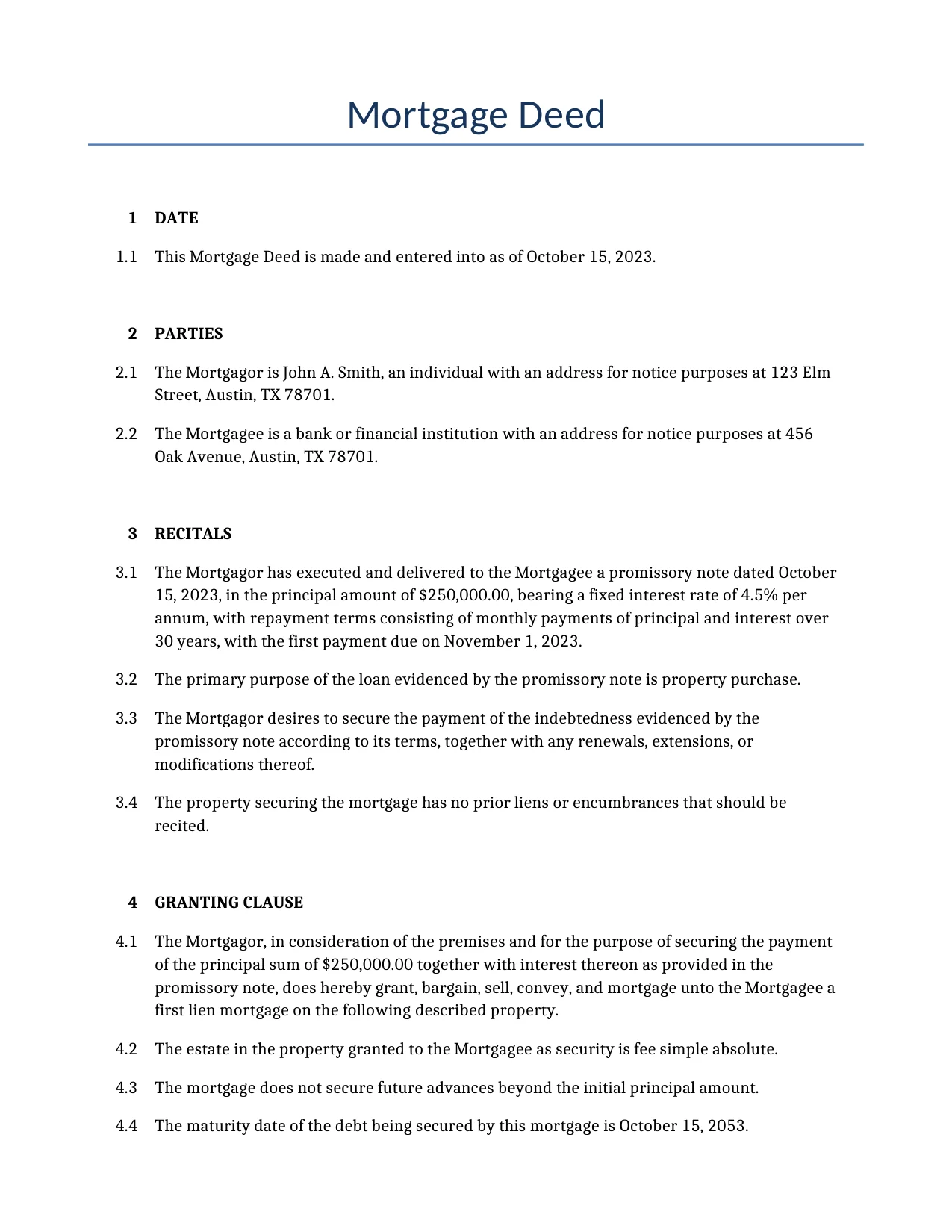
Mortgage Deed
1DATE
This Mortgage Deed is made and entered into as of October 15, 2023.
2PARTIES
The Mortgagor is John A. Smith, an individual with an address for notice purposes at 123 Elm Street, Austin, TX 78701.
The Mortgagee is a bank or financial institution with an address for notice purposes at 456 Oak Avenue, Austin, TX 78701.
3RECITALS
The Mortgagor has executed and delivered to the Mortgagee a promissory note dated October 15, 2023, in the principal amount of $250,000.00, bearing a fixed interest rate of 4.5% per annum, with repayment terms consisting of monthly payments of principal and interest over 30 years, with the first payment due on November 1, 2023.
The primary purpose of the loan evidenced by the promissory note is property purchase.
The Mortgagor desires to secure the payment of the indebtedness evidenced by the promissory note according to its terms, together with any renewals, extensions, or modifications thereof.
The property securing the mortgage has no prior liens or encumbrances that should be recited.
4GRANTING CLAUSE
The Mortgagor, in consideration of the premises and for the purpose of securing the payment of the principal sum of $250,000.00 together with interest thereon as provided in the promissory note, does hereby grant, bargain, sell, convey, and mortgage unto the Mortgagee a first lien mortgage on the following described property.
The estate in the property granted to the Mortgagee as security is fee simple absolute.
The mortgage does not secure future advances beyond the initial principal amount.
The maturity date of the debt being secured by this mortgage is October 15, 2053.
5PRIORITY AND LIENS
This Mortgage creates a valid first-priority lien on the Property, subject only to any superior liens expressly disclosed in this Mortgage Deed or any attached exhibits. There are no other superior liens, encumbrances, or interests that have priority over this Mortgage except as expressly disclosed. The Mortgagor covenants to keep the Property free from any other liens, encumbrances, or charges, and to promptly discharge any such claims that may arise. If applicable, any subordination agreements have been obtained and are attached as exhibits to this Mortgage Deed.
6PROPERTY DESCRIPTION
The property subject to this Mortgage Deed is located at 123 Elm Street, Austin, Texas 78701, and is more particularly described as Lot 5, Block 3, Green Acres Subdivision, as recorded in Plat Book 12, Page 45, in the records of the County Clerk of Travis County, Texas.
The tax parcel number or assessor's identification number for the property is 123-456-789.
The property includes improvements consisting of a single-family residence and attached garage.
7WARRANTIES AND REPRESENTATIONS
The Mortgagor represents and warrants that the Mortgagor solely owns the property without any co-owners or joint tenants.
The Mortgagor represents and warrants that the Mortgagor has clear and marketable title to the property, free from any defects or claims.
The Mortgagor represents and warrants that there are no encumbrances, liens, or claims against the property other than those disclosed in this Mortgage Deed.
The Mortgagor represents and warrants that the Mortgagor has full legal authority to mortgage the property without needing consent from others.
The Mortgagor represents and warrants that there are no bankruptcy or insolvency proceedings pending or threatened against the Mortgagor.
The Mortgagor acquired ownership of the property on May 15, 2020.
The Mortgagor represents and warrants that the property complies with all applicable zoning, building, and environmental laws.
The Mortgagor executed this Mortgage Deed on October 15, 2023.
The Mortgagor has no knowledge of any environmental hazards on the property and warrants compliance with all environmental laws, including but not limited to the Comprehensive Environmental Response, Compensation, and Liability Act (CERCLA) and all applicable state environmental regulations.
The Mortgagor warrants that all information provided in the loan application is true and correct in all material respects.
8COVENANTS OF MORTGAGOR
The Mortgagor covenants and agrees to pay the principal amount of the debt in the sum of $250,000.00 together with interest at the annual rate of 4.5 percent.
The first payment on the debt shall be made on November 1, 2023, and payments shall be due every 1 month thereafter in the amount of $1,266.71 until the final maturity date of October 15, 2053, when the entire debt must be paid.
If any installment payment is not received within 15 days after the due date, the Mortgagor shall pay a late charge as provided in the promissory note.
The Mortgagor covenants and agrees to escrow funds for property taxes in the estimated annual amount of $3,600.00.
The Mortgagor covenants and agrees to escrow funds for property insurance premiums in the estimated annual amount of $1,200.00, with the policy renewal date of December 31 each year.
The Mortgagor covenants and agrees that the Mortgagor shall be responsible for preserving and maintaining the property.
The Mortgagor covenants and agrees not to commit waste on the property.
9INSURANCE REQUIREMENTS
The Mortgagor shall maintain hazard insurance on the property in a minimum coverage amount of $250,000.00 USD.
The hazard insurance policy shall name the Mortgagee as mortgagee loss payee.
The hazard insurance policy shall be effective as of October 15, 2023, and shall be renewed annually.
The Mortgagor shall provide proof of insurance to the Mortgagee upon request.
10CONDEMNATION AND INSURANCE PROCEEDS
The Mortgagor shall promptly notify the Mortgagee of any condemnation proceeding or insurance claim relating to the Property. The Mortgagee shall have the right to participate in any such proceedings or claims adjustment. All proceeds from condemnation awards or insurance claims shall be applied first to the restoration or repair of the Property if feasible and approved by the Mortgagee, or otherwise to the reduction of the secured debt, at the Mortgagee's option.
11TAXES AND ASSESSMENTS
The Mortgagor shall pay all real estate taxes on the property when due.
The Mortgagor shall pay all assessments, such as homeowners association fees or special district levies, timely.
The Mortgagor shall pay all other governmental charges, such as water or sewer fees, timely.
The Mortgagor shall escrow funds for taxes and assessments as required by this Mortgage Deed.
12MAINTENANCE AND REPAIRS
The Mortgagor shall keep the property in good repair and condition.
The Mortgagor shall comply with all applicable laws, regulations, and ordinances affecting the property.
The Mortgagor shall not commit waste on the property.
This Mortgage Deed is for a single family residence.
13HAZARDOUS SUBSTANCES AND ENVIRONMENTAL INDEMNITY
The Mortgagor covenants not to use, store, generate, or dispose of any hazardous substances on the Property in violation of any environmental laws. The Mortgagor shall immediately notify the Mortgagee of any environmental issues, releases, or claims related to the Property. The Mortgagor agrees to indemnify, defend, and hold the Mortgagee harmless from any and all environmental liabilities, losses, claims, or damages arising from the presence or release of hazardous substances on the Property, including but not limited to claims under CERCLA or state environmental laws. This indemnity shall survive the foreclosure or satisfaction of the Mortgage.
14ESCROW FOR TAXES AND INSURANCE
The Lender shall manage an escrow account to collect funds for property taxes and homeowner's insurance premiums as required under the Real Estate Settlement Procedures Act (RESPA) and other applicable federal and state laws. The initial deposit amount for the escrow account is based on estimated annual taxes of $3,600 and insurance of $1,200. The monthly amount to be included in the mortgage payment for the escrow account is approximately $400.00. The escrow account shall be reviewed and adjusted annually in compliance with RESPA. The Lender shall provide all required escrow disclosures and accountings. In the event of force-placed insurance, the Lender shall comply with all consumer protection requirements under federal law, including providing notices and charging only reasonable premiums.
15DEFAULT PROVISIONS
Non-payment of the mortgage debt shall constitute an event of default.
Breach of any covenants in this Mortgage Deed shall constitute an event of default.
The Mortgagor's bankruptcy or insolvency shall constitute an event of default.
The Mortgagor shall have a grace period of 15 days to cure a non-payment default before it fully triggers, or such longer period as required under federal or Texas law.
The default interest rate of 18.5 percent shall apply to overdue amounts after a default event, subject to any limits under usury laws.
The Mortgagee shall provide written notice to the Mortgagor before accelerating the loan upon default, in compliance with applicable law.
Transfer of the Property without the Mortgagee's prior written consent (due-on-sale clause) shall constitute an event of default.
Failure to maintain required insurance on the Property shall constitute an event of default.
Any material misrepresentation by the Mortgagor shall constitute an event of default.
The Mortgagor shall have the right to cure defaults within the time periods permitted under federal law (including the CARES Act if applicable) and Texas law before foreclosure proceedings may commence.
16ACCELERATION CLAUSE
Upon the occurrence of an event of default consisting of failure to make payments or breach of covenants, the Mortgagee may declare the entire debt due and payable.
The Mortgagee shall provide written notice to the Mortgagor before accelerating the debt, as required by law.
After accelerating the debt, the Mortgagee shall have the remedies of foreclosure and suit for deficiency available, subject to Texas law.
The Mortgagee shall have the right to accelerate the entire debt upon the Mortgagor's default.
17REMEDIES UPON DEFAULT
Upon the Mortgagor's default, the Mortgagee shall have available the remedies of acceleration of maturity, foreclosure of the mortgage, and appointment of a receiver, all in accordance with Texas law.
The Mortgagee shall have the right to appoint a receiver upon the Mortgagor's default.
The Mortgagee shall provide notice to the Mortgagor before the Mortgagee can accelerate the debt, consistent with Texas Property Code requirements.
18FORECLOSURE PROCEDURES
This Mortgage Deed shall be subject to non-judicial foreclosure under the Texas Property Code, including the power of sale clause. The Mortgagee may conduct a non-judicial foreclosure sale after providing the notices required by Texas law, typically including a 20-day notice of default and intent to accelerate followed by a 21-day notice of the foreclosure sale. The borrower shall have reinstatement rights as provided under Texas law up to the time of the foreclosure sale. This Mortgage complies with federal requirements for pre-foreclosure notices where applicable. The lender may pursue a deficiency judgment only to the extent permitted under Texas anti-deficiency statutes. The lender shall recover costs associated with foreclosure by adding such costs to the borrower's debt or from sale proceeds.
19ASSIGNMENT OF RENTS AND LEASES
The Mortgagor hereby assigns to the Mortgagee all rents and leases from the property.
The assignment of rents and leases shall become effective upon default.
The Mortgagor is granted a license to collect rents until a default occurs.
Notices regarding the assignment of rents and leases to the Mortgagee shall be sent to 123 Elm Street, Austin, TX 78701.
Upon default, the collected rents shall be applied by the Mortgagee first to operating expenses.
This assignment includes a security interest in all existing and future leases.
20FURTHER ASSURANCES
The Mortgagor shall execute additional documents upon the Mortgagee's request to perfect the security interest.
The further assurances clause shall be governed by the laws of the State of Texas.
21RELEASE OF MORTGAGE
This Mortgage Deed includes provisions for partial release of the mortgaged property upon partial satisfaction of the debt.
The release shall occur upon satisfaction of the debt.
Satisfaction of the debt shall be verified by payment in full confirmed by the Mortgagee.
Within 30 days after satisfaction of the debt, the Mortgagee shall execute and deliver the release in compliance with Texas law.
The Mortgagee shall be responsible for recording the release of mortgage with the appropriate county recorder's office.
The Mortgagee may charge a reasonable fee for preparing and executing the release.
22SUBORDINATION AND MODIFICATION
The mortgage shall not be subordinated to future liens without the Mortgagee's consent.
Modifications to the terms of the mortgage are permitted only by written agreement.
Any subordination or modification shall require written consent from the lender.
23GOVERNING LAW
This Mortgage Deed shall be governed by and construed in accordance with the laws of the State of Texas. This Mortgage complies with the Dodd-Frank Wall Street Reform and Consumer Protection Act, including Ability-to-Repay rules, and all federal consumer financial protection laws.
24COMPLIANCE WITH APPLICABLE LAWS
The parties agree that this Mortgage and the underlying loan transaction comply with all applicable federal, state, and local laws. This includes but is not limited to the Truth in Lending Act (TILA), Real Estate Settlement Procedures Act (RESPA), Equal Credit Opportunity Act (ECOA), Fair Housing Act, Home Mortgage Disclosure Act (HMDA), the Dodd-Frank Act (including Ability-to-Repay and qualified mortgage standards), usury laws, and all consumer protection statutes. All mandatory disclosures have been or will be provided to the Mortgagor. The loan does not violate any usury limits under Texas law. The Mortgagee represents that the loan was originated in compliance with all applicable underwriting and servicing regulations. The parties further warrant adherence to all state-specific regulations for Texas, including those governing mortgage lending, foreclosure, and consumer protection.
25JURY TRIAL WAIVER AND VENUE
To the extent permitted by law, the parties mutually waive any right to a jury trial in any action or proceeding arising out of or related to this Mortgage Deed or the underlying loan. Any disputes shall be litigated exclusively in the state or federal courts located in Travis County, Texas, the county where the Property is situated.
26NOTICES
All notices to the Borrower shall be sent to 123 Elm Street, Austin, TX 78701.
All notices to the Lender shall be sent to 456 Oak Avenue, Austin, TX 78701.
Notices may be sent by certified mail, hand delivery, or electronic mail as permitted by law.
Notices shall be considered delivered upon receipt or as otherwise provided under Texas law.
Parties may change their notice addresses by written notice.
27SUCCESSORS AND ASSIGNS
This Mortgage Deed shall bind the heirs and successors of the Mortgagor.
This Mortgage Deed shall bind the successors and assigns of the Mortgagee.
The Mortgagor is an individual for succession purposes.
The Mortgagee is a bank or financial institution for assignment purposes.
28SEVERABILITY
If any provision of this Mortgage Deed is held to be invalid or unenforceable, the remaining provisions shall remain in full force and effect.
29WAIVER
Any waiver by the Mortgagee of a default must be in writing and shall not constitute a waiver of any subsequent default.
The Mortgagee does not waive the right to accelerate the full loan balance upon a single default event except as expressly provided.
30ENTIRE AGREEMENT
This Mortgage Deed and the promissory note constitute the entire agreement between the parties and supersede all prior oral and written understandings. This document represents the final agreement and no oral promises, side agreements, or other terms exist. No modification shall be effective unless in writing and signed by the parties. This provision is intended to comply with the statute of frauds and standard mortgage practices.
31EXECUTION
IN WITNESS WHEREOF, the Mortgagor has executed this Mortgage Deed on the date first above written.
John A. Smith
Mortgagor
This instrument was acknowledged before me on October 15, 2023, by John A. Smith. Notary Public, State of Texas. My commission expires: ________. This Mortgage Deed is to be recorded in Travis County, Texas.
32SIGNATURE SECTION
Mortgagor: _______________________________ Date: _______________ John A. Smith
Mortgagee: _______________________________ Date: _______________ [Authorized Signatory]
State of Texas County of Travis On this date, before me personally appeared John A. Smith, personally known to me, to be the person whose name is subscribed to the within instrument and acknowledged to me that he executed the same for the purposes therein contained. Notary Public
33EXHIBITS
Exhibit A: Full Legal Property Description
Exhibit B: Copy of the Promissory Note
Exhibit C: Environmental Disclosures
Exhibit D: Any Applicable Riders (none required for this fixed-rate loan)
Exhibit E: Subordination Agreements, if any
This example shows approximately 70% of a typical document and is provided for illustrative purposes only. The remaining content has been omitted.
Every document generated by Docaro is tailored to your specific circumstances, jurisdiction and the information you provide. The completed document includes all applicable clauses and provisions required for your situation.
To generate the full, personalised document, answer a short series of questions and your document will be created instantly.