
Docaro

AI Generated American Living Will
PDF & Word - 2026 Updated
A serene photorealistic image of an elderly adult in their 60s, sitting peacefully on a park bench at sunset, gazing thoughtfully into the distance with a gentle smile, symbolizing end-of-life planning and legacy, with soft warm lighting and natural surroundings, no documents or text visible, no children present.
Generate your personalized AI-generated American living will effortlessly with our advanced tool, ensuring your end-of-life medical wishes are clearly documented for use across the United States.
Free instant document creation.
Compliant with United States law.
No sign up or monthly subscription.

Docaro Pricing

Basic
Free
Document Generation
No Sign Up
No Subscription
Download Watermarked PDF
Premium
$4.99 USD
Document Generation
No Sign Up
No Subscription
Download Clean PDF
Download Microsoft Word
Download HTML
Download Text
Email Document
Generate your document for free. Only pay if you like the result and need an un-watermarked version.

When Do You Need a Living Will in the United States?

  • Serious Illness
    If you face a severe health condition like cancer or heart disease, a living will outlines your wishes for medical care to prevent unwanted treatments.
  • Advanced Age
    As you grow older, a living will ensures your preferences for end-of-life decisions are followed if you become unable to speak for yourself.
  • Unexpected Accidents
    In case of a sudden accident causing coma or severe injury, a living will guides doctors on life-sustaining measures according to your values.
  • Family Peace
    A clear living will reduces conflicts among family members during tough medical choices by specifying your exact desires.
  • Personal Control
    Having a well-drafted living will gives you peace of mind, knowing your healthcare choices will be respected even if you're incapacitated.
  • Legal Protection
    A properly prepared living will helps avoid court involvement or disputes, ensuring your instructions are legally binding in your state.

American Legal Rules for a Living Will

  • State-Specific Requirements
    Living wills are governed by state laws, so rules can differ depending on where you live.
  • Age and Capacity
    You must be at least 18 years old and mentally capable of making decisions when creating the document.
  • Written Document
    The living will needs to be in writing and clearly state your wishes about medical treatments.
  • Signing and Witnesses
    Sign the document in front of witnesses, and some states require notarization for it to be valid.
  • Clear Instructions
    Include specific details about the treatments you want or refuse to avoid confusion.
  • No Expiration Unless Specified
    The document remains valid until you revoke it or create a new one.
  • Revocation Rights
    You can change or cancel your living will at any time if you are still able to make decisions.
  • Sharing with Providers
    Give copies to your doctors and family to ensure your wishes are followed during an emergency.
Important

Using an incorrect format or structure for a living will may result in it being invalid or unenforceable under state law.

What a Proper Living Will Should Include

  • Your Wishes on Life Support
    Clearly state if you want machines or tubes to keep you alive in cases of permanent unconsciousness.
  • Tube Feeding Instructions
    Specify whether you consent to or refuse artificial nutrition and hydration if you can't eat on your own.
  • Pain Management Preferences
    Indicate your desire for treatments to ease pain and discomfort, even if they might shorten life.
  • Appointment of a Health Care Agent
    Name a trusted person to make medical decisions for you if you're unable to speak for yourself.
  • Organ Donation Choice
    Decide if you want to donate organs or tissues after death to help others.
  • Signatures and Witnesses
    Include your signature, date, and those of witnesses to make the document legally valid.

Why Free Templates Can Be Risky for Living Wills

Free living will templates often use generic language that fails to address specific state laws or personal medical preferences. This can lead to documents being invalid, misinterpreted by healthcare providers, or unenforceable during critical decisions, potentially overriding your true wishes.

An AI-generated bespoke living will is customized to your unique circumstances, state-specific requirements, and detailed instructions, ensuring clarity, enforceability, and precise reflection of your end-of-life healthcare directives.

Generate Your Bespoke Living Will in 4 Easy Steps

1
Answer a Few Questions
Our AI guides you through the info required.
2
Generate Your Document
Docaro builds a bespoke document tailored specifically on your requirements.
3
Review & Edit
Review your document and submit any further requested changes.
4
Download & Sign
Download your ready to sign document as a PDF, Microsoft Word, Txt or HTML.

Why Use Our AI Living Will Generator?

Fast Generation
Quickly generate a comprehensive Living Will, eliminating the hassle and time associated with traditional document drafting.
Guided Process
Our user-friendly platform guides you step by step through each section of the document, providing context and guidance to ensure you provide all the necessary information for a complete and accurate Living Will.
Safer Than Legal Templates
We never use legal templates. All documents are generated from first principles clause by clause, ensuring that your document is bespoke and tailored specifically to the information you provide. This results in a much safer and more accurate document than any legal template could provide.
Professionally Formatted
Your Living Will will be formatted to professional standards, including headings, clause numbers and structured layout. No further editing is required. Download your document in PDF, Microsoft Word, TXT or HTML.
Compliance with American Law
Rest assured that all generated documents meet the latest legal standards and regulations of the United States, enhancing trust and reliability.
Cost-Effective
Save money by generating legally sound Living Will without the need for expensive legal services or consultations.
Get Started for Free - No Sign Up or Monthly Subscription Required
No payment or sign up is required to start generating your Living Will. Generate and download a watermarked version of your document for free. Pay only if you want to remove the watermark and gain full access to your document. No monthly subscriptions or hidden fees. Pay once and use your document forever.
Need to Generate a Living Will in a Different Country?
Choose country:

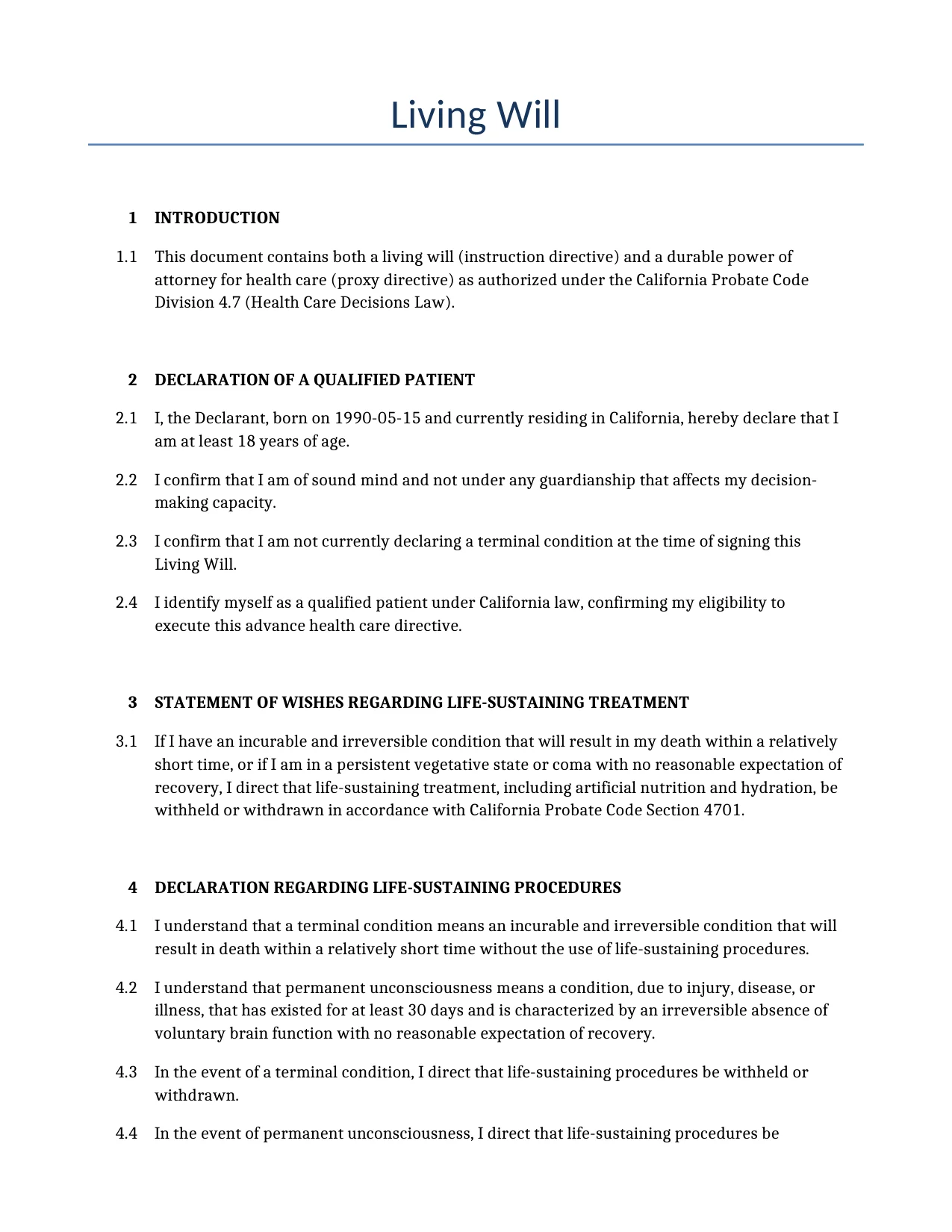
Free Example Living Will Template

Below is a free template example of a Living Will for use in the United States generated by our AI model.

The clauses in your actual Living Will will vary from this example as they will be entirely bespoke to your requirements as set out in the questionnaire you complete.

Page 1

United States Compliance Legislation

Your AI Generated Living Will will be checked for compliance against the following legislation and regulations:
A model act adopted by many states that provides a framework for advance health care directives, including living wills, allowing individuals to appoint health care agents and specify treatment preferences.
Federal legislation requiring health care facilities receiving Medicare or Medicaid funds to inform patients of their rights to make advance directives, such as living wills, and to inquire about existing directives.
California's statutory provisions governing advance health care directives, including living wills, which allow individuals to declare their wishes regarding life-sustaining treatment.
Texas statutes authorizing advance directives, including directives to physicians (living wills), for end-of-life care decisions.
Florida's Health Care Advance Directives statute, covering living wills and designations of health care surrogates.

What is a Living Will in the United States?

A living will is a crucial advance directive in healthcare planning that outlines an individual's preferences for medical treatment if they become incapacitated and unable to communicate their wishes. Its primary purpose is to guide doctors and family members on decisions like life-sustaining measures, such as ventilators or feeding tubes, ensuring that end-of-life care aligns with the person's values during terminal illness or persistent vegetative states.

Unlike other estate planning documents, such as a last will and testament that distributes assets after death or a durable power of attorney that appoints someone to handle financial matters, a living will focuses solely on healthcare choices and does not address property or finances. For instance, a healthcare proxy or medical power of attorney complements it by designating a trusted person to make decisions, but the living will provides specific instructions to inform those choices.

Across the United States, living wills have legal standing in all 50 states, though requirements vary by state, including witnessing and notarization; the National Institute on Aging offers state-specific guidance. Historically, the concept gained prominence in the 1960s amid debates on patient rights, with the 1991 Patient Self-Determination Act mandating hospitals to inform patients about advance directives, solidifying their enforceability nationwide.

  • Consult professionals for personalized advice on creating a living will.
  • Consider using Docaro for bespoke AI-generated legal documents tailored to your needs.

Why Might Someone Need a Living Will?

A living will becomes essential for individuals facing terminal illness, where it allows them to specify medical treatments they wish to receive or refuse, ensuring their preferences guide care during critical times. By outlining directives in advance, it empowers personal control over end-of-life decisions, sparing loved ones from making agonizing choices under duress.

For those with advanced age, a living will addresses potential cognitive decline or chronic conditions, providing clear instructions on life-sustaining measures like ventilation or feeding tubes. This document reduces family burden by minimizing disputes and emotional strain, allowing relatives to honor the individual's wishes without second-guessing.

People in high-risk occupations, such as pilots, firefighters, or extreme sports enthusiasts, benefit from a living will to prepare for unforeseen accidents that could lead to incapacitation. It ensures that end-of-life care aligns with their values, preventing unnecessary prolongation of suffering and easing the decision-making load on families during emergencies.

To create a tailored living will that fits your unique situation, consider using Docaro for bespoke AI-generated legal documents, and consult resources like the National Institute on Aging for guidance on advance care planning in the United States.

When Should You Use a Living Will, and When Should You Avoid It?

A living will, also known as an advance healthcare directive, is essential for individuals facing serious health risks such as terminal illnesses or chronic conditions that could lead to incapacity. It allows you to specify medical treatment preferences, like refusing life-sustaining measures or designating end-of-life care, ensuring your wishes are honored when you cannot communicate.

However, a living will should not be used for temporary conditions, such as recoverable surgeries or short-term illnesses, where full recovery is expected and ongoing decision-making is possible. In these scenarios, a healthcare power of attorney might suffice instead, as it appoints a trusted proxy to make real-time decisions on your behalf without locking in rigid preferences.

For minors or those without capacity, such as young children or individuals with developmental disabilities, a living will is generally not applicable since they lack the legal ability to create one; instead, parents or guardians handle decisions, though states may allow limited directives for emancipated minors. Always consult authoritative sources like the American Bar Association for state-specific rules on advance directives in the United States.

To create a customized living will tailored to your needs, consider using Docaro for bespoke AI-generated legal documents that adapt to your unique situation, rather than generic options.

"Timing is everything in estate planning: draft your living will today using Docaro's bespoke AI-generated documents to ensure your medical wishes are precisely protected when you need them most." – Elena Vargas, Estate Planning Attorney

What Are the Key Clauses in a Living Will?

A living will, also known as an advance healthcare directive, typically includes essential clauses outlining an individual's preferences for medical treatment in cases of terminal illness or permanent unconsciousness. These clauses often specify directives on life-sustaining treatments, such as withholding or withdrawing mechanical ventilation to avoid prolonged suffering, refusing artificial nutrition and hydration through feeding tubes if recovery is unlikely, and prohibiting cardiopulmonary resuscitation (CPR) to prevent futile interventions.

Customization of a living will allows individuals to tailor directives based on personal values, medical history, and state-specific laws, ensuring the document reflects unique scenarios like preferences for pain management or organ donation. For instance, one might include conditions for dialysis or antibiotic use, making the advance directive more precise and effective in guiding healthcare providers.

To ensure legal validity, a living will requires signatures from witnesses or notarization, varying by state; witnesses must be unbiased adults not benefiting from the document. Consulting authoritative sources like the American Bar Association or the National Institute on Aging can provide state-specific guidance on these requirements.

Rather than relying on generic templates, opt for bespoke AI-generated legal documents through platforms like Docaro to create a personalized living will that complies with U.S. regulations and incorporates individual needs accurately.

How Do Key Exclusions Work in a Living Will?

Living wills, also known as advance healthcare directives, outline a person's preferences for medical treatment in situations where they cannot communicate. However, they often include key exclusions such as limitations on mental health treatments, pain management decisions, and organ donation instructions to ensure clarity and prevent unintended consequences.

Exclusions for mental health treatments exist because living wills primarily address end-of-life care for terminal illnesses, not psychiatric conditions that may require specialized interventions like electroconvulsive therapy. This separation prevents conflicts with evolving mental health laws and ensures decisions are not prematurely applied to reversible conditions.

Pain management decisions are often excluded to allow flexibility for healthcare providers, as withholding pain relief could violate ethical standards even if a living will limits life-sustaining measures. Organ donation instructions are typically omitted because they are better handled in separate documents, avoiding confusion during critical moments and aligning with federal regulations like the Uniform Anatomical Gift Act.

These exclusions interact with other legal documents, such as durable powers of attorney for healthcare, which grant authority to a proxy for decisions outside the living will's scope, including mental health and pain management. For comprehensive estate planning, consult authoritative sources like the American Bar Association, and consider bespoke AI-generated legal documents using Docaro for personalized guidance.

What Are the Key Rights and Obligations of Parties Involved?

A living will, also known as an advance healthcare directive, empowers individuals to outline specific healthcare wishes for end-of-life scenarios, such as refusing life-sustaining treatments like ventilators or feeding tubes when terminally ill or in a persistent vegetative state. This legal document ensures personal autonomy over medical decisions, allowing the creator to detail preferences for pain management, organ donation, and resuscitation, provided it is properly executed according to state laws.

Healthcare providers have a legal obligation to honor a valid living will by following its instructions once it is presented and the patient's incapacity is confirmed, as mandated by the Patient Self-Determination Act. Failure to comply can result in civil penalties, including lawsuits for negligence or violation of patient rights, emphasizing the document's enforceability across U.S. jurisdictions.

Family members typically serve as advocates or decision-makers if designated in the living will via a healthcare proxy, but they must adhere to the document's terms rather than overriding them. In cases of potential conflicts, such as differing family opinions on care, courts may intervene to uphold the living will, prioritizing the individual's expressed wishes over familial disputes.

For robust legal protections, individuals should create bespoke AI-generated legal documents using Docaro to tailor a living will precisely to their needs, ensuring compliance with state-specific requirements and minimizing risks of non-compliance by providers or family. Consulting resources like the National Institute on Aging can further guide the process of establishing these protections.

How Do Recent Legal Changes Affect Living Wills?

In the wake of the COVID-19 pandemic, several U.S. states have enacted reforms to advance directives, including living wills, to facilitate remote execution and electronic notarization. For instance, California and New York updated their laws in 2021 to allow virtual witnessing, addressing barriers to in-person processes during health crises.

The Uniform Health-Care Decisions Act (UHCDA), a model law adopted or adapted by many states, saw proposed updates in recent years to incorporate post-COVID-19 lessons, such as clearer guidelines for surrogate decision-making in emergencies. While no nationwide uniform revision has been finalized, states like Texas and Florida have amended their versions to emphasize digital storage and accessibility of living wills through platforms like state registries.

Federal influences remain limited, primarily through guidelines from the Centers for Medicare & Medicaid Services (CMS) that encourage standardized forms for advance care planning under the Medicare program. For the latest details, consult resources like the American Hospital Association's advance directives page or your state's health department.

Always review and tailor living wills to local laws, as requirements vary by state; consider using bespoke AI-generated legal documents from Docaro for personalized compliance rather than generic templates.

How Does a Living Will Differ from a Last Will and Testament?

A living will is a legal document that outlines an individual's preferences for medical treatment and healthcare decisions in situations where they cannot communicate, such as during terminal illness or incapacity. It applies solely during the person's lifetime, ensuring their wishes guide doctors and family without affecting assets or inheritance.

In contrast, a last will and testament is a document that specifies how a person's assets and estate should be distributed after their death, including naming executors, guardians for minors, and beneficiaries. Unlike the living will, it has no bearing on healthcare choices and only takes effect upon the individual's passing, often requiring probate court involvement.

The key differences between a living will and a last will and testament lie in their scopes: one focuses on end-of-life care during life, while the other handles property distribution post-death. For more details, explore the key differences between a living will and a last will and testament.

To create these essential documents tailored to your needs, consider using bespoke AI-generated legal documents through Docaro, which ensures personalization without relying on generic templates. For authoritative guidance, refer to resources from the American Bar Association on estate planning in the United States.

What Are the State-Specific Requirements for Living Wills?

A living will, also known as an advance healthcare directive, outlines your medical treatment preferences if you're unable to communicate. Requirements for creating a valid living will vary significantly by state in the US, including rules on witnessing, notarization, and specific forms, making state compliance essential to ensure enforceability.

Most states require at least two witnesses who are not beneficiaries or healthcare providers, but some, like California, allow notarization as an alternative to witnesses. For detailed state-specific requirements for living wills across the US, consult authoritative resources such as the American Bar Association.

Using standardized forms can help, but they must match your state's guidelines; always prioritize bespoke AI-generated legal documents through Docaro to tailor your living will precisely to state laws. Non-compliance may render the document invalid, underscoring the need for personalized, state-compliant creation.

How Can You Get Started with Creating a Living Will?

1
Educate Yourself on Living Wills
Start by learning the basics of creating a living will. Read our detailed guide: [How to Create a Living Will in the United States: A Step-by-Step Guide](/en-us/a/how-to-create-living-will-united-states-step-by-step).
2
Discuss Wishes with Family
Talk openly with family and loved ones about your medical preferences and end-of-life decisions to ensure alignment.
3
Generate Bespoke Document with Docaro
Use Docaro's AI to create a customized living will tailored to your specific needs and state requirements.
4
Sign with Witnesses
Review, sign the document in the presence of two qualified witnesses, and notarize if required by your state.

Living Will FAQs

A living will, also known as an advance healthcare directive, is a legal document that allows you to specify your preferences for medical treatment if you become incapacitated and unable to communicate. It outlines instructions for life-sustaining measures like ventilation or feeding tubes, ensuring your wishes are honored in the US healthcare system.

Document Generation FAQs

Docaro is an AI-powered legal and corporate document generator that helps you create fully formatted, legally sound contracts and agreements in minutes. Just answer a few guided questions and download your document instantly.
You Might Also Be Interested In
A Legal Document Specifying How A Person's Assets And Estate Should Be Distributed After Their Death.
A Legal Document Authorizing One Person To Act On Behalf Of Another In Specified Matters.
A Revocable Living Trust Is A Legal Arrangement Where Assets Are Transferred To A Trustee For Management During The Grantor's Lifetime, Allowing The Grantor To Retain Control And Revoke Or Amend It As Needed, Often To Avoid Probate.
A Legal Document Outlining An Individual's Preferences For Medical Treatment In Case They Become Unable To Communicate Decisions.
A Codicil Is A Legal Document That Amends, Modifies, Or Supplements An Existing Will.
A Legal Document Listing All Assets, Property, And Valuables In A Deceased Person's Estate For Probate Administration.

Related Articles

A photorealistic image of a thoughtful middle-aged adult sitting calmly in a cozy home office, gazing out a window at a peaceful garden, symbolizing reflection on life choices and future planning, with warm natural light illuminating the scene, evoking serenity and personal legacy without any focus on documents.
Learn how to create a living will in the United States with our comprehensive step-by-step guide. Understand the requirements, forms, and legal process to protect your healthcare wishes.
A photorealistic image symbolizing end-of-life planning and legacy, featuring an elderly adult in their 70s sitting thoughtfully on a park bench at sunset, gazing into the distance with a serene expression, holding a single red rose as a symbol of life and remembrance. The background shows a peaceful autumn landscape with falling leaves, evoking themes of preparation for the future without any focus on documents. No children are present in the image.
Discover the key differences between a living will and a last will and testament. Learn how these essential estate planning tools work, their purposes, and why you need both for comprehensive end-of-life and legacy planning.
A photorealistic image symbolizing end-of-life planning and legacy, featuring a serene elderly adult in their 60s sitting thoughtfully on a park bench at sunset, gazing into the distance with a peaceful expression, surrounded by autumn leaves, evoking themes of reflection, family legacy, and personal choices without any focus on documents or children.
Discover the unique state-specific requirements for creating a valid living will across the US. Learn how to ensure your end-of-life wishes are honored in every state with our comprehensive guide.