
AI Generated Letter of Intent for use in the United States
PDF & Word - 2026 Updated
Docaro Pricing
When do you need a Letter of Intent in the United States?
American Legal Rules for a Letter of Intent
Using the wrong type or structure of letter of intent can inadvertently create a binding agreement when only a non-binding expression of interest was intended.
What a Proper Letter of Intent Should Include
- Parties InvolvedClearly state the names and roles of all parties entering the agreement to avoid any confusion about who is participating.
- Purpose of the LetterDescribe the main goal or transaction, such as a business deal or partnership, to set the context for the document.
- Key TermsOutline the essential details like price, timeline, or responsibilities to show the basic understanding between parties.
- Non-Binding NatureSpecify that the letter is not a final contract and does not legally obligate anyone, except where noted.
- ConfidentialityAgree to keep the information in the letter private to protect sensitive details during discussions.
- Next StepsDetail what happens after signing, like drafting a full agreement or due diligence, to guide the process forward.
- SignaturesInclude spaces for all parties to sign and date, confirming their agreement to the letter's terms.
Generate Your Document in 4 Easy Steps
Why Use Docaro?
 United States
Free Example Letter of Intent Template
Below is a free template example of a Letter of Intent for use in the United States generated by our AI model.
The clauses in your actual Letter of Intent will vary from this example as they will be entirely bespoke to your requirements as set out in the questionnaire you complete.
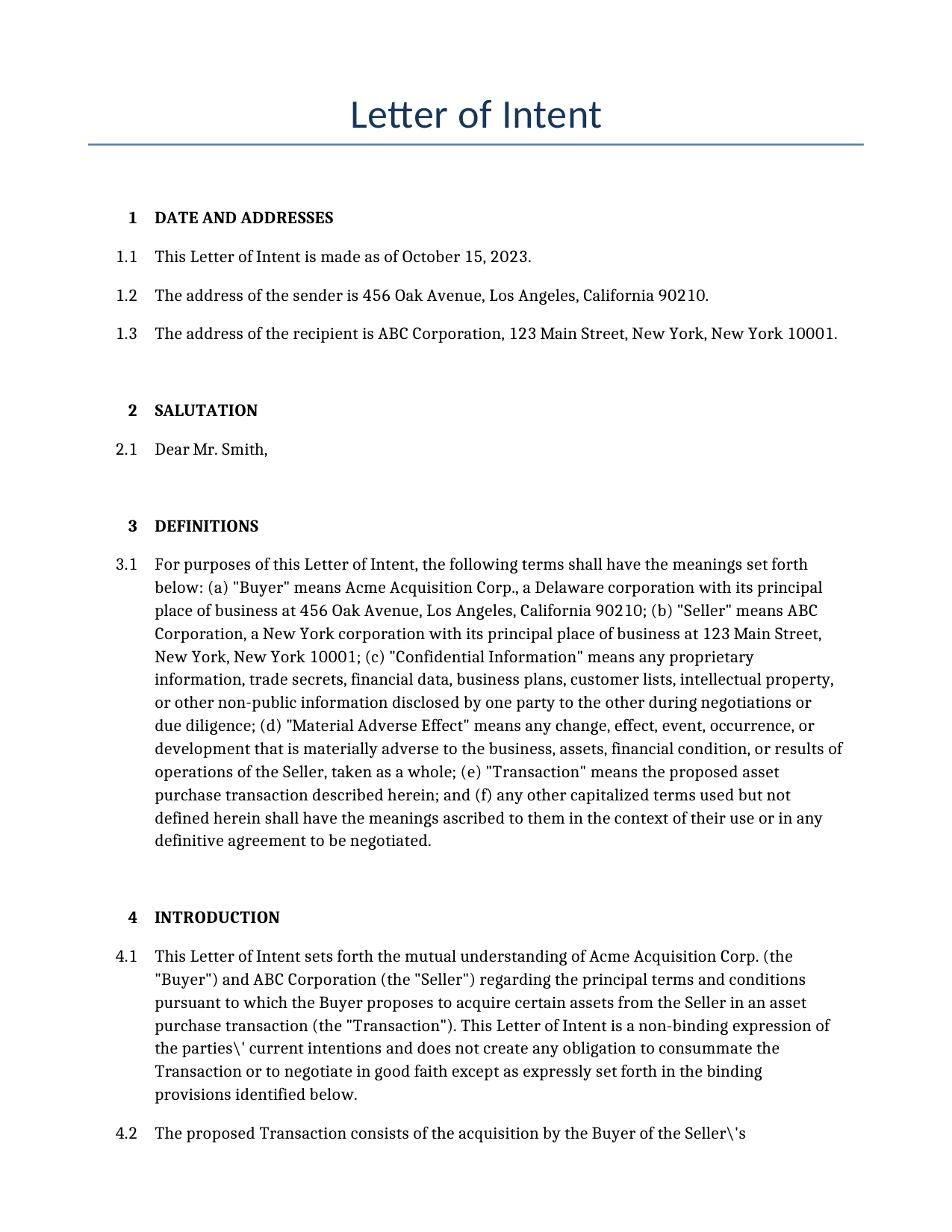
Letter of Intent
1DATE AND ADDRESSES
This Letter of Intent is made as of October 15, 2023.
The address of the sender is 456 Oak Avenue, Los Angeles, California 90210.
The address of the recipient is ABC Corporation, 123 Main Street, New York, New York 10001.
2SALUTATION
Dear Mr. Smith,
3DEFINITIONS
For purposes of this Letter of Intent, the following terms shall have the meanings set forth below: (a) "Buyer" means Acme Acquisition Corp., a Delaware corporation with its principal place of business at 456 Oak Avenue, Los Angeles, California 90210; (b) "Seller" means ABC Corporation, a New York corporation with its principal place of business at 123 Main Street, New York, New York 10001; (c) "Confidential Information" means any proprietary information, trade secrets, financial data, business plans, customer lists, intellectual property, or other non-public information disclosed by one party to the other during negotiations or due diligence; (d) "Material Adverse Effect" means any change, effect, event, occurrence, or development that is materially adverse to the business, assets, financial condition, or results of operations of the Seller, taken as a whole; (e) "Transaction" means the proposed asset purchase transaction described herein; and (f) any other capitalized terms used but not defined herein shall have the meanings ascribed to them in the context of their use or in any definitive agreement to be negotiated.
4INTRODUCTION
This Letter of Intent sets forth the mutual understanding of Acme Acquisition Corp. (the "Buyer") and ABC Corporation (the "Seller") regarding the principal terms and conditions pursuant to which the Buyer proposes to acquire certain assets from the Seller in an asset purchase transaction (the "Transaction"). This Letter of Intent is a non-binding expression of the parties\' current intentions and does not create any obligation to consummate the Transaction or to negotiate in good faith except as expressly set forth in the binding provisions identified below.
The proposed Transaction consists of the acquisition by the Buyer of the Seller\'s manufacturing equipment, inventory, intellectual property, customer contracts, and related business assets associated with the Seller\'s widget production division for an aggregate purchase price of $1,500,000 (subject to customary adjustments), which includes the $500,000 allocated to equipment as part of the overall valuation.
5TRANSACTION OVERVIEW
The proposed purchase price for the Transaction is $1,500,000 USD (the "Purchase Price"), which shall be subject to adjustment based on a final inventory count and verification of equipment condition at closing. The $500,000 referenced for equipment forms part of this overall Purchase Price and is not a separate transaction.
The proposed structure for the payment is 70% cash at closing with the balance in seller financing pursuant to a promissory note bearing interest at 5% per annum, secured by the acquired assets.
The proposed date for closing the Transaction is March 31, 2024.
6KEY TERMS AND CONDITIONS
The structure preferred for the Transaction is an asset purchase of the manufacturing equipment, inventory, intellectual property, customer contracts, and related business assets associated with the Seller\'s widget production division.
The payment shall be structured as 70% cash at closing with the balance in seller financing pursuant to a promissory note.
The target date for closing the Transaction is March 31, 2024.
7DUE DILIGENCE
The Buyer shall have a due diligence period of 45 days.
The due diligence period shall commence on the date of execution of this Letter of Intent and end 45 days thereafter.
The Seller shall be obligated to provide full cooperation in the due diligence process, subject to the Access and Cooperation section below.
The scope of the due diligence investigation shall consist of a comprehensive review of financial statements, legal contracts, operational procedures, and intellectual property holdings.
The due diligence process will involve a thorough examination of all relevant business aspects to verify representations and ensure no undisclosed liabilities.
The Buyer shall have access to financial records and books, physical facilities inspection, and contracts and legal documents during the due diligence period, subject to the Access and Cooperation section below.
The Buyer shall be required to maintain confidentiality of all information obtained during due diligence in accordance with the confidentiality provisions set forth herein.
The designated contact person for coordinating due diligence is John Doe, CFO of the Buyer.
If material issues (including any Material Adverse Effect) are found during due diligence, the Buyer shall have the right to terminate this Letter of Intent at the Buyer\'s sole discretion.
8ACCESS AND COOPERATION
The Seller shall, and shall cause its representatives, employees, and agents to, provide the Buyer and its representatives with reasonable access during normal business hours to the Seller\'s premises, books, records, contracts, employees, customers, and other information reasonably requested by the Buyer for purposes of conducting due diligence. Such access shall be subject to reasonable limitations to protect competitive information, comply with applicable law, and avoid disruption to the Seller\'s business. All information provided shall be subject to the confidentiality obligations set forth in this Letter of Intent. The Seller shall use reasonable efforts to make its key employees available to answer questions from the Buyer.
9EXCLUSIVITY AND NO-SHOP PROVISION
During the period commencing on the date of this Letter of Intent and ending 45 days thereafter (or upon earlier termination of this Letter of Intent), the Seller shall not, and shall cause its affiliates, officers, directors, employees, agents, and representatives not to, directly or indirectly solicit, initiate, encourage, or entertain any inquiries, proposals, or offers from any third party regarding the sale of the assets or any similar transaction, or negotiate, furnish information, or enter into any agreement with respect thereto (the "Exclusivity Period"). This provision is intended to be legally binding on the parties. In the event of a breach by the Seller, the Buyer shall be entitled to seek specific performance, injunctive relief, or other equitable remedies (in addition to any other remedies at law or in equity), and the Seller shall be liable for any damages suffered by the Buyer, including the Buyer\'s costs and expenses.
10NON-BINDING NATURE
Except for the provisions relating to confidentiality, exclusivity and no-shop, access and cooperation, expenses, governing law, dispute resolution, effect of termination, amendments, counterparts, and any other provisions expressly stated to be binding, this Letter of Intent is a non-binding expression of intent only. It does not create any legally binding obligation on any party to consummate the Transaction, to continue negotiations, or to negotiate in good faith. This Letter of Intent is subject to the execution of a definitive agreement containing mutually acceptable terms and conditions.
11BINDING PROVISIONS
The provisions relating to confidentiality, exclusivity and no-shop, access and cooperation, expenses and fees, governing law, dispute resolution, effect of termination, amendments, counterparts and electronic signatures, and any other sections expressly identified as binding shall be legally binding on the parties.
12EXPENSES AND FEES
Each party shall bear its own expenses incurred during the negotiations and due diligence, including legal fees, accounting fees, travel and accommodation, and advisory costs. There shall be no reimbursement obligation by one party to the other for any such costs unless separately agreed in a definitive agreement. The parties acknowledge there is no cap on total expenses.
13TERMINATION
This Letter of Intent may be terminated by either party upon 15 days written notice to the other party.
This Letter of Intent may be terminated by mutual agreement of both parties.
This Letter of Intent may be terminated upon the occurrence of failure to agree on definitive terms by the target closing date or upon a material breach of any binding provision.
This Letter of Intent may be terminated if the Transaction has not closed by March 31, 2024.
The confidentiality obligations shall survive any termination of this Letter of Intent.
14EFFECT OF TERMINATION
Upon termination of this Letter of Intent, the parties shall have no further obligations hereunder except that the following provisions shall survive: confidentiality, exclusivity and no-shop (for the full stated period), governing law, dispute resolution, expenses and fees, effect of termination, amendments, counterparts and electronic signatures, and any liability for breach of any binding provision occurring prior to termination. Termination does not relieve a party from liability for any pre-termination breach of a binding obligation.
15REPRESENTATIONS AND WARRANTIES
Each of the Buyer and the Seller (each, a "Party") represents and warrants to the other Party, to the best of its knowledge and in all material respects (except as to representations qualified by materiality, which shall be true in all respects), as follows: (a) such Party is a validly organized and existing corporation in good standing under the laws of its state of incorporation; (b) such Party has full power and authority to enter into this Letter of Intent and to perform its obligations hereunder, and this Letter of Intent has been duly authorized and executed by such Party and constitutes a valid and binding obligation enforceable in accordance with its terms (subject to bankruptcy, insolvency, and equitable principles); (c) the execution and performance of this Letter of Intent will not conflict with or violate such Party\'s organizational documents, any material contract, or applicable law; (d) no consents from third parties or governmental authorities are required for such Party to enter into this Letter of Intent (except as may be required for the Transaction itself); and (e) such Party is not subject to any pending or threatened litigation that would impair its ability to perform. The Seller additionally represents and warrants the matters set forth in the original list above (sections 14.2 through 14.15 of the prior draft), qualified by materiality or "to the best of knowledge" as appropriate for a non-binding LOI. These representations and warranties are made solely for purposes of this Letter of Intent and shall not survive the execution of a definitive agreement (except as may be expressly provided therein).
16INDEMNIFICATION
The indemnification obligations provided in any definitive agreement shall be mutual. Each party shall indemnify the other against losses arising from breach of representations, warranties, or covenants, third-party claims related to intellectual property infringement, and environmental liabilities. The indemnification obligations shall survive for 12 months after closing for most representations (24 months for fundamental representations such as authority and capitalization, and indefinitely for fraud or intentional misrepresentation). Liability shall be subject to a basket of $25,000 (with claims only recoverable in excess thereof) and a cap equal to 10% of the Purchase Price (except for fraud or intentional breaches). Claims shall be made by written notice describing the claim in reasonable detail. For third-party claims, the indemnifying party shall have the right to assume control of the defense with counsel reasonably acceptable to the indemnified party, and the indemnified party shall cooperate. These terms are indicative only and shall be negotiated in the definitive agreement.
17CLOSING CONDITIONS
The closing of the Transaction shall be subject to the satisfaction or waiver of mutual conditions, including: (i) accuracy in all material respects of the other party\'s representations and warranties; (ii) performance in all material respects of the other party\'s covenants; (iii) no Material Adverse Effect having occurred; (iv) delivery of customary closing documents, including bills of sale, assignments, and officer certificates; (v) obtaining all necessary regulatory approvals; and (vi) execution of mutually acceptable definitive agreements. Conditions specific to the Buyer shall include satisfactory completion of due diligence and receipt of third-party consents from key customers and suppliers. Conditions specific to the Seller shall include receipt of the Purchase Price and release of liens on the assets. All closing conditions must be satisfied or waived by the closing date.
18NEXT STEPS
The Buyer shall be responsible for preparing the initial draft of the definitive agreement.
The definitive agreement will be a comprehensive asset purchase agreement outlining the terms of the asset sale, including price, closing conditions, representations, warranties, and indemnities, to be drafted in accordance with standard practices under Delaware law.
The target date for signing the definitive agreement is February 29, 2024.
19DISPUTE RESOLUTION
In the event of any dispute arising from this Letter of Intent, the parties shall first attempt to resolve the dispute through mediation under the rules of the American Arbitration Association (AAA) in Wilmington, Delaware. If the dispute is not resolved through mediation within 30 days, it shall be resolved by binding arbitration under the AAA Commercial Arbitration Rules in Wilmington, Delaware. This section is a binding provision. EACH PARTY HEREBY WAIVES ITS RIGHT TO A JURY TRIAL IN ANY ACTION ARISING OUT OF OR RELATING TO THIS LETTER OF INTENT.
20GOVERNING LAW
This Letter of Intent shall be governed by and construed in accordance with the laws of the State of Delaware, without regard to its conflict of laws principles. The parties consent to the exclusive jurisdiction and venue of the state and federal courts located in Delaware for any action arising out of or relating to this Letter of Intent (except as provided in the Dispute Resolution section for arbitration). The parties acknowledge that this Letter of Intent is compliant with the Uniform Commercial Code (UCC) Article 2, the Statute of Frauds, and the Uniform Electronic Transactions Act (UETA).
21ENTIRE AGREEMENT
This Letter of Intent constitutes the entire agreement between the parties with respect to the subject matter hereof and supersedes all prior understandings, agreements, or representations, whether written or oral.
22AMENDMENTS
This Letter of Intent may only be amended by a written instrument signed by both parties. This section supersedes and merges with the prior Variation section.
23SEVERABILITY
If any provision of this Letter of Intent is held to be invalid, illegal, or unenforceable, the remaining provisions shall remain in full force and effect, and the parties shall negotiate in good faith to modify this Letter of Intent to effect the original intent of the parties as closely as possible.
24NOTICES
All notices required or permitted under this Letter of Intent shall be in writing and shall be deemed duly given when delivered personally, sent by certified mail with return receipt requested, or transmitted by email to the addresses set forth above or to such other address as a party may designate by notice pursuant to this section.
25COUNTERPARTS AND ELECTRONIC SIGNATURES
This Letter of Intent may be executed in one or more counterparts, each of which shall be deemed an original, but all of which together shall constitute one and the same instrument. Electronic signatures (including via DocuSign or similar platforms) shall be deemed original signatures for all purposes and shall be valid, enforceable, and effective under the Uniform Electronic Transactions Act (UETA) and the Electronic Signatures in Global and National Commerce Act (ESIGN Act).
26CONCLUSION
We look forward to proceeding with this transaction and finalizing the agreement in the near future.
27SIGNATURE SECTION
IN WITNESS WHEREOF, the parties have executed this Letter of Intent as of the date first above written.
Buyer: _______________________________ Date: _______________
Name: _______________________________ Title: _______________
ABC Corporation: _______________________________ Date: _______________
Name: _______________________________ Title: _______________
This example shows approximately 70% of a typical document and is provided for illustrative purposes only. The remaining content has been omitted.
Every document generated by Docaro is tailored to your specific circumstances, jurisdiction and the information you provide. The completed document includes all applicable clauses and provisions required for your situation.
To generate the full, personalised document, answer a short series of questions and your document will be created instantly.