
AI Generated At-Will Employment Agreement for use in the United States
PDF & Word - 2026 Updated
Docaro Pricing
When Do You Need an At-Will Employment Agreement in the United States?
American Legal Rules for an At-Will Employment Agreement
Using a zero hours contract without proper safeguards can inadvertently create obligations for minimum working hours or employment status.
What a Proper At-Will Employment Agreement Should Include
- At-Will Employment StatementThis clause clearly states that the employment can end at any time by either the employee or employer without notice or reason.
- Job Duties and ResponsibilitiesIt outlines the specific tasks and roles the employee will perform in the position.
- Compensation DetailsThis section specifies the salary, payment schedule, and any bonuses or incentives.
- Work Schedule and LocationIt describes the expected hours, days, and place of work, including any remote options.
- Benefits OverviewThis covers available perks like health insurance, vacation time, or retirement plans.
- Termination ProceduresIt explains how employment can end and any required steps or notice periods.
- Confidentiality RulesThis requires the employee to keep company information private during and after employment.
- Governing LawIt specifies which state's laws apply to the agreement.
Generate Your Document in 4 Easy Steps
Why Use Docaro?
 United States
Free Example At-Will Employment Agreement Template
Below is a free template example of a At-Will Employment Agreement for use in the United States generated by our AI model.
The clauses in your actual At-Will Employment Agreement will vary from this example as they will be entirely bespoke to your requirements as set out in the questionnaire you complete.
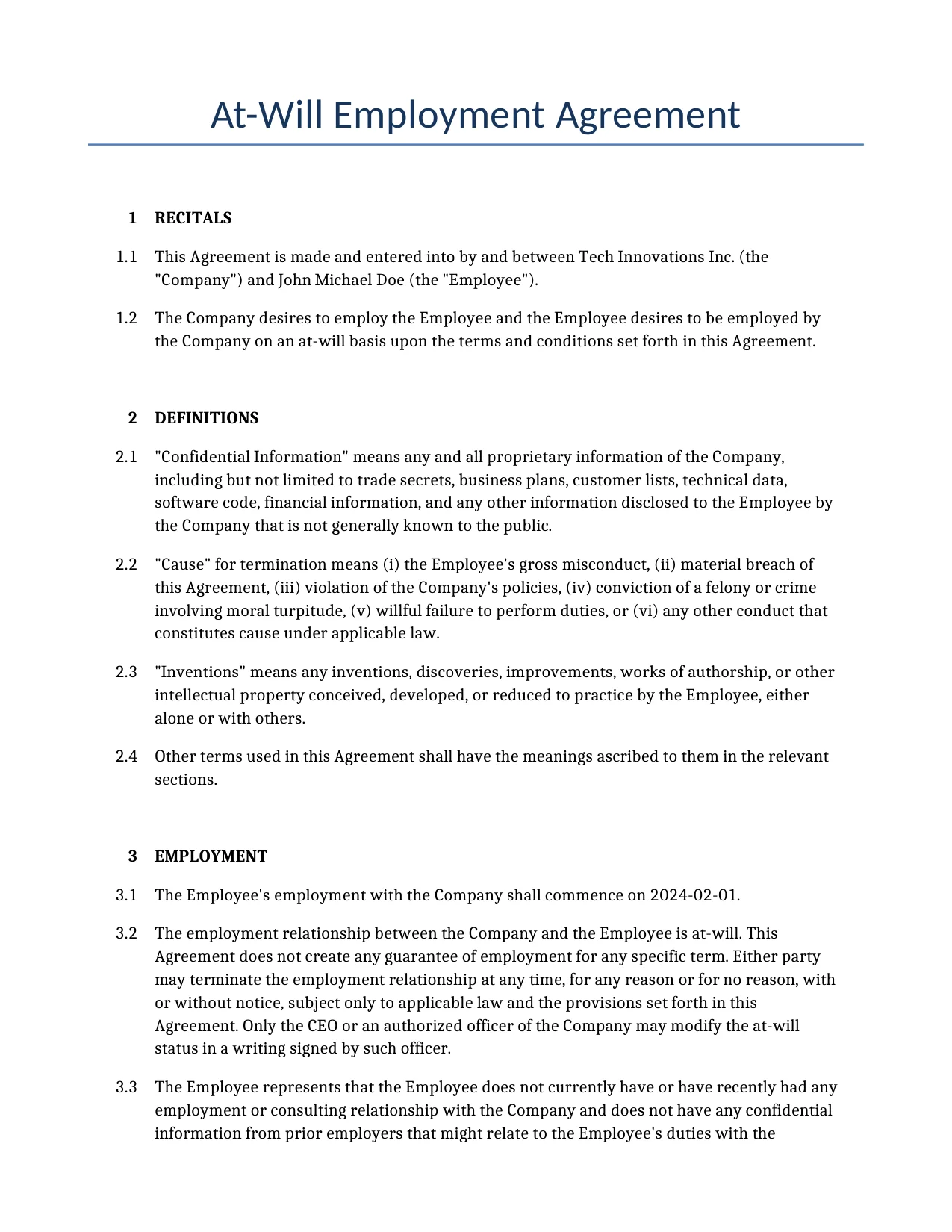
At-Will Employment Agreement
1RECITALS
This Agreement is made and entered into by and between Tech Innovations Inc. (the "Company") and John Michael Doe (the "Employee").
The Company desires to employ the Employee and the Employee desires to be employed by the Company on an at-will basis upon the terms and conditions set forth in this Agreement.
2DEFINITIONS
"Confidential Information" means any and all proprietary information of the Company, including but not limited to trade secrets, business plans, customer lists, technical data, software code, financial information, and any other information disclosed to the Employee by the Company that is not generally known to the public.
"Cause" for termination means (i) the Employee's gross misconduct, (ii) material breach of this Agreement, (iii) violation of the Company's policies, (iv) conviction of a felony or crime involving moral turpitude, (v) willful failure to perform duties, or (vi) any other conduct that constitutes cause under applicable law.
"Inventions" means any inventions, discoveries, improvements, works of authorship, or other intellectual property conceived, developed, or reduced to practice by the Employee, either alone or with others.
Other terms used in this Agreement shall have the meanings ascribed to them in the relevant sections.
3EMPLOYMENT
The Employee's employment with the Company shall commence on 2024-02-01.
The employment relationship between the Company and the Employee is at-will. This Agreement does not create any guarantee of employment for any specific term. Either party may terminate the employment relationship at any time, for any reason or for no reason, with or without notice, subject only to applicable law and the provisions set forth in this Agreement. Only the CEO or an authorized officer of the Company may modify the at-will status in a writing signed by such officer.
The Employee represents that the Employee does not currently have or have recently had any employment or consulting relationship with the Company and does not have any confidential information from prior employers that might relate to the Employee's duties with the Company.
4POSITION AND DUTIES
The Company hereby employs the Employee in the position of Software Engineer and the Employee accepts such employment.
The Employee shall perform the duties and responsibilities of developing and maintaining web applications, collaborating with team members on code reviews, troubleshooting software issues, ensuring compliance with coding standards, and such other duties as may be assigned by the Company from time to time. The Employee shall perform duties in compliance with all applicable federal, state, and local laws, including but not limited to anti-discrimination and anti-harassment laws such as Title VII of the Civil Rights Act, the Americans with Disabilities Act (ADA), the Age Discrimination in Employment Act, and analogous California and New York laws.
The Employee's position shall be full-time. The Employee shall report to the appropriate supervisor as designated by the Company.
5COMPENSATION
The Company shall pay the Employee a base annual salary of 75000.00 USD, which shall be paid bi-weekly in accordance with the Company's standard payroll practices. All compensation is subject to applicable tax withholdings and compliance with IRS regulations.
6BENEFITS
The Employee shall be eligible for health insurance benefits, dental insurance benefits, life insurance benefits, and short-term and long-term disability insurance benefits in accordance with the terms of the Company's benefit plans as in effect from time to time. The Employee shall be allowed to participate in a retirement savings plan in accordance with the terms of the Company's plan as in effect from time to time. The Employee shall be eligible for paid time off benefits in accordance with the Company's policies as in effect from time to time. The Employee's eligibility for benefits shall begin on the first day of employment.
All benefits are governed by separate plan documents, which may be amended or terminated at any time. This Agreement does not create any contractual right to benefits. In the event of termination, the Company shall comply with its obligations under the Consolidated Omnibus Budget Reconciliation Act (COBRA) and the Employee Retirement Income Security Act (ERISA), as applicable. Nothing in this Agreement alters the at-will nature of employment or creates contractual rights to benefits.
7EXPENSES
The Company shall reimburse the Employee for reasonable business expenses incurred in performing the Employee's duties under this Agreement, including travel expenses such as airfare, lodging, and mileage, meals during business trips, and office supplies and equipment necessary for job performance, provided that such expenses are incurred in compliance with the Company's expense policy.
The Employee shall submit receipts for all expenses to the Company for reimbursement. The Company shall reimburse the Employee for approved expenses within 30 days after submission. Reimbursement shall be made only for expenses that comply with the Company's expense policy.
8WORK HOURS AND LOCATION
The primary work location for the Employee shall be at 123 Main Street, New York, NY 10001, with a hybrid arrangement that permits remote work under conditions established by the Company. The Employee shall also perform on-site work at 456 Oak Avenue, San Francisco, CA 94105, as required by the Company.
The Employee is expected to work 8 hours per day and 40 hours per week on Monday through Friday. The Employee shall comply with all applicable laws, including the Fair Labor Standards Act (FLSA), California and New York wage and hour laws, and regulations regarding work hours and overtime. The Company prohibits discrimination, harassment, and retaliation in the workplace in accordance with Title VII of the Civil Rights Act, the ADA, the California Fair Employment and Housing Act, the New York State Human Rights Law, and all other applicable federal, state, and local laws.
9CONFIDENTIALITY
The Employee shall maintain the confidentiality of the Company's Confidential Information at all times during and after employment. The Employee shall not disclose Confidential Information to any third party without the Company's prior written consent.
Upon termination of employment, the Employee shall return all confidential materials to the Company.
10NON-SOLICITATION
For a period of 12 months after the termination of the Employee's employment, the Employee shall not directly or indirectly solicit, hire, or attempt to solicit or hire any of the Company's employees or customers with whom the Employee had material contact during the last 12 months of employment. This provision shall be interpreted and enforced only to the extent permitted under California Business and Professions Code Section 16600, New York law, and other applicable laws, and shall not prohibit the Employee from seeking or accepting employment with any person or entity.
In the event of a breach of this non-solicitation provision, the Company shall be entitled to seek injunctive relief and reasonable liquidated damages (not to exceed an amount that is a reasonable estimate of anticipated damages and not punitive) without the need to post a bond.
11INTELLECTUAL PROPERTY
The Employee shall disclose to the Company any Inventions conceived or created by the Employee before starting employment that relate to the Company's business. The Employee represents that there are no such Inventions except as specifically listed on an attached exhibit (if any).
Any work prepared by the Employee within the scope of employment shall be a "work made for hire" as defined under the U.S. Copyright Act. All Inventions and works created by the Employee during employment that are related to the Company's business or the Employee's job duties shall be the sole property of the Company. The Employee hereby assigns to the Company all right, title, and interest in such Inventions, including all intellectual property rights therein. This assignment does not apply to inventions that qualify for exclusion under California Labor Code Section 2870 (inventions developed entirely on the Employee's own time without using Company resources).
The Employee shall assist the Company in perfecting and enforcing intellectual property rights, including by executing documents, both during and after the termination of employment (at the Company's expense).
The Employee shall keep the Company's Confidential Information (including any trade secrets, business plans, customer lists, technical data, software code, or other proprietary information) secret during and after employment.
To the extent permitted by applicable law, the Employee waives all moral rights in the assigned intellectual property.
12TERMINATION
The Company may terminate the Employee's employment at any time, with or without Cause or notice. For terminations for Cause, the Company shall provide written notice specifying the basis for Cause. Examples of Cause are set forth in the Definitions section. For terminations without Cause, no notice is required under the at-will doctrine, though the Company may elect to provide notice or pay in lieu of notice consistent with applicable law.
Upon termination, the Employee shall return all Company property to the Company. The confidentiality obligations, non-solicitation obligations (to the extent enforceable), and other surviving provisions of this Agreement shall survive the termination of this Agreement.
13FINAL PAY AND EFFECT OF TERMINATION
Upon termination, the Company shall pay the Employee all final wages, including accrued but unused vacation time (to the extent required by law), in accordance with applicable state laws. In California, if employment ends without 72 hours' notice, final pay is due immediately; in New York, final pay is due no later than the regular pay day for the pay period. The Company shall reimburse the Employee for any unpaid business expenses within 30 days after submission.
The Employee shall return all Company property, including physical equipment such as laptops and phones, access badges and keys, and confidential documents and files, to the Company within 5 days after termination (or immediately if no notice is provided), and such property shall be returned in good working condition.
14DATA PRIVACY AND PROTECTION
The Employee shall comply with all applicable data privacy laws, including the California Consumer Privacy Act (CCPA/CPRA), New York data privacy requirements, and any other federal, state, or international laws (such as GDPR if applicable to the Company's operations). The Employee shall handle personal data only as authorized by the Company and in accordance with applicable policies and laws.
In the event of a data breach involving personal information handled by the Employee, the Employee shall promptly notify the Company. Upon termination or at any time upon request, the Employee shall return or delete all personal data in the Employee's possession as directed by the Company.
15INDEMNIFICATION
The Company shall indemnify the Employee for actions taken in good faith within the scope of the Employee's employment, including third-party claims, judgments, and reasonable legal expenses incurred in defending such actions, to the fullest extent permitted by applicable law (including Delaware or California corporate law, depending on the Company's incorporation). Indemnification shall not apply to actions involving gross negligence, willful misconduct, or conduct outside the scope of employment. The Company shall maintain directors and officers (D&O) liability insurance that covers the Employee during the term of employment and for a reasonable period thereafter, to the extent such coverage is available on commercially reasonable terms.
The Employee shall indemnify the Company for any losses arising from the Employee's gross negligence, willful misconduct, or breach of this Agreement, to the extent permitted by law.
16REPRESENTATIONS AND WARRANTIES
The Employee represents and warrants that the Employee's full legal name is John Michael Doe, that the Employee is legally authorized to work in the United States, that the Employee has no criminal convictions or pending charges that would affect employment, that the Employee is not currently bound by any non-compete or non-solicitation agreements from prior employers that would prevent performance under this Agreement, and that the Employee is not involved in any pending litigation or claims that could affect the Employee's employment. The Employee further represents that the Employee meets the qualifications for the position as set forth in any offer letter or job description.
17COMPLIANCE WITH APPLICABLE LAW
The Company and the Employee shall comply with all applicable federal, state, and local laws, including but not limited to the Fair Labor Standards Act (FLSA), Title VII of the Civil Rights Act, the Americans with Disabilities Act (ADA), the Age Discrimination in Employment Act, the California Fair Employment and Housing Act, the New York State Human Rights Law, wage and hour laws of California and New York, and all laws prohibiting discrimination, harassment, and retaliation. The Company maintains policies against discrimination and harassment, and the Employee agrees to abide by such policies and to report any violations promptly. Nothing in this Agreement shall be construed to limit any rights or remedies available under these laws.
18GOVERNING LAW
This Agreement shall be governed by and construed in accordance with the laws of the State of New York without regard to its conflict of laws principles. To the extent any provision is governed by California law (such as non-competition restrictions for California-based work), it shall be interpreted accordingly.
19DISPUTE RESOLUTION
Any disputes arising out of or relating to this Agreement shall be resolved exclusively through mandatory arbitration administered by the American Arbitration Association in New York, New York, in accordance with the Federal Arbitration Act. The arbitration shall be conducted by a single arbitrator, and the proceedings shall be confidential. The parties waive any right to a jury trial and agree to waive class, collective, or representative actions to the fullest extent permitted by law.
The prevailing party in any dispute resolution proceeding shall be entitled to recover reasonable attorneys' fees and costs.
20ENTIRE AGREEMENT
This Agreement constitutes the entire understanding between the parties and supersedes all prior understandings, whether written or oral, with respect to the subject matter hereof. This Agreement may be executed in counterparts, each of which shall be deemed an original, and electronic signatures shall be valid to the extent permitted by the U.S. ESIGN Act and applicable state laws (including California and New York).
21AMENDMENT
Any modifications to this Agreement must be in writing and signed by both the Company and the Employee. This Agreement can only be modified in writing signed by an authorized officer of the Company.
22SEVERABILITY
If any provision of this Agreement is held to be invalid or unenforceable, the remaining provisions shall remain in full force and effect to the maximum extent permitted by law. The court or arbitrator shall have the authority to reform (or "blue pencil") any unenforceable provision to make it enforceable to the maximum extent permitted by law, rather than strictly severing it.
23WAIVER
The failure of either the Company or the Employee to enforce any provision of this Agreement shall not constitute a waiver of such provision or any other provision. The Company and the Employee expressly waive any right to a jury trial in any legal proceeding arising out of or relating to this Agreement.
24ASSIGNMENT
The Company may assign this Agreement in the event of a merger, acquisition, or to its affiliates or successors, and this Agreement shall be binding on the Company's successors and assigns. The Employee may not assign any rights or obligations under this Agreement.
25NOTICES
All notices under this Agreement shall be in writing and may be delivered by hand delivery, certified mail, or email. Notices to the Company shall be sent to 123 Business Street, Suite 100, Anytown, CA 90210. Notices to the Employee shall be sent to 456 Residential Avenue, Apartment 2B, Anytown, CA 90210 or to employee@example.com. Notices sent by mail shall be deemed received 3 days after mailing.
26HEADINGS
The section headings contained in this Agreement are for convenience of reference only and shall not affect the meaning or interpretation of this Agreement.
27SIGNATURE
IN WITNESS WHEREOF the parties have executed this Agreement as of the date first above written.
Company: Tech Innovations Inc. By: _______________________________ Name: Title: Date: ________________
Employee: John Michael Doe Signature: _______________________________ Date: ________________
This example shows approximately 70% of a typical document and is provided for illustrative purposes only. The remaining content has been omitted.
Every document generated by Docaro is tailored to your specific circumstances, jurisdiction and the information you provide. The completed document includes all applicable clauses and provisions required for your situation.
To generate the full, personalised document, answer a short series of questions and your document will be created instantly.