
AI Generated American Child Custody Agreement
PDF & Word - 2026 Updated
Docaro Pricing
When Do You Need a Child Custody Agreement in the United States?
American Legal Rules for a Child Custody Agreement
Using the wrong type or structure of child custody agreement can lead to unenforceable terms or unintended legal consequences.
What a Proper Child Custody Agreement Should Include
- Custody ArrangementSpecifies whether the parents will share joint custody or if one parent will have primary custody, outlining the child's main living situation.
- Visitation ScheduleDetails the times and dates when the non-custodial parent can spend time with the child, including weekends, holidays, and vacations.
- Decision-Making RightsDefines which parent makes key decisions about the child's education, health care, religion, and activities.
- Child Support PaymentsOutlines the amount, frequency, and method of financial support from one or both parents to cover the child's needs.
- Health and Medical CareDescribes how medical expenses, insurance, and emergency decisions will be handled for the child's well-being.
- Communication GuidelinesSets rules for how parents will communicate about the child, including phone calls, emails, and updates on important matters.
- Changes and DisputesExplains how to handle modifications to the agreement and steps for resolving disagreements peacefully.
Generate Your Document in 4 Easy Steps
Why Use Docaro?
 United States
Free Example Child Custody Agreement Template
Below is a free template example of a Child Custody Agreement for use in the United States generated by our AI model.
The clauses in your actual Child Custody Agreement will vary from this example as they will be entirely bespoke to your requirements as set out in the questionnaire you complete.
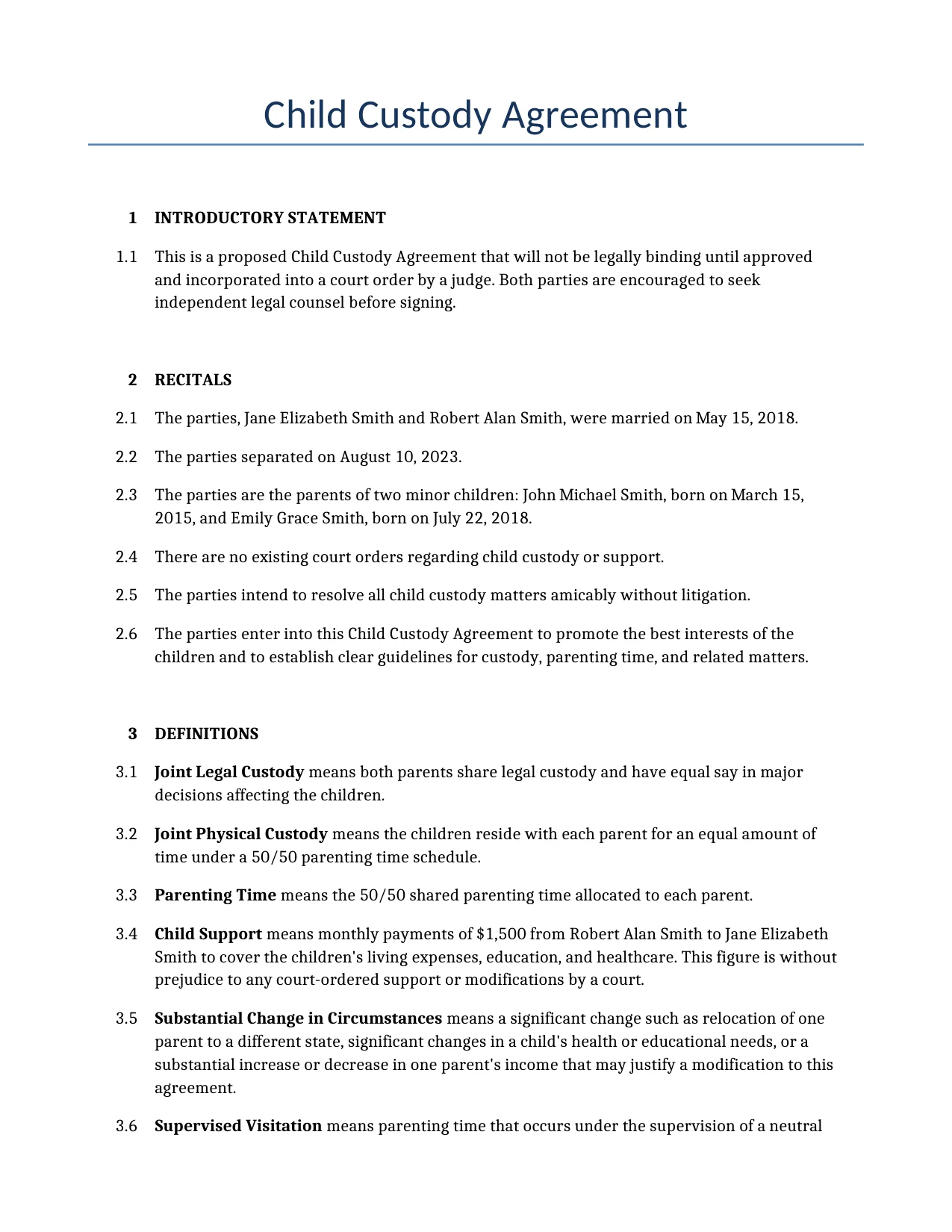
Child Custody Agreement
1INTRODUCTORY STATEMENT
This is a proposed Child Custody Agreement that will not be legally binding until approved and incorporated into a court order by a judge. Both parties are encouraged to seek independent legal counsel before signing.
2RECITALS
The parties, Jane Elizabeth Smith and Robert Alan Smith, were married on May 15, 2018.
The parties separated on August 10, 2023.
The parties are the parents of two minor children: John Michael Smith, born on March 15, 2015, and Emily Grace Smith, born on July 22, 2018.
There are no existing court orders regarding child custody or support.
The parties intend to resolve all child custody matters amicably without litigation.
The parties enter into this Child Custody Agreement to promote the best interests of the children and to establish clear guidelines for custody, parenting time, and related matters.
3DEFINITIONS
Joint Legal Custody means both parents share legal custody and have equal say in major decisions affecting the children.
Joint Physical Custody means the children reside with each parent for an equal amount of time under a 50/50 parenting time schedule.
Parenting Time means the 50/50 shared parenting time allocated to each parent.
Child Support means monthly payments of $1,500 from Robert Alan Smith to Jane Elizabeth Smith to cover the children's living expenses, education, and healthcare. This figure is without prejudice to any court-ordered support or modifications by a court.
Substantial Change in Circumstances means a significant change such as relocation of one parent to a different state, significant changes in a child's health or educational needs, or a substantial increase or decrease in one parent's income that may justify a modification to this agreement.
Supervised Visitation means parenting time that occurs under the supervision of a neutral third party or agency due to safety concerns.
Long-Distance Custody Plan means a modified parenting time schedule implemented in the event of relocation, typically providing extended summer, holiday, and school break visitation to the non-relocating parent along with virtual contact.
The primary residence of the children shall be considered with both parents under the joint physical custody arrangement.
Relocation requires notice as specified in this agreement.
This Child Custody Agreement shall become effective upon court approval and incorporation into a court order.
4PARTY INFORMATION
Mother: Jane Elizabeth Smith, residing at 123 Elm Street, Anytown, CA 90210. Contact information: (555) 123-4567; jane.smith@email.com.
Father: Robert Alan Smith, residing at 456 Oak Avenue, Anytown, CA 90210. Contact information: (555) 987-6543; robert.smith@email.com.
The parties are designated as Mother (Jane Elizabeth Smith) and Father (Robert Alan Smith) throughout this agreement to avoid confusion.
5CUSTODY ARRANGEMENT
The parties shall have Joint Legal Custody of the children, meaning both parents share decision-making authority for all major decisions affecting the children's health, education, welfare, and religious upbringing.
The parties shall have Joint Physical Custody of the children, meaning the children shall reside with each parent for equal periods of time under a 50/50 parenting time schedule, with the primary residence considered with both parents.
This custody arrangement is in the best interests of the children as it promotes frequent and continuing contact with both parents, provides stability, and ensures both parents remain actively involved in the children's lives, as required by U.S. family courts and California law.
Both parents shall have equal say in all major decisions concerning the children.
This custody arrangement shall commence upon court approval and incorporation into a court order.
6PARENTING TIME SCHEDULE
The parties shall follow a 50/50 weekly parenting time schedule as follows: Mother shall have the children from Monday at 8:00 AM until Thursday at 8:00 AM; Father shall have the children from Thursday at 8:00 AM until Monday at 8:00 AM. This alternates each week to ensure equal time.
The parties shall follow the holiday and vacation schedule as detailed in the Holidays and Special Occasions section of this agreement.
Each parent shall have two non-overlapping weeks of annual vacation time with the children, scheduled by mutual agreement with at least 30 days advance notice.
The parties shall make special arrangements for the children's extracurricular activities and medical appointments during their respective parenting times.
The parties aim for an equal split of parenting time resulting in 182.5 overnights per year with each parent (accounting for a 365-day year with equal division).
7CHILDCARE AND BABYSITTING
If a parent is unavailable to care for the children during their scheduled parenting time for more than four hours, that parent shall first offer the other parent the opportunity to care for the children (right of first refusal) before arranging for third-party childcare.
The parent exercising the right of first refusal shall provide timely notice and arrange for transportation.
Third-party caregivers must be at least 18 years of age, responsible adults known to both parties, and may not include any individuals with a history of substance abuse, domestic violence, or criminal convictions involving children.
Each parent shall notify the other parent in advance (at least 24 hours when possible) of any third-party caregiver who will be responsible for the children, including the caregiver's name and contact information.
Both parents agree to maintain consistent routines for the children and ensure that any babysitter is informed of the children's medical needs, allergies, and schedules.
8CHILD SUPPORT
Father (Robert Alan Smith) shall pay Mother (Jane Elizabeth Smith) child support in the amount of $1,500 per month. This is without prejudice to any court-ordered support or modifications by a court of competent jurisdiction.
Child support payments shall be made monthly on the 15th day of each month by direct bank transfer to Mother's designated account.
Child support payments shall commence upon court approval and incorporation into a court order.
Child support shall end upon each child's 18th birthday or as otherwise provided by California law (or upon high school graduation if later).
Support may be modified only by court order upon a showing of substantial change in circumstances. The parties may not modify support amounts by informal written agreement alone.
Regarding tax implications, the parties agree that Mother shall claim the children as dependents in odd-numbered years and Father in even-numbered years, subject to the Tax Deductions and Credits section below. Both parties shall provide necessary tax documentation to the other upon request.
9HEALTH INSURANCE AND MEDICAL EXPENSES
The parties agree to provide and maintain health, vision, and dental insurance coverage for the children as long as such coverage is available at reasonable cost (generally not exceeding 5-10% of a parent's gross income per California guidelines).
The parties shall maintain private employer-sponsored health, vision, and dental insurance coverage for the children through Blue Cross Blue Shield under policy number ABC123456789, or equivalent coverage if this policy is no longer available.
If one parent loses insurance coverage, that parent shall immediately notify the other and obtain alternative coverage. If employment-related coverage ends, the parties shall discuss continuation under COBRA, with costs shared proportionally to income.
The parties shall share the costs of health, vision, and dental insurance premiums equally unless otherwise ordered by the court.
The estimated monthly premium amount for the children's health, vision, and dental insurance is $350.
The parties shall share uninsured medical, dental, vision, and related expenses proportional to their incomes (Father 55%, Mother 45% based on current incomes).
Reimbursement for shared expenses shall be due within 30 days after receiving an itemized bill and proof of payment.
The parties shall notify each other of the children's medical, dental, and vision appointments and care via email notification and a shared calendar app.
10TAX DEDUCTIONS AND CREDITS
The parties shall alternate claiming the children as dependents for federal and state tax purposes. Mother shall claim both children in odd-numbered tax years, and Father shall claim both children in even-numbered tax years.
Dependency exemptions, child tax credits, and any other related tax benefits shall be allocated according to the above schedule.
Each party shall provide the other with a copy of their filed tax return (redacted as necessary) or other documentation confirming the claim within 30 days of filing. The parties shall cooperate in exchanging all necessary information, including IRS Form 8332 if required, to effectuate this allocation.
11EDUCATION AND SCHOOL-RELATED MATTERS
The children shall continue enrollment in the current school district unless the parties mutually agree otherwise or a court determines a change is in the children's best interest.
The parties may enroll the children in a private school if mutually agreed or if a court determines it is in the children's best interest based on changed circumstances.
The parties shall split equally the costs of the children's school tuition, fees, supplies, and related educational expenses unless otherwise agreed or ordered by the court.
The parties agree on the children's participation in extracurricular activities, with joint decision-making for any that require significant time or financial commitment.
The parties shall share the costs for the children's extracurricular activities equally.
The parties shall jointly make all decisions on the children's educational matters with full joint involvement, including decisions regarding special education needs, Individualized Education Programs (IEPs), or 504 plans.
The parties may establish a college savings plan (such as a 529 plan) for the children, with contributions to be mutually agreed upon. Decisions regarding higher education shall be made jointly, considering the children's wishes and best interests.
12DOMESTIC VIOLENCE, CHILD ABUSE, AND SAFETY
Both parties agree that the children's safety is paramount. Neither parent shall expose the children to domestic violence, verbal abuse, physical abuse, or any harmful behavior.
If either parent suspects child abuse, neglect, or domestic violence, they shall immediately notify the appropriate authorities (such as Child Protective Services or law enforcement) and inform the other parent unless doing so would endanger the child.
In the event of any safety concerns, the parties shall follow all recommendations from professionals or court orders, which may include supervised visitation, counseling, or other safety protocols.
Both parties shall refrain from the use of illegal substances or excessive alcohol during or prior to parenting time and shall not allow any third parties with such issues to be around the children.
13COMMUNICATION BETWEEN PARENTS
The primary method of communication between the parents regarding the children shall be through a co-parenting app such as OurFamilyWizard, supplemented by email for non-urgent matters and phone calls for emergencies.
Neither parent shall use the children as messengers to communicate information or negative comments about the other parent or this agreement.
The parties shall not discuss the litigation, this agreement, or any disputes with the children or in the children's presence. All communications shall remain civil and focused solely on the children's needs.
If one parent cannot exercise their scheduled parenting time for more than four hours, they shall provide the other parent with the right of first refusal to care for the children before seeking third-party childcare, as detailed in the Childcare and Babysitting section.
The parties shall respond to non-emergency communications about the children within 24 hours.
The parties shall provide regular updates to each other about the children's well-being and shall have equal access to all records and information.
14RELOCATION
A parent intending to relocate with the children must provide at least 60 days written notice if the move is more than 50 miles away or out of state, or 30 days notice for shorter distances within the same county, in compliance with California Family Code sections 3024 and related relocation laws.
Relocation is defined as a change in residence that exceeds 50 miles from the current primary exchange location or moves the children out of California, per California standards.
The relocating parent shall deliver notice by certified mail or email with read receipt, including the proposed new address, reasons for the move, and suggested modifications to the parenting plan.
The non-relocating parent shall have 30 days from receipt of notice to object in writing. If an objection is made, the relocating parent may not move with the children without court approval.
Any relocation that is not mutually agreed upon shall require a court of competent jurisdiction to determine if the move is in the children's best interest, considering factors under California law including the child's stability, relationship with both parents, and reasons for the move.
If a relocation is approved, the custody arrangement shall be modified to a long-distance custody plan as defined in this agreement.
Upon relocation, parenting time shall be adjusted to provide the non-relocating parent with extended summer vacation (at least 6 weeks), half of all major holidays and school breaks, and virtual check-ins (video calls) at least three times per week.
Transportation costs for visitation after relocation shall be allocated as follows: the relocating parent shall pay for 60% of all travel expenses, and the non-relocating parent shall pay 40%, unless otherwise ordered by the court based on income disparity. Costs include airfare, gas, or other reasonable travel methods.
15MODIFICATION AND DISPUTE RESOLUTION
Any modification to this agreement, even if both parties agree in writing, must be approved by a court of competent jurisdiction to be legally effective.
A substantial change in circumstances such as relocation of one parent to a different state, significant changes in the child's health or educational needs, or a substantial increase or decrease in one parent's income shall justify a modification to this agreement.
The parties shall use mediation as the primary method to resolve disputes before seeking court intervention. Mediation shall involve a neutral mediator trained in family law and co-parenting issues.
The costs of mediation shall be shared equally between the parties unless the mediator or court determines otherwise based on financial circumstances.
The parties shall select a mediator by mutual agreement or, if no agreement is reached within 10 days, from a list provided by the local family court mediation services or a reputable organization such as the California Dispute Resolution Council.
Emergency matters involving child safety, imminent harm, or failure of the mediation process after a reasonable period (not to exceed 45 days) allow immediate court filing without prior mediation.
This agreement shall become effective upon court approval and incorporation into a court order.
16PARENTAL RIGHTS AND RESPONSIBILITIES
Each parent has the following rights: (1) access to the children's medical, dental, educational, and activity records; (2) participation in the children's school events, extracurricular activities, and medical appointments; (3) receiving timely information about the children's health, education, and welfare; (4) reasonable telephone, video, or electronic contact with the children when in the other parent's care; and (5) the ability to make emergency decisions when the other parent is unavailable.
Each parent has the following responsibilities: (1) ensuring the children's homework is completed and they are prepared for school during their parenting time; (2) maintaining consistent routines for bedtime, meals, and discipline; (3) respecting the other parent's parenting time and not scheduling conflicting activities; (4) fostering the children's relationship with the other parent; (5) providing a safe, appropriate environment free from conflict or substance use; and (6) promptly notifying the other parent of any significant issues affecting the children.
Both parents shall promote the children's relationship with the other parent and refrain from interfering with the other's rights and responsibilities.
17HOLIDAYS AND SPECIAL OCCASIONS
The parties shall follow an alternating holiday schedule where major holidays alternate between parents each year, starting with Mother having the children in even-numbered years for the following holidays: Christmas (December 24-25), Easter, and Halloween. Father shall have these holidays in odd-numbered years.
The parties shall alternate Thanksgiving yearly, with Mother having Thanksgiving in even-numbered years and Father in odd-numbered years (from Wednesday at 6:00 PM until Sunday at 6:00 PM).
Father shall have the children on Christmas Eve and Christmas Day in even-numbered years; Mother in odd-numbered years (from December 24 at 10:00 AM until December 26 at 10:00 AM).
Mother shall have the children on New Year's Eve and New Year's Day in even-numbered years; Father in odd-numbered years (from December 31 at 6:00 PM until January 2 at 10:00 AM).
The parties shall alternate the children's birthdays (John: March 15; Emily: July 22). The non-residential parent shall have dinner or a special outing with the child on the birthday if it falls during the other parent's time. The birthday shall be celebrated with both parents if possible.
Mother shall have the children every Mother's Day; Father shall have the children every Father's Day (from 9:00 AM until 7:00 PM).
The parties shall alternate spring break, with the parent not having Easter taking the full spring break in that year.
Summer vacation shall be divided equally, with each parent receiving four consecutive weeks. The schedule shall be agreed upon by April 1 each year.
The parties shall allow makeup parenting time within 45 days for any missed holiday or special occasion due to conflict or illness, scheduled at a mutually convenient time.
The minimum notice period for changes to holiday schedules shall be 30 days.
Additional special occasions (such as religious holidays or family reunions) shall be addressed by mutual agreement, with the goal of equal sharing.
18MISCELLANEOUS PROVISIONS
Neither parent may apply for or renew a passport for the children without the written consent of the other parent. For international travel, the traveling parent must provide a detailed itinerary, contact information, and copies of travel documents at least 30 days in advance, and both parents must sign any necessary consent forms for the children to travel abroad.
Once either child reaches the age of 16 and obtains a driver's license, both parents must agree in writing on any driving privileges, including restrictions on passengers, curfews, and vehicle usage. The children may not drive themselves between parents' homes until both parents consent and the child has held a license for at least six months.
The parties agree not to post pictures, videos, or information about the children on social media without the other parent's consent. Neither party shall make negative comments about the other parent or this agreement on social media or in any public forum.
The family pet (if any), a dog named Max, shall remain with Mother, with Father having visitation rights during his parenting time if feasible. Both parties agree to share veterinary costs equally.
Both parties shall encourage the children's relationships with extended family members, including grandparents, provided such contact is positive and does not interfere with the parenting schedule.
19GOVERNING LAW
This agreement shall be governed by and construed in accordance with the laws of the State of California, specifically the Family Code and the Uniform Child Custody Jurisdiction and Enforcement Act (UCCJEA), which has superseded the UCCJA in California. This includes but is not limited to relevant provisions of the Parental Kidnapping Prevention Act (PKPA), the Uniform Interstate Family Support Act (UIFSA), and the International Child Abduction Remedies Act (ICARA) where applicable.
The parties consent to the exclusive jurisdiction of the Superior Court of California, County of [Any County], Family Court Division, for any disputes related to this agreement.
20ATTORNEY FEES
Each party shall be responsible for their own attorney fees and costs associated with the preparation and enforcement of this agreement, unless a court determines that one party has unreasonably contested or failed to comply with the terms of this agreement, in which case the prevailing party may seek recovery of reasonable attorney fees.
In any action to enforce or modify this agreement, the prevailing party shall be entitled to recover reasonable attorney fees and costs as determined by the court.
21ENTIRE AGREEMENT
This Child Custody Agreement constitutes the entire understanding between the parties regarding child custody matters.
This agreement supersedes all previous agreements or discussions the parties have had with each other about child custody.
22SEVERABILITY
If any provision of this agreement is held to be invalid or unenforceable, the remaining provisions shall remain in full force and effect.
23WAIVER
The failure of either party to enforce any provision of this agreement shall not constitute a waiver of that provision or any other provision.
24NOTICES
All formal notices under this agreement shall be delivered by certified mail or email with read receipt to the addresses provided in the Party Information section.
Notices sent by mail shall be considered effective three business days after mailing.
25SIGNATURES
The parties have read and understood this Child Custody Agreement, believe it to be in the best interests of the children, and are signing it voluntarily without duress or coercion. Each party is advised and has had the opportunity to obtain independent legal advice before signing.
Mother - Jane Elizabeth Smith: _______________________________ Date: _______________
Father - Robert Alan Smith: _______________________________ Date: _______________
Notary Acknowledgment: This document was acknowledged before me on _______________ by Jane Elizabeth Smith, known to me to be the person whose name is subscribed to the foregoing instrument, and acknowledged that she executed the same for the purposes therein contained. [Notary Seal, Signature, and Commission Expiration]
Notary Acknowledgment: This document was acknowledged before me on _______________ by Robert Alan Smith, known to me to be the person whose name is subscribed to the foregoing instrument, and acknowledged that he executed the same for the purposes therein contained. [Notary Seal, Signature, and Commission Expiration]
This example shows approximately 70% of a typical document and is provided for illustrative purposes only. The remaining content has been omitted.
Every document generated by Docaro is tailored to your specific circumstances, jurisdiction and the information you provide. The completed document includes all applicable clauses and provisions required for your situation.
To generate the full, personalised document, answer a short series of questions and your document will be created instantly.