
AI Generated American Independent Contractor Agreement
PDF & Word - 2026 Updated
Docaro Pricing
When Do You Need an Independent Contractor Agreement in the United States?
American Legal Rules for Independent Contractor Agreements
Using the wrong type of freelancer agreement can inadvertently create an employment relationship, leading to misclassification liabilities.
What a Proper Independent Contractor Agreement Should Include
- Parties InvolvedClearly identify the hiring company and the freelancer by name, address, and contact details to establish who is entering the agreement.
- Work DescriptionDetail the specific services the freelancer will provide, including any deliverables and timelines, to set clear expectations.
- Payment TermsSpecify the payment amount, method, schedule, and any expenses to be reimbursed to avoid disputes over compensation.
- Independent StatusState that the freelancer is an independent contractor, not an employee, to clarify responsibilities for taxes and benefits.
- Duration and TerminationDefine the start and end dates of the agreement and conditions under which either party can end it early.
- ConfidentialityRequire the freelancer to keep the company's sensitive information private during and after the project.
- Ownership of WorkOutline who owns the final work product, typically transferring rights to the company upon payment.
- Non-Compete and Non-SolicitLimit the freelancer from working with competitors or poaching clients for a reasonable time after the project.
- Dispute ResolutionDescribe how disagreements will be handled, such as through mediation or in a specific location's courts.
- SignaturesInclude spaces for both parties to sign and date the agreement to make it legally binding.
Generate Your Document in 4 Easy Steps
Why Use Docaro?
 United States
Free Example Independent Contractor Agreement Template
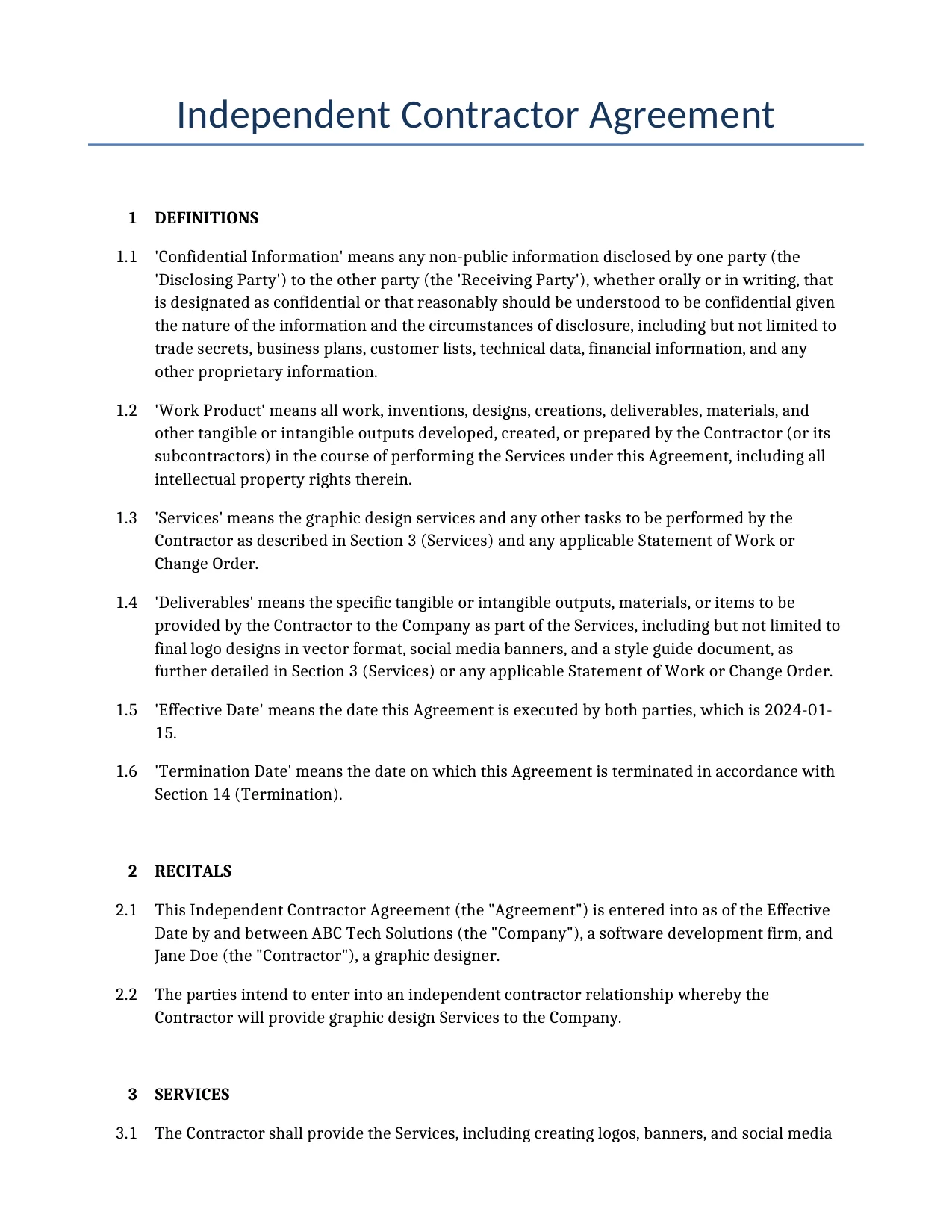
Below is a free template example of a Independent Contractor Agreement for use in the United States generated by our AI model.
The clauses in your actual Independent Contractor Agreement will vary from this example as they will be entirely bespoke to your requirements as set out in the questionnaire you complete.
Independent Contractor Agreement
1DEFINITIONS
'Confidential Information' means any non-public information disclosed by one party (the 'Disclosing Party') to the other party (the 'Receiving Party'), whether orally or in writing, that is designated as confidential or that reasonably should be understood to be confidential given the nature of the information and the circumstances of disclosure, including but not limited to trade secrets, business plans, customer lists, technical data, financial information, and any other proprietary information.
'Work Product' means all work, inventions, designs, creations, deliverables, materials, and other tangible or intangible outputs developed, created, or prepared by the Contractor (or its subcontractors) in the course of performing the Services under this Agreement, including all intellectual property rights therein.
'Services' means the graphic design services and any other tasks to be performed by the Contractor as described in Section 3 (Services) and any applicable Statement of Work or Change Order.
'Deliverables' means the specific tangible or intangible outputs, materials, or items to be provided by the Contractor to the Company as part of the Services, including but not limited to final logo designs in vector format, social media banners, and a style guide document, as further detailed in Section 3 (Services) or any applicable Statement of Work or Change Order.
'Effective Date' means the date this Agreement is executed by both parties, which is 2024-01-15.
'Termination Date' means the date on which this Agreement is terminated in accordance with Section 14 (Termination).
2RECITALS
This Independent Contractor Agreement (the "Agreement") is entered into as of the Effective Date by and between ABC Tech Solutions (the "Company"), a software development firm, and Jane Doe (the "Contractor"), a graphic designer.
The parties intend to enter into an independent contractor relationship whereby the Contractor will provide graphic design Services to the Company.
3SERVICES
The Contractor shall provide the Services, including creating logos, banners, and social media graphics for the Company's marketing campaigns, and shall deliver the Deliverables as specified.
The Services shall be performed remotely from the Contractor's location in Texas, unless otherwise agreed in writing by the parties for any onsite work at the Company's facilities in New York.
The Contractor shall provide weekly written status reports to the Company's marketing director via email, summarizing progress, hours spent, and any issues or risks related to the Services and Deliverables.
Any changes to the Services or additional services shall be made only through a written Change Order signed by both parties, which shall describe the changes, impact on timeline, and any adjustment to compensation.
The Contractor shall meet the following performance metrics and KPIs: (i) 100% of Deliverables must adhere to the Company's brand guidelines; (ii) all Deliverables must be delivered in specified file formats without errors; (iii) 95% on-time delivery rate for all milestones; and (iv) client satisfaction score of at least 4.5 out of 5 based on post-delivery feedback.
The Company shall accept the Deliverables if they meet the Company's brand guidelines, are delivered in the specified file formats, and are approved by the marketing director within 5 business days of submission. Acceptance shall not relieve the Contractor of its warranties or other obligations.
4TERM
This Agreement shall become effective on the Effective Date and shall have an initial term of 12 months (the "Initial Term").
The Contractor shall begin providing Services to the Company on 2024-02-01.
This Agreement shall automatically renew for successive 12-month periods unless either party provides the other with at least 30 days' written notice prior to the end of the then-current term of its intent not to renew.
Upon expiration or termination of this Agreement, all rights and obligations of the parties shall cease except for those that expressly survive as set forth in this Agreement.
5COMPENSATION
The Company shall pay the Contractor at an hourly rate of $50 per hour, not to exceed a maximum of 160 hours per month or a total budget cap of $50,000 during the Initial Term, unless otherwise agreed in a signed Change Order.
The Contractor shall submit monthly invoices detailing hours worked, Deliverables completed, and any applicable expenses. Invoices shall be payable via electronic funds transfer (ACH) or check within 30 days of receipt by the Company.
The Company shall reimburse the Contractor for reasonable business expenses incurred in the performance of the Services, provided that such expenses are pre-approved in writing by the Company and supported by appropriate documentation.
Late payments shall accrue interest at the rate of 1.5% per month or the maximum rate permitted by applicable law, whichever is less. The Company may withhold or deduct from any payment any amounts for which the Contractor is liable under this Agreement, including for breaches or indemnification obligations.
All amounts payable under this Agreement are exclusive of any applicable sales, use, value-added, or other taxes. The Contractor shall be responsible for collecting and remitting any such taxes if required by law; provided, however, that the Company shall pay any sales tax that it is legally obligated to pay in connection with the Services.
6INDEPENDENT CONTRACTOR STATUS
The Contractor is entering into this Agreement as an independent contractor and not as an employee, partner, joint venturer, or agent of the Company. Nothing in this Agreement shall be construed to create any such relationship.
The Contractor shall be responsible for its own business operations, including obtaining and maintaining all necessary licenses, permits, insurance, and compliance with all applicable employment, tax, and labor laws. If the Contractor uses any subcontractors, the Contractor shall ensure they are properly classified and shall comply with all employment laws with respect to them.
The Contractor shall not be entitled to any employee benefits from the Company such as health insurance, retirement plans, or paid leave.
The Company shall not withhold or pay any taxes on behalf of the Contractor. The Contractor is solely responsible for all tax obligations, including self-employment taxes, and compliance with Internal Revenue Code Section 3508 and all other applicable tax laws.
The Company shall not have the right to control or direct the details, methods, or means by which the Contractor performs the Services, consistent with the IRS behavioral, financial, and relationship tests, DOL guidelines, and the California ABC test under Labor Code Section 2775 et seq.
The Contractor shall provide all tools, equipment, and materials necessary to perform the Services.
The engagement is non-exclusive, and the Contractor may provide similar services to others, including competitors, provided that such services do not breach the Contractor's obligations under this Agreement, including confidentiality and non-solicitation.
7CONFIDENTIALITY
The Contractor shall maintain the confidentiality of the Company's Confidential Information and shall not disclose any Confidential Information to any third party without the prior written consent of the Company.
The Contractor's confidentiality obligations shall last indefinitely.
The confidentiality obligations shall not apply to information that is or becomes publicly known through no fault of the Contractor, information that is independently developed by the Contractor without use of the Company's Confidential Information, or information that is lawfully obtained from a third party without breach of any confidentiality obligation.
Upon the Termination Date, the Contractor shall return or destroy all Confidential Information in the Contractor's possession or control.
The confidentiality obligations shall survive termination or expiration of this Agreement.
The Contractor acknowledges that any breach of this confidentiality section may cause irreparable harm to the Company for which monetary damages may be inadequate, and the Company shall be entitled to seek injunctive relief in addition to any other remedies available under the Defend Trade Secrets Act (DTSA) or other applicable law.
8NON-SOLICITATION
During the term of this Agreement and for 12 months after the Termination Date, the Contractor shall not, directly or indirectly, solicit, induce, or attempt to solicit or induce any of the Company's clients, customers, employees, or independent contractors with whom the Contractor had material contact in connection with the Services to cease or reduce their relationship with the Company or to engage in any competing business.
This restriction is limited to the geographic area of California where the Company conducts business and is narrowly tailored to protect the Company's legitimate business interests. The parties agree that this non-solicitation provision is enforceable under California law, including Business and Professions Code Section 16600, as it does not prohibit the Contractor from engaging in a lawful profession, trade, or business.
The Company provides the compensation and other consideration under this Agreement as sufficient consideration for these covenants.
9INTELLECTUAL PROPERTY RIGHTS
The Contractor shall disclose to the Company in writing any pre-existing intellectual property that might be incorporated into any Work Product created under this Agreement.
All Work Product shall be deemed a work made for hire under 17 U.S.C. § 101 and shall be the exclusive property of the Company. The Company shall own all right, title, and interest in and to all Work Product, including all copyrights, patents, trademarks, trade secrets, and other intellectual property rights therein.
If any Work Product is not deemed a work made for hire, the Contractor hereby irrevocably assigns to the Company all right, title, and interest in and to such Work Product, including all intellectual property rights. The Contractor shall execute any further documents necessary to perfect the Company's ownership.
The Contractor waives all moral rights in the Work Product to the fullest extent permitted by law.
The Contractor grants the Company a perpetual, irrevocable, royalty-free license to use any pre-existing intellectual property of the Contractor incorporated into the Work Product.
The Contractor shall obtain written agreements from any subcontractors performing Services under this Agreement containing intellectual property assignment and work-made-for-hire provisions at least as protective of the Company as those in this Section 9.
The Contractor shall indemnify the Company against any intellectual property infringement claims arising from the Work Product.
10REPRESENTATIONS AND WARRANTIES
Each party represents that it has the full authority and legal capacity to enter into this Agreement and perform its obligations hereunder.
The Contractor represents that it has no conflicting obligations, is not subject to any restrictive covenants, agreements, or court orders that would prevent or limit its performance of the Services under this Agreement.
The Contractor warrants that all Work Product is original to the Contractor (or its subcontractors with proper assignments), does not infringe any third-party intellectual property rights, and will be free from defects in materials and workmanship.
The Contractor warrants that the Services shall be performed in a professional and workmanlike manner consistent with industry standards and shall comply with all applicable laws and regulations, including intellectual property laws, data privacy laws such as the California Consumer Privacy Act (CCPA), and other relevant federal and state laws.
The Contractor shall comply with all applicable Company policies and procedures during the provision of the Services.
11INDEMNIFICATION
Each party (the "Indemnifying Party") shall indemnify, defend, and hold harmless the other party, its officers, directors, employees, and agents (the "Indemnified Party") from and against any claims, losses, damages, liabilities, and expenses (including reasonable attorneys' fees) arising out of or related to the Indemnifying Party's (i) negligence or willful misconduct, (ii) breach of this Agreement, or (iii) violation of applicable law.
The Indemnified Party shall promptly notify the Indemnifying Party in writing of any claim and shall tender the defense of such claim to the Indemnifying Party. The Indemnifying Party shall have the right to control the defense, provided that the Indemnified Party may participate at its own expense. The Indemnifying Party shall not settle any claim without the Indemnified Party's prior written consent if such settlement imposes any liability or obligation on the Indemnified Party.
The indemnification obligations under this Section 11 shall survive termination or expiration of this Agreement. Liability under this Section shall not be capped except to the extent required by applicable law.
12LIMITATION OF LIABILITY
EXCEPT FOR OBLIGATIONS UNDER SECTIONS 6 (CONFIDENTIALITY), 7 (NON-SOLICITATION), 8 (INTELLECTUAL PROPERTY RIGHTS), 10 (INDEMNIFICATION), GROSS NEGLIGENCE, WILLFUL MISCONDUCT, OR IP INFRINGEMENT, IN NO EVENT SHALL EITHER PARTY BE LIABLE TO THE OTHER FOR ANY INDIRECT, CONSEQUENTIAL, INCIDENTAL, PUNITIVE, OR SPECIAL DAMAGES, INCLUDING LOST PROFITS, LOSS OF DATA, OR GOODWILL, EVEN IF ADVISED OF THE POSSIBILITY OF SUCH DAMAGES.
EXCEPT FOR THE FOREGOING EXCEPTIONS, EACH PARTY'S TOTAL AGGREGATE LIABILITY TO THE OTHER UNDER THIS AGREEMENT SHALL NOT EXCEED THE TOTAL AMOUNTS PAID OR PAYABLE TO THE CONTRACTOR UNDER THIS AGREEMENT DURING THE 12 MONTHS PRECEDING THE CLAIM.
13INSURANCE
The Contractor shall maintain, at its own expense, from the Effective Date and throughout the term of this Agreement (and for at least 3 years thereafter for claims-made policies), (i) commercial general liability insurance with limits of at least $1,000,000 per occurrence and $2,000,000 aggregate, and (ii) professional liability (errors and omissions) insurance with limits of at least $1,000,000 per claim and aggregate.
If the Contractor has employees, the Contractor shall maintain workers' compensation insurance as required by applicable law.
All policies shall name the Company as an additional insured. The Contractor shall provide certificates of insurance evidencing such coverage to the Company before commencing any Services and upon renewal. Each policy shall provide for at least 30 days' prior written notice to the Company of cancellation, non-renewal, or material reduction in coverage.
14TERMINATION
This Agreement may be terminated (i) by either party without cause upon 30 days' written notice to the other party, or (ii) by either party for cause upon written notice if the other party materially breaches this Agreement and fails to cure such breach within 15 days after receiving written notice thereof (or immediately if the breach cannot be cured or involves confidentiality, non-solicitation, or IP obligations).
Upon any termination or expiration, the Contractor shall (i) immediately cease performing Services unless otherwise directed by the Company, (ii) deliver to the Company all partially completed Deliverables, Work Product, and Company materials, and (iii) provide a final invoice within 15 days of the Termination Date for all Services properly rendered up to the Termination Date that have not been previously invoiced. The Company shall pay for accepted Deliverables and properly performed Services up to the Termination Date, subject to any offsets for damages.
Upon termination or expiration, the Contractor shall return or destroy all Confidential Information and Company property.
The parties' obligations under Sections 0 (Definitions, to the extent referenced), 6 (Confidentiality), 7 (Non-Solicitation), 8 (Intellectual Property Rights), 9 (Representations and Warranties), 10 (Indemnification), 11 (Limitation of Liability), 12 (Insurance), 14 (Governing Law), 15 (Dispute Resolution), 18 (Data Privacy and Security), 21 (Audit Rights), and any other provisions that by their nature should survive, shall survive termination or expiration of this Agreement.
15GOVERNING LAW
This Agreement shall be governed by and construed in accordance with the laws of the State of California, without regard to its conflict of laws principles.
The parties agree that all disputes arising out of or relating to this Agreement shall be subject to the exclusive jurisdiction and venue of the state and federal courts located in San Francisco County, California, and each party hereby consents to the personal jurisdiction of such courts.
16DISPUTE RESOLUTION
Any disputes arising under or related to this Agreement, including those involving IP rights, confidentiality, or non-solicitation, shall first be subject to optional mediation under the rules of JAMS before a mutually agreed mediator in San Francisco, California. If mediation does not resolve the dispute within 30 days, it shall be resolved by binding arbitration administered by JAMS under its Streamlined Arbitration Rules, by a single arbitrator in San Francisco, California. Judgment on the award may be entered in any court having jurisdiction.
This arbitration agreement is governed by the Federal Arbitration Act. Each party shall bear its own costs, except that the arbitrator may award attorneys' fees and costs to the prevailing party as permitted by applicable law. The arbitration shall be confidential.
17NOTICES
All notices under this Agreement shall be in writing and delivered by certified mail, overnight courier, or electronic mail to: (i) if to the Contractor: Jane Doe at jane.doe@email.com (with a copy to 123 Freelance Lane, Austin, TX 78701); and (ii) if to the Company: ABC Tech Solutions at legal@abctech.com (with a copy to 456 Corporate Drive, New York, NY 10001).
Notices shall be deemed received: (i) upon read receipt or written confirmation for email; (ii) the next business day after sending for overnight courier; or (iii) three business days after mailing for certified mail. Addresses may be updated by notice in accordance with this Section.
18FORCE MAJEURE
Neither party shall be liable for any delay or failure to perform its obligations (other than payment obligations) under this Agreement if such delay or failure is caused by a force majeure event, including acts of God, war, natural disasters, pandemics, government orders, or other events beyond the reasonable control of the parties, provided that the affected party promptly notifies the other party in writing within 5 business days and uses reasonable efforts to mitigate the effects and resume performance as soon as possible.
If a force majeure event continues for more than 30 days, either party may terminate this Agreement upon written notice without further liability, except for payment for Services rendered prior to the event.
19COMPLIANCE WITH LAWS
The parties shall comply with all applicable federal, state, and local laws in the performance of their obligations under this Agreement, including without limitation the Fair Labor Standards Act (FLSA), Internal Revenue Code Section 3508, the Defend Trade Secrets Act (DTSA), the California Consumer Privacy Act (CCPA), the California Privacy Rights Act (CPRA), California independent contractor classification laws (including Labor Code Section 2775 et seq.), and any other relevant laws regarding labor, taxes, data privacy, or intellectual property.
The Contractor shall maintain all necessary business licenses, permits, and registrations required to perform the Services and shall not engage in any activity that would violate the Computer Fraud and Abuse Act (CFAA) or similar laws in connection with the Services.
20DATA PRIVACY AND SECURITY
The Contractor shall comply with all applicable data protection and privacy laws, including the CCPA, CPRA, and GDPR (if applicable to any processing of EU personal data). The Contractor shall implement and maintain appropriate administrative, technical, and physical security measures to protect any personal information or Confidential Information accessed or processed in connection with the Services.
The Contractor shall notify the Company in writing within 48 hours of discovering any actual or suspected security breach or unauthorized access to personal information. The Contractor shall assist the Company with any data subject requests, investigations, or notifications required under applicable law at no additional cost.
21AUDIT RIGHTS
Upon reasonable notice (at least 10 business days), the Company or its designee may audit the Contractor's records related to hours billed, expenses, compliance with this Agreement, and use of any personal information during the term and for 3 years thereafter, during the Contractor's normal business hours. The Contractor shall cooperate fully with any such audit.
All information obtained during an audit shall be treated as Confidential Information of the Contractor, except to the extent necessary for the Company to enforce its rights or comply with legal obligations.
22ENTIRE AGREEMENT
This Agreement, including any exhibits (such as a Statement of Work for specific Deliverables), constitutes the entire understanding between the parties and supersedes all prior agreements, whether written or oral. Any future modifications must be in writing and signed by both parties.
23ASSIGNMENT
The Contractor shall not assign any rights or obligations under this Agreement to a third party without the prior written consent of the Company. The Company may assign its rights and obligations to an affiliate or in connection with a merger, acquisition, or sale of assets without the Contractor's consent. Any permitted assignment shall be binding on the successors and assigns of both parties.
24WAIVER
The failure of either party to enforce any provision of this Agreement shall not constitute a waiver of that or any other provision. Any waiver must be in writing, signed by the party granting the waiver, and shall apply only to the specific provision and instance described.
25SEVERABILITY
If any provision of this Agreement is held to be invalid or unenforceable by a court of competent jurisdiction, the remaining provisions shall remain in full force and effect, and the invalid provision shall be reformed to the minimum extent necessary to make it valid and enforceable.
26COUNTERPARTS
This Agreement may be executed in multiple counterparts, each of which shall be deemed an original, and all of which together shall constitute one and the same instrument. Electronic signatures (including via DocuSign or similar) shall be permitted and shall have the same effect as original signatures under the U.S. Electronic Signatures in Global and National Commerce Act (ESIGN) and applicable state laws.
27SIGNATURES
IN WITNESS WHEREOF, the parties have executed this Agreement as of the Effective Date.
Company: ABC Tech Solutions By: _______________________________ Printed Name: ________________ Title: ________________ Date: ________________
Contractor: Jane Doe By: _______________________________ Printed Name: Jane Doe Date: ________________ Witness/Notary (if applicable): _______________________________
This example shows approximately 70% of a typical document and is provided for illustrative purposes only. The remaining content has been omitted.
Every document generated by Docaro is tailored to your specific circumstances, jurisdiction and the information you provide. The completed document includes all applicable clauses and provisions required for your situation.
To generate the full, personalised document, answer a short series of questions and your document will be created instantly.