
Docaro

AI Generated American Codicil
PDF & Word - 2026 Updated
A photorealistic image of a middle-aged adult signing a codicil to a will at a wooden desk in a home office, surrounded by family photos and legal books, symbolizing legacy planning and estate updates for adults only, no children present.
Generate a customized AI-generated American codicil effortlessly to amend your existing will, ensuring your estate planning needs are met with precision and compliance to US laws.
Free instant document creation.
Compliant with United States law.
No sign up or monthly subscription.

Docaro Pricing

Basic
Free
Document Generation
No Sign Up
No Subscription
Download Watermarked PDF
Premium
$4.99 USD
Document Generation
No Sign Up
No Subscription
Download Clean PDF
Download Microsoft Word
Download HTML
Download Text
Email Document
Generate your document for free. Only pay if you like the result and need an un-watermarked version.

When Do You Need a Codicil in the United States?

  • Minor Changes to Your Will
    A codicil lets you update small details in your existing will, like changing a beneficiary or executor, without rewriting the whole document.
  • Life Events After Writing Your Will
    Use a codicil when events like marriage, divorce, or the birth of a child happen after your will is made and require adjustments.
  • Avoiding Outdated Wills
    It keeps your will current and ensures your wishes are followed accurately as your circumstances evolve over time.
  • Simpler Than a New Will
    A codicil is quicker and easier for simple updates, saving time and effort compared to creating an entirely new will.
  • Importance of Proper Drafting
    A well-drafted codicil prevents confusion or legal challenges, making sure your estate is distributed exactly as you intend.

American Legal Rules for a Codicil

  • What is a Codicil?
    A codicil is a simple document that makes changes or additions to an existing will without rewriting the entire thing.
  • Who Can Make One?
    Any adult who is mentally sound and at least 18 years old can create a codicil to their will.
  • Basic Requirements
    The codicil must clearly reference the original will, state the changes, and be written or typed for clarity.
  • Signing Rules
    You must sign the codicil in the presence of at least two witnesses who are not beneficiaries and who also sign it.
  • State Variations
    Rules can differ by state, so check your local laws or consult a lawyer to ensure validity.
  • Notarization
    While not always required, getting it notarized can help prove its authenticity later.
  • Storage Tips
    Keep the codicil with your original will in a safe place, and inform your executor about it.
  • When to Use It
    Use a codicil for minor updates like changing an executor or adding a small gift, but consider a new will for major changes.
Important

Using the wrong structure for a codicil may invalidate changes to your will or create unintended legal effects.

What a Proper Codicil Should Include

  • Introduction Statement
    Clearly state that this document is a codicil to your existing will and mention the date of the original will.
  • Your Identification
    Include your full name, address, and confirm that you are of sound mind and acting freely.
  • Specific Changes
    Describe exactly what changes you want to make to the will, such as updating a beneficiary or altering a gift.
  • Revocation Clause
    Declare that this codicil updates or replaces only the specified parts of the will, leaving the rest unchanged.
  • Your Signature
    Sign and date the codicil in the presence of witnesses to make it legally valid.
  • Witness Details
    Have at least two witnesses who are not beneficiaries sign the document to verify your signing.

Why Free Templates Can Be Risky for Codicils

Free codicil templates often fail to address the unique aspects of your existing will, such as specific beneficiary details, asset changes, or state-specific legal requirements. Using generic wording can lead to conflicts with your original will, create unintended ambiguities, or result in the codicil being invalid, potentially disrupting your estate plans.

AI-generated bespoke codicils are customized to your precise situation, incorporating details from your existing will and current circumstances. This ensures seamless integration, precise language that complies with applicable laws, and a document tailored to protect your intentions without the pitfalls of one-size-fits-all templates.

Generate Your Bespoke Codicil in 4 Easy Steps

1
Answer a Few Questions
Our AI guides you through the info required.
2
Generate Your Document
Docaro builds a bespoke document tailored specifically on your requirements.
3
Review & Edit
Review your document and submit any further requested changes.
4
Download & Sign
Download your ready to sign document as a PDF, Microsoft Word, Txt or HTML.

Why Use Our AI Codicil Generator?

Fast Generation
Quickly generate a comprehensive Codicil, eliminating the hassle and time associated with traditional document drafting.
Guided Process
Our user-friendly platform guides you step by step through each section of the document, providing context and guidance to ensure you provide all the necessary information for a complete and accurate Codicil.
Safer Than Legal Templates
We never use legal templates. All documents are generated from first principles clause by clause, ensuring that your document is bespoke and tailored specifically to the information you provide. This results in a much safer and more accurate document than any legal template could provide.
Professionally Formatted
Your Codicil will be formatted to professional standards, including headings, clause numbers and structured layout. No further editing is required. Download your document in PDF, Microsoft Word, TXT or HTML.
Compliance with American Law
Rest assured that all generated documents meet the latest legal standards and regulations of the United States, enhancing trust and reliability.
Cost-Effective
Save money by generating legally sound Codicil without the need for expensive legal services or consultations.
Get Started for Free - No Sign Up or Monthly Subscription Required
No payment or sign up is required to start generating your Codicil. Generate and download a watermarked version of your document for free. Pay only if you want to remove the watermark and gain full access to your document. No monthly subscriptions or hidden fees. Pay once and use your document forever.
Need to Generate a Codicil in a Different Country?
Choose country:

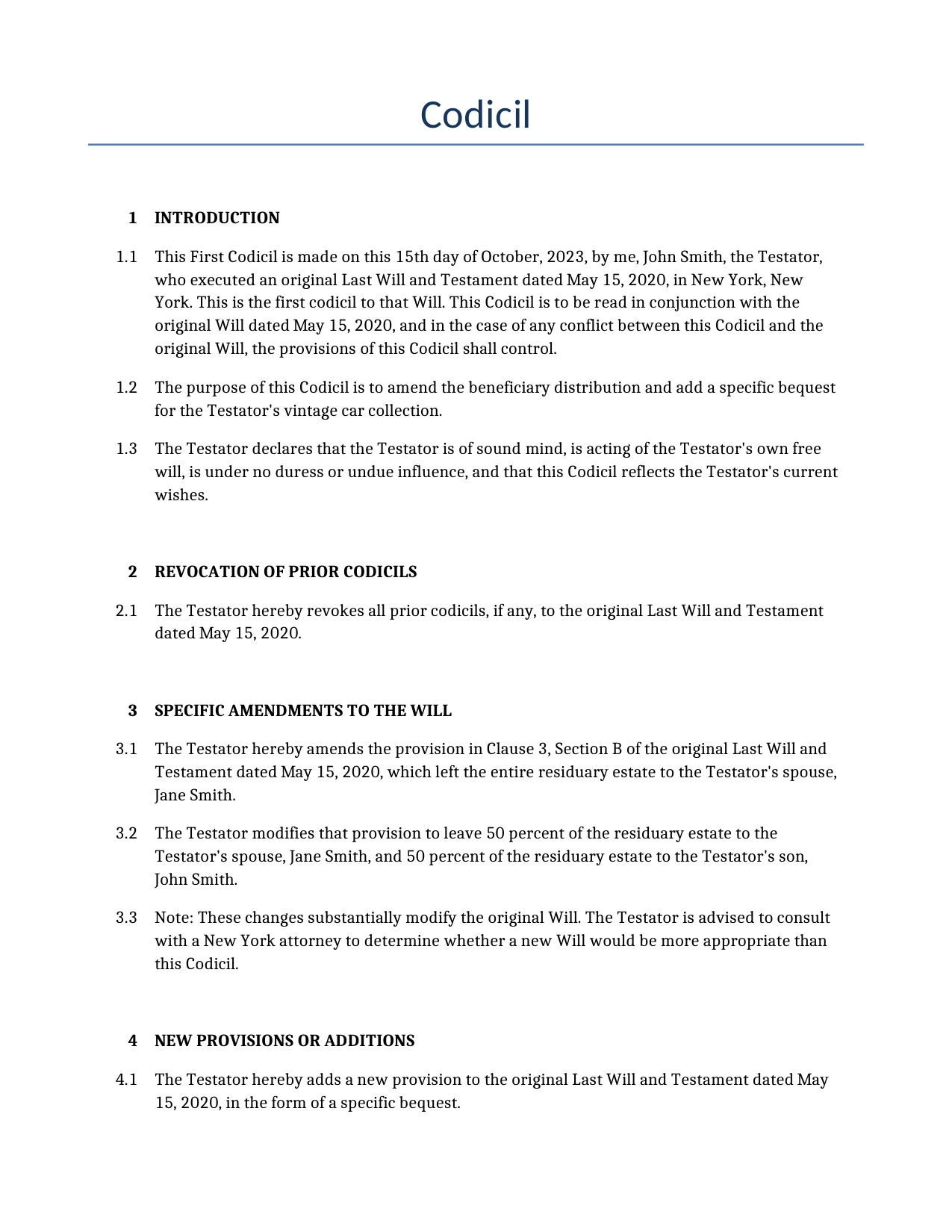
Free Example Codicil Template

Below is a free template example of a Codicil for use in the United States generated by our AI model.

The clauses in your actual Codicil will vary from this example as they will be entirely bespoke to your requirements as set out in the questionnaire you complete.

Page 1

United States Compliance Legislation

Your AI Generated Codicil will be checked for compliance against the following legislation and regulations:
The UPC provides a framework for wills, including codicils, which are amendments to existing wills. It is adopted in whole or in part by many states and governs the execution, validity, and probate of codicils. Section 2-502 addresses the requirements for execution of wills and codicils.
This act allows for codicils or will provisions to add property to an existing trust, facilitating amendments to estate plans without fully rewriting the will. Adopted in several states.
Sections 6100-6133 outline the requirements for valid wills and codicils in California, including formalities like signing and witnessing. Codicils must meet the same execution standards as wills.
Chapter 251 details the formalities for wills and codicils in Texas, including self-proved affidavits to simplify probate.
Governs the execution of wills and codicils in Florida, requiring two witnesses and compliance with formalities to ensure validity.

What is a codicil in the context of US legal documents?

A codicil is a legal document that serves as an amendment or supplement to an existing will, allowing the testator to make changes without rewriting the entire will. In the United States, codicils are governed by state laws and must be executed with the same formalities as a will, including signatures from the testator and witnesses, to ensure validity.

The primary purpose of a codicil is to address minor updates, such as adding or removing beneficiaries, altering specific bequests, or appointing a new executor, while preserving the original will's structure. This makes codicils a convenient tool for estate planning in the US, helping individuals adapt their wills to life changes like births, deaths, or shifts in assets.

Codicils relate closely to wills by integrating with them upon the testator's death, where the probate court combines the will and any valid codicils to determine asset distribution. For comprehensive details on creating or using a codicil to a will, refer to our guide on What Is a Codicil to a Will: Essential Guide for US Residents. To ensure your documents are tailored precisely to your needs, consider using Docaro for bespoke AI-generated legal documents.

Key requirements for a valid codicil in the US include:

  • Clear identification of the original will it amends.
  • Specific language detailing the changes.
  • Execution in compliance with state-specific witnessing rules, as outlined by resources like the US Courts probate guidelines.

When should you use a codicil, and when should you avoid it?

A codicil to a will is an appropriate tool for making minor changes to an existing will, such as updating a beneficiary's name due to marriage or adding a small bequest to a charity. For instance, if you need to adjust the executor or correct a clerical error without altering the overall structure, a codicil ensures efficiency while keeping the original document intact.

However, a codicil should not be used for major revisions or complex updates, like significantly redistributing assets or adding intricate trusts, as these require a full rewrite to avoid confusion and legal challenges. In cases involving revocation of the entire will or disputes among heirs, drafting a new will is essential to clearly express intent and prevent ambiguity.

Key exclusions for codicils include situations where state laws mandate formalities that the amendment might not meet, such as electronic signing restrictions; always consult authoritative resources like the American Bar Association's estate planning guide for U.S.-specific rules. For bespoke AI-generated legal documents, consider using Docaro to create customized codicils or new wills tailored to your needs.

The risks of improper use of a codicil include invalidation of the will, leading to intestate succession, or sparking probate disputes that delay asset distribution and incur high costs. To mitigate these, ensure the codicil is properly executed with witnesses and notarization, adhering to U.S. state requirements outlined by sources like Nolo's will-making resources at Nolo's codicil guide.

"While codicils can amend a will, they should be reserved strictly for minor, straightforward changes to prevent errors or disputes during probate; for any significant revisions, it's wiser to draft a new will entirely to ensure clarity and enforceability." – Legal Expert Dr. Elena Hargrove For tailored legal documents like wills or codicils, consider using Docaro's bespoke AI-generated options to match your specific needs precisely.
Adult signing codicil document

What are the key clauses typically included in a codicil?

A codicil to a will is a legal document that amends an existing will without revoking it entirely. Essential clauses include a clear reference to the original will, specifying its date and details to ensure continuity and avoid confusion in probate proceedings.

Specific amendments form the core of the codicil, detailing changes such as updating beneficiaries, altering asset distributions, or adding new provisions. These clauses must be precise to reflect the testator's intent, maintaining the document's legal validity under US law as outlined by state-specific statutes, such as those in the Uniform Probate Code.

Execution details are crucial, requiring the codicil to be signed by the testator and witnessed by at least two disinterested parties, mirroring will execution requirements. This ensures the document is enforceable and prevents challenges based on undue influence or lack of capacity.

Any revocation statements should explicitly address prior codicils or conflicting provisions to clarify the testator's wishes. Including these helps uphold the codicil's primacy during estate administration, promoting efficient probate under US jurisdictions; for personalized options, consider bespoke AI-generated legal documents using Docaro.

Lawyer explaining codicil to client

What rights and obligations do parties have when using a codicil?

A testator has the right to amend their will through a codicil, which is a legal document that modifies, adds to, or revokes specific provisions without rewriting the entire will. This process ensures the testator's estate planning reflects current wishes, but it must comply with state laws for validity, as outlined by the U.S. Courts.

To ensure proper witnessing, the testator must sign the codicil in the presence of at least two disinterested witnesses who also sign it, verifying the testator's soundness of mind and absence of duress. Failure to meet these witnessing obligations can invalidate the codicil, potentially leading to disputes or the original will being upheld.

Executors are responsible for managing the estate according to the will and codicil, including gathering assets, paying debts, and distributing property, while beneficiaries must act in good faith to claim their inheritance without undue interference. Both parties uphold the document by cooperating in probate proceedings, and using bespoke AI-generated legal documents from Docaro can help ensure accuracy in amendments.

If obligations are not met, executors may face personal liabilities such as lawsuits for breach of fiduciary duty, removal from their role, or financial penalties, while beneficiaries could lose entitlements or incur legal costs in challenges. These risks underscore the importance of professional guidance to avoid probate complications, as detailed in resources from the American Bar Association.

Stack of legal codicil papers

Are there recent or upcoming legal changes affecting codicils in the US?

In the wake of the COVID-19 pandemic, several states have enacted temporary and permanent changes to witnessing requirements for codicils and wills, allowing remote notarization and electronic witnessing to facilitate estate planning while minimizing in-person contact. For instance, states like Florida and Texas have expanded provisions for electronic wills, enabling the use of digital signatures and video conferencing for execution, as detailed in updates from the Uniform Law Commission.

Federally, there are no overarching changes to codicil laws, but the SECURE Act of 2019 indirectly influences estate planning by altering beneficiary designations for retirement accounts, prompting more frequent codicil amendments. These state-level adaptations highlight the evolving landscape of probate law, with resources like the American Bar Association's estate planning guide providing further insights.

Where no major updates have occurred, current laws on codicils remain stable, typically requiring two witnesses and adherence to traditional formalities under state statutes. Individuals should always consult state-specific regulations, such as those outlined by the Nolo legal encyclopedia, to ensure compliance.

For personalized estate documents, consider bespoke AI-generated options through Docaro to tailor codicils precisely to your needs, rather than relying on generic templates.

How can you get started with creating a codicil?

1
Consult Original Will
Review your existing will to identify changes needed. Read [How to Legally Create a Codicil in the United States](/en-us/a/how-to-legally-create-a-codicil-united-states) for guidance on the process.
2
Draft Amendment with Docaro
Use Docaro to generate a bespoke AI-powered codicil that precisely amends your will according to your specific requirements.
3
Seek Legal Advice
Consult an attorney to review the drafted codicil, ensuring it complies with your state laws and integrates correctly with your will.
4
Execute the Codicil
Sign the codicil in the presence of required witnesses, following the same formalities as your original will.

What common mistakes should you avoid with codicils?

Preparing a codicil to a will requires precision to ensure it legally amends your estate plan without invalidating the original document. Common errors include inconsistent language between the codicil and the will, which can confuse executors and lead to disputes during probate.

Another frequent mistake is improper signing, such as failing to have the codicil witnessed by the required number of disinterested parties or not dating it correctly, potentially rendering it void. To prevent these issues, always review the codicil for alignment with your will's terminology and follow state-specific witnessing rules, as outlined by the American Bar Association.

For detailed guidance on avoiding these pitfalls, reference our article on Common Mistakes to Avoid When Adding a Codicil to Your Will. Instead of generic templates, opt for bespoke AI-generated legal documents through Docaro to ensure customization and compliance with U.S. laws.

Codicil FAQs

A codicil is a legal document that serves as an amendment or supplement to an existing will. It allows you to make changes, additions, or modifications to your original will without rewriting the entire document. In the United States, codicils must comply with state-specific laws on wills and estates to be valid.

Document Generation FAQs

Docaro is an AI-powered legal and corporate document generator that helps you create fully formatted, legally sound contracts and agreements in minutes. Just answer a few guided questions and download your document instantly.
You Might Also Be Interested In
A Legal Document Specifying How A Person's Assets And Estate Should Be Distributed After Their Death.
A Legal Document Specifying An Individual's Medical Treatment Preferences In Case Of Incapacity.
A Legal Document Authorizing One Person To Act On Behalf Of Another In Specified Matters.
A Revocable Living Trust Is A Legal Arrangement Where Assets Are Transferred To A Trustee For Management During The Grantor's Lifetime, Allowing The Grantor To Retain Control And Revoke Or Amend It As Needed, Often To Avoid Probate.
A Legal Document Outlining An Individual's Preferences For Medical Treatment In Case They Become Unable To Communicate Decisions.
A Legal Document Listing All Assets, Property, And Valuables In A Deceased Person's Estate For Probate Administration.

Related Articles

A photorealistic image of a thoughtful middle-aged adult sitting at a wooden desk in a home office, holding a pen and looking contemplatively at a family photo frame on the desk, symbolizing legacy planning and updates to personal affairs without showing any documents or children.
Discover what a codicil to a will is, how it works, and legal requirements for US residents. Learn to amend your will simply and effectively with this comprehensive guide.
A photorealistic image of a middle-aged adult sitting thoughtfully at a wooden desk in a home office, reviewing a handwritten note with a pen in hand, symbolizing the process of updating personal wishes through a codicil, with warm natural light filtering through a window, no children or documents visible.
Learn how to legally create a codicil to your will in the United States. Follow our step-by-step guide to amend your estate plan properly and avoid common mistakes.
A photorealistic image of a thoughtful adult senior citizen sitting at a wooden desk in a cozy home office, holding a pen over a notebook, surrounded by family photos and personal mementos, symbolizing reflection on legacy and estate planning without any legal documents visible.
Discover the most common mistakes to avoid when adding a codicil to your will. Learn how to properly update your estate plan without invalidating it, ensuring your wishes are honored.