
AI Generated American Stock Purchase Agreement
PDF & Word - 2026 Updated
Docaro Pricing
When Do You Need a Stock Purchase Agreement in the United States?
American Legal Rules for a Stock Purchase Agreement
Using the wrong type of stock purchase agreement can lead to unintended tax consequences or unenforceable terms.
What a Proper Stock Purchase Agreement Should Include
- Parties InvolvedClearly identifies the buyer, seller, and the company whose stock is being sold.
- Stock DetailsSpecifies the number of shares, type of stock, and price per share being purchased.
- Payment TermsOutlines how and when the buyer will pay the seller for the stock.
- Representations and WarrantiesIncludes assurances from the seller about the company's condition and the stock's validity.
- Conditions to ClosingLists requirements that must be met before the deal is finalized.
- Closing ProceduresDescribes the steps and timeline for completing the stock transfer.
- IndemnificationProvides protection for the buyer against losses from seller misrepresentations.
- Non-Compete and ConfidentialityRestricts the seller from competing or sharing sensitive company information.
- Governing LawStates which state's laws will apply to the agreement.
- SignaturesRequires signatures from all parties to make the agreement binding.
Generate Your Document in 4 Easy Steps
Why Use Docaro?
 United States
Free Example Stock Purchase Agreement Template
Below is a free template example of a Stock Purchase Agreement for use in the United States generated by our AI model.
The clauses in your actual Stock Purchase Agreement will vary from this example as they will be entirely bespoke to your requirements as set out in the questionnaire you complete.
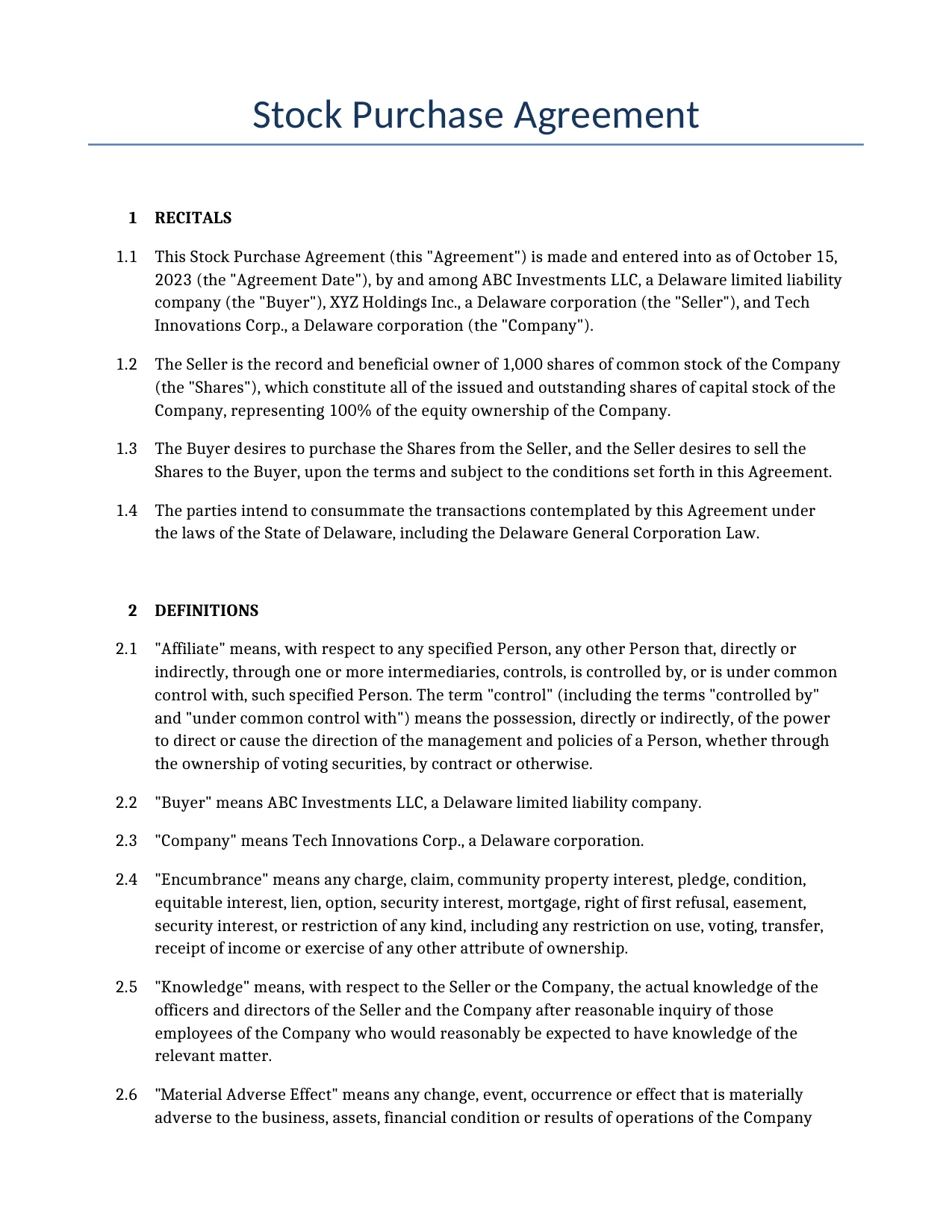
Stock Purchase Agreement
1RECITALS
This Stock Purchase Agreement (this "Agreement") is made and entered into as of October 15, 2023 (the "Agreement Date"), by and among ABC Investments LLC, a Delaware limited liability company (the "Buyer"), XYZ Holdings Inc., a Delaware corporation (the "Seller"), and Tech Innovations Corp., a Delaware corporation (the "Company").
The Seller is the record and beneficial owner of 1,000 shares of common stock of the Company (the "Shares"), which constitute all of the issued and outstanding shares of capital stock of the Company, representing 100% of the equity ownership of the Company.
The Buyer desires to purchase the Shares from the Seller, and the Seller desires to sell the Shares to the Buyer, upon the terms and subject to the conditions set forth in this Agreement.
The parties intend to consummate the transactions contemplated by this Agreement under the laws of the State of Delaware, including the Delaware General Corporation Law.
2DEFINITIONS
"Affiliate" means, with respect to any specified Person, any other Person that, directly or indirectly, through one or more intermediaries, controls, is controlled by, or is under common control with, such specified Person. The term "control" (including the terms "controlled by" and "under common control with") means the possession, directly or indirectly, of the power to direct or cause the direction of the management and policies of a Person, whether through the ownership of voting securities, by contract or otherwise.
"Buyer" means ABC Investments LLC, a Delaware limited liability company.
"Company" means Tech Innovations Corp., a Delaware corporation.
"Encumbrance" means any charge, claim, community property interest, pledge, condition, equitable interest, lien, option, security interest, mortgage, right of first refusal, easement, security interest, or restriction of any kind, including any restriction on use, voting, transfer, receipt of income or exercise of any other attribute of ownership.
"Knowledge" means, with respect to the Seller or the Company, the actual knowledge of the officers and directors of the Seller and the Company after reasonable inquiry of those employees of the Company who would reasonably be expected to have knowledge of the relevant matter.
"Material Adverse Effect" means any change, event, occurrence or effect that is materially adverse to the business, assets, financial condition or results of operations of the Company taken as a whole; provided, however, that none of the following shall be deemed to constitute a Material Adverse Effect: (a) changes in general economic conditions; (b) changes affecting the industry in which the Company operates generally; (c) changes in applicable laws or accounting rules; or (d) the announcement or pendency of the transactions contemplated by this Agreement.
"Permitted Liens" means (a) statutory liens for current Taxes not yet due and payable; (b) mechanics', carriers', workers', repairers' and other similar liens arising or incurred in the ordinary course of business; and (c) zoning, entitlement, building and other land use regulations imposed by governmental agencies having jurisdiction over the real property which are not violated by the current use and operation of such real property.
"Person" means an individual, corporation, partnership, limited liability company, joint venture, association, joint stock company, trust, unincorporated organization, governmental entity or any other entity.
"Seller" means XYZ Holdings Inc., a Delaware corporation.
"Shares" means all of the issued and outstanding shares of common stock of the Company, which total 1,000 shares and represent 100% of the equity ownership of the Company.
"Subsidiary" means, with respect to any Person, any corporation, limited liability company, partnership, association, or other business entity of which (i) if a corporation, a majority of the total voting power of shares of stock entitled (without regard to the occurrence of any contingency) to vote in the election of directors, managers, or trustees thereof is at the time owned or controlled, directly or indirectly, by such Person or one or more of the other Subsidiaries of such Person or a combination thereof or (ii) if a limited liability company, partnership, association, or other business entity (other than a corporation), a majority of the partnership or other similar ownership interest thereof is at the time owned or controlled, directly or indirectly, by such Person or one or more Subsidiaries of such Person or a combination thereof.
"Tax" or "Taxes" means all federal, state, local, foreign and other income, gross receipts, sales, use, production, ad valorem, transfer, franchise, registration, profits, license, lease, service, service use, withholding, payroll, employment, unemployment, estimated, excise, severance, environmental, stamp, occupation, premium, property (real or personal), real property gains, windfall profits, customs, duties or other taxes, fees, assessments or charges of any kind whatsoever, together with any interest, additions or penalties with respect thereto and any interest in respect of such additions or penalties.
Additional terms shall have the meanings ascribed to them elsewhere in this Agreement.
3PURCHASE AND SALE OF SHARES
Subject to the terms and conditions of this Agreement, at the Closing, the Seller shall sell, transfer, convey, assign and deliver to the Buyer, and the Buyer shall purchase from the Seller, the Shares, which consist of 1,000 shares of common stock of the Company representing 100% of the issued and outstanding shares of the Company and 100% of the equity ownership of the Company.
The Seller shall deliver to the Buyer good and marketable title to the Shares, free and clear of all Encumbrances (other than Permitted Liens, if any).
The Shares are fully paid and non-assessable.
4PURCHASE PRICE
The aggregate purchase price for the Shares shall be Seventy-Five Thousand Dollars ($75,000) (the "Purchase Price").
The Purchase Price shall be subject to adjustment for the Company's working capital as of the Closing Date in accordance with the terms set forth on Schedule 4.2.
At Closing, the Buyer shall deliver (i) Ten Thousand Dollars ($10,000) of the Purchase Price to the Escrow Agent to be held in escrow pursuant to the terms of the Escrow Agreement (the "Escrow Amount"), and (ii) the balance of the Purchase Price, net of the Escrow Amount and any applicable adjustments, by wire transfer of immediately available funds to the account or accounts designated by the Seller in writing at least two (2) business days prior to the Closing Date.
5CLOSING
The closing of the purchase and sale of the Shares (the "Closing") shall take place on December 15, 2024, at 10:00 a.m. (Eastern time), remotely via the exchange of documents and signatures by electronic transmission, or at such other time, date or place as the Buyer and the Seller may mutually agree (the "Closing Date").
The Closing shall be subject to the satisfaction or waiver of the conditions to Closing set forth in Section 10.
At the Closing, the Seller shall deliver to the Buyer the following: (i) stock certificates representing the Shares, duly endorsed in blank or accompanied by stock powers duly executed in blank; (ii) a certificate of the Secretary or an Assistant Secretary of the Company certifying as to (A) the incumbency of officers of the Company, (B) the resolutions of the board of directors of the Company authorizing the execution, delivery and performance of this Agreement and the transactions contemplated hereby, and (C) the bylaws of the Company; (iii) a certificate pursuant to Treasury Regulations Section 1.1445-2(c)(3) and Section 1.897-2(h) certifying that the Company is not and has not been a United States real property holding corporation; (iv) payoff letters with respect to any indebtedness of the Company; (v) an updated stock ledger of the Company reflecting the transfer of the Shares to the Buyer; (vi) the Escrow Agreement duly executed by the Seller and the Escrow Agent; and (vii) such other documents as the Buyer may reasonably request.
At the Closing, the Buyer shall deliver to the Seller the following: (i) the Purchase Price (net of the Escrow Amount and any adjustments) by wire transfer of immediately available funds; (ii) the Escrow Agreement duly executed by the Buyer and the Escrow Agent; (iii) a certificate of the Secretary or an Assistant Secretary of the Buyer certifying as to (A) the incumbency of officers of the Buyer and (B) the resolutions of the manager or managing member of the Buyer authorizing the execution, delivery and performance of this Agreement and the transactions contemplated hereby; and (iv) such other documents as the Seller may reasonably request.
6REPRESENTATIONS AND WARRANTIES OF THE SELLER
Organization and Good Standing. The Company is a corporation duly incorporated, validly existing and in good standing under the laws of the State of Delaware. The Company has all requisite corporate power and authority to own, lease and operate its properties and to carry on its business as now conducted. The Company is duly qualified or licensed to do business and is in good standing in each jurisdiction in which the nature of its business or the ownership, leasing or operation of its properties makes such qualification or licensing necessary, except where the failure to be so qualified would not reasonably be expected to have a Material Adverse Effect.
Capitalization. The authorized capital stock of the Company consists of 10,000,000 shares of common stock, of which 1,000 shares are issued and outstanding. The Shares constitute all of the issued and outstanding shares of capital stock of the Company. All of the Shares have been duly authorized and validly issued, are fully paid and non-assessable, and were issued in compliance with all applicable federal and state securities laws. There are no outstanding options, warrants, rights, calls, commitments, conversion rights, rights of exchange, preemptive rights or other agreements of any character that would obligate the Company to issue any additional shares of capital stock. The Seller is the record and beneficial owner of the Shares, free and clear of all Encumbrances (other than Permitted Liens, if any).
Authority. Each of the Seller and the Company has all requisite power and authority to execute, deliver and perform its obligations under this Agreement and to consummate the transactions contemplated hereby. This Agreement has been duly authorized, executed and delivered by each of the Seller and the Company and constitutes a valid and binding obligation of each of the Seller and the Company, enforceable against each in accordance with its terms, subject to applicable bankruptcy, insolvency, reorganization, moratorium and similar laws affecting creditors' rights and remedies generally and subject to general principles of equity (regardless of whether enforcement is sought in a proceeding at law or in equity).
No Conflicts; Consents. The execution, delivery and performance by the Seller and the Company of this Agreement, and the consummation of the transactions contemplated hereby, do not and will not: (a) conflict with or result in a violation or breach of any provision of the organizational documents of the Company or the Seller; (b) conflict with or result in a violation or breach of any provision of any applicable law or order; or (c) require the consent, notice or other action by any Person under, conflict with, result in a violation or breach of, constitute a default under or result in the acceleration of any material contract to which the Company or the Seller is a party. No consent, approval, permit, governmental order, declaration or filing with, or notice to, any governmental authority is required by or with respect to the Seller or the Company in connection with the execution, delivery and performance of this Agreement and the consummation of the transactions contemplated hereby, except for such filings as may be required under the Securities Act or the Exchange Act.
Financial Statements. The financial statements of the Company as of and for the year ended December 31, 2023, have been delivered to the Buyer and have been prepared in accordance with GAAP applied on a consistent basis throughout the period involved. Such financial statements fairly present in all material respects the financial condition of the Company as of such dates and the results of operations of the Company for such periods. The Company has no liabilities except (a) those which are adequately reflected or reserved against in the balance sheet as of December 31, 2023, and (b) those which have been incurred in the ordinary course of business since December 31, 2023 and which are not, individually or in the aggregate, material in amount.
Absence of Certain Changes. Since December 31, 2023, (a) the Company has conducted its business in the ordinary course of business consistent with past practice, and (b) there has not been any event, occurrence or development that has had or would reasonably be expected to have a Material Adverse Effect.
Taxes. The Company has timely filed all Tax returns required to be filed by it and has paid all Taxes due. All such Tax returns are true, correct and complete in all material respects. There are no Encumbrances for Taxes upon any of the assets of the Company other than Permitted Liens. The Company has withheld and paid all Taxes required to have been withheld and paid in connection with amounts paid or owing to any employee, independent contractor, creditor, stockholder or other third party.
Compliance with Laws. The Company is in compliance with all applicable laws in all material respects. The Company has not received any written notice of any violation of any applicable law.
Intellectual Property. The Company owns or has valid rights to all intellectual property used in its business. To the Knowledge of the Seller, the conduct of the Company's business does not infringe, misappropriate or otherwise violate the intellectual property rights of any Person. To the Knowledge of the Seller, no Person is infringing, misappropriating or otherwise violating any intellectual property rights of the Company. The Company has taken reasonable measures to protect the confidentiality of its trade secrets.
Employee Matters. The Company is in compliance in all material respects with all applicable laws respecting employment and employment practices, terms and conditions of employment, and wages and hours. The Company has no liability with respect to any misclassification of any Person as an independent contractor rather than as an employee.
Environmental Matters. The Company is in compliance with all applicable environmental laws in all material respects. The Company has not received any written notice of any violation of any environmental law.
Material Contracts. The Company has delivered to the Buyer true and complete copies of all material contracts to which the Company is a party. Each such material contract is in full force and effect and is valid and enforceable in accordance with its terms. The Company is not in material breach of or default under any material contract.
Insurance. The Company maintains insurance policies with reputable insurance carriers against such losses and risks as are generally maintained by companies of similar size in the same or similar businesses.
Brokers. No broker, finder or investment banker is entitled to any brokerage, finder's or other fee or commission in connection with the transactions contemplated by this Agreement based upon arrangements made by or on behalf of the Seller or the Company.
Related Party Transactions. No officer, director, employee, stockholder or Affiliate of the Company or the Seller, or any immediate family member of any of the foregoing, is a party to any contract with the Company or has any material interest in any property used in or pertaining to the Company's business.
Full Disclosure. No representation or warranty by the Seller in this Agreement or any certificate or schedule delivered by the Seller pursuant to this Agreement contains any untrue statement of a material fact or omits to state any material fact necessary to make the statements contained therein, in light of the circumstances in which they were made, not misleading.
The Seller and the Company have disclosed to the Buyer all exceptions to the foregoing representations and warranties on the Disclosure Schedules attached hereto. The Disclosure Schedules shall be deemed to qualify only those representations and warranties to which they expressly refer.
7REPRESENTATIONS AND WARRANTIES OF THE BUYER
Organization and Good Standing. The Buyer is a limited liability company duly organized, validly existing and in good standing under the laws of the State of Delaware. The Buyer has all requisite limited liability company power and authority to own, lease and operate its properties and to carry on its business as now conducted. The Buyer is duly qualified or licensed to do business and is in good standing in each jurisdiction in which the nature of its business or the ownership, leasing or operation of its properties makes such qualification or licensing necessary.
Authority. The Buyer has all requisite power and authority to execute, deliver and perform its obligations under this Agreement and to consummate the transactions contemplated hereby. This Agreement has been duly authorized, executed and delivered by the Buyer and constitutes a valid and binding obligation of the Buyer, enforceable against the Buyer in accordance with its terms, subject to applicable bankruptcy, insolvency, reorganization, moratorium and similar laws affecting creditors' rights and remedies generally and subject to general principles of equity (regardless of whether enforcement is sought in a proceeding at law or in equity).
No Conflicts; Consents. The execution, delivery and performance by the Buyer of this Agreement, and the consummation of the transactions contemplated hereby, do not and will not: (a) conflict with or result in a violation or breach of any provision of the organizational documents of the Buyer; (b) conflict with or result in a violation or breach of any provision of any applicable law or order; or (c) require the consent, notice or other action by any Person under, conflict with, result in a violation or breach of, constitute a default under or result in the acceleration of any contract to which the Buyer is a party, except in each case as would not reasonably be expected to prevent or materially impair or delay the consummation of the transactions contemplated by this Agreement. No consent, approval, permit, governmental order, declaration or filing with, or notice to, any governmental authority is required by or with respect to the Buyer in connection with the execution, delivery and performance of this Agreement and the consummation of the transactions contemplated hereby, except for such filings as may be required under the Securities Act or the Exchange Act and such consents, approvals, permits, orders, declarations, filings or notices which, if not obtained or made, would not reasonably be expected to prevent or materially impair or delay the consummation of the transactions contemplated by this Agreement.
Investment Intent. The Buyer is acquiring the Shares for its own account for investment purposes only and not with a view to any public distribution thereof. The Buyer has sufficient knowledge and experience in financial and business matters so as to be capable of evaluating the merits and risks of its investment in the Shares. The Buyer is an accredited investor as defined in Rule 501(a) of Regulation D under the Securities Act.
No Reliance. The Buyer acknowledges that it has conducted its own independent investigation of the Company and that it has been provided with access to the personnel, properties, premises and records of the Company for such purpose. The Buyer acknowledges that, except for the representations and warranties of the Seller expressly set forth in Section 6, neither the Seller nor any other Person has made any representation or warranty, express or implied, as to the accuracy or completeness of any information regarding the Company.
Brokers. No broker, finder or investment banker is entitled to any brokerage, finder's or other fee or commission in connection with the transactions contemplated by this Agreement based upon arrangements made by or on behalf of the Buyer.
Sufficient Funds. The Buyer has sufficient funds or financing commitments to pay the Purchase Price and to consummate the transactions contemplated by this Agreement.
8COVENANTS OF THE SELLER
Conduct of Business. From the date of this Agreement until the Closing, the Seller shall cause the Company to (a) conduct its business in the ordinary course of business consistent with past practice; (b) preserve substantially its current business organization, operations and relationships with customers, suppliers and employees; and (c) maintain the tangible assets of the Company in good condition.
Access to Information. From the date of this Agreement until the Closing, the Seller shall cause the Company to provide the Buyer and its representatives with reasonable access to the Company's premises, properties, personnel, books and records, in a manner that does not unreasonably interfere with the Company's business.
No Solicitation of Other Offers. From the date of this Agreement until the earlier of the Closing or the termination of this Agreement, the Seller shall not, and shall cause the Company and its representatives not to, directly or indirectly, solicit, initiate, encourage or facilitate any inquiries or proposals from, discuss or negotiate with, or provide any information to, any Person (other than the Buyer) concerning any sale of the Shares or any merger, consolidation, business combination or similar transaction involving the Company (each, an "Acquisition Proposal").
Consents and Approvals. The Seller shall use its reasonable best efforts to obtain all consents, approvals and waivers from, and provide all notices to, third parties that are required in connection with the transactions contemplated by this Agreement, including under any material contracts of the Company.
Insurance. The Seller shall cause the Company to maintain in full force and effect all insurance policies covering the Company and its properties, assets and businesses until the Closing.
Notification of Certain Matters. The Seller shall promptly notify the Buyer in writing of any event, condition or development that has had or would reasonably be expected to have a Material Adverse Effect or that would make any representation or warranty of the Seller inaccurate in any material respect.
Update of Disclosure Schedules. The Seller shall supplement or amend the Disclosure Schedules from time to time prior to the Closing with respect to any matter arising after the date of this Agreement that, if existing or occurring at or prior to the date of this Agreement, would have been required to be set forth or described in the Disclosure Schedules.
Post-Closing Covenants. For a period of two (2) years following the Closing Date, the Seller shall not, directly or indirectly, (a) engage in any business that competes with the business of the Company as conducted on the Closing Date, anywhere in the United States, or (b) solicit for employment or hire any employee of the Company who was employed by the Company on the Closing Date. The covenants in this Section 8.8 are reasonable in scope, duration and geographic area and are necessary to protect the legitimate interests of the Buyer.
9COVENANTS OF THE BUYER
Regulatory Filings. The Buyer shall, as promptly as practicable following the date of this Agreement, make all filings required under the Hart-Scott-Rodino Antitrust Improvements Act of 1976, as amended (the "HSR Act"), and any other applicable antitrust or competition laws. The Buyer shall also make all filings required under the Defense Production Act of 1950, as amended, and the regulations thereunder relating to the Committee on Foreign Investment in the United States ("CFIUS"). The Buyer shall use its reasonable best efforts to obtain clearance under the HSR Act and CFIUS approval. The Buyer shall be responsible for all filing fees under the HSR Act and for CFIUS.
Access to Information. From the date of this Agreement until the Closing, the Buyer shall not contact any employees, customers or suppliers of the Company without the prior written consent of the Seller (which consent shall not be unreasonably withheld, conditioned or delayed).
Confidentiality. The Buyer shall maintain the confidentiality of all information obtained from the Seller or the Company in accordance with the confidentiality provisions set forth in Section 13. The Buyer shall ensure that its employees and representatives are bound by an enhanced non-disclosure agreement with respect to the transaction and Company information prior to the Closing.
Employee Matters. The Buyer shall cause the Company to comply with all applicable requirements of the Worker Adjustment and Retraining Notification Act (the "WARN Act") and any similar state or local law with respect to any plant closing or mass layoff occurring on or after the Closing Date.
10CONDITIONS TO CLOSING
Mutual Conditions. The obligations of the Buyer and the Seller to consummate the transactions contemplated by this Agreement are subject to the satisfaction or waiver at or prior to the Closing of the following conditions: (a) no governmental authority shall have enacted, issued, promulgated, enforced or entered any order which is in effect and has the effect of making the transactions contemplated by this Agreement illegal, otherwise restraining or prohibiting consummation of such transactions or causing any of the transactions contemplated hereunder to be rescinded following completion thereof; and (b) the Buyer and the Seller shall have delivered the closing documents required to be delivered by them pursuant to Sections 5.3 and 5.4, respectively.
Conditions to Obligations of the Buyer. The obligations of the Buyer to consummate the transactions contemplated by this Agreement are subject to the satisfaction or waiver at or prior to the Closing of the following additional conditions: (a) the representations and warranties of the Seller contained in Section 6 shall be true and correct in all respects (without giving effect to any limitation as to "materiality" or "Material Adverse Effect" set forth therein) as of the Closing Date as though made on and as of the Closing Date (except to the extent such representations and warranties expressly relate to an earlier date, in which case as of such earlier date), except where the failure of such representations and warranties to be so true and correct would not, individually or in the aggregate, have a Material Adverse Effect; (b) the Seller shall have performed and complied in all material respects with all covenants and agreements required by this Agreement to be performed or complied with by it on or prior to the Closing Date; (c) there shall have been no Material Adverse Effect since the date of this Agreement; (d) the Buyer shall have received a certificate signed by an officer of the Seller confirming the satisfaction of the conditions in clauses (a) and (b) above; (e) all required third-party consents, including under key customer contracts and any debt agreements, shall have been obtained; (f) the Buyer shall have completed its due diligence investigation of the Company and the results thereof shall be satisfactory to the Buyer in its reasonable discretion; (g) all filings under the HSR Act and CFIUS review shall have been made and any applicable waiting periods (and any extensions thereof) shall have expired or been terminated, and any other required regulatory approvals (including any applicable approvals under federal securities laws) shall have been obtained; and (h) the Seller shall have delivered all items required to be delivered pursuant to Section 5.3.
Conditions to Obligations of the Seller. The obligations of the Seller to consummate the transactions contemplated by this Agreement are subject to the satisfaction or waiver at or prior to the Closing of the following additional conditions: (a) the representations and warranties of the Buyer contained in Section 7 shall be true and correct in all material respects as of the Closing Date as though made on and as of the Closing Date (except to the extent such representations and warranties expressly relate to an earlier date, in which case as of such earlier date); (b) the Buyer shall have performed and complied in all material respects with all covenants and agreements required by this Agreement to be performed or complied with by it on or prior to the Closing Date; (c) the Seller shall have received a certificate signed by an officer of the Buyer confirming the satisfaction of the conditions in clauses (a) and (b) above; and (d) the Buyer shall have delivered all items required to be delivered pursuant to Section 5.4.
The conditions set forth in this Section 10 are for the sole benefit of the respective parties and may be waived by such party in whole or in part to the extent permitted by applicable law.
11INDEMNIFICATION
Survival. The representations and warranties contained in this Agreement shall survive the Closing for a period of twelve (12) months after the Closing Date; provided, however, that (a) the representations and warranties in Sections 6.1 (Organization and Good Standing), 6.2 (Capitalization), 6.3 (Authority), 6.14 (Brokers), 7.1 (Organization and Good Standing), and 7.2 (Authority) (the "Fundamental Representations") shall survive until the expiration of the applicable statute of limitations, and (b) claims for fraud shall survive indefinitely. All covenants and agreements contained herein which by their terms contemplate performance after the Closing shall survive the Closing indefinitely or until the expiration of the term of the covenant or agreement.
Indemnification by the Seller. Subject to the limitations set forth in this Section 11, the Seller shall indemnify, defend and hold harmless the Buyer and its Affiliates, and their respective officers, directors, employees, agents, successors and assigns (collectively, the "Buyer Indemnified Parties"), from and against any and all losses, damages, liabilities, deficiencies, claims, interest, awards, judgments, penalties, costs and expenses (including reasonable attorneys' fees, costs and other out-of-pocket expenses incurred in investigating, preparing or defending the foregoing) (collectively, "Losses"), suffered or incurred by any of the Buyer Indemnified Parties to the extent arising out of or resulting from: (a) any inaccuracy in or breach of any representation or warranty made by the Seller in this Agreement; or (b) any breach or non-fulfillment of any covenant, agreement or obligation to be performed by the Seller pursuant to this Agreement.
Indemnification by the Buyer. Subject to the limitations set forth in this Section 11, the Buyer shall indemnify, defend and hold harmless the Seller and its Affiliates, and their respective officers, directors, employees, agents, successors and assigns (collectively, the "Seller Indemnified Parties"), from and against any and all Losses suffered or incurred by any of the Seller Indemnified Parties to the extent arising out of or resulting from: (a) any inaccuracy in or breach of any representation or warranty made by the Buyer in this Agreement; or (b) any breach or non-fulfillment of any covenant, agreement or obligation to be performed by the Buyer pursuant to this Agreement.
Certain Limitations. The Seller shall not be required to pay any amount in respect of any claim for indemnification pursuant to Section 11.2(a) (other than with respect to Fundamental Representations or claims based on fraud) until the aggregate amount of all Losses exceeds $5,000 (the "Basket"), in which event the Seller shall be required to pay the amount of all such Losses in excess of the Basket (it being understood that this is a "tipping basket"). The aggregate amount of all Losses for which the Seller shall be liable pursuant to Section 11.2(a) (other than with respect to Fundamental Representations or claims based on fraud) shall not exceed the Escrow Amount (the "Cap"). The aggregate amount of all Losses for which the Seller shall be liable pursuant to this Section 11 with respect to Fundamental Representations or claims based on fraud shall not exceed the Purchase Price. The Buyer shall not be required to pay any amount in respect of any claim for indemnification pursuant to Section 11.3 until the aggregate amount of all Losses exceeds the Basket, in which event the Buyer shall be required to pay the amount of all such Losses in excess of the Basket. The aggregate amount of all Losses for which the Buyer shall be liable pursuant to Section 11.3 shall not exceed the Purchase Price.
Escrow. The Escrow Amount shall serve as the first source of recovery for any claims for indemnification by the Buyer Indemnified Parties pursuant to Section 11.2. The Escrow Amount shall be held and released by the Escrow Agent pursuant to the terms of the Escrow Agreement. Any amounts remaining in escrow after the twelve (12) month anniversary of the Closing Date (less any amounts subject to pending claims) shall be released to the Seller.
Exclusive Remedy. Except with respect to claims based on fraud and claims for specific performance or injunctive relief, the indemnification provisions of this Section 11 shall be the sole and exclusive remedy of the parties for any breach of any representation, warranty, covenant or agreement contained in this Agreement.
Third-Party Claims. If a claim for indemnification is based upon a claim asserted by a third party (a "Third-Party Claim"), the indemnified party shall give the indemnifying party prompt written notice of such Third-Party Claim. The indemnifying party shall have the right to participate in the defense of such Third-Party Claim and, if it so elects, to assume control of the defense thereof with counsel reasonably satisfactory to the indemnified party. If the indemnifying party assumes the defense of a Third-Party Claim, the indemnified party shall cooperate in the defense thereof. The indemnifying party shall not settle any Third-Party Claim without the prior written consent of the indemnified party (which consent shall not be unreasonably withheld, conditioned or delayed).
Direct Claims. Any claim for indemnification not based upon a Third-Party Claim (a "Direct Claim") shall be asserted by the indemnified party by giving the indemnifying party reasonably prompt written notice thereof. The indemnifying party shall have thirty (30) days after its receipt of such notice to respond in writing to such Direct Claim. If the indemnifying party does not respond within such thirty (30) day period, the indemnifying party shall be deemed to have rejected such claim.
Mitigation. Each indemnified party shall take all reasonable steps to mitigate any Losses for which indemnification is sought under this Section 11.
12TERMINATION
Termination. This Agreement may be terminated at any time prior to the Closing: (a) by mutual written consent of the Buyer and the Seller; (b) by the Buyer, if there has been a material breach by the Seller of any representation, warranty, covenant or agreement contained in this Agreement that has not been cured within ten (10) days after written notice thereof; (c) by the Seller, if there has been a material breach by the Buyer of any representation, warranty, covenant or agreement contained in this Agreement that has not been cured within ten (10) days after written notice thereof; (d) by either the Buyer or the Seller, if the Closing has not occurred on or before December 31, 2024 (the "Outside Date"), provided that the terminating party is not then in material breach of this Agreement; (e) by either the Buyer or the Seller, if a governmental authority shall have issued an order or taken any other action permanently restraining, enjoining or otherwise prohibiting the transactions contemplated by this Agreement; or (f) by the Buyer if a Material Adverse Effect shall have occurred.
Termination Fee. In the event that this Agreement is terminated by the Buyer pursuant to Section 12.1(b) or by either party pursuant to Section 12.1(d) due to the Seller's failure to perform its obligations hereunder, then the Seller shall pay to the Buyer a termination fee of $7,500 (the "Termination Fee") within five (5) business days after such termination. The Termination Fee shall be the sole and exclusive remedy of the Buyer in such circumstances, except in the case of fraud or willful breach by the Seller.
Notice of Termination. Any termination pursuant to this Section 12 shall be effective upon delivery of written notice thereof to the other party or parties hereto.
Effect of Termination. In the event of the termination of this Agreement in accordance with this Section 12, this Agreement shall thereafter become void and have no effect, and no party shall have any liability to any other party hereto, except that (a) the provisions of this Section 12.4, Section 11 (to the extent relating to claims arising from a willful breach prior to termination), Section 13, Section 14, Section 15 and Section 19 shall survive any such termination, and (b) nothing herein shall relieve any party from liability for any willful or intentional breach of any provision of this Agreement prior to such termination.
13CONFIDENTIALITY
Confidential Information. Each party agrees that it will not, and will cause its Affiliates and representatives not to, disclose to any Person or use for its own benefit any information relating to the business, technology, financial condition or operations of the other party or the Company that is not generally known to the public ("Confidential Information"). The term "Confidential Information" does not include information that (a) is or becomes generally available to the public other than as a result of disclosure by the receiving party or its representatives in breach of this Agreement; (b) was within the receiving party's possession prior to being furnished by or on behalf of the disclosing party; (c) becomes available to the receiving party on a non-confidential basis from a source other than the disclosing party, provided that such source is not known by the receiving party to be bound by a confidentiality agreement with the disclosing party; or (d) is independently developed by the receiving party without use of or reference to the Confidential Information.
Permitted Disclosures. Each party may disclose Confidential Information (a) to its Affiliates, employees, officers, directors, partners, members, managers, agents, attorneys, accountants, advisors and representatives who need to know such information for the purpose of evaluating, negotiating or consummating the transactions contemplated by this Agreement and who are bound by confidentiality obligations at least as restrictive as those set forth herein; (b) as required by applicable law, regulation or legal process (including pursuant to the rules of any securities exchange), provided that the receiving party gives the disclosing party prompt written notice of such requirement (to the extent legally permissible) and cooperates with the disclosing party to seek a protective order or other appropriate remedy; or (c) with the prior written consent of the disclosing party.
Remedies. Each party acknowledges that a breach of this Section 13 would cause the disclosing party irreparable harm for which monetary damages would not be an adequate remedy. Accordingly, in the event of any such breach, the disclosing party shall be entitled to seek equitable relief, including injunction, without the necessity of proving the inadequacy of monetary damages or posting a bond.
Term. The obligations under this Section 13 shall survive for a period of five (5) years following the termination of this Agreement; provided, however, that with respect to any trade secrets, such obligations shall continue for so long as such information remains a trade secret under applicable law.
14EXPENSES
General. Except as otherwise expressly provided herein, all costs and expenses, including fees and disbursements of counsel, financial advisors and accountants, incurred in connection with this Agreement and the transactions contemplated hereby shall be paid by the party incurring such costs and expenses, whether or not the Closing shall have occurred.
Transfer Taxes. All transfer, documentary, sales, use, stamp, registration, value added and other such Taxes and fees (including any penalties and interest) incurred in connection with this Agreement and the transactions contemplated hereby (including any real property transfer Tax and any other similar Tax) shall be borne and paid by the Seller when due. The Seller shall prepare and file all Tax returns with respect to such Taxes.
Filing Fees. The Buyer shall be responsible for the payment of all filing fees under the HSR Act and for CFIUS. The parties shall each be responsible for fifty percent (50%) of any other filing fees required in connection with any other regulatory filings.
Termination. In the event of termination of this Agreement, the obligation of each party to pay its own expenses will remain in effect.
15GOVERNING LAW
This Agreement shall be governed by and construed in accordance with the internal laws of the State of Delaware without giving effect to any choice or conflict of law provision or rule (whether of the State of Delaware or any other jurisdiction).
Each party irrevocably submits to the exclusive jurisdiction of the Court of Chancery of the State of Delaware (or, if such court lacks subject matter jurisdiction, any state or federal court located in Delaware) for the purposes of any suit, action or other proceeding arising out of this Agreement or any transaction contemplated hereby. Each party further agrees that service of any process, summons, notice or document by U.S. registered mail to such party's address set forth in Section 19 shall be effective service of process for any action, suit or proceeding brought in any such court. EACH PARTY HEREBY IRREVOCABLY WAIVES, TO THE FULLEST EXTENT PERMITTED BY APPLICABLE LAW, ANY AND ALL RIGHT TO TRIAL BY JURY IN ANY LEGAL PROCEEDING ARISING OUT OF OR RELATING TO THIS AGREEMENT OR THE TRANSACTIONS CONTEMPLATED HEREBY.
16ASSIGNMENT
This Agreement may not be assigned by any party without the prior written consent of the other parties; provided, however, that the Buyer may assign its rights and obligations under this Agreement, without the consent of the Seller, to any Affiliate of the Buyer or to any Person that acquires all or substantially all of the assets or business of the Buyer (whether by merger, consolidation, purchase of assets or otherwise). No assignment shall relieve the assigning party of any of its obligations hereunder.
This Agreement shall be binding upon and shall inure to the benefit of the parties hereto and their respective successors and permitted assigns.
17PUBLIC ANNOUNCEMENTS
No party shall make any public announcements in respect of this Agreement or the transactions contemplated hereby or otherwise communicate with any news media without the prior written consent of the other parties (which consent shall not be unreasonably withheld, conditioned or delayed), except as may be required by applicable law, regulation or the rules of any national securities exchange, in which case the party required to make the announcement shall, to the extent practicable, allow the other parties reasonable opportunity to comment on such announcement or communication in advance of such issuance.
18FURTHER ASSURANCES
Following the Closing, each of the parties hereto shall, and shall cause their respective Affiliates to, execute and deliver such additional documents, certificates and instruments, and take such further actions, as may be reasonably requested by any other party to evidence or effectuate the transactions contemplated by this Agreement and to carry out the purposes of this Agreement.
19NO THIRD-PARTY BENEFICIARIES
This Agreement is for the sole benefit of the parties hereto and their respective successors and permitted assigns and nothing herein, express or implied, is intended to or shall confer upon any other Person any legal or equitable right, benefit or remedy of any nature whatsoever under or by reason of this Agreement; provided, however, that the provisions of Section 11 are intended for the benefit of the Buyer Indemnified Parties and the Seller Indemnified Parties, each of whom is an intended third-party beneficiary of such provisions.
20NOTICES
All notices, requests, consents, claims, demands, waivers and other communications hereunder shall be in writing and shall be deemed to have been given: (a) when delivered by hand (with written confirmation of receipt); (b) when received by the addressee if sent by a nationally recognized overnight courier (receipt requested); (c) on the date sent by facsimile or e-mail of a PDF document (with confirmation of transmission) if sent during normal business hours of the recipient, and on the next business day if sent after normal business hours of the recipient; or (d) on the third day after the date mailed, by certified or registered mail, return receipt requested, postage prepaid. Such communications must be sent to the respective parties at the following addresses (or at such other address for a party as shall be specified in a notice given in accordance with this Section 20):
If to the Buyer: ABC Investments LLC, 123 Innovation Drive, Suite 100, Wilmington, DE 19801, Attention: John Doe, CEO, Email: john.doe@abcinvestments.com.
If to the Seller: XYZ Holdings Inc., 456 Oak Avenue, Los Angeles, CA 90210, Attention: Jane Smith, President, Email: jane.smith@xyzholdings.com.
With a copy to (which shall not constitute notice): [Counsel Name and Address for Buyer], and [Counsel Name and Address for Seller].
21TAX MATTERS
Tax Allocation. The Seller shall be responsible for and shall pay all Taxes of the Company attributable to taxable periods (or portions thereof) ending on or before the Closing Date. The Buyer shall be responsible for and shall pay all Taxes of the Company attributable to taxable periods (or portions thereof) beginning after the Closing Date. For any Straddle Period, the amount of Taxes based on or measured by income or receipts of the Company for the Pre-Closing Tax Period shall be determined based on an interim closing of the books as of the close of business on the Closing Date, and the amount of other Taxes of the Company for a Straddle Period that relate to the Pre-Closing Tax Period shall be deemed to be the amount of such Tax for the entire taxable period multiplied by a fraction the numerator of which is the number of days in the taxable period ending on the Closing Date and the denominator of which is the number of days in such Straddle Period.
Tax Returns. The Seller shall prepare or cause to be prepared and file all Tax returns of the Company for all taxable periods ending on or before the Closing Date. The Buyer shall prepare or cause to be prepared and file all Tax returns of the Company for all taxable periods beginning after the Closing Date. The Buyer shall provide the Seller with a copy of any Tax return for a Straddle Period at least thirty (30) days prior to the due date for filing and shall consider in good faith any reasonable comments provided by the Seller.
Cooperation. The parties shall cooperate fully, as and to the extent reasonably requested by the other party, in connection with the filing of Tax returns and any audit, litigation or other proceeding with respect to Taxes. Such cooperation shall include the retention and (upon the other party's request) the provision of records and information that are reasonably relevant to any such audit, litigation or other proceeding and making employees available on a mutually convenient basis to provide additional information and explanation of any material provided hereunder.
Section 338(h)(10) Election. At the Buyer's election, the Seller and the Buyer shall jointly make an election under Section 338(h)(10) of the Internal Revenue Code with respect to the purchase and sale of the Shares. The Seller and the Buyer shall cooperate fully with each other in making such election and in taking all actions necessary to effect such election. The parties shall allocate the Purchase Price (and other relevant items) among the assets of the Company in accordance with Section 338(h)(10) and the applicable Treasury Regulations.
Transfer Taxes. All transfer Taxes shall be borne and paid by the Seller as provided in Section 14.2.
22EMPLOYEE MATTERS
Employee Benefits. For a period of at least twelve (12) months following the Closing Date, the Buyer shall cause the Company to provide each employee of the Company who remains employed by the Company following the Closing (each, a "Continuing Employee") with (a) base salary or hourly wages no less favorable than those provided to such Continuing Employee immediately prior to the Closing, and (b) employee benefits that are substantially comparable in the aggregate to the employee benefits provided to similarly situated employees of the Buyer.
WARN Act and COBRA. The Buyer shall cause the Company to comply with all applicable requirements of the WARN Act and any similar state or local law with respect to any plant closing or mass layoff occurring on or after the Closing Date. The Buyer shall be responsible for providing continuation coverage under COBRA to any current or former employees of the Company (and their beneficiaries) who incur a qualifying event on or after the Closing Date.
Service Credit. The Buyer shall cause the Company to recognize all service of the Continuing Employees with the Company for purposes of eligibility, vesting and determination of the level of benefits under any employee benefit plans of the Buyer or its Affiliates in which the Continuing Employees participate after the Closing to the same extent such service was recognized under a similar plan of the Company.
23SCHEDULES AND EXHIBITS
The following Schedules and Exhibits are attached hereto and incorporated herein by reference and shall be deemed a part of this Agreement for all purposes: Schedule 4.2 (Working Capital Adjustment), the Disclosure Schedules, Exhibit A (Escrow Agreement), and Exhibit B (Form of Officer Certificate). Any information disclosed in any Schedule shall be deemed to be disclosed for purposes of all representations and warranties to the extent that the relevance of such disclosure is reasonably apparent on its face.
24ENTIRE AGREEMENT
This Agreement, including all exhibits, schedules and attachments hereto, constitutes the entire agreement between the parties and supersedes all prior agreements, understandings and negotiations, whether written or oral, relating to the subject matter hereof.
Any modification to this Agreement must be made in a writing signed by both the Buyer and the Seller.
25AMENDMENT AND WAIVER
This Agreement may be amended only by a written instrument signed by the Buyer and the Seller.
Any waiver of a provision of this Agreement must be made in a writing signed by the party entitled to the benefit of the provision being waived and any such waiver shall apply only to the specific instance described therein and shall not preclude the waiving party from later claiming a breach for similar future events.
26SEVERABILITY
If any provision of this Agreement is held to be invalid or unenforceable, the remainder of this Agreement shall remain enforceable without modification.
27COUNTERPARTS
This Agreement may be executed in one or more counterparts, each of which shall be deemed an original, but all of which together shall constitute one and the same instrument.
Electronic signatures shall be deemed original signatures for purposes of this Agreement.
28HEADINGS
The headings in this Agreement are for convenience of reference only and shall not affect the interpretation of this Agreement.
29SIGNATURES
IN WITNESS WHEREOF, the parties have executed this Stock Purchase Agreement as of the date first above written.
ABC Investments LLC By: ____________________________ Name: Title: Date:
XYZ Holdings Inc. By: ____________________________ Name: Title: Date:
This example shows approximately 70% of a typical document and is provided for illustrative purposes only. The remaining content has been omitted.
Every document generated by Docaro is tailored to your specific circumstances, jurisdiction and the information you provide. The completed document includes all applicable clauses and provisions required for your situation.
To generate the full, personalised document, answer a short series of questions and your document will be created instantly.