
AI Generated American Operating Agreement for Limited Liability Company
PDF & Word - 2026 Updated
Docaro Pricing
When Do You Need an LLC Operating Agreement in the United States?
American Legal Rules for an LLC Operating Agreement
Using the wrong structure for an LLC operating agreement can lead to unintended tax liabilities or disputes among members.
What a Proper LLC Operating Agreement Should Include
- Company BasicsDetails the LLC's name, purpose, main office location, and the official records it will keep.
- Member RolesLists all members, their ownership shares, and how new members can join or existing ones can leave.
- Management SetupExplains whether members or designated managers will run the company and how decisions are made.
- Voting and VotesDescribes how votes are taken, what needs majority or full agreement, and members' voting power based on ownership.
- Money ContributionsOutlines what each member puts in as money or assets, and how additional contributions are handled.
- Profit and Loss SharingSpecifies how the company's earnings and losses are divided among members, often matching ownership percentages.
- Distributions of FundsSets rules for when and how profits are paid out to members.
- Books and TaxesRequires keeping accurate financial records and handling tax filings, including how taxes are allocated.
- Meetings and NoticesDefines how often meetings occur, how members are notified, and procedures for those meetings.
- Changes to the AgreementStates how the operating agreement can be updated, usually requiring a vote from members.
- Dissolving the LLCExplains the steps to end the company, how assets are distributed, and what happens after closure.
Generate Your Document in 4 Easy Steps
Why Use Docaro?
 United States
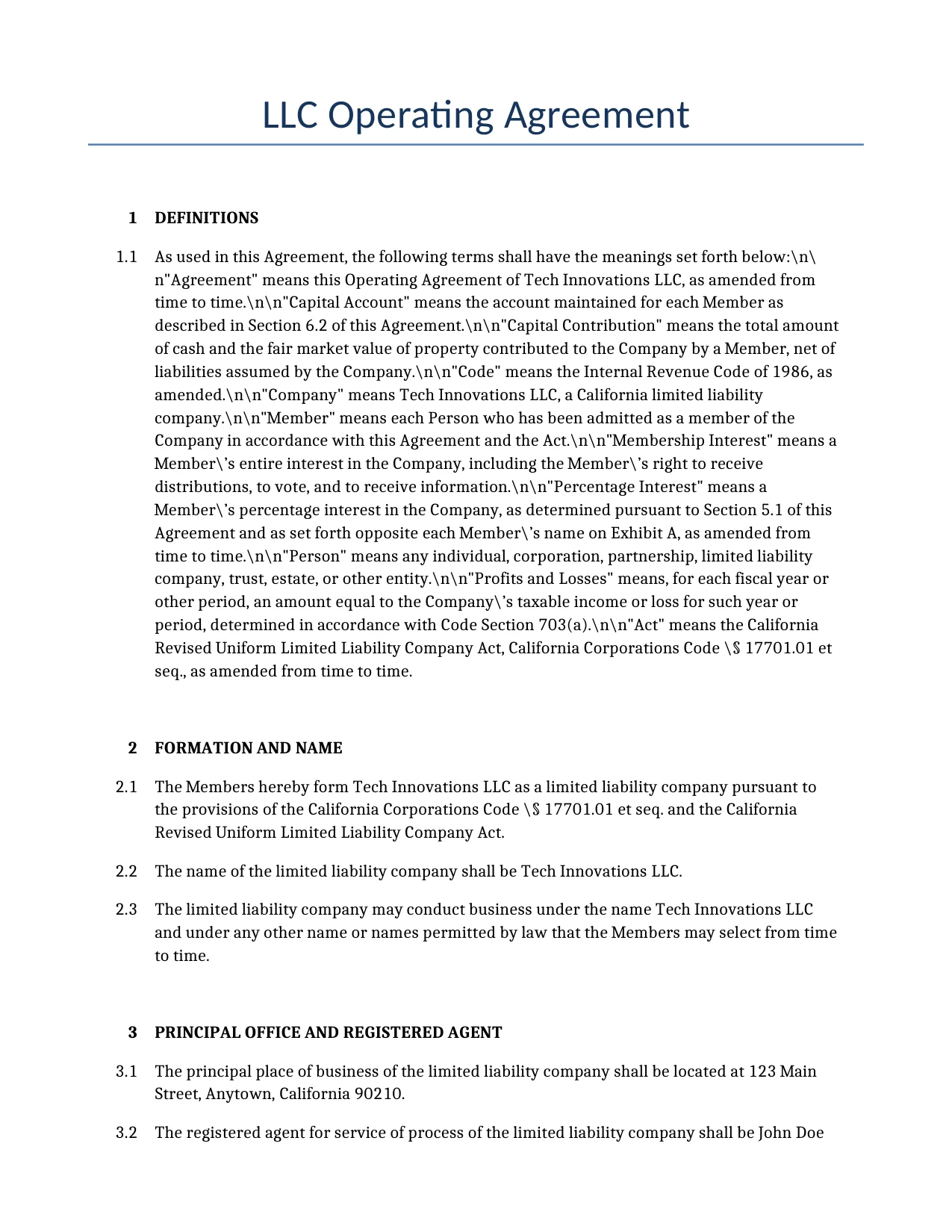
Free Example LLC Operating Agreement Template
Below is a free template example of a LLC Operating Agreement for use in the United States generated by our AI model.
The clauses in your actual LLC Operating Agreement will vary from this example as they will be entirely bespoke to your requirements as set out in the questionnaire you complete.
Operating Agreement of Tech Innovations LLC
1DEFINITIONS
As used in this Agreement, the following terms shall have the meanings set forth below:
"Agreement" means this Operating Agreement of Tech Innovations LLC, as amended from time to time.
"Capital Account" means the account maintained for each Member as described in Section 6.2 of this Agreement.
"Capital Contribution" means the total amount of cash and the fair market value of property contributed to the Company by a Member, net of liabilities assumed by the Company.
"Code" means the Internal Revenue Code of 1986, as amended.
"Company" means Tech Innovations LLC, a California limited liability company.
"Member" means each Person who has been admitted as a member of the Company in accordance with this Agreement and the Act.
"Membership Interest" means a Member\’s entire interest in the Company, including the Member\’s right to receive distributions, to vote, and to receive information.
"Percentage Interest" means a Member\’s percentage interest in the Company, as determined pursuant to Section 5.1 of this Agreement and as set forth opposite each Member\’s name on Exhibit A, as amended from time to time.
"Person" means any individual, corporation, partnership, limited liability company, trust, estate, or other entity.
"Profits and Losses" means, for each fiscal year or other period, an amount equal to the Company\’s taxable income or loss for such year or period, determined in accordance with Code Section 703(a).
"Act" means the California Revised Uniform Limited Liability Company Act, California Corporations Code \§ 17701.01 et seq., as amended from time to time.
2FORMATION AND NAME
The Members hereby form Tech Innovations LLC as a limited liability company pursuant to the provisions of the California Corporations Code \§ 17701.01 et seq. and the California Revised Uniform Limited Liability Company Act.
The name of the limited liability company shall be Tech Innovations LLC.
The limited liability company may conduct business under the name Tech Innovations LLC and under any other name or names permitted by law that the Members may select from time to time.
3PRINCIPAL OFFICE AND REGISTERED AGENT
The principal place of business of the limited liability company shall be located at 123 Main Street, Anytown, California 90210.
The registered agent for service of process of the limited liability company shall be John Doe whose address is 456 Oak Avenue, Anytown, California 90210.
The Members may change the principal office or the registered agent from time to time by filing the appropriate forms with the California Secretary of State and by providing written notice to all Members.
4PURPOSE
The purpose of the limited liability company is to develop and sell innovative mobile applications for small businesses, including software-as-a-service (SaaS) solutions for inventory management and customer relationship management.
The limited liability company shall have the authority to engage in any lawful act or activity for which limited liability companies may be organized under the California Corporations Code \§ 17701.01 et seq.
5CAPITAL CONTRIBUTIONS
The initial capital contribution of each Member shall consist of cash and property as set forth in the schedule attached hereto as Exhibit A and incorporated herein by this reference.
No Member shall be required to make any additional capital contributions to the limited liability company unless all of the Members unanimously consent to such additional capital contributions.
If additional capital contributions are required and a Member fails to make such contribution when due, the other Members may elect to make such contribution on behalf of the defaulting Member or pursue any other remedies available under this Agreement or applicable law.
No Member shall receive any interest on such Member's capital contribution.
6PERCENTAGE INTERESTS
Each Member\’s Percentage Interest shall be determined by dividing such Member\’s Capital Contributions by the total Capital Contributions of all Members, and shall be as set forth on Exhibit A attached hereto, as the same may be amended from time to time to reflect any additional Capital Contributions or adjustments. A Member\’s Percentage Interest shall be used for purposes of allocating Profits and Losses, making distributions, and voting, except as otherwise provided in this Agreement or required by the Act.
Exhibit A: Initial Capital Contributions and Percentage Interests
Member Name | Capital Contribution | Percentage Interest
John Doe | $50,000 | 50%
Jane Smith | $50,000 | 50%
Total | $100,000 | 100%
This Exhibit A may be amended from time to time by the Members to reflect changes in Capital Contributions or Percentage Interests in accordance with this Agreement.
7MANAGEMENT
The limited liability company shall be member-managed.
Each Member shall have the authority to bind the limited liability company in the ordinary course of the limited liability company's business.
All decisions requiring the approval of the Members shall be made by a majority vote of the Members based upon their respective Percentage Interests unless a higher threshold is required by this Agreement or by applicable law.
The Members may appoint officers of the limited liability company from time to time to carry out the day-to-day operations of the limited liability company.
8ALLOCATION OF PROFITS AND LOSSES
The profits and losses of the limited liability company shall be allocated among the Members in proportion to their respective Percentage Interests.
The limited liability company shall maintain capital accounts for each Member in accordance with Internal Revenue Code Section 704 and the Treasury Regulations promulgated thereunder.
The limited liability company intends to be treated as a partnership for federal income tax purposes pursuant to Internal Revenue Code Section 761.
9DISTRIBUTIONS
Distributions of available cash shall be made to the Members in proportion to their respective Percentage Interests at such times as determined by a majority vote of the Members.
No distribution shall be made to any Member if such distribution would violate the California Corporations Code \§ 17701.01 et seq. or any other applicable law.
Each Member shall be required to report the Member's distributive share of the limited liability company's income, gain, loss, deduction, and credit on the Member's federal and state income tax returns.
10MEMBERSHIP INTERESTS AND TRANSFERS
No Member may transfer all or any part of the Member's interest in the limited liability company without the prior written consent of all other Members.
Any attempted transfer of a Membership Interest without such consent shall be null and void and shall not be recognized by the limited liability company.
If a Member desires to transfer the Member's interest, the Member shall first offer such interest to the other Members on the same terms and conditions as offered to any third party.
A transferee of a Membership Interest shall not become a Member without the unanimous consent of the remaining Members and shall have only the rights of an assignee under the California Corporations Code \§ 17701.01 et seq. until admitted as a Member.
11DISSOLUTION AND WINDING UP
The limited liability company shall dissolve upon the first to occur of the following events: (i) the written consent of all Members; (ii) the sale or disposition of substantially all of the assets of the limited liability company; or (iii) any other event that requires dissolution under the California Corporations Code \§ 17701.01 et seq.
Upon dissolution, the limited liability company shall wind up its affairs, pay or provide for the payment of all debts and liabilities, and distribute the remaining assets to the Members in accordance with their positive capital account balances.
The winding up of the limited liability company shall be conducted by the remaining Members or by a person appointed by the Members.
12INDEMNIFICATION
The limited liability company shall indemnify each Member and each officer of the limited liability company against any liability or expense incurred in connection with the business of the limited liability company to the fullest extent permitted by the California Corporations Code \§ 17701.01 et seq.
No Member shall be liable to the limited liability company or to any other Member for any loss or damage caused by the Member unless such loss or damage is the result of the Member's gross negligence, willful misconduct, or breach of this Agreement.
13BOOKS AND RECORDS
The limited liability company shall maintain complete and accurate books and records of its business at its principal office.
Each Member shall have the right to inspect and copy the books and records of the limited liability company upon reasonable notice during normal business hours.
The fiscal year of the limited liability company shall be the calendar year.
14TAX MATTERS
The Members shall designate a Partnership Representative (as defined in Code Section 6223) to serve in such capacity on behalf of the Company. The initial Partnership Representative shall be John Doe. The Partnership Representative shall have the authority to act on behalf of the Company in connection with all tax audits, examinations, and proceedings, and shall keep the Members reasonably informed of any such matters. Any cost or expense incurred by the Partnership Representative in connection with its duties shall be borne by the Company.
15CONFIDENTIALITY
Each Member acknowledges that during the term of this Agreement, such Member may receive or have access to confidential and proprietary information concerning the Company\’s business, including but not limited to trade secrets, customer lists, business plans, financial data, and intellectual property (collectively, \“Confidential Information\”). Each Member agrees that it will not, during the term of this Agreement or at any time thereafter, disclose any Confidential Information to any third party without the prior written consent of all other Members, except as required by law. This obligation shall survive the termination of this Agreement or any Member\’s withdrawal.
16DISPUTE RESOLUTION AND GOVERNING LAW
Any dispute, controversy, or claim arising out of or relating to this Agreement, including its formation, interpretation, performance, breach, or termination, shall first be subject to mediation in Anytown, California, administered by a mutually agreed mediator. If the dispute is not resolved by mediation within sixty (60) days, it shall be resolved by binding arbitration in Anytown, California, administered by JAMS pursuant to its Streamlined Arbitration Rules. Judgment on the award may be entered in any court having jurisdiction thereof. This Section shall not preclude any party from seeking injunctive relief in a court of competent jurisdiction.
This Agreement and the rights of the parties hereunder shall be governed by and construed in accordance with the internal laws of the State of California without regard to its conflict of laws principles. The formation, operation, and dissolution of the limited liability company shall be governed by the California Revised Uniform Limited Liability Company Act, California Corporations Code \§ 17701.01 et seq.
17ENTIRE AGREEMENT
This Agreement constitutes the entire agreement among the parties with respect to the subject matter hereof and supersedes all prior agreements and understandings, oral or written, among the parties.
18SEVERABILITY
If any provision of this Agreement is held to be invalid or unenforceable, the remaining provisions shall remain in full force and effect.
19NOTICES
All notices required or permitted under this Agreement shall be in writing and shall be deemed given when delivered personally or when sent by certified mail, return receipt requested, to the address of each Member as set forth in the books and records of the limited liability company.
20AMENDMENT
This Agreement may be amended only by a written instrument signed by all of the Members. Each Member hereby grants to the Partnership Representative a power of attorney, coupled with an interest, to execute any amendments or documents necessary to reflect changes in Membership Interests or to comply with the Act, provided such action does not materially and adversely affect any Member without such Member\’s consent.
21WAIVER OF PARTITION
Each Member hereby waives any right to partition any property of the Company or to file a complaint or institute any proceeding at law or in equity to partition any property of the Company. This waiver shall continue until the Company\’s dissolution and the winding up of its affairs.
22FIDUCIARY DUTIES
To the fullest extent permitted by the Act, the fiduciary duties of each Member to the Company and to the other Members are limited to the duty of loyalty and the duty of care as set forth in California Corporations Code \§ 17704.09. No Member shall be liable for any breach of fiduciary duty except for acts or omissions that constitute a knowing violation of law, intentional misconduct, or a knowing violation of this Agreement. The Members acknowledge that they may engage in other business activities that may compete with the Company, and no Member shall have any obligation to offer any business opportunity to the Company.
23COUNTERPARTS
This Agreement may be executed in one or more counterparts, each of which shall be deemed an original, but all of which together shall constitute one and the same instrument.
24SIGNATURES
IN WITNESS WHEREOF, the undersigned have executed this Operating Agreement as of the date first written above.
Member: _______________________________ Date: _______________
Member: _______________________________ Date: _______________
This example shows approximately 70% of a typical document and is provided for illustrative purposes only. The remaining content has been omitted.
Every document generated by Docaro is tailored to your specific circumstances, jurisdiction and the information you provide. The completed document includes all applicable clauses and provisions required for your situation.
To generate the full, personalised document, answer a short series of questions and your document will be created instantly.