
Docaro

AI Generated American Demand Letter
PDF & Word - 2026 Updated
A photorealistic image representing the concept of a demand letter in legal contexts, showing a determined adult professional in a modern office setting, reviewing important correspondence on a desk with a serious expression, symbolizing the pursuit of resolution or justice without directly depicting any documents.
Generate a professional AI-powered demand letter for resolving disputes in the United States, ensuring compliance with legal standards and maximizing your chances of successful settlement before litigation.
Free instant document creation.
Compliant with United States law.
No sign up or monthly subscription.

Docaro Pricing

Basic
Free
Document Generation
No Sign Up
No Subscription
Download Watermarked PDF
Premium
$4.99 USD
Document Generation
No Sign Up
No Subscription
Download Clean PDF
Download Microsoft Word
Download HTML
Download Text
Email Document
Generate your document for free. Only pay if you like the result and need an un-watermarked version.

When Do You Need a Demand Letter in the United States?

  • Unpaid Debts
    Send a demand letter when someone owes you money and hasn't paid despite reminders, as it formally requests payment and sets a deadline.
  • Breach of Contract
    Use it if a party fails to fulfill their agreement, like not delivering goods or services, to notify them of the issue and demand compliance.
  • Property Damage
    Issue a demand letter after an accident where your property is damaged, to request compensation from the responsible party.
  • Before Legal Action
    It's often required or recommended before filing a lawsuit, as it gives the other side a chance to resolve the matter without court.
  • Importance of a Well-Drafted Letter
    A clear and professional demand letter strengthens your position by documenting your efforts and increasing the chances of a quick resolution.

American Legal Rules for a Demand Letter

  • What It Is
    A demand letter is a formal notice sent to someone who owes you money or has wronged you, asking them to fix the issue before you take further action.
  • When to Use It
    Use it for disputes like unpaid debts, contract breaches, or property damage to try resolving the matter without going to court.
  • Key Contents
    Include who you are, what happened, how much is owed or demanded, and a deadline for response.
  • Send by Mail
    Deliver it via certified mail with a return receipt to prove it was received.
  • Deadline for Response
    Set a reasonable time limit, like 14 to 30 days, for the recipient to reply or pay.
  • State Laws Apply
    Rules can vary by state, so check local requirements for specifics in your area.
  • Not Always Required
    It's often not mandatory but can be needed in some cases, like small claims or before suing.
  • Keep Records
    Save copies of the letter and any responses to support your case if it goes to court.
  • Seek Professional Help
    For complex issues, consult a lawyer to ensure the letter is effective and proper.
Important

Using the wrong type or structure of letter before action may fail to trigger statutory pre-action protocols, potentially weakening your legal position.

What a Proper Demand Letter Should Include

  • Your Contact Information
    Include your full name, address, phone number, and email at the top so the recipient can easily reach you.
  • Recipient's Contact Information
    List the full name and address of the person or company you're sending the letter to, ensuring it gets to the right place.
  • Clear Statement of the Problem
    Briefly describe what happened, including key dates and facts, to explain why you're making this demand.
  • Amount of Money Owed
    Specify the exact amount you claim is due, along with a simple breakdown of how you calculated it.
  • What You Want Them to Do
    State clearly what action you expect, such as paying the amount or fixing the issue, within a reasonable deadline.
  • Deadline for Response
    Set a specific date by which they must reply or act, giving them enough time but showing urgency.
  • Consequences of Ignoring the Letter
    Mention what might happen next, like legal action, if they don't respond by the deadline.
  • Your Signature
    End with your signature and printed name to make the letter official and personal.

Why Free Templates Can Be Risky for Demand Letters

Free demand letter templates often use generic language that fails to address specific details of your claim, such as precise amounts owed, timelines, or jurisdictional requirements. This can weaken your position by omitting key legal elements, leading to disputes, ignored demands, or even counterclaims due to inaccuracies.

AI-generated bespoke demand letters are customized to your unique situation, incorporating accurate facts, tailored demands, and compliant wording for your state. This results in a professional, persuasive document that strengthens your case, increases response rates, and prepares the ground for potential legal action.

Generate Your Bespoke Demand Letter in 4 Easy Steps

1
Answer a Few Questions
Our AI guides you through the info required.
2
Generate Your Document
Docaro builds a bespoke document tailored specifically on your requirements.
3
Review & Edit
Review your document and submit any further requested changes.
4
Download & Sign
Download your ready to sign document as a PDF, Microsoft Word, Txt or HTML.

Why Use Our AI Demand Letter Generator?

Fast Generation
Quickly generate a comprehensive Demand Letter, eliminating the hassle and time associated with traditional document drafting.
Guided Process
Our user-friendly platform guides you step by step through each section of the document, providing context and guidance to ensure you provide all the necessary information for a complete and accurate Demand Letter.
Safer Than Legal Templates
We never use legal templates. All documents are generated from first principles clause by clause, ensuring that your document is bespoke and tailored specifically to the information you provide. This results in a much safer and more accurate document than any legal template could provide.
Professionally Formatted
Your Demand Letter will be formatted to professional standards, including headings, clause numbers and structured layout. No further editing is required. Download your document in PDF, Microsoft Word, TXT or HTML.
Compliance with American Law
Rest assured that all generated documents meet the latest legal standards and regulations of the United States, enhancing trust and reliability.
Cost-Effective
Save money by generating legally sound Demand Letter without the need for expensive legal services or consultations.
Get Started for Free - No Sign Up or Monthly Subscription Required
No payment or sign up is required to start generating your Demand Letter. Generate and download a watermarked version of your document for free. Pay only if you want to remove the watermark and gain full access to your document. No monthly subscriptions or hidden fees. Pay once and use your document forever.
Need to Generate a Demand Letter in a Different Country?
Choose country:

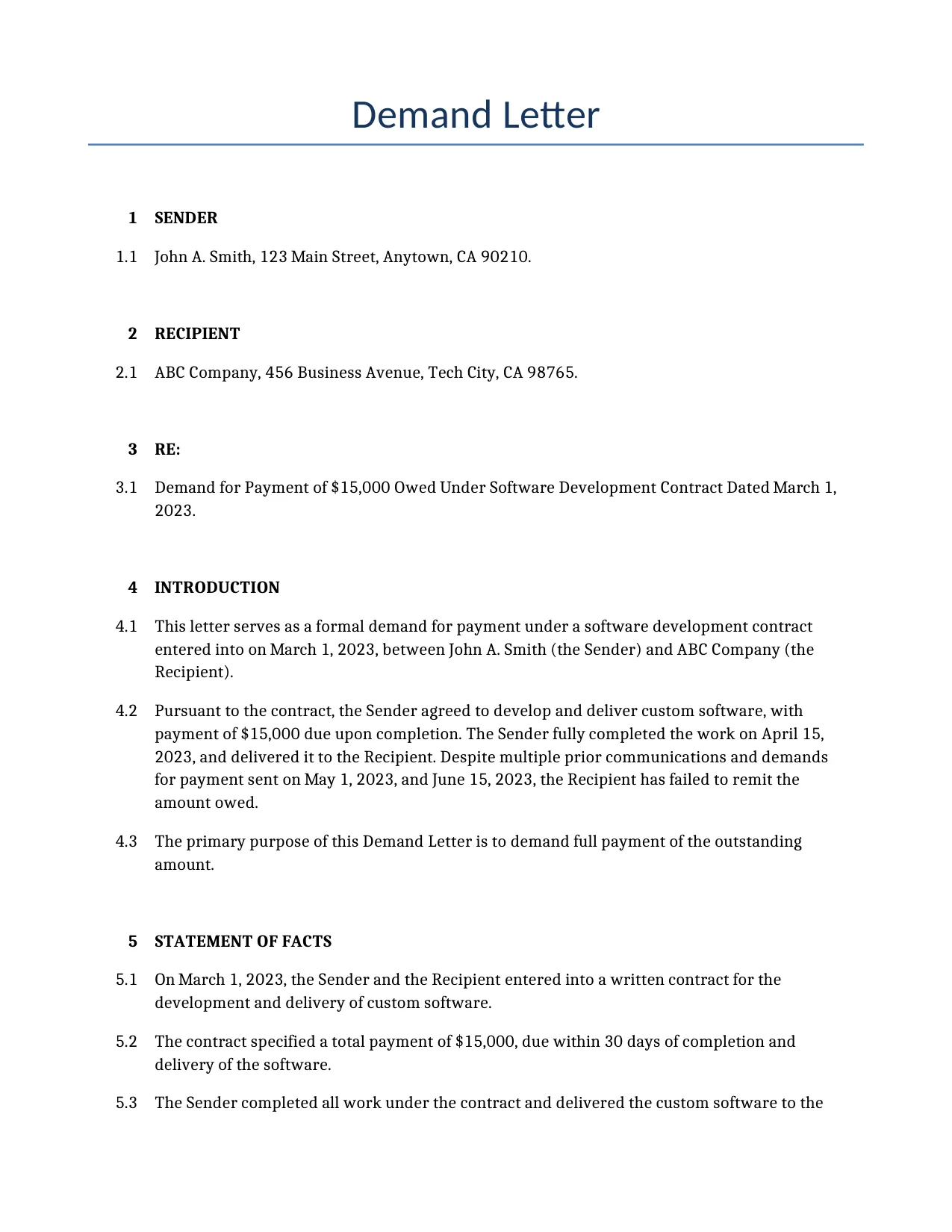
Free Example Demand Letter Template

Below is a free template example of a Demand Letter for use in the United States generated by our AI model.

The clauses in your actual Demand Letter will vary from this example as they will be entirely bespoke to your requirements as set out in the questionnaire you complete.

Page 1

United States Compliance Legislation

Your AI Generated Demand Letter will be checked for compliance against the following legislation and regulations:
Governs the issuance and service of summons in federal civil actions, which often accompanies a demand letter or letter before action to notify a defendant of impending litigation.
Regulates debt collectors, requiring validation notices and prohibiting certain practices; a letter before action in debt collection must comply to avoid unfair practices.
Applies to sales of goods and may require pre-litigation notices or demands before action for breach of contract, influencing demand letters in commercial disputes.
In California, unlawful detainer actions for eviction require a pre-litigation notice to quit, functioning as a letter before action; similar provisions exist in other states.

What is a Demand Letter in the United States?

A demand letter in the US legal context serves as a formal written notice from one party to another, outlining a grievance and demanding specific action or resolution to avoid escalation to court. It acts as an essential first step in many civil disputes, encouraging negotiation and settlement without the need for litigation, thereby saving time and costs for all involved.

Common uses of demand letters include debt collection, where a creditor demands repayment of an overdue amount plus interest, and personal injury claims, such as after a car accident where the injured party seeks compensation for medical bills and pain. These letters detail the facts of the case, the legal basis for the claim, and a deadline for compliance, often including evidence like receipts or witness statements to strengthen the position.

In the broader US legal process, a demand letter fits as a pre-litigation tool that can lead to mediation, arbitration, or voluntary compliance, and if ignored, it becomes key evidence in a subsequent lawsuit to show the recipient was fairly warned. For authoritative guidance on crafting effective demand letters, refer to resources from the American Bar Association or the Nolo legal encyclopedia.

  • Scenario 1: A tenant uses a demand letter to request repairs from a landlord for habitability issues under state housing laws before filing a complaint.
  • Scenario 2: An employee sends one to an employer demanding unpaid wages or severance, citing federal labor regulations like the Fair Labor Standards Act.
  • Scenario 3: A consumer demands a refund from a company for a defective product, referencing consumer protection statutes to prompt a response.

For personalized legal documents like demand letters, consider using bespoke AI-generated options through Docaro to ensure they fit your specific situation accurately and professionally.

When Should You Use a Demand Letter and When Should You Avoid It?

A demand letter is an essential tool in US civil disputes, serving as a formal notice to resolve issues without litigation. It is particularly appropriate for unresolved contractual disputes, where one party has breached an agreement, such as failing to deliver goods or services as promised.

For property damage claims, a demand letter can outline the extent of harm, like vehicle collisions or vandalism, and specify compensation sought. Similarly, in cases of unpaid invoices, it prompts businesses or individuals to settle outstanding debts before escalating to collections or court.

However, avoid using a demand letter in situations involving imminent harm, such as threats of immediate violence, where police intervention is necessary. It is also unsuitable for criminal matters, which require reporting to law enforcement, or when the recipient is likely to respond aggressively, potentially worsening the conflict.

For more details on timing and best practices, see When to Send a Demand Letter: A US Legal Guide. To create tailored demand letters, consider using bespoke AI-generated legal documents via Docaro, ensuring they fit your specific US-based needs. For authoritative guidance, refer to the American Bar Association's resources on demand letters.

What Are the Key Clauses in a Demand Letter?

A demand letter in the US serves as a formal notice to resolve a dispute before litigation, and it begins with the sender's contact information, including name, address, phone, and email, placed at the top for easy identification. Following this, include the date and the recipient's details to ensure professional delivery.

The core of the letter features a clear statement of facts, outlining the incident chronologically with specific details like dates, events, and evidence, avoiding emotional language to maintain objectivity. Next, articulate the legal basis for the claim, referencing relevant US laws or statutes, such as contract breaches under state codes, to substantiate your position; for guidance, consult resources from the American Bar Association.

Specify the demand for relief, such as monetary compensation or corrective action, detailing exact amounts or steps required to settle the matter. Include a deadline for response, typically 14-30 days, and outline consequences of non-compliance, like filing a lawsuit, to create urgency without threats.

Clarity and professionalism are paramount in a demand letter template, using concise language, proper formatting, and polite tone to encourage compliance and strengthen your case if escalated. For customized documents, consider bespoke AI-generated options through Docaro to tailor to your specific US legal needs.

"In demand letters, always incorporate a firm deadline—such as 14 days for compliance—to signal urgency and propel the recipient toward swift resolution, avoiding prolonged disputes," advises legal expert Elena Vasquez. For crafting such tailored documents, leverage bespoke AI-generated legal options via [Docaro's custom templates](https://docaro.com).

What Rights and Obligations Do Parties Have in Relation to a Demand Letter?

In debt collection communications, the sender's rights include the ability to seek legal remedies, such as filing a lawsuit for non-payment if the recipient ignores valid demands. Senders must fulfill obligations by providing accurate facts and documentation to prevent counterclaims for misrepresentation or harassment.

Recipients have obligations to respond reasonably, such as acknowledging receipt and engaging in good-faith discussions to resolve disputes. They also possess rights to negotiate terms or defend against invalid claims, including disputing inaccuracies within 30 days to halt collection efforts.

These dynamics are governed by U.S. laws like the Fair Debt Collection Practices Act (FDCPA), which prohibits abusive practices and requires validation of debts upon request. For detailed guidance, refer to the FTC's FDCPA overview or the CFPB's regulations on consumer protections.

To ensure tailored legal documents for such matters, consider using bespoke AI-generated options from Docaro for personalized demand letters or responses, rather than generic forms.

Are There Key Exclusions or Limitations in Demand Letters?

When drafting a demand letter in the US, avoid including threats of illegal actions, such as suggesting violence or unlawful retaliation, as these can undermine your credibility and potentially lead to legal repercussions against you. Similarly, steer clear of exaggerated claims or demands that exceed your legal entitlements, which might portray your letter as unreasonable and weaken your position in negotiations or court.

Do not use a demand letter for federal violations that require specific procedures, like those under the Fair Debt Collection Practices Act or patent infringements, where formal complaints to agencies such as the FTC are necessary instead. For guidance on common mistakes in US demand letters, refer to Common Mistakes to Avoid in US Demand Letters.

Potential pitfalls include emotional language that escalates conflicts unnecessarily or omitting key facts, which could result in the recipient dismissing your claims. To mitigate risks, opt for bespoke AI-generated legal documents using Docaro, ensuring tailored and precise content over generic templates.

For authoritative insights, consult resources like the American Bar Association's guide on demand letters, which emphasizes professional tone and factual accuracy in US legal communications.

What Recent or Upcoming Legal Changes Affect Demand Letters in the US?

Recent US legal developments have minimally altered the core practices surrounding demand letters, with no sweeping federal changes post-2020 directly impacting their use in consumer disputes. However, state-specific updates to consumer protection laws, such as California's enhancements to the Unfair Competition Law under AB 5 in 2020, emphasize clearer disclosures in demand letters to avoid predatory tactics, though these apply more to employment contexts than general consumer demands.

Electronic delivery requirements for demand letters have seen incremental evolution, particularly with the rise of digital notices under the Electronic Signatures in Global and National Commerce Act (E-SIGN), allowing email or electronic service in many jurisdictions if consent is obtained. For instance, New York's 2021 amendments to its consumer protection statutes now permit e-delivery for debt collection notices, aligning with federal Fair Debt Collection Practices Act guidelines to streamline processes while ensuring accessibility.

Despite these targeted updates, demand letter practices remain stable under common law and federal statutes like the Federal Rules of Civil Procedure, which continue to recognize them as essential pre-litigation tools for resolving disputes amicably. Their ongoing relevance in small claims courts persists, as seen in state courts where demand letters often serve as evidence of good faith efforts, reducing frivolous filings without major overhauls.

How Can You Get Started with Drafting a Demand Letter?

1
Gather Evidence
Collect all relevant documents, communications, and records supporting your claim to build a strong factual foundation.
2
Research Applicable Laws
Identify and study relevant US federal and state laws, statutes, and precedents that apply to your situation.
3
Outline Key Demands
Clearly define your specific demands, including amounts, timelines, and conditions for resolution.
4
Review Writing Guide
Consult the guide [How to Write an Effective Demand Letter in the US](/en-us/a/how-to-write-effective-demand-letter-us) and use Docaro for bespoke AI-generated drafts.

Demand Letter FAQs

A demand letter, also known as a letter before action in the US, is a formal written notice sent to an individual or business demanding payment, performance, or cessation of an action to resolve a dispute without going to court. It's a key first step in many legal claims, outlining your grievances and giving the recipient a deadline to comply.

Document Generation FAQs

Docaro is an AI-powered legal and corporate document generator that helps you create fully formatted, legally sound contracts and agreements in minutes. Just answer a few guided questions and download your document instantly.
You Might Also Be Interested In
A Legal Contract Resolving A Dispute Between Parties Without Court Trial.
A Written Contract Outlining The Terms Resolved Through Mediation To Settle Disputes Outside Of Court.
A Contract Where Parties Agree To Resolve Disputes Through Arbitration Rather Than Court Litigation.
A Formal Letter Demanding That A Party Stop An Alleged Illegal Activity And Refrain From Continuing It.
A Formal Legal Document Filed In Court To Initiate A Civil Lawsuit, Stating The Plaintiff's Claims And Facts Against The Defendant.
A Legal Document Where One Party Releases Another From All Claims, Demands, And Liabilities Arising From A Specific Incident Or Event.
A Legal Document Where Two Parties Mutually Agree To Release Each Other From All Claims, Liabilities, And Obligations Arising From A Prior Agreement Or Dispute.
A Sworn Written Statement Of Facts, Made Under Oath Before An Authorized Official.

Related Articles

A photorealistic image of a determined adult professional sitting at a desk in a modern office, reviewing paperwork with a focused expression, symbolizing the preparation and assertiveness involved in addressing a legal demand.
Learn how to write an effective demand letter in the US with our comprehensive guide. Discover key steps, tips, and templates to resolve disputes and recover damages successfully.
A photorealistic image of a professional adult in a business setting, looking frustrated while reviewing a letter at a desk, symbolizing the avoidance of mistakes in demand letters without showing any legal documents directly.
Discover the most common mistakes to avoid when drafting US demand letters. Learn expert tips to ensure your legal demands are effective, clear, and compliant to maximize success in disputes.
A professional adult in a business setting, such as a confident lawyer or executive at a desk in an office, reviewing notes or preparing for a negotiation, symbolizing the strategic decision of when to assert legal rights through a demand letter. The scene is serious and empowering, with no legal documents visible, focusing on the purpose of resolution and advocacy.
Discover when to send a demand letter in the US. This comprehensive legal guide explains timing, purposes, and steps for effective pre-litigation demands to resolve disputes efficiently.