
AI Generated Code of Conduct and Ethics for use in the United States
PDF & Word - 2026 Updated
Docaro Pricing
When Do You Need a Code of Conduct and Ethics in the United States?
American Legal Rules for a Code of Conduct and Ethics
Using an inappropriate structure for a code of conduct and ethics policy may fail to adequately address regulatory compliance requirements specific to your industry.
What a Proper Code of Conduct and Ethics Should Include
- Compliance with LawsCommit to following all applicable federal, state, and local laws and regulations in the United States.
- Honesty and IntegrityPromote truthful dealings in all business activities, avoiding any form of deception or misrepresentation.
- Conflict of InterestRequire disclosure and management of any personal interests that could influence company decisions.
- Fair TreatmentEnsure equal opportunities and respect for all employees, customers, and partners without discrimination.
- ConfidentialityProtect sensitive company and customer information from unauthorized disclosure.
- Anti-Bribery and CorruptionProhibit offering, accepting, or soliciting bribes or any improper advantages.
- Workplace SafetyMaintain a safe and healthy work environment for all employees.
- Environmental ResponsibilityCommit to sustainable practices that minimize harm to the environment.
- Reporting ViolationsEncourage reporting of any ethical concerns or violations without fear of retaliation.
- Accountability and TrainingProvide regular training and hold everyone accountable for upholding these standards.
Generate Your Document in 4 Easy Steps
Why Use Docaro?
 United States
Free Example Code of Conduct and Ethics Template
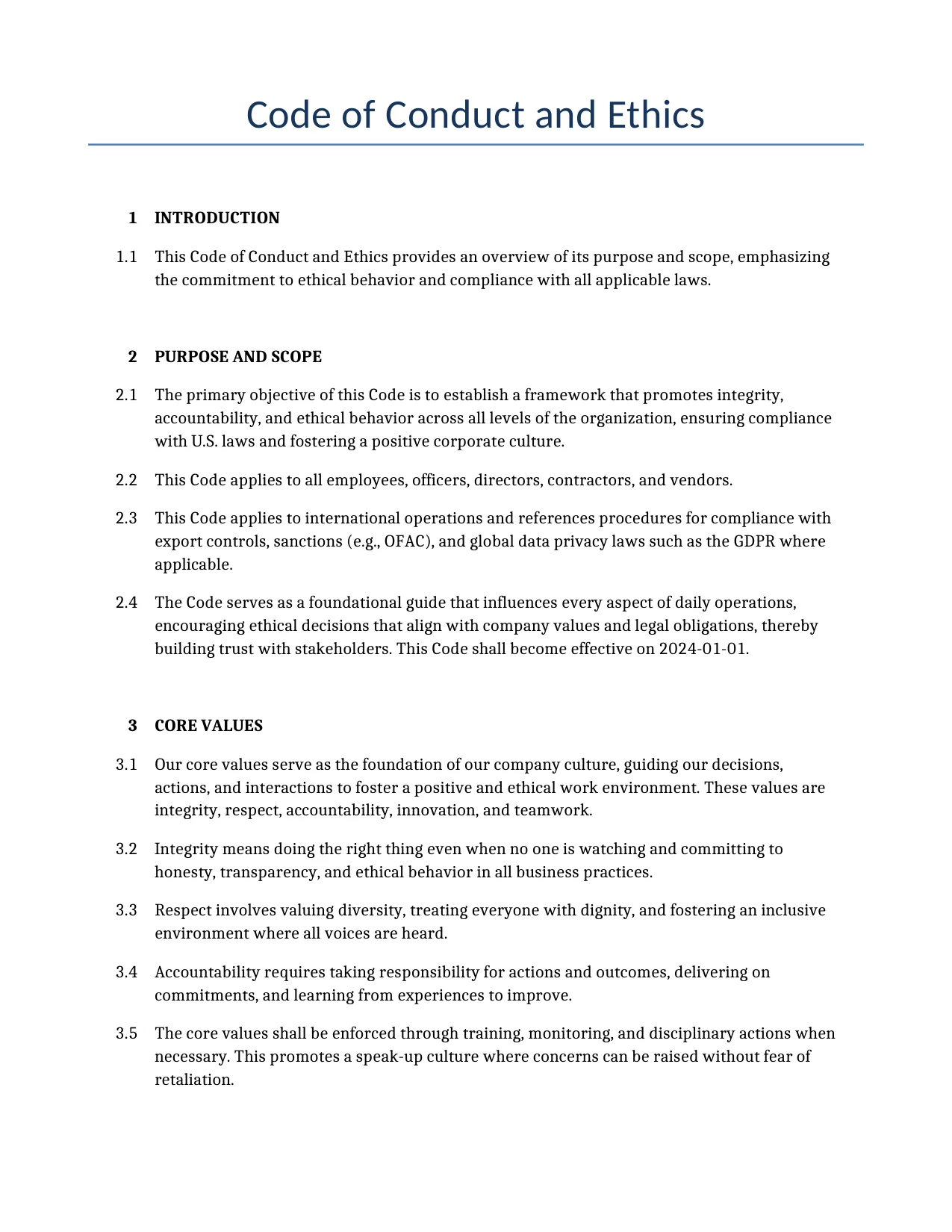
Below is a free template example of a Code of Conduct and Ethics for use in the United States generated by our AI model.
The clauses in your actual Code of Conduct and Ethics will vary from this example as they will be entirely bespoke to your requirements as set out in the questionnaire you complete.
Code of Conduct and Ethics
1INTRODUCTION
This Code of Conduct and Ethics provides an overview of its purpose and scope, emphasizing the commitment to ethical behavior and compliance with all applicable laws.
2PURPOSE AND SCOPE
The primary objective of this Code is to establish a framework that promotes integrity, accountability, and ethical behavior across all levels of the organization, ensuring compliance with U.S. laws and fostering a positive corporate culture.
This Code applies to all employees, officers, directors, contractors, and vendors.
This Code applies to international operations and references procedures for compliance with export controls, sanctions (e.g., OFAC), and global data privacy laws such as the GDPR where applicable.
The Code serves as a foundational guide that influences every aspect of daily operations, encouraging ethical decisions that align with company values and legal obligations, thereby building trust with stakeholders. This Code shall become effective on 2024-01-01.
3CORE VALUES
Our core values serve as the foundation of our company culture, guiding our decisions, actions, and interactions to foster a positive and ethical work environment. These values are integrity, respect, accountability, innovation, and teamwork.
Integrity means doing the right thing even when no one is watching and committing to honesty, transparency, and ethical behavior in all business practices.
Respect involves valuing diversity, treating everyone with dignity, and fostering an inclusive environment where all voices are heard.
Accountability requires taking responsibility for actions and outcomes, delivering on commitments, and learning from experiences to improve.
The core values shall be enforced through training, monitoring, and disciplinary actions when necessary. This promotes a speak-up culture where concerns can be raised without fear of retaliation.
4COMPLIANCE WITH LAWS AND REGULATIONS
All employees, officers, directors, contractors, and vendors must comply with all applicable federal, state, and local laws in the United States, including anti-trust laws.
This Code specifically references the Sarbanes-Oxley Act regarding corporate financial reporting and accountability, the Foreign Corrupt Practices Act regarding anti-bribery and accounting provisions, the Fair Labor Standards Act, Title VII of the Civil Rights Act, the Americans with Disabilities Act (ADA), the Age Discrimination in Employment Act (ADEA), and the Occupational Safety and Health Act for employee rights and workplace compliance.
Employees shall receive training on laws and regulations compliance upon hiring and annually thereafter. Violations of this Code may result in disciplinary action up to and including termination.
5CONFLICTS OF INTEREST
Employees shall disclose any personal, financial, or other interests that could potentially conflict with their professional duties, including outside employment, gifts, entertainment, family or personal relationships, and financial investments. (See also section 15 on Gifts, Entertainment, and Business Courtesies.)
Annual disclosures of potential conflicts of interest are required. Board or management approval is required for any transactions involving personal financial interests.
6CONFIDENTIALITY AND PROPRIETARY INFORMATION
Confidential information includes any non-public data such as business plans, customer lists, financial records, and proprietary technology that could harm the company if disclosed. This Code explicitly addresses the protection of trade secrets and personal data of employees and customers.
Permitted disclosures include those for legal requirements, internal business needs, audits, and advisors. Breaches may result in disciplinary action, termination, civil lawsuits, or criminal charges. This Code imposes ongoing confidentiality obligations after employment ends.
This section cross-references section 13 (Use of Company Assets and Resources), section 16 (Data Privacy and Protection), and the new section on Cybersecurity and Information Security for related policies. Data security measures including password protection, secure storage, access controls, and training are mandated.
7FAIR DEALING AND COMPETITION
The company strictly prohibits offering, promising, or giving anything of value to any government official or third party to influence official actions or secure business advantages, in compliance with the Foreign Corrupt Practices Act (FCPA). This includes kickbacks and unfair competitive tactics such as price fixing, bid rigging, and exclusive dealing.
Employees shall receive training on fair dealing and competition. Reporting mechanisms for suspected violations include an anonymous hotline. Violations will result in disciplinary action up to and including termination and may lead to legal proceedings.
8ANTI-CORRUPTION AND BRIBERY
The company prohibits all forms of bribery, corruption, and improper payments to government officials or business partners in compliance with U.S. anti-corruption laws. This includes prohibitions on political contributions by the company or its employees on its behalf. Charitable donations require approval to prevent misuse.
A confidential reporting mechanism is established for suspected incidents. Periodic audits of third parties are required. (See also section 17 on Supplier and Third-Party Conduct and section 5 on Conflicts of Interest.) Violations may result in disciplinary action up to and including termination.
9FINANCIAL INTEGRITY AND REPORTING
Accurate financial reporting, proper use of company assets, and adherence to accounting standards including Generally Accepted Accounting Principles (GAAP) are required. Fraud prevention measures include an internal audit program, a whistleblower hotline, and segregation of duties. (See also new section on Whistleblower Protections.)
10WORKPLACE HARASSMENT AND DISCRIMINATION
The company prohibits harassment, discrimination, and retaliation based on protected characteristics including race, color, religion, sex, national origin, age (40 or older), disability, genetic information, and other characteristics protected under Title VII of the Civil Rights Act, the Americans with Disabilities Act (ADA), the Age Discrimination in Employment Act (ADEA), and other laws. Examples of prohibited behaviors include unwelcome advances, offensive comments, and unfair treatment in hiring, promotion, or compensation.
Employees can report incidents confidentially to HR via multiple channels. Training is required upon hiring and annually. This promotes a speak-up culture. Violations may result in disciplinary action up to and including termination. (See also section 12 on Diversity, Equity, and Inclusion and new section on Whistleblower Protections.)
11HEALTH, SAFETY, ENVIRONMENT, AND SUSTAINABILITY
The company shall comply with all applicable OSHA, EPA, and other regulations. Annual safety training is required. The company commits to environmental focus areas including waste reduction, emissions control, resource conservation, and sustainability reporting under relevant EPA and SEC guidelines. Environmental impact reporting shall occur as required by law.
Whistleblower protections are included for reporting safety, environmental, or sustainability concerns. This section cross-references the dedicated Whistleblower Protections section. Violations may result in disciplinary action up to and including termination.
12DIVERSITY, EQUITY, AND INCLUSION
Annual diversity, equity, and inclusion training is required. Protected characteristics include race, color, religion, sex, national origin, age, disability, genetic information, and citizenship status. The company commits to equal pay for equal work, inclusive recruitment, and accessibility accommodations.
Employees may report concerns through established channels. This section cross-references section 10 on Workplace Harassment and Discrimination. Violations may result in disciplinary action up to and including termination.
13USE OF COMPANY ASSETS AND RESOURCES
Company assets and resources, including computers, software, equipment, machinery, and intellectual property, must be used responsibly for business purposes. Personal use is limited to reasonable and incidental levels that do not interfere with work or violate policies. The company authorizes monitoring of asset use.
Prohibited activities include unauthorized software installation, accessing inappropriate content, and commercial use for personal gain. A mechanism is provided for reporting suspected misuse. Violations may result in disciplinary action up to and including termination. This section cross-references section 4 on Compliance with Laws, section 6 on Confidentiality, and the new section on Electronic Communications and Social Media Use.
14INSIDER TRADING AND SECURITIES COMPLIANCE
Trading on non-public information by employees, officers, and directors is prohibited. Compliance with all applicable SEC regulations is required. Reporting mechanisms for suspected violations include a hotline and the compliance department. Violations may result in disciplinary action up to and including termination and legal consequences.
15GIFTS, ENTERTAINMENT, AND BUSINESS COURTESIES
Gifts, entertainment, and business courtesies must not influence or appear to influence business decisions. Cash or cash-equivalent gifts are prohibited. Gifts and entertainment should be modest, infrequent, and disclosed as required. (See also section 5 on Conflicts of Interest.)
Items exceeding reasonable value require approval. Reporting of all such items is encouraged. Violations may result in disciplinary action up to and including termination.
16DATA PRIVACY AND PROTECTION
The company is committed to protecting personal data in compliance with applicable laws, including the California Consumer Privacy Act (CCPA/CPRA) for California residents and general FTC guidelines. Encryption of sensitive personal data at rest and in transit is required. Data retention is minimized to what is necessary.
Annual training on data privacy responsibilities is mandated. In the event of a data breach, notification to affected individuals and regulators shall occur within timelines compliant with state laws (e.g., California's). The company shares data with third parties only after vetting their practices. This section cross-references the new Cybersecurity and Information Security section and section 6 on Confidentiality. Violations may result in disciplinary action up to and including termination.
17SUPPLIER AND THIRD-PARTY CONDUCT
Suppliers, contractors, and partners must adhere to principles of integrity, including no bribery or corruption, fair labor practices, environmental responsibility, and respect for human rights. Due diligence and ongoing monitoring, including periodic audits, are required before and during engagement.
Criteria include financial stability, compliance with laws, and reputation. Relationships may be terminated for non-compliance. This section cross-references sections 8 and 15. Violations by company personnel in oversight roles may result in disciplinary action up to and including termination.
18POLITICAL CONTRIBUTIONS AND LOBBYING
The company shall not make political contributions to candidates, parties, or political action committees using company funds. Lobbying activities, if any, must comply with all laws, be approved by appropriate authority, and be reported as required. Use of company funds for personal political activities is prohibited.
An annual review of such activities is required. This section cross-references section 8 on Anti-Corruption. Violations may result in disciplinary action up to and including termination.
19ELECTRONIC COMMUNICATIONS AND SOCIAL MEDIA USE
Electronic communications and social media use must comply with all laws and company policies. Employees shall not disclose confidential information online, must clearly state when not representing the company officially, and avoid conduct that could harm the company's reputation or violate laws.
Guidelines include using disclaimers where appropriate and maintaining professionalism. This section cross-references sections 6, 13, and 16. Violations may result in disciplinary action up to and including termination.
20CYBERSECURITY AND INFORMATION SECURITY
All employees are responsible for maintaining cybersecurity and information security, including using strong passwords, recognizing phishing attempts, and reporting suspicious activity promptly. Incident response procedures must be followed in case of suspected breaches.
Breach notification shall comply with state laws, such as notifying affected parties and regulators within required timelines under California's laws where applicable. This section cross-references sections 6 and 16. Violations may result in disciplinary action up to and including termination.
21WHISTLEBLOWER PROTECTIONS
The company is committed to a speak-up culture and protects whistleblowers from retaliation in accordance with the Sarbanes-Oxley Act, Dodd-Frank Act, and other laws. Safeguards include confidentiality measures, prompt investigation of reports, and prohibition of any adverse action against good-faith reporters.
Procedures for reporting include internal channels and, if necessary, external authorities such as the SEC or OSHA. This section cross-references sections 9, 10, 11, and 19 on Reporting Violations. Reports will be handled confidentially to the extent possible. Violations of whistleblower protections may result in disciplinary action up to and including termination.
22INTERNATIONAL OPERATIONS
For international operations, the company complies with U.S. export controls, economic sanctions administered by the Office of Foreign Assets Control (OFAC), and applicable foreign laws. Where operating in Europe or handling EU data, compliance with the GDPR and similar global data privacy laws is required, including data transfer mechanisms.
Employees involved in international activities shall receive relevant training. This section cross-references sections 2, 4, 7, 8, 16, and 17. Violations may result in disciplinary action up to and including termination and potential legal liability.
23REPORTING VIOLATIONS AND INVESTIGATION
Employees are encouraged to report suspected violations promptly through supervisors, HR, compliance officers, a hotline, or online portal. Anonymous reporting is allowed where permitted by law. Reports should include relevant details while maintaining confidentiality.
All reports will be investigated fairly and promptly, with initial assessments completed expeditiously. Confidentiality is maintained except as required by law. A policy against retaliation for good-faith reports is strictly enforced. This combines prior reporting and investigation elements and cross-references the dedicated Whistleblower Protections section.
Possible consequences for violations include warnings, suspension, termination, and legal action. This promotes a speak-up culture. All employees must cooperate with investigations.
24TRAINING AND EDUCATION
Training on this Code, including key topics such as anti-bribery, conflicts of interest, confidentiality, data protection, harassment, discrimination, and cybersecurity, is required for all employees upon hiring and annually thereafter. Training may include online modules, assessments, and recordkeeping for compliance.
The company shall oversee these programs to ensure understanding and adherence. This supports a culture of compliance. Failure to complete required training may result in disciplinary action.
25WAIVERS AND AMENDMENTS
Waivers or amendments to this Code require approval by the board of directors or senior management, with written documentation. Employees shall receive notice of material changes. Waivers and amendments shall be reviewed periodically for compliance with laws.
26GOVERNING LAW
This Code shall be governed by and construed in accordance with the laws of the United States and applicable state laws.
27DEFINITIONS
Confidential Information: Any non-public data that could harm the company if disclosed, including trade secrets, business plans, customer lists, financial records, and proprietary technology.
Conflict of Interest: A situation where personal, financial, or other interests could interfere with professional duties or the company's interests.
Protected Characteristics: Traits such as race, color, religion, sex, national origin, age, disability, genetic information, and others protected under federal, state, or local anti-discrimination laws.
Whistleblower: An individual who reports suspected violations of this Code, laws, or regulations in good faith.
Senior Management: Executives and other leaders with significant decision-making authority within the company.
28ACKNOWLEDGMENT
I acknowledge that I have received, read, and understand the Code of Conduct and Ethics. I agree to comply with its provisions as a condition of my employment or association with the company. I understand that compliance is an ongoing obligation and that violations may result in disciplinary action, up to and including termination, regardless of whether the violation results in legal liability.
Employee Name: _______________________________
Employee Signature: _______________________________ Date: _______________
For the Company:
Authorized Representative Name: _______________________________
Authorized Representative Signature: _______________________________ Date: _______________
29REVISION HISTORY
Version 1.0 - Effective 2024-01-01: Initial comprehensive revision to ensure completeness, legal compliance with all referenced U.S. federal, state, and local laws (including updates for SOX, Dodd-Frank, ADA, ADEA, CCPA/CPRA, OFAC, FCPA, Title VII, and others), addition of dedicated sections on Whistleblower Protections, Cybersecurity and Information Security, Electronic Communications and Social Media Use, International Operations, ESG/sustainability expansions, Definitions, and Revision History. Removed company-specific transient details (e.g., employee counts, audit dates, incident numbers, specific contacts). Combined redundant content for conciseness while enhancing cross-references, speak-up culture, uniform consequences for non-compliance, and seamless integration. Updated acknowledgment language for ongoing obligations. Signatures section placed last per guidelines.
This example shows approximately 70% of a typical document and is provided for illustrative purposes only. The remaining content has been omitted.
Every document generated by Docaro is tailored to your specific circumstances, jurisdiction and the information you provide. The completed document includes all applicable clauses and provisions required for your situation.
To generate the full, personalised document, answer a short series of questions and your document will be created instantly.