
AI Generated American Asset Purchase Agreement
PDF & Word - 2026 Updated
Docaro Pricing
When do you need an Asset Purchase Agreement in the United States?
American Legal Rules for an Asset Purchase Agreement
Using the wrong structure for an asset purchase agreement can lead to unintended tax liabilities or incomplete transfer of liabilities.
What a Proper Asset Purchase Agreement Should Include
- Parties InvolvedClearly identifies the buyer and seller, including their full legal names and addresses.
- Assets Being SoldLists all specific items, property, or rights being transferred, such as equipment, inventory, or intellectual property.
- Purchase Price and Payment TermsDetails the total amount to be paid and how and when payments will be made, including any installments or adjustments.
- Representations and WarrantiesStates assurances from the seller about the condition, ownership, and value of the assets, and from the buyer about their ability to pay.
- Closing ConditionsOutlines the steps and requirements needed to finalize the deal, like approvals or document exchanges.
- Covenants and ObligationsDescribes what each party must do before and after closing, such as maintaining the assets or providing information.
- IndemnificationExplains how the parties will protect each other from losses or claims related to the assets.
- Termination RightsSpecifies circumstances under which the agreement can be ended before closing, and any consequences.
- Governing LawIndicates which state's laws will apply to interpret and enforce the agreement.
- SignaturesIncludes spaces for the authorized signatories of both parties to execute the document.
Generate Your Document in 4 Easy Steps
Why Use Docaro?
 United States
Free Example Asset Purchase Agreement Template
Below is a free template example of a Asset Purchase Agreement for use in the United States generated by our AI model.
The clauses in your actual Asset Purchase Agreement will vary from this example as they will be entirely bespoke to your requirements as set out in the questionnaire you complete.
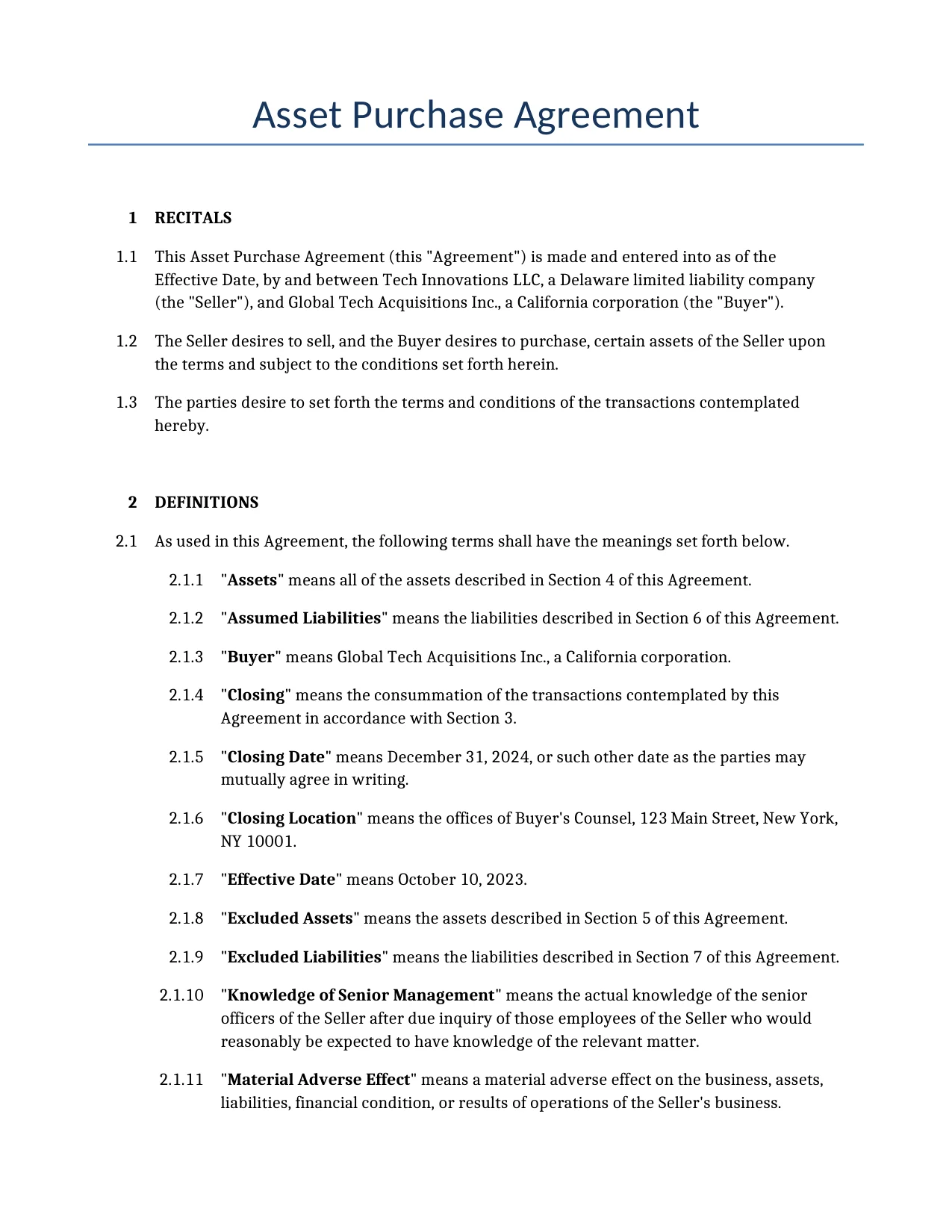
Asset Purchase Agreement
1RECITALS
This Asset Purchase Agreement (this "Agreement") is made and entered into as of the Effective Date, by and between Tech Innovations LLC, a Delaware limited liability company (the "Seller"), and Global Tech Acquisitions Inc., a California corporation (the "Buyer").
The Seller desires to sell, and the Buyer desires to purchase, certain assets of the Seller upon the terms and subject to the conditions set forth herein.
The parties desire to set forth the terms and conditions of the transactions contemplated hereby.
2DEFINITIONS
As used in this Agreement, the following terms shall have the meanings set forth below.
"Assets" means all of the assets described in Section 4 of this Agreement.
"Assumed Liabilities" means the liabilities described in Section 6 of this Agreement.
"Buyer" means Global Tech Acquisitions Inc., a California corporation.
"Closing" means the consummation of the transactions contemplated by this Agreement in accordance with Section 3.
"Closing Date" means December 31, 2024, or such other date as the parties may mutually agree in writing.
"Closing Location" means the offices of Buyer's Counsel, 123 Main Street, New York, NY 10001.
"Effective Date" means October 10, 2023.
"Excluded Assets" means the assets described in Section 5 of this Agreement.
"Excluded Liabilities" means the liabilities described in Section 7 of this Agreement.
"Knowledge of Senior Management" means the actual knowledge of the senior officers of the Seller after due inquiry of those employees of the Seller who would reasonably be expected to have knowledge of the relevant matter.
"Material Adverse Effect" means a material adverse effect on the business, assets, liabilities, financial condition, or results of operations of the Seller's business.
"Purchase Price" means the total consideration for the Assets as defined in Section 8.
"Seller" means Tech Innovations LLC, a Delaware limited liability company.
3PURCHASE AND SALE
Subject to the terms and conditions of this Agreement, at the Closing, the Seller shall sell, assign, transfer, convey, and deliver to the Buyer, and the Buyer shall purchase and acquire from the Seller, all of the Seller's right, title, and interest in and to the Assets, free and clear of all liens and encumbrances, as more particularly described in Section 4.
The Buyer shall not assume any liabilities of the Seller except for the Assumed Liabilities, and the Seller shall retain all Excluded Liabilities.
4ASSETS PURCHASED
The Assets include those items listed on Schedule 4.1 (Tangible Assets), Schedule 4.2 (Intellectual Property), and any other assets expressly identified as included in the Assets, all as more fully described in the respective Schedules attached hereto.
The Assets shall be sufficient for the Buyer to continue the business without material interruption, and all tangible assets shall be in good operating condition, subject to normal wear and tear.
The Seller shall deliver the Assets to the Buyer's Designated Location at the Closing free and clear of any liens or encumbrances.
5EXCLUDED ASSETS
The Excluded Assets shall include those items listed on Schedule 5.1, cash and cash equivalents, accounts receivable, certain inventory, and all assets not expressly included in the Assets.
The exclusions shall take effect as of the Closing Date.
6ASSUMED LIABILITIES
The Buyer shall assume the Assumed Liabilities, which shall include those obligations listed on Schedule 6.1 (Assumed Contracts).
The Buyer shall assume all employee-related obligations for the full-time staff members currently employed by the Seller that are expressly assumed pursuant to Section 23, including accrued vacation time, health benefits continuation, and any vested pension contributions as of the Closing Date.
The Buyer shall assume the Assumed Contracts and Employee Obligations as described herein, and the transfer of employees shall occur by automatic transfer.
7EXCLUDED LIABILITIES
The Seller shall retain all Excluded Liabilities, which shall include those items listed on Schedule 7.1, all outstanding loans, pending lawsuits, unpaid vendor invoices accrued before the Closing Date, trade payables, liabilities related to employees arising prior to the Closing Date, all pre-closing tax liabilities, known litigation liabilities, all environmental liabilities, and liabilities under contracts not assigned to the Buyer.
The Buyer shall not assume any liabilities other than the Assumed Liabilities, and all Excluded Liabilities shall remain the sole responsibility of the Seller.
8PURCHASE PRICE AND PAYMENT
The total Purchase Price shall be $500,000, subject to adjustments for working capital and any earn-out payments based on post-closing performance as set forth in Exhibit C.
The Purchase Price shall be paid by wire transfer as a lump sum payment simultaneously with the Closing. No deposit shall be required unless the parties otherwise agree in writing and amend this Agreement accordingly.
The Purchase Price shall be allocated among the asset categories in accordance with Section 1060 of the Internal Revenue Code, and the parties shall cooperate in preparing IRS Form 8594 consistent with such allocation.
The allocation shall be binding on the parties for tax purposes, and any earn-out provision shall be calculated and paid in accordance with the terms set forth in Exhibit C attached hereto.
9CLOSING
The Closing shall occur on the Closing Date at the Closing Location, upon satisfaction of all conditions precedent, at 10:00 AM Eastern Time.
At the Closing, the Seller shall deliver to the Buyer a bill of sale in the form of Exhibit A and such other instruments of transfer as may be necessary to convey the Assets to the Buyer.
At the Closing, the Buyer shall deliver to the Seller the Purchase Price by wire transfer and shall execute and deliver an assumption agreement in the form of Exhibit B with respect to the Assumed Liabilities.
10REPRESENTATIONS AND WARRANTIES OF THE SELLER
The Seller is a legal entity duly organized, validly existing, and in good standing under the laws of the State of Delaware and is in good standing in all jurisdictions where it conducts business.
The Seller has obtained all necessary authorizations to enter into and perform this Agreement, and the execution, delivery, and performance of this Agreement by the Seller will not conflict with the Seller's organizational documents, any other agreements to which the Seller is a party, or any applicable laws.
This Agreement constitutes a legal, valid, and binding obligation of the Seller, enforceable against the Seller in accordance with its terms.
The Seller has good and marketable title to all of the Assets, free and clear of all liens and encumbrances except as disclosed in the Disclosure Schedule.
To the Knowledge of the Seller, the Assets are sufficient for the Buyer to continue the business without material interruption, and all tangible assets are in good operating condition, subject to normal wear and tear.
To the Knowledge of the Seller, the Seller owns all intellectual property used in the business, free of third-party claims, and has not received any claims of intellectual property infringement regarding the Assets.
The Seller's financial statements as of December 31, 2023, are true, complete, and prepared in accordance with generally accepted accounting principles. To the Knowledge of the Seller, the Seller has no undisclosed liabilities that are material to the Assets or the business.
The Seller is current on all tax filings and payments related to the Assets, complies with all laws regarding employee benefits for the business, which involves approximately 25 employees, and to the Knowledge of the Seller, complies with all environmental laws applicable to the Assets.
To the Knowledge of Senior Management, there have been no material adverse changes in the Seller's business or Assets since December 31, 2023, and the Seller has disclosed all material facts regarding the representations and warranties in this Section 10.
The Seller holds all required environmental permits, including an Air Emissions Permit issued by the California Air Resources Board expiring December 31, 2025, a Hazardous Waste Generator Permit issued by the U.S. Environmental Protection Agency expiring June 15, 2026, and a Wastewater Discharge Permit issued by the State Water Resources Control Board expiring March 20, 2024, and is in compliance with all applicable environmental laws.
The intellectual property assets being transferred include patents, trademarks, and copyrights as specifically described in Schedule 4.2, all of which are owned by the Seller free of liens, are registered and active, and are not subject to any licenses, claims of infringement, or past litigation.
No broker, finder or investment banker is entitled to any brokerage, finder's or other fee or commission in connection with the transactions contemplated by this Agreement based upon arrangements made by or on behalf of the Seller, except as disclosed in the Disclosure Schedule.
The Assets and the Seller's operation of the business have been in compliance with all applicable export control laws, including the Export Administration Regulations, and all applicable sanctions laws administered by the Office of Foreign Assets Control (OFAC). No Assets are subject to export restrictions that would impair the transfer to the Buyer.
11REPRESENTATIONS AND WARRANTIES OF THE BUYER
The Buyer is a corporation duly organized, validly existing, and in good standing under the laws of the State of Delaware and is qualified to do business as a foreign entity in all jurisdictions where it conducts business.
The Buyer has duly authorized the execution, delivery, and performance of this Agreement, and the execution, delivery, and performance of this Agreement by the Buyer will not conflict with the Buyer's organizational documents, any applicable laws, or any other agreements to which the Buyer is a party.
This Agreement constitutes a valid and binding obligation of the Buyer upon execution.
The Buyer is not involved in any litigation that could affect its ability to perform under this Agreement, has self-funded the Purchase Price with available cash, and has completed all necessary due diligence on the Assets.
The Buyer acknowledges that it is not relying on any representations except those expressly stated in this Agreement.
No broker, finder or investment banker is entitled to any brokerage, finder's or other fee or commission in connection with the transactions contemplated by this Agreement based upon arrangements made by or on behalf of the Buyer, except as disclosed in the Disclosure Schedule.
12COVENANTS OF THE SELLER
During the period from the Effective Date until the Closing, the Seller shall conduct the business only in the ordinary course, shall preserve relationships with customers, suppliers, and employees, shall maintain the Assets in good condition, and shall provide the Buyer with reasonable access to information and personnel.
The Seller shall not take any action that would cause its representations and warranties to become untrue or that would result in a Material Adverse Effect.
The Seller shall use commercially reasonable efforts to obtain all required third-party consents for the assignment of Assumed Contracts, key permits, and licenses, and to make all necessary governmental filings, if any, including under the Hart-Scott-Rodino Antitrust Improvements Act if applicable.
13COVENANTS OF THE BUYER
The Buyer shall use its best efforts to consummate the transactions contemplated by this Agreement, shall conduct its review of the business in the ordinary course until the Closing Date, shall provide the Seller with reasonable access during business hours, and shall maintain the confidentiality of the Seller's information prior to the Closing.
Following the Closing, the Buyer shall provide assistance with tax filings and employee transition support as requested by the Seller.
The Buyer shall use commercially reasonable efforts to obtain all required third-party consents and to make all necessary governmental filings, if any.
14CONDITIONS PRECEDENT TO THE BUYER'S OBLIGATIONS
The Buyer's obligation to close the transactions contemplated by this Agreement is subject to the condition that the Seller's representations and warranties are true and correct in all material respects as of the Closing Date.
There shall have been no Material Adverse Effect in the business or financial condition of the Assets since the date of this Agreement.
The Seller shall have delivered an officer's certificate confirming compliance with all obligations under this Agreement, all necessary third-party consents for the asset transfer shall have been obtained, and no injunction or legal proceeding shall be pending that would prevent the Closing.
All conditions precedent must be satisfied on or before the Closing Date, or the Buyer may terminate this Agreement.
15CONDITIONS PRECEDENT TO THE SELLER'S OBLIGATIONS
The Seller's obligation to close the transactions contemplated by this Agreement is subject to the condition that the Buyer's representations and warranties are true and correct as of the Closing Date and that the Buyer has complied with all covenants in this Agreement.
The Seller shall have received the full Purchase Price, all required closing documents and deliverables from the Buyer, and there shall be no injunctions, orders, or legal proceedings preventing the transaction.
All conditions precedent must be satisfied on or before the Closing Date, or the Seller may terminate this Agreement.
16INDEMNIFICATION
The Seller shall indemnify the Buyer against all losses arising from breaches of the Seller's representations, warranties, or covenants in this Agreement.
The Buyer shall indemnify the Seller against all losses arising from breaches of the Buyer's representations, warranties, or covenants in this Agreement.
The survival period for general representations and warranties shall end on December 31, 2025, and claims shall be subject to a deductible basket of $50,000.00 USD with a cap on indemnity liability for general claims of $1,000,000.00 USD.
Fundamental representations such as title, authority, and capitalization shall not be subject to the cap, and notice of a claim must be provided within 30 days to trigger indemnification.
The Buyer shall control the defense of third-party claims, and indemnification shall be the exclusive remedy for breaches in this Agreement.
Promptly after receipt by the indemnified party of notice of any claim or the commencement of any action for which indemnification is sought, the indemnified party shall notify the indemnifying party in writing; provided, however, that the failure to provide such notice shall not relieve the indemnifying party of its obligations except to the extent the indemnifying party is actually prejudiced thereby.
If any third-party claim is brought against the indemnified party, the indemnifying party shall be entitled to assume the defense thereof with counsel reasonably satisfactory to the indemnified party. If the indemnifying party assumes the defense, it shall not settle the claim without the prior written consent of the indemnified party (which consent shall not be unreasonably withheld). The indemnified party shall cooperate in the defense at the indemnifying party's expense.
For any direct claim (not involving a third party), the indemnified party shall provide written notice to the indemnifying party. The indemnifying party shall have 30 days to respond and investigate. If the parties cannot agree, the claim shall be resolved in accordance with the Dispute Resolution provisions of this Agreement.
17TERMINATION
This Agreement may be terminated by mutual written consent of the Buyer and the Seller.
Either party may terminate this Agreement if the other party materially breaches its obligations and fails to cure such breach within 10 business days after notice thereof.
Either party may terminate this Agreement if the Closing does not occur by December 31, 2024, or if required regulatory approvals are not obtained by such date.
Upon termination under specified conditions including mutual agreement or seller material breach, or failure of closing conditions, any deposit (if one has been paid pursuant to a separate escrow agreement) shall be returned or forfeited as provided therein. If no deposit has been paid, no such right shall apply.
18EFFECT OF TERMINATION
Upon termination of this Agreement, all obligations of the parties shall cease, except that the confidentiality obligations shall survive termination.
Termination shall not relieve any party from liability for any willful breach of this Agreement prior to termination.
19SURVIVAL
The provisions regarding indemnification, confidentiality, non-compete clauses, tax representations, and tax indemnities shall survive the Closing or termination of this Agreement for a period of 5 years.
All other provisions of this Agreement shall not survive except as expressly provided herein.
20CONFIDENTIALITY
Each party shall maintain the confidentiality of the other party's financial records, trade secrets, and business plans disclosed in connection with this Agreement, and such obligations shall be mutual.
Confidential information may be disclosed to affiliates or representatives who have a need to know and who are bound by similar confidentiality obligations.
The confidentiality obligations shall survive the Closing and shall continue until December 31, 2025.
In the event of a breach of confidentiality, the non-breaching party shall be entitled to injunctive relief, monetary damages, and, in the case of the Seller, indemnification.
21NON-COMPETITION AND NON-SOLICITATION
For a period of 3 years following the Closing Date, the Seller shall not, directly or indirectly, engage in any business competitive with the business of the Seller as conducted on the Effective Date, within the geographic areas in which the Seller conducted such business on the Effective Date (limited to the specific markets and territories served by the transferred Assets and business).
For a period of 3 years following the Closing Date, the Seller shall not solicit any customers or employees of the business acquired by the Buyer.
The non-competition and non-solicitation restrictions shall be governed by and construed in accordance with the laws of the State of Delaware. The parties agree that such restrictions are intended to be reasonable and necessary to protect the Buyer's interests in the Assets purchased. If any provision is held to be unenforceable under applicable law (including California Business & Professions Code Section 16601), such provision shall be severed or reformed to the minimum extent necessary to render it enforceable, and the remaining provisions shall remain in full force and effect. The parties acknowledge potential enforceability issues under California law and agree that Delaware law shall apply exclusively to the maximum extent permitted.
22TAXES
The Buyer shall be responsible for paying any sales taxes arising from the asset purchase, and the Seller shall be responsible for paying any transfer taxes arising from the asset purchase.
The Buyer shall be responsible for any income taxes attributable to the Assets for periods after the Closing Date, and the Seller shall be responsible for all income taxes related to the Assets for periods before the Closing Date.
The parties shall provide full cooperation to each other regarding tax matters post-Closing, including with respect to the preparation and filing of all tax returns and the allocation of the Purchase Price under Section 1060 of the Internal Revenue Code.
23EMPLOYEE MATTERS
The approximately 25 employees of the Seller, consisting of full time employees, part time employees, and independent contractors, shall transfer automatically to the Buyer as of the Closing Date.
The Seller shall pay out all accrued but unused vacation, sick leave, or other paid time off for transferring employees as of the most recent payroll date prior to Closing.
There are no employees represented by a labor union, no pending or threatened labor disputes, and the Seller maintains employee benefit plans. The transaction will not trigger any obligations under the Worker Adjustment and Retraining Notification Act (WARN Act).
Except as set forth on Schedule 6.1, the Buyer shall not assume any Employee Benefit Plans subject to ERISA. The Seller shall be responsible for all COBRA obligations with respect to any qualifying events occurring on or prior to the Closing Date. The Seller represents that it does not maintain or contribute to any multiemployer plan. The Seller is in compliance in all material respects with all applicable employment laws.
24ENVIRONMENTAL MATTERS
The Seller has provided a complete list of all environmental permits as set forth in Section 10.10, is in compliance with all applicable environmental laws, uses hazardous materials in its operations, has not had any environmental site assessments in the past five years, has no pending environmental claims, and has not undertaken any remediation.
The Seller shall indemnify the Buyer for any environmental liabilities arising from pre-Closing operations, consistent with the indemnification provisions in Section 16.
25INTELLECTUAL PROPERTY
The Seller shall transfer all intellectual property assets, including the patents, trademarks, and copyrights specifically described in Schedule 4.2, to the Buyer at Closing by execution of appropriate assignment documents.
The Seller confirms that it owns all such intellectual property free of any liens or encumbrances, that all registrations are active, that there are no existing licenses to third parties, and that there are no claims or litigation related to the intellectual property, in each case to the Knowledge of the Seller.
26INSURANCE
The Seller maintains general liability insurance under Policy Number GL-12345 with ABC Insurance Co. and property insurance under Policy Number PROP-67890 with XYZ Insurers, both with coverage limits of $1,000,000 and expiring on December 31, 2024. All such policies are in full force and effect, and no claims are pending thereunder that would reasonably be expected to affect the Assets or the transferred business. To the extent relevant to the software business, the Seller maintains product liability and cyber liability insurance.
The Seller shall obtain and pay for tail insurance policies covering pre-Closing risks for a duration of at least 3 years following the Closing Date for D&O, E&O, and general liability coverage, as applicable.
27EXPENSES
Each party shall pay its own legal fees and expenses in connection with this transaction.
The Seller shall pay all accounting fees, all broker or finder fees, and all transfer taxes and similar charges.
All other transaction costs, fees, and expenses shall be allocated as each party pays their own expenses.
28PRESS RELEASES AND PUBLIC ANNOUNCEMENTS
The Buyer may issue press releases or public announcements regarding the transaction only with the prior written consent of the Seller, and the Seller shall not issue any press releases or public announcements without the prior written consent of the Buyer.
The restrictions on press releases and public announcements shall survive the Closing of the transaction.
29FURTHER ASSURANCES
Each of the Buyer and the Seller shall execute and deliver any additional documents, instruments, or conveyances reasonably required to consummate the transactions contemplated by this Agreement.
The parties shall mutually cooperate in good faith to take all actions necessary to carry out the terms of this Agreement, and such further assurances obligations shall survive the Closing indefinitely.
30NOTICES
All notices under this Agreement shall be in writing and shall be delivered by personal delivery, certified mail, or email to the addresses set forth below.
Notices to the Buyer shall be sent to 123 Buyer Street, Suite 100, New York, NY 10001, and notices to the Seller shall be sent to 456 Seller Avenue, Los Angeles, CA 90001.
Notices shall be deemed delivered 3 business days after mailing by certified mail, upon personal delivery, or upon confirmation of receipt if sent by email.
Copies of all notices shall be sent to legal counsel for both parties at the addresses to be provided in writing by each party.
31GOVERNING LAW
This Agreement shall be governed by and construed in accordance with the laws of the State of Delaware, without regard to its conflict of laws principles. The parties agree that any California corporate status or other conflicts shall not apply.
Each party hereby consents to the exclusive jurisdiction of the courts of the State of Delaware for any action arising out of or relating to this Agreement, subject to the Dispute Resolution provisions hereof.
EACH PARTY HEREBY IRREVOCABLY WAIVES ANY AND ALL RIGHT TO TRIAL BY JURY IN ANY LEGAL PROCEEDING ARISING OUT OF OR RELATING TO THIS AGREEMENT OR THE TRANSACTIONS CONTEMPLATED HEREBY.
32DISPUTE RESOLUTION
Any dispute arising out of or relating to this Agreement shall be resolved by arbitration in accordance with the rules of the American Arbitration Association in the State of Delaware.
The arbitration proceedings shall be confidential, and the prevailing party in any dispute shall be entitled to recover its attorney fees and costs.
33ASSIGNMENT
The Buyer may assign this Agreement to a third party without the Seller's consent, provided that the Buyer remains liable for all obligations hereunder.
The Seller may not assign this Agreement without the prior written consent of the Buyer.
This Agreement shall bind and inure to the benefit of the parties' successors and assigns, and all required third-party consents for assignments of assumed contracts, key permits, and licenses shall be obtained prior to Closing.
34ENTIRE AGREEMENT
This Agreement, together with all exhibits and schedules hereto, constitutes the full understanding between the parties and supersedes all prior agreements, understandings, or representations, whether oral or written.
No future modifications to this Agreement shall be effective unless in a written amendment signed by both parties.
35AMENDMENTS AND WAIVERS
All amendments to this Agreement must be in writing and signed by both the Buyer and the Seller, and no oral amendments are permitted.
Any waiver of provisions in this Agreement must be in writing and signed by the waiving party, and a waiver of any provision does not constitute a waiver of any other provision or future breach.
Amendments may be signed on behalf of the Buyer by its Chief Executive Officer or any authorized officer, and waivers may be signed on behalf of the Seller by its Chief Executive Officer or its Board of Directors.
36SEVERABILITY
If any provision of this Agreement is held to be invalid or unenforceable, such provision shall be severed from this Agreement, and the remaining provisions shall remain in full force and effect. Without limiting the foregoing, if any provision of the non-competition covenant in Section 21 is held invalid, it shall be reformed to the extent necessary to make it enforceable.
37COUNTERPARTS
This Agreement may be executed in counterparts, each of which shall be deemed an original, but all of which together shall constitute one and the same instrument.
Execution of this Agreement by electronic signatures shall be permitted and shall have the same effect as original signatures.
38HEADINGS
The headings in this Agreement are for convenience only and shall not affect the substantive meaning of the provisions.
39PRORATIONS
All items of expense and income relating to the Assets, including utilities, rents, real and personal property taxes, and other operating expenses, shall be prorated as of the Closing Date. The Seller shall be responsible for all such items up to but not including the Closing Date, and the Buyer shall be responsible for all such items from and after the Closing Date. Any prorations not determinable at Closing shall be adjusted by the parties within 90 days after the Closing Date, with payment made to the appropriate party within 10 days thereafter.
40REGULATORY APPROVALS AND CONSENTS
The parties shall use commercially reasonable efforts to obtain all required third-party consents for the assignment of the Assumed Contracts, Permits, and licenses included in the Assets. The parties shall make all necessary governmental filings, if any (including any filings that may be required under the Hart-Scott-Rodino Antitrust Improvements Act, though none are expected for a transaction of this size).
The receipt of all such material consents and the making of all such filings shall be a condition to the obligations of the Buyer and the Seller to consummate the transactions contemplated hereby, as provided in Sections 14 and 15.
41BULK SALES LAWS
The parties acknowledge that certain jurisdictions may have bulk sales or bulk transfer laws (including under UCC Article 6, if applicable). The Seller shall comply with any such laws to the extent required, or the parties shall obtain waivers thereof. Any liabilities arising from non-compliance with bulk sales laws shall be treated as Excluded Liabilities of the Seller, unless otherwise agreed in writing.
42LIMITATION ON DAMAGES
Except in the case of fraud or willful misconduct, or as provided in the indemnification for third-party claims in Section 16, neither party shall be liable to the other for any punitive, incidental, consequential, special, or indirect damages (including lost profits or loss of business) arising out of or relating to this Agreement.
43EXHIBITS AND SCHEDULES
The following Exhibits and Schedules are attached hereto and incorporated herein by reference and shall be deemed a part of this Agreement:
Exhibit A: Bill of Sale
Exhibit B: Assignment and Assumption Agreement
Exhibit C: Earn-Out Provisions
Schedule 4.1: List of Tangible Assets
Schedule 4.2: Intellectual Property
Schedule 5.1: Excluded Assets
Schedule 6.1: Assumed Contracts
Schedule 7.1: Excluded Liabilities
Schedule 10: Disclosure Schedule
Any other schedules or exhibits referenced herein.
44COMPLIANCE WITH SPECIFIC LAWS
The transactions contemplated by this Agreement are in compliance with Article 2 and Article 9 of the Uniform Commercial Code as adopted in the applicable jurisdictions, and title to the Assets shall pass in accordance with UCC Section 2-401.
The parties have considered the requirements of Section 7 of the Clayton Act and have determined that the transaction does not substantially lessen competition or tend to create a monopoly.
The allocation of the Purchase Price has been determined in accordance with Section 1060 of the Internal Revenue Code, and the parties agree to report the transaction consistently therewith.
The Seller represents that the transaction is not intended to hinder, delay, or defraud any creditors within the meaning of the Uniform Fraudulent Transfer Act or the Uniform Voidable Transactions Act as adopted in the applicable jurisdictions.
45FORCE MAJEURE
Neither party shall be liable for any delay or failure to perform its obligations hereunder (other than payment obligations) if such delay or failure results from events beyond its reasonable control, including acts of God, war, terrorism, pandemics, strikes, or governmental orders (a "Force Majeure Event"). The affected party shall promptly notify the other party and use commercially reasonable efforts to mitigate the effects. If a Force Majeure Event prevents Closing for more than 60 days beyond the scheduled Closing Date, either party may terminate this Agreement pursuant to Section 17 without liability.
46SIGNATURES
IN WITNESS WHEREOF, the parties have executed this Asset Purchase Agreement as of the date first above written.
SELLER: Tech Innovations LLC, a Delaware limited liability company By: _______________________________ Name: Title: Date:
BUYER: Global Tech Acquisitions Inc., a California corporation By: _______________________________ Name: Title: Date:
This example shows approximately 70% of a typical document and is provided for illustrative purposes only. The remaining content has been omitted.
Every document generated by Docaro is tailored to your specific circumstances, jurisdiction and the information you provide. The completed document includes all applicable clauses and provisions required for your situation.
To generate the full, personalised document, answer a short series of questions and your document will be created instantly.