
AI Generated American Software License Agreement
PDF & Word - 2026 Updated
Docaro Pricing
When Do You Need a Software License Agreement in the United States?
American Legal Rules for a Software License Agreement
Using the wrong type of software license agreement can inadvertently grant unintended usage rights or expose you to intellectual property risks.
What a Proper Software License Agreement Should Include
- License GrantThis section clearly states what rights the user gets to use the software, such as personal or commercial use, and any limits on copying or sharing it.
- Payment TermsIt outlines how much the user must pay, when payments are due, and what happens if payments are late or missed.
- Restrictions on UseThis lists what the user cannot do with the software, like reverse-engineering it or using it for illegal purposes.
- Intellectual Property RightsIt confirms that the software owner keeps all copyrights and trademarks, and the user doesn't gain ownership.
- Warranties and DisclaimersThis explains any guarantees about the software's performance and limits the owner's responsibility for issues.
- Liability LimitsIt caps the owner's financial responsibility for any damages caused by the software to protect against big claims.
- Termination RulesThis describes when and how the license can end, like for breaking the rules, and what the user must do afterward.
- ConfidentialityIt requires the user to keep private information about the software secret and not share it with others.
- Governing LawThis specifies which U.S. state's laws apply to the agreement and where disputes will be handled.
Generate Your Document in 4 Easy Steps
Why Use Docaro?
 United States
Free Example Software License Agreement Template
Below is a free template example of a Software License Agreement for use in the United States generated by our AI model.
The clauses in your actual Software License Agreement will vary from this example as they will be entirely bespoke to your requirements as set out in the questionnaire you complete.
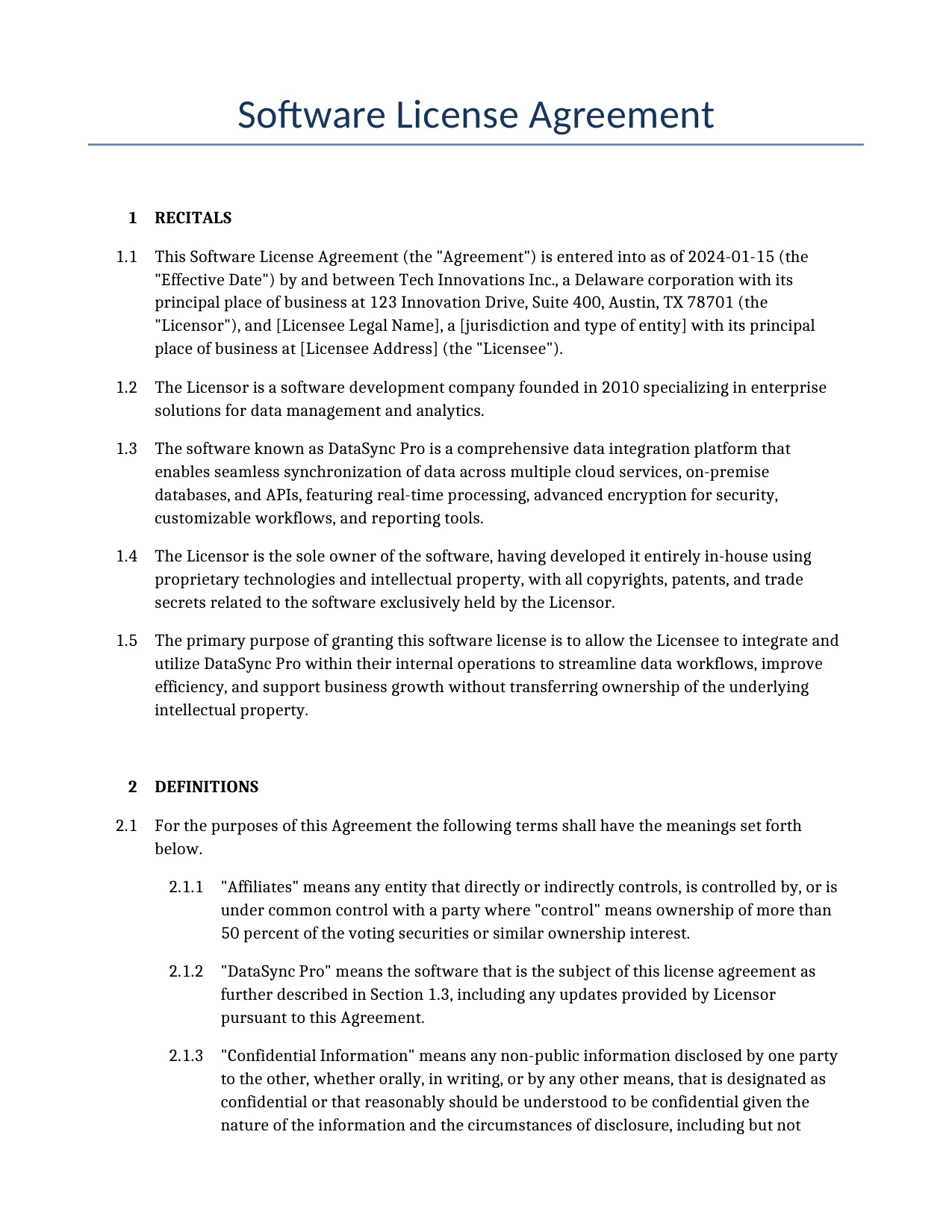
Software License Agreement
1RECITALS
This Software License Agreement (the "Agreement") is entered into as of 2024-01-15 (the "Effective Date") by and between Tech Innovations Inc., a Delaware corporation with its principal place of business at 123 Innovation Drive, Suite 400, Austin, TX 78701 (the "Licensor"), and [Licensee Legal Name], a [jurisdiction and type of entity] with its principal place of business at [Licensee Address] (the "Licensee").
The Licensor is a software development company founded in 2010 specializing in enterprise solutions for data management and analytics.
The software known as DataSync Pro is a comprehensive data integration platform that enables seamless synchronization of data across multiple cloud services, on-premise databases, and APIs, featuring real-time processing, advanced encryption for security, customizable workflows, and reporting tools.
The Licensor is the sole owner of the software, having developed it entirely in-house using proprietary technologies and intellectual property, with all copyrights, patents, and trade secrets related to the software exclusively held by the Licensor.
The primary purpose of granting this software license is to allow the Licensee to integrate and utilize DataSync Pro within their internal operations to streamline data workflows, improve efficiency, and support business growth without transferring ownership of the underlying intellectual property.
2DEFINITIONS
For the purposes of this Agreement the following terms shall have the meanings set forth below.
"Affiliates" means any entity that directly or indirectly controls, is controlled by, or is under common control with a party where "control" means ownership of more than 50 percent of the voting securities or similar ownership interest.
"DataSync Pro" means the software that is the subject of this license agreement as further described in Section 1.3, including any updates provided by Licensor pursuant to this Agreement.
"Confidential Information" means any non-public information disclosed by one party to the other, whether orally, in writing, or by any other means, that is designated as confidential or that reasonably should be understood to be confidential given the nature of the information and the circumstances of disclosure, including but not limited to software, documentation, business plans, customer data, financial information, and trade secrets.
"Licensee" means [Licensee Legal Name].
"Licensor" means Tech Innovations Inc.
"Personal Information" means any information that identifies, relates to, describes, is reasonably capable of being associated with, or could reasonably be linked, directly or indirectly, with a particular consumer or household, as defined under the California Consumer Privacy Act (CCPA).
3GRANT OF LICENSE
Subject to the terms and conditions of this Agreement, including payment of all applicable fees, the Licensor hereby grants to the Licensee a non-exclusive, non-transferable, non-sublicensable, revocable license during the Term (as defined in Section 11) to use DataSync Pro solely for Licensee's internal business purposes. This license does not include any right to commercial distribution, sale, sublicensing, or use by third parties.
The license granted herein is limited to the scope expressly set forth in this Section 3 and does not grant Licensee any rights to the software's source code unless separately agreed in writing. Any use beyond the scope requires prior written consent from Licensor.
4LICENSE RESTRICTIONS
The Licensee shall not, and shall not permit any third party to: (a) reverse engineer, decompile, disassemble, or otherwise attempt to derive the source code of the software; (b) modify, adapt, create derivative works from, or translate the software; (c) rent, lease, lend, sell, sublicense, assign, distribute, or otherwise transfer the software or any rights therein; or (d) remove, alter, or obscure any proprietary notices on the software.
The Licensee may make a reasonable number of copies of the software solely for backup and archival purposes for internal use, provided all copies include all original proprietary notices.
The Licensee shall comply with all applicable U.S. export control and economic sanctions laws.
5PAYMENT TERMS
The Licensee shall pay to the Licensor an upfront license fee of $5,000 upon execution of this Agreement. If applicable, Licensee shall also pay annual support and maintenance fees as set forth in Exhibit A.
The Licensee shall be responsible for all taxes associated with the payments made under this Agreement, excluding taxes based on Licensor's net income. Late payments shall accrue interest at 1.5% per month or the maximum rate permitted by law.
6INTELLECTUAL PROPERTY RIGHTS
As between the parties, Licensor retains all right, title, and interest in and to DataSync Pro, including all intellectual property rights therein. Except for the limited license granted in Section 3, no other rights are granted to Licensee.
The software does not include any third-party components, libraries, or open-source materials except as expressly disclosed in Exhibit B.
Any suggestions, ideas, or feedback provided by Licensee regarding the software shall be considered Licensor's Confidential Information, and Licensee hereby assigns all right, title, and interest in such feedback to Licensor.
7CONFIDENTIALITY
Each party agrees to maintain the confidentiality of the other party's Confidential Information and not to disclose it to any third party without the prior written consent of the disclosing party. The receiving party shall use the Confidential Information solely for purposes of performing its obligations or exercising its rights under this Agreement.
Confidential Information does not include information that: (a) is or becomes publicly available through no fault of the receiving party; (b) was rightfully obtained by the receiving party from a third party without breach of any confidentiality obligation; or (c) is independently developed by the receiving party without use of or reference to the disclosing party's Confidential Information.
The confidentiality obligations shall survive for five (5) years after disclosure or termination of this Agreement, except with respect to trade secrets, which shall survive for as long as they remain trade secrets under applicable law.
8WARRANTIES AND DISCLAIMERS
Licensor warrants that for a period of ninety (90) days from the Effective Date (the "Warranty Period"), the software, when used in accordance with the documentation, will substantially conform to the specifications set forth in the documentation. Licensor's sole obligation and Licensee's exclusive remedy for breach of this warranty is for Licensor to, at its option, repair or replace the non-conforming software or refund the license fees paid for the software.
EXCEPT AS EXPRESSLY SET FORTH IN THIS SECTION 8, THE SOFTWARE IS PROVIDED "AS IS." LICENSOR DISCLAIMS ALL OTHER WARRANTIES, EXPRESS OR IMPLIED, INCLUDING BUT NOT LIMITED TO WARRANTIES OF MERCHANTABILITY, FITNESS FOR A PARTICULAR PURPOSE, TITLE, AND NON-INFRINGEMENT. LICENSOR DOES NOT WARRANT THAT THE SOFTWARE WILL BE ERROR-FREE OR UNINTERRUPTED OR THAT IT WILL MEET LICENSEE'S REQUIREMENTS.
This warranty does not apply to any defects caused by misuse, unauthorized modification, or use of the software in violation of this Agreement.
9INDEMNIFICATION
Licensor shall indemnify, defend, and hold harmless Licensee from and against any third-party claims, damages, liabilities, and expenses (including reasonable attorneys' fees) arising from any claim that the software, when used in accordance with this Agreement and the documentation, infringes any U.S. patent, copyright, or trade secret (an "IP Claim").
Licensee shall indemnify, defend, and hold harmless Licensor from and against any claims, damages, liabilities, and expenses arising from: (a) Licensee's use of the software in violation of this Agreement; (b) any modification of the software by Licensee; or (c) any claim that Licensee's data or use of the software with Licensee's other products or services infringes any intellectual property rights.
The indemnified party shall promptly notify the indemnifying party in writing of any claim and provide reasonable cooperation in the defense. The indemnifying party shall have sole control over the defense and settlement of the claim, provided that no settlement shall require the indemnified party to admit liability or pay any amount without its prior written consent.
If the software is subject to an IP Claim, Licensor may, at its option: (a) procure the right for Licensee to continue using the software; (b) replace or modify the software to make it non-infringing; or (c) terminate the license and refund a pro-rata portion of the license fees paid.
10LIMITATION OF LIABILITY
IN NO EVENT SHALL EITHER PARTY'S TOTAL CUMULATIVE LIABILITY ARISING OUT OF OR RELATED TO THIS AGREEMENT EXCEED THE AMOUNTS PAID OR PAYABLE BY LICENSEE TO LICENSOR DURING THE TWELVE (12) MONTHS IMMEDIATELY PRECEDING THE FIRST EVENT GIVING RISE TO LIABILITY, REGARDLESS OF THE CAUSE OF ACTION OR THEORY OF LIABILITY.
NEITHER PARTY SHALL BE LIABLE FOR ANY INDIRECT, INCIDENTAL, SPECIAL, CONSEQUENTIAL, OR PUNITIVE DAMAGES, INCLUDING BUT NOT LIMITED TO LOSS OF PROFITS, DATA, GOODWILL, OR BUSINESS INTERRUPTION, EVEN IF ADVISED OF THE POSSIBILITY OF SUCH DAMAGES.
The limitations in this Section 10 shall not apply to: (a) a party's indemnification obligations; (b) liability for death or personal injury caused by negligence; (c) gross negligence or willful misconduct; or (d) infringement of the other party's intellectual property rights.
11TERM AND TERMINATION
This Agreement shall commence on the Effective Date and continue for an initial term of one (1) year (the "Initial Term"). Thereafter, it shall automatically renew for successive one (1) year periods unless either party provides written notice of non-renewal at least thirty (30) days prior to the end of the then-current term (collectively, the "Term").
Either party may terminate this Agreement: (a) for the other party's material breach, if such breach is not cured within thirty (30) days after written notice; or (b) immediately upon notice if the other party becomes insolvent, files for bankruptcy, or ceases business operations.
Licensor may also terminate this Agreement immediately upon notice if Licensee fails to pay any fees when due or breaches any license restrictions in Section 4.
12EFFECTS OF TERMINATION
Upon termination or expiration of this Agreement for any reason: (a) Licensee shall immediately cease all use of the software and destroy or return all copies to Licensor; (b) any amounts owed by Licensee to Licensor shall become immediately due; and (c) the provisions of this Agreement that by their nature are intended to survive (including Sections 6, 7, 9, 10, 12, 16, 17, and 22.4) shall survive.
Within thirty (30) days after termination, upon Licensee's request, Licensor shall return or securely delete any of Licensee's data in its possession, and certify such return or deletion in writing.
13SUPPORT AND MAINTENANCE
During the Term, provided Licensee has paid all applicable support and maintenance fees, Licensor shall provide technical support and software updates as described in Exhibit A (Support and Maintenance SLA). Exhibit A includes service level commitments, response times, and available support tiers.
Support is limited to the then-current version of the software and the immediately preceding version for a period of six (6) months after release of the current version.
14AUDIT RIGHTS
Licensor or its designee may audit Licensee's use of the software upon thirty (30) days' written notice, during Licensee's normal business hours, no more than once per calendar year. Such audits shall be at Licensor's expense unless the audit reveals material non-compliance, in which case Licensee shall reimburse Licensor for its reasonable audit costs.
Licensee shall maintain accurate records of its use of the software for at least two (2) years and shall make such records available for audit.
15ASSIGNMENT
Neither party may assign or transfer this Agreement without the prior written consent of the other party, which shall not be unreasonably withheld. Any attempted assignment without consent shall be null and void.
Notwithstanding the foregoing, either party may assign this Agreement without consent to an Affiliate or in connection with a merger, acquisition, or sale of all or substantially all of its assets, provided the assigning party provides prompt written notice to the other party and the assignee agrees in writing to be bound by this Agreement.
16DATA PRIVACY AND SECURITY
Each party shall comply with all applicable data protection laws, including the California Consumer Privacy Act (CCPA) and, if applicable, the General Data Protection Regulation (GDPR). Licensor shall process any Personal Information provided by Licensee solely as a service provider on behalf of Licensee and in accordance with Licensee's documented instructions.
Licensor shall implement and maintain appropriate administrative, technical, and physical safeguards to protect Personal Information from unauthorized access, use, or disclosure. In the event of a security breach affecting Personal Information, Licensor shall notify Licensee without undue delay and cooperate in any required notifications or remediation.
To the extent GDPR applies, the parties shall enter into the EU Standard Contractual Clauses as a data transfer mechanism for any transfers of Personal Information outside the EEA.
17GOVERNING LAW AND DISPUTE RESOLUTION
This Agreement shall be governed by and construed in accordance with the laws of the State of California and the federal laws of the United States applicable therein, without regard to its conflict of laws principles. The United Nations Convention on Contracts for the International Sale of Goods shall not apply.
Any dispute arising out of or relating to this Agreement shall be resolved by binding arbitration administered by the American Arbitration Association (AAA) under its Commercial Arbitration Rules, conducted in San Francisco, California, in English, by a single arbitrator. Judgment on the award may be entered in any court having jurisdiction. This Section does not limit either party's right to seek injunctive or other equitable relief in a court of competent jurisdiction.
The prevailing party in any action to enforce this Agreement shall be entitled to recover its reasonable attorneys' fees and costs.
18EXPORT CONTROL
Licensee represents that it and its users are not located in or a national of any country subject to U.S. economic sanctions or export restrictions. Licensee shall comply with all applicable U.S. export control laws and regulations, including the Export Administration Regulations (EAR) and International Traffic in Arms Regulations (ITAR).
Licensee shall not export, re-export, or transfer the software to any prohibited destination, entity, or individual without obtaining all required U.S. government authorizations.
19FORCE MAJEURE
Neither party shall be liable for any delay or failure to perform its obligations under this Agreement (other than payment obligations) if such delay or failure is caused by a Force Majeure event. A "Force Majeure" event includes acts of God, war, terrorism, riots, embargoes, acts of civil or military authorities, fires, floods, earthquakes, epidemics, pandemics, strikes, or any other causes beyond the reasonable control of the parties.
The affected party shall provide prompt written notice to the other party upon the occurrence of a Force Majeure event, including an estimate of its expected duration, and shall use commercially reasonable efforts to mitigate the effects of the Force Majeure event.
20INSURANCE
During the Term and for two (2) years thereafter, each party shall maintain, at its own expense, commercial general liability insurance, professional liability insurance (for Licensor), and cyber liability insurance (for Licensor) with limits of at least $1,000,000 per occurrence and $2,000,000 in the aggregate. Upon request, each party shall provide the other with certificates of insurance evidencing such coverage.
21ANTI-CORRUPTION COMPLIANCE
Each party represents that it has not and shall not offer, pay, promise to pay, or authorize the payment of any money or anything of value to any government official, political party, or candidate for political office for the purpose of influencing any act or decision in connection with this Agreement. Each party shall comply with the U.S. Foreign Corrupt Practices Act and all other applicable anti-bribery and anti-corruption laws.
22ENTIRE AGREEMENT
This Agreement, including all exhibits, constitutes the entire agreement between the parties with respect to the subject matter hereof and supersedes all prior and contemporaneous agreements, understandings, and communications, whether oral or written.
This Agreement may not be modified or amended except by a written instrument signed by authorized representatives of both parties.
23NOTICES
All notices under this Agreement shall be in writing and delivered by certified mail (return receipt requested), overnight courier, or email (with confirmation of receipt) to the addresses set forth below or such other address as a party may designate by notice.
Notices to the Licensor shall be sent to: Tech Innovations Inc., 123 Innovation Drive, Suite 400, Austin, TX 78701, Attn: Legal Department, Email: legal@techinnovations.com.
Notices to the Licensee shall be sent to: [Licensee Legal Name], [Licensee Address], Attn: [Contact Title], Email: [Licensee Email].
Notices shall be deemed effective upon receipt.
24MISCELLANEOUS
This Agreement may be executed in counterparts, each of which shall be deemed an original, and all of which together shall constitute one and the same instrument. Electronic signatures shall be deemed original signatures.
No waiver of any breach of this Agreement shall constitute a waiver of any prior, concurrent, or subsequent breach, and no waiver shall be effective unless made in writing.
If any provision of this Agreement is held to be invalid or unenforceable, such provision shall be severed and the remaining provisions shall remain in full force and effect.
The parties agree that this Agreement has been negotiated by both parties and that any rule of construction interpreting ambiguities against the drafting party shall not apply.
25SIGNATURE SECTION
IN WITNESS WHEREOF, the parties have executed this Agreement as of the Effective Date.
Licensor: Tech Innovations Inc. By: _______________________________ Name: _______________________________ Title: _______________________________ Date: _______________________________
Licensee: [Licensee Legal Name] By: _______________________________ Name: _______________________________ Title: _______________________________ Date: _______________________________
This example shows approximately 70% of a typical document and is provided for illustrative purposes only. The remaining content has been omitted.
Every document generated by Docaro is tailored to your specific circumstances, jurisdiction and the information you provide. The completed document includes all applicable clauses and provisions required for your situation.
To generate the full, personalised document, answer a short series of questions and your document will be created instantly.