
AI Generated Notice to Quit for Commercial Lease for use in the United States
PDF & Word - 2026 Updated
Docaro Pricing
When Do You Need a Notice to Quit for Commercial Lease in the United States?
American Legal Rules for a Notice to Quit for Commercial Lease
Using the wrong type or structure of eviction notice can invalidate the document and lead to legal challenges or delays in the eviction process.
What a Proper Notice to Quit for Commercial Lease Should Include
- Tenant and Property DetailsClearly state the tenant's name, the property address, and any relevant lease identifiers to ensure the notice is directed correctly.
- Reason for EvictionSpecify the exact issue, such as non-payment of rent or lease violation, so the tenant understands why the eviction is being pursued.
- Notice PeriodIndicate the required time frame, like 3 or 30 days depending on the state and situation, for the tenant to respond or vacate.
- Actions RequiredOutline what the tenant must do, such as paying owed rent or fixing the problem, to avoid further eviction steps.
- Date and Landlord InformationInclude the date the notice is issued and the landlord's contact details for any questions or responses.
- Delivery InstructionsDescribe how the notice will be delivered, such as in person or by mail, to prove it was properly served.
Generate Your Document in 4 Easy Steps
Why Use Docaro?
 United States
Free Example Notice to Quit for Commercial Lease Template
Below is a free template example of a Notice to Quit for Commercial Lease for use in the United States generated by our AI model.
The clauses in your actual Notice to Quit for Commercial Lease will vary from this example as they will be entirely bespoke to your requirements as set out in the questionnaire you complete.
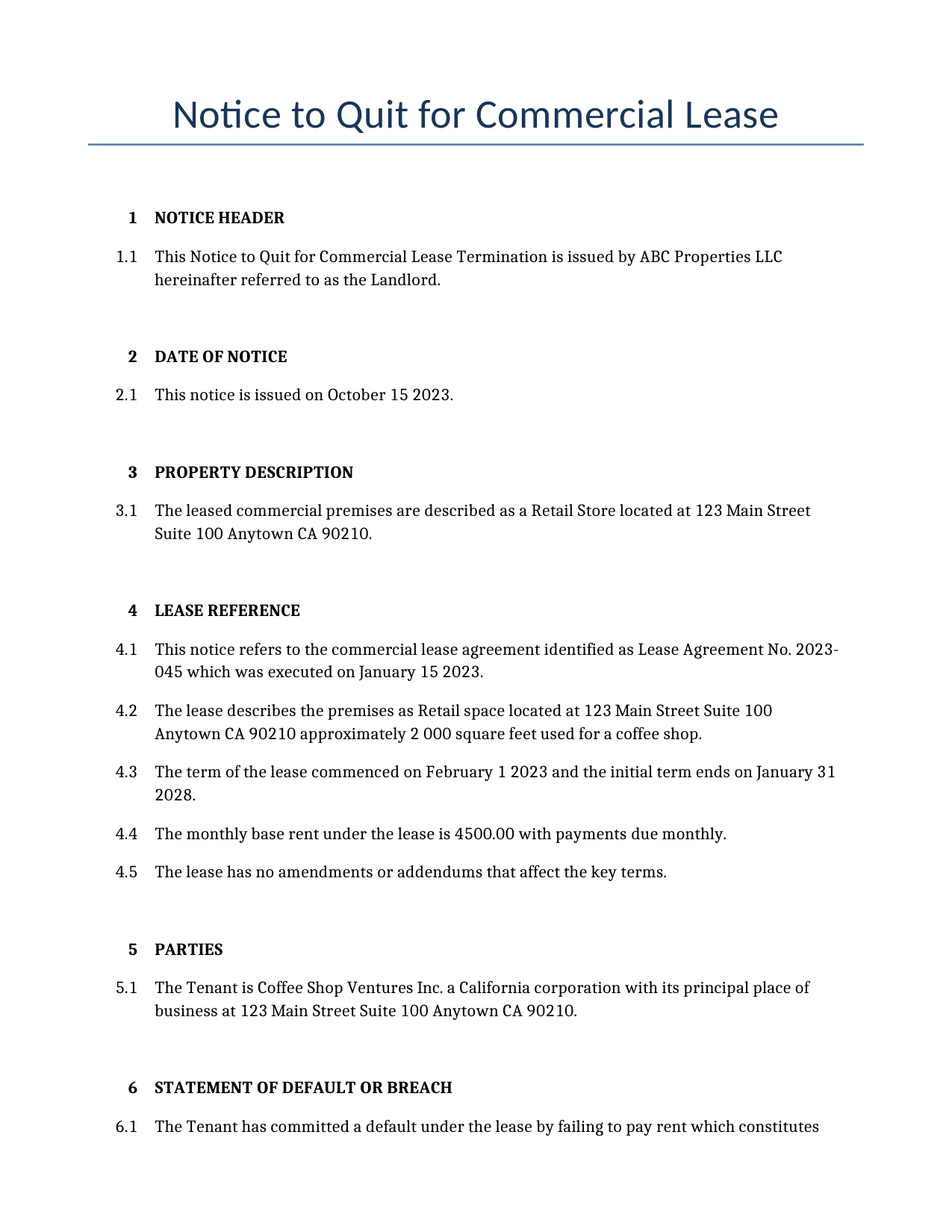
Notice to Quit for Commercial Lease Termination
1NOTICE HEADER
This Notice to Quit for Commercial Lease Termination is issued by ABC Properties LLC hereinafter referred to as the Landlord.
2DATE OF NOTICE
This notice is issued on October 15 2023.
3PROPERTY DESCRIPTION
The leased commercial premises are described as a Retail Store located at 123 Main Street Suite 100 Anytown CA 90210.
4LEASE REFERENCE
This notice refers to the commercial lease agreement identified as Lease Agreement No. 2023-045 which was executed on January 15 2023.
The lease describes the premises as Retail space located at 123 Main Street Suite 100 Anytown CA 90210 approximately 2 000 square feet used for a coffee shop.
The term of the lease commenced on February 1 2023 and the initial term ends on January 31 2028.
The monthly base rent under the lease is 4500.00 with payments due monthly.
The lease has no amendments or addendums that affect the key terms.
5PARTIES
The Tenant is Coffee Shop Ventures Inc. a California corporation with its principal place of business at 123 Main Street Suite 100 Anytown CA 90210.
6STATEMENT OF DEFAULT OR BREACH
The Tenant has committed a default under the lease by failing to pay rent which constitutes Non-payment of Rent.
The Tenant has failed to pay the monthly rent of 4500.00 due on October 1 2023 and has not made any payments since that date resulting in an outstanding balance of 4500.00 as of the date of this notice.
The default first occurred on October 1 2023.
The lease allows the Tenant three days to cure this default after service of this notice pursuant to California law.
This default is curable.
The Tenant has violated the Payment of Rent section of the lease which requires the tenant to pay rent in full on the first day of each month without deduction or offset.
7DEMAND TO QUIT
The Landlord demands that the Tenant pay the rent due or vacate and surrender possession of the premises located at 123 Main Street Suite 100 Anytown CA 90210.
This demand is made due to non-payment of rent.
8NOTICE PERIOD
The Tenant is hereby given a notice period of 3 days to pay the rent due or quit the premises.
The lease agreement does not contain a custom provision for the notice period that differs from state default laws.
The Tenant must comply with this notice within 3 days before eviction proceedings may commence.
9CONSEQUENCES OF NON-COMPLIANCE
If the Tenant fails to pay the rent due or quit the premises by the specified deadline the Landlord shall commence eviction proceedings in the local California court pursuant to CCP 1161 et seq.
The Landlord shall seek monetary damages from the Tenant for all losses incurred due to the non-compliance.
The Tenant shall be responsible for the Landlord attorney fees if eviction proceedings are necessary due to non-compliance to the extent permitted by the lease and California law.
The deadline for the Tenant to pay the rent due or quit the premises to avoid these consequences is October 18 2023.
10METHOD OF SERVICE
This notice may be served by personal delivery substituted service or certified mail with return receipt requested in accordance with California law for commercial notices.
The notice was served by John A. Smith who is an authorized agent of the landlord.
The notice is to be served on or after October 15 2023 at 123 Main Street Suite 100 Anytown CA 90210 at the tenant leased commercial premises.
Proof of service will be maintained in the form of an affidavit of service or return receipt as applicable.
11GOVERNING LAW
This notice and the underlying commercial lease shall be governed by the laws of the State of California.
This document is compliant with California Code of Civil Procedure Section 1161 et seq. and California Civil Code Section 1951.2 for damages and other sections relevant to commercial leases.
12CONTACT INFORMATION
All communications regarding this notice should be directed to the Landlord ABC Properties LLC at 123 Main Street Suite 100 Anytown CA 90210 or by telephone at (555) 555-0123.
13CERTIFICATION OF SERVICE
The undersigned certifies that this notice was served in accordance with applicable law on the date and by the method stated herein.
14SIGNATURE SECTION
The Landlord has executed this notice on the date first written above.
Landlord ABC Properties LLC By _______________________________ Authorized Signatory Title _______________________________ Date _______________________________
15RESERVATION OF RIGHTS
The Landlord reserves all rights and remedies under the lease and applicable law including but not limited to pursuing unpaid rent damages and other claims separately from the eviction.
This example shows approximately 70% of a typical document and is provided for illustrative purposes only. The remaining content has been omitted.
Every document generated by Docaro is tailored to your specific circumstances, jurisdiction and the information you provide. The completed document includes all applicable clauses and provisions required for your situation.
To generate the full, personalised document, answer a short series of questions and your document will be created instantly.