
Docaro

AI Generated Affidavit for use in the United States
PDF & Word - 2026 Updated
A photorealistic image of a professional adult lawyer or witness standing confidently in a modern courtroom, holding a gavel symbolically, representing the solemnity and purpose of affidavits in legal proceedings in the United States. The scene conveys trust, justice, and official testimony without showing any documents.
Generate a customized AI affidavit template quickly and accurately for legal proceedings in the United States, ensuring compliance with sworn statement requirements and evidentiary standards.
Free instant document creation.
Compliant with United States law.
No sign up or monthly subscription.

Docaro Pricing

Basic
Free
Document Generation
No Sign Up
No Subscription
Download Watermarked PDF
Premium
$4.99 USD
Document Generation
No Sign Up
No Subscription
Download Clean PDF
Download Microsoft Word
Download HTML
Download Text
Email Document
Generate your document for free. Only pay if you like the result and need an un-watermarked version.

When Do You Need an Affidavit in the United States?

  • In Court Cases
    Affidavits provide sworn statements as evidence without needing to appear in person, helping support your side in legal disputes.
  • For Notarizations
    They are often required for official verifications, like confirming your identity or the truth of important facts.
  • In Immigration Processes
    Affidavits support applications by declaring relationships or financial support for family members seeking to move to the U.S.
  • For Financial Matters
    They verify details like income or assets in loan applications or estate planning to ensure everything is accurate.
  • In Business Transactions
    Affidavits confirm facts in contracts or sales, such as ownership of property, to prevent future disagreements.
  • Why Well-Drafted Matters
    A clear and accurate affidavit avoids errors that could weaken your case or lead to legal complications.

American Legal Rules for an Affidavit

  • What is an Affidavit?
    An affidavit is a written statement of facts that a person swears or affirms is true under penalty of perjury.
  • Who Can Make One?
    Any competent adult who has personal knowledge of the facts can create and sign an affidavit.
  • Signing Requirement
    The person must sign the affidavit in front of an authorized official, like a notary public, to verify their identity.
  • Content Must Be Truthful
    Everything in the affidavit must be based on the signer's own knowledge, and lying can lead to serious legal penalties.
  • State Variations
    Rules can differ slightly by state, so check local laws for specific requirements like wording or additional witnesses.
  • Common Uses
    Affidavits are often used in court cases, real estate deals, or to support applications without needing in-person testimony.
  • Validity Check
    For an affidavit to be legally binding, it must be properly notarized or affirmed and kept clear and factual.
Important

Using the wrong format or structure for an affidavit may render it invalid or inadmissible in court.

What a Proper Affidavit Should Include

  • Full Name and Identity
    State your complete legal name and provide details that confirm who you are, like your address or date of birth.
  • Clear Statement of Facts
    Describe the events or information you know to be true in simple, straightforward language without opinions.
  • Sworn Oath or Affirmation
    Include a declaration that everything stated is true to the best of your knowledge, under penalty of perjury.
  • Signature and Date
    Sign the document with your full name and add the date it was completed.
  • Notarization
    Have the affidavit signed and sealed by a notary public to verify your identity and the authenticity of your statements.

Why Free Templates Can Be Risky for Affidavits

Free affidavit templates often contain generic language that fails to address specific circumstances, such as jurisdictional requirements or unique factual details. This can result in affidavits that are incomplete, ambiguous, or non-compliant with court standards, potentially leading to rejection, delays in legal proceedings, or weakened evidentiary value.

AI-generated bespoke affidavits are customized to your exact situation, incorporating precise details, appropriate legal phrasing, and compliance with relevant U.S. standards. This ensures a robust, tailored document that strengthens your case without the pitfalls of one-size-fits-all templates.

Generate Your Bespoke Affidavit in 4 Easy Steps

1
Answer a Few Questions
Our AI guides you through the info required.
2
Generate Your Document
Docaro builds a bespoke document tailored specifically on your requirements.
3
Review & Edit
Review your document and submit any further requested changes.
4
Download & Sign
Download your ready to sign document as a PDF, Microsoft Word, Txt or HTML.

Why Use Our AI Affidavit Generator?

Fast Generation
Quickly generate a comprehensive Affidavit, eliminating the hassle and time associated with traditional document drafting.
Guided Process
Our user-friendly platform guides you step by step through each section of the document, providing context and guidance to ensure you provide all the necessary information for a complete and accurate Affidavit.
Safer Than Legal Templates
We never use legal templates. All documents are generated from first principles clause by clause, ensuring that your document is bespoke and tailored specifically to the information you provide. This results in a much safer and more accurate document than any legal template could provide.
Professionally Formatted
Your Affidavit will be formatted to professional standards, including headings, clause numbers and structured layout. No further editing is required. Download your document in PDF, Microsoft Word, TXT or HTML.
Compliance with American Law
Rest assured that all generated documents meet the latest legal standards and regulations of the United States, enhancing trust and reliability.
Cost-Effective
Save money by generating legally sound Affidavit without the need for expensive legal services or consultations.
Get Started for Free - No Sign Up or Monthly Subscription Required
No payment or sign up is required to start generating your Affidavit. Generate and download a watermarked version of your document for free. Pay only if you want to remove the watermark and gain full access to your document. No monthly subscriptions or hidden fees. Pay once and use your document forever.
Need to Generate a Affidavit in a Different Country?
Choose country:

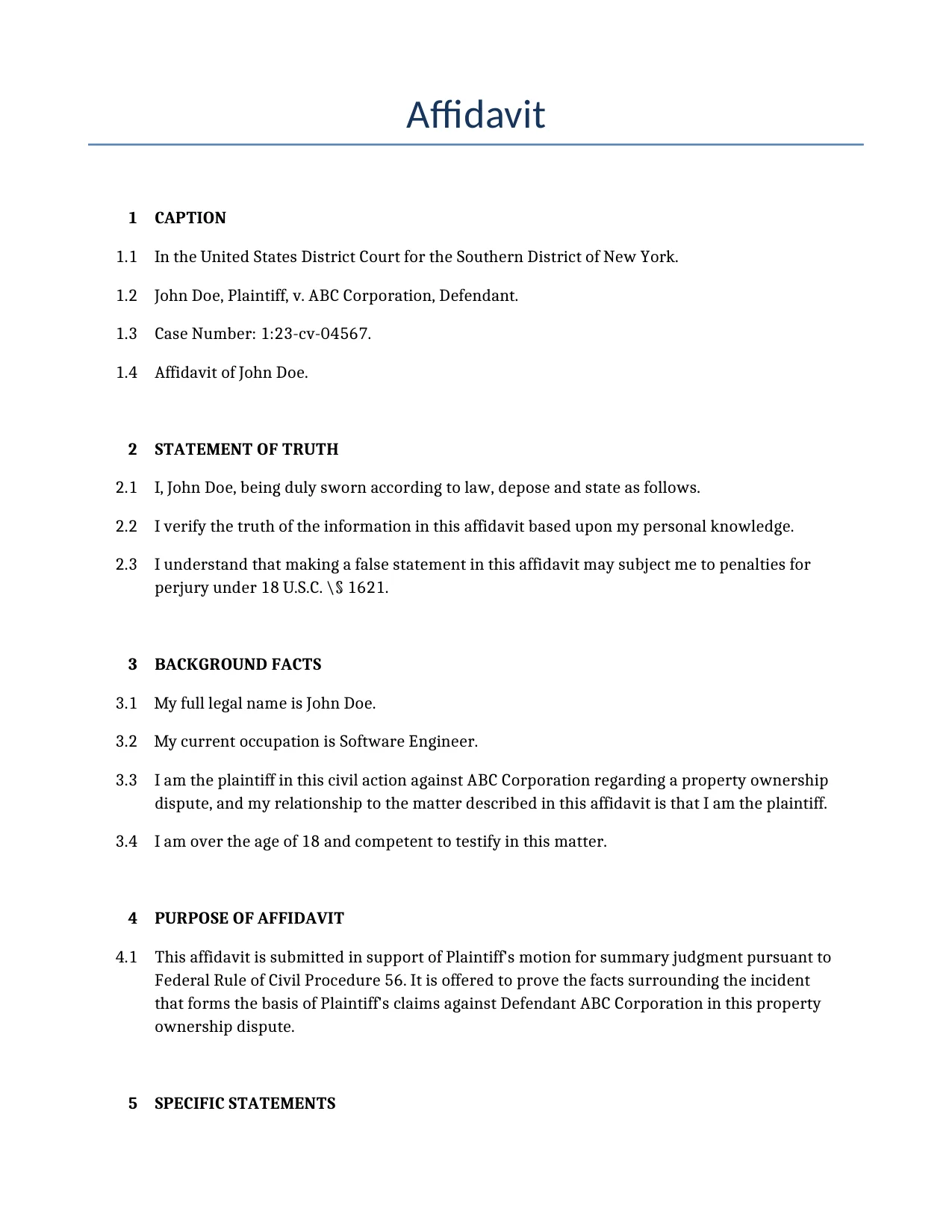
Free Example Affidavit Template

Below is a free template example of a Affidavit for use in the United States generated by our AI model.

The clauses in your actual Affidavit will vary from this example as they will be entirely bespoke to your requirements as set out in the questionnaire you complete.

Page 1

United States Compliance Legislation

Your AI Generated Affidavit will be checked for compliance against the following legislation and regulations:
Unsworn Declarations under Penalty of Perjury. This statute allows for unsworn affidavits or declarations to be made under penalty of perjury in place of sworn affidavits, applicable in federal proceedings and certain other contexts.
Perjury Generally. This criminal statute addresses false statements under oath, including in affidavits, and applies to sworn statements made in federal matters.
Summary Judgment. This rule governs the use of affidavits as supporting evidence in federal civil litigation, requiring them to be made on personal knowledge and admissible under evidence rules.
Oath or Affirmation to Testify Truthfully. This rule requires witnesses, including those providing affidavits, to declare under oath or affirmation to tell the truth in federal proceedings.

What Is an Affidavit in the United States?

An affidavit is a written statement of facts voluntarily made by an individual under oath or affirmation, serving as verifiable evidence in legal proceedings. In the US legal system, it functions as a sworn declaration that holds the same weight as courtroom testimony, allowing parties to submit information without immediate in-person appearance.

The primary purpose of an affidavit is to provide factual support for motions, claims, or defenses in civil and criminal cases, streamlining judicial processes by reducing the need for live witnesses. For a complete guide on affidavits in the United States, including preparation and notarization requirements, refer to What Is an Affidavit in the United States? A Complete Guide.

Affidavits play a crucial role in various US court procedures, such as supporting search warrant applications or probate matters, as outlined by federal and state laws. To ensure accuracy and compliance, consult authoritative resources like the US Courts website for federal guidelines.

  • Affidavits must be signed before a notary public to confirm authenticity.
  • They are inadmissible if proven false, potentially leading to perjury charges.
  • For customized legal documents like affidavits, use bespoke AI-generated options through Docaro to fit specific case needs.
"An affidavit is a written statement of fact, sworn under oath before a notary or authorized officer, and admissible as evidence in judicial proceedings," states legal scholar Elena Vargas, emphasizing its role in formal legal testimony. For your legal needs, opt for bespoke AI-generated documents tailored precisely to your situation via Docaro, ensuring accuracy and relevance over generic options.
Professional signing legal affidavit document

When Should You Use an Affidavit and When Should You Avoid It?

An affidavit is a sworn written statement used in various legal contexts in the United States, providing a formal declaration of facts under oath. It is particularly appropriate in court proceedings to submit evidence without requiring the affiant's live appearance, such as in uncontested divorce cases or motions for summary judgment, as outlined by the Federal Rules of Civil Procedure.

In real estate transactions, affidavits are commonly used to affirm ownership details, disclose liens, or verify marital status for title transfers, ensuring smooth closings. For immigration matters, they support applications by attesting to relationships, financial support, or eligibility, as required by forms from the U.S. Citizenship and Immigration Services.

Affidavits should not be used for complex disputes that demand cross-examination or live testimony, such as high-stakes litigation where credibility is contested, opting instead for depositions. They are also inappropriate for unsworn statements or informal declarations lacking legal weight, like casual business notes.

Key exclusions for affidavits include hearsay evidence unless an exception applies, statements from incompetent witnesses, or documents not properly notarized, which can invalidate their admissibility under U.S. law. For reliable legal documents, consider bespoke AI-generated options using Docaro tailored to specific needs rather than generic forms.

Common Situations for Affidavit Use

Affidavits serve as sworn statements used in various legal proceedings to provide factual evidence under oath. They are essential in situations requiring formal verification, such as probate, name changes, and debt collection, ensuring accuracy and credibility in court or administrative processes.

In probate matters, affidavits are commonly filed to confirm the validity of a will or to detail the deceased's assets and heirs. For instance, an heir might submit an affidavit of heirship to establish inheritance rights without a will, streamlining the estate distribution as outlined by the U.S. Courts probate resources.

For name changes, an affidavit is required to declare the reasons for the change and confirm no fraudulent intent, often submitted to family courts. This document supports petitions in states like California, where detailed affidavits help verify identity and residency per guidelines from the California Courts Self Help Center.

In debt collection, creditors use affidavits to affirm the debt's existence, amount owed, and payment history, bolstering claims in lawsuits. These sworn declarations prevent disputes and aid enforcement, with federal standards detailed in resources from the Consumer Financial Protection Bureau.

When to Avoid Affidavits

Affidavits serve as sworn written statements in legal proceedings, but they should not be used in situations requiring cross-examination to test the credibility of testimony. For instance, in trial settings or evidentiary hearings, courts often mandate oral testimony under oath to allow opposing parties to question witnesses directly, ensuring a fair assessment of facts.

Oral testimony is required when the law specifies live presentation, such as in criminal trials or family court disputes involving child custody, where judges need to observe demeanor and respond to immediate clarifications. Using affidavits alone in these cases could violate due process rights, as outlined by the U.S. Supreme Court in decisions emphasizing the value of confrontation.

Additionally, affidavits are inappropriate for complex or disputed factual matters needing real-time judicial oversight, like preliminary injunction hearings under Federal Rules of Civil Procedure. In such scenarios, live testimony enables cross-examination to uncover inconsistencies that written statements might obscure.

For legal documents, avoid generic templates and opt for bespoke AI-generated options through Docaro to ensure they are tailored precisely to your case's needs.

Gavel and scales of justice symbol

What Are the Key Clauses in an Affidavit?

An affidavit is a sworn written statement used in legal proceedings, and its essential clauses ensure its validity under United States law. The key components include the caption, body, signature, and jurat, each serving a critical role in establishing authenticity and reliability.

The caption appears at the top and identifies the court, case number, parties involved, and document title, such as "Affidavit of [Name]." This clause is important because it provides context and links the affidavit to the specific legal matter, ensuring it is properly filed and considered by the court; without it, the document may be deemed irrelevant or invalid.

The body contains the factual statements made under oath, written in the first person and detailing relevant information clearly and concisely. Its importance lies in conveying the substantive evidence or testimony, with accuracy vital to avoid perjury charges; courts rely on this section to assess truthfulness, making it the core of the affidavit's legal weight.

The signature and jurat conclude the affidavit, where the affiant signs to affirm the statements, and the jurat includes the notary's certification of the oath or affirmation, date, and venue. These elements are crucial for verifying the document's authenticity and the affiant's voluntary sworn intent, preventing fraud; for authoritative guidance, refer to the U.S. Courts forms or Cornell Law School's Legal Information Institute on affidavits.

To create valid affidavits tailored to your needs, opt for bespoke AI-generated legal documents using Docaro, ensuring precision and compliance without relying on generic templates.

The Jurat and Sworn Statement

The jurat clause is a critical component in notarized documents, serving as the official statement made by a notary public to verify the authenticity of a signer's signature. It typically includes the notary's certification that the signer appeared before them, acknowledged the document, and signed it willingly, often accompanied by details like the date, location, and notary's seal.

This clause certifies the execution of the document under oath or affirmation, ensuring the signer's identity and intent are confirmed, which helps prevent fraud and forgery in legal transactions. For instance, in affidavits or sworn statements, the jurat explicitly notes that the contents were sworn to be true, adding a layer of legal reliability.

Notarization is often required for documents like deeds, powers of attorney, or contracts to provide evidentiary weight in court, as it demonstrates due diligence in verifying the parties involved. According to the National Notary Association, this process upholds public trust in important legal instruments across the United States.

Adult lawyer reviewing affidavit papers

What Are the Rights and Obligations of Parties Involved in an Affidavit?

The affiant's rights in a sworn affidavit include the fundamental right to accurate representation of their statements, ensuring that the document truly reflects their testimony without distortion. This right is protected under U.S. legal standards to uphold justice and prevent misrepresentation in court proceedings.

Key obligations of the affiant involve truthfulness under penalty of perjury, meaning they must provide only factual information, as false statements can lead to severe legal consequences like fines or imprisonment. For authoritative guidance, refer to the 18 U.S. Code § 1621 on perjury from the U.S. Department of Justice.

Notaries public bear the responsibility of verifying the affiant's identity and witnessing the oath or affirmation, ensuring the document's authenticity without altering its content. Courts, in turn, review affidavits for compliance with procedural rules, holding notaries accountable for any negligence in their duties.

For creating customized legal documents like affidavits, consider using bespoke AI-generated options through Docaro to tailor them precisely to your needs, rather than relying on generic forms.

Obligations Under Penalty of Perjury

An affidavit is a sworn written statement used in legal proceedings, requiring the affiant to affirm its truthfulness under penalty of perjury. Providing false statements in an affidavit constitutes perjury, a serious criminal offense that undermines the integrity of the judicial system.

The legal consequences of submitting a false affidavit can include felony charges, with potential penalties such as fines up to $250,000 and imprisonment for up to five years under federal law, as outlined in 18 U.S.C. § 1621. In addition to criminal repercussions, civil liabilities may arise, including lawsuits for damages caused by the deception.

Affiants have a strict obligation to provide truthful information, ensuring all facts are accurate and complete to avoid invalidating the document or facing sanctions. Courts emphasize this duty, and resources like the U.S. Courts website provide guidance on perjury and ethical standards in affidavits.

For creating affidavits, consider bespoke AI-generated legal documents through Docaro to ensure they are tailored precisely to your needs and compliant with legal requirements.

How Do Recent Legal Changes Affect Affidavits?

Since 2020, the United States has seen significant expansions in remote online notarization (RON) rules, allowing affidavits to be notarized electronically without in-person meetings. This shift accelerated during the COVID-19 pandemic, with federal guidance from the U.S. Department of State endorsing RON for certain international documents, as detailed on their official page.

By 2023, over 40 states had enacted or updated laws to permit RON for affidavits and other legal documents, streamlining processes for electronic signatures and filings. For the latest state-specific RON statutes, refer to the National Notary Association's resources at this guide, which highlights ongoing legislative trends toward nationwide uniformity.

Electronic filing trends for affidavits continue to grow, with courts increasingly mandating e-submissions via platforms like PACER for federal cases to reduce paper use and speed up processing. While no sweeping federal overhaul has occurred post-2020, these RON updates and digital filing mandates are transforming affidavit handling, emphasizing secure, bespoke AI-generated legal documents through tools like Docaro for customized compliance.

What Are the Common Types of Affidavits?

Affidavits play a crucial role in US legal proceedings, serving as sworn statements that provide factual evidence under oath. These documents are commonly used to support motions, establish facts, or verify actions without requiring live testimony, ensuring efficiency in court processes.

Among the common types of affidavits, financial affidavits detail a party's income, assets, and expenses, often in family law cases like divorce or child support. For more details on financial affidavits, refer to the Common Types of Affidavits Used in US Legal Proceedings page.

Another frequent type is the affidavit of service, which confirms that legal documents have been properly delivered to the involved parties, a key step in initiating lawsuits. This type helps courts verify due process compliance, as outlined by the US Courts guidelines.

Other notable affidavits include affidavits of merit in malpractice suits and affidavits of heirship for probate matters, each tailored to specific legal needs. For customized legal documents, consider using Docaro to generate bespoke affidavits that fit your case precisely.

How Can You Draft and File an Affidavit Legally?

1
Research Legal Requirements
Consult federal and state laws, court rules, and jurisdiction-specific guidelines to understand affidavit standards. Review the guide at [How to Draft and File an Affidavit Legally in the US](/en-us/a/how-to-draft-and-file-affidavit-legally-in-us).
2
Draft the Affidavit
Use Docaro to generate a bespoke AI-crafted affidavit tailored to your facts and legal needs, ensuring clarity and completeness without templates.
3
Notarize the Document
Sign the affidavit in front of a licensed notary public to verify your identity and oath, then obtain the official seal.
4
File the Affidavit
Submit the notarized affidavit to the appropriate court or agency as required, paying any filing fees and retaining copies.

To ensure your affidavit is legally sound, always verify state-specific rules for notarization and formatting, as requirements can vary significantly across the US. For instance, some states mandate witnesses while others require only a notary public; consult authoritative resources like the US Courts website for federal guidelines that may influence state practices.

Avoid common pitfalls such as including hearsay evidence or unsubstantiated claims, which can undermine the affidavit's credibility in court. Stick to factual statements based on personal knowledge, and ensure the document is sworn under penalty of perjury to maintain its legal weight.

For optimal results, generate bespoke affidavits using Docaro's AI tools tailored to your specific jurisdiction, rather than relying on generic forms that may not comply with local laws. This approach helps incorporate precise language and avoids errors that could lead to rejection by the court.

Affidavit FAQs

An affidavit is a sworn written statement of facts that is voluntarily made by an individual under oath or affirmation, typically used as evidence in legal proceedings in the United States. Our AI tool helps generate customizable affidavits quickly and accurately.

Document Generation FAQs

Docaro is an AI-powered legal and corporate document generator that helps you create fully formatted, legally sound contracts and agreements in minutes. Just answer a few guided questions and download your document instantly.
You Might Also Be Interested In
A Legal Contract Resolving A Dispute Between Parties Without Court Trial.
A Written Contract Outlining The Terms Resolved Through Mediation To Settle Disputes Outside Of Court.
A Contract Where Parties Agree To Resolve Disputes Through Arbitration Rather Than Court Litigation.
A Formal Letter Demanding That A Party Stop An Alleged Illegal Activity And Refrain From Continuing It.
A Formal Legal Document Filed In Court To Initiate A Civil Lawsuit, Stating The Plaintiff's Claims And Facts Against The Defendant.
A Legal Document Where One Party Releases Another From All Claims, Demands, And Liabilities Arising From A Specific Incident Or Event.
A Legal Document Where Two Parties Mutually Agree To Release Each Other From All Claims, Liabilities, And Obligations Arising From A Prior Agreement Or Dispute.
A Formal Notice Sent To A Debtor Or Party In Breach, Demanding Payment Or Compliance Before Initiating Legal Proceedings.

Related Articles

A photorealistic image of a professional adult lawyer in a modern office setting, reviewing important legal documents on a desk with symbols of justice like a gavel and scales in the background, conveying trust and reliability without showing the affidavit itself.
Discover what an affidavit is in the United States, its legal significance, how to create one, and key uses in court and beyond. Your comprehensive guide to affidavits.
A photorealistic image of a professional adult lawyer in a modern office, carefully reviewing and signing legal documents on a desk, symbolizing the process of drafting and filing affidavits. The scene conveys trust, professionalism, and legal integrity, with no children present.
Learn how to draft and file an affidavit legally in the US with our step-by-step guide. Understand requirements, notarization, and court filing processes to ensure your document is valid and enforceable.
A photorealistic image of a diverse group of adult professionals in a modern courtroom setting, engaged in serious discussion around a conference table, symbolizing the sworn testimony and legal verification central to affidavits in US proceedings, with no documents visible, emphasizing trust and justice without showing any children.
Explore the most common types of affidavits used in US legal proceedings, including their purposes, requirements, and examples. Learn how sworn statements support court cases effectively.