
AI Generated American Roommate Agreement
PDF & Word - 2026 Updated
Docaro Pricing
When Do You Need a Lodger Agreement in the United States?
American Legal Rules for a Lodger Agreement
Using the wrong type of agreement can create unintended tenant rights.
What a Proper Lodger Agreement Should Include
- Parties InvolvedClearly state the names and contact details of the homeowner and the lodger to identify everyone entering the agreement.
- Rental PeriodSpecify the start and end dates of the lodger's stay, including any rules for renewal or early termination.
- Rent DetailsOutline the rent amount, payment schedule, and acceptable payment methods to avoid disputes.
- Room and Facilities AccessDescribe the specific room provided to the lodger and which common areas, like kitchen or bathroom, they can use.
- House RulesList basic expectations for behavior, such as noise levels, guests, and cleanliness to ensure a harmonious living environment.
- Deposit InformationDetail any security deposit amount, its purpose, and conditions for its return at the end of the stay.
- Utilities and ExpensesClarify which utilities and other costs, like internet or council tax, are included in the rent or paid separately by the lodger.
- Termination NoticeExplain how much notice either party must give to end the agreement and any penalties for not following it.
- SignaturesInclude spaces for both parties to sign and date the agreement to make it legally binding.
Generate Your Document in 4 Easy Steps
Why Use Docaro?
 United States
Free Example Lodger Agreement Template
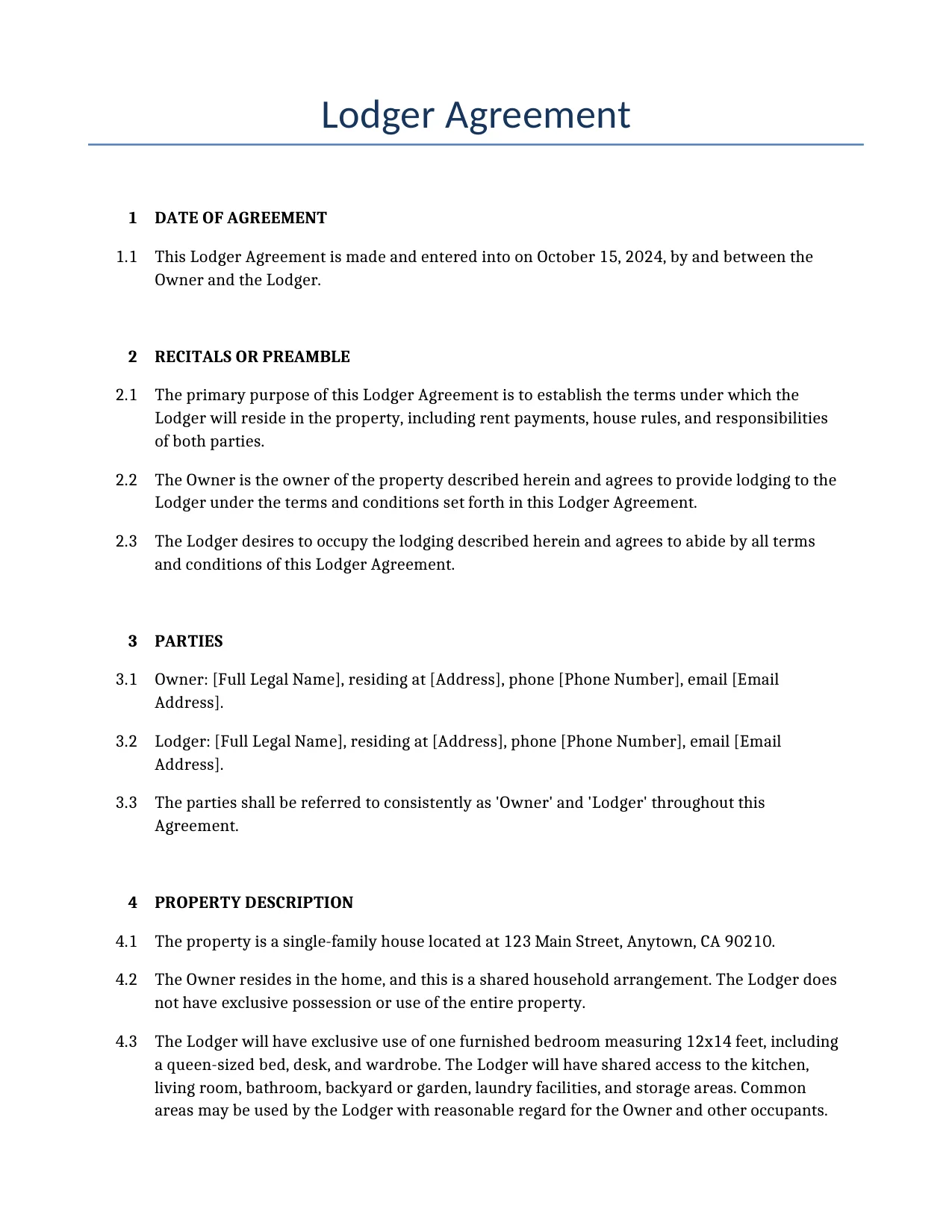
Below is a free template example of a Lodger Agreement for use in the United States generated by our AI model.
The clauses in your actual Lodger Agreement will vary from this example as they will be entirely bespoke to your requirements as set out in the questionnaire you complete.
Lodger Agreement
1DATE OF AGREEMENT
This Lodger Agreement is made and entered into on October 15, 2024, by and between the Owner and the Lodger.
2RECITALS OR PREAMBLE
The primary purpose of this Lodger Agreement is to establish the terms under which the Lodger will reside in the property, including rent payments, house rules, and responsibilities of both parties.
The Owner is the owner of the property described herein and agrees to provide lodging to the Lodger under the terms and conditions set forth in this Lodger Agreement.
The Lodger desires to occupy the lodging described herein and agrees to abide by all terms and conditions of this Lodger Agreement.
3PARTIES
Owner: [Full Legal Name], residing at [Address], phone [Phone Number], email [Email Address].
Lodger: [Full Legal Name], residing at [Address], phone [Phone Number], email [Email Address].
The parties shall be referred to consistently as 'Owner' and 'Lodger' throughout this Agreement.
4PROPERTY DESCRIPTION
The property is a single-family house located at 123 Main Street, Anytown, CA 90210.
The Owner resides in the home, and this is a shared household arrangement. The Lodger does not have exclusive possession or use of the entire property.
The Lodger will have exclusive use of one furnished bedroom measuring 12x14 feet, including a queen-sized bed, desk, and wardrobe. The Lodger will have shared access to the kitchen, living room, bathroom, backyard or garden, laundry facilities, and storage areas. Common areas may be used by the Lodger with reasonable regard for the Owner and other occupants.
See Exhibit A for a detailed inventory of all furnishings, appliances, and items provided in the Lodger's room and common areas.
5TERM OF AGREEMENT
The term of this Lodger Agreement shall commence on October 15, 2024.
This Lodger Agreement shall continue on a month-to-month basis until terminated in accordance with the provisions herein.
This Lodger Agreement includes an option for the Lodger to renew the agreement upon mutual written consent of the Owner and the Lodger.
6RENT
The Lodger shall pay to the Owner monthly rent in the amount of One Thousand Five Hundred Dollars ($1,500.00).
Rent payments shall commence on October 15, 2024, and shall be due on the 15th day of each month thereafter.
Acceptable payment methods include bank transfer to [Bank Account Details] or check mailed to 123 Main Street, Anytown, CA 90210.
If the Lodger fails to pay rent within 5 days after the due date, the Lodger shall pay a late fee of Fifty Dollars ($50.00).
Rent includes only the utilities and services listed in the Utilities and Services section. This is a lodger arrangement and rent is not subject to rent control under California law.
Prorated rent shall be allowed if the Lodger moves in or out mid-month.
7SECURITY DEPOSIT
The Lodger shall pay to the Owner a security deposit in the amount of One Thousand Dollars ($1,000.00) upon execution of this Lodger Agreement.
The security deposit will be held in a separate account as required under California Civil Code. No interest shall be paid on the security deposit.
The Owner and Lodger shall have the right to inspect the premises before move-in and before move-out. The Lodger must provide a forwarding address in writing.
The Owner shall return the security deposit or provide an itemized accounting of any deductions within 21 days after the Lodger vacates the property.
The deposit is refundable minus any unpaid rent, damages beyond normal wear and tear, cleaning costs, or other allowable deductions under California law. See Exhibit A for inventory to document condition at move-in.
8UTILITIES AND SERVICES
The following utilities are included in the rent: electricity, water and sewer, and trash removal.
The Lodger shall pay directly for the following: internet service and cable or streaming services (if applicable).
Shared utilities (if any arise) shall be divided on a 50/50 basis or based on usage as reasonably determined by the Owner. The Lodger shall be responsible for their own phone line.
9HOUSE RULES
The following house rules apply to the shared household. Any exceptions or permissions for the items below require the Owner's prior written approval: pets, smoking (permitted only in designated outdoor areas), overnight guests (maximum 2 nights per month), yard or garden maintenance responsibilities, and any alterations to common areas.
Quiet hours shall be observed from 10:00 PM to 7:00 AM each day. The Lodger shall clean their exclusive space and shared areas on a weekly basis. The Lodger shall properly dispose of their own garbage.
The Lodger shall comply with all house rules. Failure to do so may result in termination of this Agreement.
10PROHIBITED CONDUCT
The Lodger shall not engage in any of the following prohibited conduct: illegal drug use or sales on the property; excessive noise or disturbances that interfere with the Owner's or neighbors' quiet enjoyment; harassment of the Owner or other residents; any alterations to the property without prior written consent; any conduct that would violate Fair Housing laws; or any conduct that creates a nuisance.
The Lodger shall not engage in any illegal activities on the property.
11MAINTENANCE AND REPAIRS
The Lodger is responsible for minor repairs to their exclusive space up to a maximum of Fifty Dollars ($50.00). Major repairs are the Owner's responsibility.
The Lodger must report all maintenance issues promptly in writing via email. The Owner shall respond to non-emergency repairs within 7 days and handle emergencies immediately. The Owner is responsible for maintenance in shared common areas.
The Lodger must allow the Owner reasonable access for repairs and cannot withhold rent for repairs without following legal procedures under California law. The Lodger shall not make any alterations without prior written approval.
12ACCESS TO PREMISES
Because this is a lodger arrangement under California Civil Code Section 1940 et seq., the Owner may enter the premises at reasonable times with reasonable notice (typically 24 hours) for non-emergencies. The Owner may enter without notice only in the case of a true emergency.
Allowable reasons for entry include: emergencies, necessary repairs or maintenance, inspections, showing the property (with notice), or other reasonable purposes.
Notice shall be provided via email or posted at the premises.
13LODGER'S OBLIGATIONS
The Lodger shall keep the property (including exclusive and shared spaces) clean and tidy, pay rent and any owed utilities on time, comply with all house rules and this Agreement, not sublet or assign the room, comply with all applicable laws, and allow access for repairs.
14OWNER'S OBLIGATIONS
The Owner shall provide habitable conditions, ensure the Lodger's quiet enjoyment consistent with a shared household, handle major repairs and maintenance of common areas, comply with all applicable laws, and follow the termination and access provisions herein.
15INSURANCE
The Lodger shall obtain renter's insurance covering personal property and liability at least in the amount of $100,000 and shall provide proof of such insurance to the Owner within 14 days of the commencement date. The Lodger shall name the Owner as an additional insured if possible.
The Owner's homeowner's insurance does not cover the Lodger's personal belongings or liability. The Lodger shall notify the Owner of any changes or cancellation of their insurance within 30 days.
16LODGER AGREEMENT UNDER CALIFORNIA LAW
This is a lodger agreement under California Civil Code Section 1940 et seq. The Owner resides in the home. The Lodger has no exclusive possession of the entire premises, as this is a shared household. Local eviction protections for tenants do not apply. The Owner may terminate this Agreement with reasonable notice (typically 30 days for month-to-month) without court eviction proceedings in most cases. Immediate termination is permitted for serious breaches such as non-payment, illegal activity, or violation of material terms.
17TERMINATION
This Agreement is month-to-month. Either party may terminate with 30 days' written notice. The Owner may terminate with shorter or no notice for cause, including non-payment of rent, breach of house rules, illegal activity, or nuisance. Upon termination, a move-out inspection shall be conducted, and final accounting of the security deposit shall occur within 21 days.
18DEFAULT AND REMEDIES
The Lodger shall have a grace period of 5 days to cure a default before the Owner may exercise remedies. Events that constitute a default include non-payment of rent, violation of agreement terms, and abandonment of premises. Upon default, the Owner may terminate the agreement, recover unpaid rent and fees, and exercise other remedies available under California law for lodgers. The Owner shall provide written notice before exercising remedies.
19DISPUTE RESOLUTION
The parties agree to first attempt mediation to resolve any disputes arising from this Agreement. The venue for any litigation shall be the courts in the county where the property is located. The prevailing party in any dispute may recover reasonable attorney fees and costs.
20INDEMNIFICATION
The Lodger shall indemnify the Owner against claims or damages arising from the Lodger's use of the property, including personal injury to third parties, property damage, and legal fees. This obligation survives termination of the Agreement.
21GOVERNING LAW
This Lodger Agreement shall be governed by and construed in accordance with the laws of the State of California.
This Agreement complies with the Fair Housing Act, and California Civil Code Sections 1940-1954.1. If the home was built before 1978, a lead-based paint disclosure is attached as required. Bed bug information is provided per California law.
22ENTIRE AGREEMENT
This Lodger Agreement constitutes the entire understanding between the Owner and the Lodger and supersedes all prior agreements. Modifications must be in a written amendment signed by both parties.
23NOTICES
Notices between the Owner and the Lodger may be delivered by hand delivery, certified mail, or email. Notices to the Lodger shall be delivered to 123 Main Street, Anytown, CA 90210. Notices to the Owner shall be delivered to 123 Main Street, Anytown, CA 90210. Notices shall be deemed received as provided by applicable California law.
24ASSIGNMENT AND SUBLETTING
The Lodger shall not assign or sublet the room or any rights under this Agreement without the prior written consent of the Owner.
25FORCE MAJEURE
Neither party shall be liable for delays caused by events beyond their control, including pandemics, government orders, or natural disasters, provided prompt written notice is given and reasonable mitigation efforts are made. Either party may terminate if the event continues beyond 30 days.
26SEVERABILITY
If any provision of this Lodger Agreement is held to be invalid or unenforceable, the remaining provisions shall remain in full force and effect.
27WAIVER
Any waiver of a breach of this Agreement must be in writing and signed by the waiving party. Failure to enforce any provision does not constitute a waiver of future enforcement of that or any other provision.
28SIGNATURES
| OWNER | |
| Signature: | |
| Print Name: | |
| Date: |
| LODGER | |
| Signature: | |
| Print Name: | |
| Date: |
This Agreement is not effective until signed by both parties. The parties have read, understood, and agree to all terms, including Exhibit A (Inventory), which is incorporated by reference and shall be signed at move-in.
This example shows approximately 70% of a typical document and is provided for illustrative purposes only. The remaining content has been omitted.
Every document generated by Docaro is tailored to your specific circumstances, jurisdiction and the information you provide. The completed document includes all applicable clauses and provisions required for your situation.
To generate the full, personalised document, answer a short series of questions and your document will be created instantly.