
AI Generated American Move-In/Move-Out Condition Report
PDF & Word - 2026 Updated
Docaro Pricing
When Do You Need a Move-In/Move-Out Condition Report in the United States?
American Legal Rules for a Move-In/Move-Out Condition Report
Using the wrong structure for a move-in/move-out condition report can lead to disputes over property damage liability or security deposit deductions.
What a Proper Move-In/Move-Out Condition Report Should Include
- Property Address and DetailsInclude the full address of the rental property and a brief description of the unit to clearly identify the location being documented.
- Date and Time of InspectionRecord the exact date and time when the inspection occurs to establish a timeline for the condition assessment.
- Names of All Parties InvolvedList the full names of the landlord, tenant, and any other participants in the inspection to confirm who was present.
- Detailed Room-by-Room Condition DescriptionDescribe the current state of each room, including floors, walls, ceilings, windows, and fixtures, noting any existing damage or wear.
- Inventory of Appliances and FurnishingsList all provided appliances, furniture, and other items, specifying their condition and functionality at move-in.
- Photos or Supporting EvidenceAttach dated photographs or videos of the property's condition to visually support the written descriptions.
- Signatures from All PartiesHave the landlord and tenant sign and date the report to agree on the documented condition and prevent future disputes.
- Notes on Meter Readings and KeysRecord utility meter readings and the number of keys or access devices handed over to track usage and accountability.
Generate Your Document in 4 Easy Steps
Why Use Docaro?
 United States
Free Example Move-In/Move-Out Condition Report Template
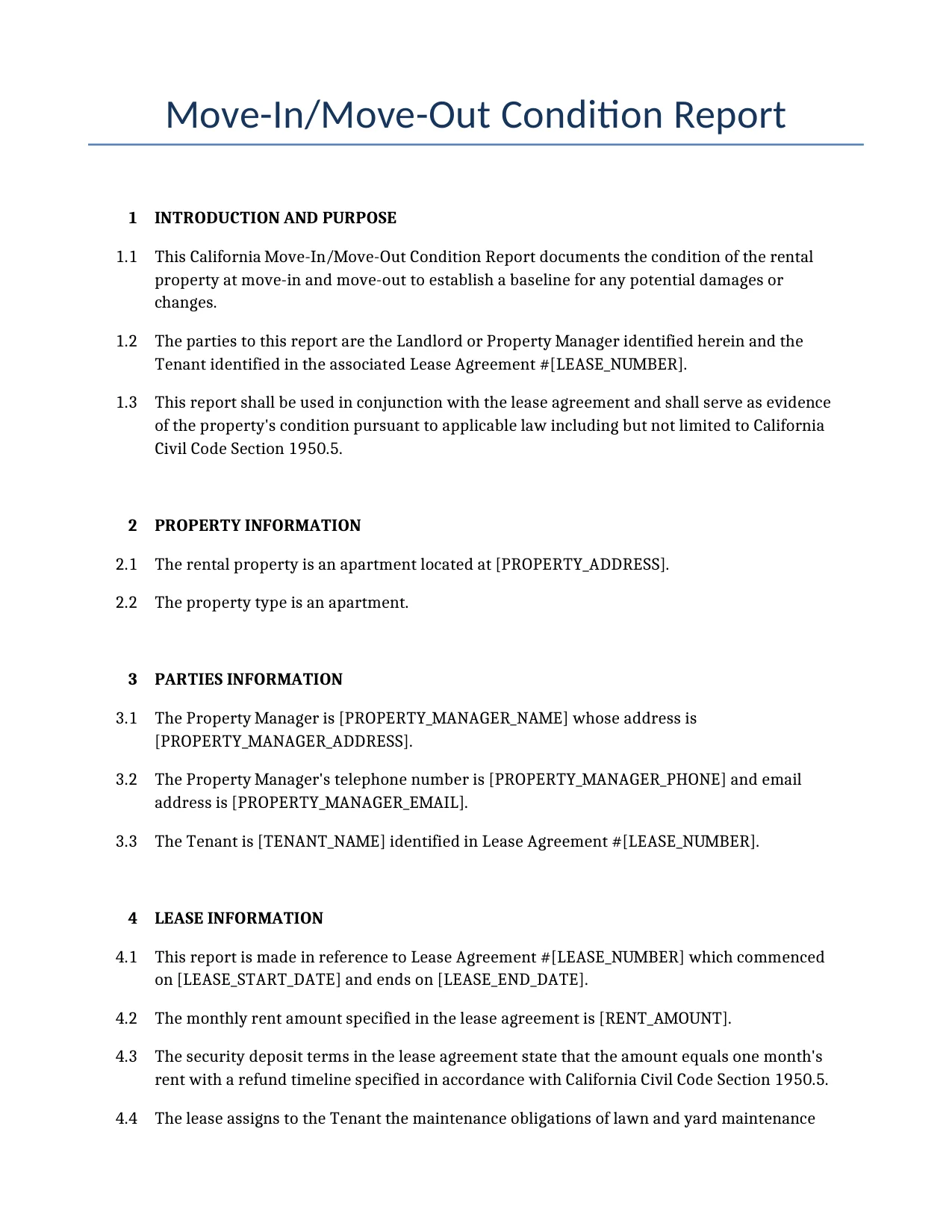
Below is a free template example of a Move-In/Move-Out Condition Report for use in the United States generated by our AI model.
The clauses in your actual Move-In/Move-Out Condition Report will vary from this example as they will be entirely bespoke to your requirements as set out in the questionnaire you complete.
California Move-In/Move-Out Condition Report
1INTRODUCTION AND PURPOSE
This California Move-In/Move-Out Condition Report documents the condition of the rental property at move-in and move-out to establish a baseline for any potential damages or changes.
The parties to this report are the Landlord or Property Manager identified herein and the Tenant identified in the associated Lease Agreement #[LEASE_NUMBER].
This report shall be used in conjunction with the lease agreement and shall serve as evidence of the property's condition pursuant to applicable law including but not limited to California Civil Code Section 1950.5.
2PROPERTY INFORMATION
The rental property is an apartment located at [PROPERTY_ADDRESS].
The property type is an apartment.
3PARTIES INFORMATION
The Property Manager is [PROPERTY_MANAGER_NAME] whose address is [PROPERTY_MANAGER_ADDRESS].
The Property Manager's telephone number is [PROPERTY_MANAGER_PHONE] and email address is [PROPERTY_MANAGER_EMAIL].
The Tenant is [TENANT_NAME] identified in Lease Agreement #[LEASE_NUMBER].
4LEASE INFORMATION
This report is made in reference to Lease Agreement #[LEASE_NUMBER] which commenced on [LEASE_START_DATE] and ends on [LEASE_END_DATE].
The monthly rent amount specified in the lease agreement is [RENT_AMOUNT].
The security deposit terms in the lease agreement state that the amount equals one month's rent with a refund timeline specified in accordance with California Civil Code Section 1950.5.
The lease assigns to the Tenant the maintenance obligations of lawn and yard maintenance and cleaning of appliances and fixtures.
The lease assigns to the Landlord the maintenance responsibilities of structural repairs and roof maintenance, HVAC and plumbing system servicing, and a response time for repair requests of 48 hours.
5INSPECTION DATES
The planned move-in date for the rental property is [MOVE_IN_DATE].
The move-in inspection was conducted on [MOVE_IN_INSPECTION_DATE].
The move-out inspection was conducted on [MOVE_OUT_INSPECTION_DATE].
6INSPECTION PARTICIPANTS AND ACKNOWLEDGMENT
The tenant has the right to be present at both the move-in and move-out inspections per California Civil Code Section 1950.5.
The following parties were present at the move-in inspection and acknowledge attendance and agreement on the inspection process by initialing below:
Landlord/Property Manager Initials: ________ Date: [MOVE_IN_INSPECTION_DATE]
Tenant Initials: ________ Date: [MOVE_IN_INSPECTION_DATE]
Witness (if applicable) Initials: ________ Date: [MOVE_IN_INSPECTION_DATE]
The following parties were present at the move-out inspection and acknowledge attendance and agreement on the inspection process by initialing below:
Landlord/Property Manager Initials: ________ Date: [MOVE_OUT_INSPECTION_DATE]
Tenant Initials: ________ Date: [MOVE_OUT_INSPECTION_DATE]
Witness (if applicable) Initials: ________ Date: [MOVE_OUT_INSPECTION_DATE]
7INSTRUCTIONS FOR COMPLETING THE REPORT
Excellent condition means the item or area is in pristine, like-new condition with no signs of wear, damage, or use.
Good condition means the item or area shows minimal signs of normal wear and tear but is fully functional and clean.
Fair condition means the item or area has noticeable wear and tear, minor imperfections, but remains usable without major issues.
Poor condition means the item or area is significantly damaged, requires repairs, or is in a state of disrepair that affects functionality.
This report must be completed jointly by the landlord and tenant at move-in, with the tenant given a copy within a reasonable time. The report must also be completed at move-out.
When noting damages, distinguish between pre-existing damage and normal wear and tear per California standards. Normal wear and tear (e.g., minor paint fading, small carpet wear in high-traffic areas) cannot be deducted from the security deposit. Pre-existing damage or tenant-caused damage beyond normal wear and tear must be documented with details including location, extent, and estimated repair costs.
Photos must be dated and timestamped. Both parties must have the opportunity to take their own photos. Photos and other evidence should be attached to this report.
When noting damages, the Landlord and the Tenant shall describe the issue in detail, including location, extent, and any estimated repair needs.
Both the Landlord and the Tenant shall agree on the description of any damages to avoid disputes.
The Landlord and the Tenant shall provide signatures upon completing the report.
8EXTERIOR OF PROPERTY
Siding
Move-in Condition: ________ (Excellent/Good/Fair/Poor)
Move-out Condition: ________ (Excellent/Good/Fair/Poor)
Tenant Notes: ________
Landlord Notes: ________
Estimated Cost of Repairs (if damaged beyond normal wear and tear): ________
Roofing
Move-in Condition: ________ (Excellent/Good/Fair/Poor)
Move-out Condition: ________ (Excellent/Good/Fair/Poor)
Tenant Notes: ________
Landlord Notes: ________
Estimated Cost of Repairs (if damaged beyond normal wear and tear): ________
Windows (Exterior)
Move-in Condition: ________ (Excellent/Good/Fair/Poor)
Move-out Condition: ________ (Excellent/Good/Fair/Poor)
Tenant Notes: ________
Landlord Notes: ________
Estimated Cost of Repairs (if damaged beyond normal wear and tear): ________
Doors (Exterior)
Move-in Condition: ________ (Excellent/Good/Fair/Poor)
Move-out Condition: ________ (Excellent/Good/Fair/Poor)
Tenant Notes: ________
Landlord Notes: ________
Estimated Cost of Repairs (if damaged beyond normal wear and tear): ________
Landscaping
Move-in Condition: ________ (Excellent/Good/Fair/Poor)
Move-out Condition: ________ (Excellent/Good/Fair/Poor)
Tenant Notes: ________
Landlord Notes: ________
Estimated Cost of Repairs (if damaged beyond normal wear and tear): ________
Driveway
Move-in Condition: ________ (Excellent/Good/Fair/Poor)
Move-out Condition: ________ (Excellent/Good/Fair/Poor)
Tenant Notes: ________
Landlord Notes: ________
Estimated Cost of Repairs (if damaged beyond normal wear and tear): ________
Walkways
Move-in Condition: ________ (Excellent/Good/Fair/Poor)
Move-out Condition: ________ (Excellent/Good/Fair/Poor)
Tenant Notes: ________
Landlord Notes: ________
Estimated Cost of Repairs (if damaged beyond normal wear and tear): ________
Fencing, Gates, Lighting Fixtures, Mailboxes, and Utilities Connections (Meters)
Fencing: Move-in Condition: ________ (Excellent/Good/Fair/Poor) Move-out Condition: ________ (Excellent/Good/Fair/Poor) Tenant Notes: ________ Landlord Notes: ________ Estimated Cost of Repairs: ________
Gates: Move-in Condition: ________ (Excellent/Good/Fair/Poor) Move-out Condition: ________ (Excellent/Good/Fair/Poor) Tenant Notes: ________ Landlord Notes: ________ Estimated Cost of Repairs: ________
Lighting Fixtures: Move-in Condition: ________ (Excellent/Good/Fair/Poor) Move-out Condition: ________ (Excellent/Good/Fair/Poor) Tenant Notes: ________ Landlord Notes: ________ Estimated Cost of Repairs: ________
Mailboxes: Move-in Condition: ________ (Excellent/Good/Fair/Poor) Move-out Condition: ________ (Excellent/Good/Fair/Poor) Tenant Notes: ________ Landlord Notes: ________ Estimated Cost of Repairs: ________
Utilities Connections (Meters): Move-in Condition: ________ (Excellent/Good/Fair/Poor) Move-out Condition: ________ (Excellent/Good/Fair/Poor) Tenant Notes: ________ Landlord Notes: ________ Estimated Cost of Repairs: ________
9INTERIOR LIVING AREAS
Living Room Walls
Move-in Condition: ________ (Excellent/Good/Fair/Poor)
Move-out Condition: ________ (Excellent/Good/Fair/Poor)
Tenant Notes: ________
Landlord Notes: ________
Estimated Cost of Repairs (if damaged beyond normal wear and tear): ________
Living Room Ceiling
Move-in Condition: ________ (Excellent/Good/Fair/Poor)
Move-out Condition: ________ (Excellent/Good/Fair/Poor)
Tenant Notes: ________
Landlord Notes: ________
Estimated Cost of Repairs (if damaged beyond normal wear and tear): ________
Living Room Floors
Move-in Condition: ________ (Excellent/Good/Fair/Poor)
Move-out Condition: ________ (Excellent/Good/Fair/Poor)
Tenant Notes: ________
Landlord Notes: ________
Estimated Cost of Repairs (if damaged beyond normal wear and tear): ________
Living Room Windows
Move-in Condition: ________ (Excellent/Good/Fair/Poor)
Move-out Condition: ________ (Excellent/Good/Fair/Poor)
Tenant Notes: ________
Landlord Notes: ________
Estimated Cost of Repairs (if damaged beyond normal wear and tear): ________
Living Room Doors
Move-in Condition: ________ (Excellent/Good/Fair/Poor)
Move-out Condition: ________ (Excellent/Good/Fair/Poor)
Tenant Notes: ________
Landlord Notes: ________
Estimated Cost of Repairs (if damaged beyond normal wear and tear): ________
Living Room Light Fixtures
Move-in Condition: ________ (Excellent/Good/Fair/Poor)
Move-out Condition: ________ (Excellent/Good/Fair/Poor)
Tenant Notes: ________
Landlord Notes: ________
Estimated Cost of Repairs (if damaged beyond normal wear and tear): ________
Living Room Electrical Outlets and Switches
Move-in Condition: ________ (Excellent/Good/Fair/Poor)
Move-out Condition: ________ (Excellent/Good/Fair/Poor)
Tenant Notes: ________
Landlord Notes: ________
Estimated Cost of Repairs (if damaged beyond normal wear and tear): ________
Dining Area Walls
Move-in Condition: ________ (Excellent/Good/Fair/Poor)
Move-out Condition: ________ (Excellent/Good/Fair/Poor)
Tenant Notes: ________
Landlord Notes: ________
Estimated Cost of Repairs (if damaged beyond normal wear and tear): ________
Dining Area Ceiling
Move-in Condition: ________ (Excellent/Good/Fair/Poor)
Move-out Condition: ________ (Excellent/Good/Fair/Poor)
Tenant Notes: ________
Landlord Notes: ________
Estimated Cost of Repairs (if damaged beyond normal wear and tear): ________
Dining Area Light Fixtures
Move-in Condition: ________ (Excellent/Good/Fair/Poor)
Move-out Condition: ________ (Excellent/Good/Fair/Poor)
Tenant Notes: ________
Landlord Notes: ________
Estimated Cost of Repairs (if damaged beyond normal wear and tear): ________
Dining Area Windows
Move-in Condition: ________ (Excellent/Good/Fair/Poor)
Move-out Condition: ________ (Excellent/Good/Fair/Poor)
Tenant Notes: ________
Landlord Notes: ________
Estimated Cost of Repairs (if damaged beyond normal wear and tear): ________
10KITCHEN CONDITION
Kitchen Cabinets
Move-in Condition: ________ (Excellent/Good/Fair/Poor)
Move-out Condition: ________ (Excellent/Good/Fair/Poor)
Tenant Notes: ________
Landlord Notes: ________
Estimated Cost of Repairs (if damaged beyond normal wear and tear): ________
Kitchen Countertops
Move-in Condition: ________ (Excellent/Good/Fair/Poor)
Move-out Condition: ________ (Excellent/Good/Fair/Poor)
Tenant Notes: ________
Landlord Notes: ________
Estimated Cost of Repairs (if damaged beyond normal wear and tear): ________
Kitchen Sink
Move-in Condition: ________ (Excellent/Good/Fair/Poor)
Move-out Condition: ________ (Excellent/Good/Fair/Poor)
Tenant Notes: ________
Landlord Notes: ________
Estimated Cost of Repairs (if damaged beyond normal wear and tear): ________
Kitchen Faucet
Move-in Condition: ________ (Excellent/Good/Fair/Poor)
Move-out Condition: ________ (Excellent/Good/Fair/Poor)
Tenant Notes: ________
Landlord Notes: ________
Estimated Cost of Repairs (if damaged beyond normal wear and tear): ________
Kitchen Stove
Move-in Condition: ________ (Excellent/Good/Fair/Poor)
Move-out Condition: ________ (Excellent/Good/Fair/Poor)
Tenant Notes: ________
Landlord Notes: ________
Estimated Cost of Repairs (if damaged beyond normal wear and tear): ________
Kitchen Oven
Move-in Condition: ________ (Excellent/Good/Fair/Poor)
Move-out Condition: ________ (Excellent/Good/Fair/Poor)
Tenant Notes: ________
Landlord Notes: ________
Estimated Cost of Repairs (if damaged beyond normal wear and tear): ________
Kitchen Refrigerator
Move-in Condition: ________ (Excellent/Good/Fair/Poor)
Move-out Condition: ________ (Excellent/Good/Fair/Poor)
Tenant Notes: ________
Landlord Notes: ________
Estimated Cost of Repairs (if damaged beyond normal wear and tear): ________
Kitchen Walls
Move-in Condition: ________ (Excellent/Good/Fair/Poor)
Move-out Condition: ________ (Excellent/Good/Fair/Poor)
Tenant Notes: ________
Landlord Notes: ________
Estimated Cost of Repairs (if damaged beyond normal wear and tear): ________
Kitchen Floors
Move-in Condition: ________ (Excellent/Good/Fair/Poor)
Move-out Condition: ________ (Excellent/Good/Fair/Poor)
Tenant Notes: ________
Landlord Notes: ________
Estimated Cost of Repairs (if damaged beyond normal wear and tear): ________
Kitchen Exhaust Fan
Move-in Condition: ________ (Excellent/Good/Fair/Poor)
Move-out Condition: ________ (Excellent/Good/Fair/Poor)
Tenant Notes: ________
Landlord Notes: ________
Estimated Cost of Repairs (if damaged beyond normal wear and tear): ________
11BEDROOM CONDITIONS
Bedroom 1 Walls
Move-in Condition: ________ (Excellent/Good/Fair/Poor)
Move-out Condition: ________ (Excellent/Good/Fair/Poor)
Tenant Notes: ________
Landlord Notes: ________
Estimated Cost of Repairs (if damaged beyond normal wear and tear): ________
Bedroom 1 Ceiling
Move-in Condition: ________ (Excellent/Good/Fair/Poor)
Move-out Condition: ________ (Excellent/Good/Fair/Poor)
Tenant Notes: ________
Landlord Notes: ________
Estimated Cost of Repairs (if damaged beyond normal wear and tear): ________
Bedroom 1 Floors
Move-in Condition: ________ (Excellent/Good/Fair/Poor)
Move-out Condition: ________ (Excellent/Good/Fair/Poor)
Tenant Notes: ________
Landlord Notes: ________
Estimated Cost of Repairs (if damaged beyond normal wear and tear): ________
Bedroom 1 Closets
Move-in Condition: ________ (Excellent/Good/Fair/Poor)
Move-out Condition: ________ (Excellent/Good/Fair/Poor)
Tenant Notes: ________
Landlord Notes: ________
Estimated Cost of Repairs (if damaged beyond normal wear and tear): ________
Bedroom 1 Windows
Move-in Condition: ________ (Excellent/Good/Fair/Poor)
Move-out Condition: ________ (Excellent/Good/Fair/Poor)
Tenant Notes: ________
Landlord Notes: ________
Estimated Cost of Repairs (if damaged beyond normal wear and tear): ________
Bedroom 1 Doors
Move-in Condition: ________ (Excellent/Good/Fair/Poor)
Move-out Condition: ________ (Excellent/Good/Fair/Poor)
Tenant Notes: ________
Landlord Notes: ________
Estimated Cost of Repairs (if damaged beyond normal wear and tear): ________
Bedroom 1 Light Fixtures
Move-in Condition: ________ (Excellent/Good/Fair/Poor)
Move-out Condition: ________ (Excellent/Good/Fair/Poor)
Tenant Notes: ________
Landlord Notes: ________
Estimated Cost of Repairs (if damaged beyond normal wear and tear): ________
Bedroom 1 Electrical Outlets and Switches
Move-in Condition: ________ (Excellent/Good/Fair/Poor)
Move-out Condition: ________ (Excellent/Good/Fair/Poor)
Tenant Notes: ________
Landlord Notes: ________
Estimated Cost of Repairs (if damaged beyond normal wear and tear): ________
Bedroom 1 Smoke Detectors
Move-in Condition: ________ (Excellent/Good/Fair/Poor)
Move-out Condition: ________ (Excellent/Good/Fair/Poor)
Tenant Notes: ________
Landlord Notes: ________
Estimated Cost of Repairs (if damaged beyond normal wear and tear): ________
Additional Bedrooms (use same format as above for each)
12BATHROOM CONDITIONS
Primary Bathroom Tub or Shower
Move-in Condition: ________ (Excellent/Good/Fair/Poor)
Move-out Condition: ________ (Excellent/Good/Fair/Poor)
Tenant Notes: ________
Landlord Notes: ________
Estimated Cost of Repairs (if damaged beyond normal wear and tear): ________
Primary Bathroom Toilet
Move-in Condition: ________ (Excellent/Good/Fair/Poor)
Move-out Condition: ________ (Excellent/Good/Fair/Poor)
Tenant Notes: ________
Landlord Notes: ________
Estimated Cost of Repairs (if damaged beyond normal wear and tear): ________
Primary Bathroom Sink and Vanity
Move-in Condition: ________ (Excellent/Good/Fair/Poor)
Move-out Condition: ________ (Excellent/Good/Fair/Poor)
Tenant Notes: ________
Landlord Notes: ________
Estimated Cost of Repairs (if damaged beyond normal wear and tear): ________
Primary Bathroom Mirror and Tiles
Move-in Condition: ________ (Excellent/Good/Fair/Poor)
Move-out Condition: ________ (Excellent/Good/Fair/Poor)
Tenant Notes: ________
Landlord Notes: ________
Estimated Cost of Repairs (if damaged beyond normal wear and tear): ________
Primary Bathroom Floors and Walls
Move-in Condition: ________ (Excellent/Good/Fair/Poor)
Move-out Condition: ________ (Excellent/Good/Fair/Poor)
Tenant Notes: ________
Landlord Notes: ________
Estimated Cost of Repairs (if damaged beyond normal wear and tear): ________
Primary Bathroom Exhaust Fan, Lighting, and Fixtures
Move-in Condition: ________ (Excellent/Good/Fair/Poor)
Move-out Condition: ________ (Excellent/Good/Fair/Poor)
Tenant Notes: ________
Landlord Notes: ________
Estimated Cost of Repairs (if damaged beyond normal wear and tear): ________
Additional Bathrooms (use same format as above for each)
13HALLWAYS, ENTRYWAYS, AND COMMON AREAS
Hallways and Entryways Floors
Move-in Condition: ________ (Excellent/Good/Fair/Poor)
Move-out Condition: ________ (Excellent/Good/Fair/Poor)
Tenant Notes: ________
Landlord Notes: ________
Estimated Cost of Repairs (if damaged beyond normal wear and tear): ________
Hallways and Entryways Walls
Move-in Condition: ________ (Excellent/Good/Fair/Poor)
Move-out Condition: ________ (Excellent/Good/Fair/Poor)
Tenant Notes: ________
Landlord Notes: ________
Estimated Cost of Repairs (if damaged beyond normal wear and tear): ________
Hallways and Entryways Ceilings
Move-in Condition: ________ (Excellent/Good/Fair/Poor)
Move-out Condition: ________ (Excellent/Good/Fair/Poor)
Tenant Notes: ________
Landlord Notes: ________
Estimated Cost of Repairs (if damaged beyond normal wear and tear): ________
Hallways and Entryways Lighting, Doors
Move-in Condition: ________ (Excellent/Good/Fair/Poor)
Move-out Condition: ________ (Excellent/Good/Fair/Poor)
Tenant Notes: ________
Landlord Notes: ________
Estimated Cost of Repairs (if damaged beyond normal wear and tear): ________
14LAUNDRY, STORAGE, AND MECHANICAL SYSTEMS
Laundry Area (Washer/Dryer Hookups, Floors, Walls, Ventilation)
Move-in Condition: ________ (Excellent/Good/Fair/Poor)
Move-out Condition: ________ (Excellent/Good/Fair/Poor)
Tenant Notes: ________
Landlord Notes: ________
Estimated Cost of Repairs (if damaged beyond normal wear and tear): ________
Storage Areas (Closets, Attic, Basement, Garage)
Move-in Condition: ________ (Excellent/Good/Fair/Poor)
Move-out Condition: ________ (Excellent/Good/Fair/Poor)
Tenant Notes: ________
Landlord Notes: ________
Estimated Cost of Repairs (if damaged beyond normal wear and tear): ________
Electrical Systems
Move-in Condition: ________ (Excellent/Good/Fair/Poor)
Move-out Condition: ________ (Excellent/Good/Fair/Poor)
Tenant Notes: ________
Landlord Notes: ________
Estimated Cost of Repairs (if damaged beyond normal wear and tear): ________
Plumbing Systems
Move-in Condition: ________ (Excellent/Good/Fair/Poor)
Move-out Condition: ________ (Excellent/Good/Fair/Poor)
Tenant Notes: ________
Landlord Notes: ________
Estimated Cost of Repairs (if damaged beyond normal wear and tear): ________
HVAC Systems
Move-in Condition: ________ (Excellent/Good/Fair/Poor)
Move-out Condition: ________ (Excellent/Good/Fair/Poor)
Tenant Notes: ________
Landlord Notes: ________
Estimated Cost of Repairs (if damaged beyond normal wear and tear): ________
15SAFETY DEVICES
Smoke Detectors: Locations ________ Number: ________ Move-in Condition/Test: ________ (Tested and Working: Yes/No) Move-out Condition/Test: ________ (Tested and Working: Yes/No) Notes: ________
Carbon Monoxide Detectors: Locations ________ Number: ________ Move-in Condition/Test: ________ (Tested and Working: Yes/No) Move-out Condition/Test: ________ (Tested and Working: Yes/No) Notes: ________
Fire Extinguishers: Locations ________ Number: ________ Move-in Condition: ________ (Excellent/Good/Fair/Poor) Move-out Condition: ________ (Excellent/Good/Fair/Poor) Tested: Yes/No Notes: ________
Egress Windows (if applicable): Locations ________ Move-in Condition: ________ Move-out Condition: ________ Notes: ________
California-Specific Safety Items (e.g., Earthquake Preparedness Kit Location, Gas Shut-off Valve Location and Accessibility): ________ Move-in: ________ Move-out: ________ Notes: ________
16KEYS, APPLIANCES, AND FURNISHINGS
Keys Provided: ________ (Number and Type) Condition at Move-in: ________ Condition at Move-out: ________ Notes: ________
Appliances and Furnishings Included: ________
Item: ________ Move-in Condition: ________ Move-out Condition: ________ Tenant Notes: ________ Landlord Notes: ________ Estimated Repair Cost: ________
Item: ________ Move-in Condition: ________ Move-out Condition: ________ Tenant Notes: ________ Landlord Notes: ________ Estimated Repair Cost: ________
17GENERAL CONDITION NOTES AND ATTACHMENTS
General Notes: ________
Attachments (Photos, Videos, Inventory): Must be dated and timestamped. List: ________
18MOVE-IN CONDITION SUMMARY
The Tenant moved into the property on [MOVE_IN_DATE].
The full address of the rental property is [PROPERTY_ADDRESS].
The overall condition of the property at move-in is ________.
Itemized List of Damages (Distinguish Normal Wear and Tear vs. Tenant-Caused):
Item: ________ Type (Wear/Tenant Damage): ________ Estimated Cost: ________
Total Estimated Deductions at Move-In (for reference only): $________. Deductions will comply with California Civil Code Section 1950.5; normal wear and tear cannot be deducted.
The property condition described is accurate as of move-in. This move-in condition summary was completed on [MOVE_IN_INSPECTION_DATE].
19MOVE-OUT CONDITION SUMMARY
The Tenant moved out of the property on [MOVE_OUT_DATE].
The Tenant or someone on the Tenant's behalf cleaned the property before moving out. Overall cleaning status: ________.
Itemized List of Damages (Distinguish Normal Wear and Tear vs. Tenant-Caused):
Item: ________ Type (Wear/Tenant Damage): ________ Estimated Cost: ________
Total Estimated Deductions: $________. Deductions will comply with California Civil Code Section 1950.5; normal wear and tear cannot be deducted.
Not all conditions at move-out reflect only normal wear and tear and there are tenant-attributable damages (if applicable).
20SECURITY DEPOSIT
The amount of the security deposit that the Tenant has paid to the Landlord is [DEPOSIT_AMOUNT].
The Tenant received a receipt for the security deposit from the Landlord on [DEPOSIT_RECEIPT_DATE].
The Tenant paid the security deposit to the Landlord by ________.
The rental property is located in California for the purposes of applying security deposit laws.
The expected move-out date for the Tenant from the rental property is [MOVE_OUT_DATE].
The Landlord expects to process the security deposit refund within 21 days after move-out in accordance with California Civil Code Section 1950.5.
This move-in and move-out condition report shall be used to document the move-in condition, document the move-out condition, and support deduction calculations from the security deposit.
21WALK-THROUGH AND FINAL ACCOUNTING
The landlord is obligated to provide an itemized statement of deductions from the security deposit within 21 days of move-out per California Civil Code Section 1950.5. The tenant shall have 14 days to respond with any objections. Any remaining deposit balance shall be returned within the statutory timeline.
Itemized Deduction Template:
Description of Damage/Issue: ________ | Category (Cleaning/Repair/Other): ________ | Amount Deducted: $________ | Notes: ________
Total Deductions: $________ | Remaining Deposit to Return: $________
22DISPUTE RESOLUTION
The parties agree to attempt resolution of any disagreements about the condition report through good-faith negotiation. If unresolved, the parties may pursue mediation. If mediation fails, either party may file in small claims court as permitted under California law. No rights are waived by either party.
The method to be used for resolving disagreements about the condition report is good-faith negotiation and mediation if needed.
The disputing party must send written notice via certified mail to the other party's address within a reasonable time of identifying the issue.
The costs of the dispute resolution process shall be equally shared between the Landlord and the Tenant or as determined by the court.
23ADDITIONAL COMMENTS OR EXCEPTIONS
Either party may note any disagreements with the report or additional observations here: ________
We have read and had the opportunity to add to this section. Landlord/Property Manager Initials: ________ Tenant Initials: ________
24CERTIFICATION
The undersigned certify that this Move-In/Move-Out Condition Report accurately reflects the property's condition at the time of move-in or move-out.
The undersigned confirm that they have personally reviewed the entire Move-In/Move-Out Condition Report.
The undersigned acknowledge they have inspected the property, agree with the noted conditions (or noted their disagreements in the Additional Comments section), and have received a copy of the completed report.
25GOVERNING LAW AND BOILERPLATE PROVISIONS
This report is governed exclusively by the laws of the State of California. This condition report is not a substitute for a formal lease agreement and must be read in conjunction with the lease. In the event of any conflict between this report and the lease, the lease terms control.
If any provision of this report is held to be invalid or unenforceable such invalidity or unenforceability shall not affect the other provisions which shall remain in full force and effect. This severability clause shall be interpreted under California law.
This document constitutes the entire agreement between the parties with respect to the subject matter hereof and supersedes all prior understandings or agreements.
Any notice required or permitted under this report shall be in writing and shall be deemed duly given if delivered personally or sent by certified mail return receipt requested to the addresses set forth herein.
No variation of this report shall be effective unless it is in writing and signed by both the Landlord or Property Manager and the Tenant.
This report shall be binding upon and inure to the benefit of the parties hereto and their respective heirs, successors, and permitted assigns.
26SIGNATURES
| PROPERTY MANAGER | |
| Signature: | |
| Print Name: | |
| Date: |
Move-in Signature: _______________________________ Date: [MOVE_IN_INSPECTION_DATE]
Move-out Signature: _______________________________ Date: [MOVE_OUT_INSPECTION_DATE]
Printed Name: [PROPERTY_MANAGER_NAME]
| TENANT | |
| Signature: | |
| Print Name: | |
| Date: |
Move-in Signature: _______________________________ Date: [MOVE_IN_INSPECTION_DATE]
Move-out Signature: _______________________________ Date: [MOVE_OUT_INSPECTION_DATE]
Printed Name: [TENANT_NAME]
| WITNESS (IF APPLICABLE) | |
| Signature: | |
| Print Name: | |
| Date: |
Move-in Signature: _______________________________ Date: [MOVE_IN_INSPECTION_DATE]
Move-out Signature: _______________________________ Date: [MOVE_OUT_INSPECTION_DATE]
Printed Name: _______________________________
This example shows approximately 70% of a typical document and is provided for illustrative purposes only. The remaining content has been omitted.
Every document generated by Docaro is tailored to your specific circumstances, jurisdiction and the information you provide. The completed document includes all applicable clauses and provisions required for your situation.
To generate the full, personalised document, answer a short series of questions and your document will be created instantly.