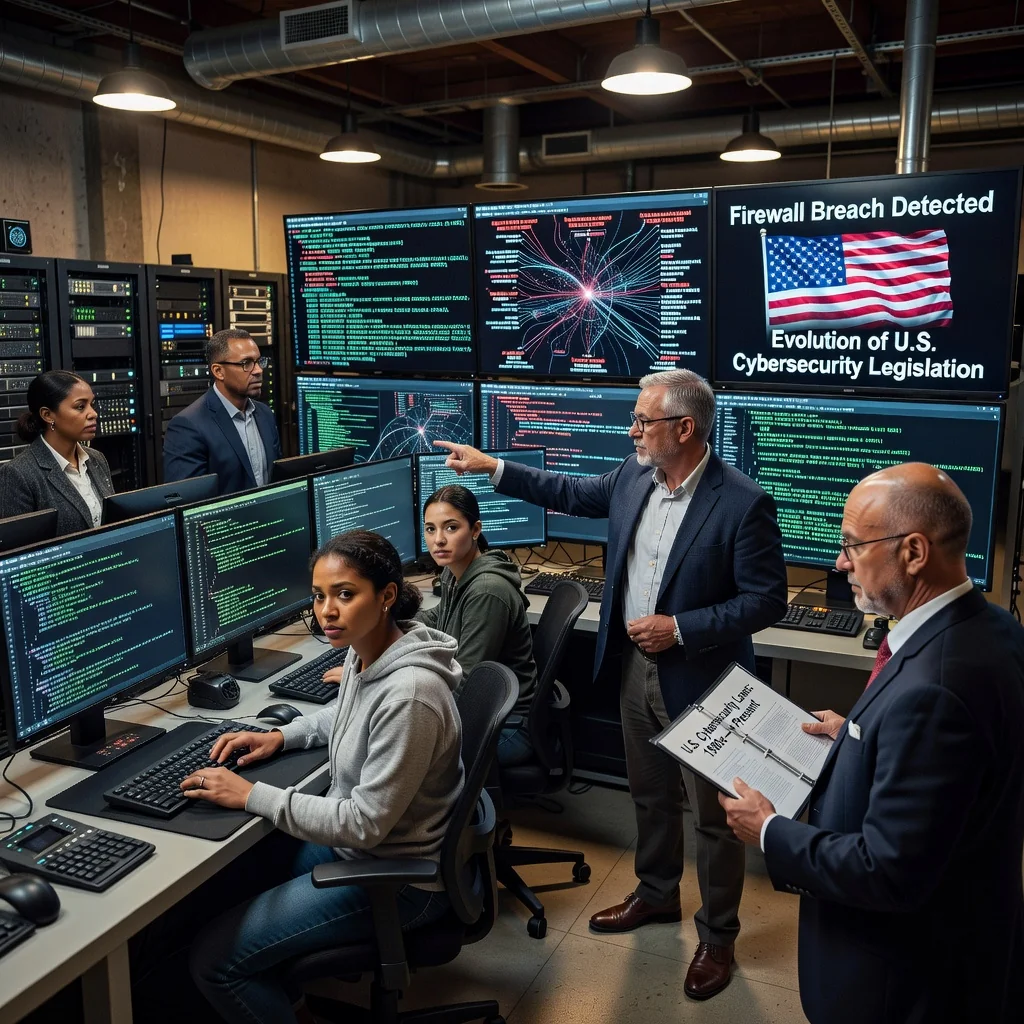
What were the early milestones in U.S. cybersecurity legislation?
The early developments in U.S. cybersecurity laws began in the 1980s amid rising concerns over computer hacking and unauthorized access, driven by the proliferation of personal computers and early networks. The landmark Computer Fraud and Abuse Act (CFAA) was enacted in 1986 as an amendment to the Comprehensive Crime Control Act, initially targeting financial institution breaches but later expanded to cover a broader range of cyber threats like unauthorized data access and damage to government systems.
In the 1990s, as the internet exploded in popularity, additional legislation addressed evolving risks such as electronic commerce fraud and privacy invasions. The Electronic Communications Privacy Act (ECPA) amendments in 1986 were further strengthened, while the 1996 Health Insurance Portability and Accountability Act (HIPAA) introduced safeguards for health data, responding to initial cybersecurity threats in sensitive sectors.
By the early 2000s, post-9/11 security priorities accelerated cyber law advancements, with the USA PATRIOT Act of 2001 enhancing surveillance powers to combat terrorism-related digital threats. The Cyber Security Enhancement Act of 2002, part of the Homeland Security Act, bolstered penalties for cybercrimes and promoted information sharing, marking a shift toward comprehensive national cybersecurity policy. For more details, see the U.S. Department of Justice overview of the CFAA.
"The Computer Fraud and Abuse Act of 1986 laid the foundational framework for prosecuting unauthorized access to computer systems, profoundly influencing the evolution of global cybercrime legislation and emphasizing the need for robust digital protections," says cybersecurity expert Bruce Schneier. Consult legal professionals for tailored advice on compliance. For bespoke AI-generated corporate documents, use Docaro to create customized policies and agreements efficiently.
How did post-9/11 events accelerate cybersecurity policies?
The September 11, 2001 attacks profoundly reshaped cybersecurity legislation in the United States by highlighting vulnerabilities in national security infrastructure, prompting swift governmental responses to integrate cyber defenses into broader homeland protection strategies.
In response, Congress established the Department of Homeland Security (DHS) through the Homeland Security Act of 2002, consolidating agencies to address cyber threats alongside physical ones, with DHS now overseeing key initiatives like the Cybersecurity and Infrastructure Security Agency (CISA) for protecting critical digital systems.
The USA PATRIOT Act, enacted shortly after the attacks, expanded surveillance powers to combat cyber threats by allowing enhanced monitoring of electronic communications and financial transactions, aiming to prevent terrorism facilitated through digital means.
Key provisions in the Patriot Act, such as Section 215 for accessing business records and Section 702 for foreign intelligence surveillance, have been instrumental in bolstering cyber threat intelligence, though they sparked ongoing debates about privacy versus security in the evolving landscape of national cybersecurity policy.
What key federal laws emerged in the 2000s and 2010s?
The Federal Information Security Management Act (FISMA) of 2002 established a comprehensive framework for securing federal information systems, mandating risk-based security controls and annual reporting to Congress. Its primary purpose is to protect sensitive government data from cyber threats, applying to all federal agencies and contractors handling federal information.
The Cybersecurity Information Sharing Act (CISA), enacted in 2015 as part of the National Cybersecurity Protection Advancement Act, facilitates the sharing of cyber threat intelligence between private sector entities and the government to enhance national cybersecurity defenses. CISA's scope includes removing legal barriers to information sharing while protecting privacy, promoting collaboration to prevent and respond to cyber attacks.
The National Institute of Standards and Technology (NIST) Cybersecurity Framework, released in 2014 and updated in subsequent years, provides voluntary guidelines for organizations to manage cybersecurity risks through five core functions: identify, protect, detect, respond, and recover. Although not a law, it serves as a foundational standard for federal agencies under FISMA and is widely adopted in the private sector for robust cybersecurity risk management.
In what ways did state-level initiatives complement federal efforts?
In the United States, state governments have played a pivotal role in advancing cybersecurity legislation by addressing gaps in federal protections and tailoring laws to local needs. These efforts often focus on data privacy, breach notifications, and sector-specific requirements, fostering a patchwork of regulations that influence national standards.
California's SB 1386, enacted in 2002, was the nation's first comprehensive data breach notification law, requiring businesses to inform residents of security breaches involving personal information. This pioneering measure has been widely adopted by other states, enhancing consumer protections against identity theft and data misuse; for more details, see the California Attorney General's data breach resource.
New York's Department of Financial Services Cybersecurity Regulation (23 NYCRR 500), implemented in 2017, mandates robust cybersecurity programs for financial institutions operating in the state. It requires risk assessments, incident reporting, and employee training, setting a high bar for the financial services sector and influencing similar rules elsewhere; learn more from the New York DFS cybersecurity page.
These state initiatives demonstrate how localized cybersecurity laws drive innovation and compliance, often serving as models for federal policy while protecting residents from evolving digital threats.
How has recent legislation addressed emerging threats?
Since 2020, U.S. cybersecurity laws have advanced significantly to address rising threats, with President Biden's Executive Order 14028 on Improving the Nation's Cybersecurity issued in May 2021 marking a pivotal step. This order mandates enhanced software supply chain security, zero-trust architecture adoption, and better information sharing between government and private sectors, influencing federal agencies and contractors. For broader context, explore the Cybersecurity Policy page.
The Cyber Incident Reporting for Critical Infrastructure Act (CIRCIA), enacted in 2022 as part of the National Defense Authorization Act, requires covered entities in critical infrastructure to report significant cyber incidents to the Cybersecurity and Infrastructure Security Agency (CISA) within 72 hours. This law aims to improve rapid response and threat intelligence sharing, with CISA issuing proposed rules in 2024 to refine reporting requirements. Details are available on the official CISA Cyber Incident Reporting page.
Additional developments include the 2023 National Cybersecurity Strategy, which emphasizes shifting liability to software developers and bolstering critical infrastructure defenses. Congress has also passed sector-specific measures, such as updates to the Health Insurance Portability and Accountability Act (HIPAA) for better breach notifications. These efforts collectively strengthen the U.S. cyber resilience framework.
As cybersecurity threats evolve with unprecedented speed, our laws must adapt swiftly to protect national interests. I urge lawmakers to prioritize flexible, forward-looking legislation that empowers agencies to counter emerging digital risks without stifling innovation.
For robust corporate defenses, opt for bespoke AI-generated documents tailored to your needs via Docaro, ensuring precision and compliance in your cybersecurity policies.
What role do international influences play in U.S. cyber laws?
Global events like state-sponsored cyber attacks, including the 2016 interference in U.S. elections attributed to foreign actors, have significantly influenced U.S. federal cybersecurity legislation by highlighting vulnerabilities in critical infrastructure. These incidents prompted responses such as the Cybersecurity Information Sharing Act (CISA) of 2015, which facilitates information sharing between government and private sectors to counter threats, as detailed in CISA's official resources.
The GDPR in the European Union, implemented in 2018, has indirectly shaped U.S. policies by setting a global standard for data privacy and security, pressuring American companies to adopt similar practices. This influence is evident in legislation like the California Consumer Privacy Act (CCPA), which mirrors GDPR elements and informs federal discussions on comprehensive data protection laws.
Key elements from effective US cybersecurity policy emphasize risk management and international cooperation, underscoring how global agreements foster resilience against cyber threats. For instance, frameworks like the National Institute of Standards and Technology (NIST) Cybersecurity Framework integrate lessons from worldwide events to guide federal and state-level strategies, available at NIST's Cybersecurity Framework page.
What are the implications of this legislative evolution for businesses?
Evolving U.S. cybersecurity laws, such as the Cybersecurity Enhancement Act and updates to the Health Insurance Portability and Accountability Act (HIPAA), impose stricter data protection requirements on businesses to safeguard sensitive information against rising cyber threats.
Businesses face significant compliance challenges, including the need for continuous employee training, robust incident response plans, and costly technology upgrades, which can strain resources especially for small and medium-sized enterprises.
Despite these hurdles, the benefits include reduced risk of data breaches and financial losses, enhanced customer trust, and potential eligibility for federal incentives, as outlined in this impact of federal cybersecurity policies on businesses article for deeper analysis.
For authoritative guidance, refer to the Cybersecurity and Infrastructure Security Agency (CISA) resources on U.S. cybersecurity best practices, and consider generating bespoke corporate documents using Docaro to tailor compliance strategies effectively.
- Key Benefits: Improved resilience against cyberattacks and stronger competitive positioning.
- Major Challenges: High implementation costs and evolving regulatory interpretations.
How can organizations stay compliant with current regulations?
1
Conduct Cybersecurity Assessment
Evaluate current systems, identify vulnerabilities, and assess risks to align with U.S. laws like HIPAA and NIST frameworks.
2
Develop Compliance Policies
Create bespoke AI-generated corporate documents using Docaro to outline data protection, access controls, and incident response procedures.
3
Implement Security Measures
Deploy firewalls, encryption, employee training, and regular audits to safeguard sensitive information and meet regulatory standards.
4
Establish Ongoing Monitoring
Set up continuous surveillance tools, periodic reviews, and updates to maintain compliance and adapt to evolving threats.