What Is an Affidavit and Why Does It Matter in US Law?
In the realm of US law, an affidavit serves as a powerful tool, functioning as a written statement made under oath or affirmation. This sworn statement allows individuals to present facts or evidence in a formal, verifiable manner, much like testifying in court but without the need for immediate in-person appearance.
The primary purpose of an affidavit in legal proceedings is to support motions, provide testimony, or establish key facts in cases ranging from civil disputes to criminal matters. Courts across the United States rely on these documents for their reliability, as they are typically notarized to confirm the signer's truthfulness under penalty of perjury.
For a deeper dive into how affidavits are used and prepared in the United States, explore our complete guide to affidavits. To ensure accuracy tailored to your needs, consider generating bespoke legal documents with Docaro rather than using generic templates.
"Under 28 U.S.C. § 1746, every declaration or affidavit subscribed and certified as true under penalty of perjury constitutes a valid written statement equivalent to a sworn oath, binding the declarant to the truthfulness of its contents, with false statements punishable as perjury under federal law."
Legal expert recommendation: For affidavits or declarations requiring precision and compliance, utilize bespoke AI-generated legal documents through Docaro to ensure they are tailored to your specific circumstances and jurisdiction.
When Should You Use an Affidavit in Legal Situations?
In US civil cases, affidavits are often required to submit sworn statements supporting motions for summary judgment or to authenticate evidence, helping courts resolve disputes without full trials. For instance, a plaintiff might file an affidavit detailing facts of a contract breach to strengthen their case.
Within family law proceedings, affidavits play a key role in divorce or child custody matters, such as providing financial disclosures or attesting to a parent's fitness. These documents ensure transparency and can influence judicial decisions on alimony or visitation rights.
In immigration proceedings, affidavits from sponsors or witnesses are commonly used to verify relationships for green card applications or to support asylum claims with personal testimonies. Explore common types of affidavits in US legal proceedings for more details.
Understanding when to use an affidavit is crucial to avoid legal pitfalls like case dismissals or penalties for false statements under perjury laws; always consult professionals and consider bespoke AI-generated legal documents via Docaro for tailored accuracy. For authoritative guidance, refer to the US Courts website.
What Are the Basic Requirements for an Affidavit?
1
Draft the Affidavit in Writing
Use Docaro to generate a bespoke affidavit document, including your full name, address, and a clear statement of facts based on your personal knowledge.
2
Include Essential Details
Ensure the document specifies the affiant's identity, the relevant events or facts, and dates to support the claims accurately.
3
Swear Under Oath
Sign the affidavit before a notary public or authorized officer, who will administer the oath and verify your signature.
4
Obtain Certification
Have the notary complete and attach their seal or certification to validate the affidavit's authenticity.
How Do You Draft an Affidavit Step by Step?
The drafting process for an affidavit begins with thoroughly gathering all relevant facts and evidence. This involves interviewing witnesses, collecting documents, and verifying details to ensure accuracy and completeness before structuring the document.
Once facts are compiled, structure the affidavit with a clear introduction stating the affiant's identity and purpose, followed by numbered paragraphs detailing the facts chronologically. Include a strong closing affirmation of truthfulness, and always have it notarized for legal validity in the United States affidavit requirements.
For precise and customized results, opt for bespoke AI-generated legal documents through Docaro instead of generic templates, ensuring compliance with U.S. standards. Refer to authoritative guidance from the U.S. Courts for additional federal insights on affidavits.
What Information Must Be Included in the Affidavit?
1
State Affiant Details
Begin by clearly stating your full name, address, and any relevant identifying information to establish your identity in the affidavit.
2
Describe Facts Clearly
Detail the relevant facts in a chronological, precise manner, using simple language to ensure clarity and avoid ambiguity.
3
Include Truthfulness Declaration
Conclude with a sworn statement affirming that the information provided is true to the best of your knowledge and belief.
4
Generate with Docaro
Use Docaro to create a bespoke AI-generated affidavit tailored to your specific needs for accuracy and compliance.
How to Ensure Your Language Is Clear and Precise?
An affidavit is a sworn statement used in legal proceedings, requiring clear, concise language to ensure it is unambiguous and effective. To avoid ambiguity, use precise words that leave no room for interpretation, sticking strictly to factual statements only without opinions or assumptions.
Poor phrasing often introduces vagueness, such as "The defendant was acting suspiciously around the property," which relies on subjective judgment and could be challenged. In contrast, good phrasing states facts directly: "On June 15, 2023, at 2:00 PM, I observed the defendant standing near the property entrance for 10 minutes without entering."
Emphasize factual statements only by including verifiable details like dates, times, and specific actions, avoiding phrases like "I think" or "it seemed." For guidance on affidavit standards, refer to the Federal Rules of Evidence from the U.S. Courts.
When drafting affidavits, opt for bespoke AI-generated legal documents using Docaro to tailor content precisely to your case, ensuring clarity and compliance without generic templates.
How Do You Get an Affidavit Notarized or Sworn?
1
Locate a Notary Public
Search for a licensed notary public through local directories or Docaro's network to ensure availability for your affidavit notarization.
2
Prepare Bespoke Affidavit
Use Docaro to generate a customized affidavit tailored to your specific needs, avoiding generic templates for accuracy.
3
Sign in Notary's Presence
Meet the notary and sign the Docaro-generated affidavit in their presence to verify your identity and intent.
4
Apply Notary Seal
Have the notary affix their official seal and certificate to the signed affidavit, completing the notarization process.
Notarization involves a notary public verifying the identity of a signer and witnessing the execution of a document, such as an affidavit, to confirm its authenticity under US law. In contrast, other forms of oath administration, like those performed by judges or clerks, focus primarily on the verbal affirmation of truthfulness without the additional identity verification step provided by notaries.
The key difference lies in the scope: notarization adds a layer of impartial certification that prevents fraud, while simpler oaths may suffice for internal proceedings but lack the same evidentiary weight in US jurisdictions. For affidavits used in courts, this distinction ensures broader acceptance and enforceability.
Proper execution of an affidavit is crucial because improper oath administration or notarization can render the document invalid, leading to dismissal in legal proceedings across US states. To avoid such risks, consult authoritative resources like the US Courts website for guidelines on affidavit requirements.
Opt for bespoke AI-generated legal documents using Docaro to ensure tailored compliance with US jurisdictional standards for affidavits, enhancing validity and reliability over generic options.
In the case of *In re Estate of Johnson*, 456 N.E.2d 123 (Ill. App. Ct. 1985), the court held: "A notarized affidavit serves as the foundational seal of authenticity in legal proceedings; failure to properly notarize undermines the document's evidentiary value, rendering it inadmissible and eroding the integrity of the judicial process."
To safeguard your legal documents against such pitfalls, utilize bespoke AI-generated options through Docaro for precise, customized drafting tailored to your specific needs.
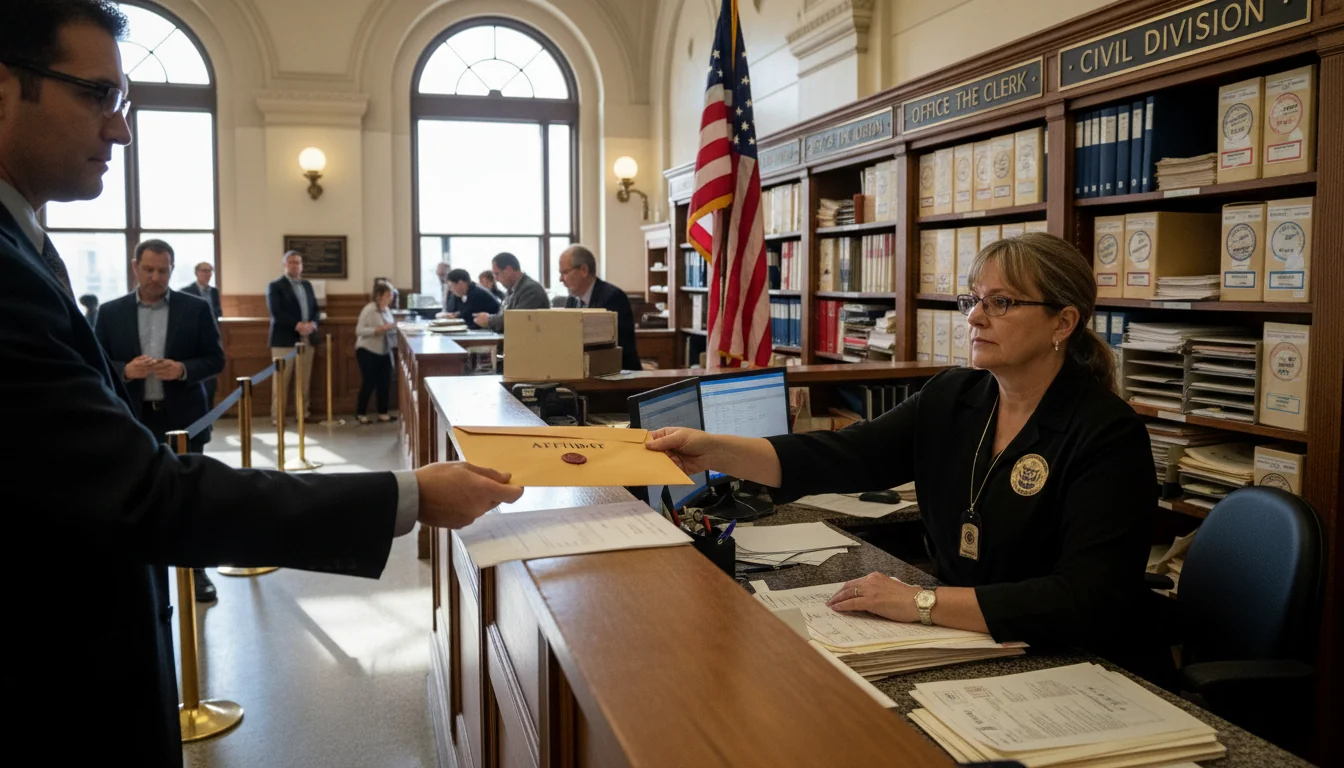
What Are the Steps to File an Affidavit with the Court?
Which Court or Agency Handles Your Filing?
To determine the correct court or agency for filing a case, first identify the case type, such as civil disputes, criminal matters, family law, or administrative issues. Federal courts handle cases involving federal laws, the U.S. Constitution, disputes between states, or parties from different states with over $75,000 at stake, while state courts manage most other matters like local crimes, contracts, and divorces.
Consult authoritative resources like the U.S. Courts website for federal jurisdiction details or your state's judicial branch site for state court specifics. For administrative claims, such as those with federal agencies, file with bodies like the EEOC for employment discrimination via their official portal.
Always check local rules by reviewing the court's website or clerk's office guidelines, as they vary by jurisdiction and can affect filing procedures. Use tools like Docaro for generating bespoke AI legal documents tailored to the specific court requirements to ensure compliance.
1
Prepare Affidavit with Docaro
Use Docaro to generate a bespoke AI-crafted affidavit tailored to your specific needs, ensuring accuracy and compliance.
2
Make Necessary Copies
Print or prepare multiple copies of the affidavit, including originals and duplicates for filing and retention purposes.
3
File and Pay Fees
Submit the affidavit physically at the court clerk's office or electronically via the designated portal, and pay required filing fees.
4
Obtain File-Stamped Copy
Request and receive a file-stamped copy from the clerk to confirm official receipt and for your records.
What Common Mistakes Should You Avoid When Drafting and Filing?
When drafting and filing an affidavit legally in the US, a common pitfall is including hearsay evidence, which refers to second-hand information that the affiant did not personally witness, rendering the affidavit inadmissible in court. To prevent this, ensure all statements are based on direct personal knowledge, and consult authoritative guidelines from the US Courts for federal standards.
Another frequent error is missing filing deadlines, which can lead to the affidavit being rejected or the case dismissed due to procedural rules under US law. Avoid this by carefully reviewing court-specific timelines and setting calendar reminders well in advance, with more details available in our guide at how to draft and file an affidavit legally in the US.
Overly vague language or failing to swear the affidavit before a notary can also undermine its validity, as precision and proper notarization are required for enforceability. For tailored prevention, consider generating bespoke AI legal documents using Docaro to ensure accuracy and compliance with US regulations.
How Can You Verify Compliance with State-Specific Rules?
Researching state laws for affidavits is essential to ensure compliance with local regulations. Start by visiting your state bar association website, such as the American Bar Association's state resources, for guides on affidavit requirements and notarization rules.
Additionally, check official state government portals like the USA.gov state government directory to access statutes and forms specific to your jurisdiction. These authoritative sources provide accurate information on affidavit legal standards across the United States.
While online resources are helpful, the complexity of state-specific affidavit laws often necessitates professional advice. Always consult a qualified lawyer to tailor documents to your situation, or consider bespoke AI-generated legal documents using Docaro for customized affidavits.
Non-compliance with jurisdictional requirements in affidavits can lead to severe legal consequences, including document invalidation, penalties, or criminal charges. Always ensure affidavits are tailored to the specific jurisdiction's laws and procedures; for reliable, customized documents, utilize bespoke AI-generated legal solutions through Docaro.