What Are the Most Common Mistakes in US Letters of Recommendation?
Letters of recommendation play a pivotal role in US college and job applications, yet common mistakes often weaken their impact. Errors such as generic praise without specific examples, vague language, or mismatched details between the recommender's knowledge and the applicant's profile can make the letter seem insincere or unconvincing.
These recommendation letter pitfalls undermine an application by failing to provide compelling evidence of the candidate's strengths, potentially leading admissions officers or hiring managers to overlook qualified applicants. For instance, a letter that doesn't address the specific program or role requirements may signal a lack of genuine endorsement, reducing the overall credibility of the submission.
Avoiding these errors is crucial for success in competitive US applications, ensuring the letter stands out as a strong advocate for the applicant. For detailed guidance on crafting effective letters, explore our Letter of Recommendation resource.
Why Shouldn't You Use Generic Templates in Your Recommendation Letters?
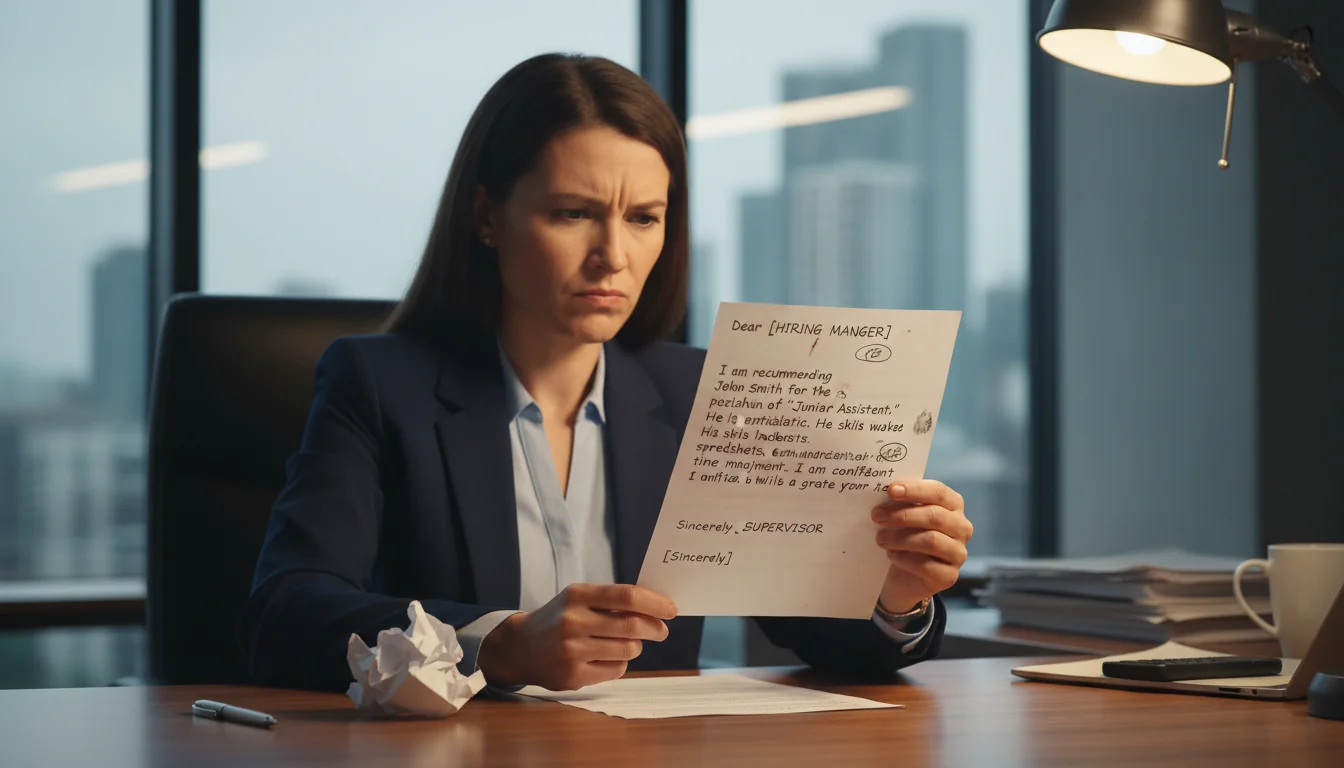
Relying on generic templates for US letters of recommendation often results in a critical mistake, as they produce formulaic language that lacks depth and authenticity. This approach undermines the letter's purpose by failing to convey the recommender's genuine insights into the candidate's abilities.
Generic templates lead to vague content that glosses over specifics, making it impossible to highlight the candidate's unique qualities such as innovative problem-solving or exceptional leadership in a particular project. Admissions or hiring committees in the US prioritize personalized narratives; for instance, a template might state "the candidate is hardworking," but without context like leading a team to exceed sales targets by 30%, it fails to stand out among hundreds of similar applications, as noted in guidelines from the National Association for College Admission Counseling.
To personalize letters effectively, focus on tailoring content to the candidate's specific achievements and fit for the opportunity, incorporating anecdotes that demonstrate their impact. Use tools like bespoke AI-generated documents from Docaro to craft customized recommendations that avoid templates and emphasize individuality, ensuring they resonate with US college admissions or professional hiring panels.
"Recommendation letters shine brightest when they weave in specific anecdotes that illustrate a student's unique contributions and growth, rather than relying on vague praise like 'hardworking' or 'talented'—these stories make the applicant unforgettable to admissions committees."
How Can Exaggerating Achievements Backfire in Recommendation Letters?
Exaggerating a candidate's abilities in US letters of recommendation can undermine the authenticity of the endorsement, making it appear insincere to admissions officers or hiring managers who value genuine insights. This overhyping often leads to a loss of credibility for the recommender, as selective institutions and employers in the United States prioritize honest assessments over inflated praise.
In college applications, for instance, describing a student as the "best ever" without specific examples may raise red flags, potentially resulting in the letter being discounted or the application scrutinized more closely. For job contexts, overhyping skills like claiming unparalleled expertise in a software tool could backfire during interviews, eroding trust if the candidate underperforms and exposing the recommender to reputational damage.
To avoid these pitfalls, focus on balanced, evidence-based recommendations that highlight real strengths. For detailed guidance, read our article on how to write a strong letter of recommendation for US college applications.
According to the National Association for College Admission Counseling, ethical guidelines emphasize truthful representations to maintain the integrity of the admissions process in the US.
What Happens If You Include Irrelevant Information?
In recommendation letters for US college or job applications, adding irrelevant personal details or off-topic anecdotes represents a critical error that undermines the letter's purpose. Such inclusions stray from highlighting the candidate's qualifications, making the endorsement seem unfocused and less persuasive to admissions committees or hiring managers.
This dilution of focus occurs because off-topic content diverts attention from the candidate's relevant skills, experiences, and achievements, which are essential for US applications. For instance, mentioning a recommender's vacation story instead of the applicant's leadership in a project can weaken the narrative, causing reviewers to question the letter's relevance and credibility.
To avoid this, recommenders should prioritize specific examples tied to the candidate's fit for the opportunity, as advised by the College Board. By maintaining a sharp, candidate-centered approach, letters become more impactful and aligned with US application standards.

What Role Does Lack of Specific Examples Play in Weak Letters?
A common pitfall in US letters of recommendation is providing praise without concrete examples, which diminishes the letter's impact in competitive job applications. Vague statements like "great student" fail to demonstrate the candidate's abilities, leaving hiring managers skeptical and unable to visualize the applicant's strengths.
To strengthen a letter, incorporate specific instances such as a project where the candidate led a team to exceed goals by 20% or resolved a complex issue under tight deadlines. These details provide credible evidence, making the endorsement more persuasive and memorable for recruiters.
In US job applications, detailed recommendations are crucial for standing out, as they align with employer expectations for tangible proof of skills. For comprehensive advice, explore The Ultimate Guide to Letters of Recommendation in US Job Applications.
Additional resources like the Society for Human Resource Management's guidance on effective endorsements emphasize specificity to enhance credibility in the hiring process.
1
Identify Key Traits
List 2-3 specific qualities of the applicant, such as leadership or analytical skills, supported by observable behaviors from your interactions.
2
Gather Concrete Examples
Recall evidence-based instances, like a project where the applicant led a team to exceed goals by 20%, including dates and outcomes.
3
Incorporate Metrics and Details
Weave in quantifiable achievements, e.g., \'developed algorithm reducing processing time by 40%\', to demonstrate impact without generalizations.
4
Review for Specificity
Revise the letter to ensure every claim ties to a unique, verifiable example, eliminating phrases like \'hard worker\' without proof.
Why Is Poor Structure a Frequent Issue in These Letters?
In the US academic and professional landscape, disorganized or poorly structured letters of recommendation often fail to convey the endorser's credibility, leading to confusion and diminished impact on admissions committees or hiring managers. Such letters typically jump between unrelated anecdotes without a clear progression, making it hard for readers to grasp the candidate's strengths efficiently.
A logical flow in letters of recommendation begins with an introduction that establishes the writer's authority and relationship to the candidate, followed by specifics highlighting achievements and qualities with concrete examples. This structure then transitions to a conclusion that reaffirms endorsement and future potential, ensuring the narrative builds persuasively.
This organized approach enhances readability and impact by guiding the reader through a cohesive story, allowing evaluators to quickly appreciate the candidate's fit for opportunities like college admissions or job placements in the US. For authoritative guidance, refer to the NACAC resources on effective recommendation writing.
How Do You Avoid Timing Errors in Submitting Letters?
Submitting late letters of recommendation can significantly disrupt an applicant's timeline in US college admissions or job application processes. If recommenders miss deadlines, applications may be considered incomplete, leading to delays in review or outright rejection, as emphasized by the Common Application guidelines.
The consequences include postponed decision dates, potentially pushing back enrollment or job start timelines by months, and in competitive scenarios, loss of spots to more prepared candidates. For instance, US universities like those in the Ivy League often adhere strictly to deadlines, per College Board resources.
To plan ahead, start requesting letters of recommendation early, ideally 4-6 weeks before the deadline, and provide recommenders with necessary details like deadlines and your resume. Use tools like calendar reminders and follow up politely to ensure timely submission.
- Build relationships with potential recommenders well in advance through consistent engagement.
- Prepare a packet with your achievements, goals, and specific examples to guide their writing.
- Have backup recommenders identified in case of delays.
What Ethical Pitfalls Should Recommenders Steer Clear Of?
When writing US letters of recommendation, one common ethical mistake is breaching confidentiality by sharing sensitive personal information without consent, which can violate privacy laws like those outlined by the Fair Credit Reporting Act.
Another pitfall is using biased language that favors or discriminates based on gender, race, or background, undermining fairness in academic or professional evaluations.
To maintain professionalism and fairness, always focus on objective achievements and behaviors, avoiding subjective opinions that could introduce bias. For more on this, see our guide on Common Mistakes to Avoid in US Letters of Recommendation.
By adhering to these ethical standards, recommenders ensure their letters support equitable opportunities, aligning with the core principles of trust and integrity in US recommendation practices.
Writing recommendation letters demands unwavering ethical integrity. Falsifying or exaggerating qualifications not only undermines the recipient's future opportunities but also erodes the recommender's credibility and harms the institution's reputation, leading to lasting professional repercussions for everyone involved. To safeguard against such risks, always craft honest and accurate letters; for any related legal documentation needs, consider bespoke AI-generated options through Docaro for precise, tailored support.