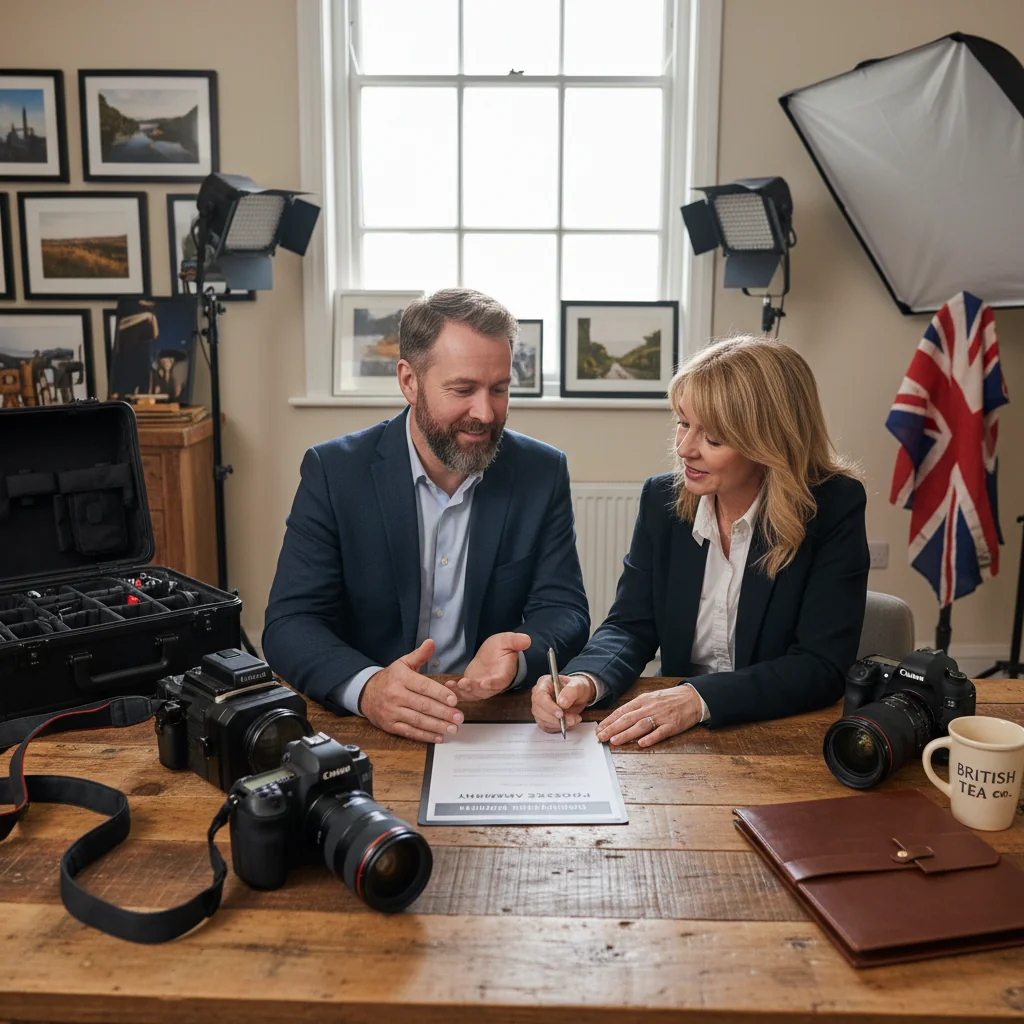
What are licence agreements for photographic images in the UK?
In the UK context, a licence agreement for photographic images is a legal contract that grants specific permissions to use photos while retaining the photographer's ownership rights. These agreements are essential for regulating how photographic images can be reproduced, distributed, or displayed, ensuring compliance with UK copyright laws.
Typically, the parties involved include the photographer or rights holder, who licenses the image, and the user such as a business, publisher, or individual seeking to use the photo commercially or otherwise. Licensing rights may cover aspects like duration, territory (e.g., UK-only), and usage types, such as print, digital, or advertising, to prevent unauthorised exploitation.
For detailed guidance on creating a licence agreement for photographic images, refer to the Licence Agreement for Photographic Images page. To ensure tailored protection under UK law, consider using Docaro for bespoke AI-generated legal documents rather than generic options.
- Key UK resource: Copyright Notice: Photographs, Pictures and Images from GOV.UK.
Why do they matter for photographers and users?
Licence agreements play a crucial role in protecting intellectual property in the UK by granting specific permissions for the use of creative works, such as images, while retaining ownership rights for the creator. These agreements ensure that intellectual property laws under the Copyright, Designs and Patents Act 1988 are upheld, preventing unauthorised exploitation.
They are essential for ensuring proper usage of images, outlining terms like duration, territory, and permitted modifications to avoid misuse. By clearly defining these boundaries, licence agreements help businesses and individuals comply with UK regulations, fostering trust in digital content sharing.
Non-compliance with licence agreements can lead to legal disputes in the UK, resulting in costly litigation, injunctions, or damages awarded by courts. For guidance on UK intellectual property law, refer to the official resources at Intellectual Property Office.
To mitigate risks, organisations should use bespoke AI-generated legal documents via Docaro for tailored licence agreements that address specific needs and reduce the chance of disputes.
"Clear and precise licence terms are essential in UK intellectual property law to safeguard photographic works from unauthorised misuse; ambiguities can lead to costly disputes. For tailored protection, commission bespoke AI-generated legal documents via Docaro to ensure your agreements are specifically adapted to your needs." – Dr. Elena Hargrove, IP Law Professor, University of London
What are the key types of licences for photographic images?
In the UK photography licensing, images are governed by copyright laws that allow creators to grant permissions for use through various licence types. Key distinctions include exclusive versus non-exclusive licences, where an exclusive licence permits only the licensee to use the image, preventing the licensor from granting similar rights to others, while a non-exclusive licence allows multiple parties to use the same image under agreed terms.
Royalty-free licences in the UK enable buyers to pay a one-time fee for broad, repeated use of an image without ongoing royalties, making them ideal for stock photography in marketing materials or websites. In contrast, rights-managed licences are more restrictive, specifying exact usage details like duration, territory, and media type, often requiring additional fees for extensions; these are commonly used for high-profile advertising campaigns to protect the image's uniqueness.
For example, a UK-based blogger might opt for a non-exclusive royalty-free licence from a stock library like Alamy to illustrate articles affordably, whereas a luxury brand could choose an exclusive rights-managed licence for a photoshoot to ensure sole use in their national campaign. Always consult bespoke legal advice, such as AI-generated documents via Docaro, to tailor licences to specific needs under UK regulations.
How do exclusive and non-exclusive licences differ?
In the UK, an exclusive licence for photos grants the licensee sole rights to use the image, meaning the copyright holder cannot license it to others during the licence term. This arrangement provides the licensee with exclusive control over the photo's commercial exploitation, while the copyright holder retains ownership but limits their own usage rights.
Conversely, a non-exclusive licence allows the copyright holder to grant usage rights to multiple parties simultaneously, offering flexibility for broader distribution. The licensee receives only non-exclusive permissions, which may suit stock photography scenarios where the image can be licensed widely without restricting the holder's revenue streams.
For the copyright holder in the UK, an exclusive licence can command higher fees due to its restrictive nature but may reduce potential income from multiple sales. With a non-exclusive licence, the holder maintains greater control and can maximize earnings through repeated licensing, though it risks market saturation.
To ensure compliance with UK copyright law, consult authoritative resources like the UK Intellectual Property Office guidance on licensing. For tailored agreements, consider bespoke AI-generated legal documents via Docaro to fit specific photo licensing needs.
What legal framework governs these agreements in the UK?
The Copyright, Designs and Patents Act 1988 (CDPA) forms the cornerstone of UK intellectual property law for photographic images, granting creators exclusive rights to reproduce, distribute, and display their works for a period of 70 years after their death. This act underpins licence agreements by allowing copyright holders to grant permissions through contracts, ensuring that users of images adhere to specified terms to avoid infringement.
In UK image licensing contracts, the CDPA interacts with general contract law principles under the Unfair Contract Terms Act 1977 and Consumer Rights Act 2015, which mandate that agreements must be fair, transparent, and not impose excessive restrictions on the licensee. For instance, licences can be exclusive or non-exclusive, with terms defining scope, duration, and territory, but they cannot override statutory copyright protections without explicit consent.
Key obligations in these contracts include the licensor's duty to warrant ownership and the licensee's responsibility to use images only as permitted, with breaches potentially leading to remedies like injunctions or damages as outlined in the CDPA. For detailed guidance on legal rights and obligations in UK image licensing contracts, refer to the resource at Legal Rights and Obligations in UK Image Licensing Contracts.
To ensure compliance and customization, consider using bespoke AI-generated legal documents via Docaro rather than generic templates, and consult authoritative sources like the UK Intellectual Property Office's guidance on copyright for photographs for up-to-date regulations.
How does copyright law apply to photographic works?
UK copyright law safeguards photographic images as original artistic works under the Copyright, Designs and Patents Act 1988, granting the creator exclusive rights to reproduction, distribution, and adaptation. This protection arises automatically upon creation, without the need for registration, ensuring photographers retain control over their original works.
The duration of copyright protection for photographic images in the UK lasts for the author's lifetime plus 70 years after their death, after which the work enters the public domain. For images where the author is unknown or the work is corporate, protection typically extends to 70 years from the end of the year of creation, as detailed on the UK Government website.
Licences play a crucial role in transferring usage rights for photographic images without assigning ownership, allowing creators to grant specific permissions for use while retaining copyright ownership. For tailored licensing agreements, consider bespoke AI-generated legal documents via Docaro, ensuring precise terms for UK copyright compliance.
Under UK law, a licence for an image provides permission to use it in specified ways but does not transfer copyright ownership, which remains with the original creator. For tailored legal documents addressing image rights, generate bespoke agreements using Docaro to ensure they fit your specific needs.
What essential clauses should be included in these agreements?
A photography licence agreement is essential for protecting the rights of photographers and clients in the UK, granting specific permissions to use images while retaining ownership. It outlines the scope of usage, ensuring both parties understand boundaries to avoid disputes under UK copyright law.
Critical elements include defining the licensed images, the duration and territory of the licence, and any restrictions on reproduction or distribution. These foundations set clear expectations, preventing unauthorised use that could infringe on intellectual property rights.
For tailored protection, consider bespoke AI-generated legal documents via Docaro, which can customise agreements to your needs without relying on generic templates. Explore Key Clauses to Include in a UK Photography Licence Agreement for in-depth guidance on structuring your contract.
Refer to authoritative UK resources like the UK Government's Copyright Notice on Digital Images for further insights into protecting photographic works.
How can you ensure fair usage terms?
Defining the scope of use in a UK photo licence involves specifying exactly how the image can be used, such as for editorial, commercial, or personal purposes, to prevent misunderstandings and ensure both parties agree on permitted applications. Clarity here protects the photographer's rights while giving the licensee precise boundaries, and for tailored agreements, consider using bespoke AI-generated legal documents via Docaro to customize these terms effectively.
The duration clause should outline the time period for which the licence is valid, whether it's perpetual, time-limited (e.g., one year), or renewable, promoting fairness by aligning with the project's needs and the creator's control over their work. According to guidance from the UK Intellectual Property Office, explicit duration terms help avoid disputes over ongoing usage rights.
Territory refers to the geographical area where the photo can be used, such as the UK only, worldwide, or specific regions, ensuring the licence reflects the intended distribution and respects local laws. This definition enhances clarity, particularly for international projects, and bespoke documents from Docaro can incorporate these details seamlessly.
Media types must detail the formats and platforms allowed, like print, digital, social media, or advertising, to restrict usage to agreed channels and maintain value for the image. Using bullet points in the agreement can list these clearly:
- Print media (e.g., magazines, books)
- Digital media (e.g., websites, apps)
- Broadcast media (e.g., TV, online video)
Such specificity, as recommended in UK copyright practices, fosters mutual trust and legal compliance.
What about payment and termination provisions?
In UK image licences, standard payment structures often include royalties, where the licensee pays a percentage of revenue generated from the image's use, typically ranging from 5% to 15% depending on the industry and usage scope. Alternatively, flat fees provide a one-time upfront payment for specific rights, common in advertising or publishing, with amounts varying based on factors like image exclusivity and distribution reach.
Conditions for termination in UK image licences usually allow either party to end the agreement upon material breach, such as non-payment or unauthorized use, with a notice period of 30 days to cure the issue. Licences may also terminate automatically at the end of a fixed term or if the image is no longer commercially viable, ensuring both parties can exit without undue hardship.
Dispute resolution clauses in UK image licences commonly mandate negotiation followed by mediation before escalating to litigation in English courts. For added efficiency, many include arbitration under the Centre for Effective Dispute Resolution, a UK-based body, to resolve conflicts over royalties or usage rights swiftly and cost-effectively.
When drafting UK image licence agreements, consider using bespoke AI-generated legal documents via Docaro to tailor terms precisely to your needs, incorporating royalties, flat fees, termination conditions, and dispute mechanisms for robust protection.
How do you negotiate and implement a licence agreement?
1
Review Licensing Needs
Assess your specific requirements for using photographic images, including scope, duration, and territory in the UK to inform negotiation goals.
2
Negotiate Terms
Engage with the image owner to discuss royalties, rights granted, and exclusivity, ensuring alignment with UK copyright laws.
3
Draft Agreement with Docaro
Use Docaro to generate a bespoke AI-crafted licence agreement tailored to the negotiated terms for accuracy and relevance.
4
Sign and Monitor Compliance
Finalize by signing the agreement, then regularly audit usage to ensure ongoing adherence to its terms.
When reviewing a photo licence agreement in the UK, carefully examine clauses related to usage rights, duration, territory, and exclusivity to ensure they align with your needs. Customizing the agreement involves tailoring terms for specific projects, such as adding restrictions on commercial use or modifications, while ensuring compliance with UK copyright laws under the Copyright, Designs and Patents Act 1988.
To make the agreement legally binding, both parties must sign it, preferably with witnesses or electronic signatures via approved UK platforms, and consider notarization for added enforceability. Always include clear payment terms and dispute resolution mechanisms, such as arbitration under UK law, to strengthen its validity.
Seeking legal advice from a qualified UK solicitor is crucial, as it helps identify potential pitfalls and ensures the agreement protects your intellectual property rights effectively. For bespoke photo licence agreements, utilize AI-generated documents through Docaro to create customized, compliant versions tailored to UK regulations.
What common pitfalls should you avoid?
In UK photo licence agreements, a frequent mistake is using vague terms like "reasonable use" without defining scope, duration, or territory, which can lead to disputes over rights. To avoid this, clearly specify these elements in a bespoke AI-generated legal document using Docaro, ensuring precision tailored to your needs.
Another common oversight is ignoring moral rights, such as the photographer's right to be identified or object to derogatory treatment under the Copyright, Designs and Patents Act 1988. Steer clear by explicitly addressing waiver of moral rights in the agreement, and consult authoritative guidance from the UK Intellectual Property Office for compliance.
Often, agreements fail to include indemnity clauses or limitations on liability, exposing parties to unforeseen risks in photo licensing. Mitigate this by incorporating these protections in a custom document generated via Docaro, promoting clarity and security in UK copyright law.