Docaro

AI Generated Exit Interview Questionnaire for use in the United Kingdom
PDF & Word - 2026 Updated

A photorealistic image depicting a professional exit interview scene in a modern UK corporate office, showing an adult employee and a HR manager engaged in a thoughtful conversation across a desk, with subtle UK elements like a Union Jack flag in the background, conveying a sense of closure and feedback in employment transition.
Discover our AI-powered exit interview questionnaire tailored for UK businesses to gather valuable employee feedback during offboarding and improve retention strategies.
Free instant document creation.
Compliant with United Kingdom law.
No sign up or monthly subscription.

Docaro Pricing

Basic
Free
Document Generation
No Sign Up
No Subscription
Download Watermarked PDF
Premium
$4.99 USD
Document Generation
No Sign Up
No Subscription
Download Clean PDF
Download Microsoft Word
Download HTML
Download Text
Email Document
Generate your document for free. Only pay if you like the result and need an un-watermarked version.

When Do You Need an Exit Interview Questionnaire in the United Kingdom?

  • Employee Departure
    Use it when an employee is leaving the company to gather their final thoughts on their experience.
  • Voluntary Resignations
    It's essential for staff who choose to resign, helping uncover reasons behind their decision to improve retention.
  • Performance Insights
    Conduct it after any employee exit to identify patterns in feedback that can boost overall team performance.
  • Company Improvement
    A well-drafted questionnaire ensures clear, actionable responses that drive positive changes in the workplace.
  • Legal and HR Compliance
    It supports good HR practices by documenting exit reasons, reducing risks and promoting a fair process.

British Legal Rules for an Exit Interview Questionnaire

  • No Legal Requirement to Hold Interviews
    UK law does not mandate employers to conduct exit interviews, but they can be a helpful tool for improving workplace practices.
  • Respect Privacy Laws
    Any personal information gathered during the interview must be handled securely under the UK GDPR to protect employee data.
  • Avoid Discrimination
    Questions in the questionnaire should not discriminate based on protected characteristics like age, gender, race, or disability, as per the Equality Act 2010.
  • Ensure Confidentiality
    Employees must be assured that their responses will remain private and not affect their references or future dealings with the employer.
  • Voluntary Participation
    Employees should not feel pressured to participate; the interview must be optional to respect their rights.
  • Keep Records Fairly
    Any notes or records from the interview should be accurate and used only for legitimate business purposes, avoiding misuse.
Important

Using an inappropriate structure for an exit interview questionnaire may inadvertently create legal liabilities or undermine its effectiveness in gathering unbiased feedback.

What a Proper Exit Interview Questionnaire Should Include

  • Introduction to the Employee
    Start with a welcoming note that thanks the employee for their service and explains the questionnaire's purpose to gather honest feedback.
  • Reasons for Leaving
    Ask open-ended questions about why the employee is departing to understand their motivations and identify any underlying issues.
  • Job Satisfaction Feedback
    Include questions on what the employee enjoyed or disliked about their role, team, and company culture to highlight strengths and areas for improvement.
  • Work Environment Insights
    Seek opinions on the workplace atmosphere, support received, and work-life balance to assess overall employee experience.
  • Suggestions for Improvement
    Encourage ideas on how the company can enhance processes, training, or policies based on the employee's perspective.
  • Future Contact Preferences
    Ask if the employee wants to stay in touch for references or updates and how they prefer to be contacted.
  • Confidentiality Assurance
    State that responses will be kept private to build trust and encourage candid replies.

Why Free Templates Can Be Risky for Exit Interview Questionnaires

Free templates for exit interview questionnaires often lack the nuance and specificity required for UK corporate environments. They may include generic questions that fail to address key legal considerations, such as data protection under GDPR or equality and discrimination laws, potentially exposing your organisation to compliance risks, incomplete feedback collection, and ineffective employee departure insights.

Our AI-generated bespoke exit interview questionnaires are tailored specifically to your company's needs and the UK regulatory landscape. This ensures comprehensive, relevant questions that capture valuable insights, promote best practices in employee relations, and help mitigate risks, all while saving time and delivering professional, customised documents instantly.

Generate Your Bespoke Exit Interview Questionnaire in 4 Easy Steps

1
Answer a Few Questions
Our AI guides you through the info required.
2
Generate Your Document
Docaro builds a bespoke document tailored specifically on your requirements.
3
Review & Edit
Review your document and submit any further requested changes.
4
Download & Sign
Download your ready to sign document as a PDF, Microsoft Word, Txt or HTML.

Why Use Our AI Exit Interview Questionnaire Generator?

Fast Generation
Quickly generate a comprehensive Exit Interview Questionnaire, eliminating the hassle and time associated with traditional document drafting.
Guided Process
Our user-friendly platform guides you step by step through each section of the document, providing context and guidance to ensure you provide all the necessary information for a complete and accurate Exit Interview Questionnaire.
Safer Than Legal Templates
We never use legal templates. All documents are generated from first principles clause by clause, ensuring that your document is bespoke and tailored specifically to the information you provide. This results in a much safer and more accurate document than any legal template could provide.
Professionally Formatted
Your Exit Interview Questionnaire will be formatted to professional standards, including headings, clause numbers and structured layout. No further editing is required. Download your document in PDF, Microsoft Word, TXT or HTML.
Compliance with British Law
Rest assured that all generated documents meet the latest legal standards and regulations of the United Kingdom, enhancing trust and reliability.
Cost-Effective
Save money by generating legally sound Exit Interview Questionnaire without the need for expensive legal services or consultations.
Get Started for Free - No Sign Up or Monthly Subscription Required
No payment or sign up is required to start generating your Exit Interview Questionnaire. Generate and download a watermarked version of your document for free. Pay only if you want to remove the watermark and gain full access to your document. No monthly subscriptions or hidden fees. Pay once and use your document forever.
Need to Generate a Exit Interview Questionnaire in a Different Country?
Choose country:

Free Example Exit Interview Questionnaire Template

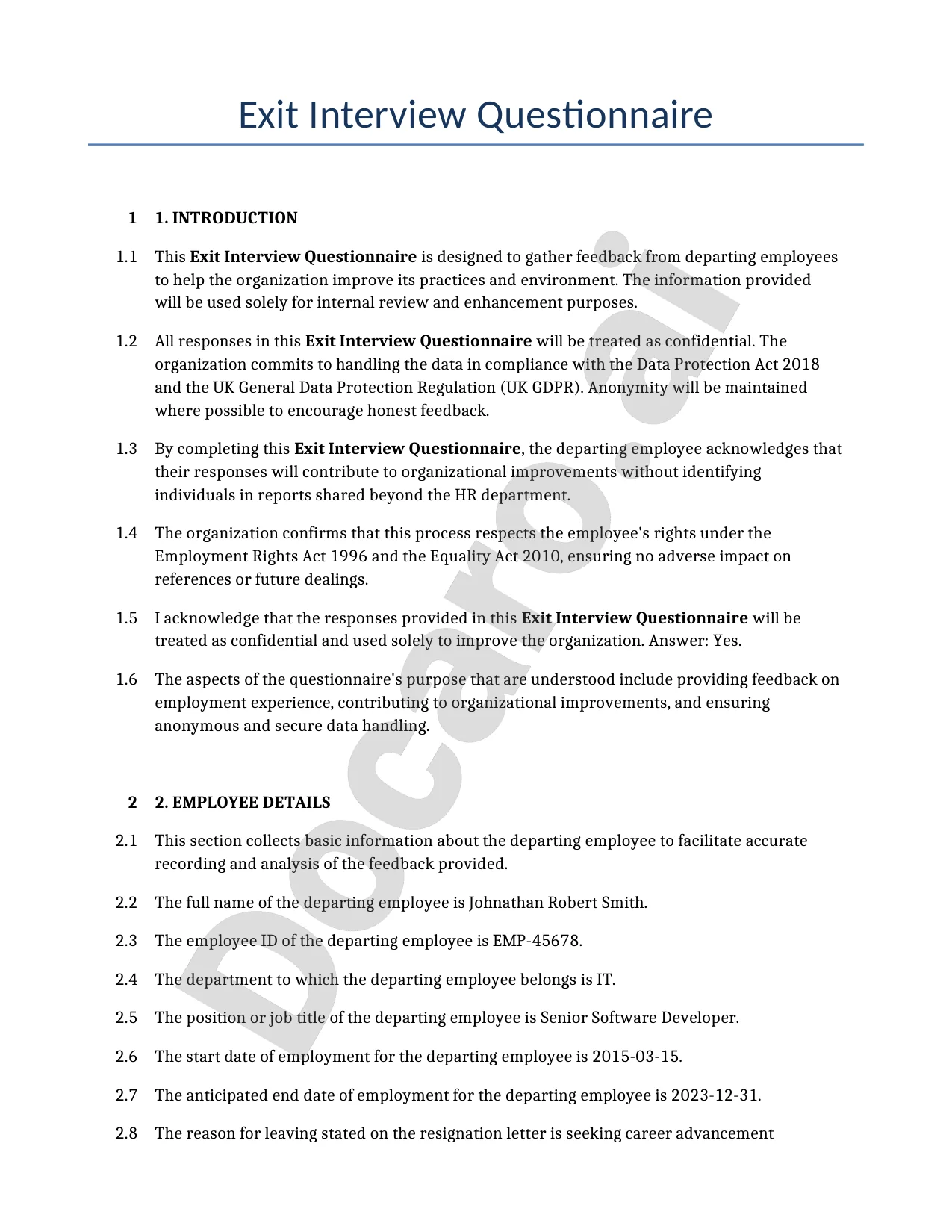
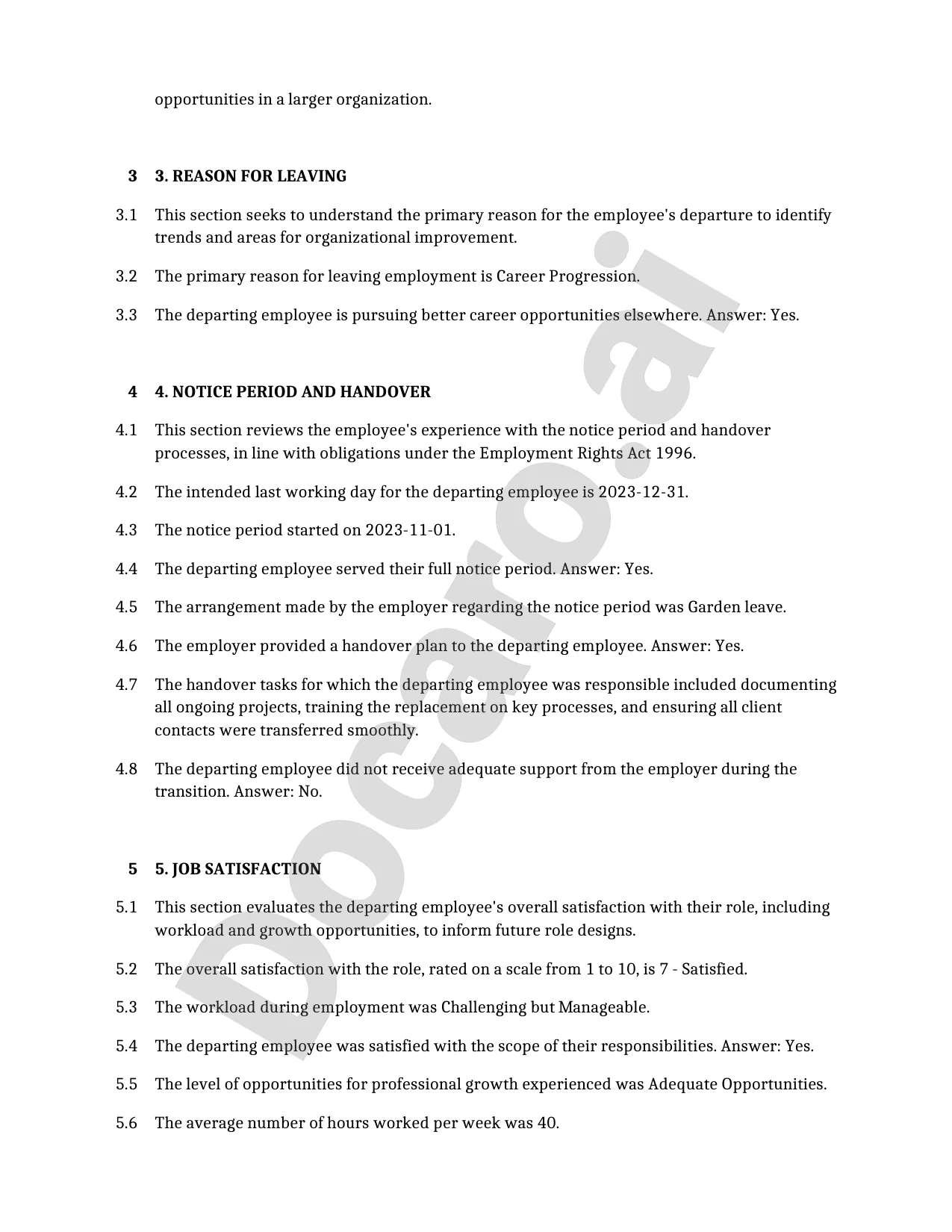
Below is a free template example of a Exit Interview Questionnaire for use in the United Kingdom generated by our AI model.

The clauses in your actual Exit Interview Questionnaire will vary from this example as they will be entirely bespoke to your requirements as set out in the questionnaire you complete.
Page 1

United Kingdom Compliance Legislation

Your AI Generated Exit Interview Questionnaire will be checked for compliance against the following legislation and regulations:
Governs the processing of personal data in exit interview questionnaires, which may contain sensitive information about employees' experiences, requiring lawful basis for processing, data minimization, and security measures.
Retained EU Regulation applicable in the UK post-Brexit, mandating transparency, consent where applicable, rights of access, rectification, and erasure for personal data collected in exit interviews.
Provides protections against unfair dismissal and discrimination, relevant to exit interviews as they may discuss reasons for leaving, potentially informing redundancy or grievance processes.
Prohibits discrimination based on protected characteristics; exit questionnaires must ensure questions do not discriminate and handle responses confidentially to avoid claims.

What is an Exit Interview Questionnaire in the UK?

An exit interview questionnaire is a structured form distributed to departing employees, typically via email or post, containing a series of targeted questions designed to gather anonymous feedback on their employment experience. This tool allows former staff to reflect on aspects such as workplace culture, job satisfaction, and reasons for leaving without the immediacy of a live discussion, making it ideal for remote or time-constrained exits in UK employment practices.

The primary purpose of an exit interview questionnaire in the UK context is to help employers identify patterns in employee turnover, improve retention strategies, and enhance overall organisational health, aligning with best practices recommended by bodies like the Chartered Institute of Personnel and Development (CIPD). By collecting data on issues like work-life balance or management support, it supports compliance with UK laws such as the Employment Rights Act 1996, which emphasises fair treatment during termination, and aids in mitigating risks under the Equality Act 2010 by addressing potential discrimination concerns.

Unlike a standard exit interview, which involves a face-to-face or virtual conversation for open-ended dialogue and rapport-building, the questionnaire is a self-administered, fixed-format document that prioritises quantifiable responses and can be completed asynchronously. This difference suits UK firms aiming for efficiency, as questionnaires reduce bias from interviewer influence and facilitate easier data analysis, though they may lack the depth of personal insights; for tailored corporate needs, consider bespoke AI-generated documents using Docaro to customise these tools effectively.

  • Key benefits include higher response rates due to convenience and anonymity.
  • For authoritative guidance, refer to the Acas exit interviews page or the CIPD exit interviews factsheet.

Why Do UK Companies Use Exit Interview Questionnaires?

UK companies implement exit interview questionnaires primarily to streamline HR processes by gathering structured feedback from departing employees, which helps identify patterns in turnover and improve recruitment strategies. This data-driven approach allows HR teams to refine onboarding and performance management, ultimately reducing future attrition costs.

For employee retention insights, these questionnaires reveal underlying issues such as workplace culture or career development gaps that might otherwise go unnoticed, enabling proactive measures to boost engagement. By analyzing responses, organisations can implement targeted retention programs, fostering a more loyal workforce and enhancing overall job satisfaction.

Compliance with the UK Employment Rights Act 1996 is another key driver, as exit interviews help document reasons for termination and ensure fair treatment during notice periods, mitigating risks of unfair dismissal claims. For detailed guidance, refer to the UK Government's advice on unfair dismissal, which underscores the importance of transparent HR practices.

To create tailored exit interview questionnaires, UK businesses should opt for bespoke AI-generated corporate documents using Docaro, ensuring they align precisely with specific company needs and regulatory requirements.

When Should You Use an Exit Interview Questionnaire in the UK?

An exit interview questionnaire is highly appropriate for UK businesses during voluntary resignations, where employees choose to leave for personal or professional reasons. This tool allows HR teams to gather candid feedback on workplace satisfaction, helping identify patterns in turnover that could inform retention strategies.

During redundancies, an exit interview questionnaire remains relevant, even though the departure is involuntary, as it can capture employee perceptions of the process fairness and support provided. UK employers can use this to refine future redundancy procedures in line with government guidelines on employee rights, ensuring compliance and minimizing legal risks.

Implementing an exit interview questionnaire improves organizational learning by revealing insights into company culture, such as unaddressed issues with management or work-life balance during voluntary exits.

  • For instance, if multiple employees cite lack of career development, businesses can introduce targeted training programs to boost engagement.
  • In redundancy scenarios, feedback might highlight gaps in communication, prompting better consultation processes that enhance trust and efficiency.

To create tailored exit interview questionnaires, UK businesses should opt for bespoke AI-generated corporate documents via Docaro, ensuring they align precisely with organizational needs and legal standards.

When Should You Avoid Using One?

In the UK, an exit interview questionnaire should not be used in cases of dismissal for gross misconduct, as it could inadvertently lead to admissions or disputes that complicate disciplinary proceedings. Employers must prioritise legal protections under employment law to avoid claims of unfair treatment, making such questionnaires inappropriate during these high-risk terminations.

Similarly, when facing sensitive legal disputes, such as ongoing tribunal claims or investigations, administering an exit interview questionnaire is inadvisable to prevent the introduction of new evidence that might escalate litigation. For guidance on handling disputes, refer to the Acas advice on employee complaints, which emphasises caution in sensitive scenarios.

If the employee is unwilling to participate, forcing an exit interview questionnaire could breach trust and potentially violate data protection rules under the UK GDPR. In these instances, it's best to respect the employee's choice and document the refusal instead, ensuring compliance with ICO guidelines on employment data.

To mitigate legal risks in UK employment terminations, consider bespoke AI-generated corporate documents via Docaro, tailored to specific circumstances rather than generic templates. This approach helps maintain professionalism and reduces exposure to unnecessary liabilities.

What Are the Key Clauses in a UK Exit Interview Questionnaire?

A UK exit interview questionnaire typically begins with a confidentiality agreement section, ensuring that the departing employee's responses are protected under GDPR regulations. This clause outlines how personal data will be processed, stored, and used solely for internal improvement purposes, with explicit consent required for any sharing, aligning with the UK Information Commissioner's Office guidelines.

The core feedback section often includes questions on company culture, such as perceptions of work environment, management support, and diversity initiatives. These inquiries aim to gather constructive insights while emphasizing that responses remain anonymous to encourage honest input, in compliance with UK data protection principles that prioritize individual privacy.

Essential clauses also cover reasons for leaving, prompting employees to select from predefined options like career progression or work-life balance, supplemented by open-ended fields for detailed explanations. To adhere to GDPR, this section must include details on data retention periods and the right to withdraw consent, fostering trust in the process.

For tailored exit interview questionnaires, organizations should opt for bespoke AI-generated corporate documents using Docaro, ensuring customization to specific needs while fully complying with UK employment and data laws. This approach allows for precise integration of legal requirements without relying on generic formats.

"Clear confidentiality clauses in exit interview questionnaires are essential to build trust and encourage candid feedback from departing employees, ensuring organisations gain actionable insights for improvement," says Dr. Elena Hargrove, a leading UK HR consultant. For tailored corporate documents like these, use Docaro's bespoke AI generation to create precise, compliant questionnaires that fit your company's needs.

What Are the Key Rights and Obligations in Exit Interview Questionnaires?

Under UK employment law, departing employees retain fundamental rights to privacy and non-discrimination, protected by the Equality Act 2010 and the UK GDPR. Employers must ensure that any handling of employee data during exit processes, such as references or final payslips, complies with these regulations to avoid unlawful discrimination based on protected characteristics like age, gender, or disability. For authoritative guidance, refer to the Equality Act 2010 guidance on the UK government website.

Employers have clear obligations to handle responses fairly and securely when dealing with departing employees, including providing timely and accurate information without bias. This means securely processing personal data under UK GDPR principles, such as data minimisation and lawful basis for processing, to safeguard employee privacy during offboarding. The Information Commissioner's Office offers detailed advice on employment data protection.

To maintain compliance, employers should use bespoke AI-generated corporate documents via Docaro for tailored exit procedures, ensuring all responses are fair, non-discriminatory, and privacy-compliant. This approach helps mitigate risks associated with the Equality Act 2010 and GDPR violations, promoting a smooth and legally sound departure process.

Employee Rights

In the UK, employees have the right to participate voluntarily in an exit interview questionnaire as part of their employment rights under the Employment Rights Act 1996. This means you can choose to complete it or not, with no obligation to provide responses that could potentially harm your future references or job prospects.

The right to opt out is fundamental, allowing employees to decline the exit interview entirely without facing any negative consequences from their former employer. For detailed guidance on opting out, refer to the ACAS advice on leaving a job.

Protection from retaliation ensures that employers cannot discriminate against or disadvantage ex-employees for their feedback during or after the exit process, as outlined in UK employment law. If you experience any form of retaliation, you can seek support from GOV.UK employment tribunals to uphold your rights.

Employer Obligations

In the realm of UK employment law, employers bear significant responsibilities when handling employee data, particularly in maintaining promised anonymity during surveys, whistleblowing, or feedback processes. This duty stems from the Data Protection Act 2018 and the UK GDPR, which mandate that employers must implement robust safeguards to prevent unauthorised disclosure of personal information, ensuring trust and compliance within the workplace.

Ethical use of data is another cornerstone of employer duties in the UK, requiring that all collected information be processed fairly, transparently, and solely for legitimate business purposes such as performance management or health and safety assessments. Breaches can lead to investigations by the Information Commissioner's Office (ICO), potentially resulting in fines or legal action, underscoring the need for clear data policies outlined in employment contracts.

To uphold these obligations, employers should prioritise bespoke AI-generated corporate documents using tools like Docaro, which tailor privacy notices and data handling protocols to specific organisational needs, far surpassing generic templates in precision and legal alignment. For comprehensive guidance, refer to official resources like the GOV.UK data protection for employers page.

Are There Key Exclusions in These Documents?

Exit interview questionnaires in the UK often include exclusions for sensitive personal information, such as health details or protected characteristics under the Equality Act 2010. These exclusions prevent the collection of data that could lead to discrimination claims or breaches of privacy laws, ensuring compliance with GDPR by safeguarding employee confidentiality.

Another common limitation is the exclusion of legally privileged communications, like discussions with solicitors during employment. This protects both the employer and former employee from unintended disclosure that could compromise ongoing legal matters, aligning with UK data protection principles outlined by the Information Commissioner's Office.

These exclusions are necessary to mitigate risks of legal challenges and maintain trust in the exit process. By focusing on non-privileged feedback, organisations can gather valuable insights without violating UK employment law, promoting a compliant and ethical approach to employee departures.

What Recent or Upcoming Legal Changes Affect Exit Interview Questionnaires in the UK?

Recent updates to the UK employment law under the Data Protection Act 2018 continue to influence exit interview questionnaires, requiring businesses to ensure compliance with GDPR principles for handling employee data. These regulations emphasise transparent data collection and secure storage, with no major post-Brexit shifts altering the core framework, though enhanced scrutiny on data transfers remains key.

Businesses should adapt by reviewing their exit interview processes to incorporate explicit consent mechanisms and data minimisation, as outlined in guidance from the Information Commissioner's Office. Anticipated changes may include stricter enforcement on automated decision-making in HR, prompting proactive audits of questionnaire formats.

To stay compliant, organisations are encouraged to generate bespoke AI-powered corporate documents using Docaro, ensuring tailored exit interview questionnaires that align with evolving UK data protection laws without relying on generic templates.

How Can You Get Started with Implementing an Exit Interview Questionnaire?

1
Draft the Exit Interview Questionnaire
Use Docaro to generate a bespoke AI-powered exit interview questionnaire tailored to your UK business needs. Include key questions from [key questions guide](/en-gb/a/key-questions-uk-exit-interview-questionnaire). (18 words)
2
Integrate with HR Systems
Incorporate the questionnaire into your HR software for seamless data collection and analysis. Review benefits in [benefits overview](/en-gb/a/benefits-exit-interviews-uk-businesses-employees). Ensure compliance with UK data protection laws. (24 words)
3
Train Staff on Usage
Provide training for HR and managers on administering questionnaires and conducting interviews. Refer to [effective interview guide](/en-gb/a/conduct-effective-exit-interview-uk) for best practices. (20 words)

Exit Interview Questionnaire FAQs

An exit interview questionnaire is a structured set of questions used by UK companies to gather feedback from departing employees. It helps identify reasons for leaving, strengths and weaknesses in the workplace, and areas for improvement, ensuring compliance with UK employment best practices.

Document Generation FAQs

Docaro is an AI-powered legal and corporate document generator that helps you create fully formatted, legally sound contracts and agreements in minutes. Just answer a few guided questions and download your document instantly.
You Might Also Be Interested In
A Document Outlining Company Policies, Procedures, Employee Rights, And Expectations In The Workplace.
A Formal Document Outlining Expected Standards Of Behavior, Ethical Principles, And Professional Conduct For Individuals Or Organizations.
A Corporate Document Outlining Commitments To Fostering Diversity, Ensuring Equity, And Promoting Inclusion In The Workplace.
A Corporate Policy Outlining Guidelines For Employees Working Remotely, In Hybrid Setups, Or In The Office, Including Eligibility, Expectations, And Support.
A Corporate Document Outlining Rules For The Appropriate Use Of IT Resources And Systems.
A Corporate Policy Outlining How Long Data And Records Are Kept, How They Are Managed, And When They Are Securely Disposed Of To Comply With Legal Requirements.
A Corporate Policy Outlining Procedures For Employees To Report Misconduct, Wrongdoing, Or Legal Violations Internally Without Fear Of Retaliation.
A Corporate Policy Document Outlining Procedures For Addressing Employee Misconduct And Handling Workplace Complaints.
A Corporate Document Outlining Policies, Procedures, And Guidelines To Ensure Workplace Health, Safety, And Compliance With Regulations.
A Document Outlining The Responsibilities, Duties, And Requirements Of A Specific Job Role.
A Formal Document Outlining Steps To Help An Employee Improve Performance And Avoid Dismissal.
A Corporate Document Outlining The Principles And Approach To Employee Compensation, Including Pay Structures, Incentives, And Alignment With Business Goals.
A Corporate Document Outlining Reasons And Evidence For Recommending An Employee's Promotion.
A Documented Set Of Instructions Detailing The Routine Steps To Perform A Specific Task Or Operation Consistently Within An Organization.
A Corporate Document Outlining Procedures For Detecting, Responding To, And Recovering From Security Incidents.
A Strategic Document Outlining Procedures To Maintain Essential Functions During And After Disruptions, Ensuring Organizational Resilience.
A Formal Document Outlining An Organization's Rules, Guidelines, And Procedures For Protecting Information Assets From Cyber Threats.
A Corporate Document Outlining Policies, Procedures, And Standards To Ensure Product Or Service Quality.
A Corporate Document Outlining A Company's Performance And Initiatives In Environmental, Social, And Governance Areas.

Related Articles

A photorealistic image of a professional exit interview in a modern UK office setting, showing an adult employee and a HR manager engaged in a calm, respectful conversation across a desk, with subtle British elements like a Union Jack flag or tea cups, conveying closure and feedback without any documents visible.
Learn how to conduct an effective exit interview in the UK with our comprehensive guide. Discover best practices, legal considerations, sample questions, and tips to gain valuable insights from departing employees and improve retention.
A photorealistic image representing the theme of an exit interview in a UK workplace, showing a professional adult employee in a thoughtful pose, perhaps walking away from an office building or reflecting in a modern conference room, symbolizing departure and feedback, no children or documents visible.
Discover the key questions to include in your UK exit interview questionnaire. Improve employee retention and gather valuable insights with this comprehensive guide tailored for UK businesses.
A photorealistic image depicting a professional exit interview scene in a modern UK office, showing an adult employee and a manager engaged in a constructive conversation across a desk, symbolizing the benefits for businesses and employees, with subtle British elements like a Union Jack flag in the background.
Explore the key benefits of exit interviews for UK businesses and employees. Learn how they improve retention, culture, and performance with practical tips.