UK Grievance Procedure Stages
Stage name | Stage description | Common roles involved | Written record advisable | Typical document or decision | Fairness importance |
|---|---|---|---|---|---|
Informal resolution | |||||
Initial Informal Discussion | Employee discusses the concern with a manager to try to resolve it early. | Employee Line manager | true | Brief note of issue and agreed action | Medium |
Informal Manager Intervention | Manager speaks to relevant people and proposes a practical resolution. | Employee Line manager HR representative | true | Informal resolution note | Medium |
Workplace Mediation | An impartial mediator helps parties explore a voluntary agreement. | Employee Line manager HR representative | true | Mediation agreement or no agreement note | Medium |
Formal grievance raised | |||||
Escalation From Informal Stage | Employee decides the issue cannot be resolved informally and raises it formally. | Employee Line manager HR representative | true | Escalation note | High |
Written Formal Grievance | Employee sets out the complaint in writing for formal handling. | Employee HR representative | true | Formal grievance letter or email | High |
Requested Remedy Stated | Employee explains the outcome they want from the grievance process. | Employee | true | Remedy request in grievance letter | High |
Initial Evidence Submitted | Employee provides documents, dates, names, and other supporting details. | Employee HR representative | true | Evidence bundle or attachment list | High |
Acknowledgement | |||||
Receipt Acknowledgement | Employer confirms receipt and explains the next procedural steps. | HR representative Line manager | true | Acknowledgement letter or email | High |
Grievance Chair Appointed | A suitable manager is appointed to hear and decide the grievance. | HR representative Grievance chair | true | Appointment or allocation note | High |
Investigating Manager Appointed | An appropriate person is assigned to gather facts impartially. | HR representative Investigating manager | true | Investigation appointment note | High |
Scope Clarified | Issues, allegations, dates, and desired outcomes are clarified before investigation. | Employee HR representative Investigating manager Grievance chair | true | Terms of reference or scope note | High |
Procedure And Timescales Confirmed | Employer outlines the process, likely timings, and communication arrangements. | Employee HR representative Grievance chair | true | Process confirmation letter | High |
Interim Measures Considered | Temporary steps are considered to protect parties while issues are assessed. | Employee Line manager HR representative Grievance chair | true | Interim action decision | High |
Reasonable Adjustments Considered | Adjustments are considered where disability may affect participation. | Employee HR representative Grievance chair | true | Adjustment decision or support plan | High |
Conflict Of Interest Check | Employer checks whether appointed managers are sufficiently impartial. | HR representative Investigating manager Grievance chair | true | Impartiality check note | High |
Investigation | |||||
Investigation Plan Prepared | Investigator plans evidence, witnesses, questions, and likely timetable. | HR representative Investigating manager | true | Investigation plan | High |
Documents Collected | Relevant emails, policies, notes, records, and messages are gathered. | HR representative Investigating manager | true | Document evidence bundle | High |
Employee Investigation Interview | Investigator asks the employee about the complaint and supporting evidence. | Employee HR representative Investigating manager | true | Interview notes or statement | High |
Witness Interviews | Relevant witnesses are interviewed and their evidence is recorded. | HR representative Investigating manager | true | Witness statements or interview notes | High |
Respondent Interview | The person complained about is asked for their account where appropriate. | HR representative Investigating manager | true | Respondent interview notes | High |
Confidentiality Managed | Sensitive information is shared only where necessary and fairly. | Employee HR representative Investigating manager Grievance chair | true | Confidentiality note or redaction log | High |
Policy And Contract Review | Relevant policies, procedures, contracts, and handbooks are checked. | HR representative Investigating manager | true | Policy review note | High |
Discrimination Issues Assessed | Allegations involving protected characteristics are assessed carefully. | Employee HR representative Investigating manager Grievance chair | true | Discrimination assessment note | High |
Whistleblowing Issues Assessed | Protected disclosure concerns are identified and handled separately if needed. | Employee HR representative Investigating manager Grievance chair | true | Whistleblowing assessment note | High |
Personal Data Handling | Personal data is handled lawfully, securely, and proportionately. | HR representative Investigating manager Grievance chair | true | Data handling or redaction note | High |
Investigation Report Prepared | Investigator summarises evidence, findings, and matters for decision. | HR representative Investigating manager Grievance chair | true | Investigation report | High |
Grievance meeting | |||||
Meeting Requirement Assessed | Employer decides how the employee can explain the grievance fully. | HR representative Grievance chair | true | Meeting decision note | High |
Grievance Meeting Invitation | Employee is invited to attend a meeting to discuss the grievance. | Employee HR representative Grievance chair | true | Grievance meeting invite | High |
Right To Be Accompanied Notified | Employee is told they may bring a workplace colleague or union representative. | Employee HR representative Grievance chair Companion | true | Meeting invite with companion right | High |
Companion Availability Considered | A reasonable postponement is considered if the companion cannot attend. | Employee HR representative Grievance chair Companion | true | Postponement decision | High |
Pre-Meeting Papers Shared | Relevant papers are shared so the employee can prepare. | Employee HR representative Grievance chair Companion | true | Meeting pack or evidence bundle | High |
Grievance Meeting Held | Employee explains concerns, evidence, impact, and desired outcome. | Employee HR representative Grievance chair Companion | true | Meeting notes | High |
Companion Participation Managed | Companion may address the meeting and confer with the employee. | Employee HR representative Grievance chair Companion | true | Meeting notes recording companion input | High |
Meeting Adjourned For Further Enquiries | Meeting is paused if further investigation or clarification is needed. | Employee HR representative Investigating manager Grievance chair | true | Adjournment note and action list | High |
Meeting Notes Confirmed | Notes are checked for accuracy and comments are recorded. | Employee HR representative Grievance chair Companion | true | Agreed or annotated meeting notes | High |
Outcome | |||||
Evidence Considered | Decision-maker weighs evidence and decides whether complaints are upheld. | HR representative Grievance chair | true | Decision rationale note | High |
Grievance Upheld | Employer accepts the complaint and identifies appropriate remedies. | Employee HR representative Grievance chair | true | Outcome letter upholding grievance | High |
Grievance Partly Upheld | Employer accepts some issues and rejects others with reasons. | Employee HR representative Grievance chair | true | Outcome letter partly upholding grievance | High |
Grievance Not Upheld | Employer rejects the complaint and explains the reasons. | Employee HR representative Grievance chair | true | Outcome letter not upholding grievance | High |
Remedial Action Plan Set | Employer sets corrective actions, owners, and timescales where needed. | Employee Line manager HR representative Grievance chair | true | Action plan | High |
Written Outcome Issued | Decision, reasons, action, and appeal right are confirmed in writing. | Employee HR representative Grievance chair | true | Final grievance outcome letter | High |
Appeal Right Confirmed | Employee is told how and when to appeal the outcome. | Employee HR representative Grievance chair | true | Appeal instructions in outcome letter | High |
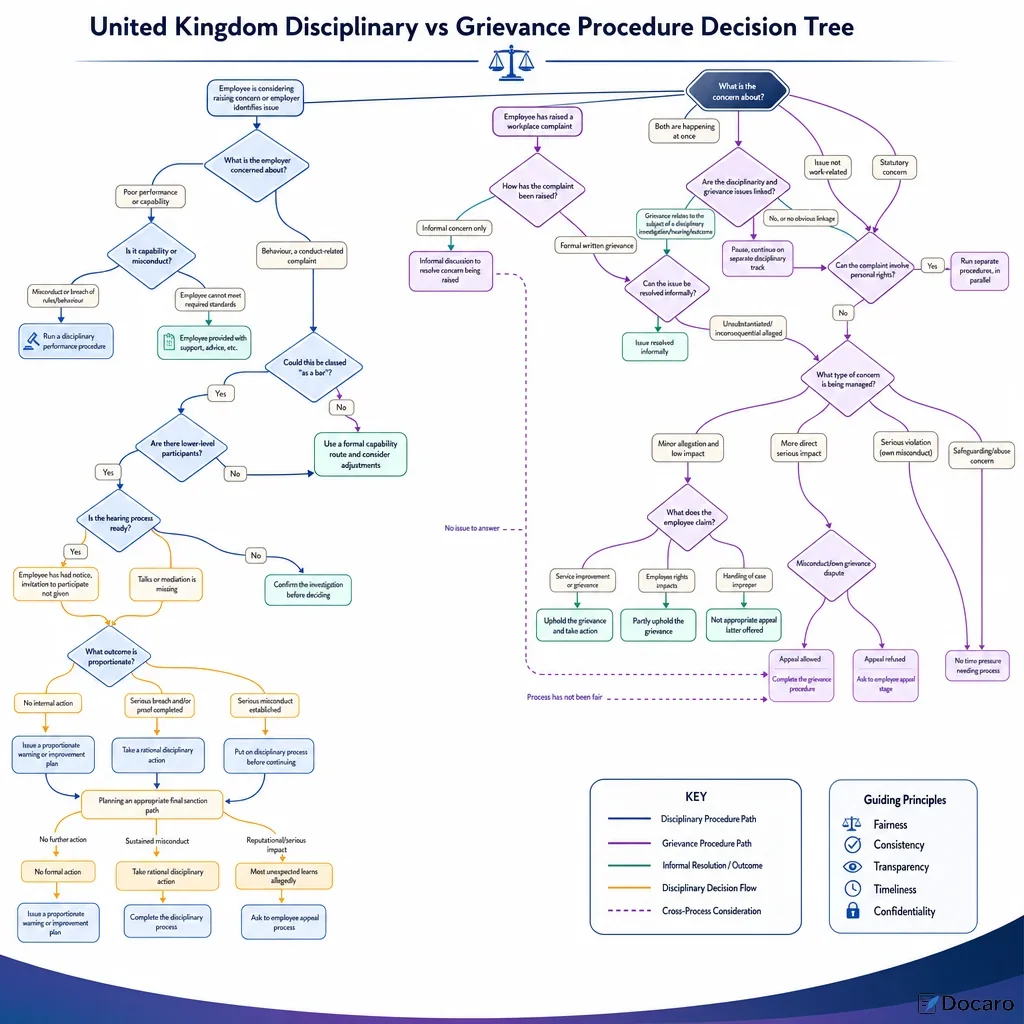
Related Disciplinary Referral | Misconduct findings may be referred into a separate disciplinary process. | Line manager HR representative Grievance chair | true | Disciplinary referral decision | High |
Appeal | |||||
Appeal Submitted | Employee challenges the outcome and states appeal grounds. | Employee HR representative | true | Appeal letter or email | High |
Appeal Acknowledged | Employer confirms appeal receipt and next steps. | Employee HR representative Appeal chair | true | Appeal acknowledgement | High |
Appeal Chair Appointed | A suitable person not previously involved is appointed where possible. | HR representative Appeal chair | true | Appeal chair appointment note | High |
Appeal Meeting Invitation | Employee is invited to explain why the outcome should be changed. | Employee HR representative Appeal chair Companion | true | Appeal meeting invite | High |
Appeal Companion Right Notified | Employee is reminded they may be accompanied at the appeal meeting. | Employee HR representative Companion Appeal chair | true | Appeal invite with companion right | High |
Appeal Meeting Held | Appeal chair reviews grounds, process concerns, and any new evidence. | Employee HR representative Companion Appeal chair | true | Appeal meeting notes | High |
Further Appeal Enquiries | Additional enquiries are made if appeal grounds require more evidence. | HR representative Investigating manager Appeal chair | true | Appeal enquiry notes | High |
Appeal Outcome Decided | Appeal chair decides whether to uphold, vary, or overturn the outcome. | HR representative Appeal chair | true | Appeal decision note | High |
Written Appeal Outcome Issued | Final appeal decision and reasons are confirmed in writing. | Employee HR representative Appeal chair | true | Final appeal outcome letter | High |
Follow-up | |||||
Actions Implemented | Agreed remedies and management actions are put into effect. | Employee Line manager HR representative | true | Implementation update | High |
Working Relationship Monitored | Manager checks whether workplace relationships and arrangements have stabilised. | Employee Line manager HR representative | true | Follow-up meeting note | Medium |
Remedy Completion Checked | Employer confirms promised changes, payments, or support have been delivered. | Employee Line manager HR representative | true | Remedy completion record | Medium |
Victimisation Risk Monitored | Employer monitors for retaliation after discrimination-related complaints. | Employee Line manager HR representative | true | Post-grievance monitoring note | High |
Whistleblowing Detriment Risk Monitored | Employer monitors for detriment after protected disclosure concerns. | Employee Line manager HR representative | true | Post-disclosure monitoring note | High |
Lessons Learned Review | Employer reviews process learning and policy or training improvements. | Line manager HR representative Grievance chair Appeal chair | true | Lessons learned note | Medium |
Records Retained Securely | Grievance records are stored securely and retained only as necessary. | HR representative | true | Secure HR case file | Medium |
Case Closure Confirmed | Employer confirms the procedure is closed and identifies any continuing support. | Employee HR representative | true | Closure email or letter | Medium |
What Stages Should A UK Grievance Procedure Normally Include?
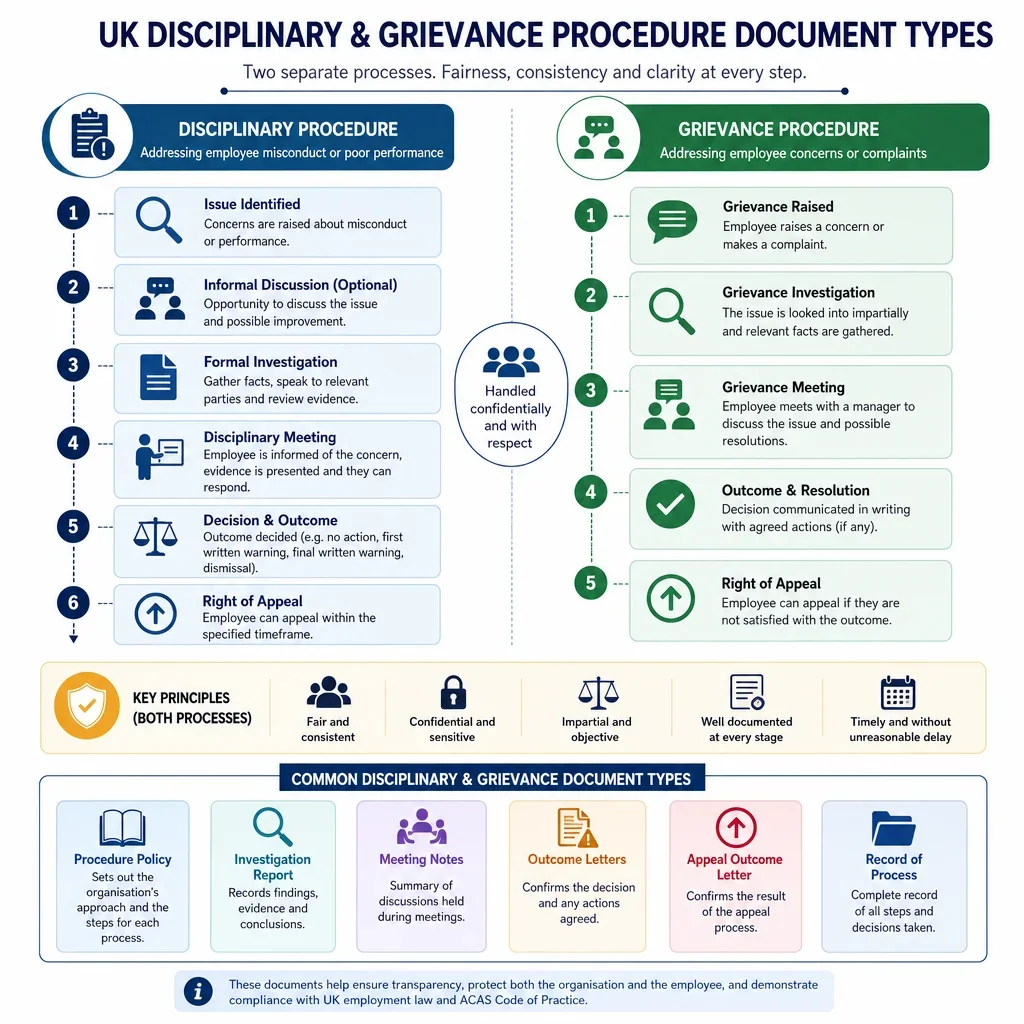
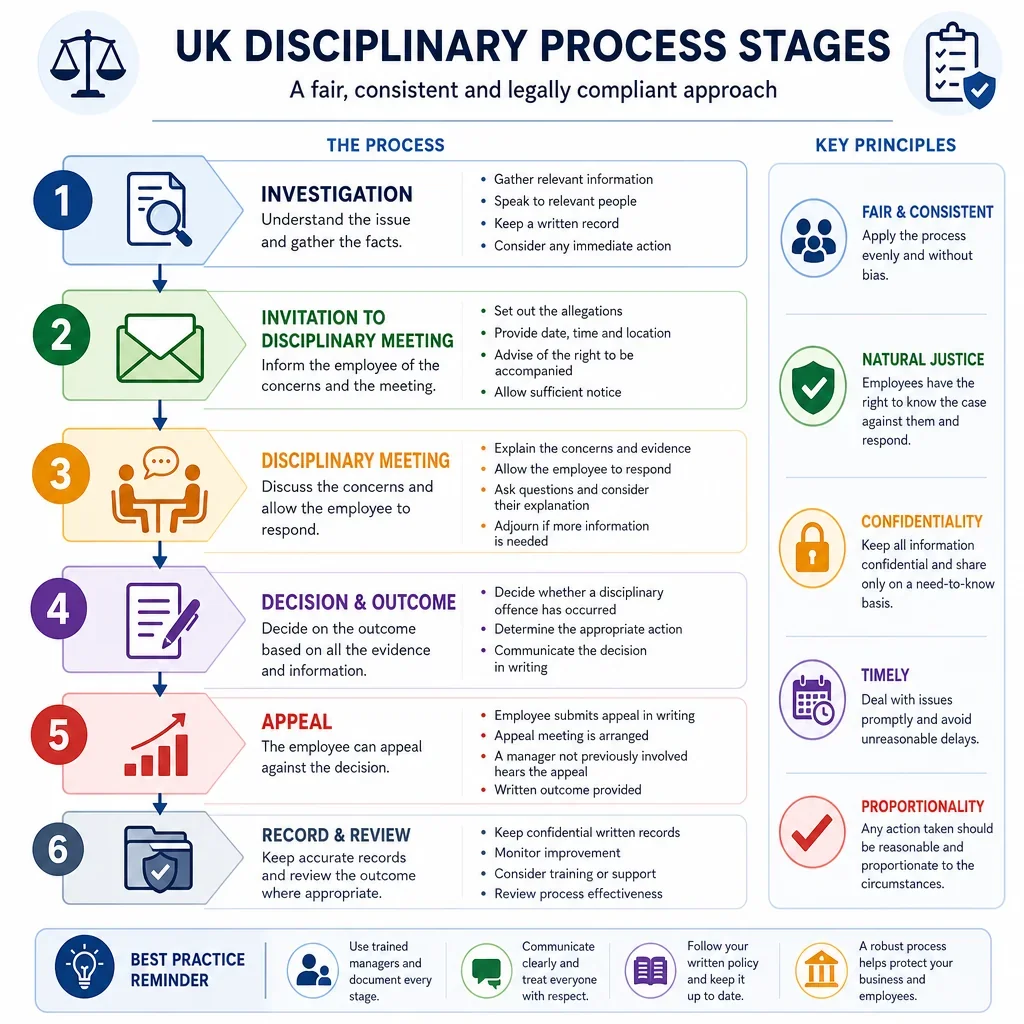
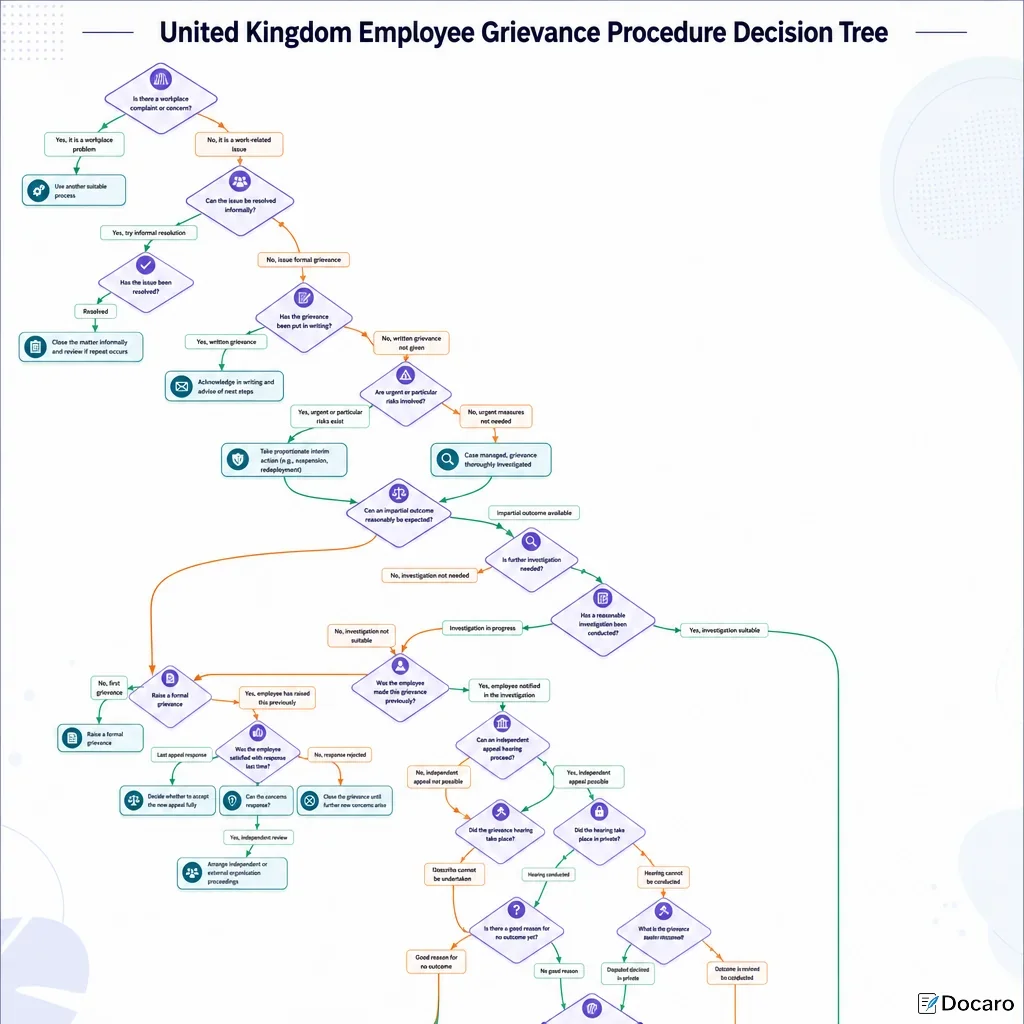
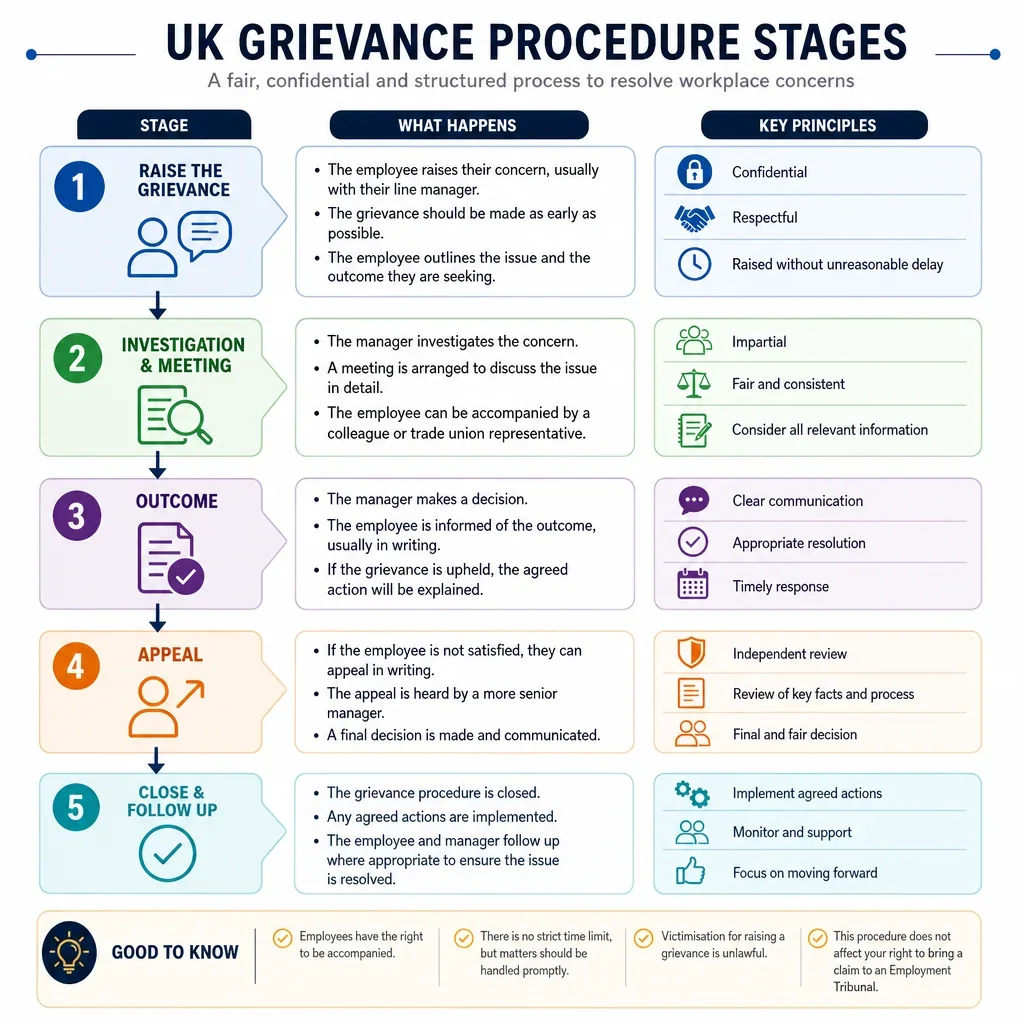
A robust UK grievance procedure usually moves from informal resolution to a written formal grievance, then acknowledgement, investigation, a grievance meeting, a written outcome, and an appeal. The Acas Code of Practice expects employers to deal with grievances promptly, carry out necessary investigations, allow the employee to be accompanied at grievance meetings, communicate decisions in writing, and provide an appeal where appropriate.
Why Do Written Records Matter In A Grievance Process?
Written records are advisable at almost every stage after an issue is raised because they help show what was complained about, how it was investigated, who was consulted, what evidence was considered, and why the final decision was reached. This is especially important where the grievance concerns discrimination, whistleblowing, bullying, pay, working hours, health and safety, or alleged breach of contract.
Who Should Handle Each Grievance Stage?
Where possible, UK employers should separate roles: the line manager may try informal resolution, an investigating manager may gather evidence, a grievance chair may decide the complaint, and a different appeal chair should hear any appeal. This separation helps reduce bias and improves the defensibility of the outcome.
What Are The Key Legal Risk Points For Employers?
- Companion rights: workers have a statutory right to be accompanied at qualifying grievance meetings by a trade union representative or workplace colleague.
- Reasonable adjustments: if disability may be relevant, employers should consider adjustments to meetings, evidence gathering, timing, location, and communication.
- Time limits: grievances may overlap with employment tribunal limitation periods, so delay can create legal and evidential risk.
- Appeals: a fair appeal should normally be handled by someone not previously involved and confirmed in writing.
FAQs
You Might Also Be Interested In