UK Disciplinary Process Stages
Stage name | Typical action | Participants | Written notice usually required | Typical output | Key procedural consideration |
|---|---|---|---|---|---|
Initial concern | |||||
Concern identified | Manager notes the issue and considers whether informal action is appropriate. | Manager Employee | false | Initial management note | Record keeping consideration |
Informal discussion | Manager discusses the concern and expected improvement informally. | Manager Employee | false | Informal action note | Internal policy consideration |
Policy and contract check | Employer checks applicable contractual and internal disciplinary rules. | Manager HR representative | false | Procedure selection note | Contractual procedure consideration Internal policy consideration |
Immediate risk assessment | Employer assesses urgent workplace risk and interim controls. | Manager HR representative | false | Risk assessment note | Evidence review consideration Record keeping consideration |
Suspension consideration | Employer decides whether suspension is necessary and proportionate. | Manager HR representative Employee | true | Suspension letter | Acas Code consideration Record keeping consideration |
Investigation | |||||
Investigator appointed | Employer appoints a suitable person to investigate the allegations. | Manager HR representative Investigating officer | false | Investigator appointment record | Acas Code consideration Internal policy consideration |
Investigation scope set | Investigator defines allegations, issues, sources and timetable. | Investigating officer HR representative | false | Investigation plan | Evidence review consideration Record keeping consideration |
Evidence gathered | Investigator collects relevant emails, records, documents and other evidence. | Investigating officer HR representative | false | Evidence bundle | Evidence review consideration Record keeping consideration |
Employee investigation meeting | Investigator asks the employee for their initial account. | Investigating officer Employee HR representative | true | Investigation meeting notes | Acas Code consideration Record keeping consideration |
Witness interviews | Investigator interviews relevant witnesses and records their evidence. | Investigating officer HR representative | false | Witness statements | Evidence review consideration Record keeping consideration |
Mitigation and context review | Investigator reviews context, explanations and possible mitigating factors. | Investigating officer HR representative | false | Mitigation review note | Evidence review consideration |
Investigation report completed | Investigator summarises facts and recommends whether there is a case to answer. | Investigating officer HR representative | false | Investigation report | Evidence review consideration Record keeping consideration |
Decision to proceed | |||||
Case to answer review | Employer decides whether evidence justifies formal disciplinary action. | Manager HR representative Investigating officer | false | Case to answer decision | Acas Code consideration Evidence review consideration |
No formal action decision | Employer closes the matter or redirects to informal management action. | Manager HR representative Employee | true | No action confirmation letter | Record keeping consideration Internal policy consideration |
Disciplinary chair appointed | Employer appoints an impartial chair to hear the disciplinary case. | Manager HR representative Disciplinary chair | false | Chair appointment record | Acas Code consideration Internal policy consideration |
Allegations framed | Employer states the allegations and possible seriousness clearly. | Disciplinary chair HR representative | true | Allegation summary | Acas Code consideration Evidence review consideration |
Disciplinary hearing invitation | Employee receives hearing details, allegations, evidence and possible outcomes. | Disciplinary chair HR representative Employee | true | Invitation to disciplinary hearing letter | Acas Code consideration Right to be accompanied consideration |
Evidence disclosed to employee | Employer shares relevant evidence in time for the employee to prepare. | Disciplinary chair HR representative Employee | true | Disciplinary evidence pack | Evidence review consideration Acas Code consideration |
Companion rights explained | Employee is told they may request an eligible companion. | HR representative Employee Companion | true | Companion rights notice | Right to be accompanied consideration |
Companion postponement request | Employer considers postponement to a reasonable alternative time. | HR representative Employee Companion Disciplinary chair | true | Postponed hearing notice | Right to be accompanied consideration |
Disciplinary meeting | |||||
Hearing opened | Chair explains roles, procedure, allegations and possible outcomes. | Disciplinary chair Employee Companion HR representative | false | Hearing opening notes | Acas Code consideration Record keeping consideration |
Management case presented | Investigation findings and evidence are presented to the chair. | Disciplinary chair Investigating officer HR representative Employee Companion | false | Management case notes | Evidence review consideration Record keeping consideration |
Employee response heard | Employee gives their explanation, challenges evidence and presents mitigation. | Disciplinary chair Employee Companion HR representative | false | Employee response notes | Acas Code consideration Evidence review consideration |
Questions and clarification | Chair tests evidence and clarifies disputed facts. | Disciplinary chair Employee Companion Investigating officer HR representative | false | Question record | Evidence review consideration Record keeping consideration |
Hearing adjournment | Chair pauses the hearing to consider evidence or obtain further information. | Disciplinary chair HR representative | false | Adjournment note | Evidence review consideration Acas Code consideration |
Further enquiries | Chair requests additional investigation before reaching a decision. | Disciplinary chair Investigating officer HR representative Employee | true | Further enquiry note | Evidence review consideration Acas Code consideration |
Reconvened hearing | Chair shares new evidence and lets the employee respond. | Disciplinary chair Employee Companion HR representative | true | Reconvened hearing notes | Acas Code consideration Evidence review consideration |
Outcome | |||||
Finding on allegation | Chair decides whether each allegation is proven or not proven. | Disciplinary chair HR representative | false | Findings note | Evidence review consideration Record keeping consideration |
Sanction decision | Chair selects a proportionate sanction using policy and mitigation. | Disciplinary chair HR representative | false | Sanction rationale | Internal policy consideration Evidence review consideration |
First written warning issued | Employer confirms misconduct and sets improvement expectations. | Disciplinary chair HR representative Employee | true | First written warning letter | Acas Code consideration Record keeping consideration |
Final written warning issued | Employer gives final warning and states risk of dismissal. | Disciplinary chair HR representative Employee | true | Final written warning letter | Acas Code consideration Record keeping consideration |
Dismissal decision | Employer decides dismissal is within the reasonable range of responses. | Disciplinary chair HR representative Employee | true | Dismissal outcome letter | Acas Code consideration Contractual procedure consideration |
Outcome letter issued | Employer confirms decision, reasons, sanction, duration and appeal right. | Disciplinary chair HR representative Employee | true | Disciplinary outcome letter | Acas Code consideration Record keeping consideration |
Appeal right confirmed | Employee is told how and when to appeal. | Disciplinary chair Employee HR representative | true | Appeal rights wording | Acas Code consideration Internal policy consideration |
Appeal | |||||
Appeal received | Employee submits appeal grounds within the stated deadline. | Employee HR representative | true | Appeal letter or form | Acas Code consideration Internal policy consideration |
Appeal chair appointed | Employer appoints a manager not previously involved where practicable. | HR representative Appeal chair | false | Appeal chair appointment record | Acas Code consideration Internal policy consideration |
Appeal hearing invitation | Employer invites employee to an appeal hearing with details and rights. | Appeal chair HR representative Employee Companion | true | Appeal hearing invitation letter | Acas Code consideration Right to be accompanied consideration |
Appeal hearing held | Appeal chair considers appeal grounds and any new evidence. | Appeal chair Employee Companion HR representative | false | Appeal hearing notes | Acas Code consideration Evidence review consideration |
Appeal further enquiries | Appeal chair checks new evidence or procedural concerns. | Appeal chair HR representative Investigating officer Employee | true | Appeal enquiry note | Evidence review consideration Record keeping consideration |
Appeal decision | Appeal chair upholds, varies or overturns the disciplinary outcome. | Appeal chair HR representative | false | Appeal decision rationale | Acas Code consideration Evidence review consideration |
Appeal outcome letter issued | Employer confirms the final appeal decision and reasons in writing. | Appeal chair HR representative Employee | true | Appeal outcome letter | Acas Code consideration Record keeping consideration |
Post-outcome monitoring | |||||
Outcome implemented | Employer applies the final sanction and updates relevant records. | Manager HR representative Employee | true | Implementation record | Record keeping consideration Contractual procedure consideration |
Improvement monitoring | Manager monitors conduct or performance against stated expectations. | Manager Employee HR representative | false | Monitoring notes | Record keeping consideration Internal policy consideration |
Warning review meeting | Manager reviews progress and records whether expectations are being met. | Manager Employee HR representative | true | Review meeting record | Record keeping consideration Internal policy consideration |
Warning expiry recorded | Employer records when the warning is no longer live. | HR representative Manager Employee | true | Warning expiry confirmation | Record keeping consideration Internal policy consideration |
Disciplinary records retained | Employer stores records securely and only for an appropriate period. | HR representative Manager | false | Retained disciplinary file | Record keeping consideration |
Acas uplift risk considered | Employer checks whether any unreasonable Code failure creates award risk. | HR representative Manager | false | Post-process legal risk note | Acas Code consideration |
What Are The Key Stages In A UK Disciplinary Procedure?
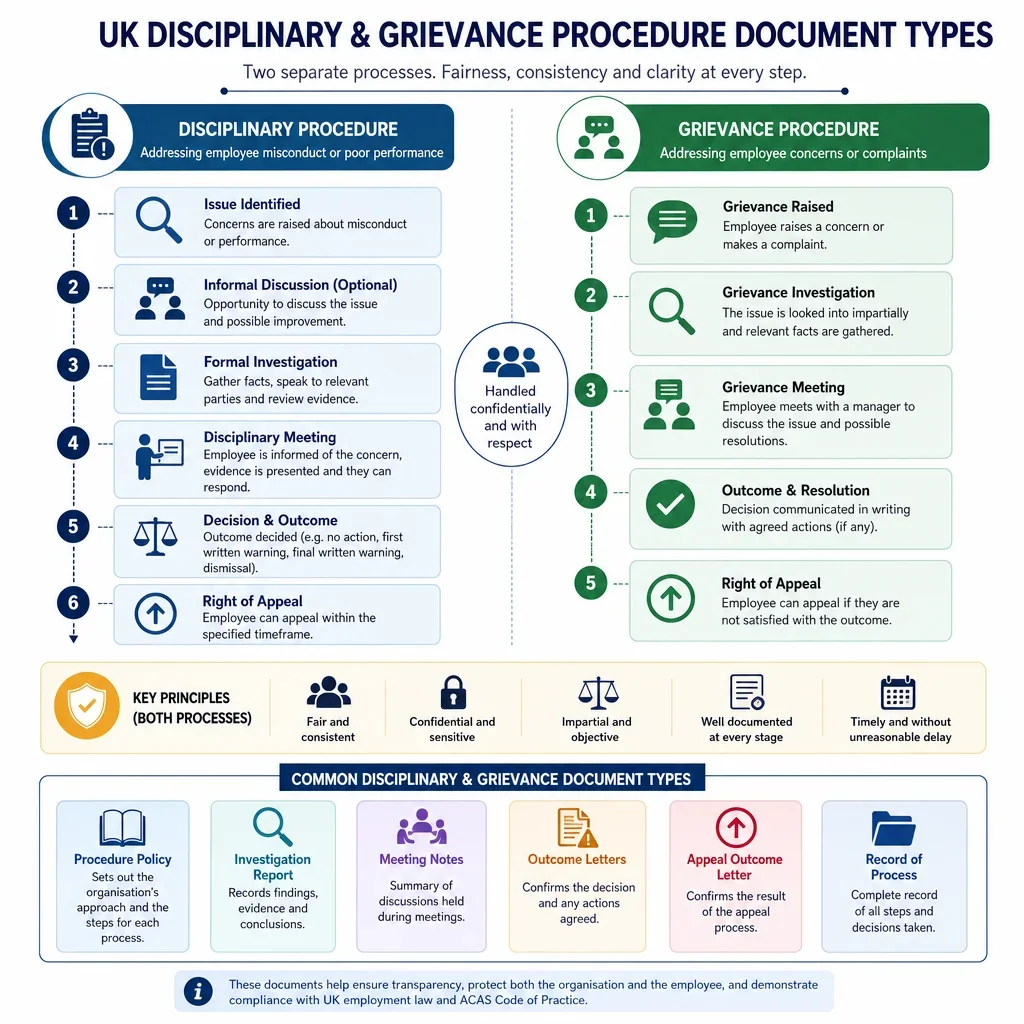
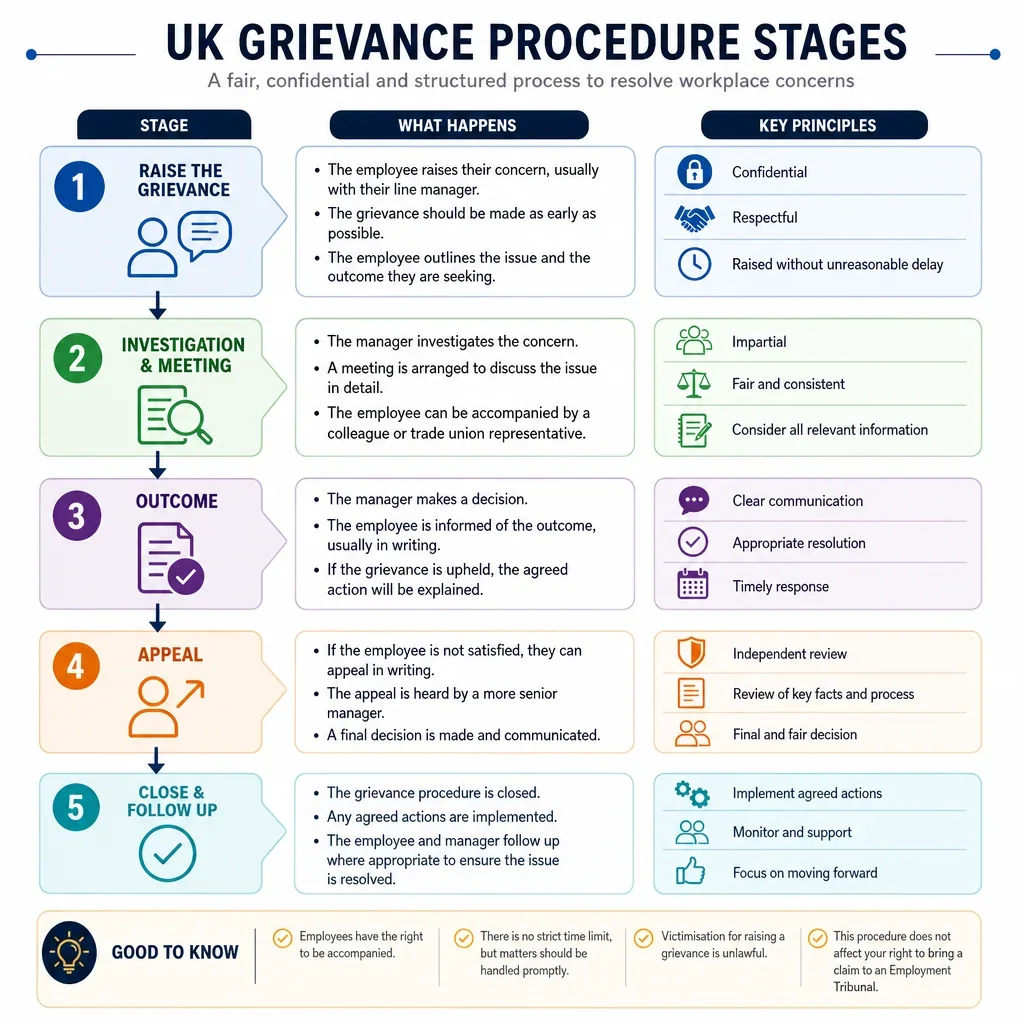
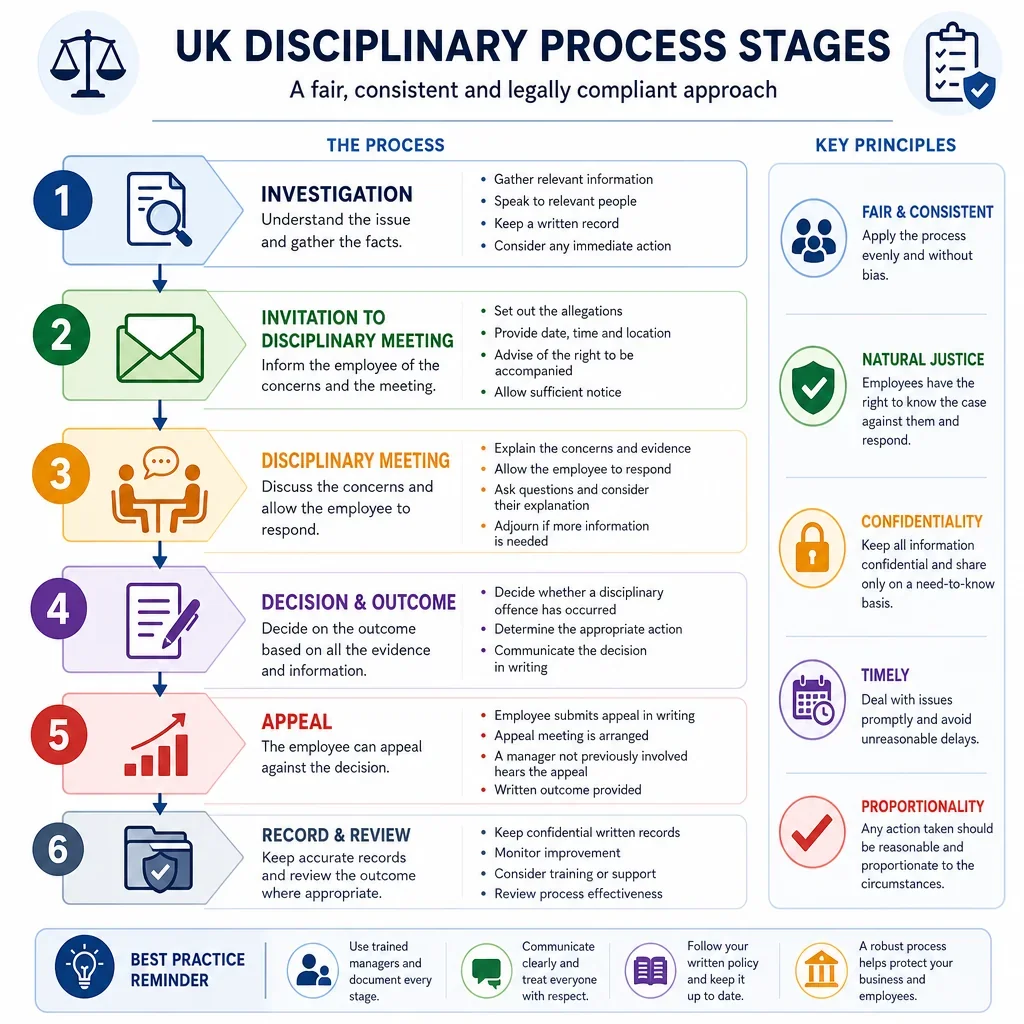
A fair UK disciplinary process usually moves from an initial concern, through fact-finding and a decision on whether there is a case to answer, to a formal disciplinary meeting, written outcome and any appeal. The Acas Code of Practice on Disciplinary and Grievance Procedures is central: employers should investigate, inform the employee of the allegations, hold a meeting, allow accompaniment where the statutory right applies, decide an outcome and offer an appeal.
When Is Written Notice Usually Needed?
Written notice becomes especially important once the employer moves from informal triage into a formal disciplinary route. The employee should normally receive the allegations, evidence, possible consequences and meeting details in writing before a disciplinary hearing. Outcome and appeal decisions should also be confirmed in writing, because employment tribunals commonly examine the paper trail when assessing fairness.
Who Should Be Involved At Each Stage?
Separation of roles helps demonstrate impartiality. An investigating officer should usually gather evidence, a disciplinary chair should decide the sanction, and a different appeal chair should hear any appeal where practicable. HR can advise on process, but the decision-maker should make the substantive decision.
What Documents Should Employers Keep?
- Initial concern records help show why action started.
- Investigation plans, witness notes and evidence bundles support the decision on whether there is a case to answer.
- Invitation letters and meeting notes show the employee was told the case and given a chance to respond.
- Outcome letters and appeal records evidence the decision, reasons, sanction length and any right of appeal.
Why Does The Acas Code Matter?
Where the Acas Code applies, unreasonable failure to follow it can affect compensation in relevant tribunal claims. The Employment Act 2008 allows tribunals to adjust certain awards by up to 25% for unreasonable failure to comply with the Code.
FAQs
You Might Also Be Interested In