

Types Of UK House Share Arrangements
Created:
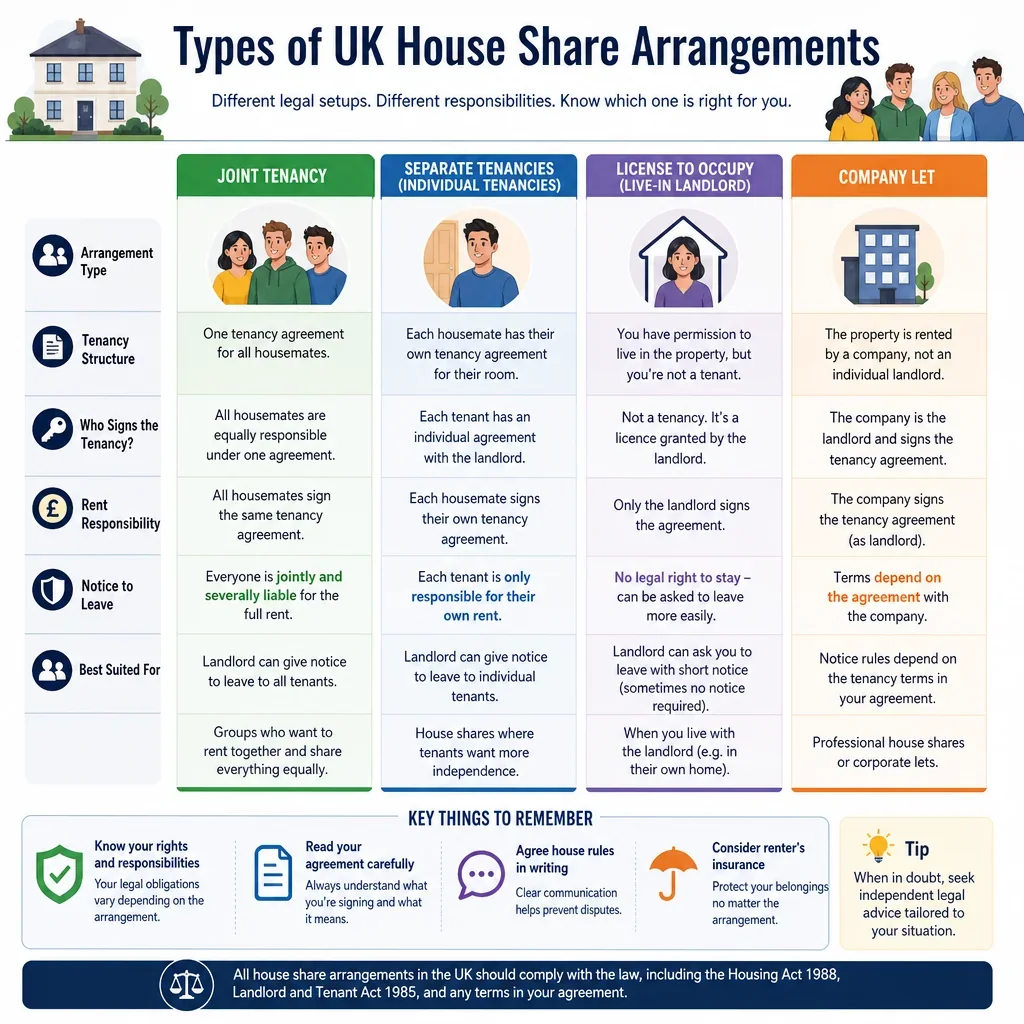
Understanding UK house share arrangements helps you choose the right setup, set expectations, and avoid disputes. This guide supports anyone using an AI-Generated British Lodger Agreement.
Arrangement Type | Typical Structure | Jurisdiction | Key Considerations |
|---|---|---|---|
Joint Tenancy | |||
Joint tenancy for whole house or flat | All sharers sign one agreement, occupy the whole property together and are usually jointly liable for rent. | England | One tenant’s arrears or notice can affect others replacement sharers usually need landlord consent. |
Joint standard occupation contract | Joint contract-holders share one occupation contract for the dwelling and are usually jointly responsible. | Wales | Use Welsh terminology contract-holder changes follow Renting Homes rules, not ordinary AST wording. |
Joint private residential tenancy | Several tenants share one Scottish PRT and occupy the property as their home. | Scotland | Scottish PRT rules differ from ASTs use the Scottish model tenancy terms where appropriate. |
Joint private tenancy | Sharers sign one private tenancy and share rent obligations for the dwelling. | Northern Ireland | Northern Ireland has separate tenancy, rent book, notice and deposit rules. |
Separate Tenancies | |||
Individual room tenancy | Each occupier rents a named room and shares kitchens, bathrooms and other common areas. | England | Clarify room, shared areas, bills and cleaning landlord usually manages common parts. |
Separate room occupation contract | Each contract-holder has rights to a room plus shared use of common areas. | Wales | Written occupation contract must include required Welsh terms and prescribed information. |
Separate room private residential tenancy | Each tenant has a separate PRT for a room with shared facilities. | Scotland | Deposit protection and Scottish repair standards apply HMO licensing may be triggered. |
Bedsit tenancy with shared facilities | Tenant occupies a self-contained or semi-contained room and shares limited facilities with others. | England | Exclusive possession of the room often indicates a tenancy, not a bare licence. |
Other | |||
HMO shared house | Three or more unrelated occupiers share facilities and form more than one household. | England | Five or more occupiers may need mandatory HMO licensing local schemes can be stricter. |
Mandatory licensable HMO | Five or more people in two or more households share facilities under joint or separate agreements. | England | Operating without a required licence can affect enforcement, rent repayment and possession rights. |
Additional licensing HMO | Smaller shared houses require a licence because the local council has an additional licensing scheme. | England | Always check the local authority before letting to unrelated sharers. |
Selective licensing shared rental | Ordinary private rental in a designated area requiring landlord licensing. | England | Licence duties may apply even if the property is not an HMO. |
Licence | |||
Lodger agreement with resident landlord | Owner lives in the home and grants a room with shared living accommodation. | England | Usually an excluded licence or excluded tenancy reasonable notice is still required. |
Lodger agreement with resident landlord | Resident landlord shares accommodation with the lodger and grants personal permission to occupy. | Wales | Some lodger arrangements may be excluded from standard occupation contract rules. |
Scottish lodger licence | Resident owner lets a room while sharing living accommodation with the lodger. | Scotland | May fall outside the PRT regime if the landlord shares the home as their only or principal residence. |
Lodger in owner’s home | Owner occupies the property and lets a room with shared facilities. | Northern Ireland | Status depends on occupation facts use clear terms on notice, access and shared areas. |
Tenant taking in a lodger | Existing tenant remains resident and licenses a room to another occupier. | England | Tenant usually needs landlord permission breach can risk their own tenancy. |
Separate Tenancies | |||
Whole-property subtenancy | Main tenant grants a tenancy of the whole property to subtenants and moves out. | England | Requires permission unless allowed unlawful subletting can have serious tenancy consequences. |
Room subtenancy from head tenant | Head tenant grants exclusive occupation of a room while retaining their own tenancy. | England | Permission, deposit protection and HMO duties should be checked before subletting. |
Other | |||
Company let for staff sharers | A company rents the property and permits employees or contractors to occupy rooms. | England | Not an AST because tenant is not an individual occupation documents should cover staff changes. |
Licence | |||
Service occupancy room | Accommodation is provided so the worker can perform their job duties. | England | Rights often depend on the employment link and whether occupation is essential to the job. |
Other | |||
Tied accommodation tenancy | Housing is connected to employment but may still be a tenancy rather than a licence. | England | Ending employment does not automatically end all housing rights status needs careful wording. |
Joint Tenancy | |||
Student joint house tenancy | Student group signs one fixed-term tenancy for a shared house. | England | Guarantors, summer rent, deposits and joint liability should be expressly stated. |
Separate Tenancies | |||
Student individual room tenancy | Each student rents a room separately and shares communal facilities. | England | Each student’s liability is usually separate check common-area management and bills. |
Licence | |||
University halls licence | Student occupies a room in institution-managed accommodation under a licence or exempt arrangement. | England | Often outside AST security rules provider codes and university policies may apply. |
Private student hall room | Student rents or licenses an ensuite or studio room with shared amenities in managed halls. | England | Status depends on provider and agreement check fixed term, cancellation and guarantor terms. |
Homestay accommodation | Guest or student lives with a host family and receives a room plus shared facilities. | United Kingdom | Set house rules, meals, safeguarding where relevant, notice and guest access clearly. |
Short-term room guest licence | Occupier stays temporarily without long-term home rights, often for work, study or travel. | England | If used as the occupier’s only or principal home, tenancy rights may arise. |
Holiday let room | Room is let for a genuine holiday stay with limited occupancy rights. | England | A genuine holiday let is excluded from assured tenancy status, but facts matter. |
Other | |||
Rent-to-rent HMO room let | Intermediate operator rents property from owner and grants room lets to occupiers. | England | Head lease permission, HMO licensing, management duties and deposit obligations are critical. |
Licence | |||
Property guardian licence | Guardian occupies vacant premises under a licence to deter trespass or damage. | England | May still be a tenancy if exclusive possession exists safety and HMO issues can arise. |
Property guardian occupation | Occupier lives in vacant property under a guardian agreement, usually labelled a licence. | Wales | If the arrangement is residential occupation, Welsh occupation contract rules may need analysis. |
Excluded occupier sharing with landlord’s family | Occupier shares living accommodation with the landlord or a resident landlord’s family member. | England | Protection from eviction is limited, but reasonable notice and non-harassment rules still matter. |
Basic protection licensee | Licensee has permission to occupy but landlord does not share living accommodation. | England | Court order may be needed to evict licence wording alone is not conclusive. |
Joint Tenancy | |||
Fixed-term joint AST house share | Group commits to a set term and rent for the whole property. | England | Early exit usually needs break clause, surrender or replacement tenant arrangement. |
Periodic joint house share tenancy | Joint tenancy runs week-to-week or month-to-month after or without a fixed term. | England | One joint tenant’s valid notice can end the tenancy for all in many cases. |
Separate Tenancies | |||
Fixed-term individual room AST | One tenant rents one room for a set term and shares common areas. | England | Tenant’s liability is separate, but common parts and house rules need clear drafting. |
Periodic individual room tenancy | Room tenancy continues weekly or monthly until ended by valid notice. | England | Notice periods and deposit protection should match the tenancy type and rent period. |
Other | |||
Informal housemate cost-sharing arrangement | A non-tenant contributes to costs while living with the named tenant or owner. | United Kingdom | Unclear status creates disputes document whether it is a lodger, licence or subtenancy. |
Joint Tenancy | |||
Guarantor-backed joint tenancy | Sharers sign jointly and each may provide a guarantor for rent or damage obligations. | England | Guarantee wording should state whether liability covers one tenant or the whole joint rent. |
Separate Tenancies | |||
Bills-inclusive room tenancy | Room rent includes utilities, council tax or internet, often with usage limits. | England | Specify included bills, caps, fair-use terms, council tax responsibility and rent review method. |
Joint Tenancy | |||
Joint tenancy with tenant-managed bills | Joint tenants pay rent to landlord and arrange utilities, broadband and council tax separately. | England | Record bill shares and exit process to avoid debt when one sharer leaves. |
Licence | |||
Non-exclusive room licence | Occupier has permission to use accommodation but no exclusive right to a particular room. | England | Licence status requires genuine lack of exclusive possession, not just licence wording. |
Excluded tenancy with resident landlord | Occupier may have exclusive room possession but shares accommodation with a resident landlord. | England | Can be a tenancy but excluded from assured tenancy protection because landlord is resident. |
Other | |||
Assured tenancy house share | Private residential tenancy giving stronger security than an AST in limited cases. | England | Less common for new private lets possession rules differ from assured shorthold tenancies. |
Regulated tenancy room or shared home | Older pre-1989 private tenancy with statutory rent and strong security rights. | England | Do not replace old agreements without advice rights may be valuable and hard to recreate. |
Joint Tenancy | |||
Social housing joint tenancy | Council or housing association grants a joint tenancy to household members. | England | Succession, assignment and ending rights differ from private house shares. |
Licence | |||
Shared owner taking a lodger | Shared owner remains resident and lets a spare room to a lodger. | England | Lease and mortgage restrictions may limit lodgers or prohibit subletting. |
Resident landlord with multiple lodgers | Owner lives in the property and rents rooms to two or more unrelated lodgers. | England | Too many unrelated lodgers can trigger HMO licensing even with a resident landlord. |
Separate Tenancies | |||
Couple room let in shared house | Couple occupies one room and shares facilities with other households. | England | Couple may count as one household, but HMO occupier numbers and room standards still matter. |
Family home with unrelated room tenant | A family household rents to or shares with an unrelated occupier using one room. | England | Resident status, exclusive possession and HMO household counting should be checked. |
Joint Tenancy | |||
Assigned place in a joint tenancy | Outgoing joint tenant assigns their interest to a replacement with required consent. | England | Use formal assignment or new tenancy deposits and guarantors need updating. |
Surrender and re-grant house share | Old joint tenancy ends and a new agreement is granted to the changed group. | England | May require new deposit protection, prescribed information and updated guarantor documents. |
Wales joint contract-holder change | Contract-holders may be added or removed under statutory Renting Homes mechanisms. | Wales | Do not use English joint tenancy notice concepts without checking Welsh contract rules. |
Scottish joint PRT tenant leaving | Joint tenant seeks to leave while others continue occupying the let property. | Scotland | Scottish joint PRT ending and replacement rules differ from England and Wales. |
Which UK House Share Agreement Type Should You Use?
The key distinction is whether occupiers share one tenancy, each hold their own tenancy, or only have a licence. A joint tenancy is often simplest for a group renting the whole property together, but it usually creates joint and several liability for rent and damage. Separate room tenancies suit unrelated sharers where each person rents a defined room and shares common areas. Lodger and other licence arrangements are more suitable where the owner or tenant remains resident and grants permission to occupy rather than exclusive possession.
Why Does Joint Liability Matter In A House Share?
- Under a joint tenancy, one tenant leaving or failing to pay can affect the whole household because the group is usually responsible for the full rent.
- Replacing a sharer normally requires landlord consent and proper documentation, such as a deed of assignment, surrender and re-grant, or new tenancy.
- A single deposit for the household can create practical disputes unless the agreement records each person’s contribution and deductions process.
When Are Separate Room Tenancies Better?
- Separate tenancies are useful where sharers move in and out independently, because each occupier is usually liable only for their own rent.
- The landlord usually controls the common parts, so the agreement should clearly describe room rights, shared areas, bills, cleaning and house rules.
- In England and Wales, a property let to several unrelated occupiers may be an HMO and can require licensing depending on size, location and local authority rules.
When Is A Lodger Agreement Appropriate?
- A lodger arrangement is generally used where the landlord lives in the same home and the occupier shares living accommodation with them.
- Lodgers commonly have fewer protection rights than assured shorthold tenants, but the arrangement must reflect reality; simply calling it a licence is not decisive.
- If the landlord moves out or gives the occupier exclusive possession, the legal status may change and a tenancy agreement may be needed.
Do UK Rules Differ By Jurisdiction?
- England commonly uses assured shorthold tenancies for private rented house shares, while Wales uses occupation contracts under the Renting Homes (Wales) Act 2016.
- Scotland uses the private residential tenancy regime for most private lets, and Northern Ireland has its own private tenancy rules.
- Documents should be jurisdiction-specific because notice rules, terminology, deposit protection and required information differ across the UK.
Want to Generate Your own Tenancy Agreement?
Docaro AI can help you write your own Tenancy Agreement for use in the United Kingdom in minutes.
FAQs
The main types are joint tenancies, individual room tenancies, lodger agreements, licences to occupy, and informal house share arrangements. The right document depends on the occupier’s status and the landlord’s living arrangements.
Show All FAQs
You Might Also Be Interested In

Explore common clauses in UK house share agreements, including rent, deposits, bills, notice periods and house rules.
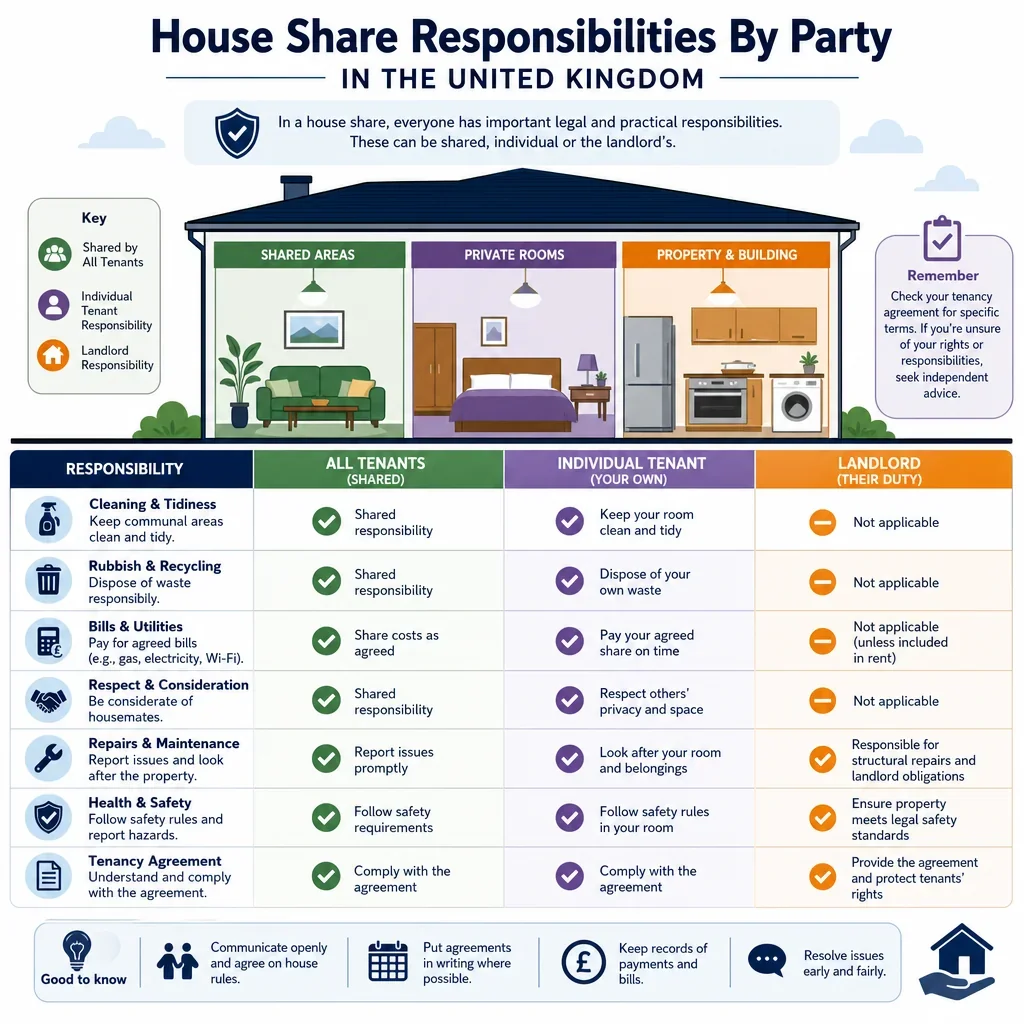
United Kingdom guide to house share responsibilities by party, helping clarify duties for landlords, lodgers, and tenants.
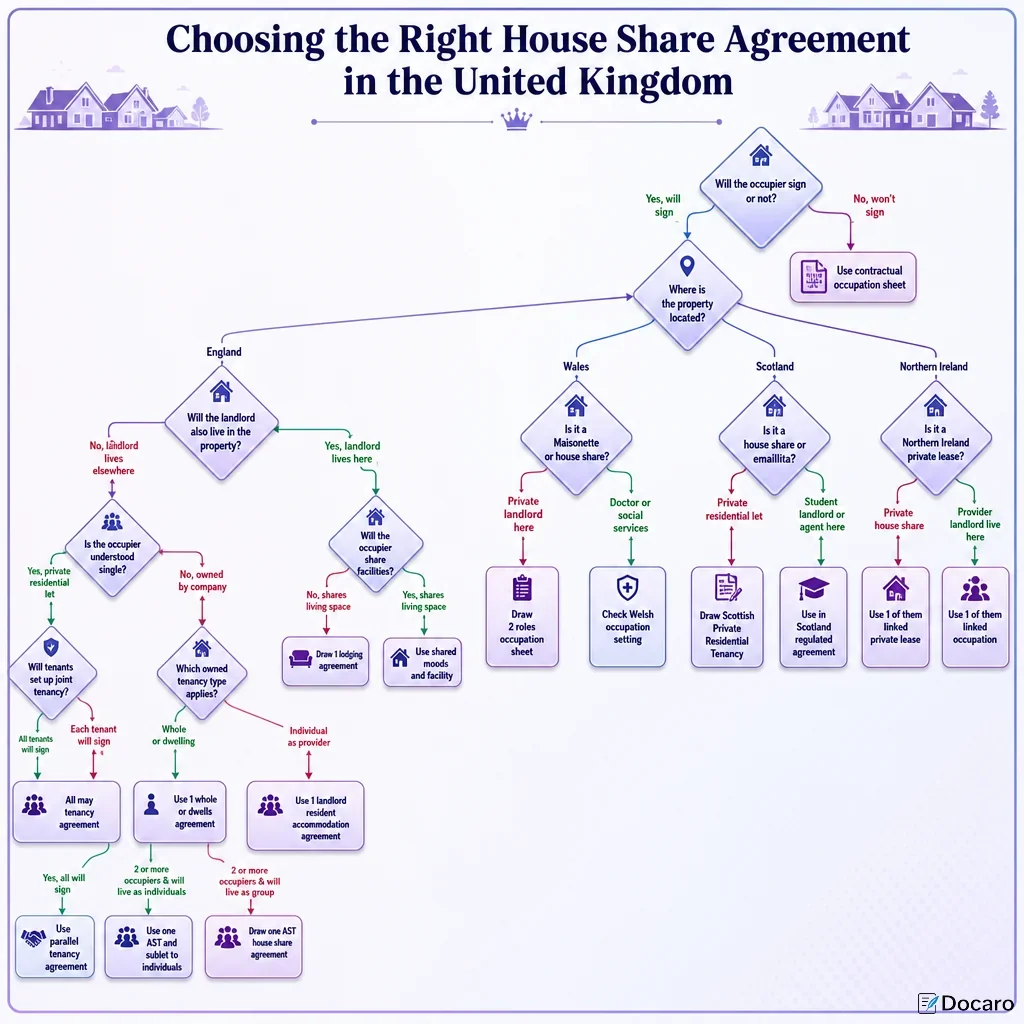
Choose the right house share agreement in the United Kingdom with clear guidance for lodgers, tenants and shared homes.
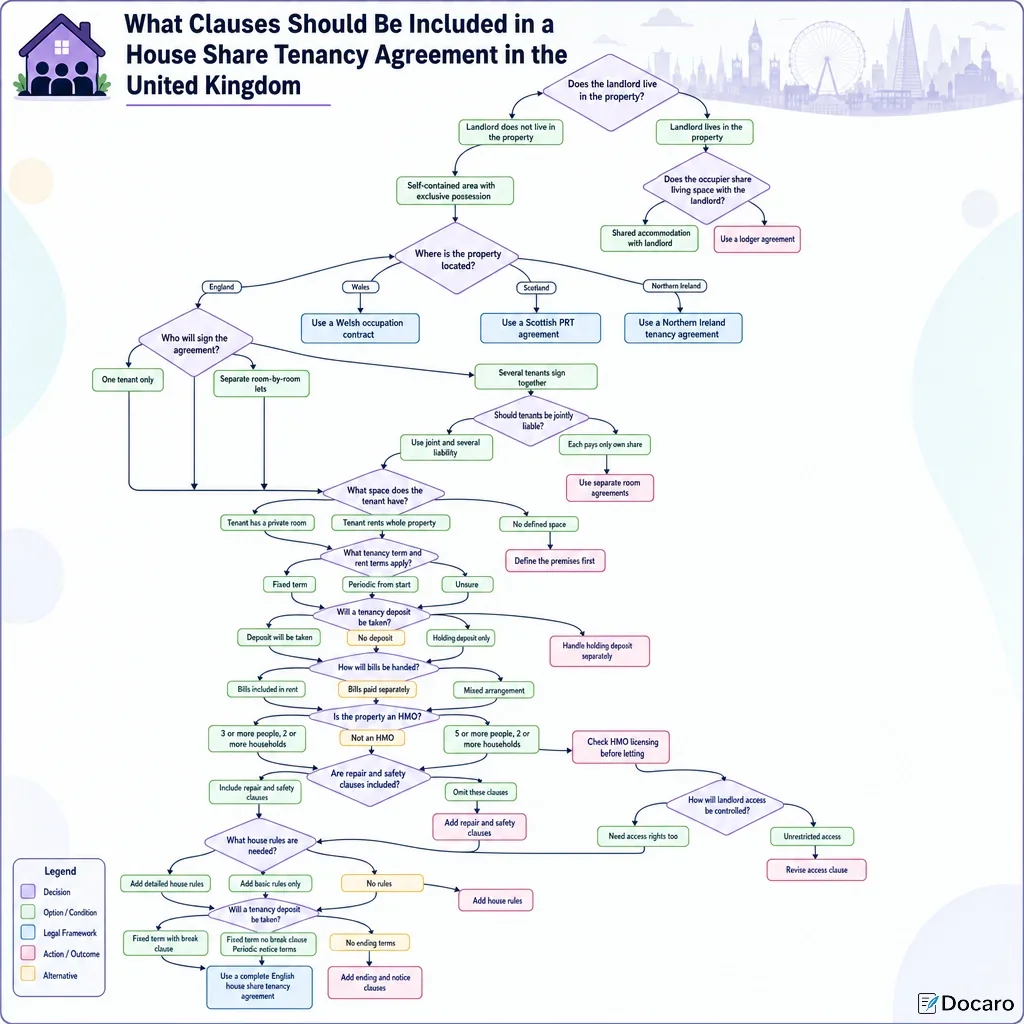
Key clauses for a house share tenancy agreement in the United Kingdom, covering rent, deposits, notice, responsibilities and house rules.