Docaro

Choosing The Right House Share Agreement In The United Kingdom

Created:
This flowchart helps you identify the most suitable house share agreement for your situation, from lodgers to shared tenants. For tailored documents, visit our AI-Generated British Lodger Agreement category page.
House Share Agreement Decision Tool
15%

Will the occupier pay rent?

First decide whether the occupier will pay money to live in the property. If no rent or equivalent payment is made, a tenancy agreement is usually not the right document. If rent is paid, continue to identify the legal status of the occupier and the correct form of agreement.
Disclaimer:
I understand and accept that the flowchart, questionnaire, decision tree, and any results, guidance, classifications, or recommendations provided by Docaro are generated automatically for general informational purposes only and do not constitute legal advice, legal representation, or any other professional advice. No solicitor-client, attorney-client, or other professional advisory relationship is created through use of this service. I acknowledge that the tool operates using simplified rules and assumptions and may not take into account all facts, circumstances, exceptions, legal requirements, or jurisdiction-specific considerations relevant to my situation. The results may be incomplete, inaccurate, outdated, or unsuitable for my particular circumstances. I agree that any outcome or recommendation provided by the tool is indicative only and should not be relied upon as a substitute for independent legal advice. I am solely responsible for verifying the accuracy and suitability of any information provided and for obtaining advice from a qualified legal professional where appropriate. To the fullest extent permitted by applicable law, Docaro disclaims all warranties and liability arising from the use of, or reliance upon, any information, outcome, recommendation, or guidance provided by this service.

Why Is The Right House Share Agreement Important In The UK?

Choosing the right house share agreement helps landlords and occupiers understand their legal rights before anyone moves in. In the United Kingdom, housing law differs between England, Wales, Scotland and Northern Ireland, so a document that works in one country may be unsuitable in another.

What Can Go Wrong If The Wrong Tenancy Agreement Is Used?

The wrong agreement can cause uncertainty about rent, deposits, repairs, bills, house rules and how the arrangement can end. It may also give the occupier different rights from those the landlord expected. For example, a lodger agreement, a joint assured shorthold tenancy and a room-only tenancy can produce very different outcomes.

How Does The Agreement Affect Deposits And Eviction Rights?

Many private tenancies require careful compliance with deposit protection and statutory information rules. If the wrong document is used, a landlord may struggle to recover possession or may face a financial claim. Tenants can also lose clarity about what protections apply to them.

Why Do UK Countries Need Different Documents?

England commonly uses assured shorthold tenancies for private renting, while Wales uses occupation contracts under the Renting Homes system. Scotland usually uses Private Residential Tenancies, and Northern Ireland has separate private tenancy rules. A UK house share should therefore be documented according to the law of the country where the property is located.

What Should A Good House Share Agreement Cover?

  • Who the parties are, including whether tenants are joint tenants or rent separate rooms.
  • What space is included, such as a whole property, a private room or shared areas.
  • Rent, deposit and bills, including payment dates and responsibility for utilities.
  • House rules, including guests, cleaning, noise and shared facilities.
  • Legal compliance, including HMO licensing, deposit protection and required notices where relevant.

Using the correct document supports a smoother house share, reduces disputes and helps both landlords and occupiers make informed decisions. For official guidance, see GOV.UK private renting, GOV.WALES Renting Homes, mygov.scot private residential tenancy and nidirect private tenancies.
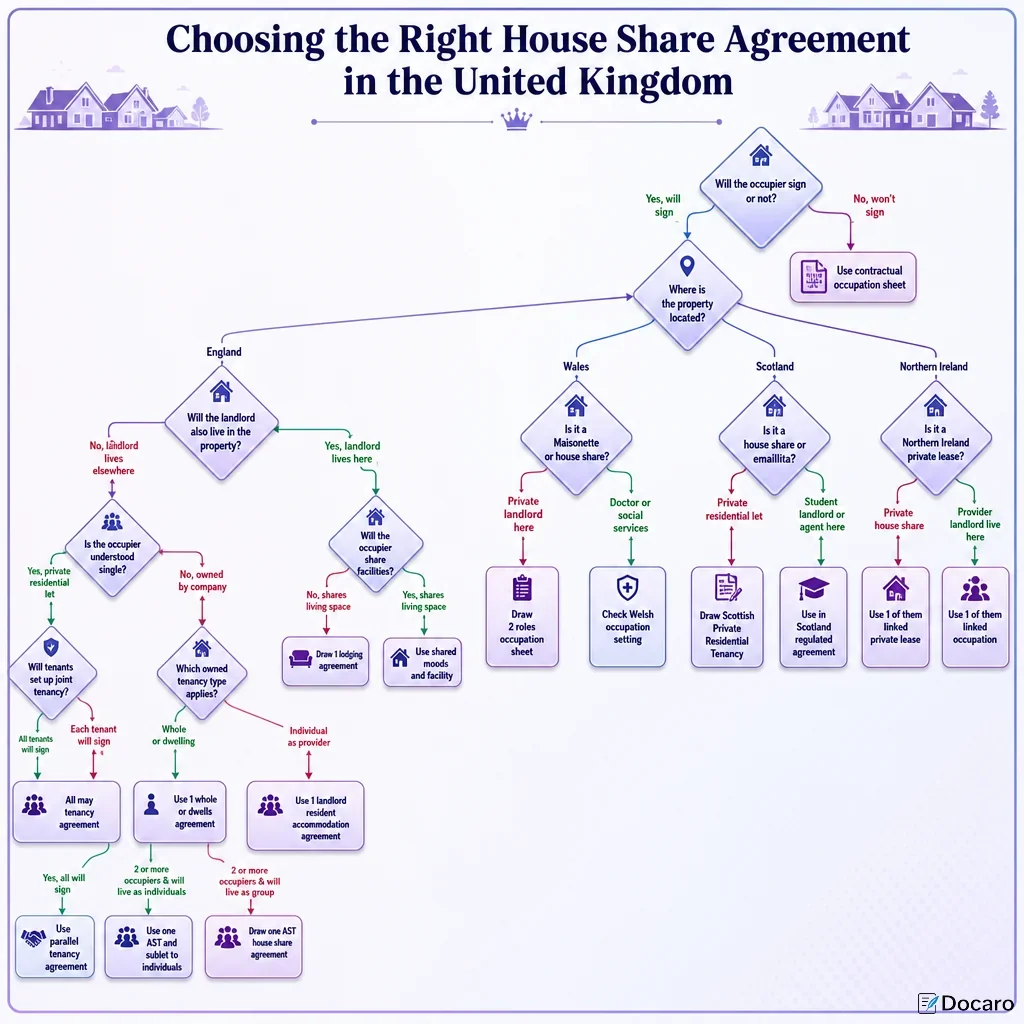
Choosing the Right House Share Agreement in the United Kingdom
This flowchart provides a simplified overview of legal concepts and should not be relied upon as legal advice. Always consider the specific facts of your situation and seek professional advice where appropriate.
Want to Generate Your own Tenancy Agreement?
Docaro AI can help you write your own Tenancy Agreement for use in the United Kingdom in minutes.
Generate Your Document Now

FAQs

A house share agreement in the UK is usually a tenancy agreement or licence agreement setting out each occupier’s rights, rent, deposits, bills, house rules, and responsibilities. The correct document depends on who lives in the property, whether the landlord lives there, and whether tenants rent jointly or separately.
Show All FAQs

You Might Also Be Interested In
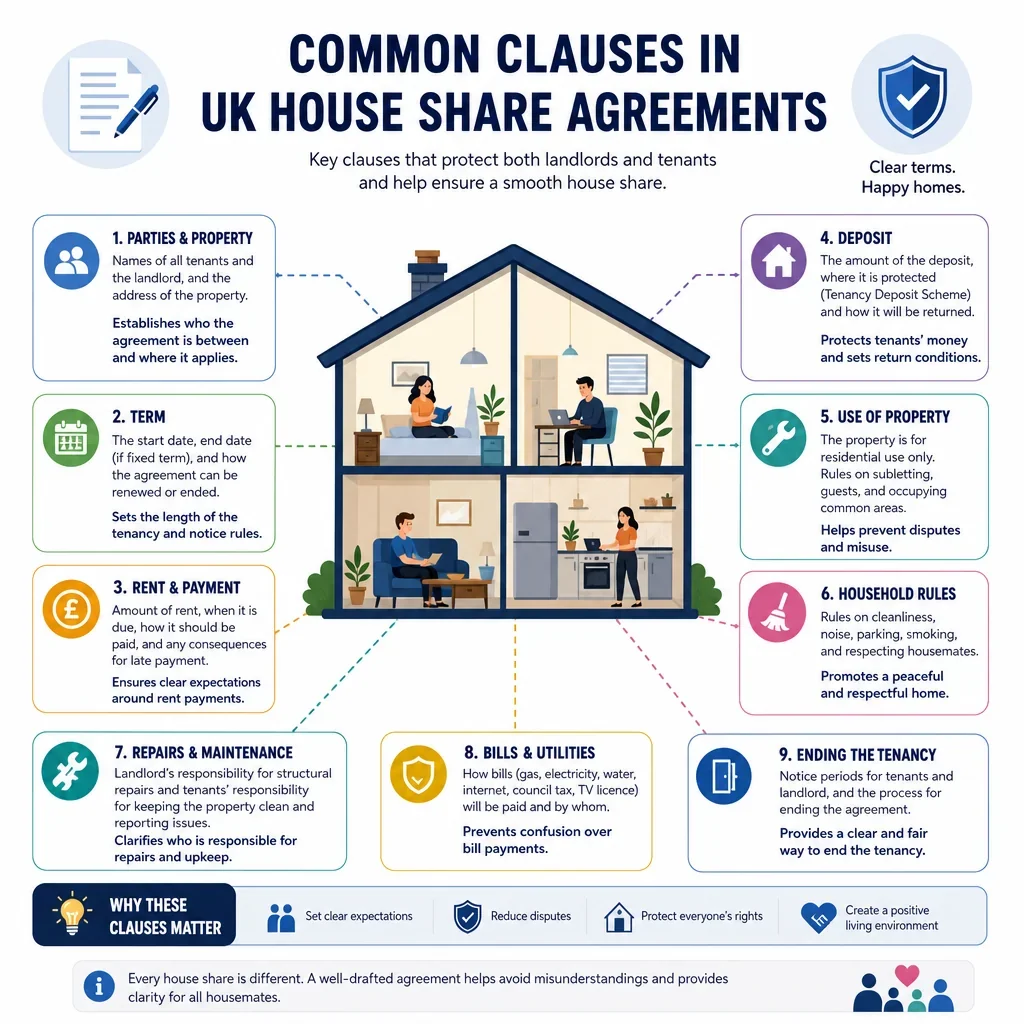
Common Clauses in UK House Share Agreements
Explore common clauses in UK house share agreements, including rent, deposits, bills, notice periods and house rules.
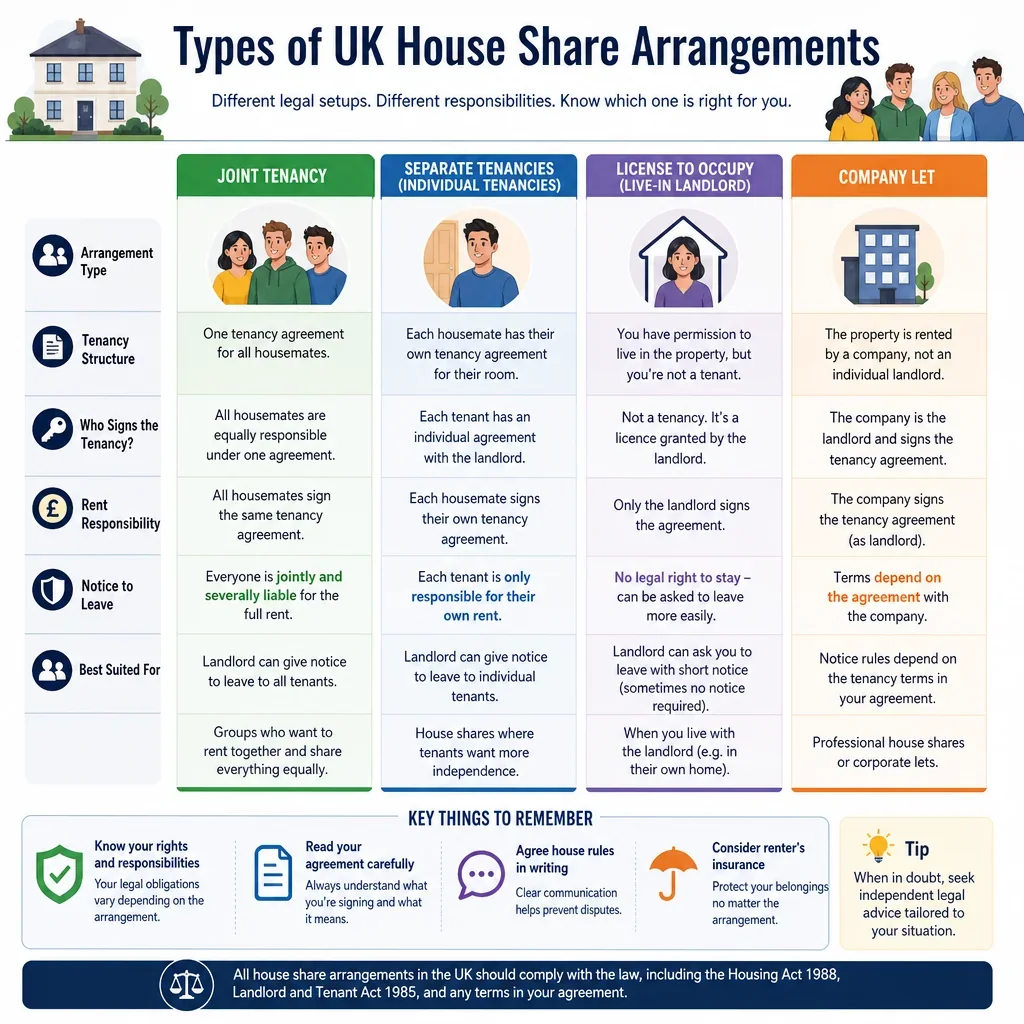
Types of UK House Share Arrangements
Explore common UK house share arrangements, from lodgers to joint tenancies, and choose the right setup for your home.
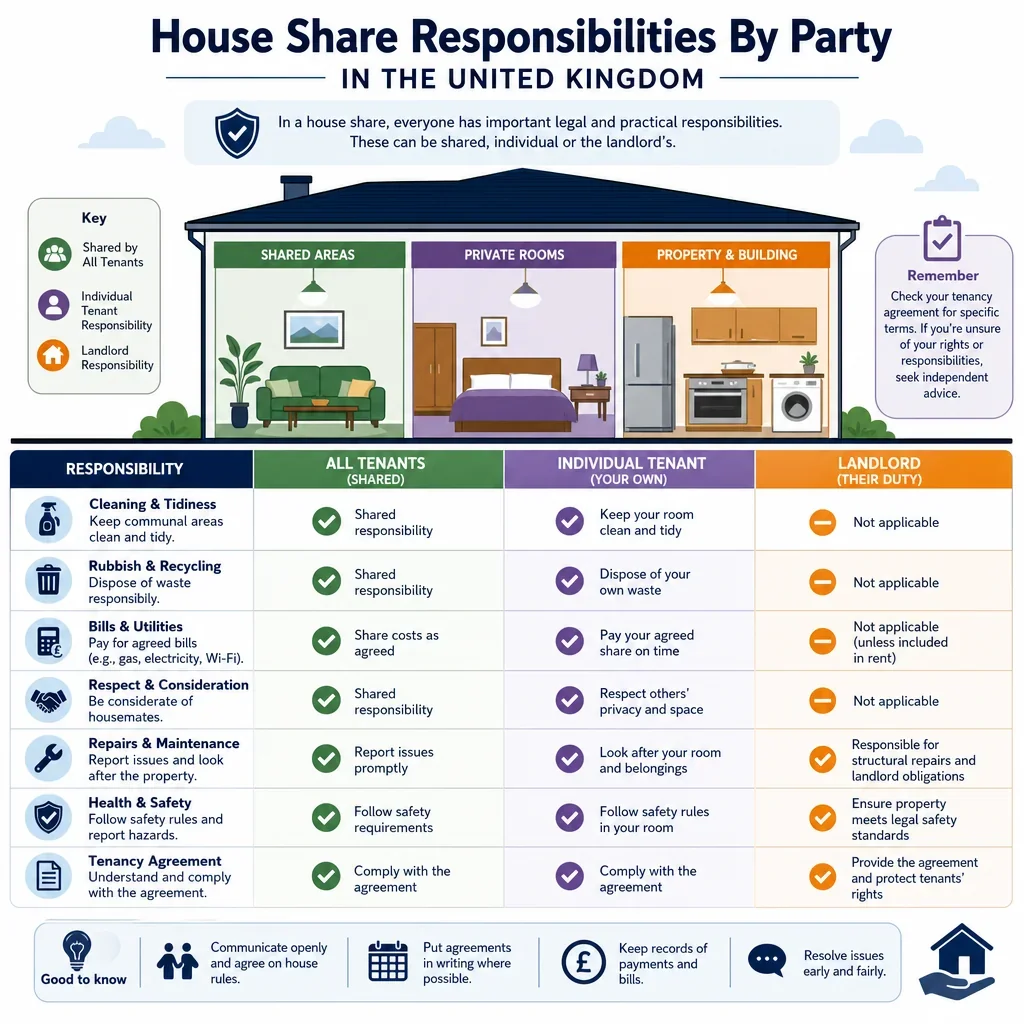
House Share Responsibilities by Party
United Kingdom guide to house share responsibilities by party, helping clarify duties for landlords, lodgers, and tenants.
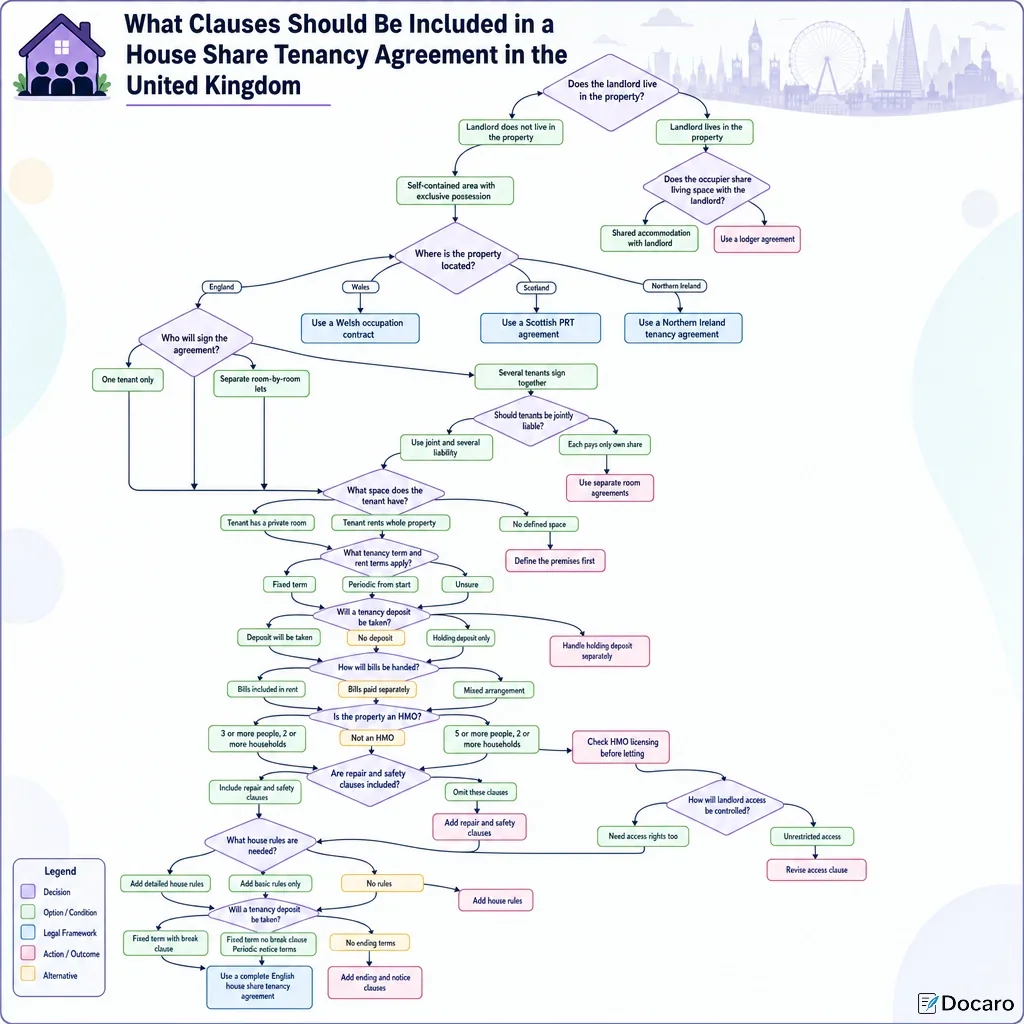
What Clauses Should Be Included in a House Share Tenancy Agreement in the United Kingdom
Key clauses for a house share tenancy agreement in the United Kingdom, covering rent, deposits, notice, responsibilities and house rules.