Copyright Licence Agreement Clause Checklist In The United Kingdom
Clause Name | Clause Purpose | Inclusion Level | Primary Protected Party | When Important | Drafting Considerations |
|---|---|---|---|---|---|
Core commercial term | |||||
Grant of licence | States the permission granted to use the copyright work. | Essential | Both parties | Always it is the operative permission. | Define rights, works, duration, territory, exclusivity, media and permitted acts. |
Licensed works | Identifies the copyright material covered by the licence. | Essential | Both parties | Where multiple files, versions, formats or contributors exist. | List titles, file names, schedules, versions, metadata and excluded materials. |
Rights and restrictions | |||||
Permitted use | Limits how the licensee may exploit the work. | Essential | Licensor | Where use is limited to a campaign, product, platform or audience. | Specify permitted channels, purposes, volumes, formats, territories and users. |
Prohibited use | States uses the licensee must not make. | Usually included | Licensor | For brand-sensitive, political, adult, gambling or competitor uses. | Ban unlawful, defamatory, misleading, immoral, AI-training or sublicensed use if needed. |
Core commercial term | |||||
Exclusive or non-exclusive licence | States whether the licensor may license others. | Essential | Depends on drafting | Where commercial value depends on market exclusivity. | Define exclusive field, territory, term, retained rights and performance conditions. |
Territory | Defines where the licensed use may occur. | Essential | Both parties | For international, online, broadcasting or franchise arrangements. | Use countries, regions, worldwide wording, geo-blocking duties and online access rules. |
Term of licence | Sets the period during which use is permitted. | Essential | Both parties | Where use is campaign-based, subscription-based or royalty-bearing. | State start date, end date, renewal, sell-off and post-term survival. |
Rights and restrictions | |||||
Media and formats | Specifies the channels and formats in which the work may be used. | Usually included | Licensor | For print, web, social media, broadcast, apps or merchandising. | Include or exclude future media, social platforms, paid ads and downloads. |
Adaptations and derivative works | Controls modification, translation, editing and creation of derivative material. | Usually included | Licensor | For software, designs, books, photos, videos, music and marketing assets. | State approval rights, ownership of adaptations and limits on derogatory treatment. |
Copying and reproduction limits | Controls the number and type of copies that may be made. | Usually included | Licensor | For print runs, downloads, internal copies and archival copies. | Define permitted copies, backups, print quantities and deletion obligations. |
Distribution and issuing copies | Regulates selling, supplying or distributing copies of the work. | Usually included | Licensor | For books, images, software, merchandise, datasets and downloads. | Specify channels, quantities, resale rules, wholesalers and exhaustion issues. |
Communication to the public | Permits or restricts online streaming, posting or making available. | Usually included | Licensor | For websites, apps, streaming, email campaigns and social media. | Address public access, paywalls, embeds, sharing, streaming and downloads. |
Performance, showing or playing in public | Controls public performance or display of the work. | Situation-specific | Licensor | For music, film, presentations, exhibitions, events and training. | State venue types, audience size, ticketing, recordings and collecting society licences. |
Sublicensing | States whether the licensee may grant rights to others. | Usually included | Depends on drafting | For agencies, distributors, group companies, platforms and contractors. | Require consent, flow-down terms, records, liability and termination of sublicences. |
Boilerplate | |||||
Assignment of licence | Controls transfer of rights or obligations to another party. | Usually included | Both parties | For acquisitions, outsourcing, group restructures or key-person licences. | Permit group transfers, prohibit assignment without consent, and address change of control. |
Ownership | |||||
Copyright ownership retained | Confirms that copyright ownership is not transferred. | Essential | Licensor | Always, unless the deal includes an assignment. | Distinguish licence rights from ownership and reserve all ungranted rights. |
Reservation of rights | Preserves rights not expressly granted to the licensee. | Usually included | Licensor | Where the licensor may exploit the work in other markets. | Use clear wording that all unlicensed rights remain with the licensor. |
Attribution and credit | Sets how the author or creator must be credited. | Usually included | Licensor | For public-facing creative works and professional authorship recognition. | Specify wording, placement, size, metadata and exceptions for impractical credit. |
Moral rights waiver or consent | Addresses moral rights that may restrict editing or use. | Situation-specific | Licensee | Where the licensee will edit, crop, translate or combine the work. | Ensure waiver is written and covers attribution, integrity and false attribution if needed. |
Derogatory treatment restriction | Prevents treatment of the work that harms the creator's honour or reputation. | Situation-specific | Licensor | For artistic, literary, photographic, film or reputationally sensitive works. | Define permitted edits, approval process and prohibited distortions or mutilations. |
Payment | |||||
Licence fee | Sets the price payable for the licence. | Essential | Licensor | Always, unless the licence is free or royalty-only. | State amount, currency, due date, payment triggers and non-refundable elements. |
Royalties | Calculates ongoing payments based on exploitation or revenue. | Situation-specific | Licensor | For publishing, music, merchandising, software, media and distribution deals. | Define gross or net receipts, deductions, rates, statements and payment dates. |
Minimum guarantee | Guarantees a minimum payment regardless of sales. | Situation-specific | Licensor | For exclusive licences or commercial exploitation by a distributor. | State recoupment, payment timing, exclusivity consequences and sales targets. |
Royalty statements and sales reporting | Requires reports supporting royalty or revenue-share payments. | Situation-specific | Licensor | Where payments depend on sales, usage, impressions or subscriptions. | Set report frequency, required data, records, format and certification. |
Audit rights | Allows verification of royalties and licence compliance. | Situation-specific | Licensor | For royalty, usage-based, exclusive or high-value licences. | Define notice, auditor, records, frequency, confidentiality and underpayment costs. |
VAT and taxes | Clarifies whether prices include VAT and who pays taxes. | Usually included | Both parties | For UK business licences and cross-border payments. | State VAT-exclusive pricing, valid tax invoices and withholding tax treatment. |
Late payment interest | Deters late payment and compensates delay. | Usually included | Licensor | For instalments, royalties, subscription fees and commercial licensees. | Refer to agreed rate or statutory commercial late payment interest. |
Expenses and production costs | Allocates costs linked to preparing or delivering the licensed work. | Situation-specific | Depends on drafting | For bespoke assets, digitisation, localisation, clearance or delivery work. | State reimbursable costs, approvals, caps, receipts and invoicing. |
Core commercial term | |||||
Delivery of materials | Sets how and when the licensor provides the work. | Usually included | Licensee | For digital files, masters, artwork, datasets, software or production schedules. | Specify format, resolution, metadata, delivery method, acceptance and deadlines. |
Compliance | |||||
Quality control | Ensures licensed use meets agreed quality and brand standards. | Situation-specific | Licensor | For merchandising, brand collaborations, education products and consumer goods. | Set standards, sample review, approvals, inspection and withdrawal rights. |
Rights and restrictions | |||||
Approval of uses | Requires consent before specified uses or modifications. | Situation-specific | Licensor | For high-profile works, sensitive campaigns or edited material. | State approval timelines, deemed approval, objective criteria and refusal rights. |
Ownership | |||||
No challenge to rights | Prevents the licensee disputing the licensor's ownership or rights. | Situation-specific | Licensor | For valuable IP, disputed provenance or strategic partnerships. | Avoid overbreadth and consider competition law and legitimate dispute carve-outs. |
Risk allocation | |||||
Non-infringement warranty | Assures the licensee that licensed use will not infringe third-party rights. | Essential | Licensee | For commercial publication, advertising, software, media and public distribution. | Limit to authorised uses and disclose known third-party material or clearances. |
Authority to license | Confirms the licensor has power to grant the licence. | Essential | Licensee | Where works involve employees, freelancers, agencies or multiple owners. | Address co-owners, contributors, employer ownership and prior licences. |
Compliance | |||||
Licensee compliance warranty | Requires the licensee to use the work lawfully and within scope. | Usually included | Licensor | For public, regulated, advertising or user-facing exploitation. | Cover laws, platform rules, advertising codes, permissions and misuse by users. |
Risk allocation | |||||
Indemnity | Allocates financial responsibility for specified claims or losses. | Usually included | Depends on drafting | For infringement claims, misuse, unlawful publication or third-party disputes. | Define covered claims, procedure, control of defence, mitigation and exclusions. |
Limitation of liability | Caps or excludes liability between the parties. | Essential | Both parties | For commercial licences with potentially high downstream losses. | Ensure reasonableness where UCTA applies carve out non-excludable liabilities. |
Excluded losses | Excludes categories such as lost profit or indirect loss. | Usually included | Depends on drafting | For advertising, publishing, software or distribution with consequential risks. | Use clear categories and align exclusions with indemnities and liability caps. |
Insurance | Requires insurance against agreed licence-related risks. | Situation-specific | Both parties | For media production, events, merchandising or high-value public use. | Specify policy types, limits, evidence, renewal and named insured status. |
Third-party infringement claims | Sets procedure for handling claims that the work infringes rights. | Usually included | Both parties | For widely published or commercially valuable content. | Cover notice, cooperation, defence control, settlement consent and remedial options. |
Compliance | |||||
Takedown and suspension | Allows removal or suspension of licensed material after a legal or rights issue. | Situation-specific | Both parties | For online platforms, marketplaces, streaming and social media campaigns. | Set trigger events, notice, response time, replacement material and refund rules. |
Boilerplate | |||||
Confidentiality | Protects non-public information exchanged under the licence. | Usually included | Both parties | For unpublished works, pricing, roadmaps, source files or marketing plans. | Define confidential information, exceptions, duration, permitted disclosures and return. |
Compliance | |||||
Data protection | Ensures compliance where personal data is shared or embedded in works. | Situation-specific | Both parties | For photos, videos, datasets, testimonials, mailing lists or analytics. | Identify controller or processor roles, lawful basis, consents, transfers and security. |
Model, privacy and publicity clearances | Addresses permissions from identifiable people in the work. | Situation-specific | Licensee | For photographs, video, interviews, endorsements and user stories. | Require releases, consent scope, sensitive uses, minors and withdrawal process. |
Ownership | |||||
Third-party materials | Identifies material within the work owned by someone else. | Usually included | Licensee | For composites, music samples, stock images, fonts, datasets and open-source code. | List third-party items, licence limits, attribution, fees and clearance responsibility. |
Compliance | |||||
Open-source components | Manages open-source software or content obligations. | Situation-specific | Licensee | For software, websites, apps, code libraries and technical content. | Identify licences, copyleft effects, notices, source code obligations and restrictions. |
Payment | |||||
Collecting society rights | Clarifies rights or royalties administered by a collecting society. | Situation-specific | Both parties | For music, performance, broadcast, copying, education or reprographic uses. | Identify excluded rights, society licences, direct licensing limits and royalty flows. |
Compliance | |||||
Advertising and marketing compliance | Requires licensed material to be used lawfully in promotions. | Situation-specific | Both parties | For adverts, influencer content, endorsements and comparative marketing. | Refer to ASA rules, consent for endorsements, claims substantiation and approvals. |
Rights and restrictions | |||||
AI training and machine learning use | Permits or prohibits use of works for AI systems or datasets. | Situation-specific | Licensor | For datasets, text, images, music, code, archives and online content. | Address training, fine-tuning, embeddings, prompts, outputs, retention and auditability. |
Text and data mining | Controls computational analysis of copyright works. | Situation-specific | Licensor | For research, AI, analytics, search, archives and content scraping. | State permitted mining, copies, security, retention and commercial use limits. |
Compliance | |||||
Metadata and copyright notices | Preserves ownership information and attribution embedded in files. | Situation-specific | Licensor | For images, audio, video, ebooks, datasets and digital asset management. | Prohibit removing notices, require metadata preservation and set notice wording. |
Digital rights management | Requires technical controls against unauthorised copying or access. | Situation-specific | Licensor | For downloads, streaming, software, ebooks and subscription content. | Specify access controls, watermarking, encryption, anti-circumvention and reporting. |
Security of licensed materials | Requires secure handling of files, masters or unpublished works. | Situation-specific | Licensor | For confidential, unreleased, premium or pre-publication content. | Set storage, access, encryption, user permissions, breach notice and deletion. |
Records of use | Requires records showing how the licensed work is used. | Situation-specific | Licensor | For usage caps, royalties, sublicences, regulated use or audits. | Define records, retention period, access rights and verification process. |
Compliance with laws | Requires lawful creation, licensing and use of the work. | Usually included | Both parties | For public content, regulated sectors, international distribution and advertising. | Cover copyright, privacy, defamation, consumer, advertising and sanctions rules. |
Defamation and unlawful content | Allocates responsibility for defamatory or unlawful material. | Situation-specific | Depends on drafting | For editorial, user-generated, biographical, investigative or social content. | Require content review, warranties, takedown cooperation and indemnities. |
Accessibility and alternative formats | Permits accessible formats and allocates accessibility responsibilities. | Situation-specific | Licensee | For education, public sector, publishing and digital services. | Allow captions, transcripts, alt text, accessible copies and format conversion. |
Termination | |||||
Termination for breach | Allows ending the licence after serious or uncured breach. | Essential | Both parties | Always especially for unauthorised use or non-payment. | Define material breach, cure period, immediate termination events and notice. |
Termination for convenience | Allows a party to end the licence without breach. | Optional | Depends on drafting | For ongoing, subscription, trial or flexible commercial arrangements. | State notice period, refunds, committed fees and wind-down rights. |
Insolvency termination | Addresses termination if a party becomes insolvent. | Usually included | Both parties | For long-term, exclusive, prepaid or business-critical licences. | Check enforceability of ipso facto termination restrictions for suppliers. |
Consequences of termination | States what must happen when the licence ends. | Essential | Both parties | Always especially where copies remain in circulation. | Cover ceasing use, deletion, return, accrued payments and certification. |
Sell-off or run-off period | Allows limited post-termination disposal of existing stock or campaigns. | Situation-specific | Licensee | For printed materials, merchandise, packaging, ads and physical stock. | Define duration, stock limits, reporting, royalties and breach exclusions. |
Survival of obligations | Identifies clauses that continue after expiry or termination. | Usually included | Both parties | Where confidentiality, payments, audits or indemnities must continue. | List surviving clauses and any survival periods. |
Core commercial term | |||||
Renewal and extension | Sets whether and how the licence continues after the initial term. | Situation-specific | Depends on drafting | For recurring campaigns, subscriptions, publishing or software licences. | State automatic renewal, opt-out deadlines, revised fees and performance conditions. |
Boilerplate | |||||
Force majeure | Excuses delay or non-performance caused by events outside control. | Usually included | Both parties | For delivery deadlines, events, physical production or live exploitation. | Define events, notice, mitigation, payment duties and long-stop termination. |
Notices | Sets how formal notices must be given. | Usually included | Both parties | For termination, breach notices, approvals and legal claims. | Specify addresses, email validity, deemed receipt and service methods. |
Entire agreement | Confirms the written agreement supersedes prior discussions. | Usually included | Both parties | Where negotiations, emails or proposals discussed wider rights. | Include non-reliance wording, but avoid excluding fraud liability. |
Variation | Controls how the licence can be amended. | Usually included | Both parties | For changing scope, fees, term, territory or platforms. | Require written agreement signed by authorised representatives. |
Waiver | Prevents delay or tolerance from giving up rights. | Usually included | Both parties | Where breaches may be tolerated temporarily, such as late reports. | State waivers must be written and apply only to the specific breach. |
Severance | Preserves the agreement if one clause is invalid. | Usually included | Both parties | For broad restrictions, liability limits or non-standard commercial terms. | Allow modification or deletion of invalid provisions while preserving intent. |
Third party rights | States whether non-parties may enforce the agreement. | Usually included | Both parties | Where group companies, contributors or indemnified persons may benefit. | Exclude or expressly name beneficiaries under the 1999 Act. |
No partnership or agency | Prevents the licence creating partnership, employment or agency status. | Usually included | Both parties | For co-branding, distribution, influencer or agency relationships. | State neither party may bind the other without express authority. |
Governing law | Identifies the law governing the licence. | Essential | Both parties | Always, especially where any party or use is outside the UK. | Usually choose England and Wales, Scotland, or Northern Ireland as appropriate. |
Jurisdiction | States which courts will hear disputes. | Essential | Both parties | Always especially for cross-border online exploitation. | Choose exclusive or non-exclusive jurisdiction and align with governing law. |
Dispute resolution escalation | Requires negotiation or mediation before formal proceedings. | Optional | Both parties | For long-term partnerships or ongoing content exploitation. | Set escalation contacts, timeframes, mediation rules and urgent injunction carve-outs. |
Risk allocation | |||||
Injunctive relief | Preserves urgent remedies for unauthorised use or disclosure. | Situation-specific | Licensor | For confidential, exclusive, unreleased or high-value copyright works. | Carve urgent court relief out of escalation or mediation requirements. |
Boilerplate | |||||
Electronic signature and counterparts | Allows signing electronically and in separate copies. | Optional | Both parties | For remote signing, agencies, international parties and fast-moving campaigns. | Confirm counterparts form one agreement and e-signatures are accepted. |
What Clauses Matter Most In A UK Copyright Licence Agreement?
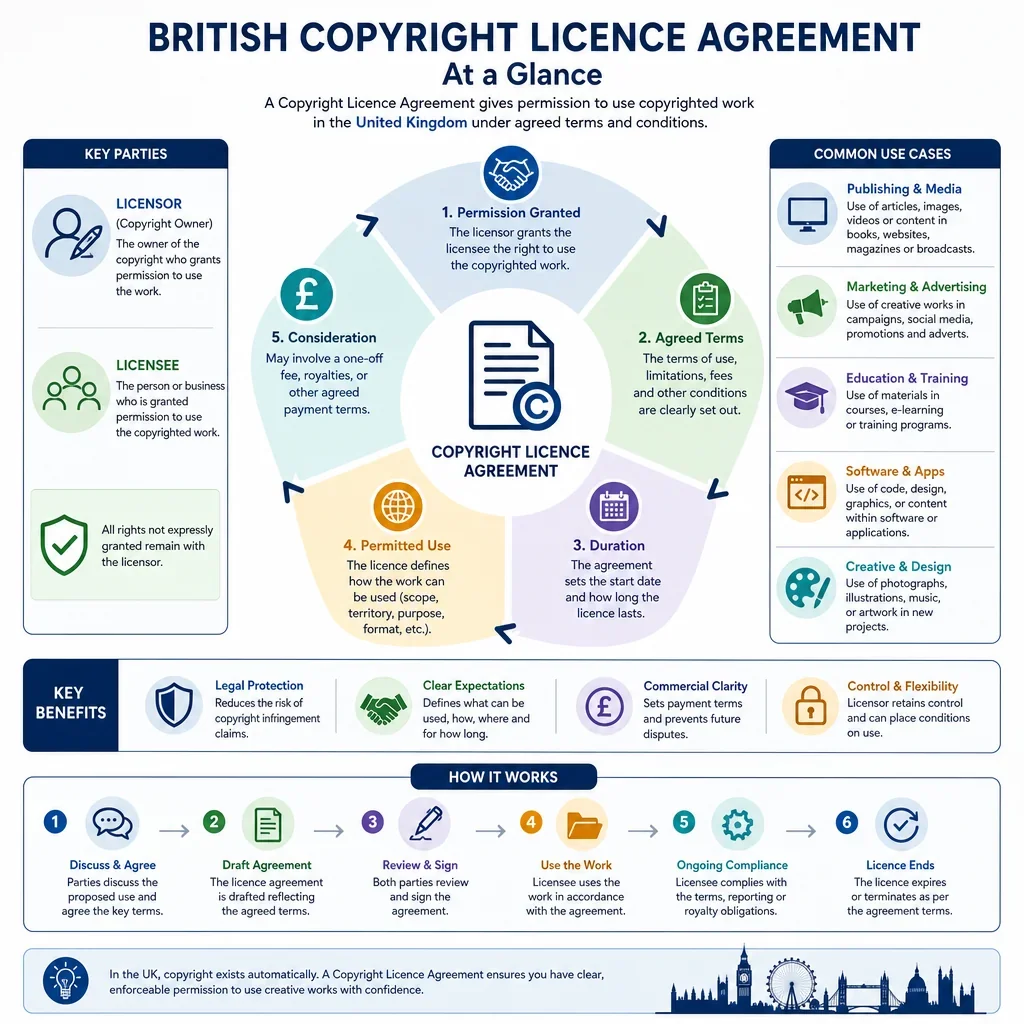
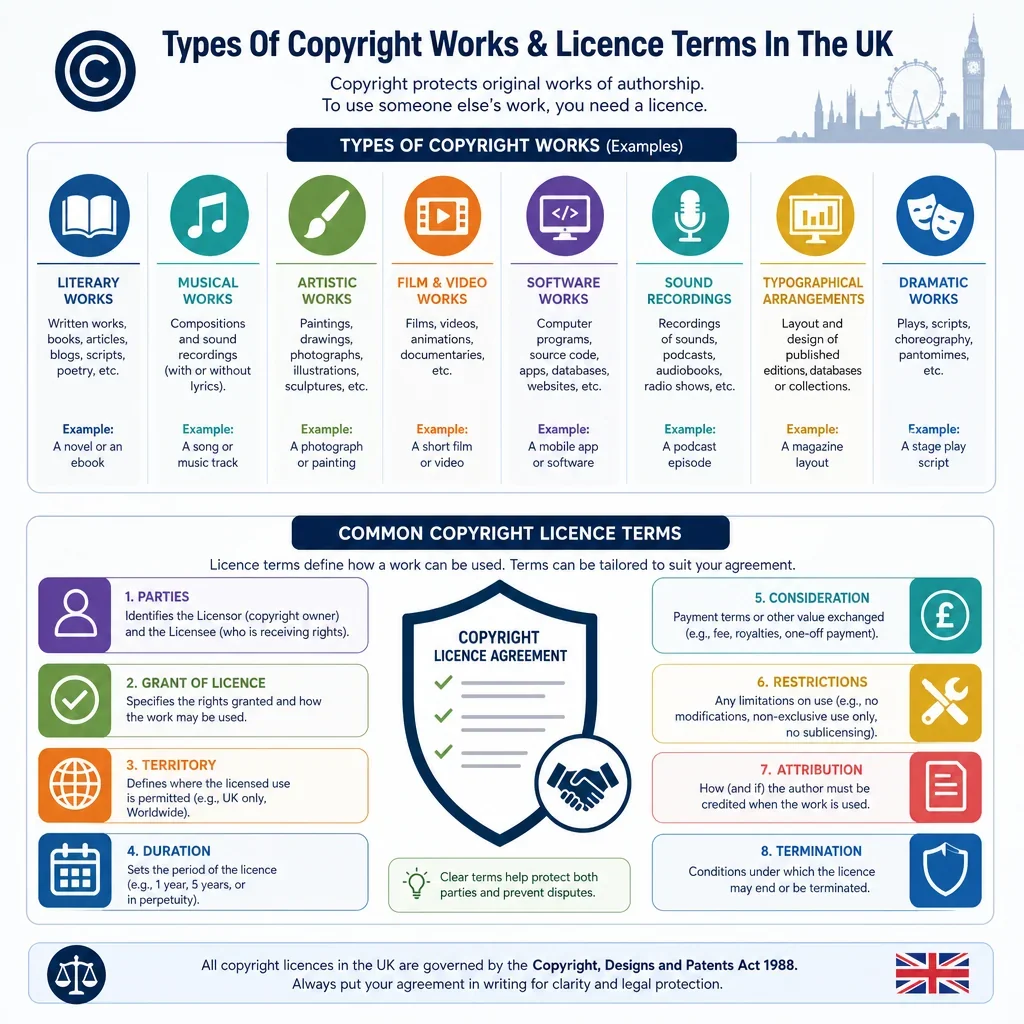
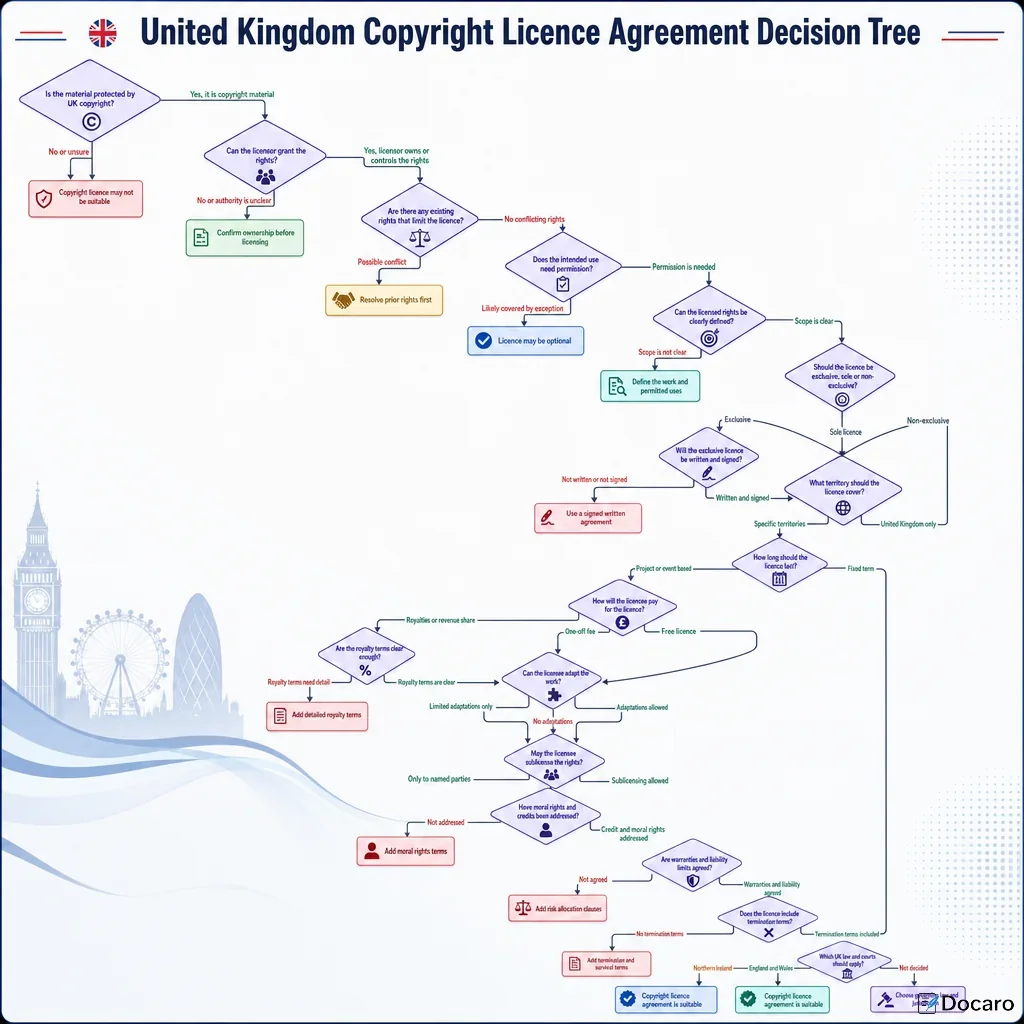
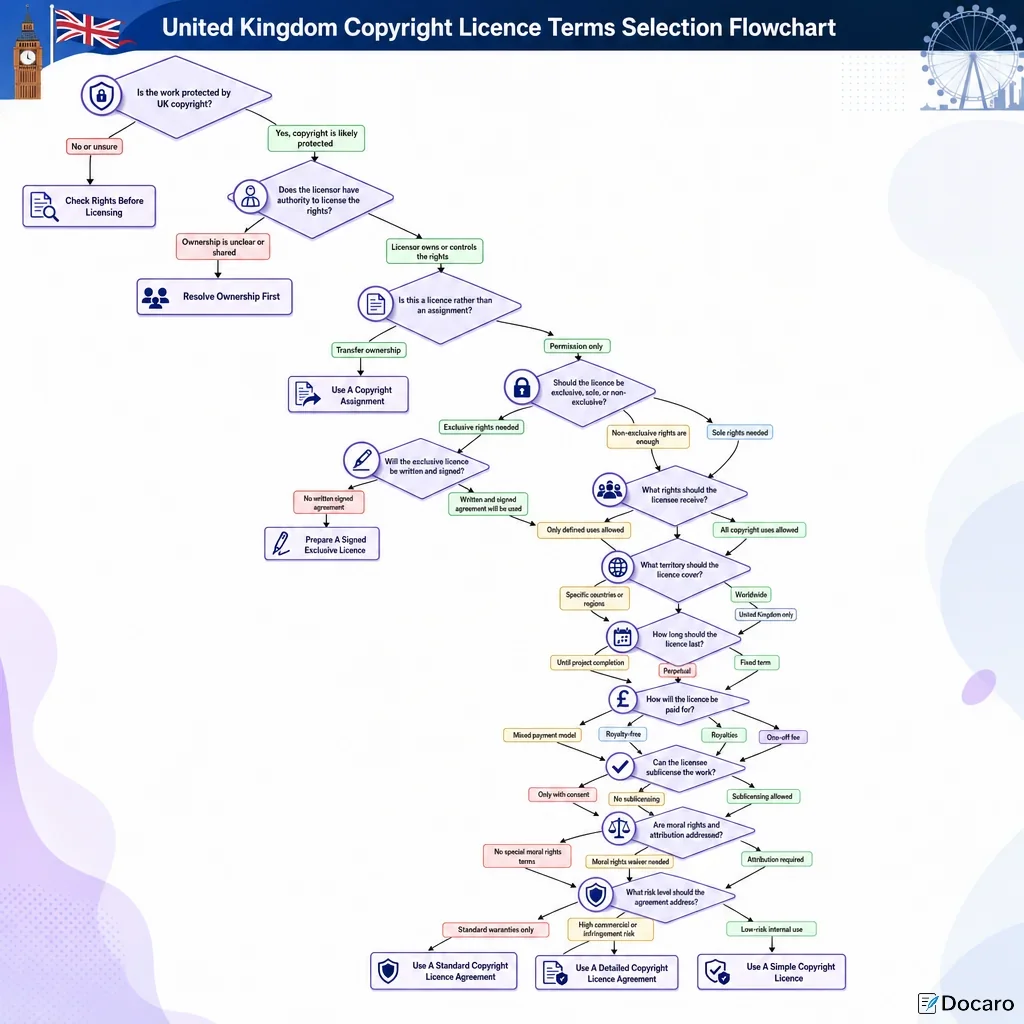
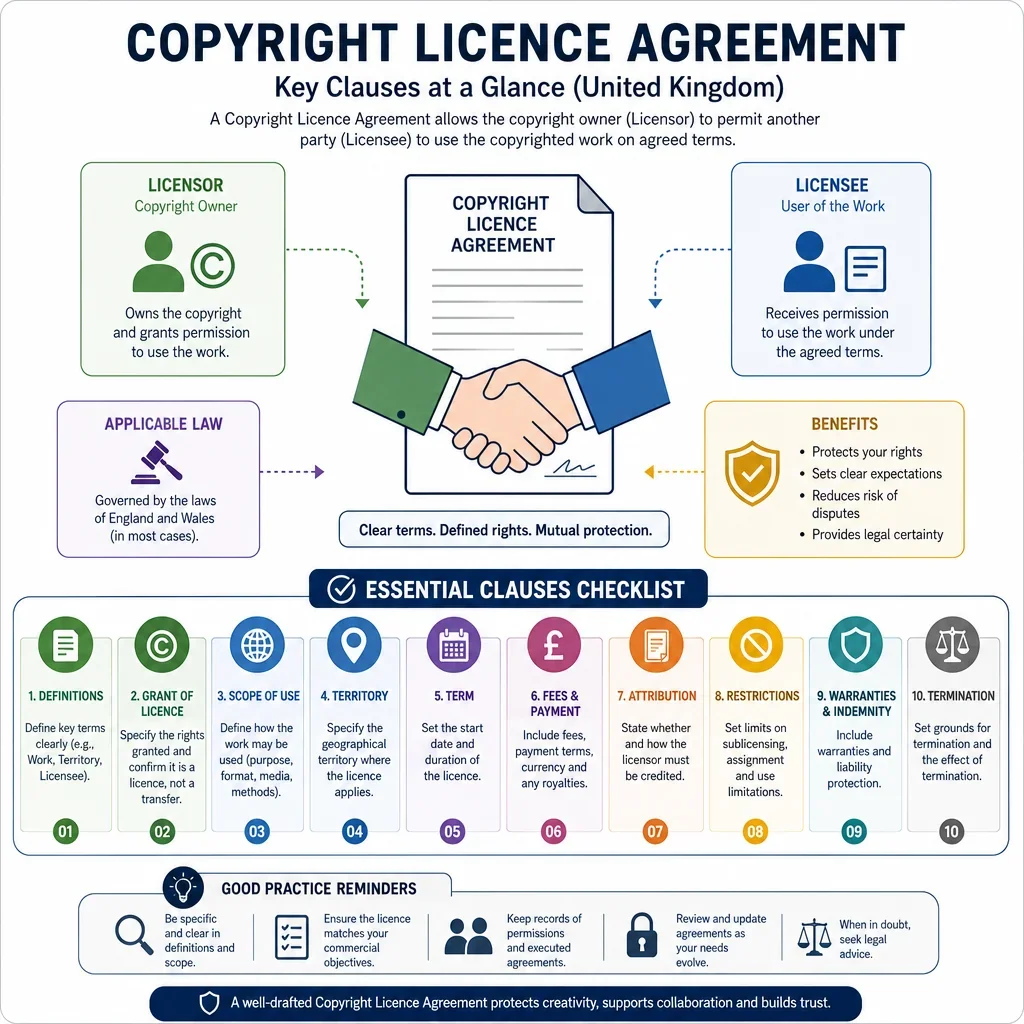
The essential clauses are the grant of licence, licensed works, permitted use, territory, term, fees, ownership, moral rights, warranties, liability, termination and governing law. These clauses decide what the licensee may do, how the licensor is paid, who keeps copyright, and what happens if the deal ends.
Why Must The Licence Scope Be Precise?
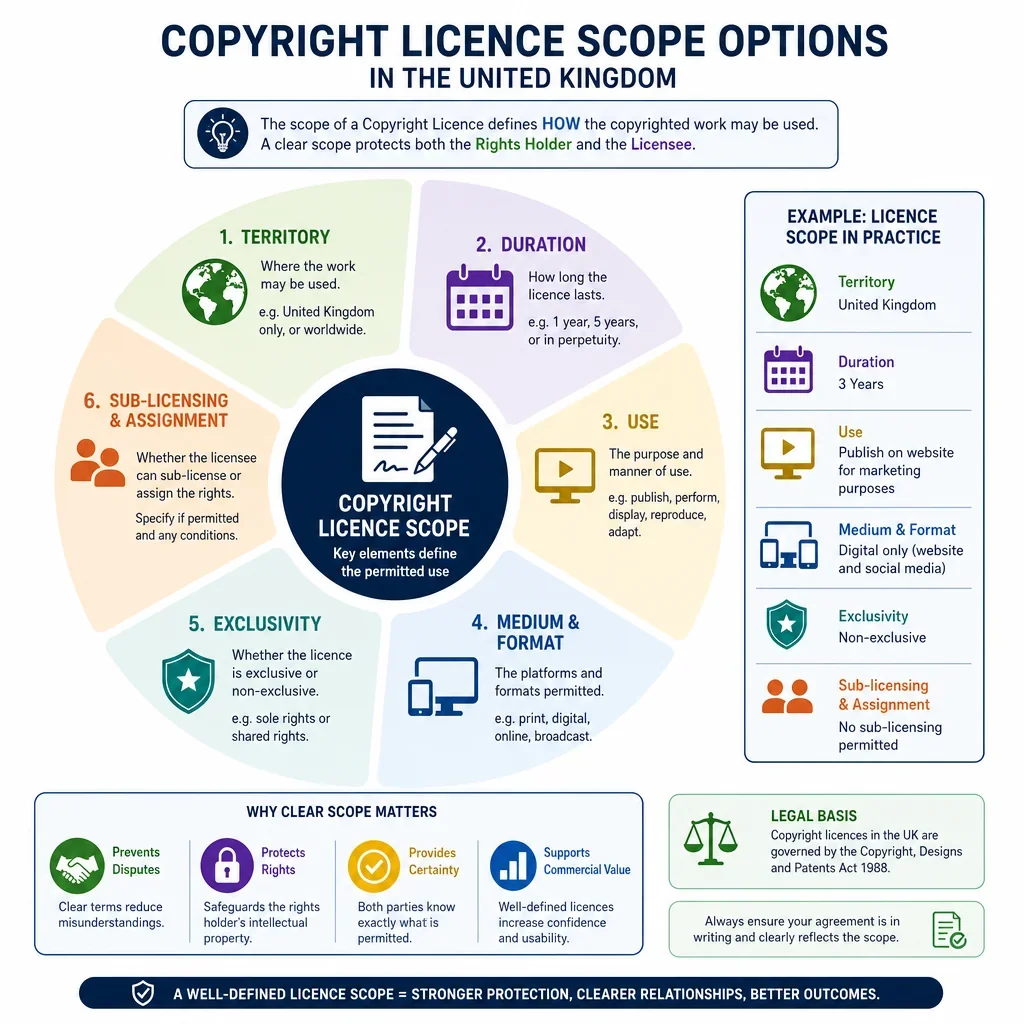
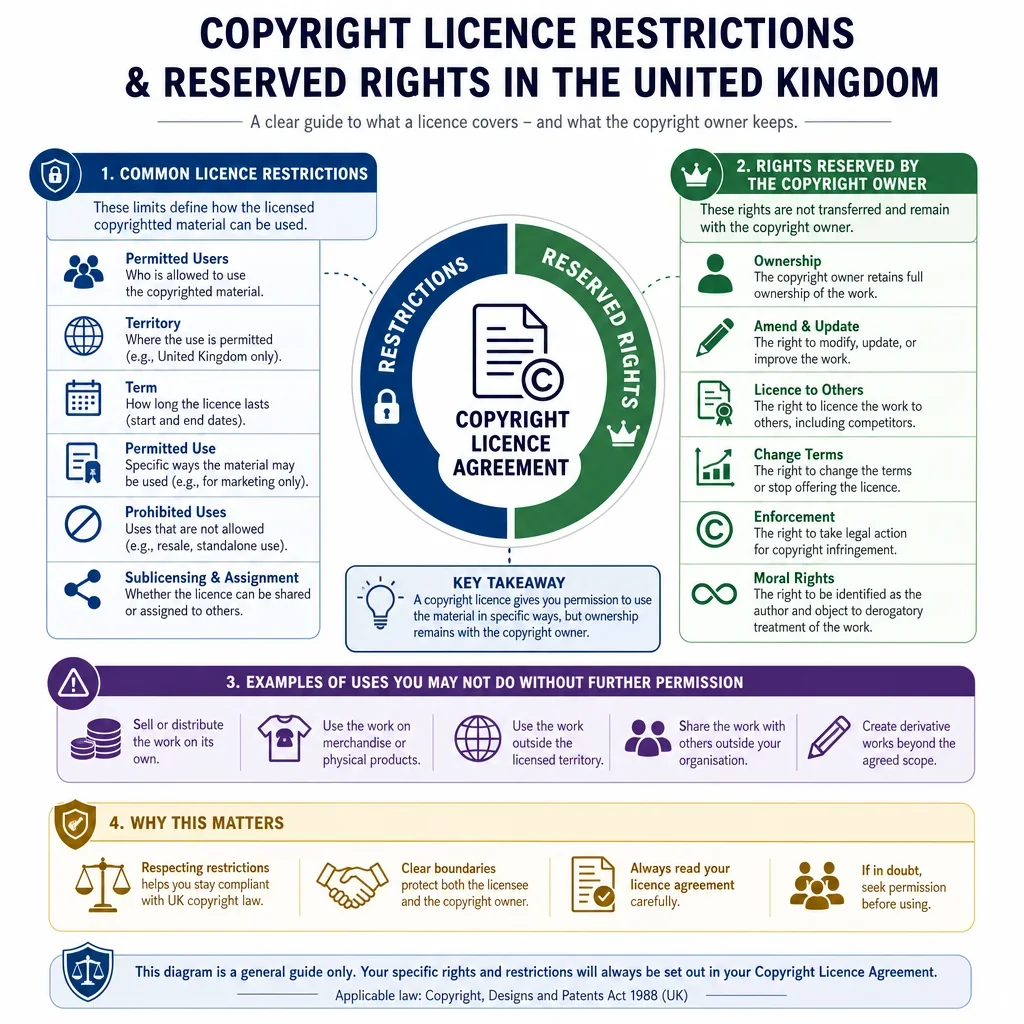
Under UK copyright law, the restricted acts include copying, issuing copies, rental or lending, performing, showing or playing, communicating to the public, and making adaptations. A UK copyright licence should therefore specify the exact acts allowed, the works covered, the territory, duration, media, exclusivity, sublicensing and whether adaptations are permitted.
When Are Moral Rights Clauses Important?
Moral rights are especially important for creative works used publicly, edited, credited, translated or incorporated into brand campaigns. UK law recognises rights including attribution and objection to derogatory treatment, but these rights generally need to be asserted and may be waived. A licence should say whether attribution is required and whether any waiver is needed.
How Should Payment Clauses Be Drafted?
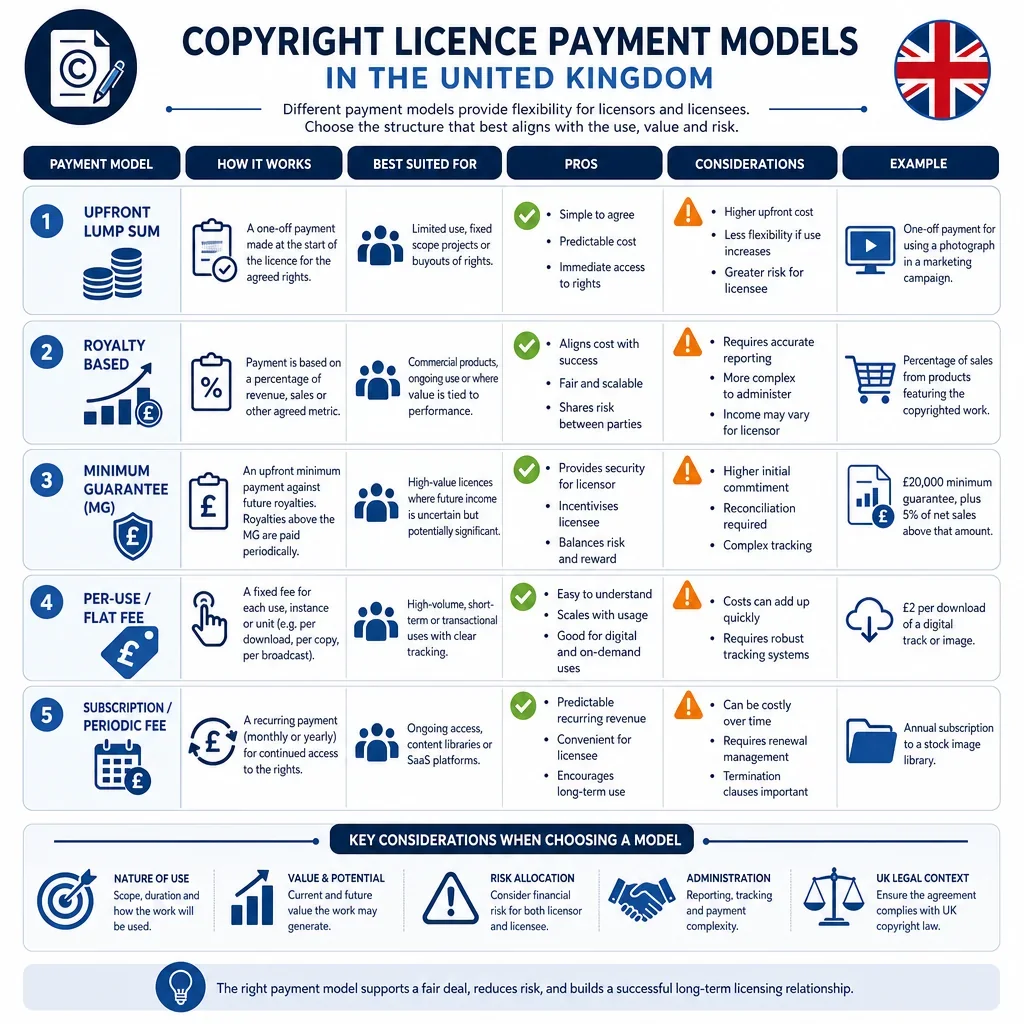
Payment terms should match the commercial model: fixed fee, royalties, revenue share, usage-based fees, minimum guarantee or audit-backed royalty accounting. VAT, invoicing, late payment interest, reporting periods and audit rights are particularly important where the licensee exploits copyright commercially over time.
What Risk Clauses Are Common In UK Copyright Licensing?
UK licences commonly allocate risk through ownership warranties, non-infringement warranties, indemnities, liability caps, insurance and takedown procedures. Licensors usually seek to limit consequential and indirect losses, while licensees often require protection if the licensed material infringes a third party's rights.
Which Clauses Need Extra Care For Online Or AI Uses?
Digital uses often require clauses on online publication, platform terms, metadata, DRM, takedowns, user-generated content, analytics, search indexing, AI training, text and data mining, and content moderation. If AI use is intended, the agreement should expressly state whether the licensed works may be used for training, fine-tuning, prompting, embeddings or dataset creation.
FAQs
You Might Also Be Interested In