Commercial Lease Renewal Routes And Processes In The United Kingdom
Renewal Route | Jurisdiction | Process Summary | Initiating Party | Key Procedural Points | Process Complexity |
|---|---|---|---|---|---|
Statutory renewal | |||||
Protected business tenancy renewal under the Landlord and Tenant Act 1954 | England and Wales | A protected business tenant can remain after contractual expiry and seek a new tenancy unless the landlord proves a statutory ground of opposition. | Either party | Uses section 25 notice or section 26 request court application deadline must be met if terms or renewal are disputed. | High |
Landlord section 25 notice proposing renewal terms | England and Wales | The landlord serves a statutory notice ending the current tenancy and may propose terms for a new lease. | Landlord | Notice must give 6 to 12 months' notice and cannot expire before the contractual term date. | Medium |
Landlord section 25 notice opposing renewal | England and Wales | The landlord ends the tenancy and opposes a new lease on one or more statutory grounds. | Landlord | Grounds include arrears, disrepair, persistent delay, alternative accommodation, redevelopment or landlord occupation. | High |
Tenant section 26 request for a new tenancy | England and Wales | The tenant requests a new tenancy starting on a proposed date and states proposed renewal terms. | Tenant | Request must give 6 to 12 months' notice landlord must serve any opposing counter-notice within 2 months. | Medium |
Landlord counter-notice to a section 26 request | England and Wales | The landlord responds to the tenant's request by stating statutory grounds for opposing a new tenancy. | Landlord | Counter-notice must normally be served within 2 months of the section 26 request and specify section 30 grounds. | High |
Court application for a new business tenancy | England and Wales | The court decides whether a new tenancy should be granted and settles disputed terms if the parties cannot agree. | Either party | Claim must be issued before the statutory termination date unless the parties validly agree extensions where permitted. | High |
Agreed renewal following section 25 notice or section 26 request | England and Wales | The parties use the statutory framework but agree rent, term and lease wording without a contested hearing. | Both parties | Heads of terms and completion should occur before statutory deadlines or after agreed deadline extensions. | Medium |
Interim rent application during 1954 Act renewal | England and Wales | Either party may ask the court to set rent payable while the statutory renewal is pending. | Either party | Application relates to the interim period between the old tenancy and the new tenancy or termination. | High |
Holding over | |||||
Statutory continuation after contractual expiry | England and Wales | A protected business tenancy continues after expiry until ended under the statutory renewal procedures. | Either party | Continuation is not a fresh lease parties should not assume expiry alone ends the protected tenancy. | Medium |
Informal negotiated renewal | |||||
Contracted-out lease negotiated renewal | England and Wales | A tenant without 1954 Act protection renews only if the landlord agrees a new lease or extension. | Either party | Check the warning notice, declaration and lease exclusion wording no statutory right to remain after expiry. | Medium |
Contractual renewal | |||||
Exercise of an express option to renew | England and Wales, Scotland, Northern Ireland | The tenant exercises a lease clause giving a right to a further term if conditions are satisfied. | Tenant | Notice form, service method, timing window, rent mechanism and pre-conditions must be followed strictly. | Medium |
Landlord call option for renewal or re-grant | England and Wales, Scotland, Northern Ireland | A lease clause allows the landlord to require renewal or continuation on stated terms. | Landlord | Rare in tenant-occupation leases enforceability depends on clear drafting and compliance with notice terms. | Medium |
Mutual contractual renewal option | England and Wales, Scotland, Northern Ireland | The lease renews only if both parties follow an agreed contractual renewal mechanism. | Both parties | Usually requires written confirmation, agreed rent or valuation, and completion of renewal documents. | Low |
New lease after expiry | |||||
Reversionary lease granted before expiry | England and Wales, Scotland, Northern Ireland | The parties grant a new lease now that starts when the existing lease ends. | Both parties | Useful where renewal terms are agreed early registration and SDLT or LBTT implications may arise. | Medium |
Contractual renewal | |||||
Lease extension by deed of variation | England and Wales, Scotland, Northern Ireland | The parties vary the existing lease to extend the term instead of granting a wholly new lease. | Both parties | May be treated as a surrender and regrant if changes are substantial, especially term or demise changes. | Medium |
Holding over | |||||
Temporary licence to occupy pending renewal | England and Wales, Scotland, Northern Ireland | The landlord permits short-term occupation while renewal terms or documents are finalised. | Both parties | Should preserve the landlord's position, avoid unintended tenancy creation and state rent, term and termination rights. | Medium |
Tenancy at will pending renewal | England and Wales, Northern Ireland | The tenant occupies temporarily by consent while either party can end the arrangement at will. | Both parties | Document clearly as temporary rent payments and conduct can otherwise suggest a periodic tenancy. | Medium |
Periodic tenancy arising after expiry | England and Wales, Northern Ireland | A periodic tenancy may arise if the tenant remains, pays rent and the landlord accepts it without clear temporary terms. | Either party | Risk depends on conduct, rent period and whether negotiations show occupation is temporary. | High |
New lease after expiry | |||||
Surrender and regrant of replacement lease | England and Wales, Scotland, Northern Ireland | The old lease is surrendered and a new lease is granted on updated commercial terms. | Both parties | Check guarantors, charges, licences, registration, tax and whether any security of tenure is excluded. | Medium |
New lease granted after old lease expiry | England and Wales, Scotland, Northern Ireland | After the old lease ends, the parties complete a fresh lease rather than extending the previous one. | Both parties | Record the start date, rent commencement, deposits, guarantees, fit-out rights and any rent-free period. | Low |
Informal negotiated renewal | |||||
Informal heads of terms renewal | England and Wales, Scotland, Northern Ireland | The parties agree commercial heads of terms before solicitors draft the renewal lease or extension. | Either party | Mark non-binding where intended cover rent, term, break rights, repair, service charge and incentives. | Low |
Renewal agreed by side letter pending formal lease | England and Wales, Scotland, Northern Ireland | A side letter records interim renewal concessions or agreed terms before the final lease is completed. | Both parties | State whether it is binding, personal, temporary, confidential and conditional on completing the lease. | Medium |
Renewal linked to open market rent valuation | England and Wales, Scotland, Northern Ireland | The parties renew after agreeing market rent or using a surveyor or expert valuation mechanism. | Either party | Define assumptions, disregards, incentives, comparable evidence and whether expert determination is binding. | Medium |
Renewal with new break clause negotiation | England and Wales, Scotland, Northern Ireland | The renewal lease includes updated tenant, landlord or mutual break rights as part of the bargain. | Either party | Draft break dates, notice length, service rules and any payment or vacant possession conditions precisely. | Medium |
Contractual renewal | |||||
Renewal lease contracted out of 1954 Act protection | England and Wales | The parties renew but agree that the new lease will not carry 1954 Act renewal rights. | Landlord | Landlord warning notice and tenant declaration must be completed before the tenant becomes bound to take the lease. | Medium |
Statutory renewal | |||||
Unopposed 1954 Act renewal on agreed terms | England and Wales | The landlord accepts renewal in principle and the parties focus on rent and lease terms. | Either party | Court may still decide disputed rent, term or clauses if agreement is not reached in time. | Medium |
Opposed renewal with statutory compensation | England and Wales | If renewal is refused on certain no-fault grounds, the tenant may receive statutory compensation. | Landlord | Compensation may apply for grounds such as redevelopment or landlord occupation, not tenant default grounds. | High |
Renewal opposed for redevelopment | England and Wales | The landlord seeks to refuse renewal because it intends to demolish, reconstruct or substantially work on the premises. | Landlord | Landlord must prove the statutory intention and ability to carry out the relevant works. | High |
Renewal opposed for landlord's own occupation | England and Wales | The landlord seeks to refuse renewal because it intends to occupy the premises for its own business or residence. | Landlord | Landlord must prove qualifying intention compensation may be payable if the ground succeeds. | High |
Court-determined renewal terms | England and Wales | Where renewal is granted but terms are disputed, the court settles the lease terms under the statutory criteria. | Either party | Court considers existing tenancy terms and reasonable modernisation rent is assessed under section 34. | High |
Statutory renewal settled by consent order | England and Wales | After proceedings start, the parties settle the renewal and ask the court to record the agreed outcome. | Both parties | Consent order should align with lease completion dates, costs terms and any dismissal or stay of proceedings. | Medium |
Holding over | |||||
Tacit relocation of commercial lease | Scotland | If neither party validly ends a Scottish lease, it may automatically continue on broadly the same terms. | Either party | A valid notice to quit is usually needed to prevent automatic continuation at the lease end. | Medium |
Informal negotiated renewal | |||||
Scottish notice to quit before renewal negotiation | Scotland | A party serves notice to quit to stop tacit relocation while negotiating any replacement lease separately. | Either party | Notice periods and service requirements depend on the lease and Scots law serve in good time before expiry. | Medium |
Contractual renewal | |||||
Scottish express lease extension agreement | Scotland | The landlord and tenant sign an agreement extending the Scottish lease or granting a replacement lease. | Both parties | Consider registration, LBTT, guarantor consent and whether notice to quit is still needed to avoid ambiguity. | Medium |
Holding over | |||||
Tacit relocation followed by variation | Scotland | The lease continues by tacit relocation and the parties later vary rent or other terms by agreement. | Both parties | Variation should be documented clearly tacit relocation may continue existing terms unless validly changed. | Medium |
New lease after expiry | |||||
New Scottish lease after ish | Scotland | After the lease end date, the parties enter a fresh Scottish commercial lease on new terms. | Both parties | Check that tacit relocation was excluded or managed and deal with LBTT and registration requirements. | Medium |
Statutory renewal | |||||
Business tenancy renewal under the Business Tenancies Order 1996 | Northern Ireland | A qualifying business tenant may have statutory protection and seek a new tenancy under Northern Ireland legislation. | Either party | The Order sets procedures for termination, renewal requests, opposition and court determination of terms. | High |
Northern Ireland landlord notice to determine business tenancy | Northern Ireland | The landlord serves a statutory notice to end the tenancy and may state whether a new tenancy is opposed. | Landlord | Notice content, timing and any opposition grounds must comply with the Business Tenancies Order. | High |
Northern Ireland tenant request for new tenancy | Northern Ireland | The tenant requests a new business tenancy under the Northern Ireland statutory renewal regime. | Tenant | The landlord may oppose in accordance with the Order unresolved renewal terms can go to court. | High |
Northern Ireland court application for new business tenancy | Northern Ireland | The court determines whether a new tenancy is granted and settles disputed terms under the Order. | Either party | Proceedings are used where renewal entitlement, opposition grounds or terms remain disputed. | High |
Informal negotiated renewal | |||||
Northern Ireland unprotected negotiated renewal | Northern Ireland | Where statutory protection does not apply or has been excluded, renewal depends on the parties' agreement. | Either party | Check whether the Business Tenancies Order applies before assuming the tenant must vacate at expiry. | Medium |
Renewal with turnover rent arrangement | England and Wales, Scotland, Northern Ireland | The parties renew on rent linked partly or wholly to the tenant's trading performance. | Either party | Define turnover, exclusions, audit rights, reporting periods, base rent and confidentiality obligations. | High |
Renewal with green lease provisions | England and Wales, Scotland, Northern Ireland | The renewal updates the lease to include energy, data sharing, works and sustainability obligations. | Either party | Align clauses with service charge, alterations, EPC duties, metering and environmental performance targets. | Medium |
Renewal requiring MEES and EPC compliance review | England and Wales | Before renewal, the landlord checks whether energy efficiency rules restrict letting the premises. | Landlord | Non-domestic private rented property generally needs a compliant EPC rating or a valid registered exemption. | Medium |
Renewal with new guarantor or rent deposit | England and Wales, Scotland, Northern Ireland | The landlord agrees renewal subject to updated security for the tenant's obligations. | Landlord | Document guarantees, authorised guarantee issues, deposit deed, release triggers and insolvency protections. | Medium |
Contractual renewal | |||||
Renewal requiring superior landlord or lender consent | England and Wales, Scotland, Northern Ireland | A renewal can proceed only after required consents from a superior landlord, freeholder or secured lender. | Landlord | Check headlease restrictions, mortgage conditions, consent timescales and whether consent must be by deed. | High |
Sublease renewal aligned with headlease term | England and Wales, Scotland, Northern Ireland | A subtenant renews on terms that must fit within the tenant-landlord's remaining headlease rights. | Both parties | Sublease term must usually end before the headlease consent and statutory protection should be checked. | High |
Informal negotiated renewal | |||||
Renewal after assignment to current tenant | England and Wales, Scotland, Northern Ireland | The current assignee negotiates renewal and the landlord checks assignment documents and continuing liabilities. | Either party | Review licences to assign, guarantors, authorised guarantee agreements and tenant identity before renewing. | Medium |
Renewal following tenant insolvency or restructuring | England and Wales, Scotland, Northern Ireland | Renewal is negotiated with attention to administrators, liquidators, CVA terms or restructuring arrangements. | Either party | Confirm authority to contract, arrears treatment, security, rent deposit use and any insolvency moratorium limits. | High |
Renewal with rent-free or stepped rent incentive | England and Wales, Scotland, Northern Ireland | The tenant renews in return for rent incentives such as a rent-free period or stepped rent increases. | Tenant | Set incentive dates, repayment clawback, break interaction, VAT and rent review assumptions clearly. | Medium |
Renewal with dilapidations settlement | England and Wales, Scotland, Northern Ireland | The parties renew while agreeing how existing repair breaches or dilapidations will be handled. | Either party | Record works, payment, release wording, schedules of condition and whether old breaches are waived. | Medium |
Renewal with schedule of condition | England and Wales, Scotland, Northern Ireland | The tenant renews with repair obligations limited by an agreed photographic or written condition record. | Tenant | Attach the schedule to the lease and align it with yielding up, decoration and reinstatement clauses. | Low |
Statutory renewal | |||||
Tenant withdrawal from statutory renewal claim | England and Wales | A protected tenant may decide not to pursue renewal and instead agree exit terms or vacate. | Tenant | Withdrawal or failure to issue a claim can end renewal rights settlement should address occupation and arrears. | Medium |
What Is The Best Route For Renewing A Commercial Lease In The UK?
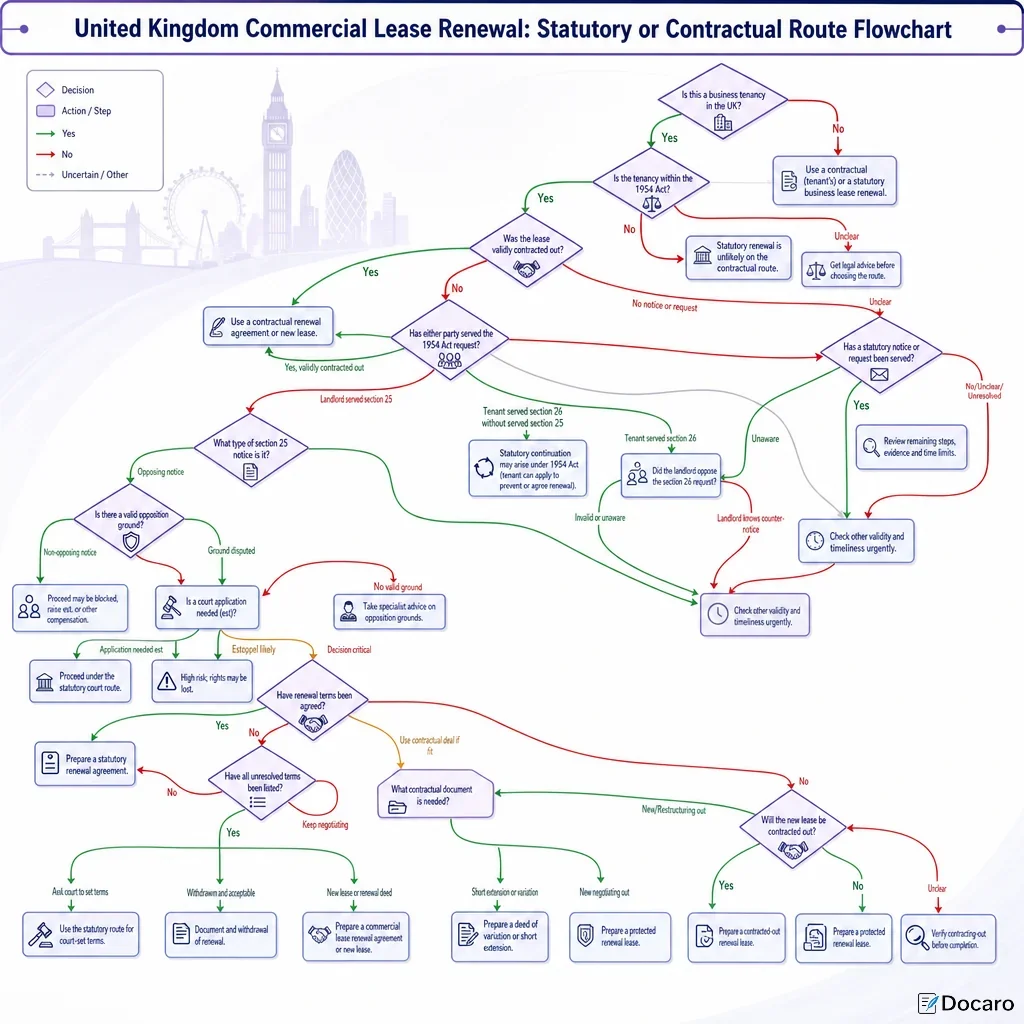
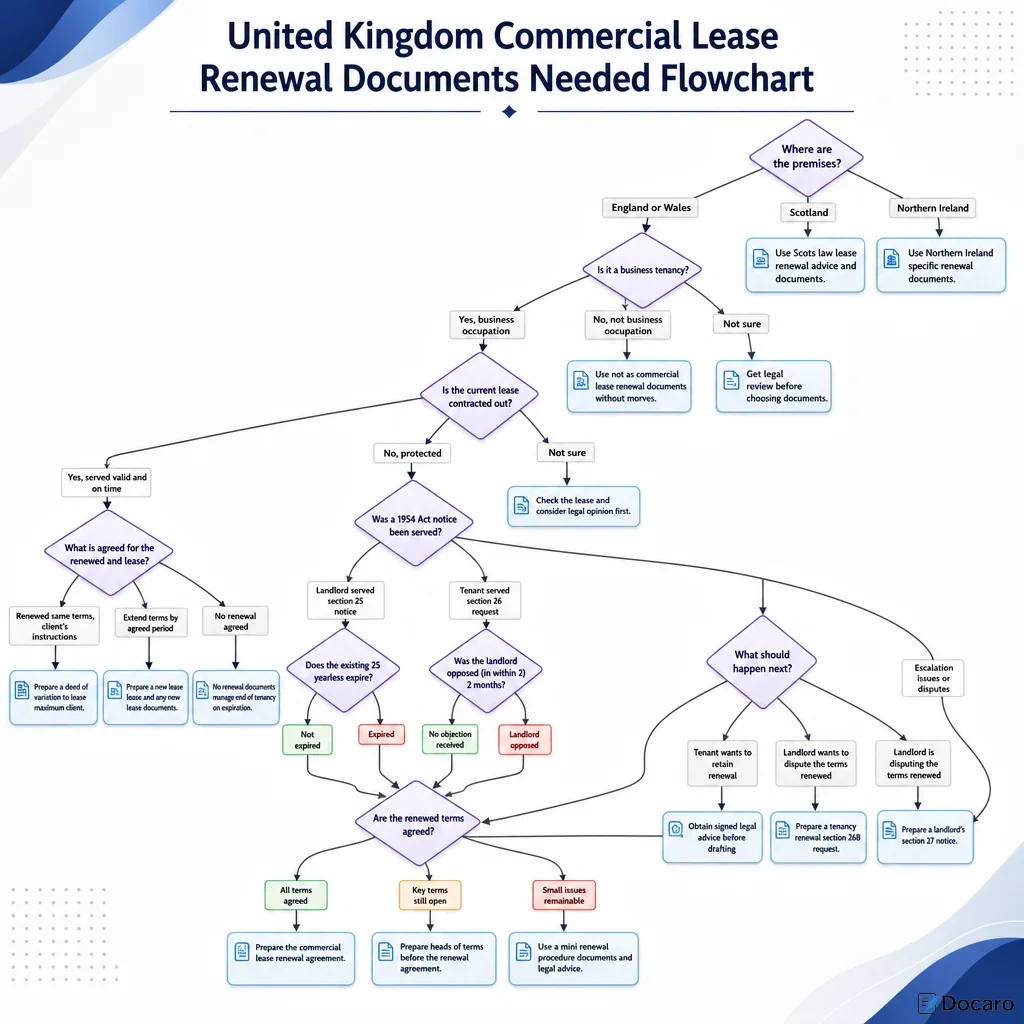
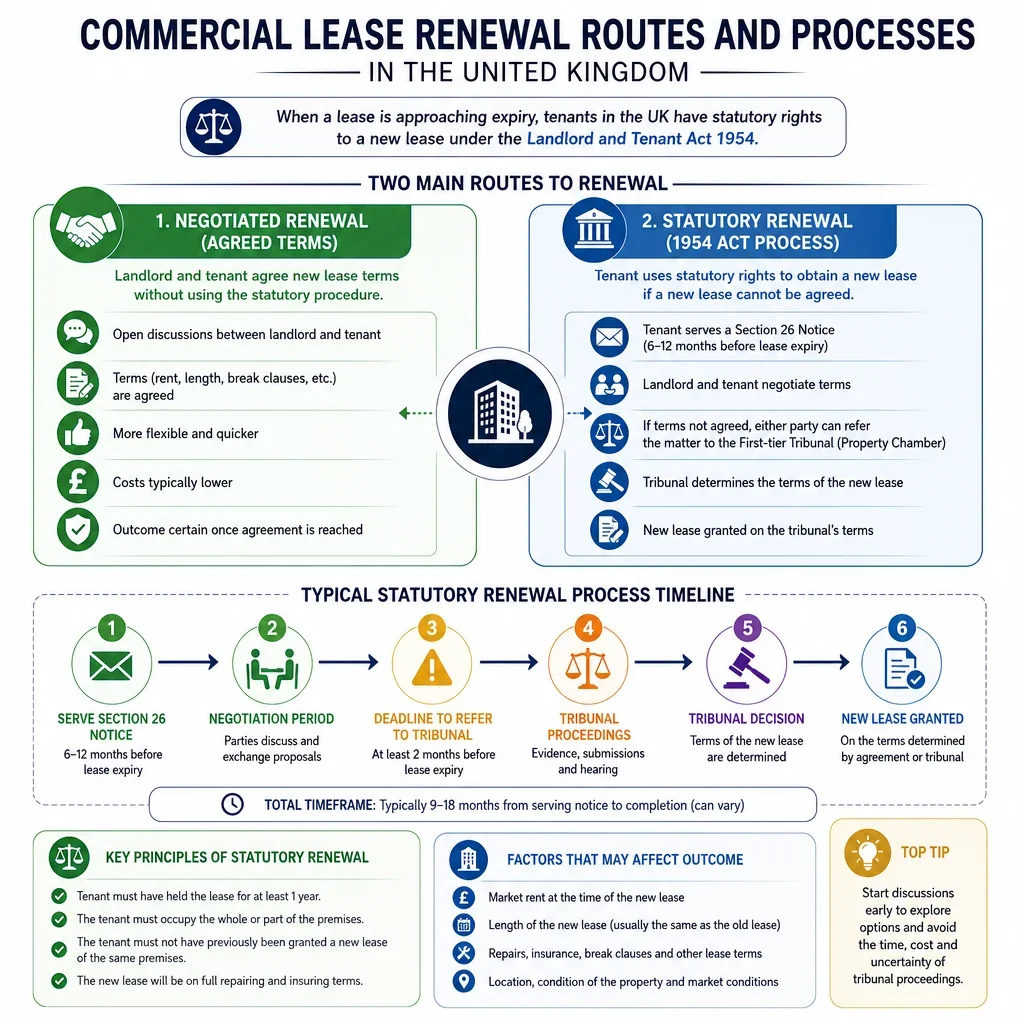
In England and Wales, the key first question is whether the lease is protected by Part II of the Landlord and Tenant Act 1954. If it is protected, the tenant may have a statutory right to a new tenancy and the renewal process normally turns on section 25 notices, section 26 requests, counter-notices and, if needed, a court application before the statutory deadline.
- Protected tenants should watch deadlines carefully: missing the court application deadline after a section 25 notice or section 26 request can cause the statutory right to a new lease to be lost.
- Contracted-out leases are different: where the 1954 Act exclusion procedure was validly completed before grant, there is no statutory renewal right and renewal depends on negotiation or an express option.
- Options to renew are deadline-driven: an option clause may require notice in a precise form and within a strict window; late or defective exercise can invalidate the renewal.
- Holding over is risky: continuing occupation after expiry can preserve a protected tenancy in some England and Wales cases, but it can also create uncertainty about rent, termination and the parties' rights.
- Scotland and Northern Ireland use different regimes: Scottish renewal may involve tacit relocation and notices to quit, while Northern Ireland has its own Business Tenancies Order with statutory notices and possible court involvement.
When Should A Commercial Lease Renewal Agreement Be Used?
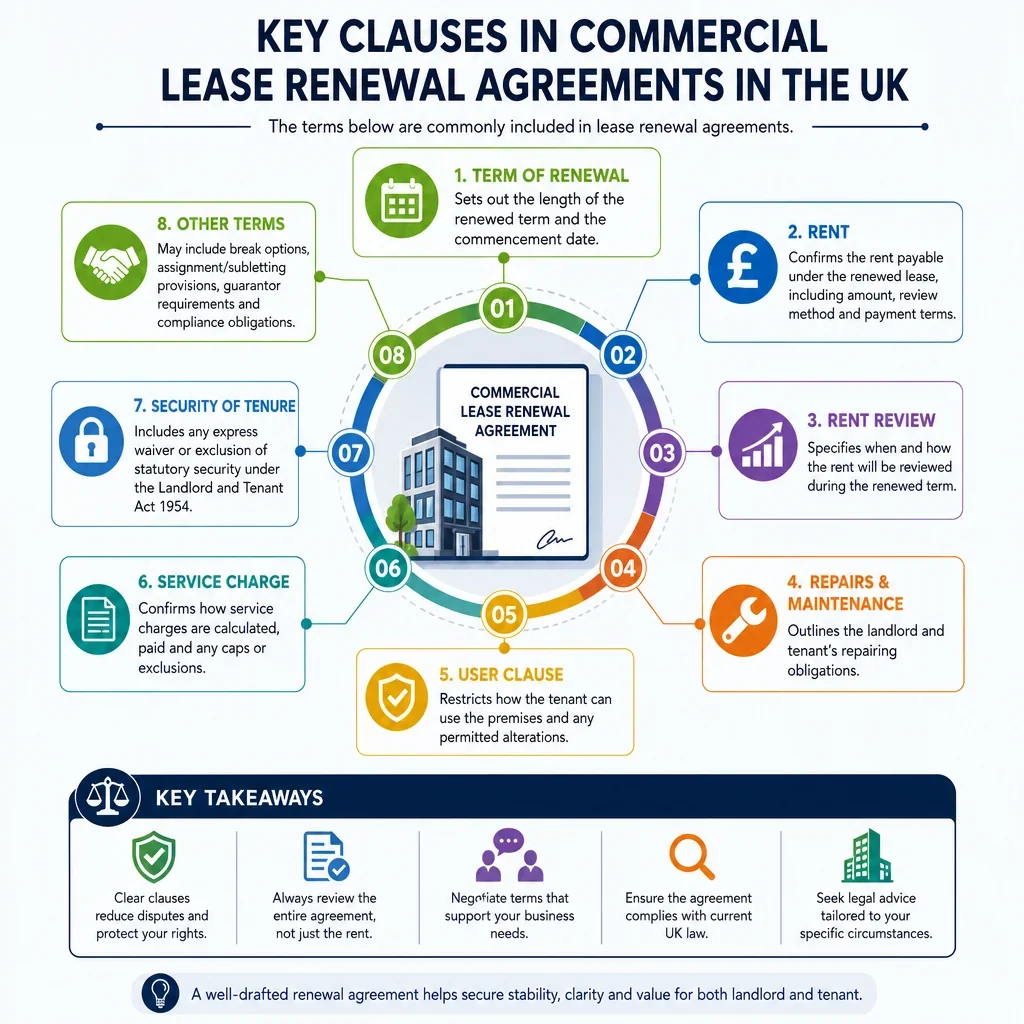
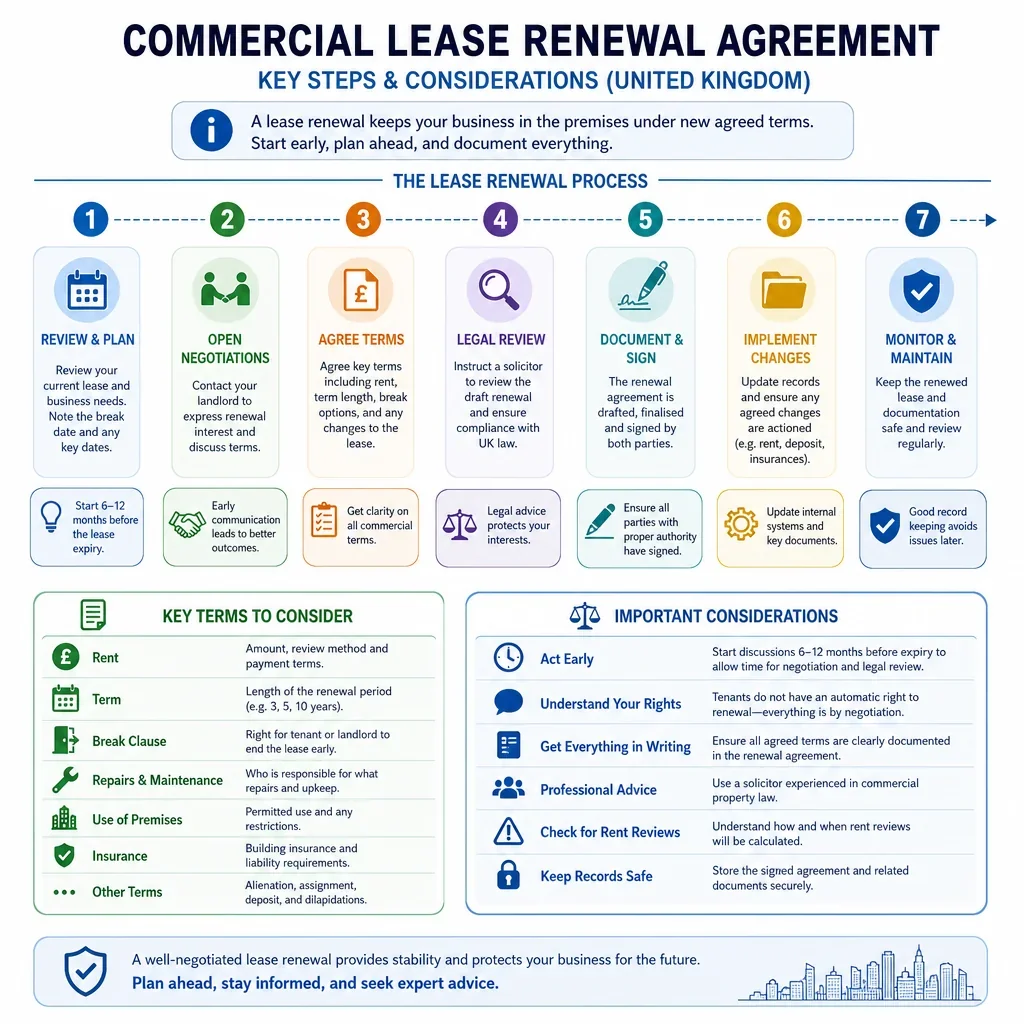
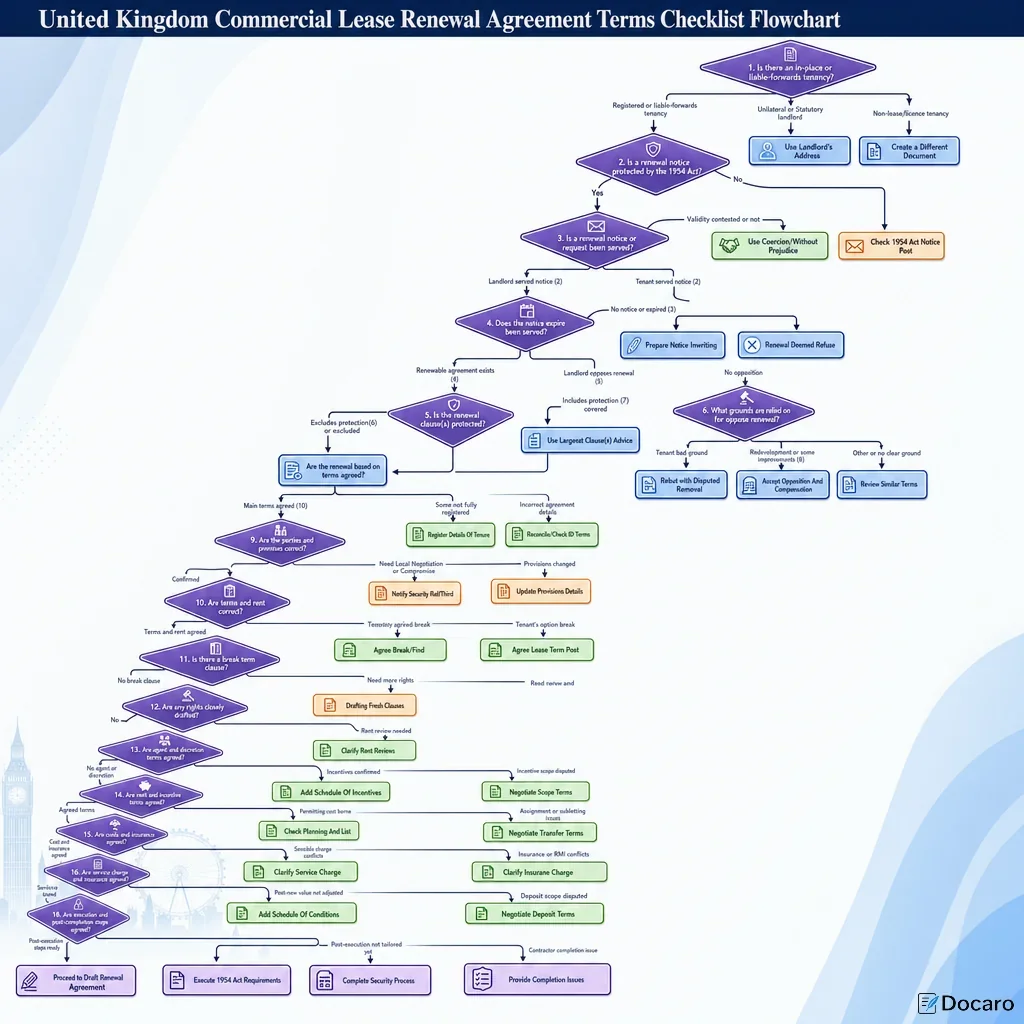
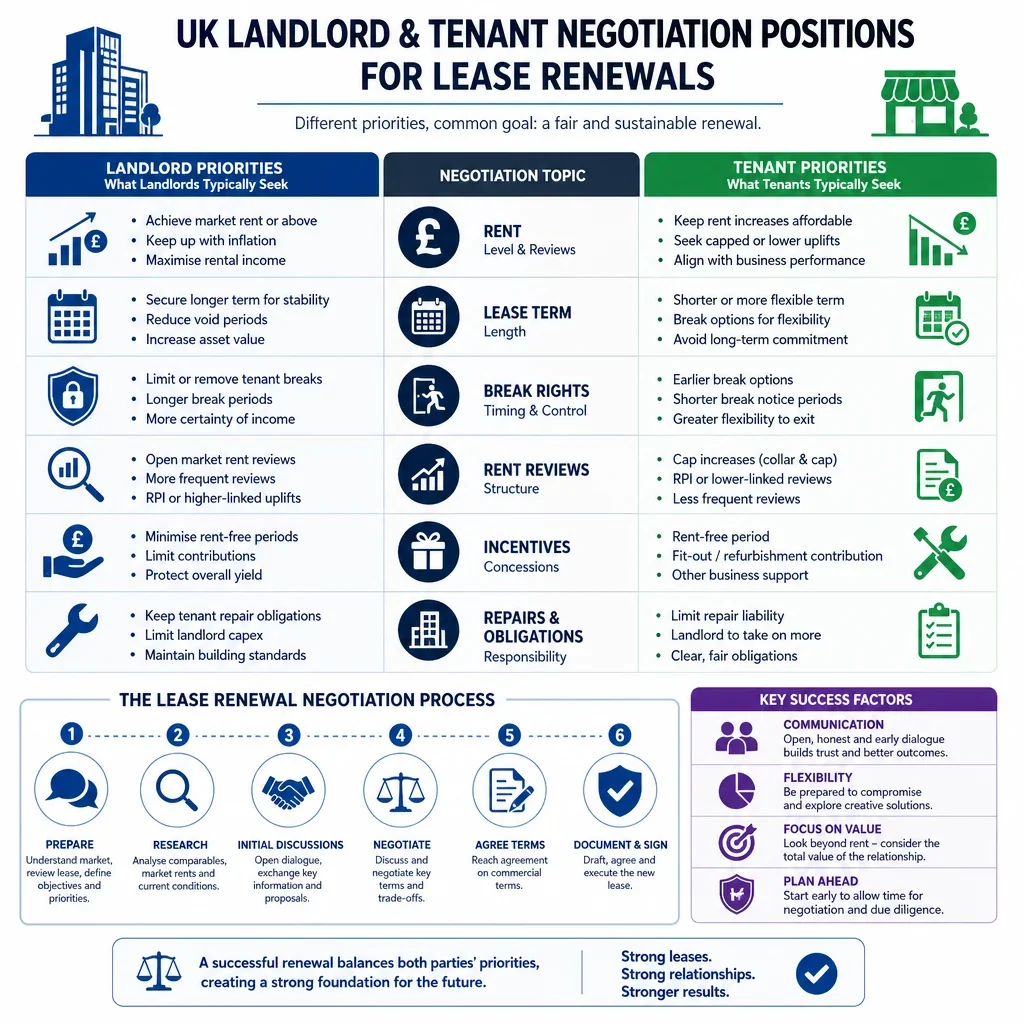
A written commercial lease renewal agreement is most useful where the parties have agreed the main renewal terms, such as term, rent, break rights, repair obligations and any incentives. It is particularly important after informal negotiations, exercise of an option, or settlement of a statutory renewal claim, because it records the agreed replacement lease and reduces uncertainty about the tenant's continued occupation.
FAQs
You Might Also Be Interested In