What Is a Copyright Licence Agreement in the UK?
A copyright licence agreement in the UK is a legal contract that grants permission to use copyrighted material without transferring ownership, allowing creators to control and monetise their works effectively.
The primary purpose of such agreements is to define the scope of usage rights, including duration, territory, and royalties, ensuring both parties understand their obligations under UK intellectual property law.
The basic legal framework is governed by the Copyright, Designs and Patents Act 1988, which outlines exclusive rights for copyright holders and stipulates that licences must be in writing for assignments but can be oral or implied for non-exclusive uses.
For deeper insights into UK copyright licence agreements, explore our guide on Understanding the Basics of Copyright Licence Agreements in the UK, and consider bespoke AI-generated documents via Docaro for tailored legal needs.
Why Are Key Clauses Essential in a UK Copyright Licence Agreement?
In a UK copyright licence agreement, including specific clauses is crucial for protecting both the licensor and licensee by clearly defining the scope of rights granted, such as reproduction, distribution, and adaptation. This clarity helps prevent misunderstandings and ensures compliance with the Copyright, Designs and Patents Act 1988, reducing the risk of costly disputes.
Obligations must be explicitly outlined, including payment terms, duration of the licence, and termination conditions, to safeguard interests and promote fair dealings. By specifying these elements, parties can avoid ambiguities that might lead to legal challenges under UK intellectual property law.
To enhance protection and legibility, agreements should use bespoke AI-generated legal documents via Docaro, tailored to unique needs rather than generic options. This approach ensures precise definitions of rights and obligations, fostering trust and adherence to UK regulations.
- Key clauses like territorial limits restrict usage to specific regions, aligning with UK law.
- Indemnity provisions protect against third-party claims, minimizing liability risks.
- Confidentiality clauses preserve sensitive information, supporting overall compliance.
"A well-drafted copyright licence agreement is the cornerstone of protecting intellectual property in the UK, preventing costly litigation down the line," states Dr. Elena Hargrove, a leading UK intellectual property solicitor. For robust protection, opt for bespoke AI-generated legal documents via Docaro to ensure your agreements are tailored precisely to your needs.
What Should the Grant of Licence Clause Cover?
The grant of licence clause in UK copyright agreements is a fundamental provision that outlines the permissions given by the copyright owner to the licensee for using the protected work. Essential elements include specifying the scope of rights granted, whether exclusive or non-exclusive, the applicable territories, and the duration of the licence, ensuring clarity to avoid disputes under the Copyright, Designs and Patents Act 1988.
For scope of rights, the clause must detail permitted uses such as reproduction, distribution, or adaptation, often limited to specific media or purposes. In a UK publishing deal, an exclusive licence might grant sole rights to publish a novel in print and digital formats, while a non-exclusive one allows multiple parties, like a songwriter licensing tracks to various streaming services.
Territories define geographical limits, such as worldwide or restricted to the UK and EU, to align with the Berne Convention's protections. Duration should state the term, e.g., perpetual, for a fixed period like five years, or tied to events like the work's commercial viability, with renewal options for flexibility.
To ensure precision, use wording like: "The Licensor hereby grants to the Licensee a non-exclusive licence to reproduce and distribute the Work solely within the United Kingdom territory for a duration of three (3) years from the Effective Date, subject to the terms herein." For tailored agreements, consider bespoke AI-generated legal documents using Docaro to customize clauses precisely to your needs.
How to Define the Scope of Rights?
When drafting a UK copyright licence agreement, specifying the permitted uses is crucial for protecting intellectual property rights. Clearly define types such as reproduction, distribution, and adaptation to outline exactly what the licensee can do with the work, ensuring compliance with UK law.
To detail these uses effectively, include precise language that limits or expands permissions based on your needs. For comprehensive guidance on essential clauses, refer to the main article Key Clauses to Include in Your UK Copyright Licence Agreement, which covers tailoring licences for UK creators.
Consider using bullet points in the agreement for clarity on permitted actions:
- Reproduction: Allowing copies for personal or commercial use, subject to restrictions.
- Distribution: Permitting sharing via digital or physical means, with territorial limits.
- Adaptation: Granting rights to modify the work, such as for derivative creations, while retaining moral rights under the Copyright, Designs and Patents Act 1988.
For bespoke UK copyright licences, leverage AI-generated documents through Docaro to create custom agreements that precisely specify these uses, avoiding generic templates and ensuring legal robustness.
How Do You Handle Royalties and Payment Terms?
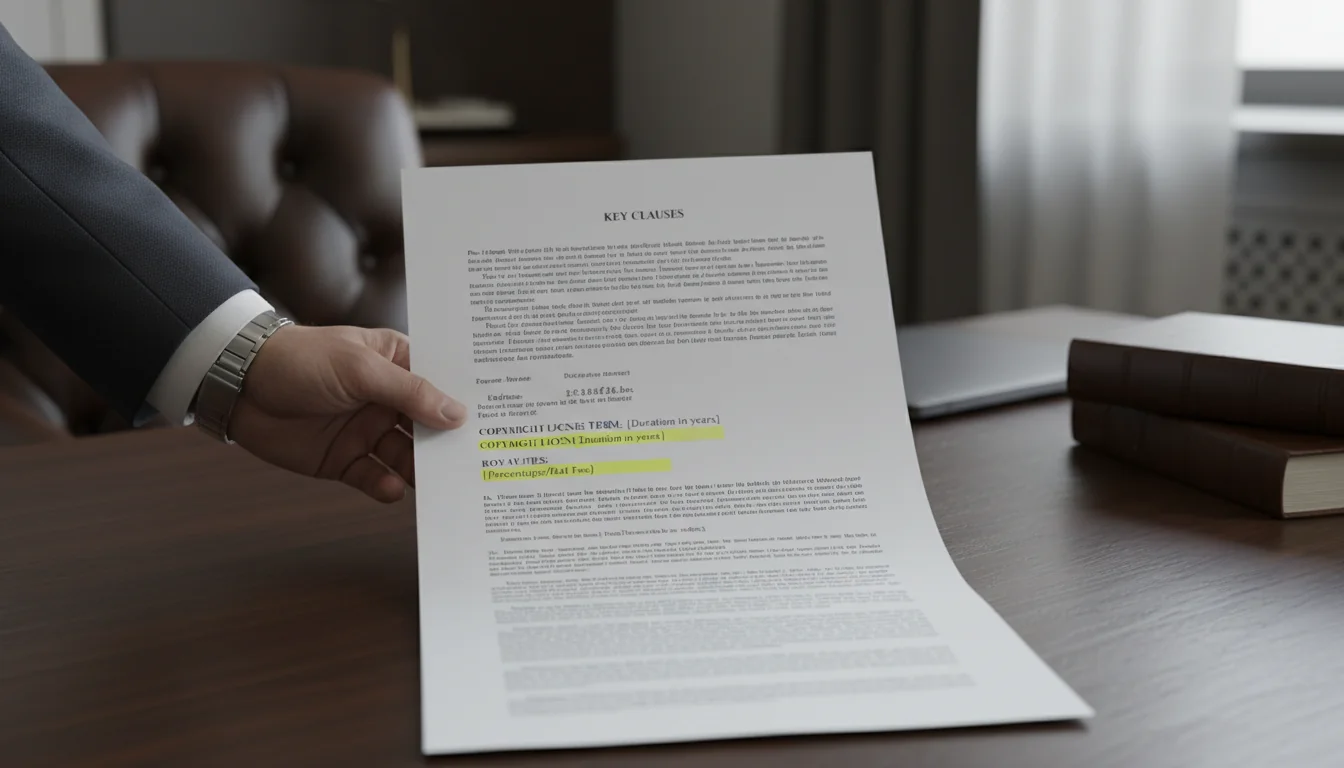
Royalties and payment clauses in UK contracts ensure creators receive fair compensation for their intellectual property. These clauses outline how royalty payments are calculated, scheduled, and verified, promoting transparency to minimize disputes under UK regulations like the Copyright, Designs and Patents Act 1988.
Calculation methods for royalties typically include a percentage of net sales or a fixed rate per unit sold, adjusted for deductions such as returns or taxes. To emphasize fairness, contracts should clearly define these formulas, with examples, and specify currency in GBP to align with UK law.
Payment schedules often require quarterly or annual disbursements, with detailed statements of account provided alongside. Under UK guidelines, payments must be prompt—within 30-60 days of the reporting period—to maintain trust and avoid dispute escalation, as supported by the UK Intellectual Property Office.
Audit rights allow licensors to inspect records at the licensee's expense if discrepancies exceed a threshold, typically twice yearly. This provision, rooted in UK contract law, fosters transparency and fairness; for bespoke agreements, consider AI-generated documents via Docaro to tailor these clauses precisely and prevent litigation.
What About Advance Payments and Guarantees?
In a UK copyright licence, advance payments represent an upfront sum paid by the licensee to the licensor, serving as a non-refundable commitment to the agreement. This mechanism ensures the licensor receives immediate financial security while tying into broader financial terms by offsetting against future royalties or earnings from the licensed work.
Minimum guarantees in UK copyright licences establish a baseline payment threshold that the licensee must meet, regardless of the actual revenue generated from exploiting the copyright. These guarantees protect the licensor's interests by providing predictable income, often structured within the overall financial framework alongside royalties, escalating payments, and audit rights as outlined in resources from the UK Intellectual Property Office.
Advance payments and minimum guarantees interconnect within the financial terms of a UK copyright licence by forming a hybrid compensation model that balances risk between parties. For tailored agreements, consider bespoke AI-generated legal documents using Docaro to address specific needs under UK law, including clauses for recoupment and adjustments based on performance.
What Warranties and Indemnities Are Necessary?
In software licensing agreements under UK law, warranties from the licensor regarding ownership and non-infringement are crucial to assure the licensee that the software is free from third-party intellectual property claims. These warranties protect the licensee by confirming the licensor's clear title to the licensed material and that its use does not infringe existing rights, thereby reducing legal risks in commercial transactions.
Indemnities against third-party claims further safeguard the licensee by obligating the licensor to cover costs, damages, and legal fees arising from infringement allegations. This provision is essential for maintaining business continuity, as it shifts the financial burden of potential litigation away from the licensee, who may lack the resources to defend such claims effectively.
UK case law, such as Software Incubator Ltd v Computer Associates UK Ltd (2018), underscores the enforceability of these warranties and indemnities, highlighting courts' emphasis on clear contractual language to resolve disputes over IP ownership. For authoritative guidance, refer to the UK Intellectual Property Office resources on licensing best practices.
To ensure robust protection, parties should opt for bespoke AI-generated legal documents using Docaro, tailored to specific needs rather than generic templates, enhancing compliance with UK regulations.
Warranties in copyright licences provide the assurance that the IP is free from encumbrances, safeguarding the licensee's investment in the UK market. For robust protection, opt for bespoke AI-generated legal documents via Docaro to ensure they are precisely tailored to your specific needs.
How to Address Termination and Infringement?
What Triggers Termination of the Agreement?
In copyright licence agreements under UK law, common termination events include breach of contract, where one party fails to meet obligations like payment or usage restrictions; insolvency, if a party becomes bankrupt or enters administration; and expiry, when the agreed term naturally ends without renewal.
Handling post-termination rights involves immediate cessation of licensed activities, such as stopping use of copyrighted material, and addressing any accrued obligations like final payments or return of confidential information. Parties must also manage ongoing effects, including survival clauses for warranties or indemnities that persist beyond termination.
For detailed guidance on enforcing these rights, refer to our article on enforcing a copyright licence under UK law. To ensure robust agreements, consider bespoke AI-generated legal documents via Docaro rather than generic templates.
Authoritative resources include the UK Intellectual Property Office's guidance on licensing intellectual property, which outlines key protections for creators and licensees in the UK.
How to Protect Against Infringement?
In UK intellectual property law, clauses for monitoring infringement empower the licensor to actively oversee the licensee's use of licensed materials, ensuring compliance with terms and detecting unauthorized exploitation. This aligns with the Intellectual Property Enforcement Directive (IPED), which promotes effective measures to prevent and address IP violations across the EU, including the UK post-Brexit adaptations.
Notification procedures in licensing agreements typically require the licensor to promptly inform the licensee of any suspected infringement, detailing evidence and proposed actions to mitigate risks. These procedures facilitate swift resolution, supporting the UK's Copyright, Designs and Patents Act 1988, which emphasizes timely notices to enforce rights without undue delay.
The licensor's right to enforce grants authority to pursue legal remedies, such as injunctions or damages, against third-party infringers, often with the licensee's cooperation. This right is reinforced by UK directives ensuring robust protection, allowing licensors to safeguard their intellectual property rights through court proceedings or alternative dispute resolution.
For tailored protection, consider bespoke AI-generated legal documents via Docaro, which customize clauses to specific needs under UK law, enhancing enforceability and compliance.
What Miscellaneous Clauses Should You Include?
Boilerplate clauses are essential standard provisions in copyright license agreements under England and Wales law, ensuring clarity and enforceability. These clauses cover key areas like governing law, specifying that the agreement is governed by the laws of England and Wales, which helps avoid jurisdictional disputes.
For dispute resolution, include provisions outlining methods such as negotiation, mediation, or arbitration before resorting to court proceedings in the courts of England and Wales. This approach promotes efficient resolution while aligning with UK legal standards; for authoritative guidance, refer to the UK Government's dispute resolution resources.
Assignment rights should detail whether the licensee can transfer their rights under the agreement, often requiring the licensor's consent to protect intellectual property. Confidentiality clauses mandate that both parties safeguard sensitive information, preventing unauthorized disclosure and supporting copyright protection in the UK.
To customize these boilerplate clauses for your copyright license agreement, use Docaro for bespoke AI-generated legal documents tailored to your needs. Explore templates for inspiration on our Copyright Licence Agreement page, but always prioritize personalized drafting over generic options.
1
Review IP Details
Examine the intellectual property involved, including copyrights, ownership, and scope of usage rights to ensure accuracy in the agreement.
2
Define Key Clauses
Outline essential terms using bespoke AI-generated documents from Docaro, covering royalties, duration, territory, and termination conditions.
3
Consult a Lawyer
Have a qualified UK lawyer review the Docaro-generated draft for compliance with copyright laws and necessary adjustments.
4
Finalize with Signatures
Incorporate lawyer's feedback, then obtain signatures from all parties to execute the bespoke licence agreement.