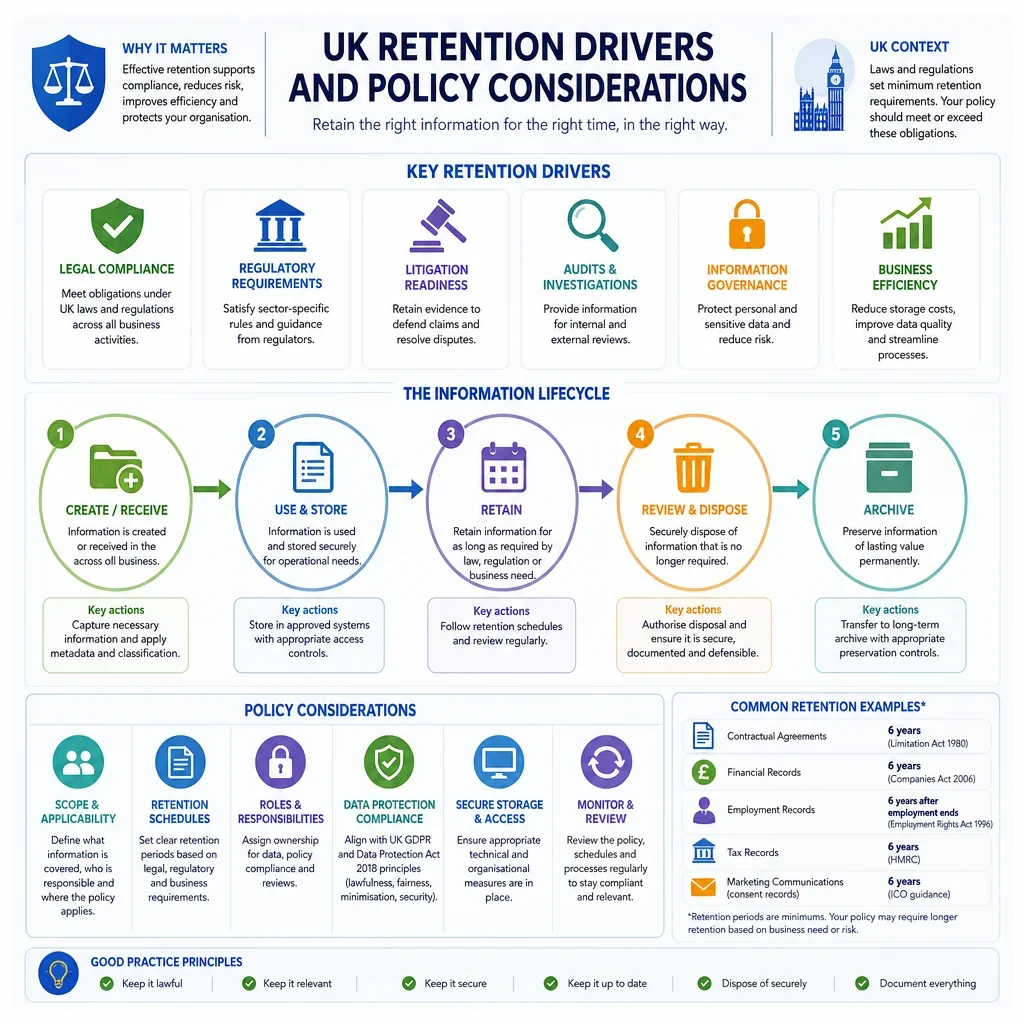
UK Retention Drivers And Policy Considerations
Basis for Retention | Relevant Record Types | Policy Relevance | Typical Retention Impact | Practical Importance |
|---|---|---|---|---|
Legal obligation | ||||
UK GDPR storage limitation principle | All personal data records | Requires justified, time-limited retention of personal data. | No fixed period retain only as necessary. | High |
Data Protection Act 2018 compliance | Personal data, special category data, criminal offence data | Supports lawful handling, retention limits and accountability. | Varies by lawful purpose and sector. | High |
Legal obligation, Audit or assurance | ||||
UK GDPR accountability evidence | RoPA, DPIAs, policies, consent records, breach logs | Requires evidence that privacy duties were met. | Usually retained while processing continues plus audit period. | High |
Record of processing activities | Article 30 processing records and data maps | Retention schedule should reflect processing purposes and owners. | Keep current and archive superseded versions briefly. | High |
Personal data breach documentation | Breach registers, investigation files, notifications | Requires retention of breach facts, effects and remedial action. | Often 6 years or longer for serious incidents. | High |
Legal obligation, Dispute or claims management | ||||
Data subject rights request evidence | SAR files, identity checks, response logs, exemptions | Preserves evidence of timely and lawful responses. | Often 2 to 6 years after closure. | Medium |
Legal obligation, Regulatory requirement | ||||
Marketing consent and PECR compliance | Consent logs, suppression lists, marketing preferences | Needs proof of consent and ongoing suppression. | Keep consent while relied on suppressions may be indefinite. | High |
Dispute or claims management | ||||
Simple contract limitation period | Contracts, orders, invoices, correspondence, delivery records | Supports defence or enforcement of ordinary contract claims. | 6 years from breach or contract end. | High |
Deed or specialty limitation period | Deeds, guarantees, leases, settlement deeds, security documents | Longer claim window requires longer document retention. | 12 years from breach or termination. | High |
Tort claim limitation period | Incident files, advice records, product records, service logs | Retains evidence for negligence and civil wrong claims. | Usually 6 years, subject to special rules. | High |
Personal injury claim limitation | Accident reports, risk assessments, training and PPE records | Injury claims may arise after incident or knowledge date. | At least 3 years often longer for defence. | High |
Latent damage longstop | Professional advice, design, construction and engineering files | Hidden defects can extend practical evidence needs. | Up to 15 years longstop in negligence. | High |
Dispute or claims management, Legal obligation | ||||
Litigation hold or preservation duty | Potentially relevant documents, emails, chats, logs and backups | Suspends deletion where proceedings or disclosure are likely. | Until dispute and appeal risk end. | High |
Legal obligation | ||||
Corporation tax records | Company tax returns, calculations, ledgers, receipts | Tax evidence must be available for HMRC enquiries. | Normally 6 years from financial year end. | High |
Companies Act accounting records | Accounting records, invoices, receipts, asset records | Companies must retain accounting records for statutory periods. | Private companies 3 years public companies 6 years. | High |
VAT recordkeeping | VAT invoices, returns, credit notes, import and export records | VAT evidence must support returns and inspections. | Usually 6 years. | High |
Legal obligation, Regulatory requirement | ||||
Making Tax Digital records | Digital VAT records and digital links | Requires retention in compliant digital form. | Aligns with VAT retention, usually 6 years. | High |
Legal obligation | ||||
PAYE payroll records | PAYE records, tax codes, payments, deductions, reports | HMRC requires payroll evidence after tax year end. | 3 years from tax year end. | High |
National Minimum Wage records | Pay calculations, hours, rates, deductions, worker records | Evidence needed for wage compliance and HMRC enforcement. | At least 6 years for records after April 2021. | High |
Working time records | Hours records, opt-outs, night work, rest records | Shows compliance with working time limits and obligations. | 2 years from creation. | High |
Right to work check evidence | Right to work copies, online check confirmations | Evidence supports statutory excuse against civil penalties. | Employment duration plus 2 years. | High |
Regulatory requirement, Legal obligation | ||||
Sponsor licence recordkeeping | Sponsored worker documents, contact details, absence records | Sponsor compliance depends on available worker records. | Follow Home Office guidance often employment plus audit period. | High |
Dispute or claims management | ||||
Employment tribunal claim risk | Personnel files, grievance, disciplinary and dismissal records | Short tribunal limits still require evidence retention. | Often 6 years after employment ends. | High |
Equality Act claim risk | Recruitment, promotion, pay, grievance and adjustment records | Supports defence of discrimination and equal pay claims. | Often 6 to 7 years for employment evidence. | High |
Legitimate business need, Dispute or claims management | ||||
Recruitment decision evidence | Applications, CVs, interview notes, shortlists, test results | Balances discrimination claim defence against data minimisation. | Usually 6 to 12 months longer with consent or dispute. | Medium |
Legal obligation, Dispute or claims management | ||||
Health and safety compliance evidence | Risk assessments, training, inspections, maintenance, PPE records | Evidence demonstrates compliance and supports injury claim defence. | Often 3 to 6 years longer for hazardous exposure. | High |
Accident book records | Accident book entries and workplace incident records | Supports statutory accident recording and injury claim handling. | At least 3 years from entry. | High |
Legal obligation | ||||
RIDDOR reports | Reportable injuries, diseases and dangerous occurrence records | Requires traceable records of reportable workplace events. | At least 3 years. | High |
COSHH health surveillance records | Exposure records, health surveillance, medical records | Long-latency occupational disease evidence needs long retention. | Health records commonly 40 years. | High |
Asbestos exposure records | Asbestos exposure, medical surveillance and monitoring records | Very long latency disease risk requires extended retention. | Medical records 40 years exposure records often 40 years. | High |
Legal obligation, Dispute or claims management | ||||
Employers liability insurance certificates | Employers liability insurance certificates and policies | Helps identify insurer for historic workplace injury claims. | Indefinite retention recommended for older liabilities. | High |
Legal obligation | ||||
Fire safety risk assessment records | Fire risk assessments, drills, alarm tests, maintenance logs | Proves fire safety management and review history. | Keep current and superseded versions for several years. | High |
Statutory company registers | Registers of members, directors, secretaries and PSCs | Core legal evidence of ownership and company administration. | Long-term some registers effectively permanent. | High |
Legal obligation, Audit or assurance | ||||
Company minutes and resolutions | Board minutes, shareholder resolutions, written resolutions | Records corporate decisions and authority. | At least 10 years often permanent for key decisions. | High |
Annual accounts and audit trail | Annual accounts, directors reports, audit reports | Supports statutory filing, audit and stakeholder review. | Usually 6 years or longer for corporate history. | High |
Legal obligation, Regulatory requirement | ||||
AML customer due diligence records | CDD, KYC, transaction records, risk assessments, SAR records | Regulated firms must retain AML evidence for inspection. | 5 years after relationship or transaction ends. | High |
Suspicious activity report handling | Internal reports, MLRO decisions, SAR submissions, consent requests | Needs secure retention and strict access controls. | Usually at least 5 years under AML controls. | High |
UK sanctions compliance evidence | Screening results, licences, frozen asset reports, decisions | Supports OFSI reporting, licensing and enforcement response. | Often 6 years or longer for regulated firms. | High |
Regulatory requirement, Audit or assurance | ||||
FCA regulated firm records | Client files, advice records, compliance monitoring, complaints | FCA rules often prescribe record retention by activity. | Commonly 5 years, 6 years, or indefinite depending record. | High |
Regulatory requirement, Dispute or claims management | ||||
Financial services complaint records | Complaint files, final responses, redress calculations | Firms must evidence complaint handling and outcomes. | At least 3 years or 5 years depending activity. | High |
Regulatory requirement | ||||
MiFID investment services records | Orders, transactions, communications, client instructions | Investment firms need reconstructable transaction evidence. | Often 5 years up to 7 years if requested. | High |
Legal obligation, Regulatory requirement | ||||
Pension scheme administration records | Member data, contributions, benefit calculations, trustee records | Members may need evidence decades after employment. | Long-term, often member lifetime plus years. | High |
Automatic enrolment pension records | Assessment, opt-out, contributions and enrolment records | Employers must prove pension duties were met. | Usually 6 years opt-out notices 4 years. | High |
Charity accounting records | Charity accounts, trustees minutes, donations, grants | Charities must evidence stewardship and reporting compliance. | Usually 6 years 3 years for some smaller charities. | High |
Legal obligation | ||||
Gift Aid declaration records | Gift Aid declarations, donor details, claim schedules | HMRC may check charity tax relief claims. | 6 years after last claimed donation. | High |
Legal obligation, Regulatory requirement | ||||
Public records management code | Public authority administrative and operational records | Public bodies need structured appraisal, retention and transfer. | Varies includes transfer or destruction schedules. | High |
Legal obligation, Audit or assurance | ||||
Freedom of Information request records | FOI requests, searches, exemptions, responses, review files | Public authorities need audit trail of request handling. | Often 3 to 6 years after closure. | Medium |
Environmental information request records | EIR requests, environmental datasets, responses, exemptions | Public bodies need evidence of access request compliance. | Often 3 to 6 years after closure. | Medium |
Regulatory requirement, Audit or assurance | ||||
NHS records management code | Health records, social care records, administrative records | Sets sector-specific health and care retention schedules. | Varies widely many health records 8 years or longer. | High |
Legal obligation, Legitimate business need, Dispute or claims management | ||||
Safeguarding records | Child protection concerns, referrals, incident logs, case files | Records may be needed for future safeguarding or inquiries. | Often until age 25 or longer serious cases longer. | High |
Legal obligation, Legitimate business need | ||||
School pupil records | Pupil files, attendance, SEN, safeguarding, assessment records | Schools need sector schedules for pupil lifecycle records. | Often until age 25 for core pupil files. | High |
Legal obligation, Regulatory requirement | ||||
Building safety golden thread | Building design, safety case, approvals, change records | Higher-risk building information must be accurate and available. | For building lifecycle and occupation period. | High |
Legal obligation | ||||
CDM health and safety file | Health and safety file, design risk information, maintenance data | File must be available for future works and maintenance. | For life of structure or project relevance. | High |
Legal obligation, Dispute or claims management | ||||
Product safety traceability | Batch records, technical files, test reports, recalls | Supports recalls, safety investigations and liability defence. | Often product lifecycle plus 10 years or more. | High |
Legal obligation, Contractual requirement, Dispute or claims management | ||||
Consumer rights and warranty claims | Sales records, warranties, returns, refunds, complaint correspondence | Evidence supports statutory consumer remedies and disputes. | Usually up to 6 years for claims. | High |
Contractual requirement, Dispute or claims management, Legitimate business need | ||||
Insurance claim and coverage evidence | Policies, claims files, notifications, loss adjuster reports | Records prove coverage, notification and claim value. | Policy term plus limitation period long-tail claims longer. | High |
Legitimate business need, Contractual requirement, Dispute or claims management | ||||
Intellectual property ownership evidence | Assignments, licences, invention records, design files, brand use | Preserves proof of ownership, use and licensing rights. | Life of IP right plus limitation period. | High |
Property title and lease evidence | Title deeds, leases, licences, rent reviews, surveys | Records evidence property rights and occupation obligations. | Ownership or lease term plus 12 years for deeds. | High |
Legal obligation, Audit or assurance, Dispute or claims management | ||||
Public procurement audit trail | Tender documents, evaluation scores, award decisions, contracts | Supports transparency, challenge defence and audit review. | Usually contract term plus 6 years deeds 12 years. | High |
Contractual requirement, Audit or assurance | ||||
Grant funding terms | Grant agreements, claims, evidence, outputs, monitoring reports | Funders often impose audit and clawback record duties. | Often 6 years after grant closure terms may vary. | Medium |
Audit or assurance, Regulatory requirement | ||||
Audit working papers | Audit files, testing evidence, management letters, confirmations | Auditors and organisations need evidence of assurance work. | Often at least 5 to 6 years. | Medium |
Audit or assurance, Legitimate business need | ||||
Internal audit and risk assurance | Internal audit reports, risk registers, control testing | Shows governance, control improvements and assurance history. | Often 6 years, longer for major findings. | Medium |
Legitimate business need, Audit or assurance, Dispute or claims management | ||||
Cyber incident and security logging | Security logs, SIEM alerts, incident tickets, forensic images | Retention must support detection, investigation and breach evidence. | Often 6 to 12 months for logs incidents longer. | High |
Contractual requirement, Audit or assurance, Legitimate business need | ||||
ISO management system evidence | Policies, risk assessments, audit results, corrective actions | Certification audits require controlled documented information. | Certification cycle plus evidence period, often 3 years. | Medium |
Legitimate business need, Dispute or claims management | ||||
Customer complaint handling | Complaints, responses, refunds, remedial action, correspondence | Supports trend analysis, service improvement and dispute defence. | Usually 2 to 6 years depending claim risk. | Medium |
Contractual requirement, Legitimate business need, Dispute or claims management | ||||
Supplier contract management | Supplier contracts, SLAs, due diligence, performance reviews | Records prove obligations, performance and termination rights. | Contract term plus 6 years deeds 12 years. | High |
Legal obligation, Contractual requirement, Audit or assurance | ||||
Processor contract and due diligence records | DPAs, SCCs, due diligence, audits, subprocessors | Shows compliant outsourcing and processor oversight. | Contract term plus limitation period. | High |
Legal obligation, Audit or assurance | ||||
International data transfer evidence | IDTAs, SCCs, transfer risk assessments, safeguards | Demonstrates lawful restricted transfers and safeguards. | While transfer continues plus audit period. | High |
Legal obligation, Dispute or claims management, Legitimate business need | ||||
Whistleblowing report records | Disclosure reports, investigation files, outcomes, retaliation evidence | Requires secure retention for investigation and employment claims. | Often 6 years after closure longer if serious. | High |
Legal obligation, Dispute or claims management, Audit or assurance | ||||
Fraud and bribery investigation evidence | Investigation files, gifts registers, due diligence, approvals | Evidences prevention procedures and investigation response. | Often 6 years serious matters longer. | High |
Legal obligation, Audit or assurance | ||||
Modern slavery compliance records | Statements, supplier due diligence, risk assessments, training | Supports transparency statement and supply chain assurance. | Often 6 years for audit trail. | Medium |
Legal obligation, Regulatory requirement | ||||
Environmental permit compliance records | Monitoring results, waste transfers, emissions, permit reports | Permit conditions may require specific retention and reporting. | Often 6 years permit conditions may differ. | High |
Legal obligation | ||||
Waste transfer notes | Waste transfer notes and waste descriptions | Shows lawful transfer and duty of care compliance. | At least 2 years. | Medium |
Hazardous waste consignment notes | Consignment notes and hazardous waste returns | Evidence supports hazardous waste duty of care. | Usually 3 years. | Medium |
Legal obligation, Audit or assurance | ||||
ESOS compliance evidence | Energy audits, calculations, lead assessor records, notifications | Qualifying organisations need evidence for compliance audits. | At least 2 compliance periods recommended. | Medium |
Legal obligation, Regulatory requirement | ||||
Clinical trial master file retention | Trial master files, consent, protocol, safety reports, data | Research records must support inspection and participant safety. | Often at least 5 years longer for advanced therapies. | High |
Regulatory requirement, Legal obligation | ||||
Pharmacovigilance records | Adverse event reports, safety databases, signal assessments | Supports medicine safety monitoring and regulator inspection. | Long-term often product authorisation plus 10 years. | High |
Legal obligation, Regulatory requirement | ||||
Food safety traceability records | Supplier, batch, delivery, recall and HACCP records | Enables food traceability, withdrawals and recalls. | Depends product shelf life often 6 months to 5 years. | High |
Drivers hours and tachograph records | Tachograph data, duty rosters, drivers hours records | Transport operators must evidence drivers hours compliance. | At least 12 months working time records often 2 years. | High |
Regulatory requirement, Audit or assurance | ||||
Vehicle operator maintenance records | Inspection sheets, defect reports, maintenance and repair records | Operator licence compliance depends on maintenance evidence. | Often at least 15 months. | High |
Legal obligation, Regulatory requirement | ||||
Export control records | Export licences, end-user undertakings, shipping and screening records | Supports licence compliance and regulator inspection. | Often at least 4 years licence terms may vary. | High |
Legal obligation | ||||
Customs import and export records | Customs declarations, commercial invoices, shipping documents | HMRC may inspect trade and duty evidence. | Usually 4 years for customs records. | High |
Contractual requirement | ||||
Contractual retention clauses | Project records, deliverables, audit evidence, service reports | Customer or supplier contracts may set minimum periods. | As agreed commonly 6 or 7 years. | High |
Legitimate business need, Audit or assurance | ||||
Business continuity evidence | BCP plans, tests, incident logs, recovery reports | Records show resilience testing and response capability. | Often 3 to 6 years for test and incident evidence. | Medium |
Legitimate business need, Contractual requirement, Dispute or claims management | ||||
M&A and corporate transaction records | Due diligence, warranties, disclosure letters, completion bibles | Supports warranty, indemnity and ownership evidence. | Often 6 to 12 years or permanent for key records. | High |
Legal obligation, Dispute or claims management | ||||
Insolvency and restructuring evidence | Creditor files, board papers, transactions, forecasts, asset records | Supports investigations, creditor claims and director conduct review. | Often 6 years or longer after insolvency closure. | High |
Legal obligation, Contractual requirement | ||||
Employee share scheme tax records | Option grants, exercises, valuations, EMI notifications, returns | Supports tax reporting and employee entitlement evidence. | Often 6 years after tax year or scheme end. | Medium |
Legitimate business need, Legal obligation, Dispute or claims management | ||||
CCTV footage retention | CCTV footage, access logs, incident clips, disclosure logs | Retention should be short unless incident footage is needed. | Often 30 days incidents retained until resolved. | Medium |
Legitimate business need, Dispute or claims management | ||||
Physical security access logs | Visitor logs, badge records, door access logs | Retention should match security and investigation needs. | Often 3 to 12 months incidents longer. | Medium |
Legitimate business need, Legal obligation, Dispute or claims management | ||||
Worker monitoring evidence | Device logs, email monitoring, productivity and location records | Requires proportionate retention and clear privacy justification. | Short retention unless needed for investigation or compliance. | High |
Legitimate business need, Dispute or claims management, Audit or assurance | ||||
Email and collaboration record value | Emails, Teams or chat records, attachments, shared files | Retention should preserve records, not entire mailboxes unnecessarily. | Varies by content transitory messages short. | High |
Legitimate business need, Audit or assurance | ||||
Backup and disaster recovery copies | System backups, snapshots, archives, restore media | Backup cycles must not undermine deletion commitments. | Often 30 days to 12 months depending recovery needs. | High |
Legal obligation, Legitimate business need | ||||
Archiving, research and statistics exemption | Research datasets, anonymised analytics, statistical records | Longer retention may be allowed with safeguards and minimisation. | Potentially extended if safeguards and purpose limits apply. | Medium |
Regulatory requirement, Dispute or claims management, Legal obligation | ||||
Regulatory investigation hold | Notices, correspondence, evidence packs, investigation files | Deletion should pause when regulator enquiries are active. | Until enquiry closes plus appeal or limitation period. | High |
What Drives Record Retention Periods In The UK?
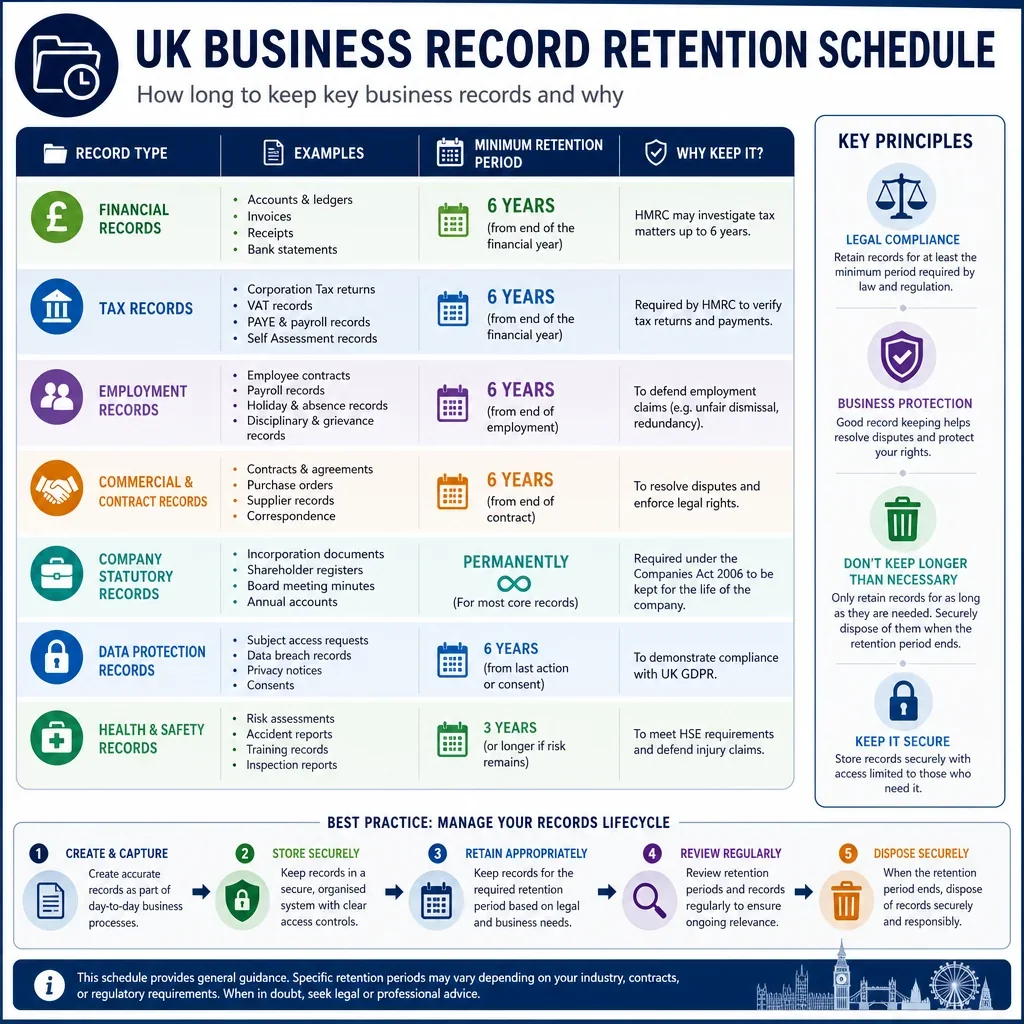
UK retention policies are usually driven by a combination of limitation periods, tax and accounting duties, employment law, sector regulation, and data protection storage limitation. The strongest practical anchors are often 6 years for ordinary contract claims and many tax/accounting records, 12 years for deeds and specialty contracts, and longer periods for health and safety, pensions, safeguarding, regulated financial services, and corporate constitutional records.
How Should A UK Retention Policy Balance GDPR And Legal Hold Requirements?
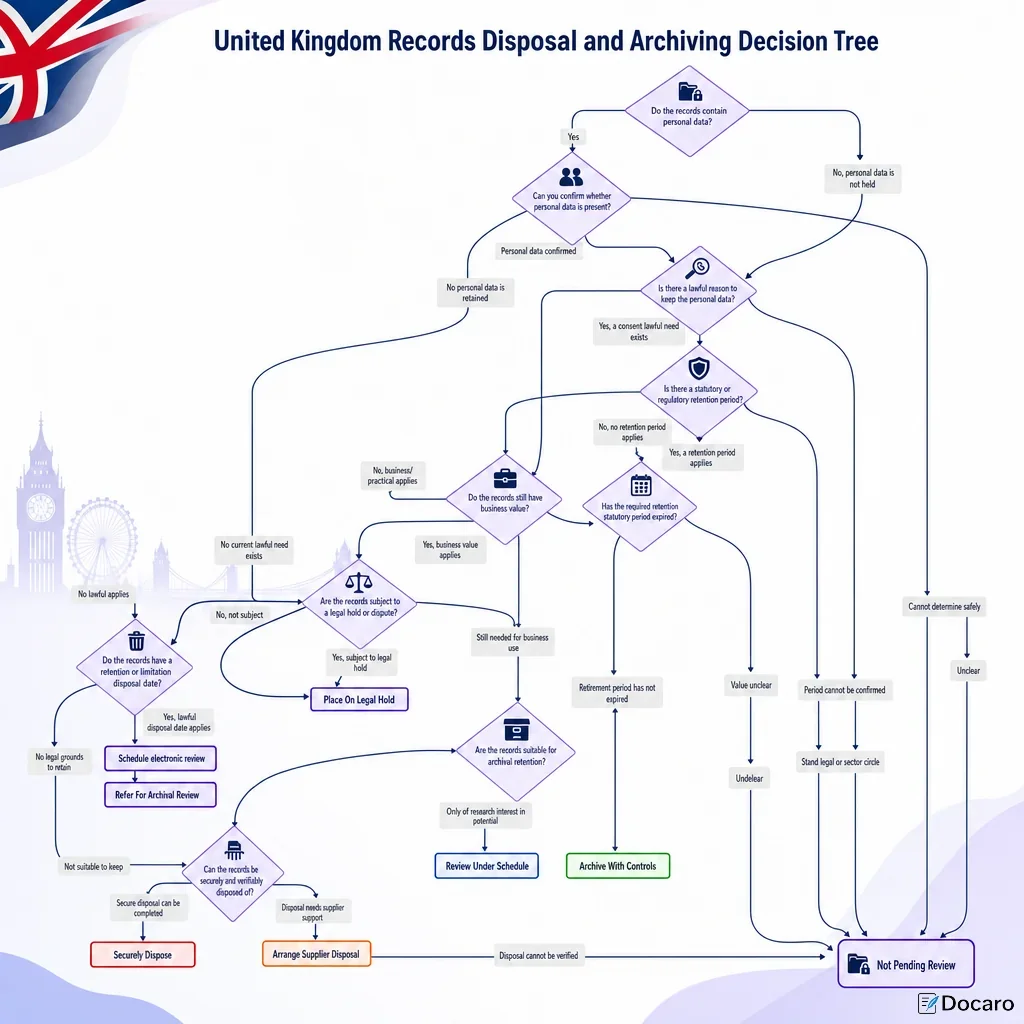
The UK GDPR does not prescribe fixed retention periods, but it requires personal data to be kept no longer than necessary. A policy should therefore identify the specific driver for each record category, set a default deletion point, and include a legal hold override where litigation, regulatory investigation, audit, insurance notification, or a subject access request requires preservation.
Which Records Commonly Need Longer Retention?
- Company registers, constitutional records, board approvals and major transaction records may need long-term or permanent retention because they evidence corporate existence, authority and ownership.
- Tax, VAT, PAYE, payroll and accounting records commonly require at least 6 years, with special rules for some VAT and tax situations.
- Employment, health and safety, accident, exposure, pension and safeguarding records may need extended retention because claims can arise years later and statutory or regulatory expectations may be lengthy.
- Regulated financial services, anti-money laundering and sanctions records should reflect FCA, AML and UK sanctions requirements, not only general commercial limitation periods.
What Should Be Documented In A Data Retention Policy?
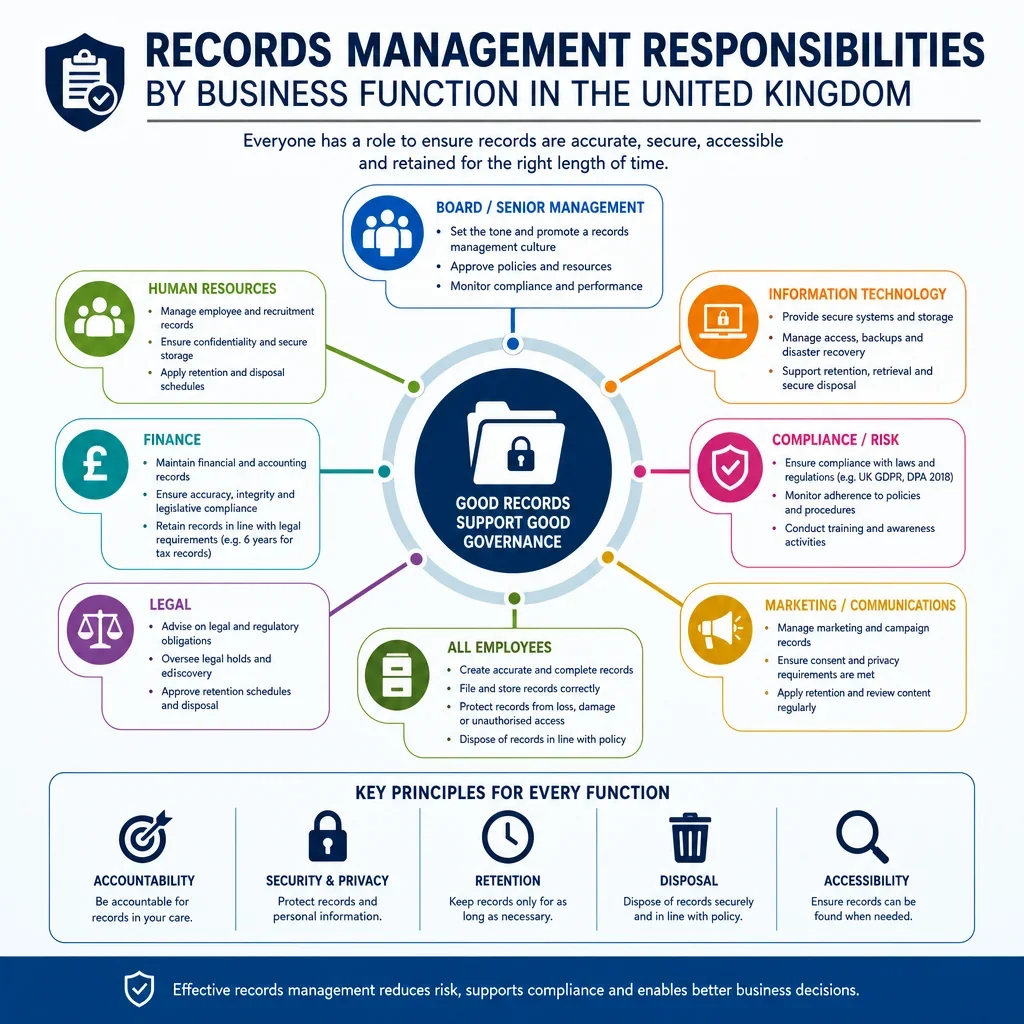
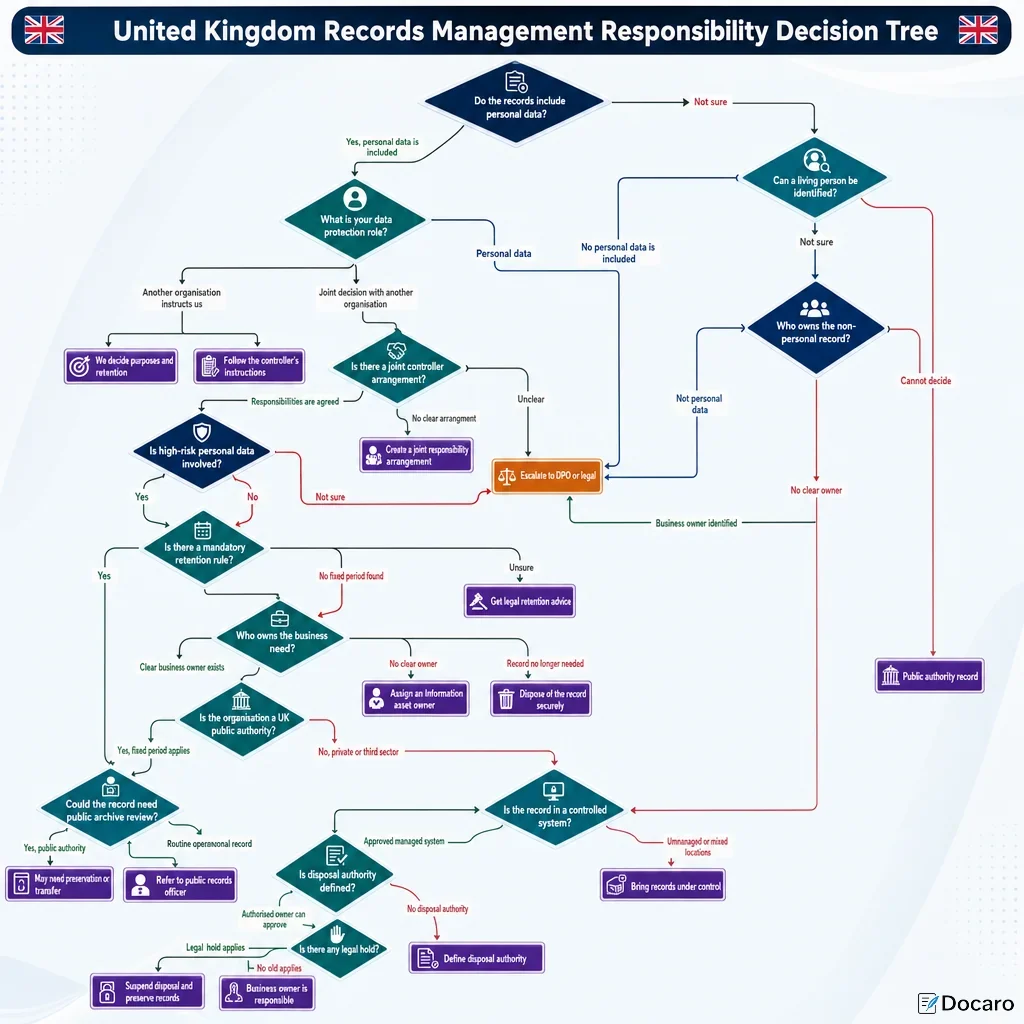
A strong UK policy should map each record type to a retention basis, retention period, trigger date, owner, disposal method, and exceptions. It should also explain how the organisation handles archived records, back-ups, litigation holds, statutory registers, audit trails, and personal data minimisation.
FAQs
You Might Also Be Interested In