

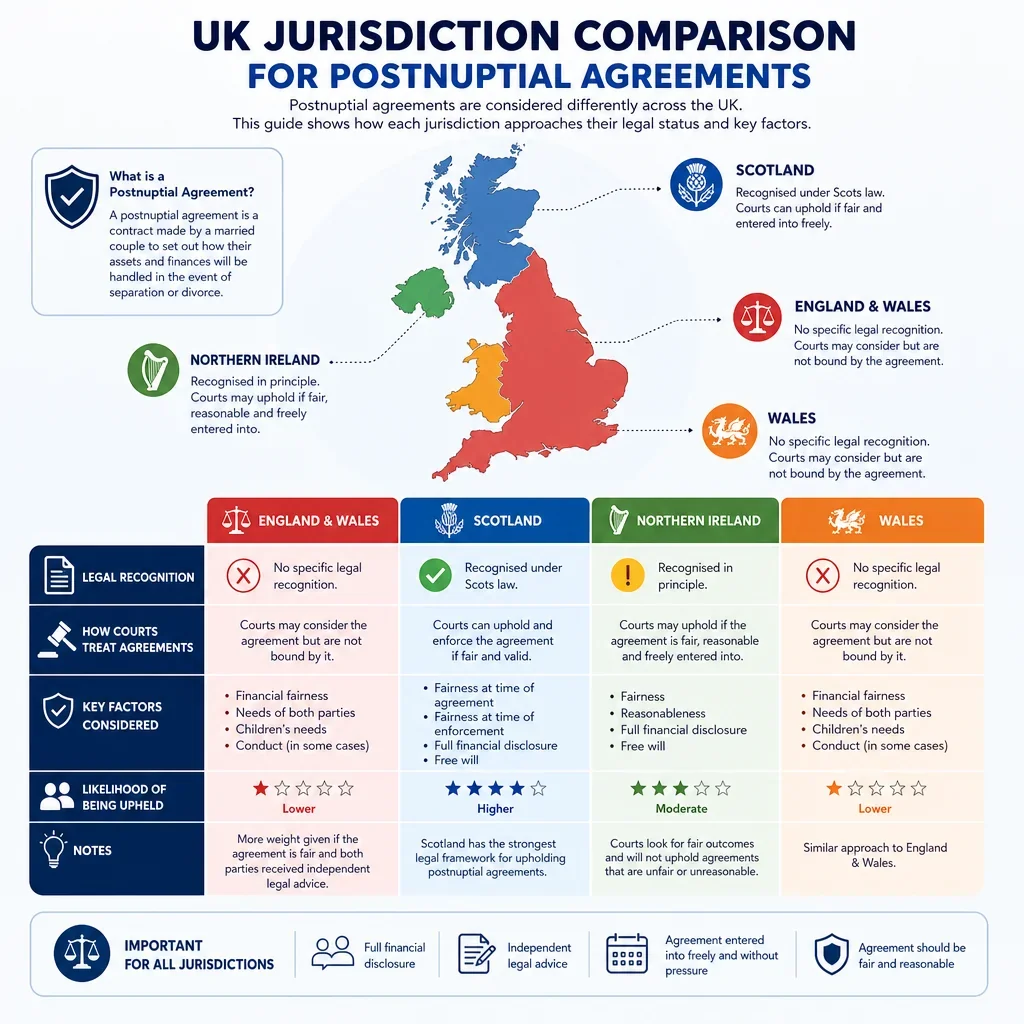
UK Jurisdiction Comparison For Postnuptial Agreements
Created:
This guide helps you compare how postnuptial agreements are treated across UK jurisdictions, so you can understand key legal differences before planning next steps. It is especially useful alongside our AI Generated British Postnuptial Agreement resources.
General approach | Relevant factors | Independent advice note | Disclosure expectations | Practical notes |
|---|---|---|---|---|
England and Wales | ||||
Postnuptial agreements are not automatically binding, but courts may give decisive weight to nuptial agreements freely entered into with full appreciation unless it would be unfair. | Freedom from pressure, understanding of consequences, fairness at outcome, child welfare, needs, compensation and sharing principles. | Strongly recommended it helps prove informed consent and reduces arguments about exploitation, misunderstanding or undue pressure. | Full and frank disclosure of assets, debts, income, pensions, business interests and foreseeable future resources is expected. | Record disclosure in schedules, allow time for advice and review terms after major events such as children, illness or relocation. |
The court decides financial remedies under statutory factors and cannot be forced to approve an unfair postnuptial agreement. | Section 25 factors include welfare of minor children, income, earning capacity, property, needs, standard of living, age, marriage duration and contributions. | Recommended because the court will examine whether each party understood the agreement against the background of statutory financial claims. | Disclosure should be broad enough for each party to compare the agreement with likely statutory claims. | Draft with the section 25 checklist in mind and explain why the outcome meets needs and is fair. |
A postnuptial agreement cannot override the court's duty to give first consideration to the welfare of any minor child of the family. | Housing, maintenance, education, disability needs and the practical care arrangements for children can affect weight given to the agreement. | Recommended so both parties understand that child-related needs may override agreed asset division. | Disclosure should include child-related costs, childcare, school fees, housing needs and child maintenance assumptions. | Include a child welfare carve-out and review clause after births, adoption, disability diagnosis or schooling changes. |
Agreements limiting maintenance are considered against needs and the court's duty to consider a clean break where just and reasonable. | Earning capacity, childcare responsibilities, disability, housing, retirement provision and realistic transition to financial independence. | Important where one spouse gives up or limits maintenance claims because long-term needs may be disputed later. | Include income, expenditure budgets, mortgage capacity, pension forecasts and likely childcare or care costs. | Avoid absolute waivers that would leave one spouse unable to meet basic needs consider review or hardship clauses. |
Postnuptial terms about pensions are relevant but the court can still make pension sharing, attachment or offsetting orders. | Retirement needs, pension values, age gap, marital accrual, offset fairness and liquidity of non-pension assets. | Recommended because pension rights are technical and may require actuarial or pension-on-divorce expert input. | Provide cash equivalent transfer values, scheme details, state pension forecasts and any defined benefit estimates. | Do not rely on simple asset values specify whether pensions are shared, retained or offset and on what assumptions. |
The court can transfer, settle or order sale of property despite postnuptial terms if fairness requires it. | Housing needs, mortgage capacity, ownership history, contributions, children, non-matrimonial property and liquidity. | Recommended where the agreement ring-fences a home or requires occupation, sale or transfer on separation. | Include title details, valuations, mortgage balances, beneficial interests and any trusts or third-party contributions. | Check Land Registry title, mortgage consent issues and whether a separate declaration of trust is needed. |
Post-registration agreements for civil partners are approached similarly to postnuptial agreements for spouses in financial remedy proceedings. | Fairness, needs, child welfare, disclosure, advice and absence of pressure remain central. | Strongly recommended to evidence understanding of financial claims on dissolution. | Use the same comprehensive disclosure approach as for married spouses, including pensions and property. | Use terminology suitable for civil partners and refer to dissolution rather than divorce where applicable. |
The Law Commission proposed qualifying nuptial agreements, but the proposals have not made such agreements automatically binding in current law. | Suggested safeguards include contract validity, timing, disclosure, legal advice and protection of financial needs. | Recommended because independent advice is a core safeguard in reform proposals and current best practice. | Material disclosure is treated as a major safeguard for any agreement intended to carry substantial weight. | Do not describe an English postnuptial agreement as automatically binding draft for fairness and enforceability risk. |
Scotland | ||||
Postnuptial agreements can have strong contractual effect, but the court may set aside or vary them if not fair and reasonable when made. | Fairness at signing, full knowledge, bargaining position, advice, pressure, concealment and whether the agreement was reasonable when entered into. | Strongly recommended because advice helps resist later section 16 challenges based on unfairness or lack of understanding. | Each party should disclose enough financial information to show informed and fair agreement, especially matrimonial property values. | Draft as a formal written contract, with clear asset schedules and separate Scottish legal advice for each spouse. |
Scottish financial provision starts from fair sharing of matrimonial property, generally property acquired during marriage before separation. | Source and timing of acquisition, gifts, inheritances, pre-marriage assets, family home exceptions and valuation at relevant date. | Recommended because Scottish matrimonial property differs from English concepts of matrimonial and non-matrimonial assets. | Identify matrimonial property, excluded property, relevant-date values, debts and evidence of gifts or inheritances. | State whether the agreement alters statutory sharing and list assets treated as excluded or ring-fenced. |
Postnuptial terms operate against statutory principles for fair financial provision on divorce. | Fair sharing, economic advantage or disadvantage, child-care burden, adjustment after support loss and serious financial hardship. | Important because parties should understand how agreement terms compare with statutory principles. | Disclosure should cover resources needed to assess economic advantage, disadvantage and hardship, not just asset ownership. | Explain in recitals how the agreement addresses section 9 principles and any departure from equal sharing. |
The court can make orders such as capital sums, property transfer, periodical allowance and pension sharing where justified. | Whether orders are justified by statutory principles and reasonable having regard to parties' resources. | Recommended so parties understand which claims they are settling or restricting in the agreement. | List capital assets, real property, pension rights, income, debts and resources available to implement any settlement. | Ensure the agreement contains implementable transfer, payment and timing provisions compatible with Scottish remedies. |
Scottish valuation often turns on the relevant date, usually separation or service of the divorce summons if no prior separation. | Asset values and debts at the relevant date, later changes in value, and whether parties agree a different mechanism. | Recommended because valuation date choices can materially change the settlement. | Include evidence of values and liabilities at signing and specify how future separation-date values will be established. | Define valuation dates, who obtains valuations, and how disputes over value will be resolved. |
Postnuptial agreements should be in writing and executed so they are formally valid and evidentially reliable under Scots law. | Writing, subscription, witnessing, capacity, identification of parties and clear contractual intention. | Recommended alongside proper execution because formality alone does not prove fairness or understanding. | Attach signed schedules of disclosed finances so the written contract records the information relied on. | Use Scottish signing blocks, consider probative execution and retain signed advice and disclosure certificates. |
Agreements may address spousal support, but child support and aliment obligations can limit attempts to exclude support entirely. | Legal duty of aliment, needs of children, resources of parties and statutory child maintenance rules. | Recommended where the agreement waives support or fixes payments after separation. | Include income, child costs, care patterns, benefits, housing costs and maintenance assumptions. | Do not present child maintenance clauses as preventing statutory child maintenance claims. |
Civil partners in Scotland can use post-registration agreements, with financial provision rules broadly aligned to spouses. | Fair and reasonable agreement, statutory financial provision principles, disclosure, advice and absence of pressure. | Strongly recommended for each civil partner before signing. | Use the same Scottish asset, debt, pension and matrimonial-property disclosure approach as for spouses. | Use civil partnership terminology and ensure Scottish formalities for written agreements are met. |
Northern Ireland | ||||
Postnuptial agreements are persuasive but not automatically binding courts retain discretion in ancillary relief proceedings. | Fairness, needs, child welfare, resources, contributions, duration, standard of living, advice, disclosure and absence of pressure. | Strongly recommended to show informed consent and to reduce later challenge based on unfairness or pressure. | Full disclosure of assets, liabilities, income, pensions, property and business interests is expected before signing. | Draft to reflect Northern Ireland ancillary relief discretion rather than assuming English or Scottish treatment applies. |
The court considers statutory matters when deciding financial provision and property adjustment, so agreements are assessed within that framework. | Income, earning capacity, property, financial needs, obligations, standard of living, age, marriage duration, disability, contributions and conduct where relevant. | Recommended because each spouse should understand the statutory claims being compromised. | Disclosure should allow comparison between the agreement and likely ancillary relief outcomes. | Include recitals explaining why the agreed outcome is fair by reference to Northern Ireland statutory factors. |
A postnuptial agreement cannot displace the court's obligation to consider the welfare of any minor child of the family. | Child housing, education, care arrangements, disability, maintenance and the financial position of the primary carer. | Recommended so parties understand that child-focused provision may override private financial arrangements. | Include childcare costs, school fees, child maintenance assumptions, benefits and suitable housing needs. | Use review clauses if children are born, care arrangements change or a child develops additional needs. |
The court can make property adjustment orders despite agreed terms if required by the ancillary relief framework. | Family home needs, ownership, equity, mortgages, contributions, children, liquidity and any third-party interests. | Recommended for clauses dealing with transfer, sale, occupation or ring-fencing of the home. | Provide title information, valuations, mortgage balances, charges, trusts and beneficial ownership details. | Check Land Registry records in Northern Ireland and align the agreement with title and mortgage arrangements. |
Postnuptial pension clauses are relevant, but the court can make pension sharing or attachment orders where permitted. | Retirement needs, pension values, scheme type, age, contributions, offsetting and fairness of excluding pension claims. | Recommended because pension waiver or offset clauses can have major long-term value consequences. | Include cash equivalent values, scheme booklets, defined benefit estimates and state pension information. | Consider pension expert input where values are large, defined benefit rights exist or offsetting is proposed. |
The court considers whether financial obligations should be terminated where just and reasonable, so maintenance waivers are not conclusive. | Needs, earning capacity, childcare, health, duration of marriage, transition to independence and hardship risk. | Important for any clause waiving, capping or time-limiting spousal maintenance. | Include income, outgoings, housing costs, budgets, earning prospects, benefits and care responsibilities. | Use hardship safeguards and review triggers instead of relying on absolute maintenance exclusions. |
Post-registration agreements between civil partners may be considered in dissolution-related financial proceedings, but court discretion remains. | Needs, resources, child welfare, fairness, advice, disclosure, pressure and statutory civil partnership financial relief factors. | Strongly recommended so each civil partner understands dissolution claims and the effect of the agreement. | Disclose property, pensions, income, debts, business assets and any child-related financial commitments. | Use civil partnership wording and avoid assuming marriage terminology covers all statutory claims. |
England and Wales, Scotland, Northern Ireland | ||||
Across the UK, an agreement signed under pressure or without real opportunity to consider it is less reliable. | Duress, undue influence, exploitation of vulnerability, last-minute signing, emotional pressure, language barriers and lack of negotiation time. | Separate advice for each party is the main practical safeguard against later pressure allegations. | Disclosure should be provided early enough for advice, questions, negotiation and revisions before signing. | Build in a cooling-off period, keep negotiation records and avoid signing during acute marital crisis if possible. |
Choice of law and forum clauses may help but cannot guarantee which UK court will handle divorce or financial claims. | Domicile, habitual residence, location of assets, court jurisdiction rules, enforceability and public policy. | Cross-border advice is recommended where spouses live, own assets or may divorce in different UK jurisdictions. | Disclosure should identify assets by jurisdiction and any foreign or inter-UK tax, trust or property issues. | Include governing law, forum intention and severance clauses, but warn that court discretion may override them. |
Incomplete disclosure can reduce the weight of a postnuptial agreement or support a later challenge. | Material omissions, undervaluation, hidden debts, undisclosed trusts, private company interests, pension understatement and future resources. | Independent lawyers can test disclosure, request evidence and advise on whether the agreement remains fair. | Provide written schedules, valuations, account statements, pension values, property title, tax liabilities and business accounts where relevant. | Attach disclosure schedules to the agreement and include acknowledgements of what information was provided. |
Review clauses help keep a postnuptial agreement aligned with later family, health and financial changes. | Birth or adoption of children, serious illness, disability, major asset change, business sale, relocation, inheritance and long marriage duration. | Recommended at each review so both parties understand changes and confirm continued consent. | Updated disclosure should be exchanged before each material amendment or reaffirmation. | Specify review dates, trigger events and whether old terms continue while a review is pending. |
Business ring-fencing clauses may be respected if fair, informed and compatible with needs and statutory remedies. | Ownership history, marital contributions, liquidity, valuation, shareholder restrictions, income extraction, tax and impact on family needs. | Recommended because business valuation and control clauses often need specialist legal, accountancy and tax input. | Provide accounts, shareholdings, valuations, loans, dividends, remuneration, shareholder agreements and contingent liabilities. | Coordinate with articles, shareholder agreements, tax planning and buyout mechanisms to avoid inconsistent obligations. |
Agreements often ring-fence inherited or gifted property, but treatment depends on fairness, needs and local property-sharing rules. | Timing, source, mingling with family assets, use as the home, children, needs, donor intention and Scottish matrimonial property rules. | Recommended to explain whether ring-fencing is likely to be effective in the relevant jurisdiction. | Disclose source documents, valuations, trust terms, tax exposure and whether assets have been mixed with joint property. | Keep inherited assets traceable and avoid inconsistent joint ownership if the agreement intends ring-fencing. |
How Do Postnuptial Agreements Differ Across The UK?
England and Wales, Scotland, and Northern Ireland do not treat postnuptial agreements identically. In England and Wales and Northern Ireland, the court retains a broad discretion on divorce or dissolution, so the agreement is influential but not automatically binding. In Scotland, a qualifying agreement can have stronger contractual effect, but it can still be challenged if it was not fair and reasonable when made.
What Makes A UK Postnuptial Agreement More Persuasive?
- Independent legal advice is especially important in every UK jurisdiction because it helps show that each spouse understood the effect of the agreement and was not pressured.
- Full financial disclosure is a key practical safeguard. A schedule of assets, liabilities, income, pensions, business interests and expected inheritances can reduce later arguments about non-disclosure.
- Fairness and needs matter most in England and Wales and Northern Ireland. A postnuptial agreement is unlikely to be followed if it leaves a spouse or children without proper financial provision.
- Scottish agreements should be drafted with special attention to statutory challenge rules because a party may seek to set aside or vary an agreement that was not fair and reasonable at the time it was entered into.
Should One Postnuptial Agreement Be Used Across The UK?
A single UK-wide template can be risky. Couples with homes, businesses, pensions or residence links in more than one UK jurisdiction should state the intended governing law, consider where divorce proceedings might be brought, and take jurisdiction-specific advice before signing.
Want to Generate Your own Postnuptial Agreement?
Docaro AI can help you write your own Postnuptial Agreement for use in the United Kingdom in minutes.
FAQs
A UK jurisdiction comparison explains how England and Wales, Scotland, and Northern Ireland may treat postnuptial agreements differently in terms of legal principles, court approach, and enforceability.
Show All FAQs
You Might Also Be Interested In
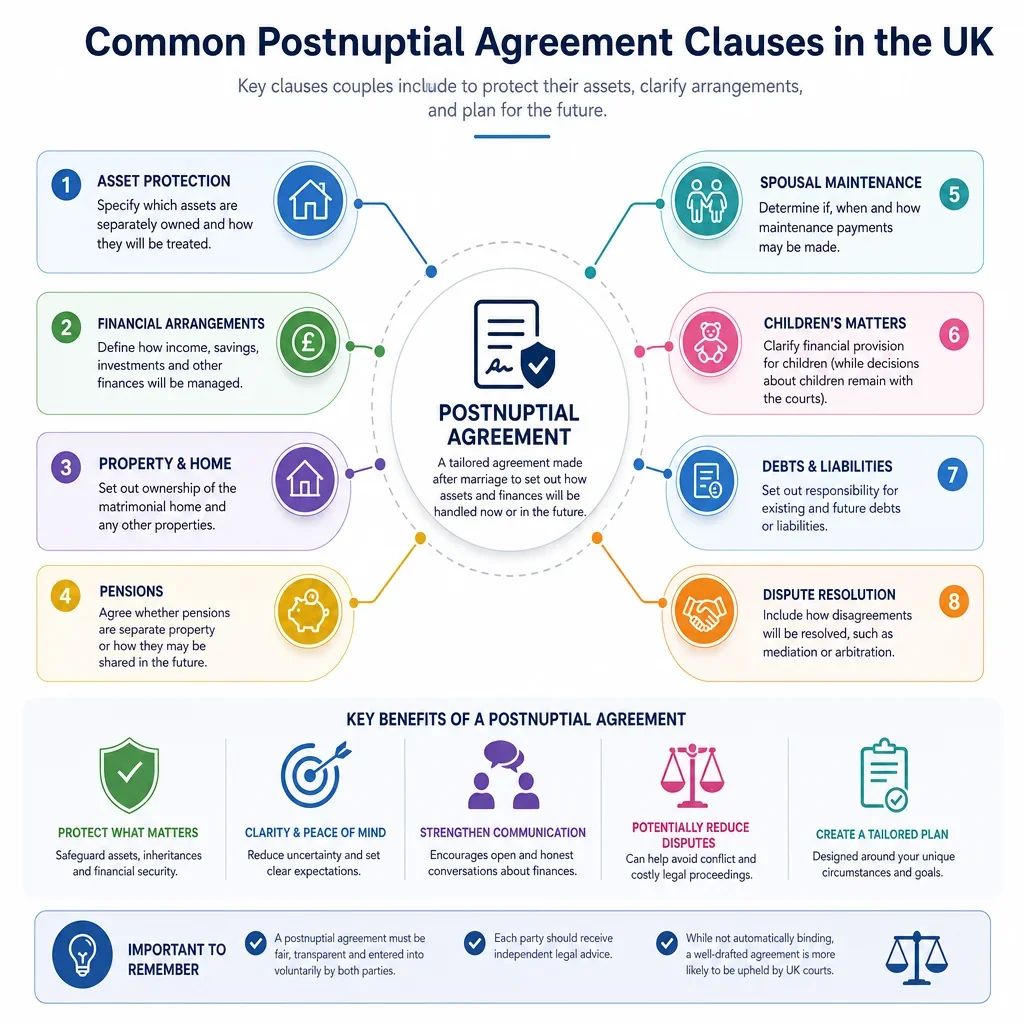
Explore common UK postnuptial agreement clauses, including assets, debts, property, and support, to help plan with clarity.
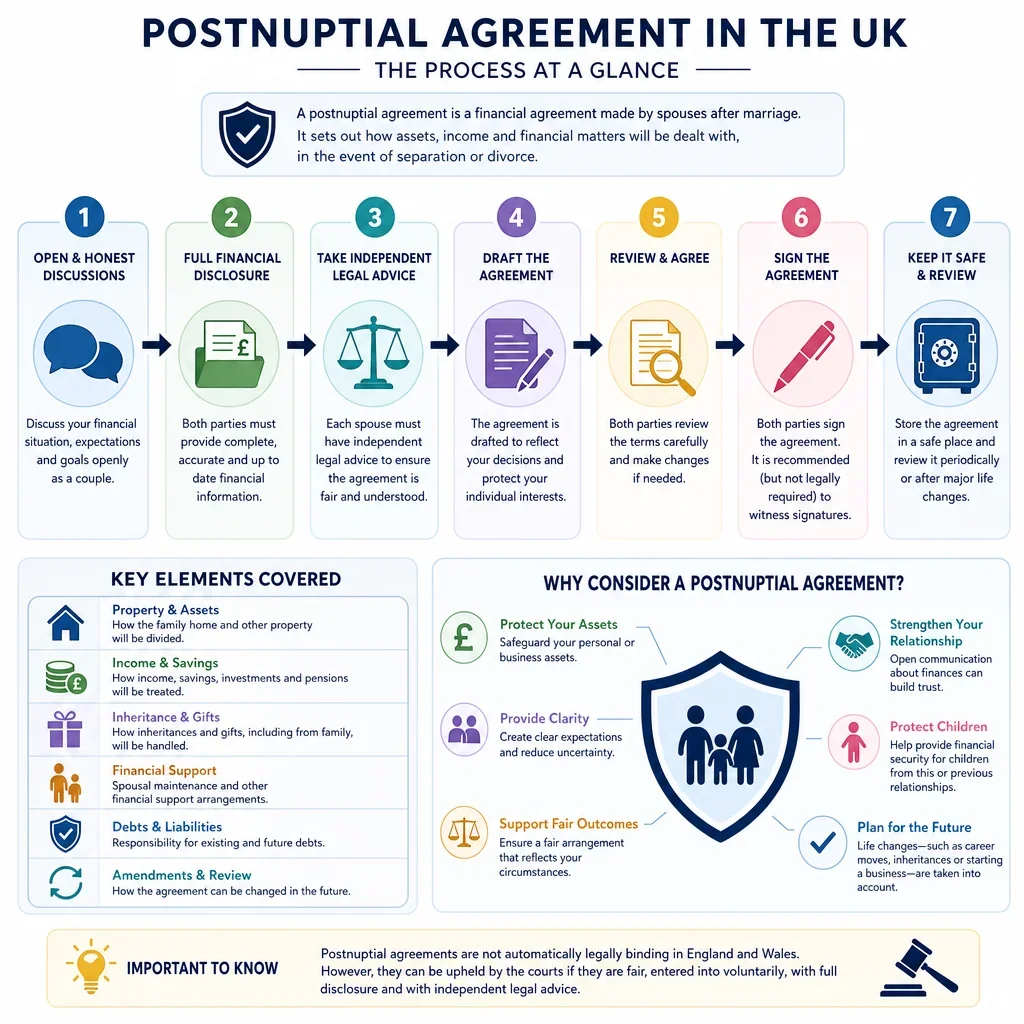
Prepare a United Kingdom postnuptial agreement with this concise checklist covering key documents, decisions and practical next steps.