UK Employment Contract Terms Checklist
Employment Term | Inclusion Status | What It Covers | UK Law Note | Common Pitfalls |
|---|---|---|---|---|
Duties and Conduct | ||||
Employer and employee names | Usually Required | Identifies the contracting parties. | The written statement must include names of the employer and employee or worker. | Using a trading name only or failing to identify the correct legal employer. |
Start date | Usually Required | The date employment begins. | A day-one written statement must state the employment start date. | Confusing offer acceptance, induction, and contractual start dates. |
Termination | ||||
Continuous employment date | Usually Required | Whether earlier service counts towards statutory rights. | The written statement must state the date continuous employment began if different from the start date. | Ignoring TUPE transfers, group moves, or previous service recognition. |
Duties and Conduct | ||||
Job title and role description | Usually Required | Job title, role, and expected duties. | The written statement must include job title or a brief work description. | Drafting duties too narrowly, making reasonable changes harder. |
Working Time | ||||
Place of work | Usually Required | Normal work location and mobility expectations. | The written statement must state the place of work or indicate that work is at various places. | Using a broad mobility clause without reasonableness limits. |
Remote or hybrid working | Role-Dependent | Homeworking days, attendance, equipment, expenses, and security. | Home and hybrid working arrangements should be clear, especially where they affect contractual place of work. | Failing to address health and safety, confidentiality, data security, and recall to office. |
Overseas working | Role-Dependent | Work abroad, duration, currency, benefits, and return arrangements. | Additional particulars are required where an employee must work outside the UK for more than one month. | Omitting tax, immigration, insurance, social security, and governing law issues. |
Pay and Benefits | ||||
Salary or wages | Usually Required | Rate of pay and pay calculation method. | The written statement must state scale, rate, or method of calculating remuneration. | Not stating whether pay is annual, hourly, gross, pro rata, or inclusive of allowances. |
Pay interval and payday | Usually Required | How often and when wages are paid. | The written statement must state the intervals at which remuneration is paid. | Leaving uncertainty about monthly cut-offs, arrears, overtime, and final pay timing. |
National Minimum Wage compliance | Usually Required | Ensures pay does not fall below statutory minimum rates. | Workers must receive at least the applicable National Minimum Wage or National Living Wage. | Ignoring unpaid working time, deductions, uniforms, travel time, or salary sacrifice effects. |
Overtime | Often Included | Whether overtime is required, voluntary, paid, or unpaid. | Overtime arrangements should not cause average pay to fall below minimum wage or breach working time limits. | Not defining approval, rate, time off in lieu, or compulsory overtime obligations. |
Bonus | Optional | Eligibility, targets, discretion, payment date, and forfeiture. | Discretionary bonuses must still be exercised rationally and consistently with contractual obligations. | Calling a bonus discretionary but drafting guaranteed payment language. |
Commission | Role-Dependent | Commission entitlement, calculation, triggers, clawback, and leavers. | Commission terms should be clear because ambiguity often leads to unlawful deduction or breach claims. | Not defining whether commission is earned on booking, invoice, payment, or completion. |
Expenses reimbursement | Often Included | Business expense approval, evidence, limits, and repayment. | Tax treatment depends on the type of expense and HMRC rules. | Failing to require receipts or distinguish taxable benefits from reimbursable expenses. |
Benefits package | Optional | Non-cash benefits such as healthcare, insurance, or vouchers. | Benefits may have tax, eligibility, insurer, and scheme rule conditions. | Making benefits contractual when the employer needs flexibility to vary schemes. |
Pension auto-enrolment | Usually Required | Workplace pension scheme and employee contributions. | Eligible workers must be automatically enrolled into a workplace pension unless they opt out. | Treating pension enrolment as optional for eligible staff or misstating contribution rates. |
Salary sacrifice | Optional | Exchange of salary for benefits or pension contributions. | Salary sacrifice must not reduce cash earnings below National Minimum Wage. | Failing to document the contractual pay variation before sacrifice takes effect. |
Deductions from wages | Often Included | Permitted deductions for overpayments, loans, property, or losses. | Deductions generally need statutory authority, contractual authority, or prior written consent. | Making deductions without a clear written clause or specific consent. |
Working Time | ||||
Normal working hours | Usually Required | Days, hours, shift pattern, and variability. | The written statement must include normal working hours and normal working days if variable. | Not stating variable hours, rota rules, or whether breaks are paid. |
48-hour working week opt-out | Role-Dependent | Agreement to work beyond the 48-hour average weekly limit. | Workers cannot usually be forced to work over 48 hours a week on average unless they opt out. | Including an opt-out without a genuine separate agreement or withdrawal right. |
Rest breaks and rest periods | Usually Required | Daily breaks, weekly rest, and lunch arrangements. | Most adult workers are entitled to rest breaks, daily rest, and weekly rest under working time rules. | Failing to account for young workers, shift work, and compensatory rest. |
Shift work and rotas | Role-Dependent | Shift patterns, rota notice, swaps, and changes. | Variable working patterns should be stated in the written particulars where applicable. | Not reserving reasonable flexibility or giving insufficient rota notice. |
Night work | Role-Dependent | Night hours, health assessments, and limits. | Night workers have special limits and may be entitled to free health assessments. | Ignoring young worker restrictions and special hazards for night work. |
Leave and Absence | ||||
Annual holiday entitlement | Usually Required | Paid holiday entitlement, holiday year, and booking rules. | Most workers are entitled to 5.6 weeks paid holiday each leave year. | Not stating whether bank holidays are included in the entitlement. |
Holiday pay calculation | Usually Required | How holiday pay is calculated for regular or irregular pay. | Holiday pay rules differ for regular hours, irregular hours, and part-year workers. | Using basic pay only where overtime, commission, or allowances must be reflected. |
Bank holidays | Often Included | Whether bank holidays are paid and included in annual leave. | There is no automatic statutory right to paid bank holidays in addition to statutory holiday. | Promising bank holidays separately while also intending them to count within holiday entitlement. |
Holiday carry-over | Often Included | When unused holiday can be carried into the next year. | Carry-over rules can apply in sickness, family leave, and other statutory situations. | Using a blanket lose it or lose it rule without statutory exceptions. |
Sickness absence reporting | Usually Required | How and when sickness absence must be reported and evidenced. | The written statement must include terms about incapacity for work due to sickness or injury, including sick pay. | Not explaining fit notes, self-certification, reporting deadlines, or medical evidence. |
Statutory Sick Pay | Usually Required | Minimum sick pay entitlement if eligibility conditions are met. | Eligible employees can receive Statutory Sick Pay for qualifying sickness absence. | Promising enhanced sick pay unintentionally or misstating eligibility and waiting days. |
Contractual sick pay | Optional | Enhanced sick pay, duration, discretion, and offsets against SSP. | Contractual sick pay can exceed SSP but should define conditions and employer discretion. | Failing to cap entitlement or state whether SSP is included within enhanced pay. |
Maternity leave and pay | Usually Required | Maternity leave, statutory pay, notice, and return rights. | Eligible employees have statutory maternity leave and may qualify for statutory maternity pay. | Omitting protections against discrimination or failing to reference current statutory policy. |
Paternity leave and pay | Usually Required | Paternity leave, statutory pay, eligibility, and notice. | Eligible employees can take statutory paternity leave and may qualify for statutory paternity pay. | Using outdated notice rules or failing to cover adoption and partner eligibility. |
Adoption leave and pay | Usually Required | Adoption leave, statutory pay, notice, and matching evidence. | Eligible employees can take statutory adoption leave and may qualify for statutory adoption pay. | Failing to cover overseas adoption or surrogacy-related parental orders. |
Shared parental leave | Usually Required | Sharing eligible maternity or adoption leave and pay. | Eligible parents may share leave and pay after birth or adoption if statutory conditions are met. | Not distinguishing leave notices, booking notices, and discontinuous leave requests. |
Parental bereavement leave | Usually Required | Leave and statutory pay after the death of a child. | Eligible employed parents can take statutory parental bereavement leave. | Applying ordinary absence procedures insensitively or contrary to statutory rights. |
Neonatal care leave | Usually Required | Leave and pay when a baby receives neonatal care. | The Neonatal Care (Leave and Pay) Act 2023 creates statutory neonatal care leave and pay rights, implemented through regulations. | Using family leave policies that omit newer neonatal care rights. |
Unpaid parental leave | Often Included | Unpaid time off to care for a child. | Eligible employees can take unpaid parental leave subject to statutory limits and notice rules. | Confusing unpaid parental leave with shared parental leave or time off for dependants. |
Time off for dependants | Often Included | Emergency unpaid time off for dependant care issues. | Employees have a statutory right to reasonable unpaid time off for dependant emergencies. | Treating emergency dependant leave as ordinary unauthorised absence. |
Carer leave | Usually Required | Unpaid leave to provide or arrange care for a dependant. | Eligible employees can take statutory unpaid carer leave from day one of employment. | Requiring excessive evidence or ignoring day-one eligibility. |
Working Time | ||||
Flexible working requests | Often Included | Procedure for requesting changes to hours, times, or place of work. | Employees have a day-one statutory right to request flexible working, subject to statutory handling rules. | Stating outdated service requirements or refusing outside permitted statutory grounds. |
Termination | ||||
Probationary period | Often Included | Trial period, review, extension, and shorter notice if applicable. | Probation does not remove statutory employment rights, but can set performance review and notice arrangements. | Not saying whether probation can be extended or what happens if no review occurs. |
Notice period | Usually Required | Notice required from employer and employee to end employment. | Employees are entitled to at least statutory minimum notice after one month of employment. | Setting notice below statutory minimum or forgetting longer contractual notice for senior roles. |
Payment in lieu of notice | Often Included | Employer right to pay instead of requiring work during notice. | A contractual PILON clause helps avoid breach where employment ends immediately with notice pay. | Not defining whether PILON includes benefits, bonus, commission, or only basic salary. |
Garden leave | Role-Dependent | Keeping employee away from work during notice while employment continues. | Garden leave should be supported by an express contractual clause, especially for senior or client-facing roles. | Using garden leave without pay, benefits, duties, contact, or access restrictions. |
Summary dismissal for gross misconduct | Often Included | Immediate dismissal without notice for serious misconduct. | Employers should still follow a fair process where unfair dismissal rights apply. | Listing examples as exhaustive or dismissing without investigation where fairness is required. |
Redundancy | Often Included | Redundancy process, consultation, notice, and statutory payments. | Eligible employees may be entitled to statutory redundancy pay and consultation rights. | Promising enhanced redundancy terms unintentionally or omitting consultation expectations. |
Final pay and holiday on termination | Usually Required | Accrued holiday pay, repayment for overtaken leave, and final deductions. | Workers are entitled to payment for statutory holiday accrued but untaken on termination. | Deducting overtaken holiday without clear contractual authority. |
Confidentiality and Property | ||||
Return of company property | Often Included | Return of devices, documents, keys, cards, records, and data. | Employers commonly include return obligations to protect assets and confidential information at termination. | Forgetting personal devices, cloud accounts, copies, backups, and remote-working equipment. |
Duties and Conduct | ||||
Disciplinary procedure | Usually Required | Rules for misconduct investigations, warnings, hearings, and appeals. | The written statement must give disciplinary rules or identify where they can be found. | Making a detailed procedure contractual when flexibility is needed. |
Grievance procedure | Usually Required | How employees raise workplace complaints and appeals. | The written statement must state who grievances can be raised with and how applications should be made. | Not aligning the clause with the ACAS Code and internal policy. |
ACAS Code procedures | Often Included | Fair handling of disciplinary and grievance issues. | Tribunals can adjust compensation where parties unreasonably fail to follow the ACAS Code. | Treating the Code as optional in misconduct, performance, or grievance cases. |
Duties and reasonable instructions | Often Included | Obligation to perform duties and follow lawful reasonable instructions. | Contracts commonly include flexibility for duties consistent with the employee's role and status. | Using unlimited flexibility that risks breaching mutual trust and confidence. |
Performance standards | Often Included | Expected competence, targets, appraisal, and improvement processes. | Capability issues should be handled fairly, with reasonable support and process where dismissal risk exists. | Not distinguishing conduct, capability, targets, and discretionary performance ratings. |
Outside interests and second jobs | Often Included | Restrictions on other work, conflicts, and disclosure duties. | Exclusivity clauses are restricted in zero-hours contracts and certain low-income worker contracts. | Banning all outside work without considering zero-hours rules, conflicts, or working time. |
Conflicts of interest | Often Included | Disclosure and management of competing personal or business interests. | Employees owe duties of fidelity, and senior staff may owe fiduciary duties in some circumstances. | Not covering family interests, gifts, suppliers, clients, and directorships. |
Anti-bribery and corruption | Often Included | Prohibits bribes, improper payments, facilitation payments, and undeclared gifts. | The Bribery Act 2010 creates bribery offences and a corporate offence of failing to prevent bribery. | Not linking the contract to gifts, hospitality, expenses, and reporting policies. |
Equality, diversity, and harassment | Often Included | Expected behaviour and prohibition of discrimination, harassment, and victimisation. | The Equality Act 2010 prohibits workplace discrimination, harassment, and victimisation relating to protected characteristics. | Using a policy only, without making serious harassment a potential disciplinary matter. |
Sexual harassment prevention | Often Included | Standards, reporting, training, and prevention of workplace sexual harassment. | Employers must take reasonable steps to prevent sexual harassment of employees. | Relying on a generic equal opportunities clause without prevention measures or reporting routes. |
Health and safety duties | Often Included | Compliance with safety rules, training, PPE, and reporting hazards. | Employers and employees have health and safety duties at work. | Not adapting clauses for remote work, driving, lone working, or hazardous roles. |
Right to work and immigration status | Usually Required | Evidence of legal right to work and ongoing notification duties. | Employers must check a worker's right to work and can face penalties for illegal working. | Discriminatory checks, poor record keeping, or no clause requiring status updates. |
Training requirements | Usually Required | Mandatory training, employer-funded training, and costs. | The written statement must include details of training entitlement, mandatory training, and whether the employer pays for it. | Not distinguishing compulsory training from optional development or repayable courses. |
Pay and Benefits | ||||
Training repayment agreement | Optional | Repayment of specified training costs if employment ends early. | Repayment clauses should be proportionate, clearly agreed, and not operate as a penalty. | Using vague costs, no sliding scale, or deductions without wage deduction authority. |
Confidentiality and Property | ||||
Data protection and privacy | Often Included | Handling personal data, privacy notices, monitoring, and security duties. | Employers must comply with UK GDPR and the Data Protection Act 2018 when processing worker data. | Relying on consent as the main basis for employee data processing. |
Confidential information | Often Included | Protection of trade secrets, business information, client data, and know-how. | Express confidentiality clauses strengthen protection during and after employment. | Defining confidential information too broadly or ignoring whistleblowing and legal disclosures. |
Intellectual property | Role-Dependent | Ownership and assignment of work-created IP, inventions, and materials. | Copyright created by an employee in the course of employment usually belongs to the employer unless agreed otherwise. | Not covering moral rights, inventions, open-source code, contractors, or pre-existing materials. |
Employee inventions | Role-Dependent | Disclosure, ownership, registration, and assistance with patentable inventions. | Employee invention ownership depends on statutory patent rules and the employee's normal duties. | Assuming all inventions belong to the employer regardless of duties and circumstances. |
IT systems and acceptable use | Often Included | Use of devices, email, internet, passwords, software, and cyber security. | IT terms support data security, monitoring transparency, and protection of employer systems. | Monitoring staff without a clear policy, lawful basis, and privacy information. |
Duties and Conduct | ||||
Social media use | Often Included | Work-related posts, brand protection, confidentiality, and online conduct. | Employers should set clear expectations for social media use and disciplinary consequences. | Overbroad restrictions that ignore lawful whistleblowing, union activity, or private life issues. |
Confidentiality and Property | ||||
Workplace monitoring | Role-Dependent | Email, internet, CCTV, location, call, and productivity monitoring. | Worker monitoring must comply with data protection, transparency, necessity, and proportionality principles. | Hidden or excessive monitoring without impact assessment or clear notice. |
Duties and Conduct | ||||
Whistleblowing | Often Included | Reporting wrongdoing, protected disclosures, and non-retaliation. | Workers are protected from detriment or dismissal for qualifying protected disclosures. | Confidentiality clauses that appear to prevent protected disclosures. |
Termination | ||||
Post-termination restrictions | Role-Dependent | Non-compete, non-solicitation, non-dealing, and poaching restrictions. | Restrictive covenants are enforceable only if reasonable and protecting a legitimate business interest. | Using long, generic restrictions not tailored to role, geography, clients, or seniority. |
Non-solicitation of clients | Role-Dependent | Prevents approaching recent clients or prospects after leaving. | Client restrictions must be no wider than necessary to protect customer connections. | Protecting all clients worldwide, including those the employee never dealt with. |
Non-poaching of staff | Role-Dependent | Restricts recruiting or encouraging colleagues to leave. | Staff non-poaching clauses must be reasonable and targeted to protect workforce stability. | Applying restrictions to junior staff without influence over colleagues. |
Pay and Benefits | ||||
Collective agreements | Role-Dependent | Whether union or collective agreements affect employment terms. | The written statement must specify any collective agreements directly affecting the terms and conditions. | Failing to identify incorporated collective terms on pay, hours, holiday, or procedures. |
Duties and Conduct | ||||
Variation of contract | Often Included | How employment terms may be changed. | Employment contract changes generally require agreement unless a valid flexibility clause applies and is used reasonably. | Assuming a unilateral variation clause allows any change without consultation. |
Termination | ||||
Governing law and jurisdiction | Often Included | Which legal system and courts or tribunals apply. | UK employment contracts commonly specify the law of England and Wales, Scotland, or Northern Ireland as appropriate. | Using England and Wales law for a role mainly based in Scotland or Northern Ireland without considering local differences. |
Pay and Benefits | ||||
Lay-off and short-time working | Role-Dependent | Temporary reduction or suspension of work and pay. | Employers usually need a contractual right or agreement to lay off employees or put them on short-time working. | Assuming business downturn permits unpaid lay-off without an express clause. |
Working Time | ||||
Travel and mobility | Role-Dependent | Business travel, relocation, travel time, and working away from home. | Travel requirements should be reasonable and may affect working time, expenses, and family responsibilities. | Not addressing travel time, overnight stays, expenses, or relocation limits. |
Duties and Conduct | ||||
Driving for work | Role-Dependent | Driving licence, insurance, vehicle use, fines, and safety rules. | Employers must manage work-related road safety risks under health and safety duties. | Not requiring licence checks, business insurance, accident reporting, or mobile phone rules. |
Pay and Benefits | ||||
Company car or car allowance | Role-Dependent | Vehicle entitlement, private use, tax, insurance, fuel, and return. | Company cars and fuel can create taxable benefits under HMRC rules. | Not stating whether the benefit continues during sickness, leave, notice, or garden leave. |
Duties and Conduct | ||||
Uniform and dress code | Role-Dependent | Required appearance, uniforms, PPE, branding, and cost responsibility. | Uniform costs can affect National Minimum Wage calculations if workers must pay for them. | Requiring workers to buy clothing without checking minimum wage impact and equality issues. |
Alcohol and drugs | Role-Dependent | Prohibited use, fitness for work, testing, and support routes. | Alcohol and drug policies are especially important in safety-critical work and must be handled fairly. | Introducing testing without consent, clear policy, proportionality, or data protection safeguards. |
Leave and Absence | ||||
Unauthorised absence | Often Included | Rules for absence notification, approval, and consequences. | Absence rules should be applied consistently and adjusted where disability or statutory leave rights are involved. | Treating protected leave or disability-related absence as misconduct without assessment. |
Duties and Conduct | ||||
Suspension | Often Included | Temporary removal from work during investigations or risk situations. | Suspension should not be automatic and should usually be on full pay unless contractually justified otherwise. | Using suspension as punishment before investigation or without review. |
Termination | ||||
Retirement | Optional | Retirement planning and any employer retirement age. | Default retirement age has been abolished compulsory retirement must be objectively justified. | Including a mandatory retirement age without a strong objective justification. |
Duties and Conduct | ||||
Apprenticeship terms | Role-Dependent | Apprenticeship standard, training, employment status, pay, and duration. | Apprentices must have appropriate apprenticeship documentation and receive at least the applicable minimum wage. | Using an ordinary employment contract where an apprenticeship agreement is required. |
Termination | ||||
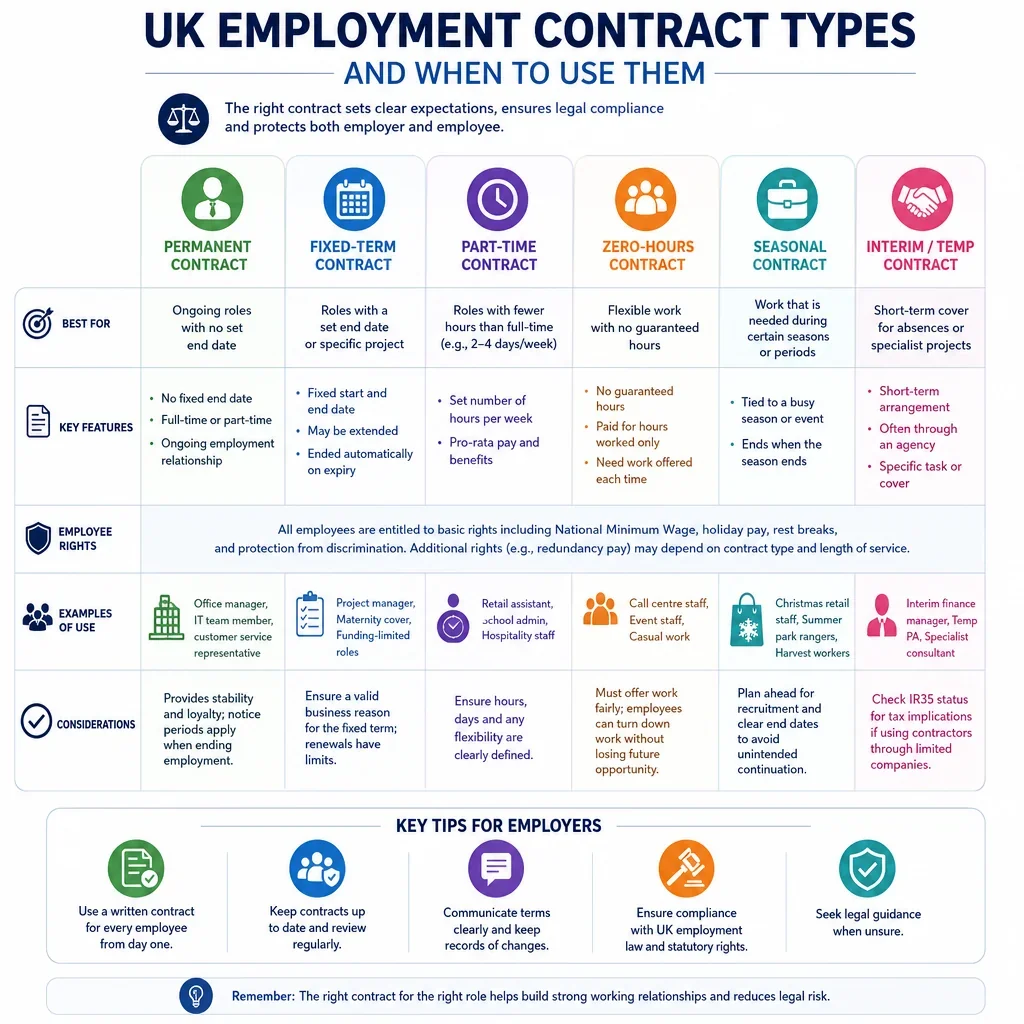
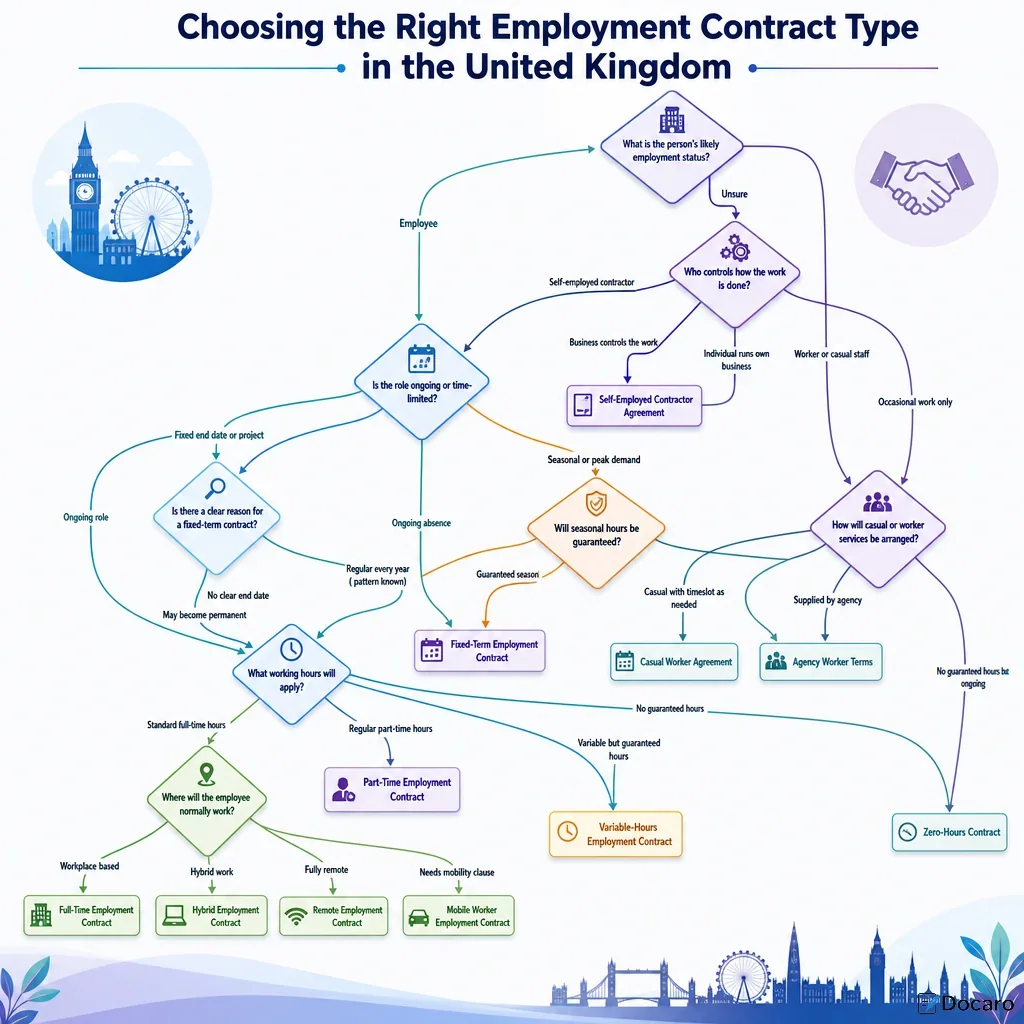
Fixed-term duration | Role-Dependent | End date, project completion, renewal, and early termination. | Fixed-term employees have protection against less favourable treatment and may become permanent after successive contracts in some cases. | No early termination clause, causing liability for the whole fixed term. |
Working Time | ||||
Zero-hours arrangements | Role-Dependent | No guaranteed hours, offer of work, refusal rights, and status. | Zero-hours workers are entitled to statutory rights including minimum wage and paid holiday. | Including prohibited exclusivity terms or mislabelling employment status. |
Pay and Benefits | ||||
Agency worker arrangements | Role-Dependent | Agency status, hirer obligations, pay, facilities, and assignment details. | Agency workers have rights under the Agency Workers Regulations, including equal treatment after the qualifying period. | Using a standard employee contract when the arrangement is through an employment business. |
Termination | ||||
TUPE transfer protection | Role-Dependent | Transfer of employment on business sale, outsourcing, or service change. | TUPE can transfer employees and preserve terms when a relevant transfer occurs. | Changing terms because of a transfer without considering TUPE restrictions. |
What Terms Must A UK Employment Contract Usually Cover?
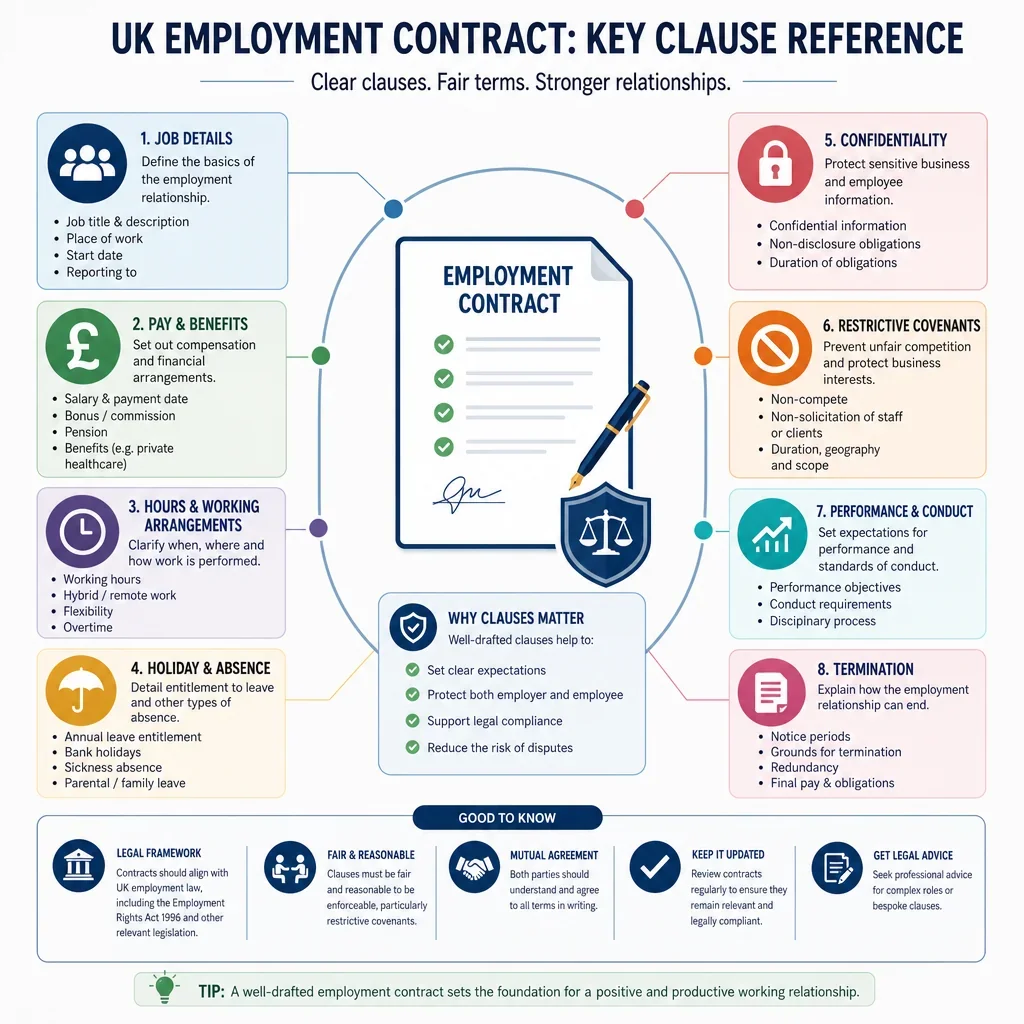
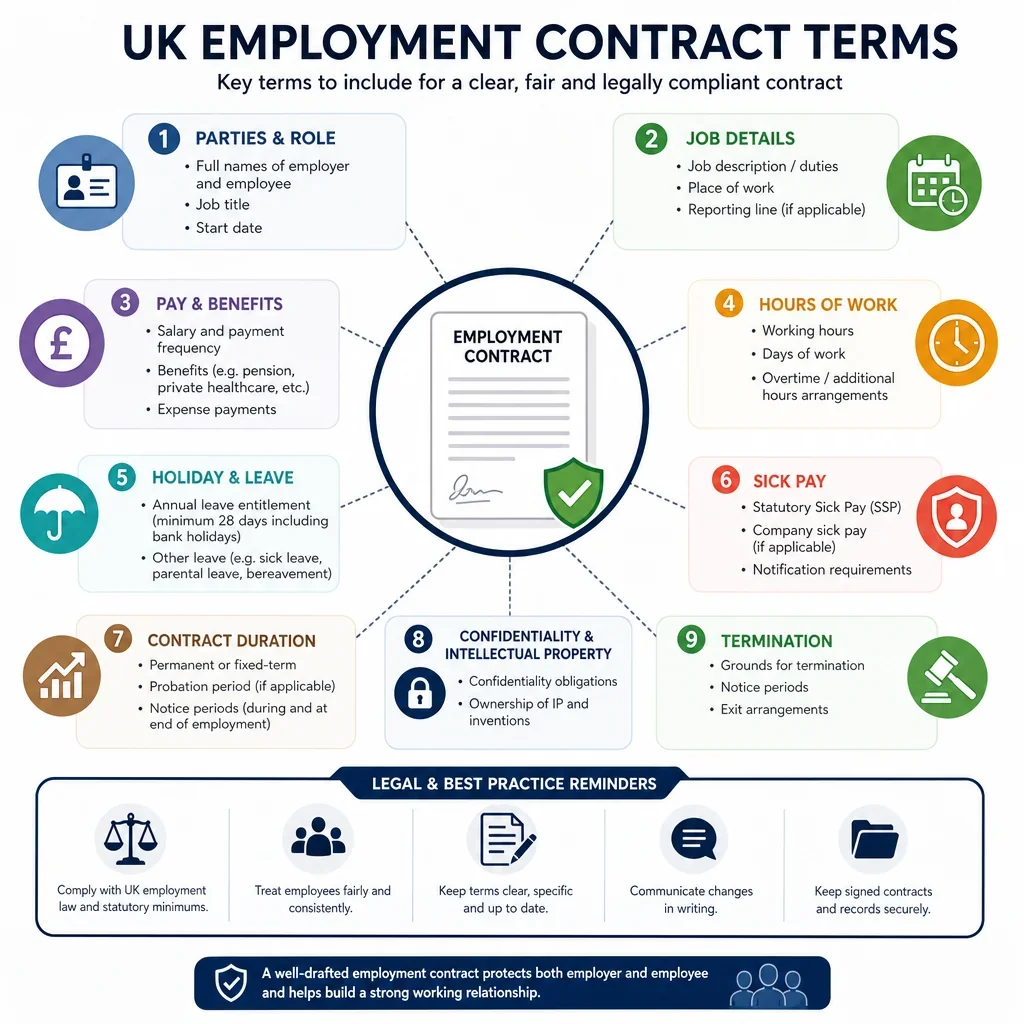
UK employees and workers are entitled to a written statement of employment particulars from day one. In practice, the contract should clearly cover pay, hours, holiday, sick leave, notice, pension, place of work, job title, start date, probation if used, and disciplinary and grievance arrangements. Some details can be supplied in a separate accessible document, but core particulars should not be left vague.
Which Employment Contract Terms Need The Most Care?
- Holiday and working time: Draft holiday entitlement, holiday year, bank holidays, carry-over, and working hours consistently with Working Time Regulations rules.
- Pay and deductions: State salary, pay frequency, commission or bonus conditions, and any deduction authority clearly to reduce unlawful deduction disputes.
- Termination: Notice, probationary notice, garden leave, payment in lieu of notice, and post-termination restrictions should be precise and proportionate.
- Confidentiality and IP: Employers should protect confidential information, company property, inventions, and work-created intellectual property, especially in senior, creative, technical, sales, and remote roles.
How Should Employers Use This Checklist?
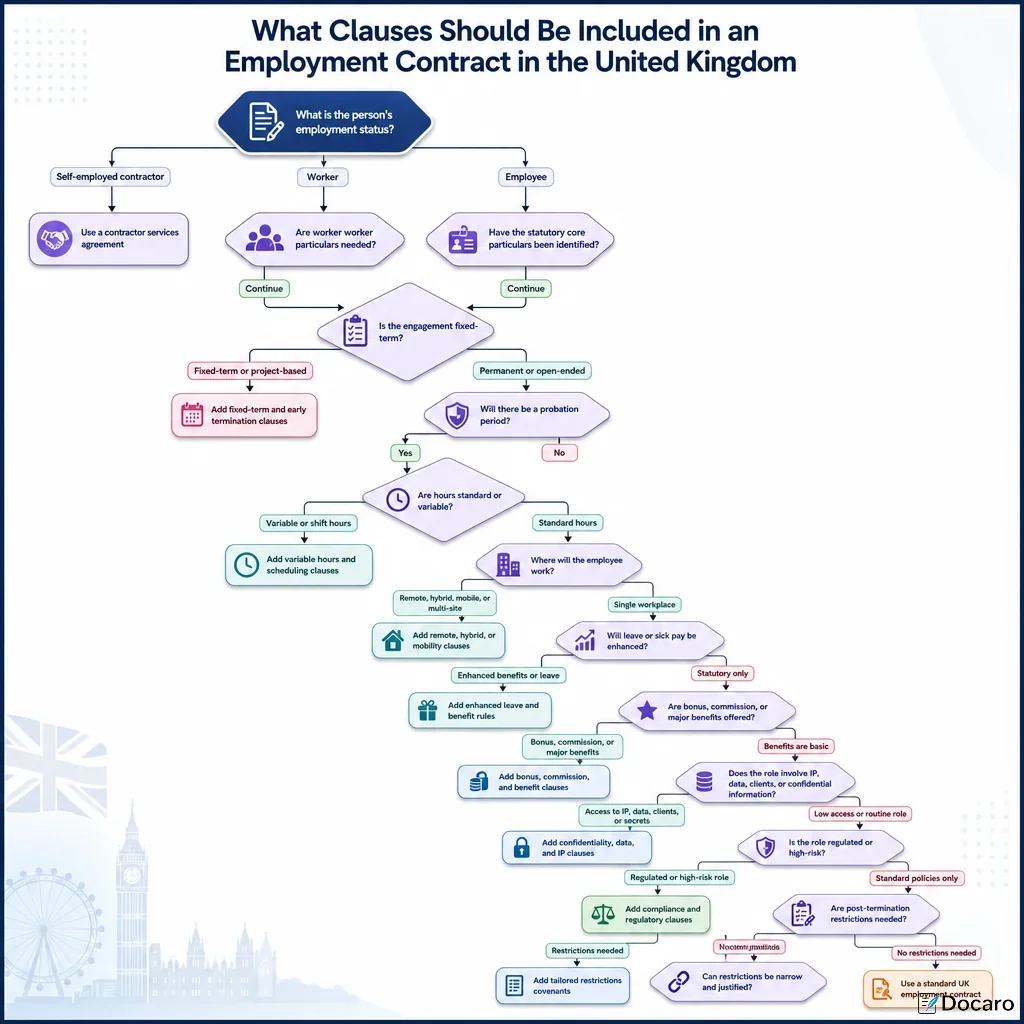
Use the checklist to decide which terms are legally required, commonly expected, or role-dependent before generating an employment contract. Avoid copying generic clauses without checking the role, seniority, working pattern, location, benefits, and sector-specific obligations. For regulated, senior, international, or restrictive covenant-heavy roles, legal review is advisable.
FAQs
You Might Also Be Interested In