Typical Duration Ranges For UK Restrictive Covenants
Restricted Party Role | Typical Minimum Months | Typical Maximum Months | Duration Factors | Duration Risk Level |
|---|---|---|---|---|
Non-compete | ||||
Junior employee | 0 | 3 | Rarely justified limited influence, confidential information or customer connection. | High |
Mid-level employee | 3 | 6 | Customer influence, sensitive know-how, sales cycle and garden leave offset. | Medium |
Senior employee | 6 | 12 | Strategic knowledge, senior client control, team influence and narrow market scope. | Medium |
Director | 6 | 12 | Board-level information, fiduciary role, client ownership and competitive threat. | Medium |
Founder | 6 | 18 | Equity exit, goodwill, key relationships, product roadmap and bargaining power. | Medium |
Seller of a business | 12 | 36 | Purchased goodwill, price paid, industry, geography and seller customer influence. | Low |
Consultant | 3 | 6 | Project sensitivity, exclusivity, client exposure and independent contractor status. | Medium |
Partner or LLP member | 6 | 24 | Client book, profit share, seniority, goodwill and negotiated exit terms. | Medium |
Non-solicitation | ||||
Junior employee | 0 | 3 | Only where direct recent customer contact exists. | Medium |
Mid-level employee | 3 | 6 | Recent dealings, customer loyalty, renewal cycle and role scope. | Low |
Senior employee | 6 | 12 | High-value accounts, long sales cycle and strategic customer relationships. | Low |
Director | 6 | 12 | Fiduciary exposure, board relationships, key accounts and succession period. | Low |
Founder | 9 | 18 | Personal goodwill, investor deal, transition support and customer dependence. | Medium |
Seller of a business | 12 | 36 | Goodwill transfer, earn-out period, customer migration and sale price. | Low |
Consultant | 3 | 9 | Client introduction, project length, account ownership and referral access. | Medium |
Partner or LLP member | 6 | 24 | Client following, firm goodwill, partnership deed and seniority. | Medium |
Non-dealing | ||||
Junior employee | 0 | 3 | High risk unless limited to customers actually handled. | High |
Mid-level employee | 3 | 6 | Recent material dealings and genuine risk of customer following. | Medium |
Senior employee | 6 | 12 | Senior account control, passive approaches and long procurement cycle. | Medium |
Director | 6 | 12 | Strategic accounts, fiduciary knowledge and customer substitution period. | Medium |
Founder | 9 | 18 | Personal goodwill, founder brand, earn-out and customer dependency. | Medium |
Seller of a business | 12 | 36 | Protects purchased customer goodwill even against customer-initiated work. | Low |
Consultant | 3 | 6 | Client access during assignment and whether consultant introduced the client. | Medium |
Partner or LLP member | 6 | 24 | Client ownership, sector norms, partnership goodwill and negotiated buyout. | Medium |
Non-poaching | ||||
Junior employee | 0 | 3 | Usually only justified if the employee can influence colleagues to leave. | Medium |
Mid-level employee | 3 | 6 | Team influence, recruitment plans and vulnerability of key staff. | Low |
Senior employee | 6 | 12 | Management authority, key team knowledge and replacement period. | Low |
Director | 6 | 12 | Leadership influence, retention risk and access to remuneration data. | Low |
Founder | 9 | 18 | Founder loyalty, key engineers or sales team and transition risk. | Medium |
Seller of a business | 12 | 36 | Stabilising acquired workforce and protecting value paid for management team. | Low |
Consultant | 3 | 6 | Access to project team, subcontractors and recruitment discussions. | Medium |
Partner or LLP member | 6 | 24 | Team following, lockstep arrangements and goodwill protection. | Medium |
Confidentiality | ||||
Junior employee | 12 | 60 | Ordinary confidential information should expire trade secrets can last longer. | Low |
Mid-level employee | 24 | 84 | Commercial sensitivity, product cycle and whether information is a trade secret. | Low |
Senior employee | 36 | 120 | Strategic plans, pricing, trade secrets and continued secrecy measures. | Low |
Director | 36 | 120 | Board papers, strategy, fiduciary duties and ongoing trade secrecy. | Low |
Founder | 36 | 120 | Technical know-how, fundraising information, roadmap and trade secrets. | Low |
Seller of a business | 60 | 999 | Trade secrets, know-how sold with goodwill and information not public. | Low |
Consultant | 24 | 84 | Project data, client materials, trade secrets and sector sensitivity. | Low |
Partner or LLP member | 36 | 120 | Firm strategy, client files, pricing, trade secrets and professional duties. | Low |
Supplier restriction | ||||
Junior employee | 0 | 3 | Only defensible with direct supplier influence or procurement leverage. | High |
Mid-level employee | 3 | 6 | Procurement role, supplier dependence and exclusivity arrangements. | Medium |
Senior employee | 6 | 12 | Strategic suppliers, exclusive terms, pricing knowledge and sourcing cycle. | Medium |
Director | 6 | 12 | Strategic procurement, board-level supplier plans and exclusivity. | Medium |
Founder | 6 | 18 | Founder-built supply chain, exclusive suppliers and transition period. | Medium |
Seller of a business | 12 | 36 | Protects acquired supply chain, exclusivity and operational goodwill. | Low |
Consultant | 3 | 6 | Supplier introductions, project dependence and access to pricing. | Medium |
Partner or LLP member | 6 | 24 | Firm-specific supplier network, exclusivity and negotiated exit. | Medium |
How Long Should A UK Restrictive Covenant Last?
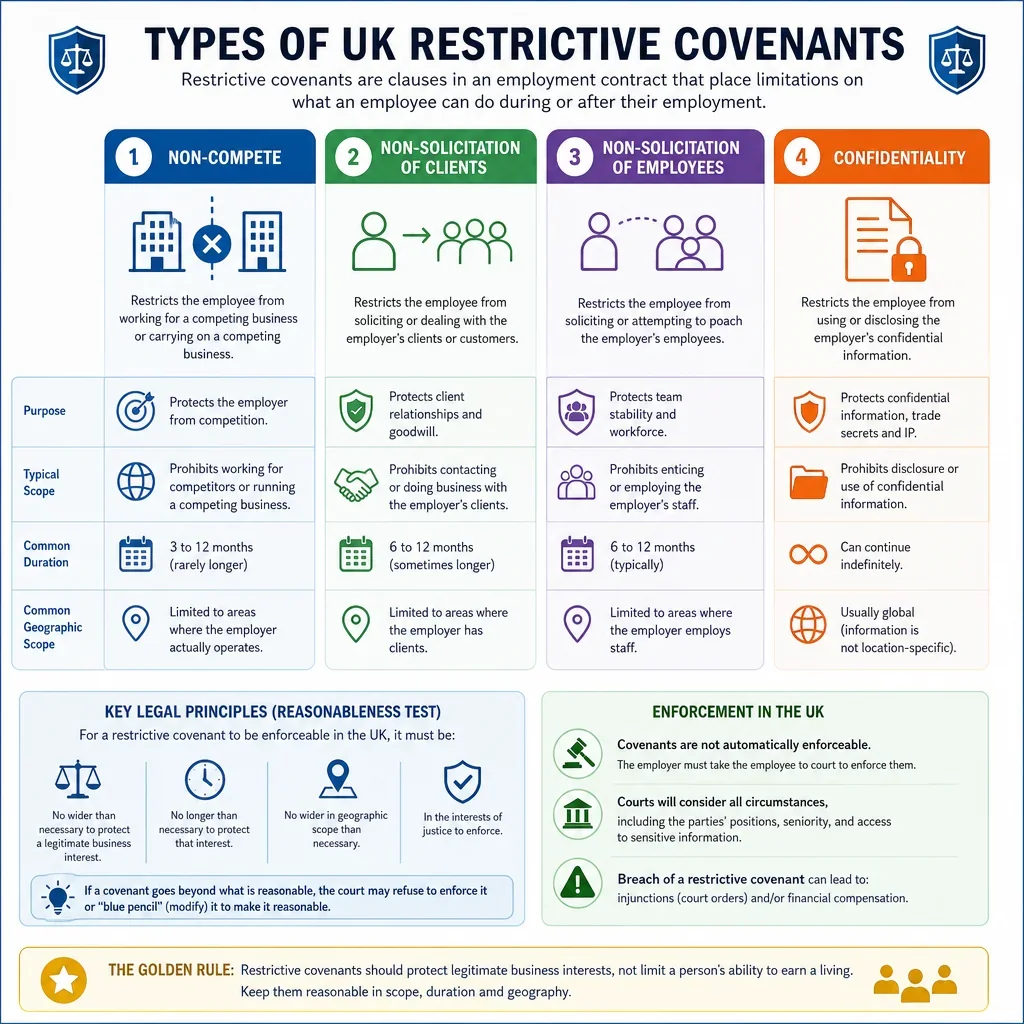
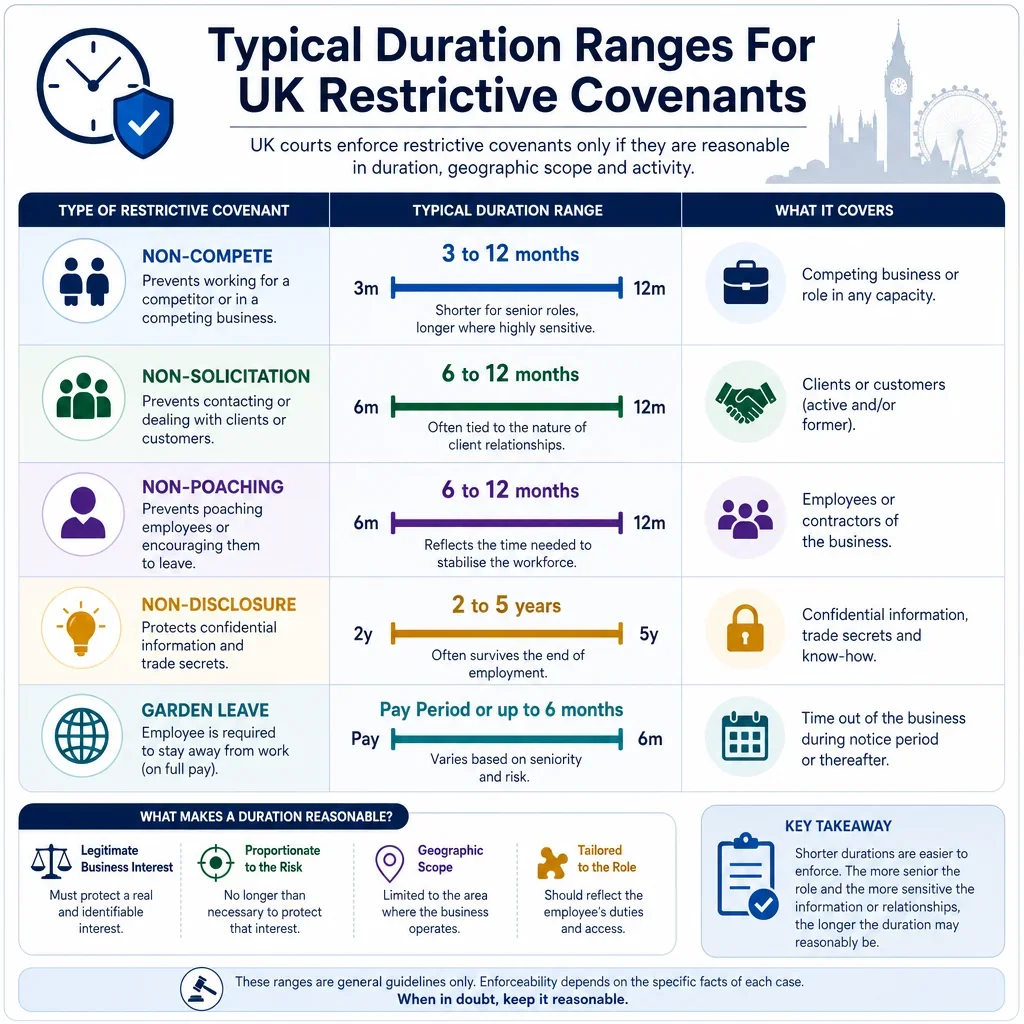
For employees, UK restrictive covenants are usually drafted in months rather than years. The data shows that 3 to 6 months is common for non-solicitation, non-dealing and non-poaching restrictions, while employee non-competes often sit around 3 to 6 months and become higher risk as they approach 9 to 12 months.
When Is A Longer Non-Compete More Likely To Be Justifiable?
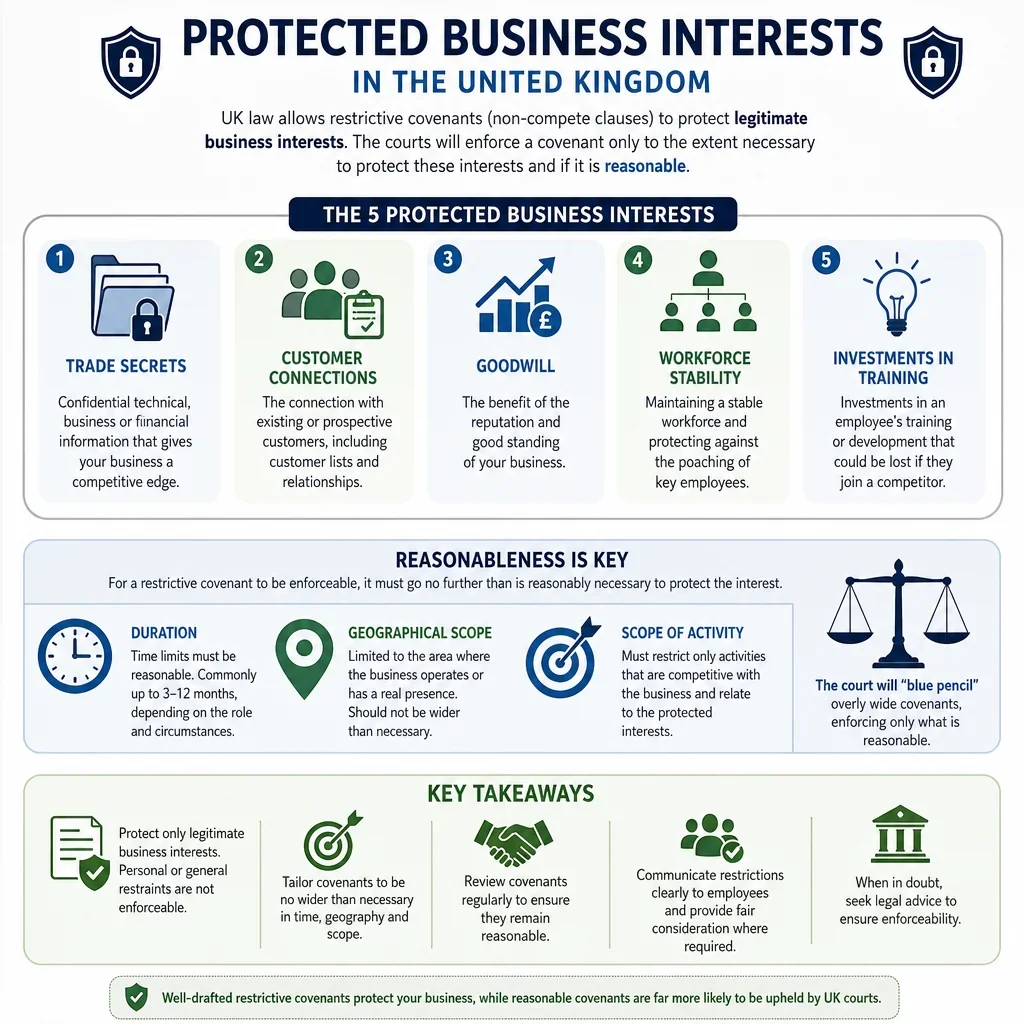
Longer periods are most defensible where the restricted person had exceptional influence, access to strategic confidential information, close customer control or received sale consideration for goodwill. The data therefore gives wider ranges for directors, founders, partners and sellers of a business than for junior or mid-level employees.
Which Restrictions Usually Need The Shortest Duration?
Junior employee restraints and broad non-compete clauses are higher risk and should usually be short, tightly linked to a legitimate business interest and limited by role, geography and market. Confidentiality can last longer where it protects genuine trade secrets, but ordinary business information should not be treated as confidential forever.
Why Are Business Sale Covenants Different From Employment Covenants?
UK courts are generally more willing to uphold longer restraints in a business sale because the buyer is protecting the goodwill it purchased. Records for sellers therefore commonly show 12 to 36 months, especially for non-compete, non-solicitation and non-dealing covenants, while equivalent employee covenants often carry medium or high risk at much shorter durations.
What Drafting Point Matters Most For Duration?
The duration should match the time reasonably needed to protect the specific interest: customer connection, workforce stability, supplier relationships, confidential information or purchased goodwill. A single blanket duration across all restriction types and roles is less defensible than tailored periods for each covenant.
FAQs
You Might Also Be Interested In