Protected Business Interests In The United Kingdom
Interest Category | Why It Matters | Supporting Evidence | Relevant Clause Types | Limitations |
|---|---|---|---|---|
Direct customer relationships built through personal contact | ||||
Customer relationships | The employee may be able to exploit personal influence over customers after leaving. | CRM notes, account ownership, meeting history, sales records, client testimonials. | Non-solicitation Non-dealing Garden leave | Should usually be limited to customers with whom the employee had recent material contact. |
Active prospective customer pipeline | ||||
Customer relationships | Prospects may be diverted before the employer can convert ongoing sales efforts. | Pipeline reports, proposals, pitch decks, tender submissions, contact logs. | Non-solicitation Non-dealing Confidentiality | Speculative or dormant leads are weak support for restraint. |
Key account management relationships | ||||
Customer relationships | Key accounts may represent a large share of revenue and be vulnerable to targeted approach. | Revenue concentration reports, account plans, contract renewal schedules, contact maps. | Non-solicitation Non-dealing Garden leave | The protected customer group should not include accounts the employee never handled. |
Customer-specific pricing and discount knowledge | ||||
Confidential information Customer relationships Strategic business information | Knowledge of margins and discounts may allow undercutting or targeted poaching. | Pricing matrices, approval workflows, margin reports, access logs. | Confidentiality Non-solicitation Non-dealing Garden leave | Pricing that is public, stale or obvious is less likely to justify strong restraint. |
Customer purchasing patterns and renewal cycles | ||||
Customer relationships Confidential information | Timing knowledge can help a competitor approach customers at the most vulnerable point. | Renewal calendars, order history, account notes, forecast reports. | Confidentiality Non-solicitation Non-dealing | Restrictions should match the life of the renewal cycle and the employee's actual knowledge. |
Personal client loyalty in professional services | ||||
Customer relationships Goodwill | Clients may follow the individual adviser rather than the firm. | Client relationship records, fee earner allocation, matter history, client feedback. | Non-solicitation Non-dealing Garden leave | A blanket restriction on all clients is risky if the employee served only some clients. |
Confidential customer lists and contact databases | ||||
Confidential information Customer relationships | A curated list can save a competitor substantial time and cost. | CRM exports, access permissions, list maintenance costs, data classification records. | Confidentiality Non-solicitation Non-dealing | Lists assembled from public sources may have limited confidential value. |
Technical trade secrets and proprietary know-how | ||||
Trade secrets Confidential information | Secret technical know-how may give the business a competitive advantage. | Restricted repositories, NDAs, invention records, security controls, training logs. | Confidentiality Garden leave Non-compete | The employer should identify the secret information and show reasonable steps to keep it secret. |
Information protected as a trade secret under UK regulations | ||||
Trade secrets Confidential information | The regulations define protected trade secrets and remedies for unlawful acquisition, use or disclosure. | Evidence the information is secret, commercially valuable and subject to reasonable secrecy steps. | Confidentiality Garden leave Non-compete | Statutory protection does not automatically make an overbroad employment restraint enforceable. |
Software source code and architecture | ||||
Trade secrets Confidential information | Source code and architecture can reveal proprietary product design and security weaknesses. | Repository permissions, commit history, code ownership records, access logs. | Confidentiality Garden leave Non-compete | General coding skill and experience cannot be restrained as confidential information. |
Unreleased product roadmap | ||||
Strategic business information Confidential information | A competitor may pre-empt launches, copy features or target weaknesses. | Board papers, product plans, roadmap decks, limited-access documents. | Confidentiality Garden leave Non-compete | Value may diminish quickly once launches become public or plans change. |
Bid, tender and procurement strategy | ||||
Strategic business information Confidential information Customer relationships | Knowledge of bid pricing and tactics may unfairly assist a competing bid. | Tender documents, pricing models, bid calendars, internal approval notes. | Confidentiality Garden leave Non-compete Non-solicitation | A restraint should be tied to live or recent tenders, not indefinite market exclusion. |
Merger, acquisition or disposal plans | ||||
Strategic business information Confidential information | Premature disclosure may affect negotiations, valuation or market positioning. | Board minutes, deal documents, data room access, adviser correspondence. | Confidentiality Garden leave Non-compete | A non-compete may be hard to justify unless the employee has current sensitive deal knowledge. |
Sales strategy and market targeting plans | ||||
Strategic business information Confidential information | A competitor may adjust its approach to neutralise the employer's plans. | Sales plans, territory maps, campaign calendars, budget allocations. | Confidentiality Garden leave Non-compete | Generic market knowledge or public strategy is not enough. |
Internal financial forecasts and margin data | ||||
Strategic business information Confidential information | Sensitive financial data can reveal commercial pressure points and pricing flexibility. | Management accounts, forecasts, margin reports, board packs, access logs. | Confidentiality Garden leave | Financial information may go stale quickly and rarely justifies broad market exclusion alone. |
Unreleased marketing campaigns and launch plans | ||||
Strategic business information Confidential information | Advance knowledge may allow a competitor to counter or copy the campaign. | Campaign briefs, media plans, launch calendars, agency contracts. | Confidentiality Garden leave | Protection usually ends once the campaign is public or obsolete. |
Key supplier relationships and preferential terms | ||||
Supplier relationships Confidential information | A former employee may divert suppliers or reveal negotiated terms. | Supplier contracts, negotiation emails, rebate schedules, relationship ownership records. | Non-solicitation Non-dealing Confidentiality | Restrictions should focus on suppliers the employee dealt with or whose terms they knew. |
Exclusive or limited supply arrangements | ||||
Supplier relationships Goodwill | Disruption may harm product availability and competitive advantage. | Exclusivity clauses, supply contracts, procurement records, dependency analysis. | Non-solicitation Non-dealing Confidentiality | Clauses should avoid preventing ordinary dealings with industry-wide suppliers. |
Stability of a trained workforce | ||||
Workforce stability | Coordinated departures can disrupt operations and transfer capability to a competitor. | Team structure charts, training records, retention data, evidence of influence over staff. | Non-poaching Garden leave | A clause should target key employees, not all staff regardless of seniority or contact. |
Influence of senior employees over key staff | ||||
Workforce stability | Senior employees may persuade valuable colleagues to follow them. | Line management records, hiring involvement, appraisal duties, team dependency evidence. | Non-poaching Garden leave | Mere friendship or former colleagueship is not enough to justify wide restraints. |
Investment in recruiting and training specialist staff | ||||
Workforce stability | Loss of trained staff may waste recruitment and training investment. | Training budgets, recruitment costs, qualification records, skills matrices. | Non-poaching | Protecting investment does not justify preventing staff from moving freely without targeted risk. |
Goodwill sold as part of a business sale | ||||
Goodwill | The buyer may need protection against the seller taking back the goodwill sold. | Sale agreement, goodwill valuation, customer transfer records, completion accounts. | Non-compete Non-solicitation Non-dealing Confidentiality | Sale covenants may be treated more flexibly than employment covenants but must still be reasonable. |
Local goodwill attached to a trading area | ||||
Goodwill Customer relationships | Local customer loyalty may be diverted if a former owner or key employee competes nearby. | Customer location data, local revenue reports, branch records, advertising reach. | Non-compete Non-solicitation Non-dealing | Geographic scope must match the actual area where goodwill exists. |
Brand reputation and client trust | ||||
Goodwill | Departing staff may use perceived association with the brand to divert business. | Brand guidelines, customer surveys, repeat business data, marketing investment records. | Non-solicitation Non-dealing Confidentiality | Reputation alone rarely supports a broad non-compete without customer or confidential information risk. |
Franchise network goodwill and territory integrity | ||||
Goodwill Customer relationships Confidential information | A former franchisee may use the system and local goodwill to compete unfairly. | Franchise agreement, operating manuals, territory maps, customer records. | Non-compete Non-solicitation Confidentiality | Territory and duration should reflect the franchise area and genuine risk to the network. |
Confidential operating manuals and business processes | ||||
Confidential information Trade secrets | Internal methods may give efficiency, quality or cost advantages. | Access controls, version history, training materials, confidentiality markings. | Confidentiality Garden leave | General know-how learned by the employee cannot usually be locked away indefinitely. |
Secret manufacturing methods and process parameters | ||||
Trade secrets Confidential information | Process details can reduce cost, improve quality or enable copying. | SOPs, process specifications, restricted production data, access controls. | Confidentiality Garden leave Non-compete | The secret process should be defined ordinary industry methods are not enough. |
Secret recipes, formulas and compositions | ||||
Trade secrets Confidential information | A protected formula may be central to product differentiation. | Formula registers, restricted lab notebooks, NDAs, access logs, secrecy protocols. | Confidentiality Garden leave Non-compete | If the formula is reverse-engineerable or public, restraint is harder to justify. |
Unpublished research and development work | ||||
Trade secrets Confidential information Strategic business information | R&D knowledge may allow a competitor to shortcut development or patent strategy. | Lab records, prototype files, project plans, grant documents, invention disclosures. | Confidentiality Garden leave Non-compete | Restrictions should reflect the sensitivity and expected shelf life of the R&D. |
Proprietary algorithms, models and training methods | ||||
Trade secrets Confidential information | Model design and training methods may be valuable non-public technical assets. | Model documentation, private repositories, dataset records, access logs, security policies. | Confidentiality Garden leave Non-compete | General AI or data science skill cannot be treated as the employer's property. |
Proprietary datasets and data enrichment methods | ||||
Trade secrets Confidential information Strategic business information | Curated data may be costly to build and valuable to competitors. | Data dictionaries, collection costs, licence terms, access logs, data governance records. | Confidentiality Garden leave | Data protection and ownership issues should be separated from restraint enforceability. |
Regulated client data and sensitive files | ||||
Confidential information Customer relationships | Misuse may harm clients, breach confidentiality and expose the business to regulatory risk. | Data access logs, file permissions, privacy policies, client confidentiality terms. | Confidentiality Garden leave Non-solicitation | Data protection duties do not automatically justify a broad non-compete. |
Personal data handled under UK data protection law | ||||
Confidential information | The Data Protection Act 2018 supplements UK GDPR obligations for handling personal data. | Privacy notices, DPIAs, access controls, audit logs, breach response records. | Confidentiality Garden leave | A restrictive covenant must still be reasonable and targeted, even where personal data is involved. |
Investment plans and capital allocation strategy | ||||
Strategic business information Confidential information | Competitors may anticipate expansion, acquisitions or market exits. | Board packs, budgets, investment committee papers, strategy presentations. | Confidentiality Garden leave Non-compete | Information should be current and commercially sensitive at the termination date. |
Senior executive knowledge of business strategy | ||||
Strategic business information Confidential information | A senior executive may carry current strategic information into a competitor role. | Board attendance, strategy papers, executive committee minutes, role description. | Garden leave Confidentiality Non-compete | Seniority alone is insufficient the employer should identify the sensitive information and risk. |
Risk of inevitable disclosure of highly sensitive information | ||||
Confidential information Trade secrets Strategic business information | Some roles may make it unrealistic to avoid using current confidential knowledge for a competitor. | Overlap of roles, current sensitive projects, competitor job description, access history. | Garden leave Non-compete Confidentiality | Courts are cautious the risk must be concrete, not assumed from joining a competitor. |
Market-sensitive information in listed or regulated businesses | ||||
Confidential information Strategic business information | Improper disclosure may create market abuse, insider dealing or regulatory concerns. | Insider lists, restricted project names, FCA policies, disclosure committee records. | Confidentiality Garden leave | Regulatory sensitivity supports confidentiality controls but may not require a non-compete. |
Innovation pipeline and prototype roadmap | ||||
Trade secrets Strategic business information Confidential information | Competitors may accelerate competing products or target gaps in development. | Prototype records, sprint plans, invention disclosures, budget approvals. | Confidentiality Garden leave Non-compete | The restraint should not outlast the commercial sensitivity of the pipeline. |
Proprietary business methods and playbooks | ||||
Confidential information Strategic business information | Detailed playbooks may reveal how the business wins, prices and delivers work. | Internal manuals, sales scripts, delivery frameworks, access controls. | Confidentiality Garden leave | Standard industry practice and personal experience are not protected interests. |
Channel partner and reseller relationships | ||||
Supplier relationships Customer relationships Goodwill | Partners may control route to market and could be diverted to a competitor. | Partner agreements, reseller performance reports, contact ownership, rebate terms. | Non-solicitation Non-dealing Confidentiality | Clauses should distinguish genuine strategic partners from general market contacts. |
Distributor network and territory relationships | ||||
Supplier relationships Customer relationships Goodwill | A competitor may use established distribution routes to replace the employer. | Distributor contracts, territory maps, sales data, negotiation correspondence. | Non-solicitation Non-dealing Confidentiality | Restrictions should be tied to territories and distributors actually known to the employee. |
Agency and introducer relationships | ||||
Supplier relationships Customer relationships Goodwill | Introducers can redirect a valuable flow of business to a competitor. | Introducer agreements, referral reports, commission schedules, relationship logs. | Non-solicitation Non-dealing Confidentiality | A broad ban on all industry intermediaries may be excessive. |
Regulatory and licence-related business relationships | ||||
Strategic business information Goodwill | Knowledge of licensing strategy or regulator engagement may affect competitive positioning. | Licence applications, regulator correspondence, compliance committee minutes. | Confidentiality Garden leave | Regulatory experience is portable only specific confidential strategy is protectable. |
Client onboarding methodology and risk assessment process | ||||
Confidential information Customer relationships | Efficient onboarding can be a competitive differentiator and reveal client risk profiles. | Onboarding manuals, risk templates, client files, workflow data. | Confidentiality Garden leave | Routine compliance knowledge is unlikely to justify a non-compete. |
Customer implementation details and integration knowledge | ||||
Customer relationships Confidential information | Knowing technical setup and pain points may help a competitor displace the employer. | Implementation plans, support tickets, architecture diagrams, project notes. | Confidentiality Non-solicitation Non-dealing | Protection should focus on customers and systems the employee actually supported. |
Support and service relationships with customers | ||||
Customer relationships Goodwill | Trusted service staff may influence renewals and switching decisions. | Support ownership records, renewal notes, customer satisfaction data, escalation logs. | Non-solicitation Non-dealing | Low-level or incidental support contact may not justify restrictive covenants. |
Confidential contract terms and negotiation positions | ||||
Confidential information Customer relationships Supplier relationships | Knowledge of break clauses, pricing and concessions may aid competitive targeting. | Signed contracts, redlines, negotiation notes, contract management system access logs. | Confidentiality Non-solicitation Non-dealing Garden leave | Restrictions should not cover contracts that are public or outside the employee's knowledge. |
Patient or service-user relationships in private services | ||||
Customer relationships Goodwill Confidential information | Service users may follow a trusted practitioner, reducing the business's goodwill. | Appointment records, practitioner allocation, private client lists, consent and privacy records. | Non-solicitation Non-dealing Confidentiality | Patient choice, professional rules and data protection must be considered. |
Candidate and hiring manager relationships in recruitment | ||||
Customer relationships Confidential information Goodwill | A recruiter may transfer both candidate pipeline and client demand to a competitor. | Candidate database access, vacancy ownership, call logs, placement revenue records. | Non-solicitation Non-dealing Confidentiality | Publicly available candidates and clients outside recent dealings are weaker targets. |
Insurance broker client relationships and renewal information | ||||
Customer relationships Confidential information Goodwill | Renewal dates and risk profiles may allow targeted switching approaches. | Policy records, renewal diary, client risk files, commission reports. | Non-solicitation Non-dealing Confidentiality Garden leave | The restraint should align with renewal cycles and actual client involvement. |
Estate agency vendor, landlord and applicant relationships | ||||
Customer relationships Goodwill Confidential information | Instructions and applicant demand can be diverted in a local market. | Instruction records, applicant lists, valuation notes, branch territory data. | Non-solicitation Non-dealing Confidentiality | Geographic and client scope should reflect local goodwill and recent contact. |
Network of specialist contractors and consultants | ||||
Supplier relationships Workforce stability | Access to scarce contractors may be critical to delivery capacity. | Contractor database, framework agreements, assignment records, rate cards. | Non-poaching Non-solicitation Non-dealing Confidentiality | A restraint should not block normal market hiring of contractors with no special connection. |
Business continuity during employee notice period | ||||
Customer relationships Confidential information Workforce stability | The employer may need time to transition customers, staff and confidential projects. | Handover plans, replacement timeline, customer transition records, project dependency logs. | Garden leave Confidentiality | Garden leave must be contractually permitted and not used oppressively. |
Confidential pricing models and rate cards | ||||
Confidential information Strategic business information | Competitors can undercut or mirror profitable pricing structures. | Rate cards, pricing algorithms, approval levels, margin analysis, access logs. | Confidentiality Garden leave Non-compete | Published prices or widely shared rate cards are less protectable. |
Sales commission and incentive strategy | ||||
Strategic business information Confidential information Workforce stability | Competitors may use incentive knowledge to poach high performers. | Commission plans, bonus documents, sales performance data, restricted HR files. | Confidentiality Non-poaching | Employees' own pay knowledge is not the same as confidential workforce strategy. |
Succession plans and key-person risk information | ||||
Workforce stability Strategic business information Confidential information | A competitor may target vulnerable teams or key successors. | Succession matrices, talent reviews, restricted HR reports, board papers. | Confidentiality Non-poaching Garden leave | HR data sensitivity supports confidentiality, not blanket restrictions on hiring. |
Cybersecurity architecture and vulnerability information | ||||
Confidential information Trade secrets Strategic business information | Disclosure may expose systems to attack or allow competitors to exploit weaknesses. | Security designs, penetration test reports, access control logs, incident records. | Confidentiality Garden leave | Security sensitivity should be handled with precise confidentiality controls, not vague restraints. |
Infrastructure credentials and privileged access knowledge | ||||
Confidential information Trade secrets | Privileged knowledge may expose systems and customer data to misuse. | Admin access lists, password vault logs, offboarding checklists, key rotation records. | Confidentiality Garden leave | Access should be revoked promptly covenants are not a substitute for security controls. |
Customer churn risk and retention plans | ||||
Customer relationships Confidential information Strategic business information | A competitor can target dissatisfied or at-risk customers first. | Churn reports, retention plans, complaint logs, account risk scores. | Confidentiality Non-solicitation Non-dealing Garden leave | Information may go stale quickly and should not justify long restrictions alone. |
Customer complaints, service weaknesses and remediation plans | ||||
Customer relationships Confidential information | Competitors may exploit known dissatisfaction to win customers. | Complaint logs, service review notes, remediation plans, customer success records. | Confidentiality Non-solicitation Non-dealing | Restrictions should be connected to actual customers and recent knowledge. |
Intellectual property filing and enforcement strategy | ||||
Strategic business information Confidential information Trade secrets | Premature disclosure may affect filings, enforcement or competitive positioning. | Patent drafts, invention disclosures, legal advice records, IP committee minutes. | Confidentiality Garden leave | Registered IP rights are separate from employment restraint enforceability. |
Patentable inventions before public filing | ||||
Trade secrets Confidential information | Disclosure before filing can damage novelty and commercial value. | Invention disclosures, lab notebooks, patent drafts, restricted project files. | Confidentiality Garden leave Non-compete | A restraint should protect the invention, not prevent use of general technical skill. |
Confidential databases with substantial investment | ||||
Confidential information Strategic business information | Database rights may protect substantial investment in obtaining, verifying or presenting data. | Build costs, verification processes, database access logs, licence terms. | Confidentiality Non-solicitation | Database rights do not automatically justify stopping an employee from competing. |
Third-party confidential information received under NDAs | ||||
Confidential information | Misuse may breach customer or partner confidentiality obligations. | NDAs, confidentiality schedules, access registers, project files. | Confidentiality Garden leave | The employer should define the third-party information and affected projects clearly. |
Outsourcing transition plans and service migration knowledge | ||||
Strategic business information Confidential information Customer relationships | A competitor may target transition weaknesses or key stakeholders. | Transition plans, service maps, stakeholder lists, commercial risk registers. | Confidentiality Garden leave Non-solicitation | Protection is strongest during active transition and weakens once migration completes. |
Public sector bid strategy and framework positioning | ||||
Strategic business information Confidential information Customer relationships | Knowledge of framework strategy can help competitors in procurement processes. | Framework submissions, scoring analysis, bid libraries, procurement correspondence. | Confidentiality Garden leave Non-compete | Restrictions must not conflict with lawful employment mobility or procurement transparency. |
Strategic alliances and joint venture relationships | ||||
Supplier relationships Strategic business information Goodwill | A former employee may divert or undermine strategic partnership opportunities. | Heads of terms, JV documents, alliance plans, partner contact logs. | Non-solicitation Non-dealing Confidentiality Garden leave | A clause should identify the relevant partners or relationship class narrowly. |
Knowledge of scarce market opportunities | ||||
Strategic business information Confidential information | A competitor may capture identified opportunities before the employer can act. | Opportunity papers, feasibility studies, target lists, investment approvals. | Confidentiality Garden leave Non-compete | The opportunity must be specific and current, not general market awareness. |
Exclusive customer frameworks and preferred supplier status | ||||
Customer relationships Goodwill Confidential information | Preferred status may be undermined if a former employee steers work elsewhere. | Framework agreements, preferred supplier records, call-off history, stakeholder maps. | Non-solicitation Non-dealing Confidentiality | Restrictions should align with the framework term and the employee's involvement. |
Investor and funding relationships | ||||
Supplier relationships Strategic business information Goodwill | A departing executive may divert funding opportunities or reveal financial strategy. | Investor decks, funding pipeline, term sheets, cap table discussions. | Confidentiality Non-solicitation Garden leave | General investor networks are hard to restrict unless tied to employer-specific opportunities. |
Temporary labour pool and agency worker availability | ||||
Workforce stability Supplier relationships | Loss of a reliable labour pool may disrupt delivery and service levels. | Agency agreements, worker allocation records, shift fulfilment data, rate terms. | Non-poaching Non-solicitation Confidentiality | Restrictions must be careful where worker mobility and agency regulations are relevant. |
Financial adviser client book and suitability information | ||||
Customer relationships Confidential information Goodwill | Client trust, financial needs and renewal opportunities may be moved to a competitor. | Client book records, suitability files, servicing logs, revenue statements. | Non-solicitation Non-dealing Confidentiality Garden leave | Client choice and regulatory duties must be respected restrictions should be proportionate. |
Confidential litigation and dispute strategy | ||||
Confidential information Strategic business information | Disclosure may prejudice negotiations, settlement strategy or legal privilege. | Privileged correspondence, settlement papers, dispute risk registers, legal budgets. | Confidentiality Garden leave | Legal privilege and confidentiality should be protected separately from competition restraints. |
Commercial negotiation leverage and walk-away positions | ||||
Confidential information Strategic business information Supplier relationships | Competitors or counterparties can exploit known limits and concessions. | Negotiation briefs, approval limits, board mandates, deal models. | Confidentiality Garden leave | The information must be current and not already known to the counterparty or market. |
Specialised sales territory relationships | ||||
Customer relationships Goodwill | Territory knowledge and personal relationships can be used to divert sales locally or sectorally. | Territory assignments, sales maps, customer visit records, regional revenue data. | Non-solicitation Non-dealing Non-compete | A geographic non-compete must reflect the true territory, not the employer's whole market. |
Subscription customer base and renewal revenue | ||||
Customer relationships Goodwill Confidential information | Recurring revenue can be targeted using renewal timing and usage knowledge. | Subscription records, renewal dates, usage data, customer success plans. | Non-solicitation Non-dealing Confidentiality Garden leave | The covenant period should reflect renewal cycles and actual customer exposure. |
Sector-specific compliance strategy for competitive tenders | ||||
Strategic business information Confidential information | Compliance approach may affect scoring, qualification and bid success. | Compliance matrices, tender scoring reviews, accreditation documents, audit plans. | Confidentiality Garden leave | General regulatory competence is portable and should not be restrained. |
Operational goodwill transferred in a share sale | ||||
Goodwill Customer relationships Confidential information | A seller may otherwise compete with the business value they have sold. | Share purchase agreement, seller role, goodwill valuation, customer transfer plan. | Non-compete Non-solicitation Non-dealing Confidentiality | Reasonableness depends on bargaining power, consideration, scope and connection to goodwill sold. |
Legitimate business interest required for restraint of trade | ||||
Customer relationships Confidential information Trade secrets Goodwill Workforce stability Supplier relationships Strategic business information | A covenant must protect a legitimate interest and be reasonable, not merely prevent competition. | Role analysis, sensitive access records, customer contact evidence, clause rationale. | Non-compete Non-solicitation Non-dealing Non-poaching Confidentiality Garden leave | A restriction with no protectable interest is likely void as an unlawful restraint of trade. |
Preserving enforceable parts of a covenant by severance | ||||
Customer relationships Confidential information Trade secrets Goodwill Workforce stability Supplier relationships Strategic business information | Courts may sever offending words only in limited circumstances. | Clear drafting, separable wording, no major change to overall effect. | Non-compete Non-solicitation Non-dealing Non-poaching | Do not rely on severance to rescue an overbroad covenant draft narrowly from the start. |
Protected interests affected by proposed UK non-compete reform | ||||
Customer relationships Confidential information Trade secrets Goodwill Workforce stability Supplier relationships Strategic business information | The UK Government has consulted on limiting post-termination non-compete clauses in employment contracts. | Review current government position, employment contract type and available narrower restraints. | Non-compete Garden leave Confidentiality Non-solicitation Non-dealing Non-poaching | Reform proposals should be checked for current status before relying on them. |
What Business Interests Can A UK Restrictive Covenant Protect?
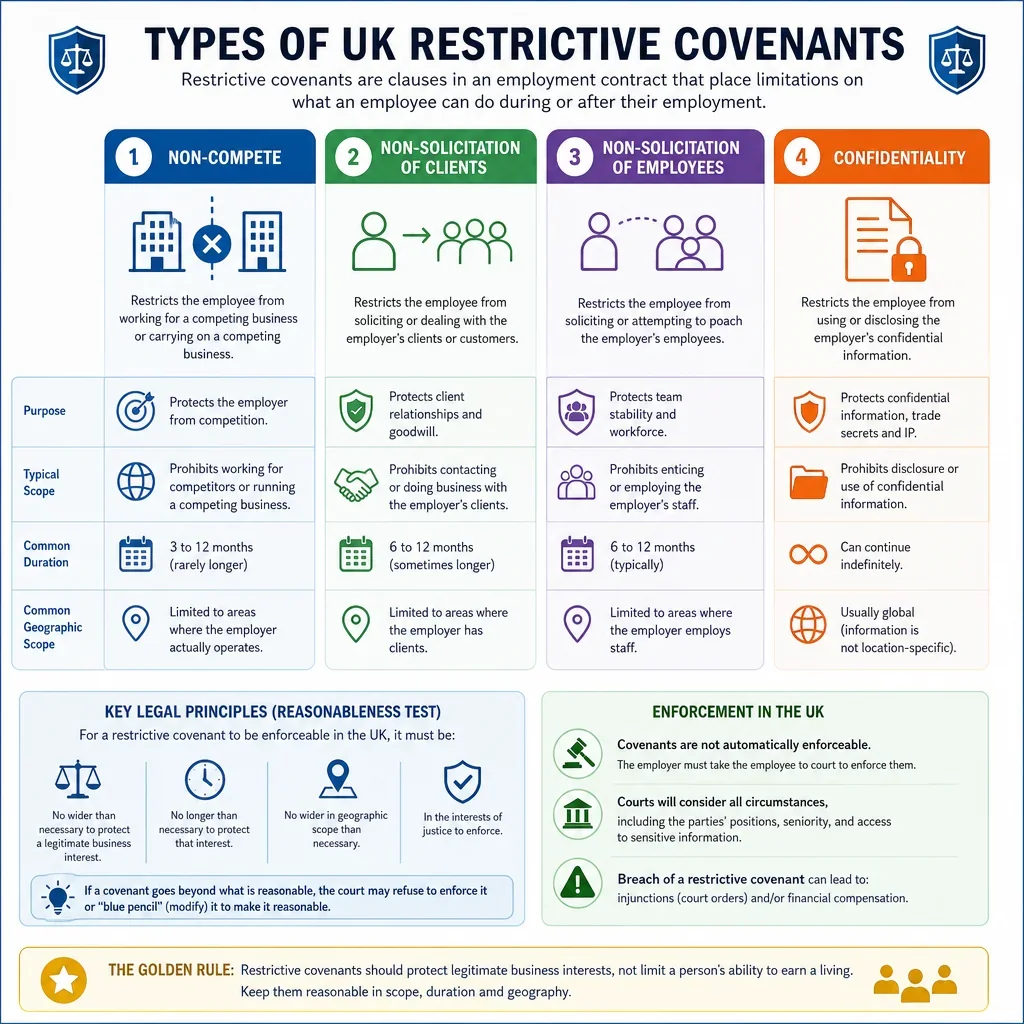
UK non-compete and restrictive covenant clauses are most likely to be enforceable where they protect a specific legitimate business interest, such as customer relationships, confidential information, trade secrets, goodwill, workforce stability, supplier relationships or strategic business information. A restriction aimed only at preventing ordinary competition is high risk.
Which Evidence Helps Justify A Non-Compete Or Restrictive Covenant?
Useful evidence includes customer contact records, CRM notes, pricing access logs, confidential project documents, seniority and influence within the business, recruitment responsibilities, supplier negotiations, and documented exposure to trade secrets or strategic plans. The evidence should show why this particular worker could harm this particular interest after leaving.
When Is A Non-Compete More Difficult To Justify?
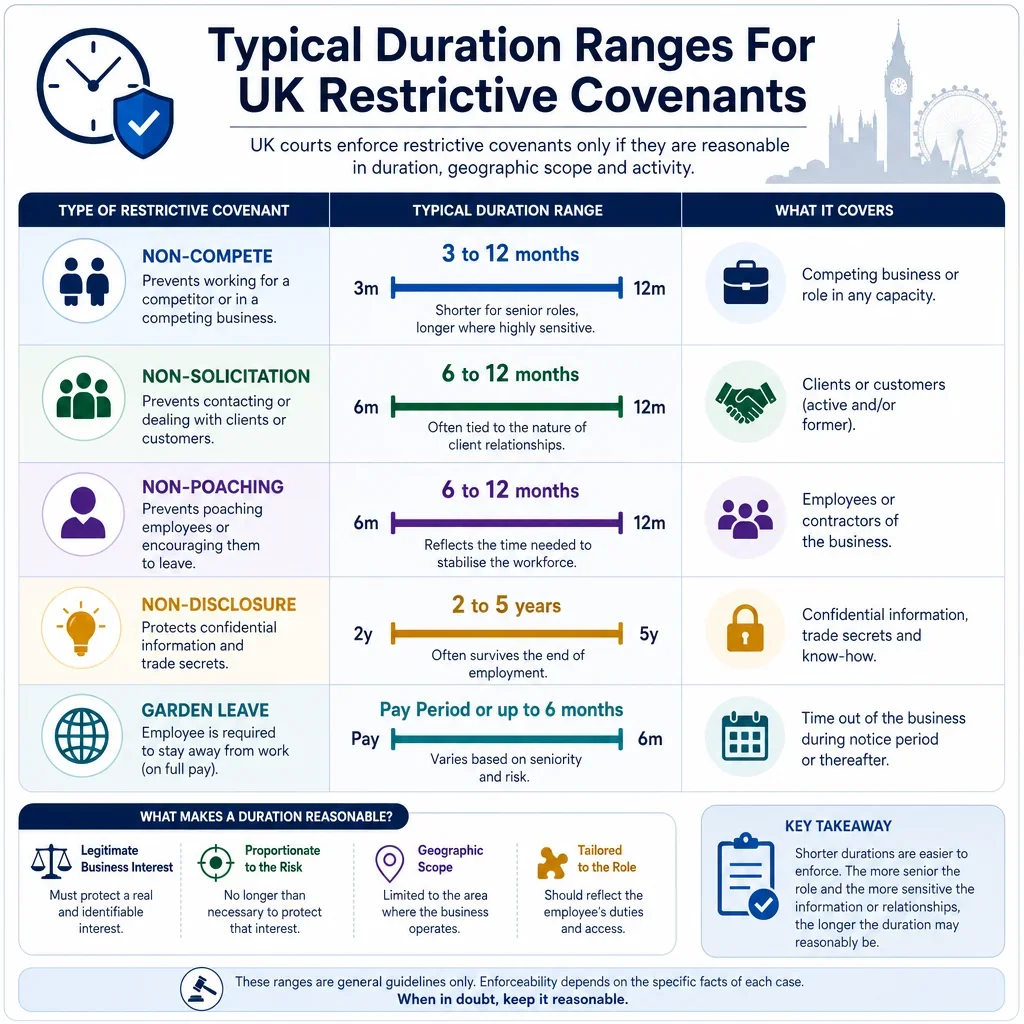
A non-compete is usually the most intrusive option. It is more vulnerable where a narrower clause, such as non-solicitation, non-dealing, confidentiality, garden leave or non-poaching, would protect the interest. Duration, geography, client scope and role scope should be no wider than necessary.
How Should Employers Match Clauses To Protected Interests?
- Customer relationships: often better protected by non-solicitation or non-dealing clauses than a broad non-compete.
- Trade secrets and confidential information: may support confidentiality, garden leave and, in exceptional cases, a narrow non-compete.
- Workforce stability: is usually addressed by non-poaching clauses targeting key staff, not blanket restrictions.
- Goodwill from a business sale: can justify stronger restraints than an ordinary employment covenant, especially where the seller received value for goodwill.

FAQs
You Might Also Be Interested In