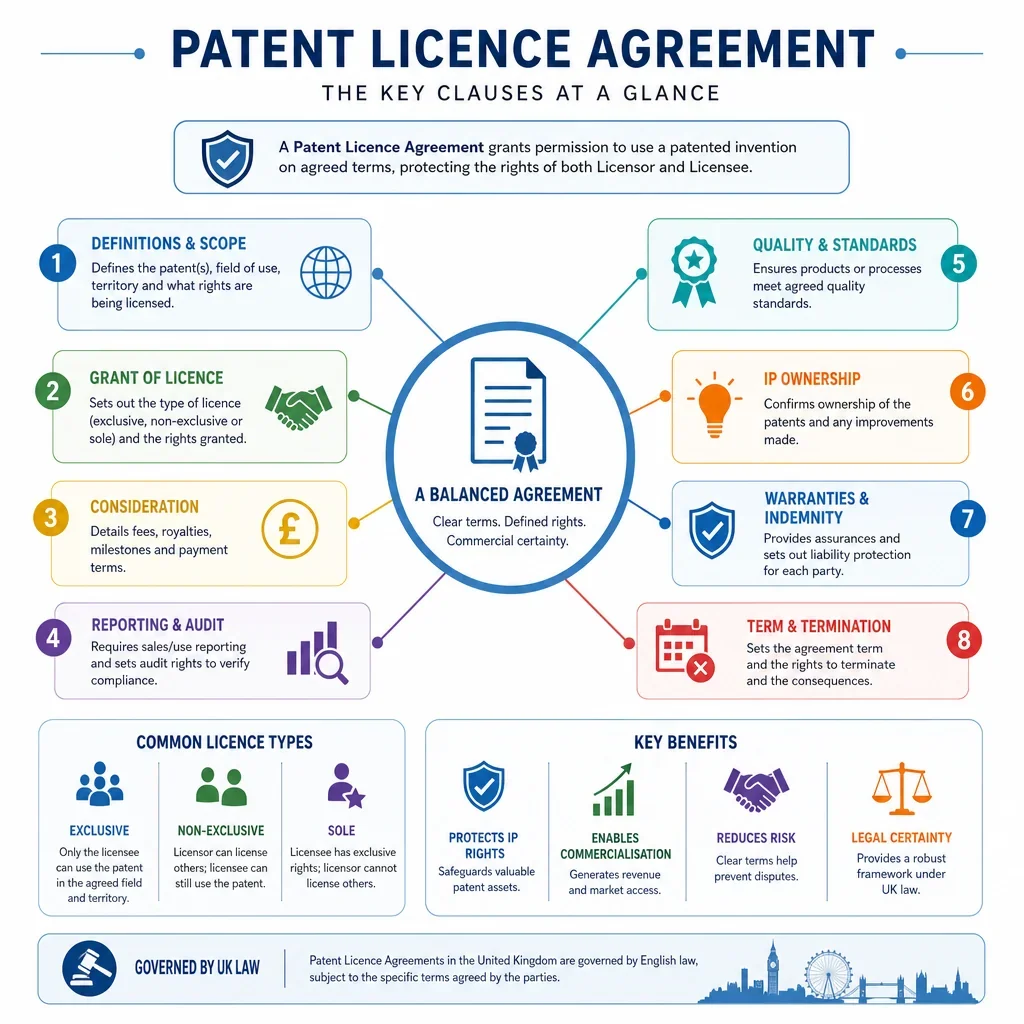
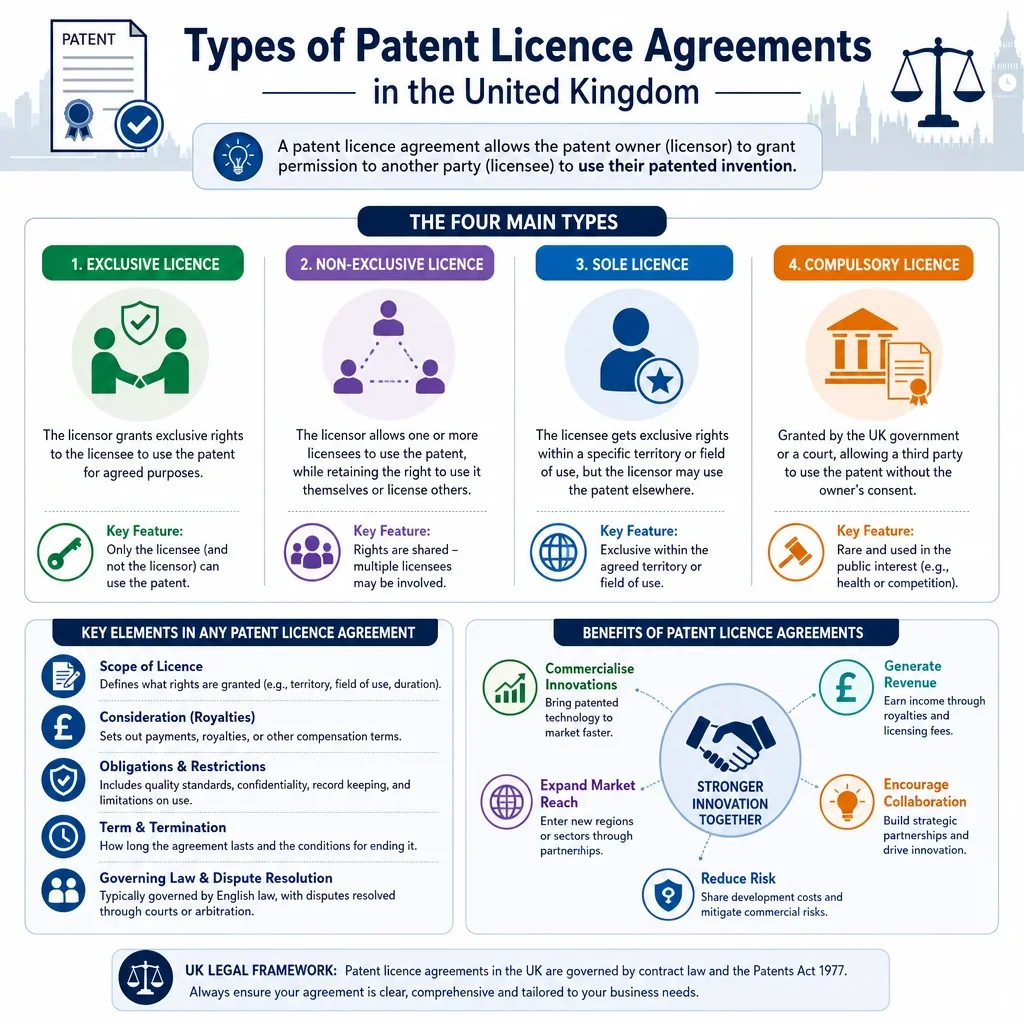
Types Of Patent Licence Agreements In The United Kingdom
Description | Licensee control level | Licensor retained rights | Common use cases |
|---|---|---|---|
Exclusive licence | |||
Only the licensee may use the patent rights within the agreed scope, usually excluding even the patent owner unless reserved. | High | Low | Major commercialisation deals, spin-outs, product launches needing exclusivity, investor-backed exploitation. |
Sole licence | |||
The licensee is the only third-party licensee, but the patent owner usually keeps the right to use the patent. | Medium | Medium | Strategic partner deals where the owner wants one licensee but still needs internal use rights. |
Non-exclusive licence | |||
The patent owner may grant the same or similar rights to multiple licensees and may also use the patent itself. | Low | High | Standard technology access, low-cost volume licensing, broad market adoption, non-core patents. |
Field-limited licence | |||
Rights are limited to a defined field, such as a product category, industry sector or technical application. | Medium | Medium | Licensing one invention separately for medical, industrial, consumer or agricultural applications. |
Territory-limited licence | |||
Rights are restricted to specified countries, regions or markets covered by the licensed patent rights. | Medium | Medium | International roll-outs, local distributors, regional manufacturing partners, country-by-country patent portfolios. |
Research-only licence | |||
Permits limited use of the patented technology for research, evaluation or experimentation, not commercial sale. | Low | High | University collaborations, feasibility studies, due diligence testing, early-stage R&D access. |
Manufacturing licence | |||
Allows the licensee to make patented products or use patented processes, often subject to quality and volume controls. | Medium | Medium | Outsourced production, contract manufacturing, scale-up, local manufacture for regulated or supply-chain reasons. |
Distribution licence | |||
Allows sale, offer for sale, import or distribution of patented products, usually without manufacturing rights. | Low | High | Channel partners, resellers, importers, sector-specific distributors and regional sales arrangements. |
Cross-licence | |||
Each party grants patent rights to the other, often to avoid infringement claims or enable combined technology use. | Medium | Medium | Patent thickets, settlement agreements, joint development, standards implementation and freedom-to-operate deals. |
Field-limited licence | |||
Exclusive rights are granted only within a defined field, while the patent owner keeps other fields open. | High | Medium | One licensee takes healthcare uses while the owner licenses industrial or consumer uses separately. |
Non-exclusive rights are limited to a defined market or technical field, with parallel licensing preserved. | Low | High | Platform technologies licensed to many industry participants under sector-specific terms. |
Territory-limited licence | |||
The licensee receives exclusive rights in a specified territory, while other territories remain reserved or separately licensed. | High | Medium | UK-only, EU-only or country-specific launch rights handled by local commercial partners. |
The licensee may exploit the patent in a defined territory, but the owner can appoint others or trade there too. | Low | High | Multiple regional resellers, pilot markets, limited sales territories and non-exclusive importer arrangements. |
One third-party licensee is appointed for a territory, but the patent owner keeps its own exploitation rights there. | Medium | Medium | Regional partner deals where the owner retains direct key-account or online sales rights. |
Research-only licence | |||
A narrow licence for testing or evaluation before deciding whether to negotiate commercial rights. | Low | High | Technical due diligence, proof-of-concept trials, investor review and pre-licence feasibility work. |
Permits research use by a university or research body, often with limits on publication, confidentiality and improvements. | Low | High | Sponsored research, university-industry collaborations and grant-funded non-commercial projects. |
Manufacturing licence | |||
Authorises a manufacturer to make patented products for the licensor or customer, usually without independent sales rights. | Low | High | Contract manufacturing, toll manufacturing, private-label supply and production outsourcing. |
Allows manufacturing plus associated commercial exploitation, subject to territory, field, quality and royalty terms. | Medium | Medium | Scale-up partners, licensed production plants, technology transfer and local manufacturing programmes. |
Distribution licence | |||
Grants protected distribution rights for patented products, commonly excluding rights to make or modify them. | Medium | Medium | Exclusive channel partners, specialist sector distributors and national sales appointments. |
Allows distribution of patented products without exclusivity, usually alongside other distributors or direct sales. | Low | High | Reseller networks, online channels, import arrangements and low-commitment market entry. |
Cross-licence | |||
Mutual patent permissions reduce infringement risk where each party needs access to the other’s patent portfolio. | Medium | Medium | Freedom-to-operate settlements, overlapping patents, competing products and patent thickets. |
A reciprocal licence used to settle or avoid patent litigation, sometimes with balancing payments or covenants not to sue. | Medium | Medium | Patent infringement settlements, portfolio disputes, product clearance and coexistence arrangements. |
Exclusive licence | |||
An exclusive licensee may have statutory rights to bring patent infringement proceedings in its own name in the UK. | High | Low | Exclusive commercialisation where the licensee needs enforcement standing against infringers. |
UK patent licences and exclusive rights can be registered, affecting public notice and some infringement remedies. | High | Low | UK patent licensing where the licensee wants the licence recorded on the patents register. |
Manufacturing licence | |||
The licence should match the patented acts needed, such as making, disposing of, offering, using or importing the invention. | Medium | Medium | Drafting manufacturing, import, sales and process-use permissions under UK patent rights. |
Distribution licence | |||
Distribution rights usually cover selling, offering to sell, keeping or importing patented products within the licensed scope. | Low | High | Authorised importers, sales agents and distributors of patented goods in the UK market. |
Research-only licence | |||
Research-only terms should be drafted against the UK experimental use exception and any commercial-use restrictions. | Low | High | Non-commercial experiments, evaluation work and research collaborations involving patented inventions. |
Non-exclusive licence | |||
Non-exclusive licensing supports wider access but restrictions on price, customers or markets may need competition-law review. | Low | High | Multi-licensee technology access, FRAND-style licensing and broad commercial availability. |
Territory-limited licence | |||
Territory limits allocate markets, but sales restrictions and parallel trade controls should be checked under competition law. | Medium | Medium | Country-by-country licensing, regional exclusivity and international distribution structures. |
Field-limited licence | |||
Field limits and exclusivity terms should avoid agreements that prevent, restrict or distort competition in the UK. | Medium | Medium | Patent licences with market allocation, exclusivity, pricing, output or customer restrictions. |
Manufacturing licence | |||
Gives the licensee exclusive rights to make patented products within a defined territory, field or product line. | High | Low | Dedicated factory investment, technology transfer, regulated production and supply-chain localisation. |
Exclusive licence | |||
An exclusive licence may include rights to grant sublicences, extending the licensee’s commercial control over downstream users. | High | Low | Master licence structures, global commercialisation, platform roll-outs and group-company exploitation. |
Non-exclusive licence | |||
A narrow non-exclusive licence often bars sublicensing and limits use to the named licensee’s own operations. | Low | High | Internal business use, evaluation-to-commercial conversion, supplier access and limited operational permissions. |
Cross-licence | |||
Each party licenses existing patents and may agree access to future improvements or continuation patents. | Medium | Medium | Joint development, interoperability projects, co-created products and technology roadmaps. |
Exclusive licence | |||
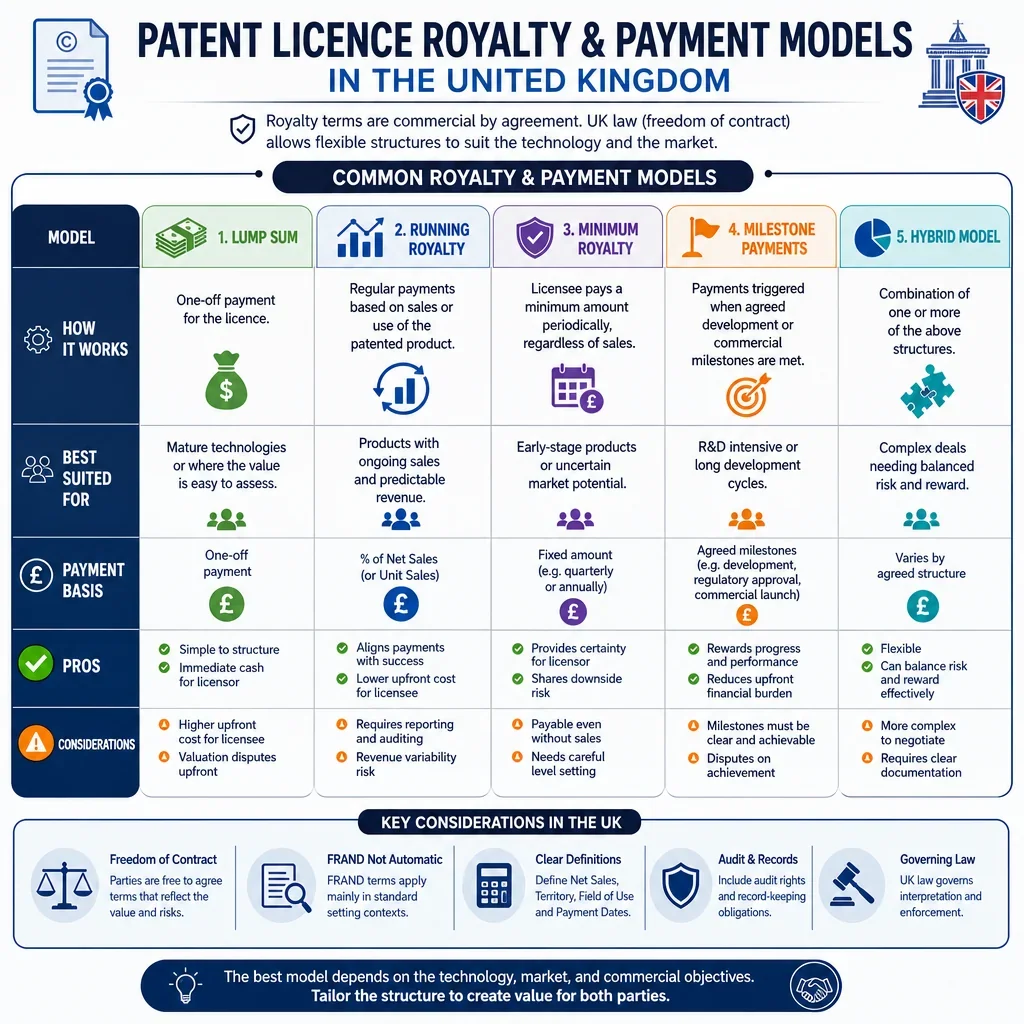
Exclusive rights are granted in return for royalties, often with minimum sales, milestones or diligence obligations. | High | Low | Life sciences licensing, university technology transfer, high-value product commercialisation and start-up spin-outs. |
Non-exclusive licence | |||
Multiple licensees may use the patent in return for royalties, with the owner preserving broad licensing freedom. | Low | High | Portfolio monetisation, industry-wide access, routine product permissions and standard licence programmes. |
A paid-up licence grants ongoing rights after a one-off fee or settlement payment, usually without running royalties. | Low | High | Settlement deals, legacy products, low-administration licences and portfolio clean-up arrangements. |
Distribution licence | |||
Distribution rights are exclusive for a defined sector or product line, but not for all patent applications. | Medium | Medium | Specialist distributors for healthcare, industrial, defence, construction or consumer channels. |
Manufacturing licence | |||
Manufacturing is allowed only in specified countries or sites, with sales territories dealt with separately. | Medium | Medium | Local production, tax or supply-chain planning, regulated manufacturing and regional outsourcing. |
Distribution licence | |||
Covers import and resale of patented goods, while excluding rights to manufacture or modify patented products. | Low | High | UK importers, wholesalers, online resellers and downstream distribution chains. |
Manufacturing licence | |||
Allows use of a patented process and, where relevant, dealing in products obtained directly by that process. | Medium | Medium | Chemical, pharmaceutical, manufacturing-method, diagnostics and materials processing technologies. |
Non-exclusive licence | |||
A non-exclusive structure may support broad access to patents needed for interoperability or industry standards. | Low | High | Standards-based technology, interoperability, telecommunications, connected devices and platform ecosystems. |
Field-limited licence | |||
A platform patent is licensed separately by vertical market, allowing multiple tailored commercialisation paths. | Medium | Medium | AI hardware, diagnostics, materials, sensors, biotech tools and manufacturing platforms. |
Cross-licence | |||
Each party licenses a portfolio of patents, often with schedules, exclusions and defined technology areas. | Medium | Medium | Large technology companies, patent pools, complex products and multi-jurisdictional clearance. |
Exclusive licence | |||
Exclusive rights apply for a fixed period or until milestones fail, after which rights may become non-exclusive. | High | Medium | Launch windows, development milestones, clinical programmes and market-entry commitments. |
Research-only licence | |||
Research rights are paired with an option to negotiate or take a later commercial licence if results justify it. | Low | High | Early-stage evaluation, sponsored trials, university IP pipelines and investor-led diligence. |
Which Patent Licence Type Is Usually Best In The UK?
Exclusive licences give the licensee the strongest commercial position but usually require tighter drafting, especially around whether the patent owner may still use the invention. In the UK, an exclusive licensee may have statutory rights to bring infringement proceedings in certain circumstances, so exclusivity should be recorded clearly and the licence should usually be registered at the UK Intellectual Property Office.
How Do Field And Territory Limits Affect A Patent Licence?
Field-limited and territory-limited licences let a patent owner split rights by application area or geography. This can support multiple revenue streams, but the agreement should define the licensed field, excluded fields, countries, channels, sublicensing rights and enforcement responsibilities precisely.
When Is A Non-Exclusive Patent Licence More Practical?
Non-exclusive licences are often suitable where the patent owner wants to license the same technology to several users, such as standards, platform technology or low-value volume licensing. They normally give the licensee less control and leave the licensor with high retained rights.
What UK Legal Points Should Be Checked Before Signing?
- Registration: UK patent transactions and exclusive licences can be registered. Failure to register may affect remedies for infringement before registration.
- Competition law: patent licences should avoid restrictions that unlawfully limit competition, especially around pricing, market sharing, output restrictions or post-term restrictions.
- Enforcement: the agreement should state who controls infringement actions, who pays, who receives recoveries and whether the licensee can act if the patent owner does not.
- Scope: each licence type should define territory, field, duration, permitted acts, royalties, sublicensing, improvements, confidentiality and termination consequences.
FAQs
You Might Also Be Interested In