

Tenancy Types And Section 13 Notice Suitability In The UK
Created:
Understand which tenancies can use a Section 13 notice and why suitability matters before proposing a rent increase. This guide supports landlords and tenants using AI Generated British Section 13 Notice resources.
Tenancy Type | Reason | Arrangement Category | Alternative Method | Jurisdiction |
|---|---|---|---|---|
Usually not suitable | ||||
Assured shorthold tenancy - fixed term | Section 13 is for periodic assured tenancies, not ordinary fixed-term increases. | Fixed term | Use a rent review clause or written agreement. | England |
Usually suitable | ||||
Assured shorthold tenancy - statutory periodic | A periodic AST can usually be increased by prescribed Section 13 notice. | Periodic | Tenant agreement or valid contractual review clause. | England |
May be suitable | ||||
Assured shorthold tenancy - contractual periodic | Suitable if no contractual rent review mechanism already applies. | Periodic | Follow the contractual rent review clause. | England |
Usually not suitable | ||||
Assured tenancy - fixed term | Section 13 generally applies after the tenancy is periodic. | Fixed term | Use rent review clause or agree a variation. | England |
Usually suitable | ||||
Assured tenancy - periodic | Section 13 covers periodic assured tenancies if statutory conditions are met. | Periodic | Tenant agreement or contractual review clause. | England |
Monthly rolling assured shorthold tenancy | A monthly periodic AST is a common Section 13 use case. | Periodic | Agree new rent in writing. | England |
Weekly periodic assured shorthold tenancy | Section 13 can apply, with minimum notice aligned to periodic rules. | Periodic | Written agreement or contractual review process. | England |
Quarterly periodic assured shorthold tenancy | Section 13 may be used for periodic assured tenancies paid quarterly. | Periodic | Agree new rent or follow contract. | England |
Yearly periodic assured shorthold tenancy | Section 13 can apply, but longer statutory notice may be needed. | Periodic | Agree rent or use contractual review clause. | England |
May be suitable | ||||
Periodic AST with rent review clause | Section 13 is generally displaced where a valid review clause applies. | Periodic | Use the agreed rent review mechanism. | England |
AST with agreed rent increase | Section 13 is unnecessary if the tenant validly agrees the new rent. | Other | Record the agreed variation in writing. | England |
Usually suitable | ||||
AST after fixed term has expired | Often becomes statutory periodic, allowing Section 13 if no clause controls rent. | Periodic | Renew tenancy at a new rent. | England |
Usually not suitable | ||||
New replacement AST at higher rent | A new tenancy can set the new rent without Section 13. | Fixed term | Grant a new tenancy agreement. | England |
May be suitable | ||||
Assured agricultural occupancy | May be assured, but agricultural status and rent rules need checking. | Other | Specialist agricultural tenancy advice. | England |
Usually not suitable | ||||
Regulated tenancy under the Rent Act 1977 | Rent Act tenancies usually use fair rent registration, not Section 13. | Regulated or protected | Apply for registered fair rent. | England |
Protected tenancy | Protected tenancies are outside the ordinary Housing Act 1988 route. | Regulated or protected | Fair rent registration process. | England |
Rent Act statutory tenancy | Rent is normally controlled by registered fair rent rules. | Regulated or protected | Register or re-register a fair rent. | England |
Not applicable | ||||
Secure council tenancy | Secure public-sector tenancies are not assured tenancies. | Other | Council rent-setting and statutory consultation rules. | England |
Flexible council tenancy | It is a form of secure tenancy, not an assured tenancy. | Fixed term | Council rent-setting process. | England |
Introductory council tenancy | Public-sector introductory tenancies are outside Section 13. | Other | Council rent-setting process. | England |
Demoted tenancy | Demoted social tenancies are not ordinary assured periodic tenancies. | Other | Social landlord rent-setting rules. | England |
May be suitable | ||||
Housing association assured tenant | Can be assured, but social rent and tenancy terms must be checked. | Periodic | Tenancy rent review provisions or social rent policy. | England |
Housing association assured shorthold tenant | Section 13 may apply if the tenancy is periodic and assured. | Periodic | Contractual review or social landlord rent policy. | England |
Housing association starter tenancy | Often an AST, but provider terms usually control rent changes. | Other | Provider rent review process. | England |
Not applicable | ||||
Excluded tenancy | Excluded occupiers are not usually assured tenants. | Licence | Licence fee variation or new licence terms. | England |
Lodger living with resident landlord | A lodger is usually an excluded licensee, not an assured tenant. | Licence | Change licence fee by agreement or licence terms. | England |
Occupier with basic protection | This status is outside the assured tenancy rent increase regime. | Licence | Contractual fee change or negotiated variation. | England |
Usually not suitable | ||||
Service occupancy tied to employment | Occupation may be a licence linked to employment, not an assured tenancy. | Licence | Employment contract or occupational licence terms. | England |
May be suitable | ||||
Service tenancy | May be assured if a true tenancy and Housing Act criteria are met. | Other | Check employment and tenancy terms. | England |
Not applicable | ||||
Company let | A company cannot occupy as its only or principal home. | Other | Contractual rent review or new agreement. | England |
High-rent residential tenancy above assured limit | Tenancies above the statutory rent limit cannot be assured. | Other | Contractual rent review or negotiated variation. | England |
Low-rent tenancy below assured limit | Very low-rent tenancies are excluded from assured status. | Other | Contractual variation or specialist advice. | England |
Usually not suitable | ||||
Tenancy with resident landlord in same building | Resident landlord arrangements are often excluded from assured status. | Licence | Use agreement terms or negotiate variation. | England |
Not applicable | ||||
Holiday let | Holiday lettings are excluded from assured tenancy status. | Licence | Set new holiday booking price or licence fee. | England |
Student accommodation in university halls | Certain student lettings by specified institutions are excluded from assured status. | Licence | Accommodation contract fee terms. | England |
May be suitable | ||||
Private student house AST | May be an AST Section 13 only fits if periodic. | Fixed term | New fixed-term tenancy at revised rent. | England |
Private purpose-built student accommodation | Status depends on whether it is an assured tenancy or licence. | Other | Contract pricing or renewal terms. | England |
HMO room let on individual AST | Suitable if the room tenancy is assured and periodic. | Periodic | Contractual review or written agreement. | England |
HMO let on joint AST | May apply to the joint periodic tenancy as a whole. | Periodic | Joint written agreement or renewal tenancy. | England |
Usually suitable | ||||
Joint periodic assured shorthold tenancy | Notice should address the joint tenancy and all tenants correctly. | Periodic | Agreement by all joint tenants. | England |
Sole periodic assured shorthold tenancy | A standard periodic AST is the main Section 13 scenario. | Periodic | Written agreement to new rent. | England |
May be suitable | ||||
Private registered provider assured tenancy | Can be assured, but provider rent rules and agreement may override. | Periodic | Provider rent review and regulatory rent policy. | England |
Usually not suitable | ||||
Protected agricultural occupancy | Protected agricultural occupiers have specialist statutory protection. | Regulated or protected | Specialist agricultural rent process. | England |
Not applicable | ||||
Business tenancy | Commercial tenancies are not assured residential tenancies. | Other | Commercial lease rent review clause. | England |
May be suitable | ||||
Mixed residential and business occupation | Status depends on dominant purpose and whether Housing Act criteria apply. | Other | Lease rent review or specialist advice. | England |
Periodic assured subtenancy | A subtenancy can be assured if statutory conditions are met. | Periodic | Head-tenant landlord agreement or contract terms. | England |
Unauthorised residential subtenant | Status is fact-specific lawful landlord and assured status must be checked. | Other | Specialist advice before increasing rent. | England |
Not applicable | ||||
Crown tenancy | Certain Crown tenancies are excluded from assured status. | Other | Terms of Crown tenancy or statutory scheme. | England |
Asylum support accommodation | Accommodation is support-based and not an ordinary assured tenancy. | Licence | Home Office support arrangements. | England |
Usually not suitable | ||||
Hostel accommodation licence | Hostel occupiers are often licensees rather than assured tenants. | Licence | Licence fee terms or provider policy. | England |
Supported housing licence | Supported occupiers may be licensees, not periodic assured tenants. | Licence | Support provider licence fee process. | England |
May be suitable | ||||
Supported housing assured tenancy | May qualify if it is a true periodic assured tenancy. | Periodic | Tenancy rent review and support funding rules. | England |
Usually not suitable | ||||
Almshouse occupier | Almshouse residents are commonly licensees, not assured tenants. | Licence | Maintenance contribution or licence terms. | England |
Not applicable | ||||
Mobile home pitch agreement | Pitch fee reviews use the mobile homes statutory regime. | Other | Pitch fee review notice and Mobile Homes Act rules. | England |
Houseboat mooring agreement | Mooring agreements are not assured residential tenancies of a dwelling-house. | Licence | Mooring agreement fee review terms. | England |
Tolerated trespasser or unauthorised occupier | No assured tenancy exists to vary by Section 13. | Other | Regularise occupation or seek possession advice. | England |
Informal family occupation without tenancy | Section 13 requires an assured tenancy, not informal permission. | Licence | Create written agreement or vary family arrangement. | England |
Standard occupation contract | Wales uses Renting Homes occupation contracts, not Section 13. | Other | Use Renting Homes rent variation notice process. | Wales |
Periodic standard occupation contract | Rent increases use Welsh contract-holder notice rules, not Section 13. | Periodic | RHWall prescribed rent variation notice. | Wales |
Fixed-term standard occupation contract | Welsh fixed-term contract terms govern rent variation. | Fixed term | Use contract rent review term or agree variation. | Wales |
Secure occupation contract | Secure Welsh contracts follow Renting Homes rules, not Housing Act Section 13. | Other | Welsh statutory rent variation notice. | Wales |
Converted Welsh AST occupation contract | Existing Welsh tenancies converted to occupation contracts from December 2022. | Other | Renting Homes Wales rent variation process. | Wales |
Private residential tenancy | Scotland uses PRT rent increase notices, not Section 13. | Periodic | Scottish rent-increase notice for PRTs. | Scotland |
Short assured tenancy | Scottish assured tenancy law has separate rent rules. | Fixed term | Scottish contractual or statutory rent review route. | Scotland |
Scottish assured tenancy | Section 13 of the English Housing Act 1988 does not apply in Scotland. | Periodic | Scottish rent review procedures. | Scotland |
Scottish regulated tenancy | Scottish regulated tenancies use fair rent rules. | Regulated or protected | Scottish fair rent registration. | Scotland |
Scottish secure tenancy | Scottish social tenancies have separate statutory rent rules. | Other | Social landlord rent-setting and consultation. | Scotland |
Northern Ireland private tenancy | Northern Ireland has separate private tenancy legislation. | Other | Northern Ireland tenancy agreement and statutory rent rules. | Northern Ireland |
Northern Ireland protected tenancy | Protected tenancies in NI use controlled rent and protected tenancy rules. | Regulated or protected | NI controlled rent or rent officer process. | Northern Ireland |
Northern Ireland statutory tenancy | NI statutory tenancies are governed by separate Rent Order rules. | Regulated or protected | Rent officer or controlled rent mechanism. | Northern Ireland |
Northern Ireland Housing Executive tenancy | NI social housing rent increases are outside Section 13. | Other | NIHE rent-setting process. | Northern Ireland |
Northern Ireland housing association tenancy | NI housing association tenancies do not use English Section 13 notices. | Other | Association rent policy and NI tenancy rules. | Northern Ireland |
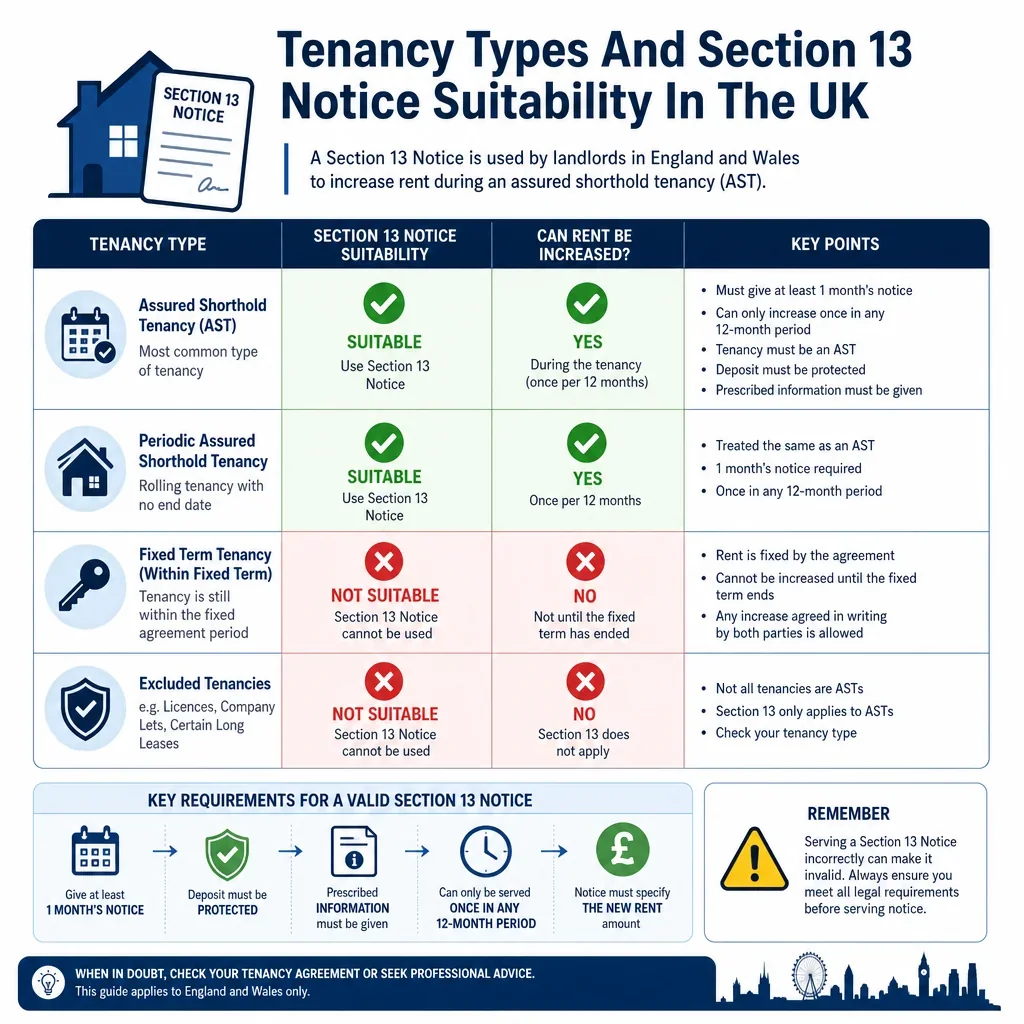
When Is A Section 13 Notice Suitable For A Rent Increase?
A Section 13 notice is mainly an England-only mechanism for increasing rent under an assured or assured shorthold tenancy that is periodic. It is usually suitable where the fixed term has ended and the tenancy is continuing weekly, monthly, quarterly or yearly, and there is no effective rent review clause already governing the increase.
When Should Landlords Avoid Using A Section 13 Notice?
- During a fixed term: a Section 13 notice is usually not suitable unless the tenancy has become periodic; landlords should rely on a valid rent review clause or agree a variation.
- Where the occupier is a licensee or lodger: Section 13 is usually not applicable because the arrangement is not normally an assured tenancy.
- In Wales, Scotland and Northern Ireland: Section 13 is generally not the correct process; separate statutory rules apply.
- For regulated or protected tenancies: fair rent registration or specialist statutory rules are usually relevant instead.
What Is The Main Practical Risk?
Using the wrong rent increase route can make the proposed increase ineffective and may give the tenant grounds to challenge it. For England, landlords should first identify the tenancy type, check whether it is periodic, and review the agreement for any rent review clause before using a Section 13 notice.
Want to Generate Your own Section 13 Notice?
Docaro AI can help you write your own Section 13 Notice for use in the United Kingdom in minutes.
FAQs
A Section 13 Notice can only be used to propose a rent increase for certain periodic assured or assured shorthold tenancies in England. It is not suitable for fixed-term tenancies unless the term has ended and the tenancy has become periodic.
Show All FAQs
You Might Also Be Interested In

UK guide to Section 13 notice requirements, procedure, timelines and key rules for lawful rent increases.
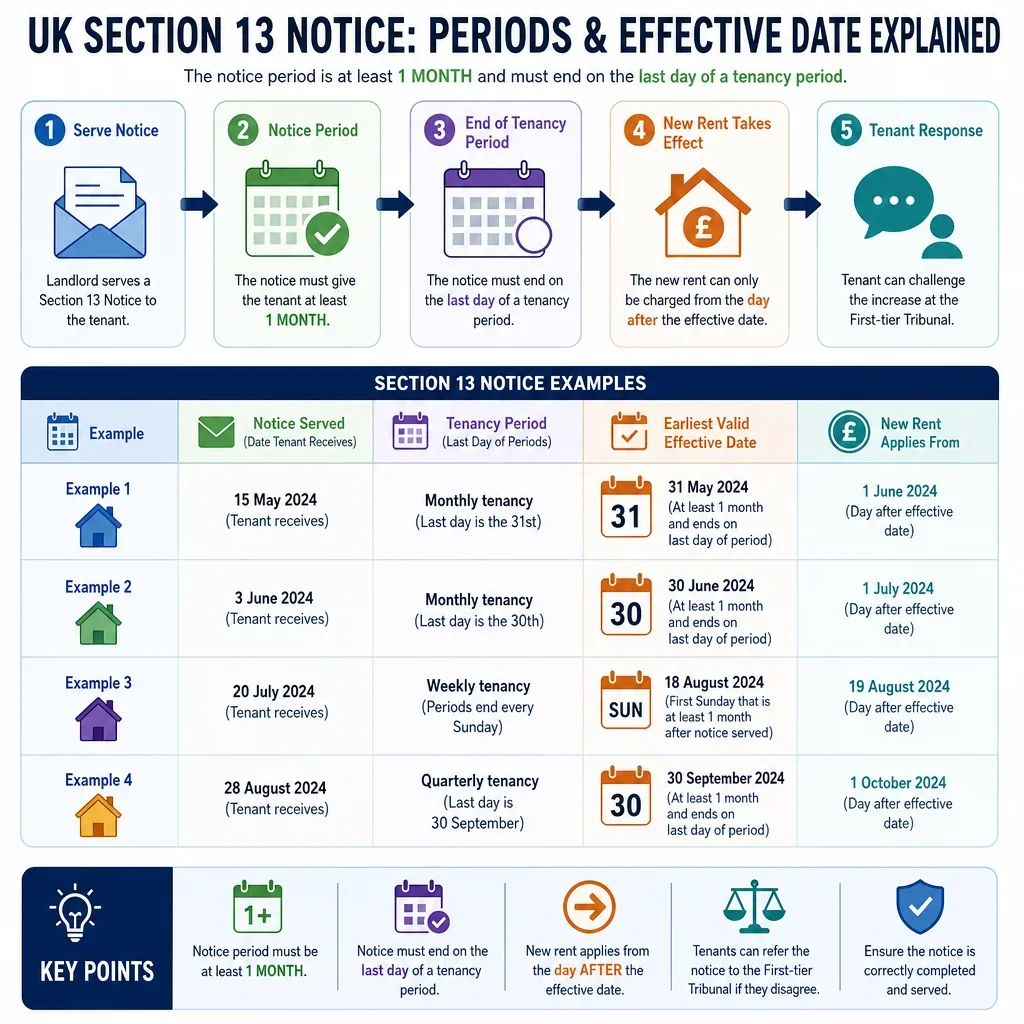
United Kingdom guide to Section 13 notice periods, effective dates, and compliant rent increase timing for landlords and tenants.
References and Information Sources
16.https://england.shelter.org.uk/housing_advice/council_housing_association/flexible_council_tenancies
20.https://england.shelter.org.uk/housing_advice/council_housing_association/demoted_council_tenancies