Section 13 Notice Requirements And Procedure In The UK
Requirement | Practical Explanation | Timing Rule | Jurisdiction | Source Reference |
|---|---|---|---|---|
Eligibility | ||||
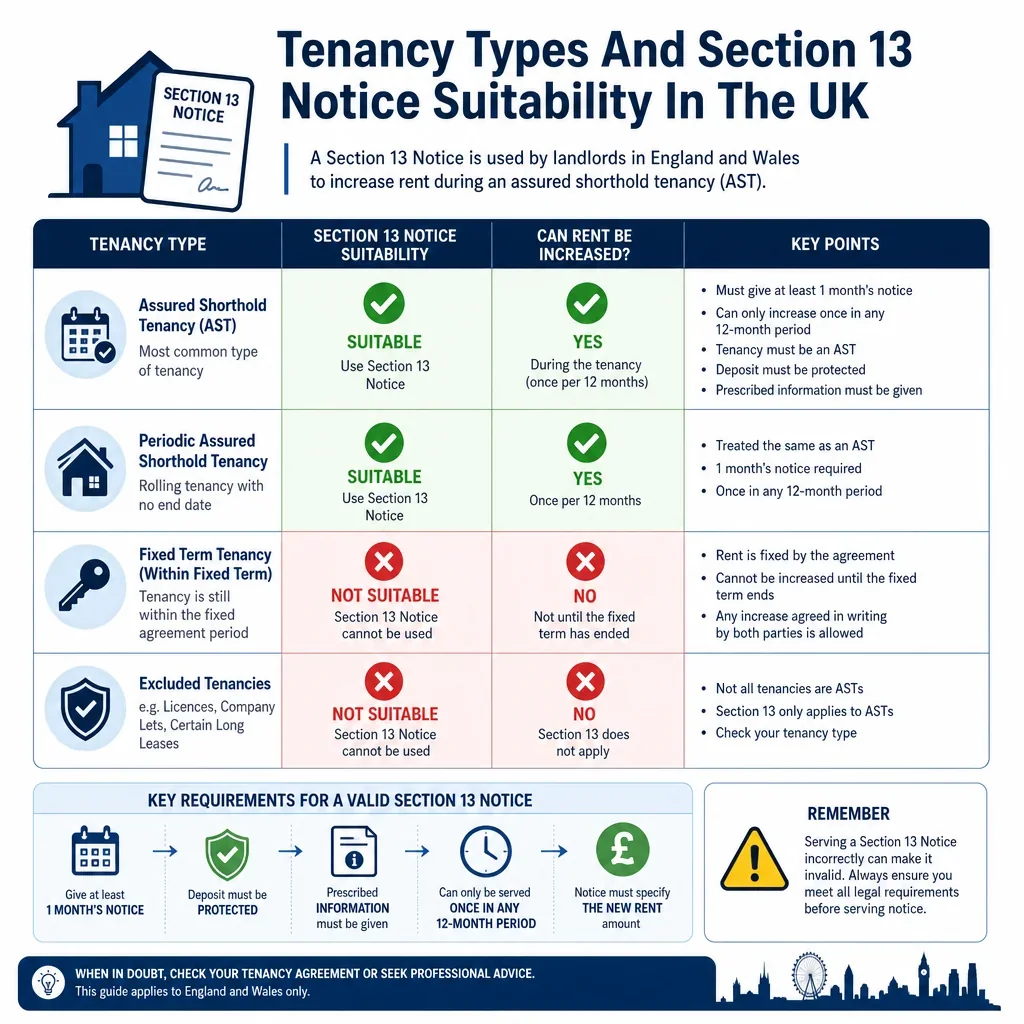
Tenancy must be assured or assured shorthold | Section 13 applies to assured tenancies, including most private assured shorthold tenancies. | Use only when the statutory conditions are met. | England and Wales | Housing Act 1988, section 13 |
Tenancy must normally be periodic | A Section 13 notice is used after a fixed term has ended and the tenancy continues periodically. | Do not serve before the tenancy is periodic. | England and Wales | Housing Act 1988, section 13(1) |
Restriction | ||||
Do not use during a fixed term | Rent cannot be increased by Section 13 while the fixed term is still running. | Wait until the fixed term has ended. | England and Wales | Housing Act 1988, section 13 |
No effective contractual rent review clause | If the agreement has a valid rent review mechanism, that mechanism should be used instead. | Check the tenancy agreement before service. | England and Wales | Housing Act 1988, section 13(1)(b) |
Contractual periodic rent terms may exclude Section 13 | A contractual periodic tenancy may require the landlord to follow agreed rent increase wording. | Follow the contract where it governs rent increases. | England and Wales | Housing Act 1988, section 13(1)(b) |
Notice Content | ||||
Use the prescribed Form 4 | The notice must be in the government-prescribed form for proposing a new rent. | Use the current form when serving notice. | England | Assured Tenancies and Agricultural Occupancies Forms (England) Regulations 2015, Form 4 |
Use the Welsh prescribed rent increase form where applicable | For Wales, use the relevant Welsh prescribed form or Renting Homes Wales process where applicable. | Use the Wales-specific current form before service. | Wales | Assured Tenancies and Agricultural Occupancies (Forms) (Wales) Regulations 2016 |
State the current rent and proposed new rent | The tenant must be able to see exactly what rent is being proposed. | Include before serving the notice. | England | Form 4, Assured Tenancies and Agricultural Occupancies Forms (England) Regulations 2015 |
State the rent period or frequency | The notice should say whether the rent is weekly, monthly, quarterly or yearly. | Include in the notice before service. | England | Prescribed Form 4 |
Identify the landlord | The notice should clearly name the landlord proposing the increase. | Include before service. | England | Prescribed Form 4 |
Identify the tenant | The notice should be addressed to the tenant or joint tenants. | Include before service. | England | Prescribed Form 4 |
Identify the rented property | The notice must make clear which dwelling the proposed rent applies to. | Include before service. | England | Prescribed Form 4 |
State the first date the new rent is payable | The notice must specify when the increased rent is intended to begin. | Date must comply with statutory notice periods. | England and Wales | Housing Act 1988, section 13(2) |
Timing | ||||
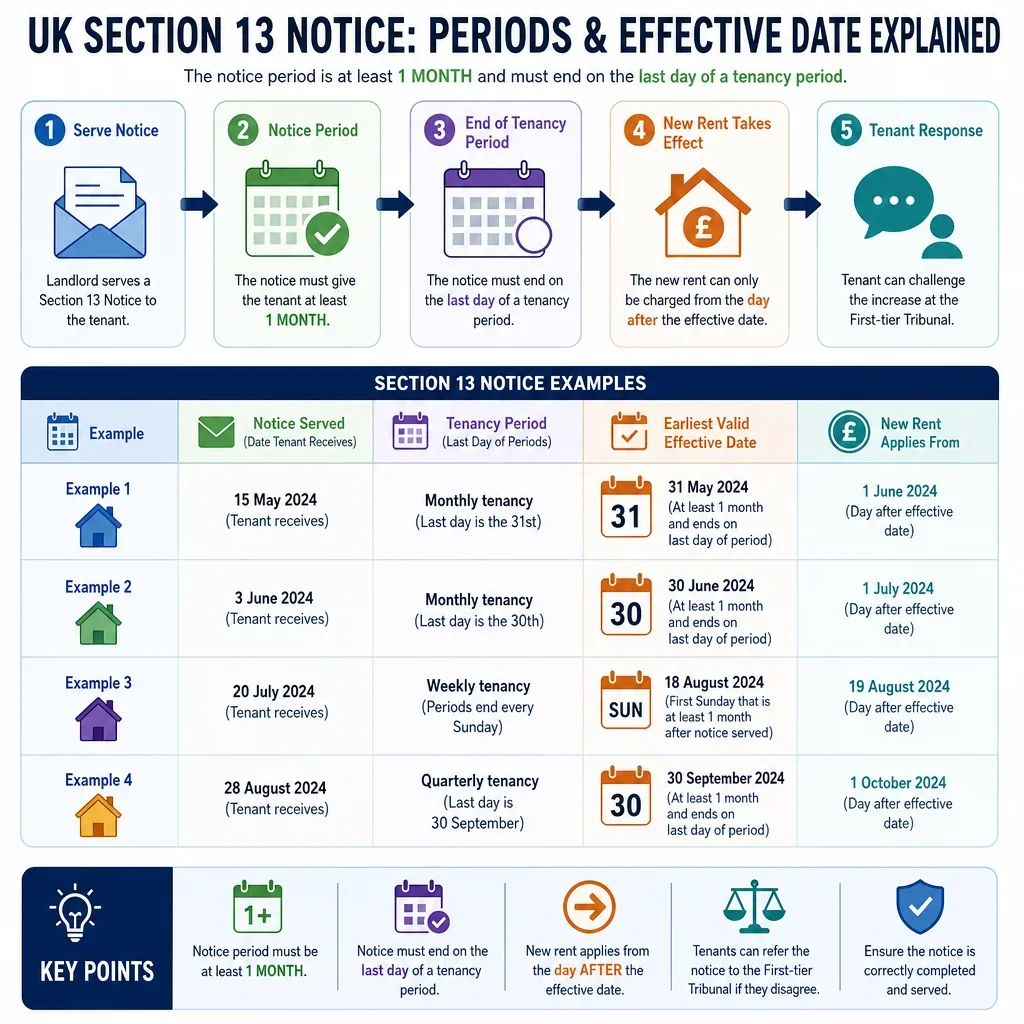
New rent should start on a new tenancy period | Choose the first day of a rental period, not a random mid-period date. | Start date must be after the required notice period. | England and Wales | Housing Act 1988, section 13(2) |
Give at least one month for monthly or shorter periods | Most monthly tenancies need at least one month between service and the increase date. | Minimum one month notice. | England and Wales | Housing Act 1988, section 13(2)(a) |
Give at least one month for quarterly tenancies | A quarterly rent period still usually requires at least one month notice. | Minimum one month notice. | England and Wales | Housing Act 1988, section 13(2)(a) |
Give at least six months for yearly tenancies | A yearly periodic tenancy needs much longer notice before the increase can start. | Minimum six months notice. | England and Wales | Housing Act 1988, section 13(2)(b) |
For other periods, notice must match the period length | If the rent period is unusual, the notice must be at least that period long. | Minimum equal to tenancy period. | England and Wales | Housing Act 1988, section 13(2)(c) |
Restriction | ||||
Only one Section 13 increase in any 52 weeks | A landlord generally cannot use repeated Section 13 notices within the same year. | At least 52 weeks since the last Section 13 increase. | England and Wales | Housing Act 1988, section 13(2) proviso |
Timing | ||||
First Section 13 increase usually needs 52 weeks from tenancy start | The first statutory increase is usually delayed until the tenancy has run for about a year. | Normally at least 52 weeks after tenancy start. | England and Wales | Housing Act 1988, section 13(2) proviso |
52-week start rule may not apply to some new periodic tenancies | Some statutory wording allows earlier increases for certain periodic tenancies. | Check section 13 exceptions before relying on 52 weeks. | England and Wales | Housing Act 1988, section 13(2) proviso |
Notice Content | ||||
Include prescribed notes explaining tenant rights | The form must tell the tenant how to challenge the proposed rent. | Include with the served notice. | England | Prescribed Form 4 notes |
Sign and date the notice | The landlord or authorised agent should sign and date the notice. | Sign before service. | England | Prescribed Form 4 |
Service | ||||
Agent may serve on landlord’s behalf if authorised | A letting agent can usually issue the notice if acting for the landlord. | Authority should exist before notice is served. | England and Wales | Official Form 4 practice |
Serve the notice in writing | An informal conversation or text is not enough for a Section 13 increase. | Written notice must be served before the increase date. | England and Wales | Housing Act 1988, section 13(2) |
Postal service is commonly permitted | A notice can often be served by properly addressing, pre-paying and posting it. | Allow delivery time before the statutory notice period expires. | England and Wales | Interpretation Act 1978, section 7 |
Check the tenancy agreement service clause | The agreement may specify where and how notices must be served. | Check before serving the notice. | England and Wales | Tenancy agreement notice provisions |
Keep evidence of service | Retain copies, posting proof or delivery records in case validity is disputed. | Record service on the day it happens. | England and Wales | Practical service evidence |
Address all joint tenants where possible | For joint tenancies, naming all tenants reduces the risk of challenge. | Serve before the proposed increase date. | England and Wales | General notice service practice |
Tenant Response | ||||
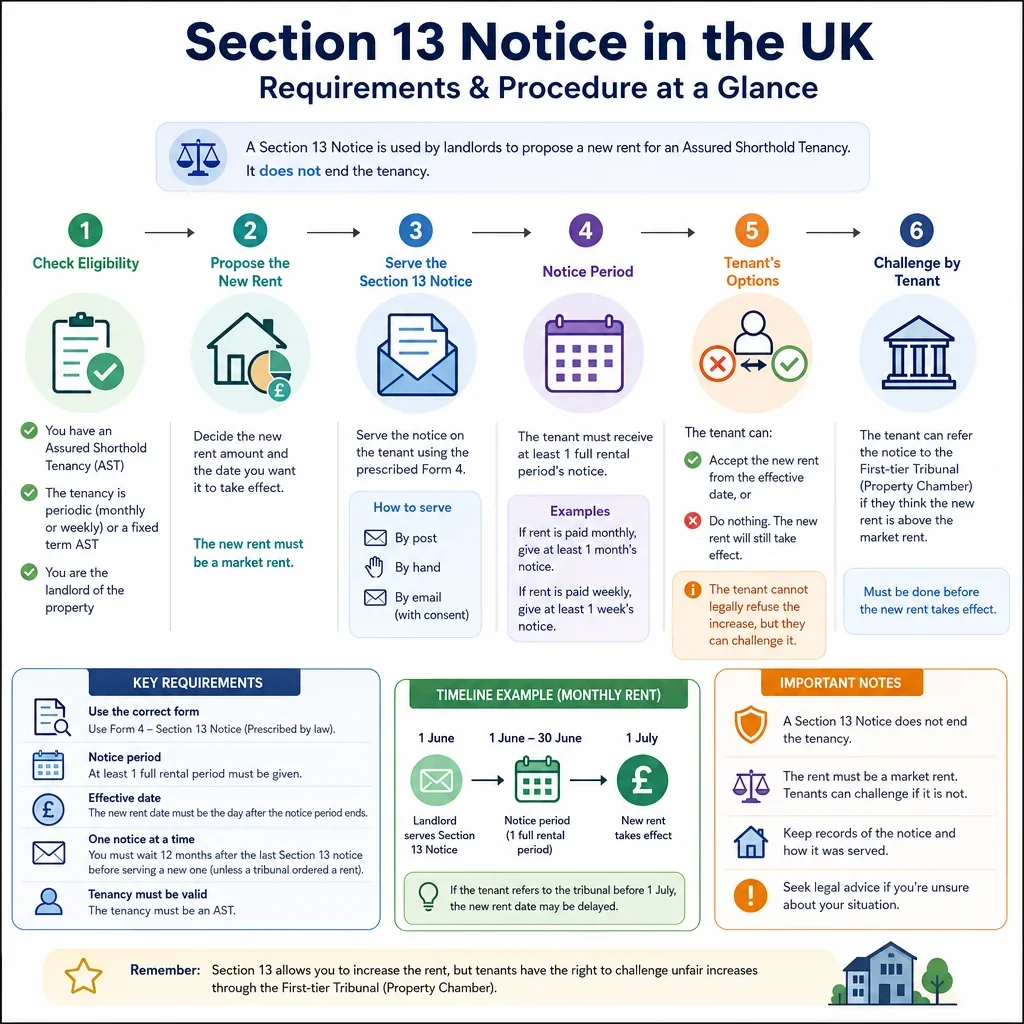
Tenant may challenge at the tribunal | The tenant can ask the tribunal to decide the market rent. | Apply before the proposed rent start date. | England and Wales | Housing Act 1988, section 13(4) |
Tribunal application must be made before the increase date | If the tenant misses the deadline, the proposed rent may take effect. | Before the date specified in the notice. | England and Wales | Housing Act 1988, section 13(4)(a) |
England applications go to the First-tier Tribunal | In England, rent disputes are handled by the First-tier Tribunal (Property Chamber). | Apply before the proposed start date. | England | GOV.UK rent disputes guidance |
Wales applications go to the Rent Assessment Committee or tribunal route | In Wales, rent disputes use the Welsh residential property tribunal system. | Apply before the proposed start date where section 13 applies. | Wales | Residential Property Tribunal Wales guidance |
Tribunal determines open market rent | The tribunal sets the rent a willing landlord and tenant would agree in the market. | Decision follows a valid tenant application. | England and Wales | Housing Act 1988, section 14 |
Tribunal rent can be higher than proposed | Challenging the notice can result in the same, lower or higher market rent. | Risk arises after tribunal application. | England and Wales | Housing Act 1988, section 14 |
Tribunal rent usually starts from the notice date | The tribunal normally sets the rent from the date stated in the Section 13 notice. | Usually from the date in the notice. | England and Wales | Housing Act 1988, section 14(7) |
Tribunal may postpone the start date for hardship | If the increase would cause undue hardship, the tribunal can delay when it starts. | Postponement can be up to a statutory maximum period. | England and Wales | Housing Act 1988, section 14(7) |
Paying the new rent can amount to acceptance | If the tenant pays the increased rent without challenge, it may become payable. | After the proposed increase date. | England | Shelter England rent increase guidance |
Rent may be increased by agreement instead | Landlord and tenant can agree a different rent without relying on Section 13. | Agreement can be made at any mutually agreed time. | England and Wales | GOV.UK private renting rent increases |
Restriction | ||||
Proposed rent should reflect market rent | A tenant can challenge an above-market increase and ask the tribunal to set rent. | Challenge before the increase date. | England and Wales | Housing Act 1988, sections 13 and 14 |
Do not use for Rent Act regulated tenancies | Regulated tenancies have different fair rent rules and are not Section 13 cases. | Check tenancy type before service. | England and Wales | Rent Act 1977 |
Do not use for licences to occupy | A lodger or licensee normally does not have an assured tenancy requiring Section 13. | Check occupier status before service. | England and Wales | GOV.UK lodger tenancy type guidance |
Check social housing rent rules separately | Registered providers and local authorities may be subject to separate rent standards. | Check before issuing any rent increase notice. | England | Rent Standard direction and regulator guidance |
Eligibility | ||||
Agricultural occupancy cases may use related prescribed forms | Some agricultural occupancy rent notices are covered by the same forms regulations. | Check the applicable occupancy type first. | England | Assured Tenancies and Agricultural Occupancies Forms (England) Regulations 2015 |
Check assured agricultural occupancy status | Special rules can apply where the occupier is an assured agricultural occupant. | Confirm status before selecting the notice form. | England and Wales | Housing Act 1988, Part I Chapter III |
Wales Renting Homes contracts may need a different process | Since Renting Homes Wales, many Welsh tenancies are occupation contracts rather than ASTs. | Check Welsh contract type before using Section 13. | Wales | Renting Homes (Wales) Act 2016 |
Check whether the tenancy became statutory or contractual periodic | The correct rent increase method can depend on how the tenancy continued after the fixed term. | Check after fixed term expiry, before notice. | England | Shelter England periodic tenancy rent increase guidance |
Statutory periodic tenancy arises under section 5 | After an assured fixed term ends, a statutory periodic tenancy can arise automatically. | Applies after fixed term expiry if tenant remains. | England and Wales | Housing Act 1988, section 5 |
Timing | ||||
Calculate the tenancy period accurately | The tenancy period affects both notice length and the date the new rent can start. | Work out before choosing the increase date. | England | Shelter England periodic tenancy guidance |
Restriction | ||||
Do not give less than the statutory minimum notice | A notice with too little notice is vulnerable to being invalid. | One month, six months or period-length minimum as applicable. | England and Wales | Housing Act 1988, section 13(2) |
Do not alter prescribed wording materially | Changing mandatory wording or omitting notes can create a validity risk. | Use the prescribed wording when serving. | England | Assured Tenancies and Agricultural Occupancies Forms (England) Regulations 2015, Schedule 2 |
Timing | ||||
Increase date cannot be earlier than the notice expiry | The tenant must receive the full statutory notice before the new rent starts. | Start after the minimum notice period ends. | England and Wales | Housing Act 1988, section 13(2) |
Tenant Response | ||||
Unpaid valid increase can become rent arrears | If the notice is valid and unchallenged, not paying the new rent can create arrears. | From the valid increase date. | England | Shelter England rent increase guidance |
Tribunal route may be unavailable after agreeing the increase | A tenant should not agree or pay the increase if they intend to challenge it. | Decide before the proposed increase date. | England and Wales | GOV.UK rent disputes guidance |
Use the correct tribunal application form | In England, tenants commonly use Form Rent 1 to refer a Section 13 notice. | Submit before the proposed rent start date. | England | Form Rent 1 tribunal application guidance |
Tribunal disregards tenant improvements in assessing rent | The market rent should not be inflated because of qualifying improvements made by the tenant. | Applied during tribunal valuation. | England and Wales | Housing Act 1988, section 14(2) |
Tribunal can disregard tenant-caused disrepair | Market rent assessment can ignore deterioration caused by tenant breach. | Applied during tribunal valuation. | England and Wales | Housing Act 1988, section 14(2) |
Comparable market rents are important evidence | Both sides should gather local comparable rents if a dispute is likely. | Gather before tribunal consideration. | England and Wales | GOV.UK rent disputes guidance |
Valid notice takes effect if not challenged | If no tribunal application is made in time, the rent in the notice usually becomes payable. | From the date specified in a valid notice. | England and Wales | Housing Act 1988, section 13(3) |
Service | ||||
Defective notices should usually be withdrawn and re-served | If key dates or form details are wrong, serve a corrected notice rather than relying on it. | Recalculate notice periods from the new service date. | England and Wales | GOV.UK rent increase guidance |
Notice Content | ||||
Notice concerns rent, not deposits or fees | Use the notice to propose rent only, not unrelated charges. | State the rent payable for the rental period. | England and Wales | GOV.UK private renting rent increases |
Be clear if rent includes service elements | Avoid ambiguity where the rent includes utilities, services or other agreed elements. | Clarify before serving the notice. | England and Wales | Practical drafting point based on rent notice requirements |
Use the jurisdiction-specific form for the property location | Do not use an England form for a Welsh property without checking Welsh rules. | Check before generating and serving notice. | England and Wales | GOV.UK and GOV.WALES prescribed forms guidance |
When Can A Landlord Use A Section 13 Notice To Increase Rent?
A Section 13 notice is mainly for a statutory periodic assured or assured shorthold tenancy in England or Wales where the tenancy agreement does not contain an effective rent review clause. It normally cannot be used during a fixed term, for contractual periodic rent increases, or more than once in any 52-week period.
How Much Notice Must A Section 13 Rent Increase Give?
The minimum notice period depends on the rental period. For weekly, fortnightly, monthly or quarterly tenancies, at least one month is usually required. For yearly tenancies, at least six months is required. For any other period, the notice must be at least equal to the length of the tenancy period.
What Makes A Section 13 Notice Invalid?
- Using the wrong prescribed form or omitting required notes.
- Stating a proposed start date that is too early or not aligned with a new tenancy period.
- Serving it before the tenancy has become periodic.
- Serving it within 52 weeks of the last Section 13 increase or the start of the tenancy in many cases.
- Using it where a valid contractual rent review mechanism applies.
What Can A Tenant Do If The Proposed Rent Is Too High?
The tenant can apply to the First-tier Tribunal before the proposed increase date. The tribunal decides the open market rent for the property and can set a rent that is the same as, lower than, or higher than the landlord’s proposed rent.
FAQs
You Might Also Be Interested In