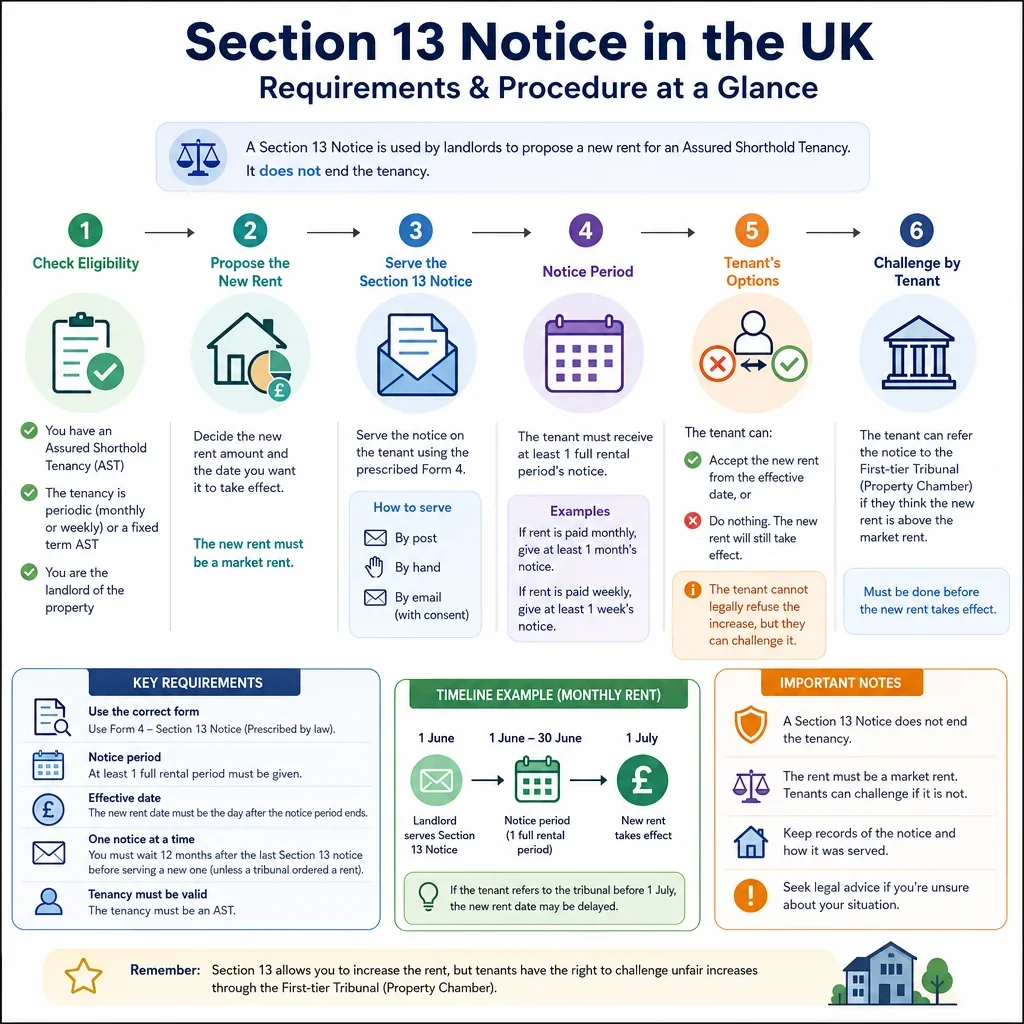
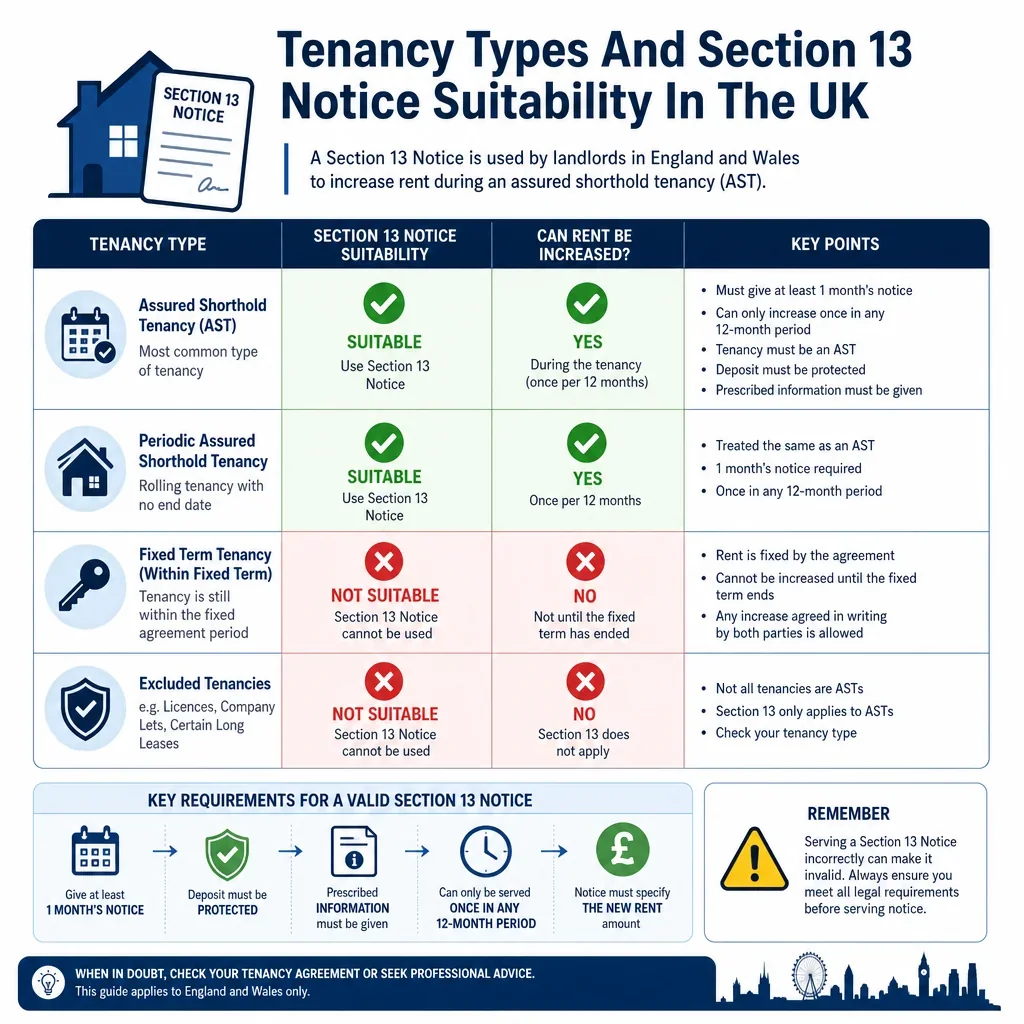
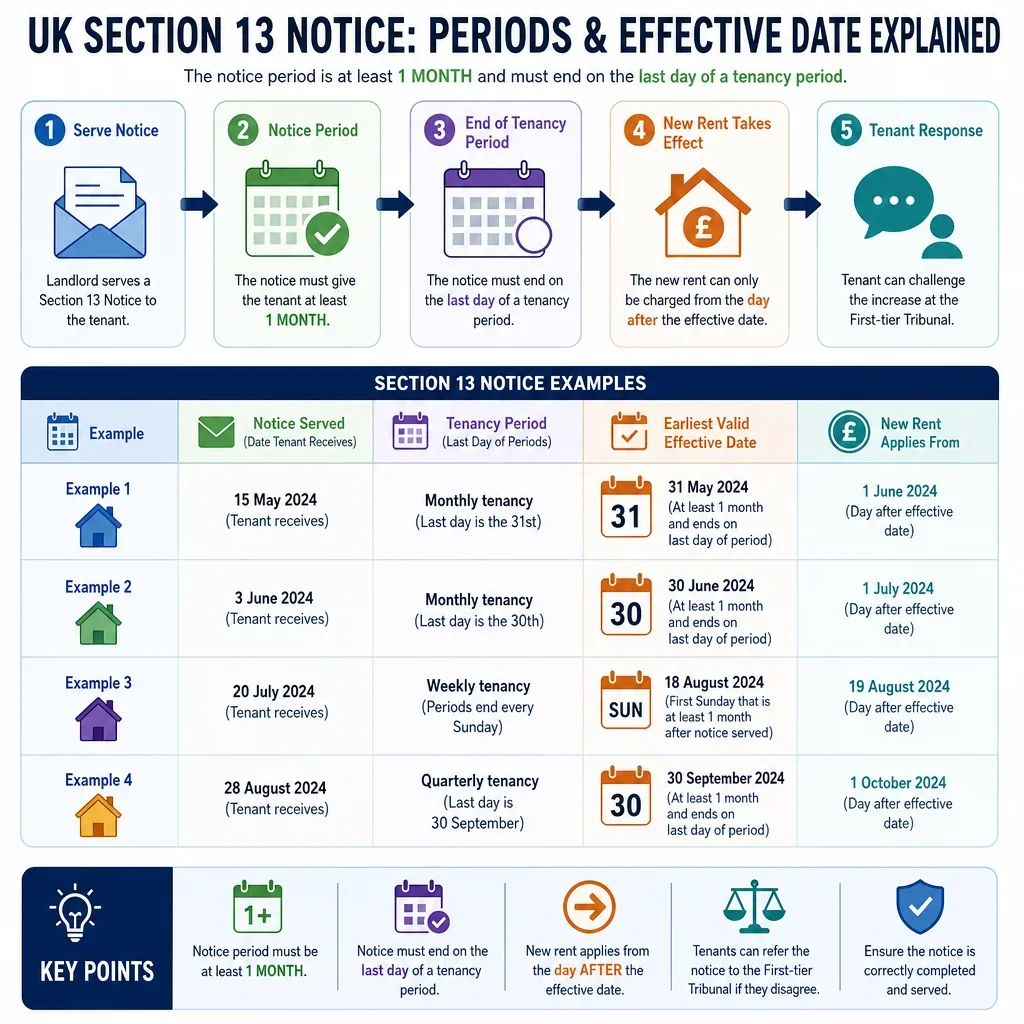
United Kingdom Section 13 Notice Periods And Effective Date Examples
Minimum Notice Period | Effective Date Rule | Example Service Date | Example Earliest Increase Date | Common Date Mistake |
|---|---|---|---|---|
Monthly | ||||
At least one month | First day of a new monthly tenancy period | 2026-01-05 | 2026-02-10 | Using 5 February instead of the next period start |
At least one month | Use the next monthly period start after notice expires | 2026-01-12 | 2026-03-01 | Choosing 12 February or 1 February |
At least one month | First day of the next monthly period after notice | 2026-04-14 | 2026-05-15 | Assuming calendar month end controls the date |
At least one month | Start on a monthly period start after a full month notice | 2026-04-16 | 2026-06-15 | Selecting 15 May without a full month notice |
At least one month | Use the next period start after one calendar month | 2028-01-31 | 2028-03-31 | Treating 29 February as the period start |
Weekly | ||||
At least one month | First day of a weekly period after one month notice | 2026-01-06 | 2026-02-09 | Using exactly one month later on a non-period day |
At least one month | Use the next weekly start after the month expires | 2026-02-10 | 2026-03-16 | Choosing 10 March, which is not a weekly start |
At least one month | First Friday period start after the notice month | 2026-07-20 | 2026-08-21 | Starting on 20 August rather than Friday |
Fortnightly | ||||
At least one month | First day of a fortnightly period after one month | 2026-01-08 | 2026-02-16 | Using the next weekly rent day instead of fortnight start |
At least one month | Wait for the next fortnightly period start | 2026-05-19 | 2026-06-29 | Selecting 22 June when the notice month expired after the prior start |
Four-weekly | ||||
At least one month | First day of a four-weekly period after one month | 2026-01-20 | 2026-03-02 | Confusing four-weekly rent with monthly rent |
At least one month | Use the next four-weekly period start after notice | 2026-09-02 | 2026-10-12 | Using the monthly anniversary of service |
Quarterly | ||||
At least three months | First day of a quarterly period after three months notice | 2026-01-15 | 2026-07-01 | Giving only one month notice for quarterly rent |
At least three months | Start on the next quarterly period start after notice | 2026-03-20 | 2026-07-01 | Choosing 20 June, not a quarter start |
At least three months | Use the tenancy's own quarterly period start | 2026-02-01 | 2026-05-15 | Assuming quarters always start on 1 January, April, July or October |
Six-monthly | ||||
At least six months | First day of a six-monthly period after six months notice | 2026-01-10 | 2026-07-01 | Treating six-monthly rent as monthly rent |
At least six months | Use the next six-monthly period start after full notice | 2026-01-02 | 2027-01-01 | Choosing 1 July when six full months have not elapsed |
At least six months | Start on the tenancy's six-monthly period date | 2026-03-25 | 2026-10-01 | Using 25 September instead of 1 October |
Yearly | ||||
At least six months | First day of a yearly period after six months notice | 2026-02-01 | 2027-01-01 | Assuming six months notice allows a mid-year start |
At least six months | Use the next annual period start after six months notice | 2026-08-31 | 2027-09-01 | Choosing 1 September 2026 with no six-month notice |
At least six months | Start on the annual tenancy period date after notice | 2026-09-30 | 2027-04-06 | Using 30 March rather than the annual period start |
Monthly | ||||
At least one month | First day of a monthly period after the notice is served | 2026-05-31 | 2026-07-01 | Posting on 31 May and assuming same-day service |
At least one month | First monthly period start after one month notice | 2026-02-27 | 2026-03-28 | Thinking February always prevents a March increase |
At least one month | Allow a full month before the monthly period start | 2026-02-28 | 2026-04-28 | Using 28 March where a full month may be disputed |
At least one month | Use the 5th after one full month notice | 2026-11-04 | 2026-12-05 | Using the rent payment processing date instead of period start |
At least one month | New rent cannot start until a later monthly period | 2026-11-05 | 2027-01-05 | Serving on the 5th and increasing on 5 December |
Weekly | ||||
At least one month | First Sunday period start after one month notice | 2026-03-31 | 2026-05-03 | Using 30 April, which is not a Sunday period start |
Fortnightly | ||||
At least one month | First Friday fortnightly period after one month notice | 2026-06-04 | 2026-07-10 | Using any Friday instead of the correct fortnightly cycle |
Four-weekly | ||||
At least one month | First four-weekly cycle date after one month notice | 2026-06-01 | 2026-07-24 | Treating every fourth calendar date as a four-week period |
Quarterly | ||||
At least three months | First 10th quarterly start after three months notice | 2026-04-09 | 2026-07-10 | Serving one day later and still using 10 July |
At least three months | A later quarterly start is needed after full notice | 2026-04-10 | 2026-10-10 | Increasing on 10 July after serving on 10 April |
Six-monthly | ||||
At least six months | First cycle start after six months notice | 2026-03-31 | 2026-10-01 | Assuming 30 September is valid as the notice expiry date |
Yearly | ||||
At least six months | Annual period start after the six-month minimum | 2026-03-15 | 2026-10-01 | Using 15 September instead of the annual start date |
How Much Notice Is Needed For A Section 13 Rent Increase?
For assured periodic tenancies in England and Wales, a Section 13 notice generally needs at least one month where rent is paid weekly, fortnightly, four-weekly or monthly. Longer rent periods require longer notice: six months for yearly tenancies, and for other periods above monthly the notice must normally be at least equal to the period of the tenancy.
What Date Should The New Rent Start?
The proposed new rent should normally start on the first day of a new tenancy period, not merely the day after the minimum notice expires. If rent is due monthly on the 10th, the safest effective date is usually a 10th after the required notice period has fully elapsed.
What Is The Most Common Section 13 Date Mistake?
- Using a date exactly one calendar month after service even though that date is not the first day of a tenancy period.
- Forgetting that quarterly, six-monthly and yearly tenancies usually need more than one month.
- Assuming the rent payment date is always the tenancy period start date without checking the tenancy history.
- Serving too late in the day or by post and ignoring when the notice is deemed served.
Where Can Tenants Challenge The Proposed Date Or Rent?
A tenant can apply to the First-tier Tribunal before the proposed start date if they dispute a Section 13 increase. The official form and guidance are available from GOV.UK assured tenancy forms.
FAQs
You Might Also Be Interested In