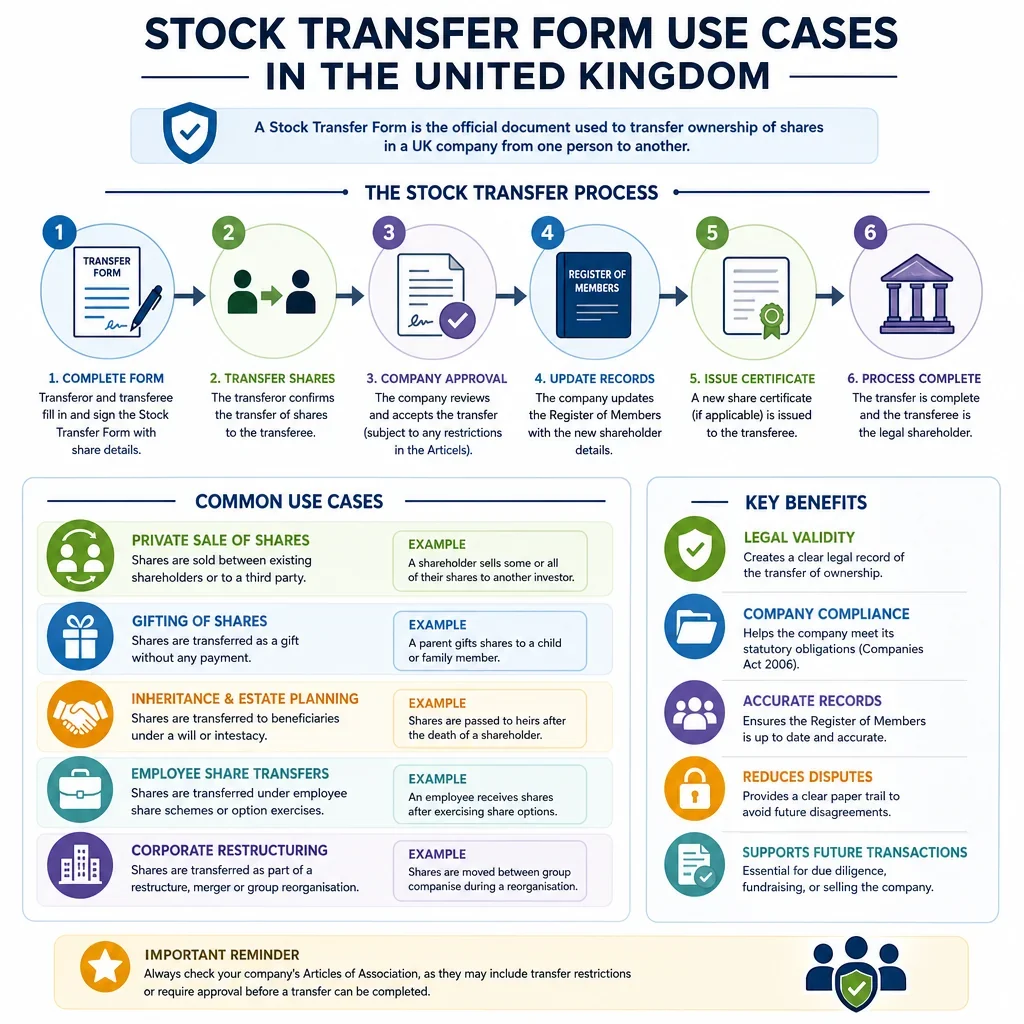
Stock Transfer Form Information Requirements In The United Kingdom
Information Item | Purpose | Typical Source | Accuracy Importance | Common Mistakes |
|---|---|---|---|---|
Company details | ||||
Company name | Identifies the company whose shares are being transferred. | Companies House register or company records. | High | Using a trading name, old name or abbreviated name. |
Company registration number | Distinguishes the company from similarly named entities. | Companies House company profile. | High | Omitting digits or using a VAT number instead. |
Registered office address | Confirms the company's official registered address. | Companies House register or company statutory books. | Medium | Using a branch, accountant or outdated office address. |
Company jurisdiction | Shows whether the company is registered in England and Wales, Scotland or Northern Ireland. | Companies House profile. | Medium | Assuming all UK companies are registered in England and Wales. |
Share details | ||||
Class of shares | Identifies the rights attached to the transferred shares. | Share certificate, register of members or articles. | High | Writing ordinary shares when A ordinary or preference shares are held. |
Number of shares transferred | States the quantity of shares passing to the transferee. | Share certificate and register of members. | High | Transferring more shares than the holder owns. |
Nominal value per share | Describes the face value of each transferred share. | Articles, statement of capital or share certificate. | Medium | Confusing nominal value with sale price or market value. |
Paid-up status | Shows whether any unpaid liability attaches to the shares. | Register of members, allotment records or share certificate. | High | Assuming all shares are fully paid without checking records. |
Share certificate number | Helps the company identify the certificate to cancel or replace. | Original share certificate. | Medium | Using the certificate issue date or member number instead. |
Administrative details | ||||
Original certificate availability | Indicates whether the certificate can be lodged with the transfer form. | Transferor and company secretary. | Medium | Ignoring lost certificate indemnity requirements. |
Transferor details | ||||
Transferor full legal name | Identifies the existing registered holder disposing of shares. | Register of members and share certificate. | High | Using nicknames, maiden names or incomplete company names. |
Transferor address | Matches the seller against the company register and contact records. | Register of members or transferor documents. | Medium | Using a new address without updating company records. |
Transferor shareholder reference | Helps identify the correct member account in company records. | Registrar records, dividend statements or share portal. | Medium | Entering a broker account number instead of member reference. |
Transferor capacity | Shows if the transferor signs as owner, trustee, executor or attorney. | Probate documents, trust records or power of attorney. | High | Failing to state executor or attorney capacity. |
Transferor company number | Identifies a corporate transferor accurately. | Companies House or corporate register. | High | Using group company details rather than the registered holder. |
Joint transferor names | Captures all joint holders who must usually sign the transfer. | Register of members and share certificate. | High | Listing only the first named joint holder. |
Transferee details | ||||
Transferee full legal name | Identifies the new holder to be entered in the register. | Transferee identity documents or corporate records. | High | Misspelling names or omitting middle names for formal records. |
Transferee address | Provides the address to record for the new member. | Transferee or KYC records. | High | Using a temporary address or missing postcode. |
Transferee company number | Identifies a corporate transferee accurately for the register. | Companies House or corporate registry. | High | Entering a trading name or parent company number. |
Joint transferee names | Records all proposed joint holders of the transferred shares. | Transferees' instructions or identity documents. | High | Not specifying the intended order of joint holders. |
Transferee contact details | Allows company or registrar to resolve queries quickly. | Transferee or professional adviser. | Low | Providing adviser details without authority to respond. |
Consideration details | ||||
Cash consideration amount | Shows the price paid for the shares and supports Stamp Duty analysis. | Sale agreement, payment records or parties' instructions. | High | Entering nominal value instead of the agreed sale price. |
Consideration wording | Describes whether the transfer is for cash, non-cash or no consideration. | Stock transfer form instructions and transaction documents. | High | Writing nil when the buyer has paid or assumed debt. |
Non-cash consideration description | Records assets, services or debt release given for the shares. | Share purchase agreement or settlement agreement. | High | Treating non-cash consideration as a gift without advice. |
Nil consideration reason | Explains why no payment or value is given for the transfer. | Parties' instructions, gift letter or group documents. | High | Stating gift where linked payments exist. |
Whether consideration exceeds £1,000 | Indicates whether Stamp Duty may need to be paid and form stamped. | Transaction price and HMRC guidance. | High | Ignoring multiple linked transfers below £1,000 each. |
Stamp Duty calculation basis | Supports calculation of duty, usually 0.5% rounded up to the nearest £5. | HMRC guidance and transaction price. | High | Calculating 0.5% without applying rounding rules. |
Stamp Duty relief or exemption claim | Records any claimed reason duty is not payable or is reduced. | HMRC guidance, tax advice or transaction documents. | High | Claiming relief without meeting conditions or keeping evidence. |
Execution details | ||||
Transfer date | Dates the instrument and helps determine tax and registration timing. | Signing arrangements or completion documents. | High | Backdating the form or using the board approval date by mistake. |
Transferor signature | Evidences the transferor's authority to transfer the shares. | Signed stock transfer form. | High | Unsigned forms, scanned pasted signatures or wrong signatory. |
Corporate signatory details | Shows a company transferor has executed through authorised signatories. | Board minutes, Companies House officer details and execution block. | High | One director signing without witness where two signatories are required. |
Witness name and address | Supports valid witnessing where a signature requires attestation. | Witness and signed form. | Medium | Using the transferee as witness or omitting witness address. |
Power of attorney details | Confirms an attorney has authority to sign for the transferor. | Power of attorney document and attorney certificate. | High | Using an expired, limited or uncertified authority. |
Transferor details | ||||
Probate or letters of administration | Shows personal representatives can transfer shares of a deceased holder. | Grant of probate or letters of administration. | High | Relying on a will alone without a required grant. |
Transferee details | ||||
Minor or trustee holding details | Clarifies legal holding where shares are intended for a minor or trust. | Trust deed, nominee agreement or legal advice. | High | Naming a minor directly where the company will not register minors. |
Administrative details | ||||
Board approval status | Confirms directors have approved registration if required. | Board minutes, written resolutions or articles. | High | Submitting the form before required director approval. |
Articles transfer restrictions | Identifies restrictions affecting whether shares can be transferred. | Company articles and Companies House filings. | High | Assuming shares are freely transferable without reading articles. |
Pre-emption rights compliance | Shows existing shareholders were offered shares first if required. | Articles, shareholders' agreement and waiver documents. | High | Ignoring contractual pre-emption rights outside the articles. |
Shareholders' agreement consent | Confirms any contractual consent or waiver has been obtained. | Shareholders' agreement, consent letters or waivers. | High | Checking articles but not the shareholders' agreement. |
Correct stock transfer form type | Ensures the right instrument is used for certificated share transfers. | HMRC stock transfer form template and company registrar. | Medium | Using a CREST process form for a private certificated transfer. |
Lodging party contact | Lets the company or HMRC contact the person submitting the form. | Solicitor, accountant, buyer or seller. | Low | Providing no email or phone number for urgent queries. |
HMRC stamping reference | Links the form to HMRC Stamp Duty submission and confirmation. | HMRC email confirmation or payment reference. | High | Registering transfer before required HMRC confirmation is obtained. |
Consideration details | ||||
Stamp Duty payment date | Shows when duty was paid for HMRC and company records. | Bank payment record and HMRC confirmation. | High | Using intended payment date instead of actual payment date. |
Administrative details | ||||
Request to register transfer | Asks the company to update its register of members. | Cover letter, board pack or company secretary instructions. | High | Sending the form to HMRC but not lodging it with the company. |
Register of members update details | Provides information needed to enter the transferee as a member. | Stock transfer form and company statutory register. | High | Updating Companies House but not the statutory register. |
Registration date in register of members | Records when the transferee becomes registered as shareholder. | Company register of members and board approval record. | High | Treating signing date as automatic membership date. |
PSC register impact | Checks whether the transfer changes significant control information. | Shareholding percentages, voting rights and PSC register. | High | Ignoring PSC updates after a large share transfer. |
Confirmation statement impact | Ensures shareholder changes are reflected in later Companies House filings. | Register of members and confirmation statement records. | Medium | Expecting the stock transfer form itself to be filed at Companies House. |
New share certificate details | Provides details needed to issue certificates after registration. | Register of members and company secretary records. | Medium | Failing to cancel old certificate before issuing new one. |
Balance certificate requirement | Identifies whether the seller needs a certificate for retained shares. | Original certificate and number of shares retained. | Medium | Not requesting a balance certificate after partial transfer. |
Share details | ||||
Whole share confirmation | Confirms the transfer is for whole shares capable of registration. | Register of members and transaction terms. | Medium | Trying to transfer fractional shares in a certificated private company. |
Consideration details | ||||
Currency of consideration | Shows the currency used and whether sterling conversion is needed. | Sale agreement, payment evidence or HMRC guidance. | High | Using foreign currency without sterling equivalent for Stamp Duty. |
Administrative details | ||||
Completion or settlement confirmation | Confirms price payment and document exchange have occurred. | Completion statement, bank confirmation or solicitor undertaking. | Medium | Releasing signed form before agreed payment conditions are met. |
Transferee details | ||||
Beneficial owner details | Identifies if the registered holder differs from the beneficial owner. | Nominee agreement, trust deed or parties' instructions. | Medium | Assuming nominee details disclose the beneficial owner. |
Administrative details | ||||
Identity verification evidence | Supports adviser or registrar checks where AML procedures apply. | Passport, proof of address or corporate KYC documents. | Medium | Providing expired ID or documents for the wrong party. |
Consideration details | ||||
Parties' tax residence | Helps advisers identify wider tax consequences outside the form. | Parties' tax records or adviser questionnaires. | Medium | Assuming UK company shares mean all parties are UK tax resident. |
Connected party status | Flags family, group or related-party transfers needing tax review. | Parties' relationship information and tax advice. | Medium | Not disclosing family or group relationships affecting tax analysis. |
Share valuation evidence | Supports tax and accounting treatment where price may not equal market value. | Valuation report, accounts or HMRC Shares and Assets Valuation. | Medium | Using par value as market value for private company shares. |
Payment method | Records how the buyer paid the consideration. | Bank transfer record, cheque or completion statement. | Low | Confusing company payment with buyer personal payment. |
Consideration apportionment | Separates share consideration from other assets or obligations. | Business sale agreement or completion statement. | High | Putting total deal value on the form when only part relates to shares. |
Share details | ||||
Unpaid share liability acknowledged | Alerts transferee to calls or unpaid amounts attached to shares. | Company register, accounts and share terms. | High | Failing to disclose unpaid amounts before completion. |
Administrative details | ||||
Company lien or security restrictions | Checks whether shares are subject to lien, charge or other restriction. | Articles, loan documents, charges register or company records. | High | Ignoring lender consent or company lien provisions. |
Regulatory consent requirement | Flags sector approvals needed before transferring shares. | Licences, regulatory rules and legal advice. | High | Completing transfer before FCA, licence or sector consent is checked. |
Employee share scheme reference | Identifies whether scheme rules affect the transfer or tax reporting. | EMI, CSOP, SIP or option scheme documents. | Medium | Ignoring leaver provisions or option exercise conditions. |
Whether transfer is a company buyback | Distinguishes ordinary transfer from purchase of own shares procedure. | Buyback agreement, board minutes and Companies House forms. | High | Using a simple transfer process for a statutory buyback. |
Consideration details | ||||
Seller payment account details | Allows payment of the agreed price outside the form itself. | Transferor or solicitor client account details. | Medium | Sending bank details by insecure email without verification. |
Administrative details | ||||
Professional adviser details | Identifies who prepared or reviewed the transfer documents. | Engagement letter, email correspondence or completion statement. | Low | Assuming adviser involvement means tax advice has been given. |
Supporting documents enclosed | Confirms required certificates, approvals and HMRC evidence are included. | Completion checklist or company secretary pack. | Medium | Sending signed form without certificate or Stamp Duty confirmation. |
Company or registrar delivery address | Ensures the executed form reaches the person who can register it. | Company secretary, registrar or registered office records. | Medium | Posting to Companies House instead of the company or registrar. |
Original or electronic submission status | Clarifies whether originals, scans or HMRC electronic stamping evidence are needed. | Company registrar requirements and HMRC guidance. | Medium | Assuming a scan is enough for company registration without checking. |
Transferee details | ||||
Allocation between transferees | States how many shares each transferee receives. | Sale agreement or parties' written instructions. | High | Listing multiple buyers without specifying share allocations. |
Administrative details | ||||
Transfer purpose | Explains if the transfer is sale, gift, restructure, divorce or probate-related. | Parties' instructions and transaction documents. | Medium | Describing a sale as a gift to avoid Stamp Duty review. |
Court order or settlement reference | Supports transfers required by divorce, dissolution or court settlement. | Court order, consent order or settlement agreement. | Medium | Not matching the form to the order's exact share allocation. |
Consideration details | ||||
Group relationship details | Supports assessment of group relief or restructuring treatment. | Group structure chart and tax advice. | High | Assuming all group transfers automatically qualify for relief. |
Transferor details | ||||
Overseas party registration details | Identifies overseas corporate parties where UK company numbers do not exist. | Foreign company register, certificate of incorporation or legal opinion. | High | Leaving registration number blank without alternative identifiers. |
Transferee details | ||||
Overseas transferee registration details | Records foreign entity identifiers for a non-UK transferee. | Foreign registry extract or constitutional documents. | High | Using an English translation without the legal registered name. |
Share details | ||||
Dividend entitlement date | Clarifies who receives dividends around completion and registration. | Sale agreement, dividend resolutions and company records. | Medium | Assuming dividends follow signing date rather than agreement terms. |
Voting rights attached to shares | Helps assess control changes and PSC consequences. | Articles, share terms and register of members. | Medium | Treating all share classes as having equal votes. |
Post-transfer shareholding percentage | Shows ownership level after transfer and supports control checks. | Register of members and statement of capital. | Medium | Calculating percentage using authorised capital instead of issued shares. |
Execution details | ||||
Authorised representative evidence | Confirms an institution's signer is authorised to execute the transfer. | Board resolution, signing mandate or attorney document. | High | Relying on job title without a mandate or authority evidence. |
Administrative details | ||||
Board meeting date | Records when directors considered registration of the transfer. | Board minutes or written resolution. | Medium | Dating registration before the approving board meeting. |
Possible refusal grounds | Identifies reasons directors may refuse to register a transfer. | Articles, board records and Companies Act requirements. | High | Assuming signature alone obliges the company to register immediately. |
Transferee details | ||||
Transferee agreement to articles | Shows the new shareholder accepts membership obligations and articles. | Transfer form, accession deed or shareholders' agreement. | Medium | Not signing required accession deed to shareholders' agreement. |
Administrative details | ||||
Accession deed status | Confirms transferee has joined any shareholders' agreement if required. | Shareholders' agreement and signed accession deed. | High | Completing share transfer but omitting mandatory accession deed. |
Register restrictions or stop notices | Checks whether the company records show a stop, restriction or dispute. | Company secretary, registrar or statutory books. | High | Ignoring internal notes preventing registration. |
Share details | ||||
Encumbrance disclosure | Discloses pledges, options or third-party rights over the shares. | Sale agreement, security documents and seller confirmation. | High | Failing to disclose option rights or bank security over shares. |
Transferor details | ||||
Transferor tax reference | Helps advisers handle tax reporting outside the form. | UTR, National Insurance records or corporate tax records. | Low | Putting personal tax references on the public company register. |
Transferee details | ||||
Transferee tax reference | Helps advisers handle tax and onboarding records outside the form. | UTR, National Insurance records or corporate tax records. | Low | Including sensitive tax data where not required for registration. |
Shareholder communication preference | Helps company send shareholder notices and certificates correctly. | Transferee instructions or company portal. | Low | Using business email when personal notice address is required. |
Share details | ||||
Certificated or uncertificated status | Confirms whether a paper stock transfer form is appropriate. | Share certificate, CREST records or registrar. | High | Using a paper form for shares held and transferred through CREST. |
Security identifier or ISIN | Identifies listed or traded securities precisely. | Share certificate, broker statement or registrar. | Medium | Using ticker symbol only when formal identifier is needed. |
Transferor details | ||||
Registrar account or investor code | Helps listed company registrars identify the shareholder account. | Dividend voucher, share portal or registrar correspondence. | Medium | Confusing broker client ID with registrar investor code. |
Transferee details | ||||
Charity or trust registration details | Identifies non-company transferees such as charities or trusts. | Charity Commission register, trust deed or trustee records. | Medium | Naming the charity brand rather than legal charity name or trustees. |
Trustee names | Records the legal holders where shares are held on trust. | Trust deed and trustee appointment documents. | High | Entering the trust name only instead of legal trustee names. |
LLP registration details | Identifies a limited liability partnership party to the transfer. | Companies House LLP profile. | High | Treating an LLP as a limited company or listing members personally. |
Execution details | ||||
Partnership authority evidence | Confirms who can sign for a partnership transferor or transferee. | Partnership agreement or partner resolution. | High | One partner signing without checking authority limits. |
Transferor details | ||||
Nominee holder details | Identifies whether shares are registered in a nominee name. | Broker statement, nominee agreement or register of members. | Medium | Naming the beneficial owner when the nominee is registered holder. |
Administrative details | ||||
Custodian transfer instructions | Coordinates transfer where shares are held through broker or custodian. | Broker forms, custodian instructions or registrar requirements. | Medium | Completing paper form without custodian release process. |
Transaction governing law | Identifies law governing sale terms separate from company law registration. | Share purchase agreement or transfer agreement. | Low | Assuming foreign governing law removes UK registration requirements. |
Dispute or injunction status | Checks whether litigation prevents or challenges the transfer. | Court orders, solicitor correspondence or company records. | High | Registering despite notice of a court order or ownership dispute. |
Sanctions screening result | Helps advisers identify sanctions risks before completing a transfer. | OFSI consolidated list and adviser checks. | Medium | Screening only company names and not individuals or beneficial owners. |
Consideration details | ||||
Consideration payment date | Shows when payment was made for completion and record-keeping. | Bank records or completion statement. | Medium | Confusing invoice date with payment receipt date. |
Deferred consideration terms | Records any future, contingent or instalment payments for shares. | Share purchase agreement or completion statement. | High | Only listing the first instalment and omitting deferred amounts. |
Debt assumed or released | Identifies debt value that may count as consideration. | Loan agreements, settlement deed or sale agreement. | High | Ignoring debt release because no cash changes hands. |
Share-for-share exchange details | Describes consideration where shares are exchanged for other shares. | Reorganisation agreement and tax advice. | High | Treating exchange as nil consideration without relief analysis. |
Transferor details | ||||
Transferor email address | Allows administrative queries about signing or certificate return. | Transferor or adviser. | Low | Using an inactive or unmonitored address. |
Transferee details | ||||
Transferee email address | Allows administrative queries and shareholder communications. | Transferee or adviser. | Low | Providing adviser email for long-term shareholder notices. |
What Information Do You Need To Complete A UK Stock Transfer Form?
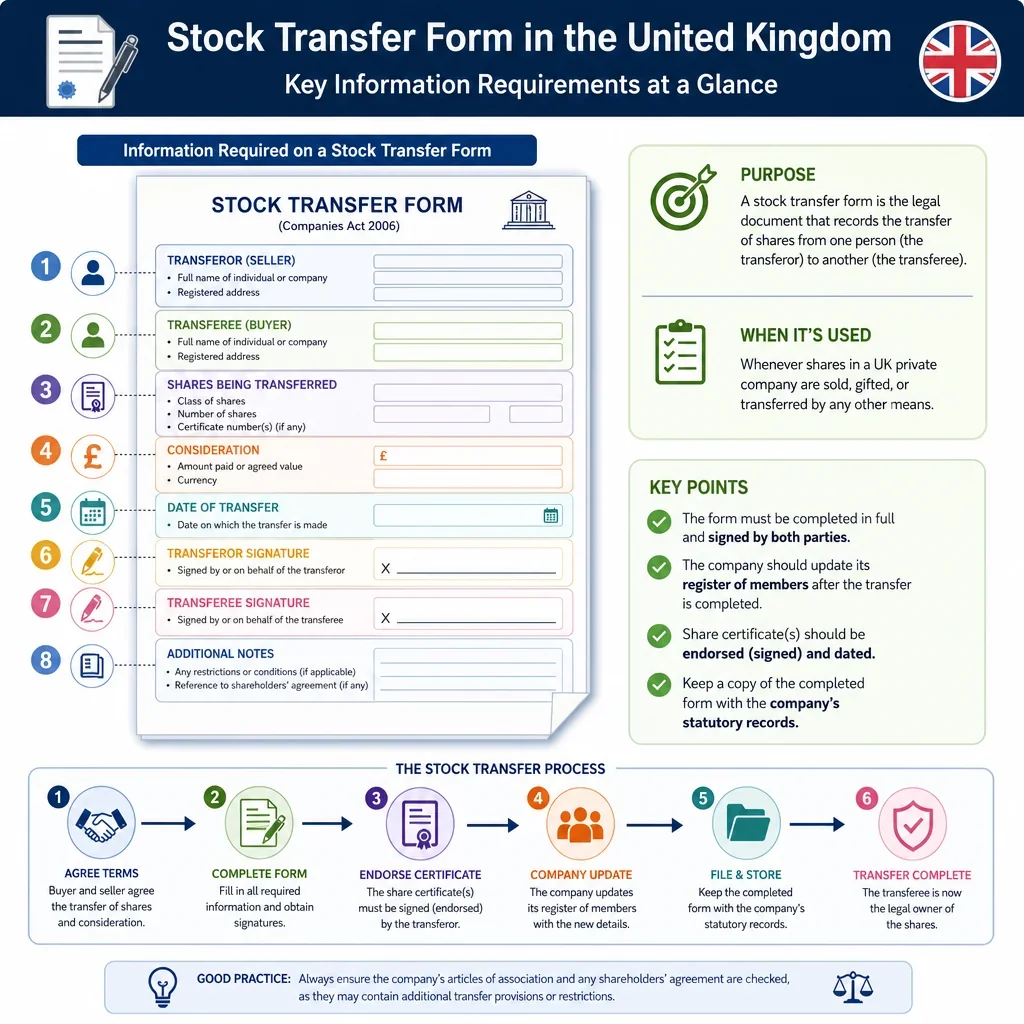
A UK stock transfer form normally needs precise company, share, transferor, transferee, consideration and execution details. The most important checks are the company name and registration number, the exact share class, the number of shares, the transferor\'s registered holder details, the transferee\'s full name and address, and the consideration paid.
When Is Stamp Duty Relevant To A Stock Transfer Form?
Stamp Duty is a key issue where chargeable consideration for shares exceeds £1,000. The consideration details must be accurate because HMRC may require the form to be stamped before the company registers the transfer. Gifts, nil consideration transfers and certain exempt transfers should be described clearly to avoid confusion.
Why Must The Form Match The Company Register?
The company should only register a transfer if the details are consistent with its register of members, share certificates and articles of association. Mistakes in the transferor name, share class, certificate number or number of shares can delay registration or cause the transfer to be rejected.
Who Should Check Restrictions Before Signing?
The parties should check the company\'s articles, shareholders\' agreement and board procedures before signing. Private companies often have pre-emption rights, director approval requirements or restrictions on transfers, so administrative approvals may be needed even where the stock transfer form itself is complete.
FAQs
You Might Also Be Interested In