United Kingdom Shareholders' Agreement Clause Library
Clause name | Purpose | Typical usage | Example use case | Drafting considerations |
|---|---|---|---|---|
Ownership and share transfers | ||||
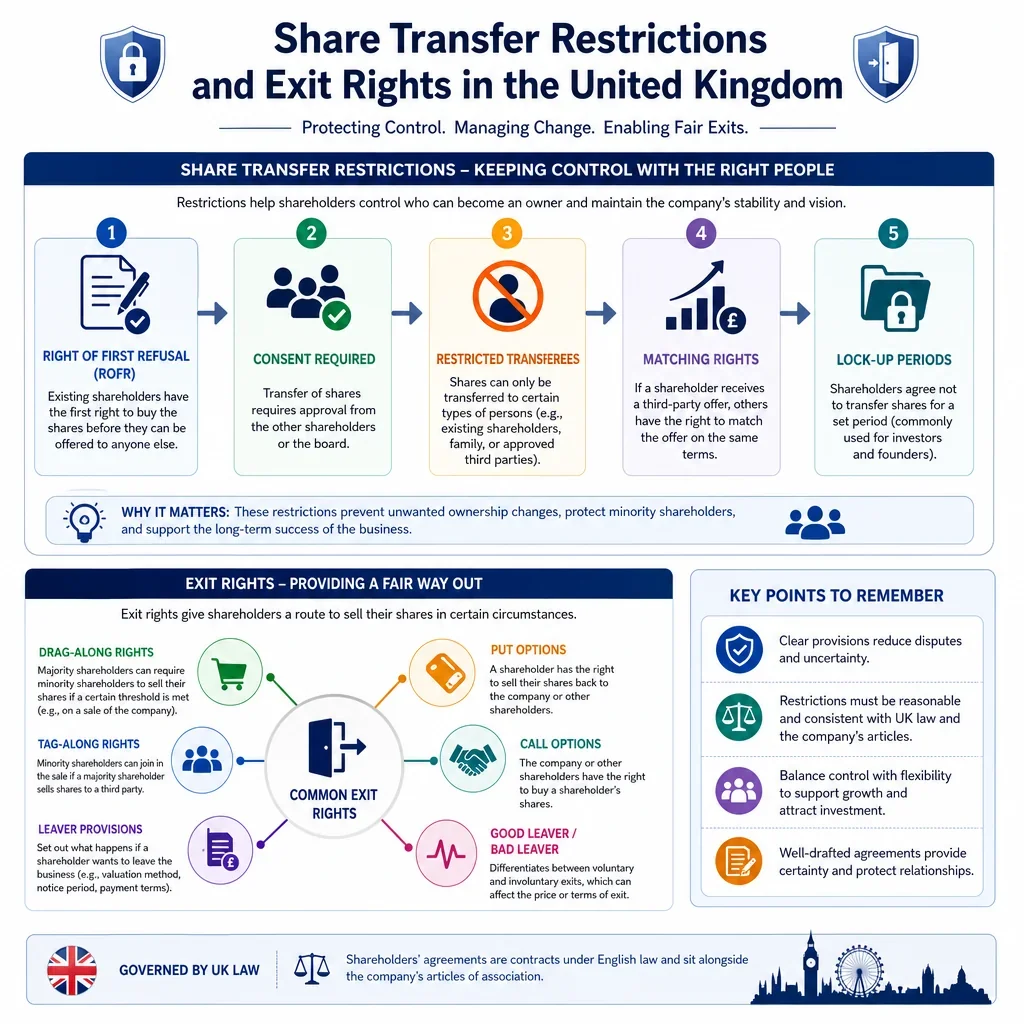
Pre-emption rights on share transfers | Gives existing shareholders first refusal before shares are sold to outsiders. | Common in most agreements | A founder wants to sell shares to a third party and the others want a chance to buy first. | Define offer process, price, timing, excluded transfers and whether the articles must mirror the restriction. |
Shareholder protections | ||||
Pre-emption rights on new share issues | Protects shareholders from dilution when the company issues new shares for cash. | Common in most agreements | The company raises new equity and existing shareholders want the chance to maintain their percentages. | Check whether statutory rights are excluded in the articles and set any contractual top-up process clearly. |
Ownership and share transfers | ||||
Permitted transfers | Allows transfers to approved persons without triggering full transfer restrictions. | Optional depending on circumstances | A shareholder transfers shares to a family trust or group company for tax or succession planning. | Define permitted transferees narrowly and require re-transfer if the transferee stops qualifying. |
Transfer notice procedure | Sets the formal steps for offering or transferring shares under the agreement. | Common in most agreements | A selling shareholder serves notice so the company can circulate an offer to the others. | Specify form of notice, deemed sale price, acceptance period, completion date and withdrawal rights. |
Share valuation mechanism | Provides a method for valuing shares when a compulsory or disputed transfer occurs. | Common in most agreements | A leaver must sell shares and the parties cannot agree the price. | Choose fair value, market value, formula or discount appoint an expert allocate costs and set assumptions. |
Compulsory transfer events | Requires a shareholder to sell shares after specified events. | Common in most agreements | A shareholder becomes insolvent, dies, leaves employment or materially breaches the agreement. | List triggers carefully and ensure price consequences are proportionate and enforceable. |
Good leaver and bad leaver provisions | Determines whether a departing founder or employee shareholder keeps value or loses shares at a discount. | Common for founder-led companies | A founder resigns early and the company wants unearned equity returned. | Define leaver categories, vesting, price, board discretion and employment law sensitivity. |
Founder share vesting | Links founders' retained equity to continued involvement over time or milestones. | Common for founder-led companies | Two founders receive equal shares but one leaves after six months. | Set vesting schedule, cliff, acceleration, leaver consequences and tax advice requirements. |
Exit and termination | ||||
Drag-along rights | Allows a selling majority to force minority shareholders to join a company sale. | Common in most agreements | A buyer wants 100% of the company and a small minority refuses to sell. | Set approval threshold, minimum price, same terms, notice procedure and article alignment. |
Shareholder protections | ||||
Tag-along rights | Allows minority shareholders to sell on the same terms as a selling majority. | Common for minority protection | The majority shareholder sells control and minority shareholders want an exit too. | Define control sale trigger, pro rata or full tag rights, timing and buyer obligations. |
Ownership and share transfers | ||||
Restrictions on charging or encumbering shares | Prevents shareholders from granting security or other third-party rights over shares without consent. | Optional depending on circumstances | A shareholder wants to use shares as security for personal borrowing. | Cover charges, liens, options, trusts and nominee arrangements include breach transfer consequences. |
Execution of transfer documents | Requires shareholders to sign documents needed to complete a share transfer. | Common in most agreements | A defaulting shareholder refuses to sign a stock transfer form after a compulsory transfer. | Include power of attorney, delivery of certificates and board registration obligations. |
Decision-making and governance | ||||
Board composition | Sets the number and categories of directors who will manage the company. | Common in most agreements | Each founder or investor wants a seat on the board. | Align with articles, statutory duties and appointment or removal mechanics. |
Director appointment rights | Gives specified shareholders the right to appoint and remove a director. | Common for minority protection | An investor requires a board seat while holding at least 10% of the shares. | Set minimum holding thresholds, alternate rights, removal process and confidentiality obligations. |
Confidentiality and information rights | ||||
Board observer rights | Allows a non-director to attend board meetings and receive papers without voting. | Common for investor-backed companies | A seed investor wants visibility but no formal director duties. | Reserve rights to exclude observers for conflicts, privilege or sensitive discussions. |
Decision-making and governance | ||||
Board meeting procedure | Sets how board meetings are called, held and documented. | Common in most agreements | Directors need clear notice and agenda rules for regular decision-making. | Specify notice period, agenda, remote attendance, chair, minutes and emergency meetings. |
Board quorum | Requires specified directors to be present before board business can be validly conducted. | Common in most agreements | A company wants both founder and investor directors present for major decisions. | Avoid deadlock by including adjourned meeting rules and limits on quorum vetoes. |
Shareholder meeting procedure | Sets notice, quorum and voting rules for shareholder decisions. | Common in most agreements | Shareholders need rules for approving special resolutions or reserved matters. | Ensure contractual rules are compatible with statutory notice, written resolution and voting provisions. |
Shareholder protections | ||||
Reserved matters | Requires shareholder or investor consent before key actions are taken. | Common for minority protection | The board cannot issue shares, borrow heavily or sell assets without investor approval. | Keep the list proportionate and set monetary thresholds, consent timing and emergency exceptions. |
Shareholder veto rights | Gives specified shareholders the right to block defined decisions. | Common for minority protection | A minority investor can block changes to share rights or a major acquisition. | Tie rights to minimum shareholding and avoid rights that make the company unmanageable. |
Decision-making and governance | ||||
Enhanced consent thresholds | Raises approval levels above ordinary statutory voting thresholds for selected matters. | Common for minority protection | A 75% vote is required for borrowing above an agreed limit. | Distinguish ordinary resolutions, special resolutions and contractual unanimity requirements. |
Business plan and budget approval | Requires annual plans and budgets to be approved by the board or shareholders. | Common for investor-backed companies | Investors want spending to follow an approved annual budget. | State approval deadline, default position if no approval and permitted variances. |
Shareholder protections | ||||
Dividend policy | Sets expectations for distributing profits to shareholders. | Optional depending on circumstances | Family shareholders want regular dividends if sufficient distributable profits exist. | Subject wording to distributable profits, directors' duties, solvency and working capital needs. |
Confidentiality and information rights | ||||
Shareholder information rights | Gives shareholders access to management accounts, reports and key company information. | Common for minority protection | A minority investor wants monthly management accounts and cash runway updates. | Set frequency, format, recipients, confidentiality and limits for competing shareholders. |
Access to accounts and records | Allows shareholders or their advisers to inspect financial records beyond statutory accounts. | Optional depending on circumstances | A shareholder suspects financial underperformance and asks to inspect supporting records. | Protect privilege, personal data and commercially sensitive information require reasonable notice. |
Confidentiality | Prevents shareholders from disclosing company information except in permitted cases. | Common in most agreements | A shareholder receives sensitive customer, pricing or fundraising information. | Include exceptions for law, regulators, advisers, investors and information already public. |
Public announcements | Controls press releases and public statements about the company or investment. | Optional depending on circumstances | A shareholder wants to announce an investment round before the company is ready. | Allow mandatory legal disclosures and agree approval process for marketing references. |
Data protection and personal data | Regulates handling of personal data received through shareholder information rights. | Optional depending on circumstances | Investor reports include employee, customer or founder personal data. | Address UK GDPR roles, lawful basis, security, retention and onward disclosure. |
Decision-making and governance | ||||
Conflicts of interest | Requires disclosure and management of conflicts involving directors or shareholders. | Common in most agreements | A director has an interest in a supplier contract being approved by the board. | Coordinate with Companies Act duties, voting exclusions and article authorisation provisions. |
Shareholder protections | ||||
Non-compete covenant | Restricts founders or key shareholders from competing with the business. | Common for founder-led companies | A founder exits and starts a directly competing business using market knowledge. | Keep scope, duration and geography no wider than reasonably necessary to protect legitimate interests. |
Non-solicitation covenant | Prevents shareholders from poaching customers, suppliers, employees or consultants. | Common for founder-led companies | A departing shareholder tries to hire the development team for a new venture. | Define protected relationships, look-back period, restricted period and permitted passive responses. |
Non-dealing covenant | Stops shareholders from dealing with protected clients or suppliers, even without solicitation. | Optional depending on circumstances | A former founder accepts work from a key customer of the company. | Use only where justified courts scrutinise broad restraints of trade closely. |
Intellectual property assignment undertakings | Requires founders or shareholders to assign relevant IP to the company. | Common for founder-led companies | A founder created software before incorporation and the company needs ownership confirmed. | Identify existing IP, future IP, moral rights waivers, third-party code and further assurance obligations. |
Exit and termination | ||||
Further assurance | Requires parties to sign extra documents needed to give effect to the agreement. | Common in most agreements | A shareholder must sign filings or transfer documents after completion. | Include time limits, cost responsibility and attorney powers for non-compliance. |
Shareholder protections | ||||
Anti-dilution protection | Protects investors from economic dilution in a down-round share issue. | Common for investor-backed companies | The company issues shares at a lower price than the investor's previous subscription price. | Choose full ratchet or weighted average, define excluded issues and model cap table effects. |
Exit and termination | ||||
Liquidation preference | Gives preferred shareholders priority return on a sale, winding up or deemed liquidation. | Common for investor-backed companies | An investor wants its money back before ordinary shareholders receive sale proceeds. | Define participating or non-participating rights, multiple, deemed liquidation and article rights. |
Decision-making and governance | ||||
Future funding obligations | Sets whether shareholders must or may provide further capital or loans. | Optional depending on circumstances | A joint venture needs agreed capital calls for future project costs. | Avoid unintended funding duties state default consequences and whether dilution applies. |
Shareholder loans | Regulates loans made by shareholders to the company. | Optional depending on circumstances | Founders fund short-term cash needs before a funding round. | Set interest, maturity, security, subordination, conversion and repayment priority. |
Shareholder protections | ||||
Investor consent rights | Requires named investor approval for actions affecting their investment. | Common for investor-backed companies | The company cannot change share capital, borrow above a limit or hire a CEO without investor consent. | Use objective thresholds and minimum holding tests so rights fall away when investment reduces. |
Shareholder warranties | Confirms key facts given by shareholders, founders or the company. | Common for investor-backed companies | Founders warrant that company IP is owned by the company before an investment round. | Limit scope, knowledge qualifiers, liability caps, disclosure and survival periods. |
Indemnities | Provides pound-for-pound compensation for specified losses or liabilities. | Optional depending on circumstances | A founder indemnifies the company for a known historic tax issue. | Specify covered losses, exclusions, caps, mitigation and claim procedure. |
Limitation of liability | Caps or limits contractual liability between shareholders. | Optional depending on circumstances | Founders want warranty liability capped at the amount received for shares. | Carve out fraud and deliberate breach consider reasonableness under UCTA where relevant. |
Dispute management | ||||
Deadlock definition | Defines when a failure to agree becomes a formal deadlock. | Common in most agreements | Two 50:50 shareholders cannot agree the annual budget or strategic direction. | Limit deadlock to material reserved matters and require repeated failed votes or meetings. |
Deadlock escalation procedure | Requires senior-level negotiation before a deadlock triggers exit rights. | Common in most agreements | Founders must meet within 10 business days to resolve a blocked decision. | Set short deadlines and specify what happens if escalation fails. |
Mediation | Requires parties to attempt facilitated settlement before litigation or buy-out steps. | Optional depending on circumstances | Shareholders disagree on management conduct but want to avoid court proceedings. | Name mediation body or appointment process, timetable and without-prejudice treatment. |
Expert determination | Refers technical issues, such as valuation, to an independent expert. | Common in most agreements | The parties disagree on fair value for a compulsory share sale. | State whether expert acts as expert or arbitrator and whether decision is final except manifest error. |
Arbitration | Requires disputes to be resolved privately by arbitral tribunal rather than court. | Optional depending on circumstances | International shareholders want a confidential forum and enforceable award. | Specify seat, rules, number of arbitrators, language and interim relief carve-outs. |
Jurisdiction | Identifies which courts can hear disputes under the agreement. | Common in most agreements | UK shareholders want disputes heard in the courts of England and Wales. | Choose exclusive or non-exclusive jurisdiction and match the governing law clause. |
Governing law | States which legal system governs the agreement. | Common in most agreements | The company is incorporated in England and the parties choose English law. | Consider whether the company is registered in England and Wales, Scotland or Northern Ireland. |
Unfair prejudice carve-out | Clarifies that contractual remedies do not remove statutory unfair prejudice rights. | Optional depending on circumstances | A minority shareholder claims company affairs are being conducted unfairly prejudicially. | Do not assume dispute clauses prevent statutory petitions consider buy-out mechanics to reduce litigation risk. |
Exit and termination | ||||
Russian roulette buy-sell | Allows one party to name a price at which the other must buy or sell. | Optional depending on circumstances | Two equal shareholders need a decisive deadlock exit mechanism. | Best for parties with similar resources otherwise it may be commercially unfair. |
Texas shoot-out | Uses sealed bids to decide which shareholder buys the other out after deadlock. | Optional depending on circumstances | Joint venture partners both want control after a strategic deadlock. | Specify bid rules, deposit, completion timing and consequences of default. |
Call option | Gives a party the right to buy another shareholder's shares on specified terms. | Optional depending on circumstances | The company can buy back a founder's shares if they breach restrictive covenants. | Define trigger, exercise period, price, completion steps and interaction with buyback rules. |
Put option | Gives a shareholder the right to require another party to buy their shares. | Optional depending on circumstances | A minority investor can exit if the company misses an agreed milestone. | Ensure buyer funding, price formula, exercise limits and tax consequences are considered. |
Company buyback of shares | Allows the company to repurchase shares if statutory requirements are met. | Optional depending on circumstances | A private company wants to buy back a departing employee shareholder's shares. | Comply with Companies Act buyback approval, funding, contract and filing requirements. |
Decision-making and governance | ||||
Consistency with articles of association | Ensures the shareholders' agreement and articles work together. | Common in most agreements | Transfer restrictions in the agreement also need to bind future shareholders through the articles. | State which document prevails between parties, but amend articles where public constitutional rules matter. |
Ownership and share transfers | ||||
Deed of adherence or accession | Requires new shareholders to become bound by the shareholders' agreement. | Common in most agreements | A new investor subscribes for shares and must join the existing agreement. | Make transfer or allotment conditional on signing and define whether all rights apply equally. |
Exit and termination | ||||
Termination | States when the agreement ends for all or individual shareholders. | Common in most agreements | A shareholder sells all shares and should no longer have governance rights. | Preserve confidentiality, restrictive covenants, dispute clauses and accrued rights after exit. |
Dispute management | ||||
Remedies for breach | Sets consequences if a shareholder breaches the agreement. | Common in most agreements | A shareholder transfers shares without consent or discloses confidential information. | Include damages, injunctions, compulsory transfer rights and cure periods where appropriate. |
Specific performance and injunctions | Acknowledges that damages may be inadequate and equitable relief may be sought. | Common in most agreements | A shareholder threatens to disclose confidential information or refuse a required share transfer. | Do not assume relief is automatic court discretion still applies. |
Ownership and share transfers | ||||
Power of attorney for defaulting shareholder | Allows documents to be signed for a shareholder who refuses to comply. | Common in most agreements | A bad leaver refuses to execute transfer forms for compulsory sale shares. | Use deed execution where required and keep authority limited to implementing agreed obligations. |
Decision-making and governance | ||||
Notices | Specifies how formal notices must be served under the agreement. | Common in most agreements | A transfer notice or deadlock notice must be validly delivered. | Include permitted methods, addresses, deemed receipt rules and email validity. |
Dispute management | ||||
Entire agreement | Limits reliance on pre-contract statements not included in the written agreement. | Common in most agreements | A shareholder later claims they relied on an informal promise about dividends. | Do not exclude liability for fraud consider misrepresentation risk and reasonableness. |
Decision-making and governance | ||||
Variation | Requires amendments to be made in writing and approved by agreed parties. | Common in most agreements | Shareholders want to prevent informal changes to veto rights. | Decide whether unanimity, majority or investor consent is needed for amendments. |
Ownership and share transfers | ||||
Assignment of rights | Controls whether a shareholder can transfer contractual rights under the agreement. | Common in most agreements | An investor transfers shares to a fund affiliate and wants rights to follow. | Distinguish share transfer from contractual assignment and require accession by transferees. |
Decision-making and governance | ||||
No partnership or agency | Confirms shareholders are not partners or agents merely by signing the agreement. | Common in most agreements | A shareholder wants to avoid being bound by another shareholder's unauthorised commitments. | Ensure the practical commercial arrangements do not contradict the clause. |
Costs and expenses | Allocates legal, professional and transaction costs between parties or the company. | Optional depending on circumstances | The company pays investor legal fees up to an agreed cap. | Set caps, VAT treatment, timing and whether costs are conditional on completion. |
Shareholder protections | ||||
Tax matters and elections | Allocates responsibility for tax issues connected with shares or employee shareholder status. | Optional depending on circumstances | A founder receives growth shares and must consider employment-related securities tax treatment. | Require independent tax advice and address section 431 elections where relevant. |
Ownership and share transfers | ||||
Employee share scheme pool | Reserves shares or options for employees, consultants or advisers. | Common for investor-backed companies | A startup creates a 10% option pool before a funding round. | State pool size, dilution treatment, approvals and whether EMI eligibility is relevant. |
Shareholder protections | ||||
Share class rights | Defines rights attaching to different share classes, such as voting, dividends and return of capital. | Common for investor-backed companies | Investors receive preferred shares with priority economic rights. | Put core class rights in the articles and comply with statutory variation rules. |
Dispute management | ||||
Waiver of rights | Explains when failure to enforce a right does or does not waive it. | Common in most agreements | An investor permits one late report but does not want to lose future reporting rights. | Require waivers to be written and limited to the specific breach or right waived. |
Severance | Preserves the rest of the agreement if one provision is invalid or unenforceable. | Common in most agreements | A restrictive covenant is too broad but the rest of the agreement should survive. | Do not rely on severance to rescue overbroad restraints draft covenants carefully. |
Decision-making and governance | ||||
Third party rights | Controls whether non-parties can enforce rights under the agreement. | Common in most agreements | An investor director or affiliate may need the benefit of an indemnity or confidentiality right. | Either exclude the Act or specify named third-party beneficiaries and amendment controls. |
Execution as deed | Ensures formal execution where powers of attorney, accession deeds or longer limitation periods are desired. | Common in most agreements | The agreement includes a power of attorney for forced share transfers. | Follow individual and company deed formalities arrange witnessing and delivery wording. |
Confidentiality and information rights | ||||
PSC register cooperation | Requires shareholders to provide information for people with significant control filings. | Optional depending on circumstances | A shareholder's ownership or voting rights make them registrable as a PSC. | Require prompt information updates and cooperation with Companies House filings. |
Decision-making and governance | ||||
Statutory registers and filings | Requires the company to maintain registers and make filings after share changes. | Common in most agreements | A share transfer or allotment must be reflected in the register of members and Companies House filings. | Set responsibility for registers, confirmation statements, allotment forms and buyback filings. |
Confidentiality and information rights | ||||
Survival of confidentiality obligations | Keeps confidentiality restrictions in force after a shareholder exits. | Common in most agreements | A former investor still holds confidential financial forecasts after selling shares. | Set duration, trade secret treatment, return or destruction obligations and permitted retained copies. |
Decision-making and governance | ||||
Founder time commitment | Requires founders to devote agreed time and attention to the business. | Common for founder-led companies | Investors require founders to work full-time after closing a funding round. | Coordinate with employment or service agreements and define permitted outside interests. |
Exit and termination | ||||
Key person departure | Creates consent, notification or transfer consequences if a key founder leaves. | Common for investor-backed companies | The technical founder leaves before product launch and investors want protective rights. | Define key persons, departure triggers, cure periods and links to vesting or consent rights. |
Decision-making and governance | ||||
Milestone obligations | Links rights, funding or governance consequences to commercial milestones. | Common for investor-backed companies | A second investment tranche is released after regulatory approval or revenue targets. | Use objective metrics, evidence requirements and consequences for partial achievement. |
Exit and termination | ||||
Sale process cooperation | Requires shareholders to support an approved sale or exit process. | Common for investor-backed companies | The board appoints advisers for a trade sale and shareholders must provide information and signatures. | Protect minority shareholders with minimum price, same terms and liability limits. |
IPO or listing conversion | Sets how shareholder rights change if the company lists its shares. | Common for investor-backed companies | Preferred shares convert and private company veto rights fall away on an IPO. | Define qualifying IPO, conversion terms, lock-ups and termination of private rights. |
What Clauses Should A UK Shareholders' Agreement Usually Cover?
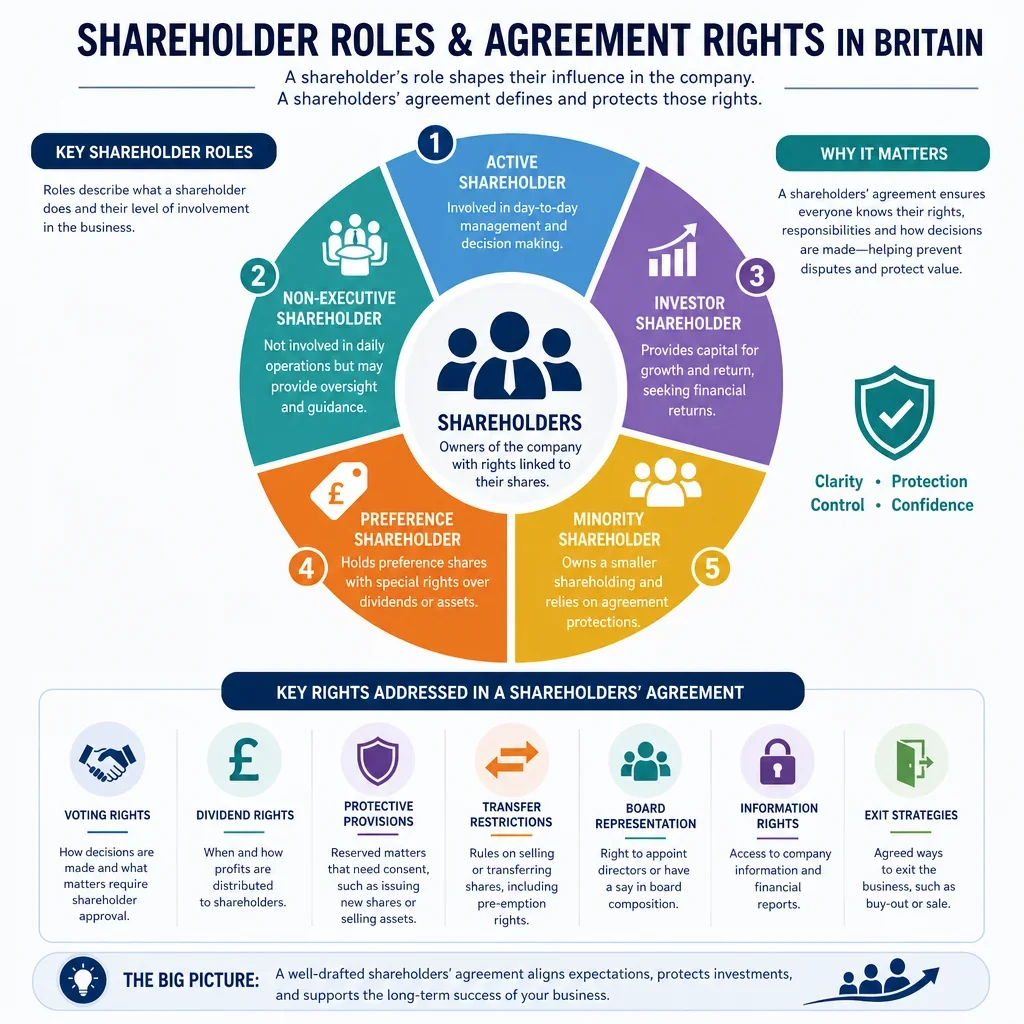
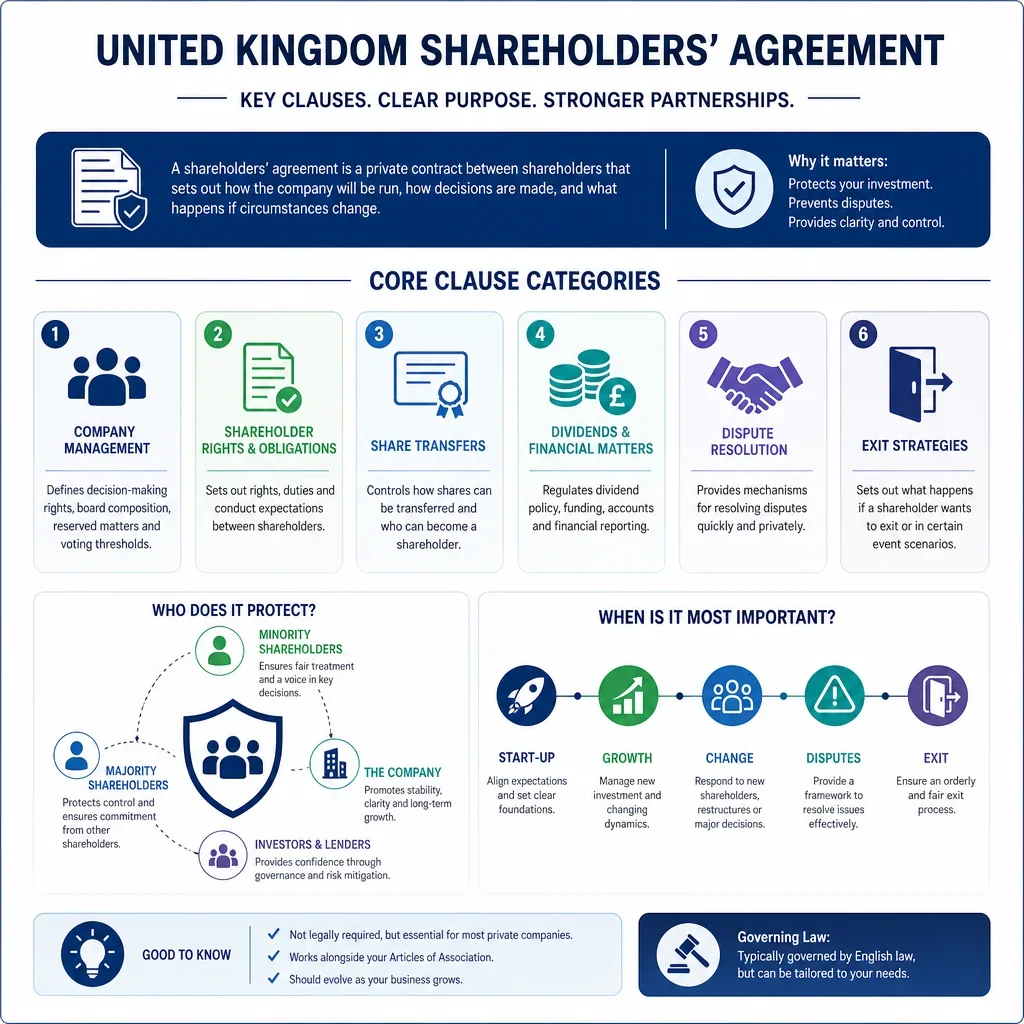
A robust UK shareholders' agreement usually needs more than basic share transfer wording. The dataset shows that the most important areas are ownership controls, board and shareholder decision-making, minority protections, information rights, deadlock resolution, and exit mechanics.
Why Do Share Transfer Clauses Matter?
Clauses such as pre-emption rights, permitted transfers, compulsory transfer events, leaver provisions, drag-along rights and tag-along rights control who can own shares and on what terms. They are particularly important in private UK companies because the company's articles and any shareholders' agreement should work together, especially where statutory rights under the Companies Act 2006 may apply or be modified.
How Can Minority Shareholders Be Protected?
Minority shareholders often rely on reserved matters, veto rights, information rights, anti-dilution protections, tag-along rights and fair valuation wording. These clauses can reduce the risk of exclusion from key decisions, but they must be drafted precisely to avoid blocking ordinary management or creating unworkable consent thresholds.
What Should Founder And Investor Agreements Include?
Founder-led companies commonly need vesting, good leaver and bad leaver provisions, non-compete and non-solicitation wording, IP assignment undertakings and founder time-commitment clauses. Investor-backed companies more often need investor consent matters, anti-dilution, liquidation preference, observer rights, reporting obligations and future funding mechanics.
Why Must The Agreement Match The Articles Of Association?
Several clauses, including share transfers, drag-along, pre-emption, board appointment rights and compulsory transfers, may need to be reflected in the articles to bind the company and future shareholders effectively. Inconsistency between the articles and the shareholders' agreement can create uncertainty and enforcement risk.
FAQs
You Might Also Be Interested In