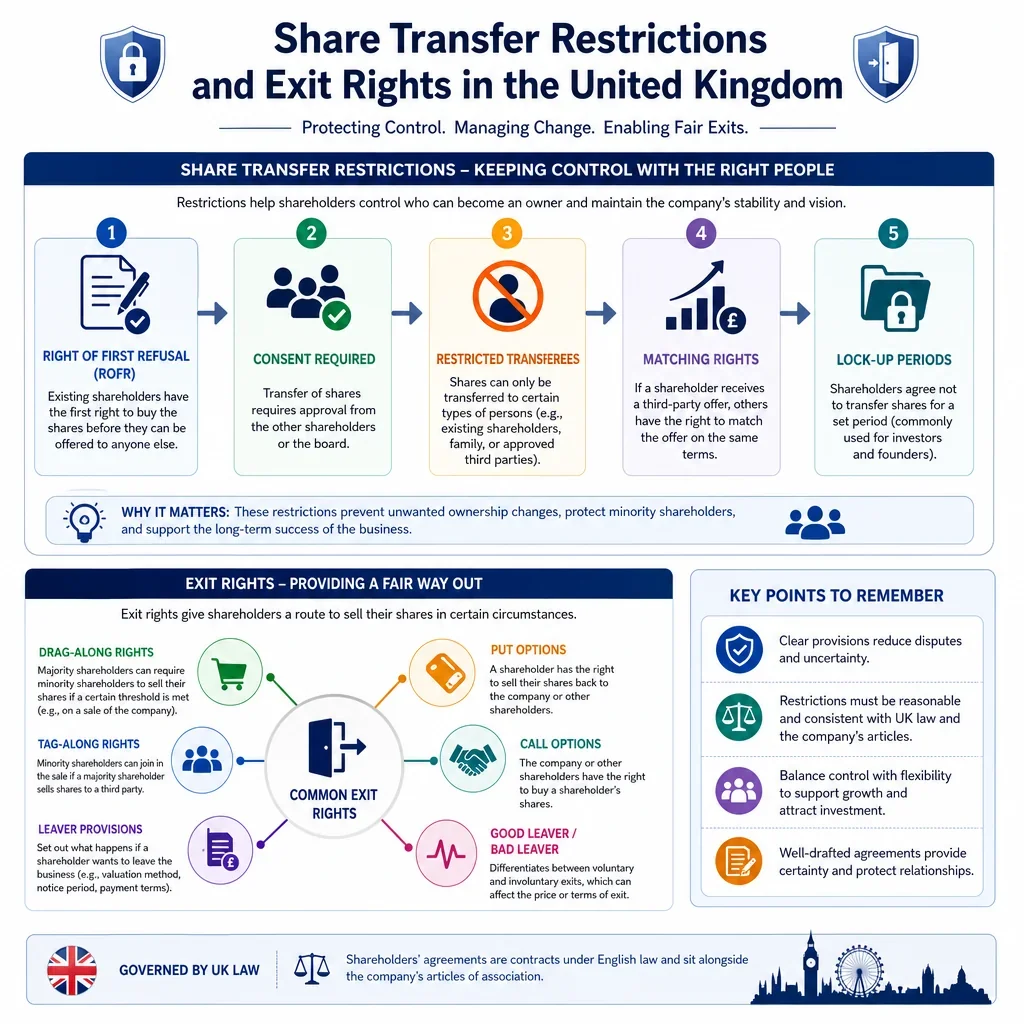
Share Transfer Restrictions And Exit Rights In The United Kingdom
Transfer mechanism | How it works | Who it protects | Trigger event | Drafting considerations |
|---|---|---|---|---|
Pre-emption | ||||
Right of first refusal | A selling shareholder must first offer shares to existing shareholders on the proposed sale terms before selling to a third party. | Existing shareholders who want to prevent unwanted third-party ownership. | Before any third-party sale | Define notice contents, offer period, matching terms, partial acceptances, and consistency with article transfer restrictions. |
Right of first offer | A seller must invite existing shareholders to make an offer before marketing shares to third parties. | Existing shareholders, while giving the seller more pricing flexibility than a first refusal right. | Before any third-party sale | State whether the seller may accept lower third-party terms and how long the process remains open. |
Pro rata pre-emption on transfer | Offered shares are allocated among existing shareholders in proportion to their current holdings. | Shareholders who want to preserve percentage ownership and voting balance. | Before any third-party sale | Include rounding, oversubscription, undersubscription, and whether different share classes participate separately. |
Class-based pre-emption | Shares are first offered to holders of the same class before being offered more widely. | Investors or founders holding a particular share class with class-specific economics or voting rights. | Before any third-party sale | Align with class rights, preference shares, conversion rights, and any investor consent matters. |
Cascading pre-emption | Shares are offered in stages, often first to a class or group, then to all shareholders, then to third parties. | Priority investors, founders or strategic shareholders with negotiated first priority. | Before any third-party sale | Set clear sequence, deadlines, lapse rules and consequences if only some shares are taken up. |
Third-party matching right | Existing shareholders can buy on the same terms as a bona fide third-party offer. | Shareholders who want to block an outsider without forcing an early valuation. | Before any third-party sale | Define what counts as a genuine offer, non-cash consideration, conditional offers and related-party offers. |
Approval requirement | ||||
Board approval of transfers | A transfer cannot be registered unless the board approves it or has no power to refuse registration. | The company and continuing shareholders seeking control over the register. | On board or shareholder approval | Articles should state any discretion to refuse registration and comply with Companies Act notice requirements. |
Shareholder consent for transfers | A transfer needs consent from specified shareholders, a majority, or a reserved-matter approval threshold. | Key investors, founders or minority shareholders with veto rights. | On board or shareholder approval | Specify approval threshold, deemed consent, conflicts, and whether consent can be withheld absolutely. |
Investor consent right | Transfers require consent from a named investor or investor majority before completion. | Institutional or strategic investors protecting governance and cap table stability. | On board or shareholder approval | Avoid deadlock by adding response deadlines, objective refusal grounds or deemed approval. |
Exit rights | ||||
Tag-along rights | Minority shareholders may sell a proportionate number of shares alongside a majority seller on the same terms. | Minority shareholders facing a change in control. | On sale of majority stake | Define control threshold, same terms, notice process, apportionment and treatment of warranties. |
Full tag-along right | Minority shareholders can require the buyer to buy all their shares, not merely a proportionate amount. | Minority shareholders who do not want to remain after control changes. | On sale of majority stake | State whether it applies only to a control sale and whether the buyer must acquire 100%. |
Drag-along rights | A required majority can force remaining shareholders to sell to a buyer on the same terms. | Majority shareholders and buyers needing full ownership. | On sale of majority stake | Set approval threshold, minimum price, notice, warranty limits and execution powers of attorney. |
Investor-approved drag threshold | Drag-along can be used only if specified investor holders approve the proposed sale. | Preference shareholders or venture investors concerned about undervalue exits. | On sale of majority stake | Coordinate with liquidation preference, anti-dilution rights and reserved matter thresholds. |
Co-sale right | A shareholder may participate in another shareholder's sale to the same buyer on equivalent terms. | Minority investors where founders or controlling holders sell down. | Before any third-party sale | Clarify overlap with tag-along rights and whether founder transfers to vehicles are exempt. |
Put option | A shareholder can require another party or the company, if lawful, to buy its shares at a set or determined price. | Minority shareholders or investors needing a contractual exit route. | On shareholder departure | If the company buys shares, ensure Companies Act buyback rules and distributable profits are addressed. |
Call option | A party can require a shareholder to sell shares at a fixed, formula-based or independently valued price. | Founders, investors or the company where agreed exit events arise. | On shareholder departure | Define exercise period, completion mechanics, price formula and whether articles must compel registration. |
Buy-sell shotgun clause | One shareholder names a price the other must choose to buy at that price or sell at that price. | Deadlocked shareholders with similar bargaining strength. | On shareholder departure | Use cautiously where parties have unequal resources specify funding, timing and completion defaults. |
Texas shoot-out | Competing shareholders submit sealed bids the highest bidder buys the other's shares at the winning price. | Joint venture parties seeking a decisive deadlock exit. | On shareholder departure | Define deadlock trigger, bid format, deposits, completion deadline and consequences of non-completion. |
Russian roulette clause | One party offers either to buy the other out or sell to the other at the same price per share. | Deadlocked parties who want a rapid exit mechanism. | On shareholder departure | Best suited to equal holdings address financing ability and abusive timing. |
Compulsory transfer | ||||
Good leaver compulsory transfer | A departing shareholder-employee must sell shares, usually at fair value or market value. | The company, continuing shareholders and a departing founder treated as a good leaver. | On shareholder departure | Define good leaver events precisely, including death, ill health, redundancy and agreed retirement. |
Bad leaver compulsory transfer | A departing shareholder must sell shares at a discount or lower price after misconduct or early resignation. | The company and continuing shareholders against disloyal or non-performing participants. | On shareholder departure | Avoid unenforceable penalty risk by using proportionate pricing and clear bad leaver definitions. |
Founder vesting reverse transfer | Unvested founder shares must be transferred back or sold if the founder leaves before vesting. | The company, investors and remaining founders. | On shareholder departure | State vesting schedule, cliff, acceleration, price for unvested shares and tax treatment. |
Employee shareholder departure transfer | An employee who holds shares must offer or transfer them when employment or office ends. | The employer company and remaining active shareholders. | On shareholder departure | Coordinate with employment contracts, EMI options, tax rules and unfair prejudice considerations. |
Director resignation transfer | A director-shareholder must sell shares after resigning or being removed from the board. | Continuing directors and shareholders who require active management participation. | On shareholder departure | Separate voluntary resignation, lawful removal, wrongful removal and retirement to avoid disputes. |
Death compulsory transfer | Shares held by a deceased shareholder's estate must be offered or transferred under agreed rules. | Continuing shareholders and the deceased shareholder's estate if fair valuation is used. | On shareholder departure | Address personal representatives, probate timing, insurance funding and whether family transfers are permitted. |
Mental incapacity compulsory transfer | Shares may be transferred if a shareholder loses capacity for a defined period. | The company and continuing shareholders where active participation is required. | On shareholder departure | Use objective medical evidence, clear duration thresholds and attorney or deputy signing mechanics. |
Bankruptcy compulsory transfer | A bankrupt individual shareholder must offer or transfer shares to prevent control passing to a trustee in bankruptcy. | The company and solvent continuing shareholders. | On shareholder departure | Consider insolvency law limits, timing of vesting in trustee, valuation and registration restrictions. |
Corporate insolvency compulsory transfer | A corporate shareholder must transfer shares if it enters liquidation, administration or another insolvency process. | Continuing shareholders against an office-holder or creditor-controlled shareholder. | On shareholder departure | Define insolvency events broadly but check enforceability and anti-deprivation concerns. |
Material breach compulsory transfer | A shareholder who materially breaches the agreement can be required to sell its shares. | Non-defaulting shareholders and the company. | On shareholder departure | Include notice, cure period, dispute process and proportionate pricing to reduce penalty risk. |
Restrictive covenant breach transfer | A shareholder must sell if it breaches non-compete, non-solicit or confidentiality obligations. | The company and remaining shareholders from competitive harm. | On shareholder departure | Ensure covenants are reasonable in scope, duration and geography under UK restraint principles. |
Change of control deemed transfer | A corporate shareholder is treated as transferring shares if control of that shareholder changes. | Other shareholders against indirect transfers to an unwanted controller. | Before any third-party sale | Define control, group reorganisations, listed parent exemptions and evidence obligations. |
Loss of required status transfer | Shares must be transferred if the holder no longer satisfies agreed eligibility criteria. | Regulated businesses, professional firms or companies with ownership eligibility requirements. | On shareholder departure | State objective eligibility criteria, regulator notice requirements and permitted transferee rules. |
Sanctions or illegality transfer | A shareholder must divest if continued ownership creates sanctions, illegality or serious compliance risk. | The company, directors and compliant shareholders. | On shareholder departure | Allow suspension where dealing with shares is prohibited and require compliance with OFSI licensing. |
Permitted transfer | ||||
Family permitted transfer | A shareholder may transfer shares to defined family members without triggering pre-emption. | Founder or family shareholders planning succession. | On permitted family or group transfer | Define spouse, civil partner, children, remoter issue, divorce consequences and required adherence deed. |
Family trust permitted transfer | Shares may be transferred to trustees of a family trust for specified beneficiaries. | Shareholders using estate planning while preserving agreed ownership limits. | On permitted family or group transfer | Require trustee adherence, beneficiary limits, re-transfer if trust ceases to qualify, and tax advice. |
Intra-group permitted transfer | A corporate shareholder can transfer shares to a group company without pre-emption. | Corporate investors needing internal reorganisations. | On permitted family or group transfer | Define group, holding company and subsidiary, and require re-transfer if the transferee leaves the group. |
Nominee or custodian transfer | Shares may be moved to or from a nominee holding legal title for the beneficial owner. | Investors using custodians, nominee platforms or bare trustee arrangements. | On permitted family or group transfer | Preserve beneficial ownership, voting instructions, information rights and adherence obligations. |
Transmission to personal representatives | On death, legal title passes through personal representatives before any sale or distribution. | The deceased shareholder's estate and the company register process. | On shareholder departure | Distinguish transmission by operation of law from voluntary transfer and set voting rights during probate. |
Court-ordered matrimonial transfer | Shares may transfer under a divorce or dissolution financial order, subject to agreement restrictions where enforceable. | A shareholder subject to family court orders and continuing shareholders. | On permitted family or group transfer | Include notice, buyout alternative, valuation and adherence before registration. |
Employee benefit trust transfer | Shares may be transferred to or from an employee benefit trust for employee share arrangements. | The company and employees participating in share incentives. | On permitted family or group transfer | Coordinate with tax rules, leaver provisions, voting control and trustee adherence. |
Approval requirement | ||||
Deed of adherence condition | A transferee cannot be registered unless it signs a deed agreeing to be bound by the shareholders' agreement. | All shareholders and the company by keeping new holders bound to the agreement. | On board or shareholder approval | Make execution a condition precedent and mirror the requirement in the articles where possible. |
Competitor transfer prohibition | Shares may not be transferred to a competitor or other prohibited person without consent. | The company against confidential information and strategic control risks. | On board or shareholder approval | Define competitor objectively and include affiliates, nominees and indirect ownership. |
Minimum holding transfer restriction | A shareholder cannot transfer shares if it would be left with less than an agreed minimum holding. | The company by avoiding fragmented, uneconomic or administratively burdensome holdings. | On board or shareholder approval | Set exceptions for full transfers, employee leavers and compulsory transfer events. |
Lock-in period | Shareholders cannot transfer shares for a fixed period except for permitted transfers or approved transfers. | Investors, founders and the company by preserving early-stage stability. | On board or shareholder approval | State duration, carve-outs, hardship exceptions and interaction with drag, tag and leaver provisions. |
Pre-emption | ||||
Post-offer sale moratorium | If pre-emption is not taken up, the seller may sell to a third party only within a fixed period. | Existing shareholders against stale or changed third-party sale terms. | Before any third-party sale | Require any later sale or lower price to restart the pre-emption procedure. |
Valuation mechanism | ||||
Board-determined fair value | The board sets the share price for a compulsory or pre-emption transfer, often subject to challenge. | The company if speed is needed, but it may be challenged by sellers or buyers. | On board or shareholder approval | Add objective criteria, conflict rules and an expert referral if the price is disputed. |
Independent expert valuation | An accountant or valuer determines the transfer price under agreed assumptions. | Both sellers and buyers where a neutral price is needed. | On shareholder departure | State appointment process, valuation date, assumptions, expert status, costs and binding effect. |
Fair market value formula | Shares are priced by reference to market value between willing buyer and willing seller. | Shareholders seeking an economically neutral exit price. | On shareholder departure | Specify minority discount, control premium, information basis and whether sale restrictions are ignored. |
Earnings multiple valuation | Shares are valued using an agreed multiple of EBITDA, profit or revenue, adjusted for debt or cash. | Parties wanting predictable pricing tied to business performance. | On shareholder departure | Define accounting standards, normalisations, exceptional items, debt, cash and management accounts. |
Net asset value valuation | Shares are priced by reference to the company's assets less liabilities. | Asset-heavy companies and shareholders seeking balance-sheet-based valuation. | On shareholder departure | Specify asset revaluations, contingent liabilities, goodwill, tax provisions and valuation date. |
Nominal value bad leaver price | Bad leaver shares are bought at nominal value rather than market value. | The company and continuing shareholders after serious default. | On shareholder departure | Use only for clearly serious triggers consider penalty, employment and tax issues. |
Discounted bad leaver value | Bad leaver shares are bought at market value less a fixed or sliding-scale discount. | The company while reducing harshness compared with nominal value. | On shareholder departure | Tie the discount to severity, vesting period or length of service. |
Deferred leaver sale consideration | The transfer price is paid in instalments after completion rather than in full on transfer. | Continuing shareholders or the company where immediate funding is limited. | On shareholder departure | Set interest, security, acceleration, default remedies and whether title passes before full payment. |
Exit rights | ||||
Company share buyback | The company buys back its own shares if statutory requirements and funding rules are satisfied. | Departing shareholders and continuing shareholders who do not want to buy personally. | On shareholder departure | Comply with Companies Act 2006 Part 18, distributable profits, approvals, contract terms and filings. |
Redemption of redeemable shares | Redeemable shares are bought back or redeemed by the company on agreed terms. | Investors or the company where an agreed liquidity event is needed. | On shareholder departure | Redeemable share terms must be in the articles or share terms and comply with statutory rules. |
Statutory squeeze-out after takeover offer | A bidder can compulsorily acquire remaining shares after reaching the statutory acceptance threshold for a takeover offer. | A successful bidder seeking full ownership after a takeover offer. | On sale of majority stake | Contractual drag rights may operate separately, but statutory squeeze-out rules apply only where conditions are met. |
Statutory sell-out after takeover offer | Minority shareholders can require the bidder to buy their shares after the statutory threshold is reached. | Minority shareholders left behind after a successful takeover offer. | On sale of majority stake | Do not confuse statutory sell-out with contractual tag rights thresholds and procedures differ. |
Unfair prejudice court-ordered buyout | A court may order a share purchase remedy where company affairs unfairly prejudice a member's interests. | Minority shareholders affected by unfairly prejudicial conduct. | On shareholder departure | Contractual exit clauses can reduce disputes but cannot exclude statutory unfair prejudice remedies. |
Approval requirement | ||||
Stamp duty and stock transfer condition | Completion and registration are conditional on proper transfer documents and any required stamp duty payment. | The company, buyer and directors maintaining the register. | On board or shareholder approval | Require executed stock transfer forms, share certificates, stamp duty evidence and board registration approval. |
Power of attorney for defaulting transferor | If a seller refuses to sign, an appointed attorney can execute transfer documents on its behalf. | Buyers and shareholders enforcing drag, leaver or compulsory transfer rights. | On board or shareholder approval | Make the power irrevocable where appropriate and comply with Powers of Attorney Act formalities. |
Permitted transfer | ||||
Transmission by operation of law carve-out | Transfers occurring automatically by law are treated separately from voluntary transfers. | Estates, trustees in bankruptcy and the company register process. | On shareholder departure | State whether pre-emption applies after transmission and whether representatives may vote or receive dividends. |
Approval requirement | ||||
Minor transferee restriction | The company may refuse transfers to minors or require a trust or adult nominee structure. | The company and directors from capacity and enforcement complications. | On board or shareholder approval | Use trust or nominee alternatives and ensure the transferee can sign adherence documents. |
Partial transfer restriction | A shareholder cannot sell only part of its holding unless minimum transfer or residual holding rules are met. | The company and existing shareholders by avoiding cap table fragmentation. | On board or shareholder approval | Set minimum parcel size, whole holding exceptions and class-specific rules. |
Permitted transfer | ||||
Investment fund affiliate transfer | A fund investor may transfer shares to affiliated funds, nominees, partners or managed vehicles. | Venture capital, private equity and institutional investors. | On permitted family or group transfer | Define affiliate carefully and require re-transfer if management or affiliation ceases. |
Fund distribution in kind | An investment fund may distribute shares to its partners, members or investors on winding up. | Fund investors and fund managers nearing fund termination. | On permitted family or group transfer | Require recipient adherence, confidentiality undertakings and aggregation for consent thresholds. |
Pre-emption | ||||
Pre-emption waiver | Shareholders waive transfer pre-emption rights for a specific proposed sale or category of transfer. | A seller needing certainty and speed for an agreed transaction. | Before any third-party sale | Record waiver in writing, identify shares and buyer, and check whether articles require separate waiver. |
Approval requirement | ||||
Deemed consent after no response | Consent to a transfer is treated as given if the approving party does not respond by a deadline. | Sellers and buyers against strategic delay. | On board or shareholder approval | Specify notice method, response deadline, excluded transfers and whether deemed consent binds directors. |
Exit rights | ||||
Limited warranties on forced sale | Dragged or tagging shareholders give only title and capacity warranties, not business warranties. | Minority shareholders compelled to sell or joining a sale. | On sale of majority stake | Limit liability to sale proceeds and prevent joint liability for warranties controlled by majority sellers. |
Exit sale escrow or retention | Part of sale proceeds is held back to cover claims or completion adjustments in a company sale. | Buyers and sellers sharing post-completion claim risk. | On sale of majority stake | State whether dragged minorities must accept escrow, caps, duration and release mechanics. |
Approval requirement | ||||
Indirect transfer anti-avoidance clause | Transactions structured to avoid transfer restrictions are treated as transfers requiring consent or pre-emption. | All shareholders relying on transfer restrictions. | Before any third-party sale | Cover beneficial ownership changes, options, swaps, pledges and nominee arrangements. |
Share security consent requirement | A shareholder cannot grant security over shares without consent, as enforcement may cause a transfer. | The company and shareholders against lenders becoming shareholders through enforcement. | On board or shareholder approval | Define security interests, enforcement rights, lender step-in and whether pre-emption applies on enforcement. |
Option and derivative transfer restriction | Shareholders cannot grant options, warrants or economic interests over shares without consent. | Shareholders against hidden economic transfers or future control shifts. | On board or shareholder approval | Cover calls, puts, swaps, beneficial interests and arrangements conferring voting influence. |
Compulsory transfer | ||||
Fraud or dishonesty transfer | A shareholder must sell if involved in fraud, dishonesty or serious misconduct affecting the company. | The company, investors and continuing shareholders. | On shareholder departure | Define misconduct, evidence standard, appeal process and price consequences. |
Criminal conviction transfer | A shareholder must sell after conviction for specified offences or offences harming reputation. | The company and shareholders concerned with regulatory or reputational risk. | On shareholder departure | Specify relevant offences, appeal status, reputation threshold and valuation impact. |
Failure to fund default transfer | A shareholder who fails to meet an agreed funding call may suffer dilution or be required to sell. | Funding shareholders and the company needing committed capital. | On shareholder departure | Coordinate with share issue authority, debt funding obligations and penalty risk. |
Approval requirement | ||||
Reserved matter transfer approval | Certain transfers are reserved matters requiring enhanced shareholder or investor approval. | Minority investors with negotiated veto rights. | On board or shareholder approval | Align with reserved matter schedule, articles, board authority and deemed approval rules. |
Directors' refusal to register transfer | Directors may refuse registration where the articles give that power, subject to statutory notice duties. | The company and shareholders using article-based transfer controls. | On board or shareholder approval | Articles must contain the refusal power notice of refusal must be sent within the statutory period. |
Article-based transfer restriction | Transfer restrictions in the articles bind the company and its members as statutory contract terms. | The company and all members, including future shareholders on the register. | On board or shareholder approval | Mirror key shareholders' agreement restrictions in the articles to bind later transferees and the company. |
Contract-only transfer restriction | A transfer restriction binds only the parties to the shareholders' agreement unless reflected in the articles. | Contracting shareholders, but less effectively against non-parties. | On board or shareholder approval | Use deeds of adherence and article amendments to improve enforceability against new shareholders. |
Pre-emption | ||||
All-or-nothing sale condition | A seller need not sell unless all offered shares are bought under the pre-emption process. | Selling shareholders who do not want to be left with a reduced minority stake. | Before any third-party sale | State whether partial acceptances are allowed and whether remaining shares may be sold externally. |
Exit rights | ||||
Proportional drag-along | A majority sale can require minorities to sell the same proportion of their shares. | Majority sellers where the buyer wants a controlling but not 100% stake. | On sale of majority stake | Clarify whether tag rights also apply and how sale proportions are calculated across classes. |
100% drag-along | A qualifying majority can force all shareholders to sell all shares to a buyer. | Buyers and majority shareholders seeking a clean acquisition of the whole company. | On sale of majority stake | Require same price per share class, limited warranties and attorney powers for non-signing holders. |
Minimum price drag condition | Drag-along can be used only if the sale price meets a minimum valuation or return threshold. | Minority shareholders and investors against low-value forced exits. | On sale of majority stake | Define threshold by enterprise value, share price, investor return multiple or board-approved valuation. |
What Share Transfer Restrictions Should A UK Shareholders' Agreement Cover?
Pre-emption rights are usually the core protection: they require a selling shareholder to offer shares to existing shareholders before a third-party buyer. For UK private companies, these rights should be aligned with the company articles because a transfer can also be restricted by the articles and registered only if the directors approve the transfer.
How Do Exit Rights Protect Minority And Majority Shareholders?
Tag-along rights protect minority shareholders by letting them join a majority sale on the same terms, while drag-along rights help a majority shareholder deliver 100% of the company to a buyer. Both need careful thresholds, notice mechanics, price rules and completion obligations to avoid disputes at sale.
When Are Compulsory Transfers Useful?
Compulsory transfer provisions are most useful on defined events such as leaver events, death, insolvency, breach, loss of required status or a change of control of a corporate shareholder. They should specify whether fair value, market value, nominal value or a discount applies and should avoid uncertain wording that leaves the price or buyer unclear.
Why Do Valuation Rules Matter In Share Transfer Clauses?
Valuation mechanics decide the economic outcome of transfer restrictions. A shareholders' agreement should state who values the shares, the valuation date, assumptions, minority discounts, treatment of debt, whether the expert acts as expert or arbitrator, and whether the valuation binds the parties.
How Should Transfer Clauses Interact With UK Company Law?
- Check the articles as well as the shareholders' agreement, because the articles govern registration of transfers and bind the company and members under the Companies Act 2006.
- Use clear carve-outs for family trusts, group transfers and nominee arrangements so ordinary reorganisations do not accidentally trigger pre-emption or compulsory sale rights.
- Keep stamp duty and stock transfer form requirements in mind for UK share transfers, especially where consideration exceeds the current stamp duty threshold.
FAQs
You Might Also Be Interested In