United Kingdom Separation Agreement Clause Library
Clause Name | Purpose | Typical Use | When It May Be Relevant | Practical Notes |
|---|---|---|---|---|
General terms | ||||
Parties And Background | Identifies the separating partners and records key relationship facts. | Common | Useful in almost every agreement to set context and avoid ambiguity. | Include names, addresses, relationship status, marriage or civil partnership date, and separation date if agreed. |
Legal process | ||||
Date Of Separation | Records when the couple separated or intend to separate. | Common | Helpful for benefits, tax, housing, divorce timing and future evidence. | Avoid inventing a date record disagreement if the date is not accepted by both parties. |
Property and housing | ||||
Living Separately Under One Roof | Sets rules for separated partners who remain in the same property. | Sometimes included | Where neither person can immediately move out or the home is being sold. | Cover bedrooms, bills, visitors, privacy, childcare, chores and expected move-out date. |
Practical arrangements | ||||
Agreement To Live Apart | Confirms that the parties intend to live separate lives. | Common | Useful where one party may later dispute that separation was agreed. | State whether the arrangement is trial, temporary or intended to be permanent. |
Financial arrangements | ||||
Full Financial Disclosure | Confirms each person has disclosed income, assets, debts and pensions. | Common | Important for financial fairness and later enforceability arguments. | Attach schedules or summaries non-disclosure can undermine reliance on the agreement. |
Legal process | ||||
Independent Legal Advice | Records that each party had the chance to take separate legal advice. | Common | Especially important for high-value assets, unequal bargaining power or complex terms. | Separate advice helps show informed consent one solicitor should not advise both parties. |
General terms | ||||
Voluntary Agreement And No Duress | Confirms the agreement is made freely without pressure or coercion. | Common | Where negotiations were difficult or one party is financially dependent. | Allow time before signing avoid signing immediately before a major deadline. |
Financial arrangements | ||||
Fairness And Financial Needs | Records that arrangements are intended to meet both parties' reasonable needs. | Common | Useful where the agreement may later be considered during divorce finances. | A court may still consider fairness and children's welfare if asked to approve or vary arrangements. |
Legal process | ||||
Court Approval And Future Financial Order | Explains that divorce financial certainty usually needs a court order. | Common | Where married couples or civil partners intend to divorce or dissolve later. | Use a consent order during divorce or dissolution to make financial terms enforceable as an order. |
Consent Order Cooperation | Requires both parties to help convert agreed financial terms into a court order. | Sometimes included | Where divorce or civil partnership dissolution is expected soon. | The court can refuse unfair terms even if both parties agree. |
Financial arrangements | ||||
Clean Break Intention | Records the intention to end future financial claims between the parties. | Sometimes included | Where both parties are financially independent or a lump sum settlement is agreed. | A full clean break for spouses or civil partners normally requires a court order. |
Spousal Or Civil Partner Maintenance | Sets any regular financial support paid by one spouse or civil partner to the other. | Sometimes included | Where one party has lower income, caring responsibilities or limited earning capacity. | State amount, frequency, review dates, indexation, triggers for variation and end date. |
Interim Maintenance | Provides temporary support until sale, divorce, new employment or final settlement. | Sometimes included | Where immediate living costs cannot be met after separation. | Make clear whether payments are temporary and whether they affect later maintenance claims. |
Lump Sum Payment | Records a one-off payment to settle agreed financial obligations. | Sometimes included | Where one person keeps an asset or buys out the other's interest. | Specify payment date, method, interest for late payment and whether it is full settlement. |
Household Bills And Utilities | Allocates responsibility for utilities, council tax and other home expenses. | Common | Where one person remains in the home or both remain temporarily. | Notify suppliers and check whose name is on each account arrears may affect credit records. |
Property and housing | ||||
Mortgage Payments | Sets who pays the mortgage pending sale, transfer or refinance. | Common | Where the parties jointly own mortgaged property or one remains living there. | A private agreement does not release either borrower from mortgage liability to the lender. |
Rent Payments And Tenancy Costs | Allocates rent and tenancy-related costs after separation. | Sometimes included | Where the couple rent jointly or one party is leaving a rented home. | Check the tenancy joint tenants may remain liable for rent unless tenancy is changed or ended. |
Financial arrangements | ||||
Council Tax Responsibility | States who will pay council tax and claim any applicable discount. | Common | Where one person moves out or the household composition changes. | Notify the council promptly single person discount may apply where only one adult remains. |
Joint Bank Accounts | Sets how joint accounts will be used, frozen, closed or divided. | Common | Where both parties have access to shared current, savings or offset accounts. | Contact the bank about signing rules overdrafts may create joint liability. |
Savings And Investments | Divides savings, ISAs, shares, funds and other liquid investments. | Sometimes included | Where either party holds significant cash, shares or investment portfolios. | Consider valuation date, market movement, tax, transfer fees and beneficial ownership. |
Practical arrangements | ||||
Personal Belongings | Sets how clothes, personal effects and sentimental items will be collected or divided. | Common | Where one party has left the home or access is difficult. | Use inventories and agreed collection times to avoid disputes or allegations of missing items. |
Property and housing | ||||
Household Contents | Divides furniture, appliances and shared household possessions. | Common | Where one party remains in the home or contents have significant value. | Attach a schedule for high-value items and avoid vague terms such as "fair share". |
Financial arrangements | ||||
Vehicles | Records who keeps, sells, insures and maintains each vehicle. | Sometimes included | Where cars are jointly funded, used for children or subject to finance. | V5C registered keeper is not necessarily legal owner check finance and insurance. |
Debts And Liabilities | Allocates responsibility for credit cards, loans, overdrafts and other debts. | Common | Where either party has joint borrowing or relationship-related debts. | Private allocation does not bind lenders joint borrowers may remain jointly and severally liable. |
Debt Indemnity | Requires one party to reimburse the other if they have to pay an allocated debt. | Sometimes included | Where lenders will not remove one person from a joint liability. | An indemnity may need enforcement if the paying party defaults. |
Practical arrangements | ||||
Credit File Disassociation | Encourages parties to separate financial links on credit files where possible. | Sometimes included | Where joint accounts, loans or mortgages have created financial associations. | Credit agencies may only disassociate once joint financial products are closed or separated. |
Property and housing | ||||
Occupation Of The Family Home | States who will live in the home and on what terms. | Common | Where one person remains in the family home after separation. | Consider mortgage, rent, repairs, insurance, children and whether occupation is exclusive or shared. |
Sale Of The Family Home | Sets how and when the home will be marketed, sold and proceeds divided. | Sometimes included | Where neither party can buy out the other or sale is agreed. | Include agent selection, asking price, reductions, costs, redemption of mortgage and net proceeds split. |
Transfer Of Property Interest | Records transfer of one party's share in a property to the other. | Sometimes included | Where one party keeps the home and can refinance or release the other. | Needs lender consent if mortgaged and Land Registry formalities for legal transfer. |
Property Buyout | Sets the sum paid for one party to buy the other's property interest. | Sometimes included | Where one person wants to remain in the home and can fund the buyout. | Use a clear valuation method and deadline address mortgage release and default consequences. |
Property Valuation Method | Defines how property value will be assessed for sale, transfer or buyout. | Sometimes included | Where property equity is being divided without an immediate open-market sale. | Specify single expert, estate agent averages, RICS valuation, date and cost sharing. |
Mortgage Release Or Refinance | Requires steps to remove one party from mortgage liability where possible. | Sometimes included | Where one party keeps a mortgaged property. | Lender consent is required set a fallback sale if refinance is refused. |
Declaration Of Trust Or Beneficial Shares | Records beneficial ownership shares in property, especially for unmarried couples. | Only in specific circumstances | Where legal title and financial contributions do not match the intended ownership split. | Property ownership disputes for cohabitants may involve trust law rather than divorce finance principles. |
Matrimonial Or Civil Partnership Home Rights | Addresses occupation rights of a spouse or civil partner in the family home. | Only in specific circumstances | Where the home is owned or rented by one spouse or civil partner only. | Home rights may be protected by registration specialist advice is recommended before waiving rights. |
Repairs And Maintenance Of Property | Allocates responsibility for repairs, upkeep and emergency works. | Sometimes included | Where property is retained, occupied by one party or awaiting sale. | Distinguish routine repairs from capital improvements and require approval above a cost threshold. |
Property Insurance | Ensures the home and contents remain insured after separation. | Common | Where one party moves out, the home is empty, or ownership remains joint. | Tell insurers about occupancy changes non-disclosure may affect cover. |
Tenancy Transfer Or Surrender | Sets whether a rented home will be assigned, surrendered or retained. | Only in specific circumstances | Where the parties rent and one wants to stay in the property. | Landlord consent or court order may be needed depending on tenancy type and relationship status. |
Children and parenting | ||||
Child Living Arrangements | Records where children will live and how time is shared. | Common | Where the parties have dependent children together. | Focus on practical routines and children's welfare arrangements may need revision as children grow. |
Parental Responsibility | Records how parents will exercise major legal responsibilities for children. | Sometimes included | Where decisions about schooling, health, religion or travel must be shared. | Parental responsibility cannot simply be removed by private agreement. |
Child Contact Schedule | Sets regular contact times, handovers and communication with each parent. | Common | Where children spend time with both parents on a structured basis. | Include term-time, weekends, collection points, lateness and communication expectations. |
School Holidays And Special Days | Allocates school holidays, birthdays, religious festivals and family events. | Common | Where term-time routines do not cover holidays and celebrations. | Use clear dates, alternating years, booking notice and priority rules for clashes. |
Child Handover Arrangements | Sets safe, predictable arrangements for collecting and returning children. | Common | Where direct contact between parents is tense or logistics are difficult. | Specify location, time, who may collect, delay notice and safety arrangements. |
Parent Communication | Sets how parents share information and make child-related decisions. | Common | Where communication needs structure to reduce conflict. | Use email, parenting app or text reserve urgent calls for emergencies. |
Education And Schooling | Records how school choices, reports, parents' evenings and education costs are handled. | Sometimes included | Where children are changing schools or private school fees are involved. | Major education decisions should usually be discussed by those with parental responsibility. |
Health And Medical Decisions | Sets how parents share information and consent to medical treatment. | Sometimes included | Where a child has medical needs or parents disagree on treatment. | Emergency treatment should not be delayed share GP, dentist and medication information. |
Child Maintenance | Sets financial support for children, including amount and payment frequency. | Common | Where children live mainly with one parent or care is shared unequally. | CMS rules may override or replace private child maintenance arrangements in some circumstances. |
Additional Children's Expenses | Allocates costs beyond basic child maintenance. | Sometimes included | For childcare, uniforms, clubs, school trips, phones, travel and medical costs. | State approval process, receipts, caps, reimbursement deadline and percentage split. |
Childcare Costs | Sets responsibility for nursery, childminder, after-school and holiday childcare costs. | Sometimes included | Where childcare enables work or study after separation. | Check eligibility for Tax-Free Childcare or Universal Credit childcare support. |
School Fees | Allocates private school fees, deposits, extras and notice liabilities. | Only in specific circumstances | Where children attend fee-paying school or parents plan private education. | Check school contract both parents may be liable if both signed it. |
Child Benefit And Tax Credits | Records who claims child-related benefits and how changes are notified. | Sometimes included | Where children live mainly with one parent or claims need updating. | Benefit entitlement depends on government rules, not just the agreement. |
Children's Holidays Abroad And Passports | Sets consent, passport holding and notice for taking children abroad. | Sometimes included | Where either parent wants to travel internationally with children. | Taking a child abroad may require consent from everyone with parental responsibility unless a court order permits it. |
Relocation With Children | Requires notice and agreement before moving children far away or overseas. | Only in specific circumstances | Where one parent may move city, region or country after separation. | International relocation normally needs consent or court permission if parental responsibility is shared. |
Emergency Childcare And Illness | Sets how parents respond to school closures, illness and emergency care needs. | Sometimes included | Where work schedules make last-minute childcare difficult. | Include emergency contacts, decision hierarchy and reimbursement of urgent costs. |
New Partners And Children | Sets expectations before introducing new partners to children. | Sometimes included | Where introductions may cause conflict or affect children's stability. | Avoid overly intrusive terms focus on notice, safety and children's wellbeing. |
Practical arrangements | ||||
Pets | Records who keeps pets and who pays for their care. | Sometimes included | Where pets are shared, valuable or important to children. | Include vet bills, insurance, microchip records, contact arrangements and decision-making. |
Financial arrangements | ||||
Pensions | Records how pension assets will be considered or divided. | Sometimes included | Where either party has workplace, personal, public sector or defined benefit pensions. | Pension sharing usually requires a court order obtain pension valuations and specialist advice. |
Pension Attachment Or Earmarking Intention | Records any intention to pay pension benefits to the other party when paid. | Only in specific circumstances | Where pension sharing is unsuitable but future pension income is relevant. | Implementation normally depends on a court order and pension scheme rules. |
Life Insurance | Provides protection for maintenance, mortgage or child-related obligations if a party dies. | Sometimes included | Where one party depends on ongoing payments or mortgage support. | Specify policy owner, beneficiary, cover amount, term and proof of premium payment. |
Health Insurance And Benefits | Sets whether private medical cover or employment benefits continue after separation. | Only in specific circumstances | Where one party or children are covered under the other's employment benefits. | Employer and insurer rules may end spouse or partner cover after separation or divorce. |
Business Interests | Addresses ownership, valuation and future involvement in a business. | Only in specific circumstances | Where either party owns shares, is a director or works in a family business. | Consider shareholder agreements, tax, valuation evidence, dividends and company law duties. |
Tax Liabilities | Allocates tax arising from transfers, sales, income or investments. | Sometimes included | Where property, shares, businesses or rental income are involved. | Capital gains tax and stamp taxes may need specialist advice before asset transfers. |
HMRC And Tax Return Cooperation | Requires cooperation on tax returns and historic tax liabilities. | Only in specific circumstances | Where parties had joint business, rental property or self-employment income. | Separate agreement terms do not alter statutory tax liability to HMRC. |
Practical arrangements | ||||
Wills And Estate Planning | Records whether each party should review wills, beneficiaries and estate planning. | Sometimes included | Where spouses, civil partners or cohabitants remain named in wills or policies. | Separation alone may not revoke a will get estate planning advice promptly. |
Pension And Death Benefit Nominations | Encourages review of nominated beneficiaries for pensions and life policies. | Sometimes included | Where a former partner is named on pension death benefits or insurance. | Scheme trustees may retain discretion update nomination forms directly with providers. |
Lasting Powers Of Attorney Review | Records that parties should review any power of attorney appointing the other. | Only in specific circumstances | Where one party appointed the other as attorney for finances or health decisions. | Formal revocation or replacement may be needed separation does not automatically cancel an LPA. |
General terms | ||||
Confidentiality | Limits disclosure of the agreement and private financial or family information. | Common | Where privacy, reputation, children, business interests or sensitive finances matter. | Allow disclosure to lawyers, courts, tax advisers, lenders and agencies where required. |
Social Media And Public Statements | Sets expectations for online posts and public comments about the separation. | Sometimes included | Where online conflict could affect children, work or reputation. | Keep terms proportionate and avoid restricting lawful reporting or safeguarding disclosures. |
Non-Disparagement | Discourages hostile comments about the other party, especially to children. | Sometimes included | Where conflict is affecting children or wider family relationships. | Should not prevent genuine safeguarding, legal advice or truthful evidence to authorities. |
Practical arrangements | ||||
Personal Data And Documents | Requires return, deletion or secure handling of personal documents and data. | Sometimes included | Where one party holds the other's paperwork, passwords, devices or personal records. | Do not destroy documents needed for legal, tax, child or property matters. |
Passwords And Digital Accounts | Sets steps to separate online accounts, passwords, cloud storage and subscriptions. | Sometimes included | Where parties shared email, banking, streaming, photo or smart-home accounts. | Change passwords, recovery details and two-factor authentication avoid unauthorised access. |
Post And Correspondence | Sets how post, official letters and deliveries will be handled. | Sometimes included | Where one party moves out but still receives important post at the former home. | Use mail redirection and promptly forward court, bank, tax, medical and school correspondence. |
Change Of Address And Contact Details | Requires parties to keep each other informed of relevant contact details. | Common | Where ongoing payments, children, documents or property obligations continue. | Limit disclosure if there are safeguarding concerns consider solicitor or app-based communication. |
Legal process | ||||
Dispute Resolution | Sets how disagreements will be handled before court action. | Common | Useful for future disputes about money, property or child arrangements. | May include negotiation, mediation, solicitor correspondence or arbitration urgent court action may still be needed. |
Mediation Referral | Encourages mediation before escalating unresolved issues. | Sometimes included | Where parties want a lower-conflict way to resolve future disagreements. | Mediation may be unsuitable where there is domestic abuse, coercion or urgent safeguarding risk. |
Family Arbitration | Allows a private arbitrator to decide specified family finance or child issues. | Only in specific circumstances | Where parties want a private, specialist decision without full court proceedings. | Arbitration clauses need careful drafting and legal advice on scope and court interaction. |
General terms | ||||
Variation Of Agreement | Explains how the agreement can be changed after signing. | Common | Where finances, children, housing or work arrangements may change. | Require written changes signed by both parties major changes may need fresh legal advice. |
Review Date | Sets a date or event for reviewing the arrangements. | Sometimes included | Where arrangements depend on children's ages, employment, sale, illness or retirement. | A review is not the same as automatic variation specify what happens if no agreement is reached. |
Practical arrangements | ||||
Implementation Timetable | Lists deadlines for payments, transfers, signatures and practical steps. | Common | Where several actions must happen in sequence after signing. | Use dates, responsible person and consequences for delay. |
General terms | ||||
Signing Documents And Further Assurance | Requires parties to sign documents needed to implement the agreement. | Common | For property transfers, bank changes, pension forms, school records or consent orders. | Specify deadlines and who pays professional or administrative fees. |
Legal process | ||||
Legal And Professional Costs | Allocates solicitor, mediator, accountant, valuation and court application costs. | Common | Where professional help is used to prepare, advise on or implement the agreement. | State whether costs are paid separately, shared equally or deducted from sale proceeds. |
Governing Law And Jurisdiction | States which UK legal system and courts apply to the agreement. | Common | Important where parties, property or children are connected to different UK nations or overseas. | England and Wales, Scotland and Northern Ireland have distinct family law systems. |
General terms | ||||
Entire Agreement | Confirms the written agreement replaces earlier informal discussions on the same issues. | Common | Where negotiations included emails, messages or draft proposals. | Do not rely on this to hide disclosure or exclude mandatory legal rights. |
Severability | Keeps the rest of the agreement working if one clause is invalid or unenforceable. | Common | Useful where the agreement covers many different obligations. | Some core terms may be too central to sever without renegotiation. |
Legal process | ||||
Counterparts And Electronic Signatures | Allows parties to sign separate copies or use valid electronic signing methods. | Sometimes included | Where parties are in different places or signing remotely. | Deeds and property documents may have stricter witnessing and execution requirements. |
Execution As A Deed | Provides formal signing where deed status is intended or required. | Sometimes included | Where there is no consideration, property-related promises, or formal enforceability is desired. | A deed must be validly executed, witnessed and delivered under applicable law. |
Financial arrangements | ||||
Schedules Of Assets And Debts | Attaches detailed lists of assets, liabilities, income and agreed values. | Common | Where full detail would make the main agreement hard to read. | Date each schedule and identify documents used for valuations and balances. |
Financial Warranties | Confirms each party's statements about finances are accurate to their knowledge. | Sometimes included | Where parties rely on each other's disclosure to reach settlement. | Include duty to correct mistakes or disclose material changes before signing. |
General terms | ||||
Material Change Before Completion | Requires disclosure if circumstances change before the agreement is implemented. | Sometimes included | Where completion depends on mortgage approval, sale, redundancy, illness or asset values. | Define material changes and whether they trigger renegotiation, suspension or termination. |
Legal process | ||||
Default And Enforcement | Sets consequences if a party fails to comply with agreed obligations. | Sometimes included | Where payments, sale steps or document signing depend on cooperation. | Private agreement enforcement may require court action avoid punitive penalties. |
Financial arrangements | ||||
Interest On Late Payments | Applies interest if agreed payments are made late. | Sometimes included | Where lump sums, reimbursements or sale proceeds must be paid by set dates. | Use a reasonable rate and clear calculation method to reduce enforceability disputes. |
General terms | ||||
No Waiver | Prevents delay or flexibility from being treated as giving up rights permanently. | Sometimes included | Where parties may temporarily tolerate late payments or changed arrangements. | Repeated informal changes can still create uncertainty document agreed variations. |
Formal Notices | Sets how official notices under the agreement must be sent and received. | Sometimes included | Where deadlines, default notices or review triggers are important. | Specify email, post, deemed receipt rules and address update obligations. |
Safety And Safeguarding Priority | Makes clear that safety and safeguarding override ordinary communication or handover terms. | Only in specific circumstances | Where there has been domestic abuse, coercive control, stalking or safeguarding risk. | Do not use an agreement to pressure unsafe contact seek specialist support or protective orders if needed. |
Legal process | ||||
Protective Orders And Existing Court Orders | Confirms the agreement does not override protective family court orders. | Only in specific circumstances | Where non-molestation, occupation, child arrangements or injunction orders exist. | Court orders take priority breaching protective orders can have serious consequences. |
Children and parenting | ||||
Existing Child Arrangements Orders | Ensures private parenting terms do not conflict with court orders. | Only in specific circumstances | Where a child arrangements order, prohibited steps order or specific issue order already exists. | Varying a court order usually requires proper legal steps, not just a private agreement. |
Practical arrangements | ||||
Immigration And Visa Notification | Records responsibility to deal with visa or immigration consequences of separation. | Only in specific circumstances | Where one party's UK visa depends on the relationship. | A person on a family visa may need to tell the Home Office when the relationship ends. |
Benefits And Universal Credit Changes | Requires parties to report separation-related changes affecting benefits. | Sometimes included | Where either party receives Universal Credit, tax credits, housing support or other benefits. | Benefit entitlement is decided by government rules inaccurate reporting can cause overpayments. |
Change Of Name And Identity Documents | Sets cooperation for changing names and updating official documents. | Only in specific circumstances | Where one party wants to revert to a previous name after separation. | Name change processes vary by organisation children's names need special care and consent. |
Subscriptions And Memberships | Allocates responsibility for shared subscriptions, clubs and memberships. | Sometimes included | Where payments continue from joint accounts or benefit both parties or children. | Cancel or transfer accounts to avoid ongoing charges and access disputes. |
Mobile Phones And Devices | Deals with ownership, payment and return of phones, laptops and tablets. | Sometimes included | Where family plans, financed devices or shared cloud accounts exist. | Separate billing, remove tracking access and preserve evidence if proceedings are likely. |
Financial arrangements | ||||
Insurance Policies Generally | Reviews car, home, travel, pet, health and income protection insurance. | Sometimes included | Where policies are joint, paid jointly or depend on cohabitation status. | Tell insurers about separation, address changes and main drivers or occupants. |
Property and housing | ||||
Rental Deposit | Allocates the return or deduction of a protected tenancy deposit. | Only in specific circumstances | Where the parties rented together and paid a deposit. | Deposit scheme rules and tenancy terms determine release record contribution shares and deductions. |
Financial arrangements | ||||
Arrears At Separation | Records responsibility for unpaid bills, rent, mortgage, tax or maintenance at the separation date. | Sometimes included | Where accounts are already overdue when the agreement is signed. | Confirm balances with creditors and avoid assuming creditors are bound by the agreement. |
Reimbursements Between Parties | Sets how one party repays shared expenses paid by the other. | Common | For children's costs, repairs, bills, professional fees or emergency payments. | Require receipts, approval rules, payment deadline and bank details. |
Overseas Assets | Records treatment of property, accounts or investments outside the UK. | Only in specific circumstances | Where either party owns foreign property, bank accounts, pensions or inheritances. | Foreign legal advice may be needed for enforceability, tax and transfer formalities. |
Inheritance And Family Gifts | Records how inheritances and family gifts are treated in the settlement. | Only in specific circumstances | Where one party received inherited money, parental gifts or loans used for the home. | Clarify whether family money was a gift, loan, contribution or ring-fenced asset. |
Family Loans | Allocates responsibility for loans from relatives or friends. | Only in specific circumstances | Where relatives funded deposits, renovations, legal fees or living costs. | Record evidence, repayment terms and whether the lender agrees the arrangement. |
Trust Interests | Records disclosure and treatment of trust interests or expected trust benefits. | Only in specific circumstances | Where either party is a beneficiary, settlor or trustee of a family trust. | Trust documents, discretion and tax treatment require specialist advice. |
Cryptocurrency And Digital Assets | Discloses and divides cryptoassets, NFTs and digital investment accounts. | Only in specific circumstances | Where either party holds digital assets or exchange accounts. | Record wallet addresses, valuation date, volatility, tax and secure transfer method. |
Children and parenting | ||||
Child Safeguarding Information Sharing | Allows sharing of necessary information where a child may be at risk. | Only in specific circumstances | Where there are welfare concerns, social services involvement or safety plans. | Confidentiality clauses should not prevent reporting genuine child protection concerns. |
Religion And Cultural Upbringing | Records expectations about religious, cultural or community involvement for children. | Only in specific circumstances | Where parents have different beliefs or cultural practices. | Major decisions should reflect parental responsibility and the child's welfare. |
Children's Activities And Clubs | Allocates decisions, transport and costs for children's extracurricular activities. | Sometimes included | Where activities affect both parents' time or involve significant fees. | Set approval rules for new activities and clashes with parenting time. |
Transport Costs For Children | Allocates travel costs for handovers, school, contact and activities. | Sometimes included | Where parents live far apart or travel costs are significant. | Specify driving, public transport, fuel, overnight stays and missed journey costs. |
Support For Adult Or Older Children | Records voluntary support for children over 18 or in further education. | Only in specific circumstances | Where children are at university, disabled or financially dependent beyond childhood. | Clarify whether support is voluntary, conditional, time-limited and paid to the child or parent. |
University And Further Education Costs | Allocates contributions to tuition, accommodation and living costs for older children. | Only in specific circumstances | Where parents agree to support post-18 education costs. | Student finance entitlement depends on government rules and household income assessment. |
What Clauses Should A UK Separation Agreement Usually Cover?
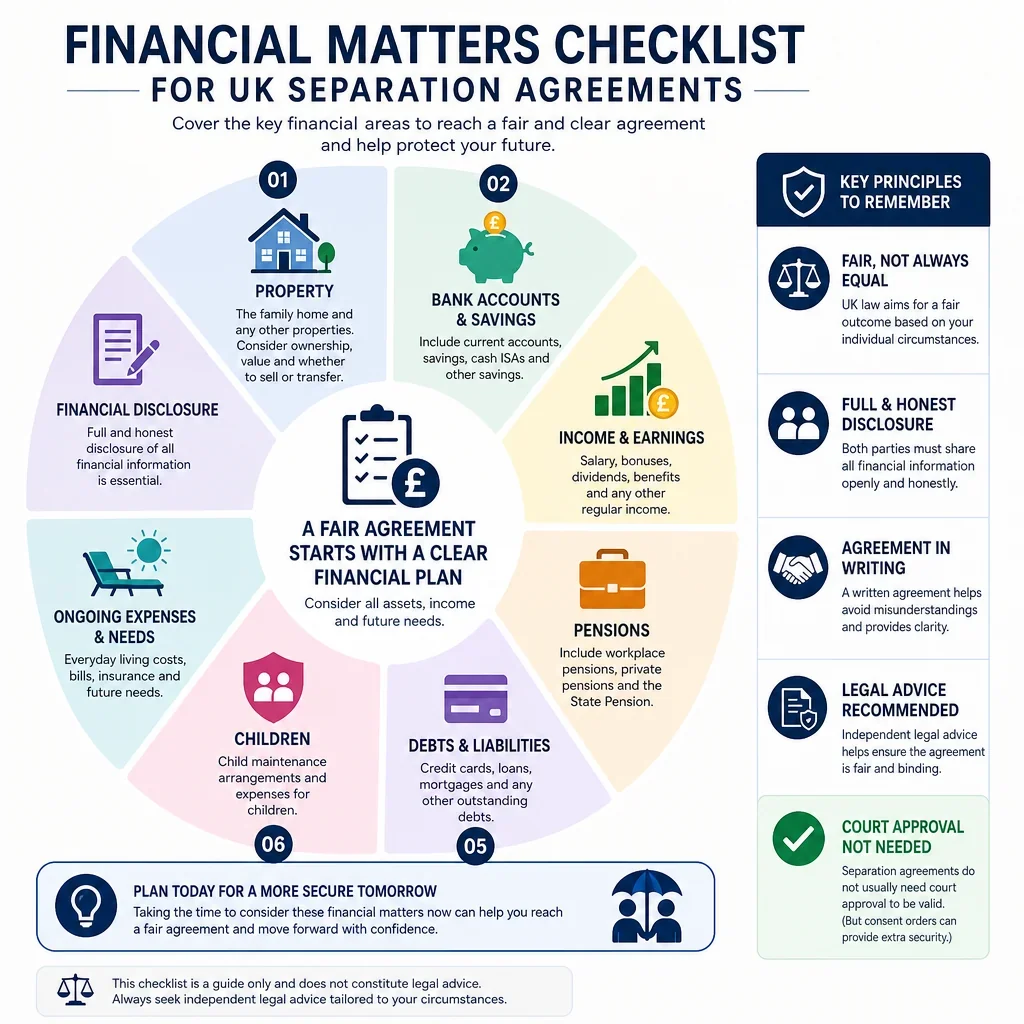
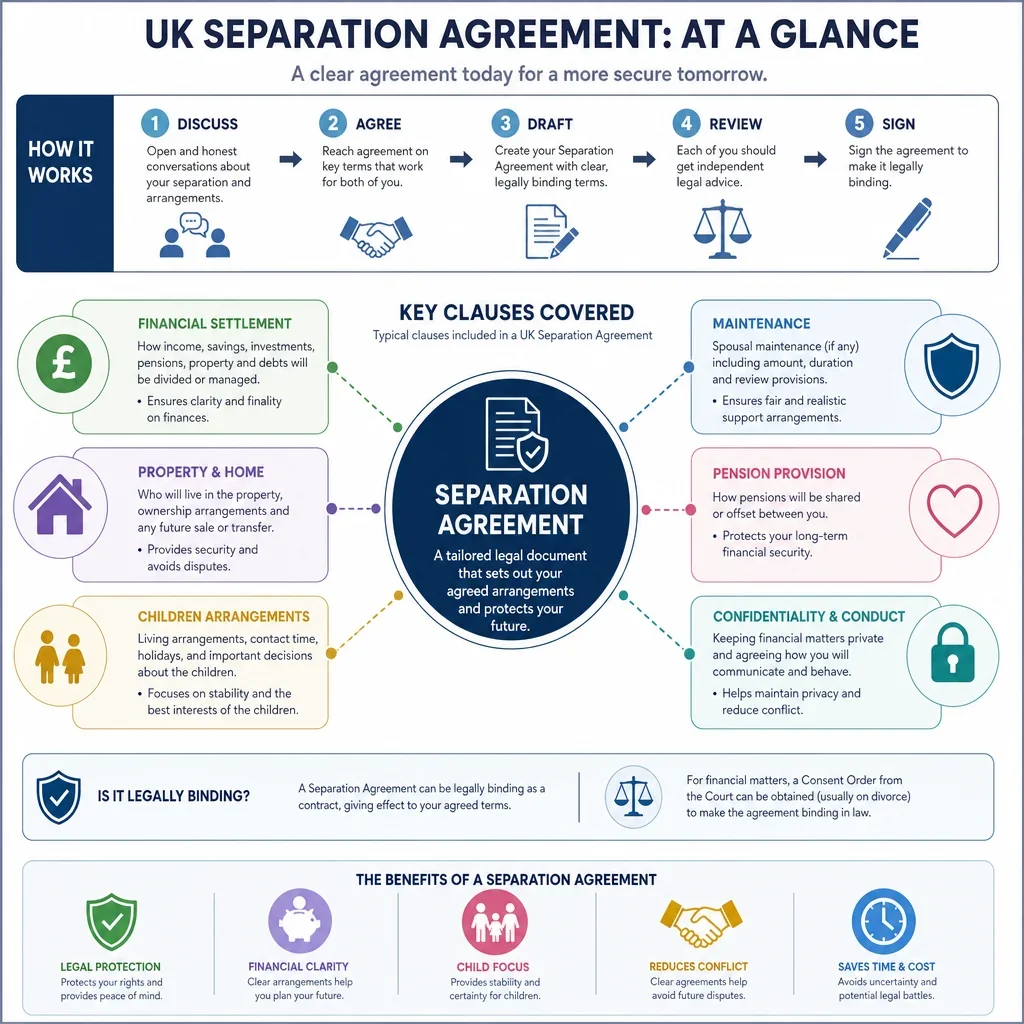
A strong separation agreement usually combines financial arrangements, property and housing, children and parenting, and legal process clauses. The most consistently relevant clauses are disclosure, living arrangements, payment responsibilities, child maintenance, parenting arrangements, debts, pensions, tax, confidentiality, variation and independent legal advice.
Is A Separation Agreement Legally Binding In The UK?
A separation agreement is not automatically the same as a court order. In England and Wales, the court can still decide financial remedies on divorce or dissolution, but agreements are more likely to carry weight if both people gave full financial disclosure, took independent legal advice, understood the terms, and the agreement is fair. For final financial certainty after divorce or dissolution, many couples later convert agreed terms into a financial consent order.
Which Clauses Need Extra Care Before Signing?
- Children clauses should reflect the child\'s welfare and may need to adapt over time. Private child maintenance terms may also be affected by Child Maintenance Service rules.
- Pension clauses normally need specialist legal and financial advice because pension sharing generally requires a court order.
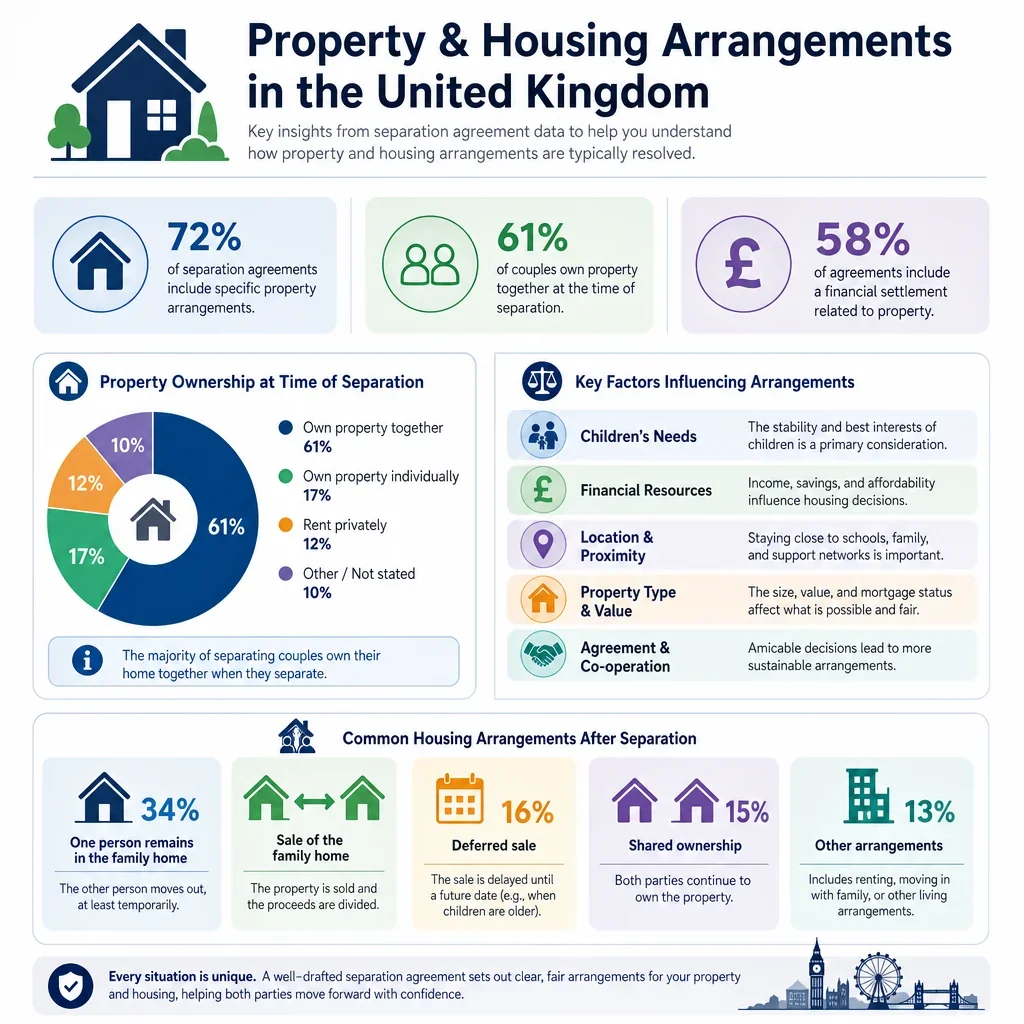
- Property clauses should deal with mortgage liability, occupation, sale, transfer, insurance and Land Registry restrictions where relevant.
- Tax clauses can be important where homes, investments, businesses or overseas assets are being transferred.
- Clean break clauses are useful in principle, but usually require a court order to be fully effective on divorce or dissolution.
When Should The Agreement Be Reviewed?
Review clauses are particularly useful where arrangements depend on changing circumstances, such as children\'s schooling, mortgage affordability, sale of the family home, redundancy, retirement, illness, a new partner moving in, or divorce proceedings starting. A variation clause should explain how changes must be agreed, usually in writing and signed by both parties.
FAQs
You Might Also Be Interested In